Coaching, Ride-Alongs, and Building D2D Sales Culture
Turn this article into takeaways for your work.


Each assistant summarizes the article only for you and suggests best practices for your work.
Field sales culture either compounds in your favor or against you. When it's working, you see reps pushing each other to hit numbers, veterans mentoring rookies without being asked, and turnover that's lower than anyone in your market. When it's not, you see cliques, comp complaints, quiet quitting, and reps treating the job like a gig rather than a career.
The difference between these two outcomes usually traces back to one thing: whether managers are actually coaching their reps, or just managing their numbers.
Coaching in D2D is specific. It's not a quarterly review or a weekly pipeline check. It's a manager riding next to a rep, watching them knock a real door on a Wednesday afternoon, and giving them targeted, immediate feedback that makes them better by the next street. That kind of development compounds. And when you pair it with a team culture that makes people want to show up every morning, you build something your competitors can't easily copy.
What Is D2D Coaching, Really?
Key Facts: D2D Coaching and Culture
- HBR research found that quality coaching can improve performance of the core middle 60% of a sales workforce by up to 19%, and that coaching average performers delivers a higher ROI than focusing exclusively on top producers. (HBR, 2011)
- HubSpot data puts the average sales rep tenure at 18 months, yet peak performance in field sales typically doesn't arrive until the two-to-three year mark. Regular ride-alongs with senior reps are one of the few interventions that extend tenure past the average. (HubSpot via Xactly, 2024)
- McKinsey found that meaningful compensation differentiation between top and bottom performers is essential for pay plans to change behavior. The same principle applies to recognition architecture: what you celebrate publicly defines what your team strives for. (McKinsey)
Most sales managers in D2D think they're coaching when they're actually just reporting. "You need more accounts this week" is not coaching. "Your qualifying question is taking too long and losing homeowner interest at the 90-second mark" is coaching. According to HBR research on sales coaching effectiveness, no other productivity investment comes close to coaching in improving rep performance. The problem is that most managers overestimate the time they actually spend coaching versus tracking pipeline and reporting on numbers.
The difference is specificity and actionability. Good coaching identifies the exact behavior that's limiting performance and gives the rep a clear, concrete adjustment they can make right now. It comes from direct observation, not from looking at numbers on a dashboard.
The three levels of D2D coaching:
Skill coaching targets specific technique gaps. The rep's door approach is too formal. Their objection response is too defensive. They're pitching the product before they've built any rapport. These are observable, fixable behaviors. Skill coaching happens at or near the door.
Mindset coaching addresses the mental game. D2D is rejection-heavy. Reps who don't build psychological resilience burn out fast. Mindset coaching is less about technique and more about how a rep thinks about a tough day, how they recover from a string of nos, and how they maintain energy across a full field shift. This happens in one-on-ones and informal conversations.
Career coaching is about where the rep is going. Not every rep wants to be a manager, but every rep wants to know there's a path forward. Career coaching happens in monthly or quarterly conversations about goals, comp trajectory, and what the rep's next 90 days should look like.
Most D2D managers are reasonably good at skill coaching when they actually go to the field. The mindset and career coaching are what get skipped when things get busy, and they're often what determines whether a rep stays or leaves.
Quotable Nuggets "HBR research found that coaching the core middle 60% of a sales team, not just the top performers, delivers up to a 19% performance improvement. In D2D, that means the rep who is closing 6 accounts a week could realistically close 7 to 8 with structured coaching. Over a 12-week summer, that is 12 to 24 additional accounts per rep. (HBR, 2011)"
"The average sales rep tenure is 18 months according to HubSpot data. Peak performance in D2D field sales typically arrives at two to three years. That gap is why investing in top-performer ride-alongs, not just new-rep ride-alongs, is the lever that extends tenure past the point where the rep becomes truly valuable. (HubSpot via Xactly)"
"A high-producing negative culture carrier is a multiplier, but in the wrong direction. The reps they influence cost production and retention. The net effect of keeping one often exceeds their individual contribution in lost output and turnover within two quarters."
The Three-Level Coaching Model: A structured approach to D2D manager coaching that separates development into three distinct tracks: skill coaching (observable technique gaps fixed at or near the door), mindset coaching (psychological resilience addressed in one-on-ones), and career coaching (trajectory and comp opportunity discussed monthly). Most D2D managers default to skill only. The teams that retain reps longest are those where all three tracks are active.
The Ride-Along Framework
Ride-alongs are the highest-leverage coaching activity available to a D2D manager. An hour in the field watching a rep sell, with a structured debrief afterward, is worth more than ten one-on-ones in the office.
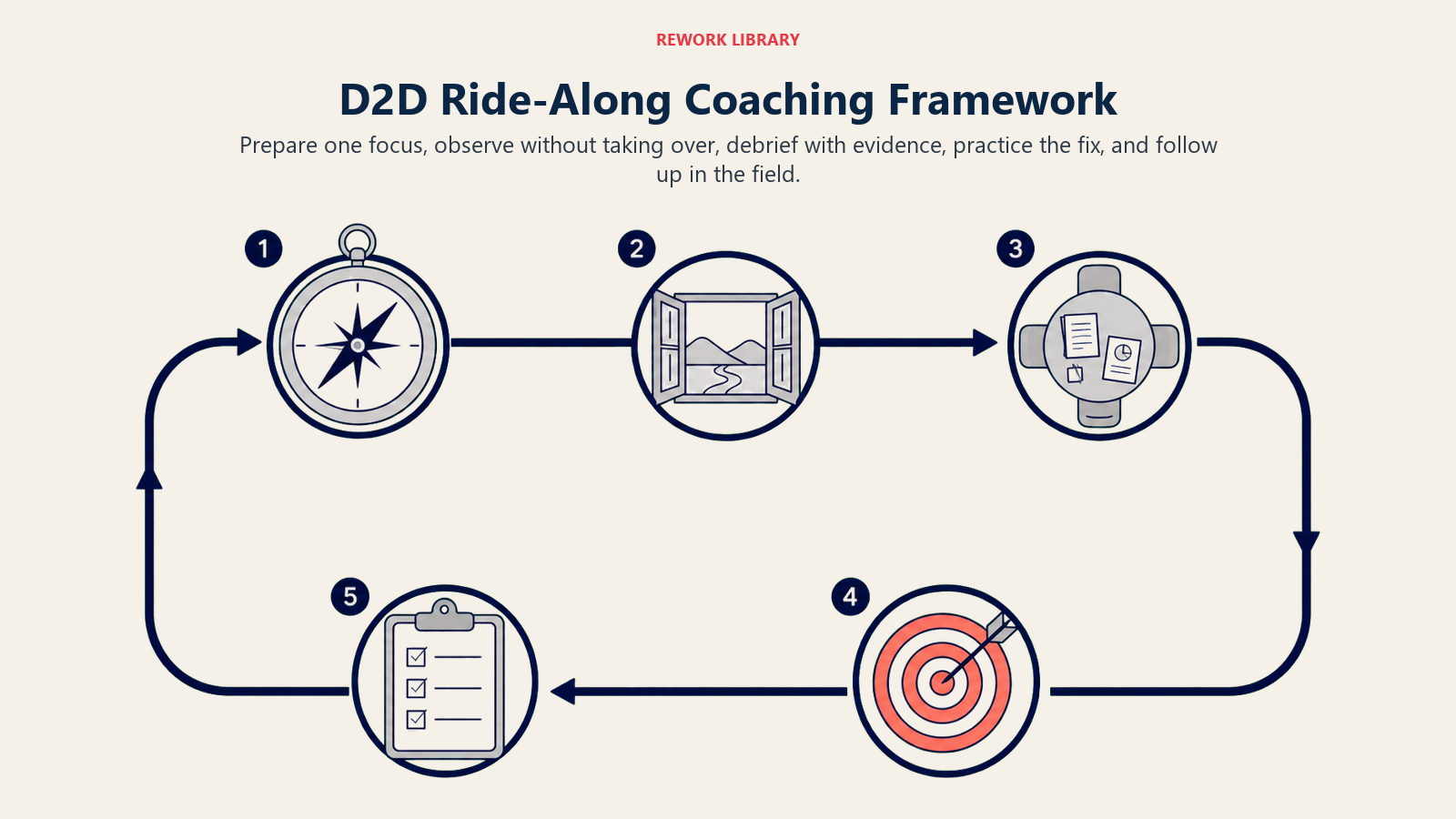
But ride-alongs only deliver value when they're done with intention. A manager who rides along, stands back silently for two hours, and says "nice job" at the end has wasted everyone's time.
Before the Ride-Along
Set a focus before you go out. Don't try to observe everything. Pick one or two specific things you want to evaluate based on what you already know about this rep. For a newer rep, it might be their door approach and first 30 seconds. For a veteran who's been slipping on conversions, it might be how they're handling the price objection.
Tell the rep what you're watching. This isn't a surprise inspection. "Today I want to specifically watch how you're transitioning from the qualifying questions into your pitch. I've noticed that's where your conversations sometimes stall." Transparency makes the coaching better. The rep will be more conscious of that specific behavior, which surfaces it faster.
During the Ride-Along
Observation mode (first 30 to 45 minutes): Watch without intervening. Let the rep work. Take brief notes. The rep needs to work naturally, not perform for you.
Calibration moment: After the first few doors, have a 3-minute check-in. Not a full debrief, just a quick temperature check. "How are you feeling about your approach today? Anything you're noticing yourself?" This surfaces the rep's self-awareness, which is diagnostic information.
One correction only, mid-session: If there's something significant breaking down at the door, correct it once in the middle of the ride-along. Not after every door. Not a running commentary. One specific, clear adjustment: "After you ask the qualifying question, pause and let them answer fully before you respond. You're jumping in about 30% too early." Then let them apply it for the rest of the session.
Positive reinforcement in real time: When the rep does something well, say so immediately after the door closes. "Did you notice how she leaned forward when you explained the service guarantee? That's because you framed it around her specific concern. That was exactly right."
After the Ride-Along (The Debrief)
The debrief is where the coaching actually lands. Do it within 30 minutes of finishing the field time, before the rep's attention shifts.
Structured debrief format:
Rep speaks first: "What did you feel went well today? What felt off?" Let them assess themselves before you give your observations. You'll learn more about their self-awareness, and they'll be more receptive to feedback that builds on what they've already said.
One specific strength: Name one specific thing they did well, with the example from today. Not "you did great." "Your opening on the third door was much stronger than the first. You built the connection before moving into the qualifying question and she visibly relaxed. That's the version I want to see consistently."
One specific development area: Just one. Not three. Not "a few things." One behavior, one adjustment, one way to practice it. "Your response to the 'I need to think about it' objection is breaking down because you're accepting it too quickly. Next week I want you to practice the 'what specifically do you need to think about?' follow-up until it feels natural. We'll role-play it tomorrow morning."
Commitment: The rep names one thing they're going to do differently at the next door they knock. You write it down. You reference it at the next ride-along.
For the skill-specific content that ride-along coaching builds on, see same-visit close techniques and objection handling at the door.
Ride-Along Frequency by Rep Level
| Rep Stage | Recommended Frequency | Focus |
|---|---|---|
| Days 1 to 5 (training) | Daily | Foundation: approach, qualify, pitch structure |
| Weeks 2 to 4 (ramp) | 2 to 3 times per week | Conversion mechanics, objection handling |
| Months 2 and 3 (developing) | Weekly | Consistency, advanced close techniques |
| Month 4 and beyond (producing) | Biweekly | Refinement, referral generation, upsell |
| Top performers | Monthly or by request | Advanced skills, leadership development |
Don't skip ride-alongs for your top performers. Many managers make this mistake, assuming strong producers don't need attention. Top performers often stay specifically because their manager invests in them. And they're the ones most likely to be recruited by competitors. A monthly ride-along with a senior rep signals: "Your development still matters to us." As the HubSpot tenure data cited earlier suggests, ride-alongs with senior reps are one of the few interventions that extend tenure past the point where most reps quit, by making the role feel like a development track rather than a dead end.
Building a Coaching Cadence
Ride-alongs are the field component. But coaching also needs an office-side structure to be consistent.
Daily huddle (10 minutes, team-wide): Morning stand-up before reps head to their territories. Numbers from yesterday, one learning from the field, motivational context, territory updates. Keep it short. The value is routine and momentum, not information transfer.
Weekly one-on-one (20 to 30 minutes, per rep): Numbers review, one skill focus from the prior week, one goal for the coming week, and a check-in on how the rep is feeling about the job. The emotional check-in sounds optional but isn't. D2D is hard. Reps who don't feel their manager cares about them as a person eventually find a manager who does.
Monthly strategy session (45 to 60 minutes, per rep): Longer-format conversation on trajectory. Where is this rep relative to their goals? What's the comp opportunity over the next 90 days? What's getting in their way? Is there a leadership or mentoring opportunity to offer them?
Quarterly team review: Pull the full team together to review performance data, share what's working in different territories, and recalibrate goals. This is also where you publicly recognize top performers with enough specificity that others understand what behavior is being rewarded.
The managers who maintain this cadence consistently, not just in the weeks when they remember or when numbers are down, build teams that are significantly more stable.
Culture-Building Practices That Actually Work
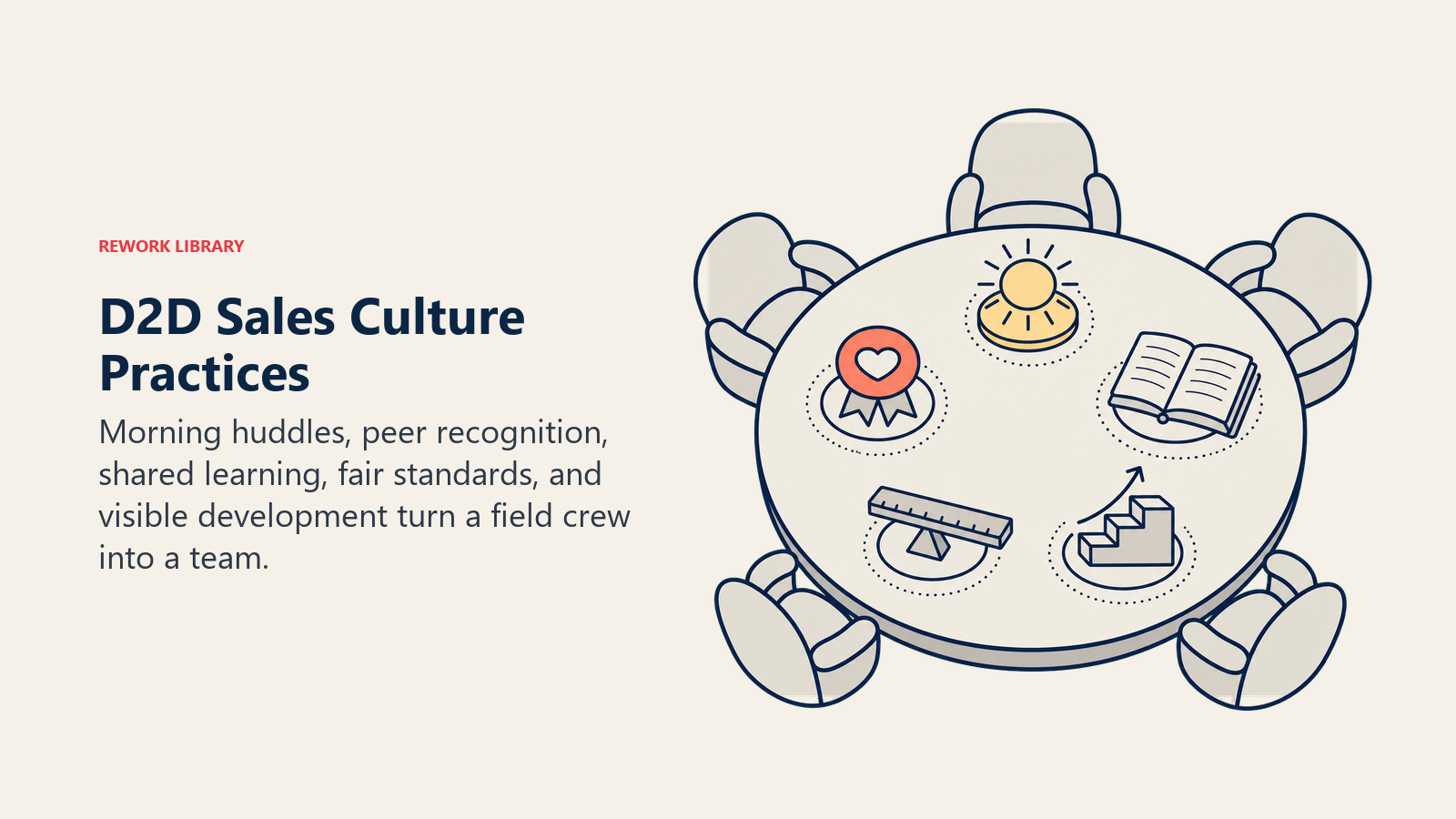
Culture in a D2D team is built through specific, repeated actions. It's not a mission statement. It's what happens in the morning huddle, what gets celebrated on Fridays, and what the manager does when a rep is having a terrible week.
Recognition Architecture
What you celebrate publicly is what your team learns to value. In D2D, the recognition hierarchy should be:
First: Quality of customer (retention matters, not just volume) Second: Consistency over time (not one great week followed by two mediocre ones) Third: Volume (more sales is good, but not if they cancel) Fourth: Improvement (a rep who goes from 6 to 9 accounts in a month deserves recognition even if they're not at the top of the leaderboard)
The team leaderboard is useful but incomplete as the only recognition mechanism. It only rewards the top few reps and can demoralize everyone else. Pair it with recognition that celebrates improvement, consistency, and quality.
Naming specific behaviors in public recognition matters. "Congrats to Marcus for another 12-account week" is okay. "Marcus got his first sale-to-service handoff completed same-day this week, which is something we've been working on in coaching, and it made a real difference for the customer experience" is much better. It teaches while it celebrates.
Accountability Without Embarrassment
Culture breaks when accountability becomes public humiliation. If a rep is underperforming and the manager addresses it by calling them out in the group chat or making examples in team meetings, every other rep on the team notices. They think: "That could be me."
Accountability for underperformance should be direct, private, and specific. Not punitive, not a performance review tone, but clear: "You've had three weeks in a row under 4 accounts. We've talked about your door approach twice and I haven't seen consistent improvement. I want to do a full day ride-along this week and we're going to figure out exactly where the breakdown is."
That conversation is harder than posting a comment on the leaderboard. But it produces an outcome the leaderboard comment never will: either the rep improves, or you both decide quickly that D2D isn't the right fit.
Team Rituals
Rituals are the repeated social behaviors that define a team's identity. They don't need to be elaborate. Some of the most effective ones are simple:
The first sale call: A tradition where the rep who closes their first sale of the season (or day) calls the office and everyone cheers. Creates immediate social belonging for new reps.
Friday totals: A team-wide message at end of day Friday where everyone shares their week's numbers. No commentary from the manager. Just the numbers. The peer visibility is its own accountability mechanism.
Rep of the month: A single recognition, detailed and specific, shared in the team channel and sometimes in a company-wide note. The rep gets their name on something. The criteria are known in advance so it doesn't feel arbitrary.
Monthly team dinner or activity: Budget a small amount for this. Even 60 to 90 minutes of team time outside of work changes the relationships. Reps who know each other as people, not just colleagues, cover for each other, mentor each other, and are less likely to quietly quit.
Dealing With Negative Culture Carriers
Every D2D team has had one: the rep who produces well but is corrosive. They complain constantly, undermine the manager in the group chat, and influence newer reps to be cynical about the company, the comp plan, and the work.
This is the hardest culture management problem because the rep's production makes the decision feel costly.
The calculus here is almost always wrong. A high-producing negative culture carrier is a multiplier, but in the wrong direction. Every rep they influence costs you production and retention. The net effect of keeping them often exceeds their individual contribution in lost productivity and turnover.
The right move is a direct conversation, first: "Your production is strong. Your influence on the team is not. Here's specifically what I've observed. I need both to be strong if we're going to continue." Sometimes this works. When it doesn't, the exit needs to happen before the damage deepens.
For the broader management framework, also see managing seasonal 1099 teams for how these culture dynamics shift at scale during summer programs.
The Manager's Development Path
D2D managers are almost always former reps. They were good at the door, got promoted, and are now responsible for a team without formal management training. The transition from individual contributor to people manager is one of the hardest jumps in any sales organization.
The most common failure mode: the new manager keeps acting like a rep. They go to the field and personally close deals instead of coaching their team to close. Their personal production stays high but their team doesn't improve, because the manager is doing the work rather than developing the people.
Breaking this pattern requires a deliberate shift in how the manager defines success. The rep's job is: I sold 10 accounts today. The manager's job is: my team sold 60 accounts today and two of my struggling reps improved measurably.
Skills new D2D managers need that aren't taught:
- How to give feedback that lands without creating defensiveness
- How to run a ride-along debrief that builds the rep's self-awareness rather than just delivering conclusions
- How to identify which reps need more attention right now and which can operate independently
- How to have the "this isn't working" conversation without making it a confrontation
- How to protect their own energy in a high-rejection environment. Vicarious burnout is real for D2D managers.
Build manager development into your operating model the same way you build rep development. The onboarding and ramping new reps article covers the ramp side; what happens after month one is the manager's development problem to solve.
Which Metrics Reflect Culture Health?
Numbers don't tell you everything about culture. But some metrics correlate with culture health so consistently that they're worth tracking:
| Metric | What It Tells You | Red Flag Threshold |
|---|---|---|
| 30-day rep retention rate | Whether new reps are surviving the early weeks | Below 60% |
| Ride-along completion rate | Whether managers are actually coaching | Below 2 per rep per month |
| Average tenure of producing reps | Whether you're retaining your developed talent | Below 6 months |
| First-sale time for new reps | Whether onboarding is working | Over 7 days |
| Rep-initiated one-on-one requests | Whether reps trust their manager | Near zero |
The rep-initiated one-on-one metric is one people rarely track. But it's a leading indicator of culture health. When reps proactively ask to talk to their manager, it means the manager is someone they trust. When no one ever initiates a one-on-one, you have a trust problem even if the numbers are acceptable.
For the performance tracking infrastructure that makes these metrics visible, see lead and rep performance dashboards.
The D2D teams that win are the ones that field the same core of producers season after season, lose fewer reps to burnout and attrition, and develop their own managers from within because they built the culture worth staying for. Coaching and ride-alongs are the mechanism. The culture is the outcome. Both require deliberate, consistent work from the people at the top of the org chart.
The accounts those reps bring in also need to stay. For an understanding of how retention works once the sale is made, retention fundamentals covers what the service delivery team needs to do to keep the customers your reps worked to close.
Learn more: Recruiting and ramping solar reps covers how similar coaching cadences work in an adjacent D2D vertical.
Frequently Asked Questions about Coaching, Ride-Alongs, and Building D2D Sales Culture
What is the difference between coaching and managing in D2D sales?
Managing means tracking numbers and directing activity: "You need more accounts this week." Coaching means identifying the specific behavior limiting performance and giving the rep an actionable adjustment: "Your qualifying question is taking too long and you're losing homeowner interest at the 90-second mark." The difference is specificity and direct observation. Coaching requires actually watching a rep at a door, a return no pipeline check can match.
How often should a D2D manager do ride-alongs?
The right frequency depends on the rep's stage. New reps in days 1 to 5 need daily ride-alongs. Reps in weeks 2 to 4 need two to three per week. Developing reps in months 2 and 3 need weekly ride-alongs. Producing reps beyond month 4 need biweekly coverage. Top performers should have at least monthly contact. The biggest mistake managers make is stopping ride-alongs with strong producers: top performers often stay specifically because their manager invests in their development. A monthly ride-along signals the job is a development track, not a dead end.
What makes a ride-along actually useful versus just carpooling?
Three things separate useful ride-alongs from passive observation. First, set a specific focus before going out: one or two behaviors to watch, communicated to the rep in advance. Second, give one correction mid-session, not a running commentary: one specific adjustment at the midpoint lets the rep apply it for the rest of the outing. Third, run a structured debrief within 30 minutes of finishing: rep speaks first, manager names one strength with a specific example, manager names one development area, rep commits to one change. Without the debrief, most of what happened in the field doesn't transfer.
What are the three levels of D2D coaching?
Skill coaching targets observable technique gaps: approach timing, objection responses, close mechanics. It happens at or near the door. Mindset coaching addresses psychological resilience: how a rep processes a string of rejections, their self-talk after a bad day, how they reset energy across a full field shift. It happens in one-on-ones. Career coaching covers trajectory, including comp opportunity, progression path, and what the rep's next 90 days should look like. It happens in monthly conversations. Most D2D managers only do skill coaching. The teams with the lowest turnover run all three.
How should D2D managers handle accountability without damaging culture?
Accountability for underperformance should be direct, private, and specific. Not public. Calling out a rep's low numbers in the group chat teaches every other rep on the team that poor performance leads to public embarrassment. The right approach: "You've had three weeks under 4 accounts. We've talked about your door approach twice. I'm going to ride with you for a full day this week and we'll find where the breakdown is." That conversation is harder than posting on the leaderboard but produces either real improvement or a clean mutual decision that the role isn't the right fit.
What cultural rituals actually work in D2D teams?
Four low-cost rituals build culture more reliably than elaborate programs: the first-sale call (new rep calls in when they close their first account, team reacts), Friday totals (everyone shares their week's numbers without manager commentary; peer visibility creates accountability), rep of the month with explicit criteria known in advance, and a monthly team dinner or activity. What makes rituals work is consistency: the manager runs them every week, not just during strong months. When rituals disappear during tough stretches, reps notice.
How do you identify a negative culture carrier, and what do you do?
A negative culture carrier produces well but is corrosive: complaints that spread, undermining the manager or comp plan in group channels, influencing newer reps toward cynicism. The mistake is keeping them because their individual production looks valuable. The calculus is wrong: their influence multiplies attrition and reduces output across the team. The right move is a direct one-on-one conversation: "Your production is strong. Your influence on the team is not. Here's specifically what I've observed. I need both to be strong." If that conversation doesn't shift things, the exit needs to happen before the damage extends further.

Senior Implementation Consultant
On this page
- What Is D2D Coaching, Really?
- The Ride-Along Framework
- Before the Ride-Along
- During the Ride-Along
- After the Ride-Along (The Debrief)
- Ride-Along Frequency by Rep Level
- Building a Coaching Cadence
- Culture-Building Practices That Actually Work
- Recognition Architecture
- Accountability Without Embarrassment
- Team Rituals
- Dealing With Negative Culture Carriers
- The Manager's Development Path
- Which Metrics Reflect Culture Health?