Ethical Selling and Avoiding Buyer's Remorse in D2D Subscription Sales
Turn this article into takeaways for your work.


Each assistant summarizes the article only for you and suggests best practices for your work.
A cancellation three days after the sale is one of the most expensive things in door-to-door subscription selling. You spent time and commission on a sale that disappeared. The company spent onboarding resources on a customer who never started. And the homeowner has a story about a pushy salesperson they now tell their neighbors.
Buyer's remorse is not random. It's caused. And in the vast majority of cases, it traces back to something that happened during the sale: information that was left out, pressure that was applied, or an agreement the homeowner didn't fully understand. This article covers how to prevent all of that, not just because it's the ethical thing to do, but because it's also the business thing to do.
What Buyer's Remorse Actually Looks Like in D2D
Buyer's remorse in subscription home services shows up in a few predictable patterns:
- The homeowner calls to cancel within 72 hours, often citing a vague "changed my mind"
- The homeowner disputes a charge, claiming they didn't understand they were being billed
- The homeowner tells neighbors they "felt pressured" and warns them about your company
- The homeowner googles "how to cancel [your company name]" within hours of signing
Each of these is avoidable. And every single one of them starts with something that went wrong during the sales conversation.
What Does the FTC Cooling-Off Rule Require From D2D Reps?
The Federal Trade Commission's Cooling-Off Rule (16 CFR Part 429) gives consumers the right to cancel most door-to-door sales above $25 within three business days of signing, with no penalty and no explanation required. This is federal law, not a company policy. Non-compliance is an unfair and deceptive act under Section 5 of the FTC Act and can trigger enforcement actions. The FTC's consumer guide to the Cooling-Off Rule explains what the rule covers, how consumers exercise it, and what sellers must provide at the time of signing.
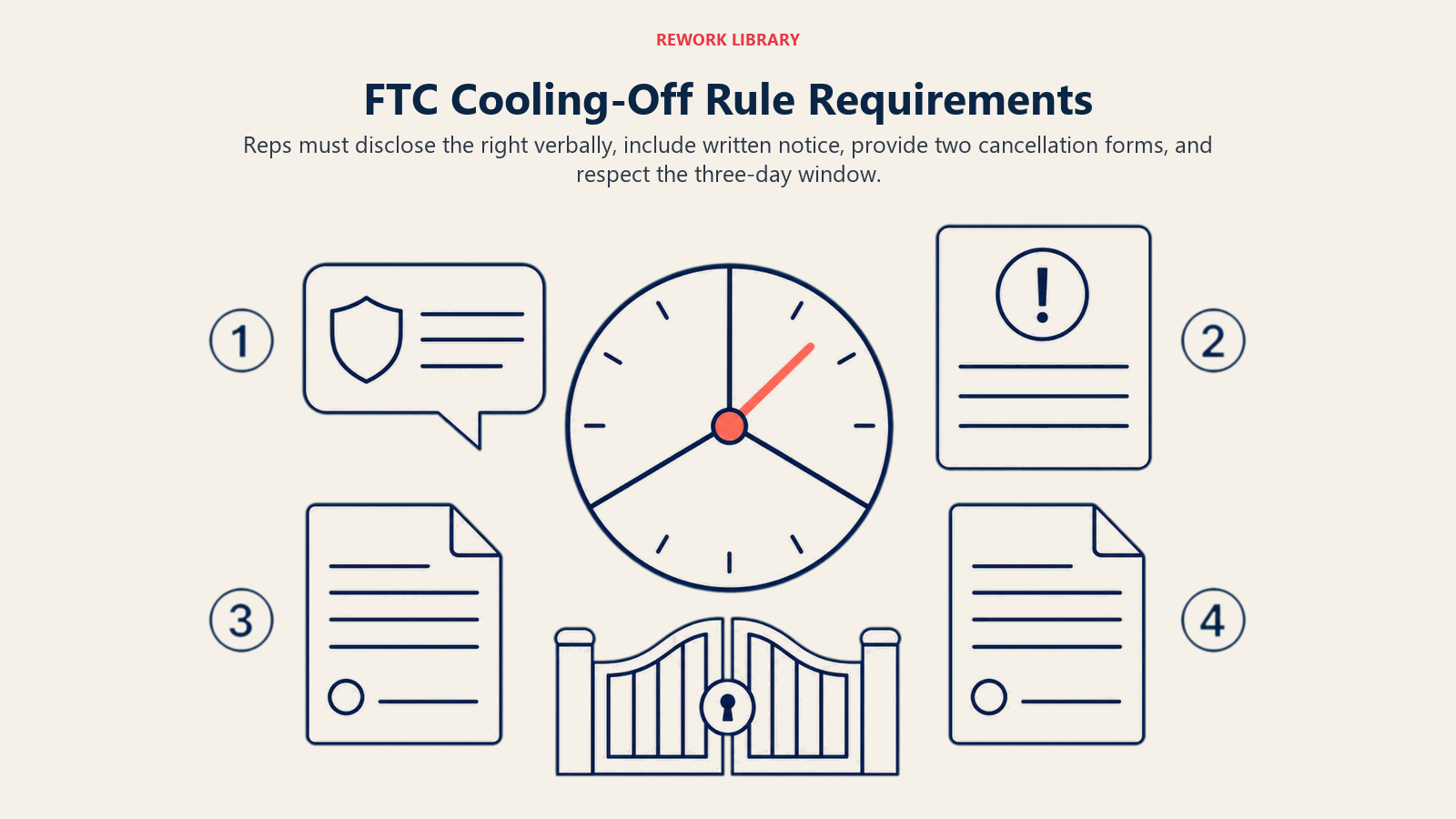
The Disclosure Checklist: Here's exactly what the rule requires at the time of sale:
1. Verbal disclosure. The rep must tell the customer about their right to cancel during the sales conversation itself, not just in small print.
2. Written notice in the contract. The signed agreement must include a bold 10-point-type notice of the right to cancel, in the specific format mandated by the FTC.
3. Two cancellation notice forms. The company must provide the customer with two completed copies of a "Notice of Cancellation" form at the time of signing, one to keep and one to return if they exercise the right.
4. No work before the three-day period expires. In many service categories, you cannot begin service before the three-business-day cancellation window closes unless the customer explicitly requests early start in a separate, handwritten, dated, signed statement.
What counts as "three business days": Business days under the rule exclude Sundays and federal holidays. A sale on Friday gives the customer until the following Wednesday to cancel.
Reputable D2D companies train reps to explain the cooling-off right clearly, not to bury it. If your company doesn't include this in training, that's a compliance red flag worth raising with management. For the full compliance context, see D2D Legal and Licensing Compliance.
Key Facts: Ethical Selling and Buyer's Remorse
- The FTC Cooling-Off Rule (16 CFR Part 429) covers door-to-door sales of $25 or more and gives consumers three business days to cancel without penalty. Sellers must provide two completed "Notice of Cancellation" forms and verbally disclose the right at the time of signing. Non-compliance is an unfair and deceptive act under the FTC Act. (ftc.gov/legal-library/browse/rules/cooling-period-sales-made-home-or-other-locations)
- Research by Frederick Reichheld of Bain and Company, cited in Harvard Business Review (October 2014), found a 5% improvement in retention rates can increase profits by 25% to 95%. Early cancellations driven by high-pressure or misleading closes are among the most direct destroyers of this compound value.
- US direct selling generated $34.7 billion in revenue in 2024, per the Direct Selling Association's 2025 Growth and Outlook Study. The industry's long-term growth depends on consumer trust, making ethical disclosure practices a competitive advantage, not a compliance burden.
Honest Disclosure: What to Tell Every Customer
Ethical selling isn't just about what you say. It's also about what you don't omit. Here's a practical disclosure checklist that covers what every homeowner should know before they sign:
| What to Disclose | Why It Matters |
|---|---|
| Full price, including all fees | Price surprises after signing are the single biggest driver of cancellations |
| Billing schedule and first charge date | Many customers don't expect the charge to hit so quickly |
| Contract length and any commitment period | If there's a 12-month minimum, say so clearly |
| Cancellation terms and any early termination fees | Hidden ETFs are the fastest way to destroy trust |
| The FTC 3-day right to cancel | Required by law; also builds confidence in the sale |
| What's NOT covered by the service | Managing scope expectations prevents anger at the first service visit |
| How to reach customer service after today | Gives the customer a path forward if something goes wrong |
A rep who covers all of this proactively doesn't come across as weak. They come across as a professional. Homeowners who get the full picture upfront are more confident in their decision and far less likely to feel manipulated after you leave.
High-Pressure Tactics That Cause Remorse (and Why They Backfire)
Door-to-door sales has a long history of manipulation tactics. Most still get used today, and most cause more harm than good. Here's a straight look at the most common ones and what to do instead:
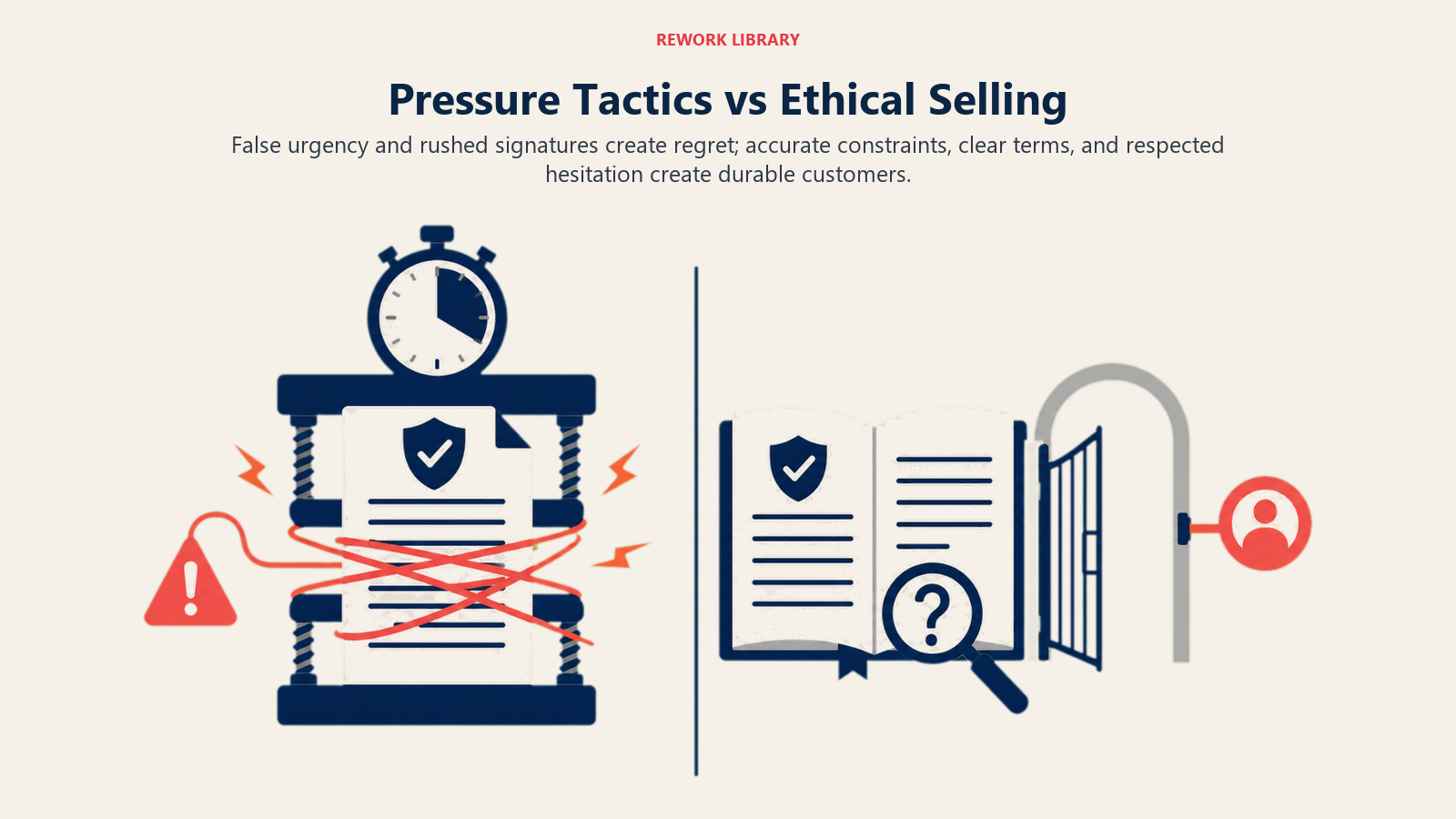
The artificial urgency close. "This pricing is only available today" when it isn't. Or "We only have one slot left in your neighborhood" when that's not true. Customers who later discover the urgency was manufactured feel cheated, and they tell people.
Better approach: If there's a genuine promotion or capacity constraint, say so accurately. Real deadlines are a perfectly legitimate reason to act. Invented ones aren't.
The guilt or obligation pitch. Telling a homeowner they'd be "crazy" not to take advantage of the offer, or implying their family is at risk if they say no. These tactics work sometimes in the short term and generate resentment almost every time.
Better approach: Let the value of the service carry the sale. If the customer doesn't see enough value to say yes on their own, that's information, not an obstacle to barrel through.
The agreement extraction rush. Talking so fast through the contract that the customer doesn't have time to read it, or pressuring them to sign while you're still mid-explanation. Customers who sign something they didn't understand will cancel once they figure out what they agreed to.
Better approach: Slow down at the agreement stage. Walk through it clearly. Invite questions. This is counterintuitive but it closes more sales that stick.
Ignoring the "I need to think about it." Treating a homeowner's hesitation as a problem to overcome rather than a signal to address. Sometimes "I need to think about it" means they need more information. Sometimes it means no. Both deserve respect.
Better approach: Ask what's behind the hesitation. Often you'll surface one specific concern that's easy to address. And when the answer really is no, accepting it gracefully leaves the door open for a future yes or a referral.
What Is the Connection Between Ethics and Early Cancellation Rates?
Early cancellations, typically defined as cancellations within the first 30 to 90 days, are one of the most damaging metrics in D2D subscription businesses. They destroy unit economics, waste service capacity, and often signal a sales culture that's optimizing for signatures over relationships.
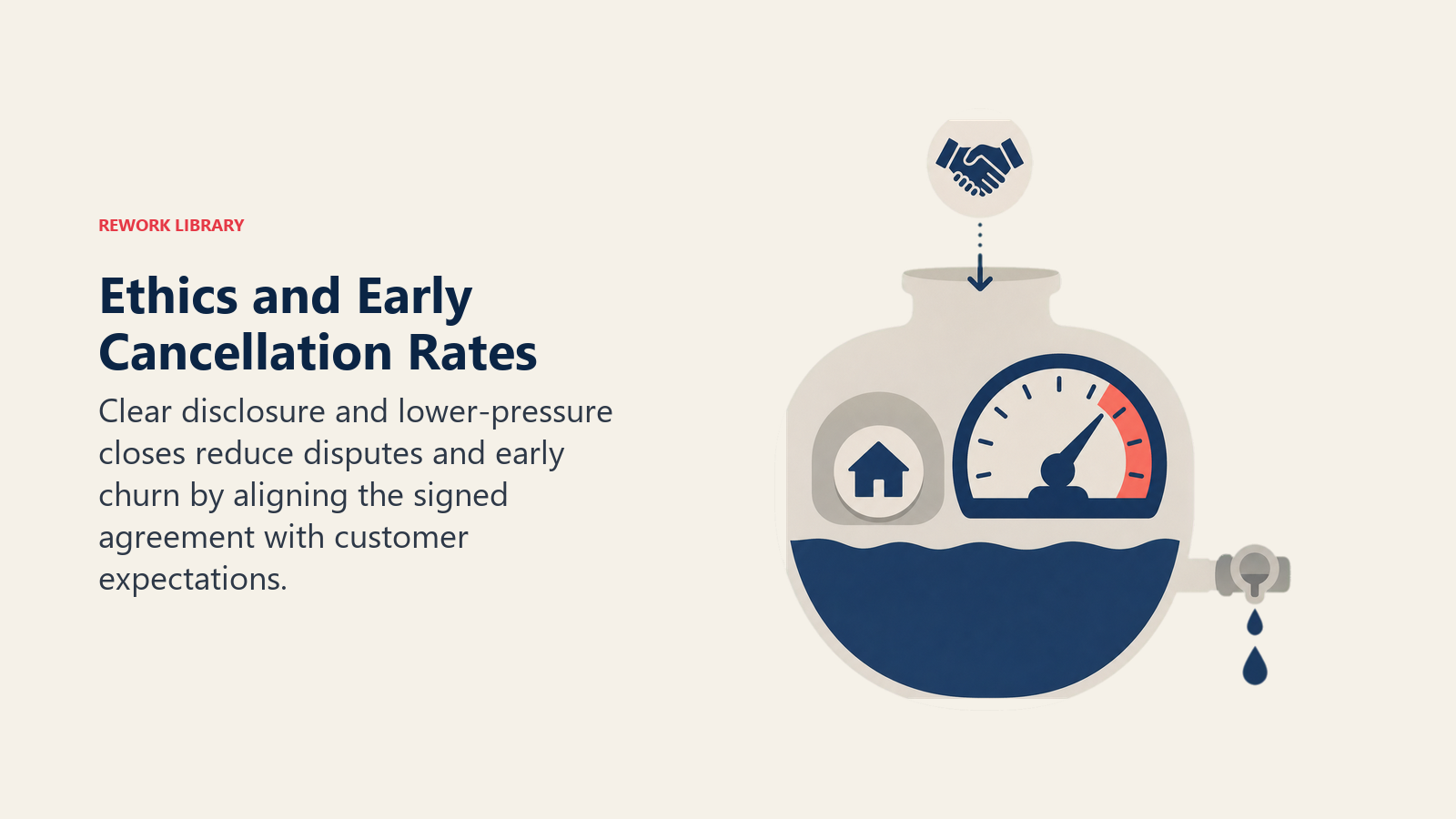
The pattern is consistent across subscription businesses: teams with transparent disclosure practices and lower-pressure close styles generate customers who stay longer and refer more. Teams that use artificial urgency tactics and rush through the paperwork generate customers who cancel quickly, dispute charges, and warn neighbors.
That last group matters most. The best salespeople are building a referral machine, not a revolving door. And referrals only come from customers who felt good about the sale, which means they were treated honestly from the first knock.
Note on cancellation rate figures: specific early cancellation rate benchmarks vary widely by company, territory, and service category. If your operation tracks this metric, use your own cohort data as the baseline rather than industry estimates, which are largely self-reported and not independently verified.
For more on how customer quality at acquisition affects long-term retention, see Reducing Early Cancellations and Subscription Retention Fundamentals.
How to Handle the Cooling-Off Period Without Anxiety
Some reps fear the 3-day window because they worry the customer will cancel. That anxiety is understandable, but it points to a deeper problem. If you're afraid the customer will cancel when they have time to think, that's a sign the sale wasn't clean.
Ethical reps frame the cooling-off right as a feature, not a risk:
"Just so you know, you have three business days to cancel the agreement at no charge if you change your mind. We want you to feel completely comfortable with your decision. That's why we explain everything upfront."
That framing does several things at once. It fulfills the disclosure requirement, signals confidence in the service, and reduces the psychological pressure the customer might feel. Paradoxically, customers who don't feel trapped are less likely to cancel.
Companies that explain the cooling-off right clearly and confidently see lower cancellation rates during that window than companies that rush past it. Customers who feel respected tend to stay.
Building an Ethical Sales Culture on Your Team
Individual rep behavior matters, but culture matters more. Here's what managers can do to build teams where ethical selling is the norm:

Track early cancellations by rep. If one rep has a 25% cancellation rate in the first 30 days while others average 8%, that's not bad luck. That's a behavior signal. Investigate what's happening at the door. The Better Business Bureau's consumer tips for door-to-door sales document exactly what credible reps do differently: they carry photo ID, provide a business card with the local office number, submit to identity checks by phone, and proactively mention the FTC three-day right. These aren't just consumer protections; they're the markers of teams that generate referrals instead of complaints.
Include disclosure practice in ride-alongs. When you ride with a rep, watch how they handle the cooling-off disclosure and the agreement walk-through. That's where most ethical breakdowns happen, and it's where coaching should focus.
Separate commission from cancelled sales. If a rep gets paid on a sale that cancels within 30 days, you've misaligned the incentives. Commission clawbacks for early cancels are one of the cleanest structural tools for encouraging honest selling.
Reward retention, not just sales. A retention bonus for reps whose customers stay past 90 days often shifts behavior more than any training program.
Create a culture where reps can walk away. Reps who feel pressure to close every door regardless of fit will use pressure tactics. Reps who know it's acceptable to disqualify a bad-fit customer will do so, and they'll close better customers with lower cancellation rates.
Building compensation structures that align sales and retention is its own discipline. See Learn More below for the full framework.
What Ethical Selling Looks Like in Practice: A Quick Reference
The visual below translates What Ethical Selling Looks Like in Practice: A Quick Reference into a simple field model, so managers can connect the section to daily D2D execution.
| Unethical Practice | Ethical Alternative |
|---|---|
| "This price is only available today" (false) | Accurately state any real time constraints; skip the urgency if there isn't one |
| Rushing through the contract so they don't ask questions | Walk through each section, pause for questions, explain in plain language |
| Omitting early termination fees | Disclose all fees during the pitch, before presenting the agreement |
| Not mentioning the FTC 3-day right | Mention it proactively and explain it clearly |
| Pressuring a hesitant customer to sign | Ask what's behind the hesitation; accept a genuine no |
| Starting service during the cooling-off window | Wait for the 3-day window to close or get explicit written early-start consent |
| Misrepresenting what's covered by the service | Clearly explain scope, including what the service does NOT cover |
The Long-Term Business Case for Ethical Selling
Ethical selling isn't a slower path to revenue. In subscription home services, it's the faster path to lasting revenue. A customer who signed after a transparent conversation and understood exactly what they were agreeing to:
- Cancels at a fraction of the rate of a pressured close
- Is more likely to accept an upsell or add-on when you offer it
- Is more likely to refer a neighbor when you ask
- Is more likely to renew when the contract term ends
The math is straightforward. A rep who closes 10 sales a week at a 20% first-30-day cancellation rate is generating 8 lasting customers. A rep who closes 8 sales a week at a 5% cancellation rate is generating 7.6 lasting customers. Essentially the same volume, except the ethical rep has far fewer conflicts, chargebacks, and angry neighbors to manage.
Build a D2D business on honest disclosure and respect for the customer's right to choose, and you build a sustainable revenue base instead of a churn machine. That's the real close.
For more on the full retention picture and what drives long-term subscriber value, see Retention Fundamentals and Churn Prevention Strategy.
Learn more: Commission and Comp Design for D2D covers building compensation structures that align sales incentives with retention. Urgency and Same-Day Close Ethics has a parallel treatment of legitimate versus manufactured urgency in another high-pressure D2D vertical.
The Retention Compound: Frederick Reichheld's research across more than 100 companies found that a 5% improvement in retention rates increases profits by 25% to 95%. Each early cancellation driven by a misleading or high-pressure close isn't just one lost customer. It's the compounding future value of that customer's renewals, referrals, and upsells.
The Transparency Paradox: Reps who explain the FTC's three-day cancellation right proactively see fewer cancellations during that window than reps who rush past it. Customers who feel they can leave freely tend to stay. The cooling-off right, presented as a feature rather than a liability, is one of the simplest trust signals a D2D rep can offer.
The Referral Effect: Customers acquired through neighbor referrals cancel at significantly lower rates than cold-door customers across subscription home services, because they came in with social proof rather than skepticism. Every ethical sale that generates a referral multiplies the value of that original close across multiple new customers.
Frequently Asked Questions about Ethical Selling and Avoiding Buyer's Remorse in D2D Subscription Sales
What is buyer's remorse in door-to-door subscription sales?
Buyer's remorse is the anxiety or regret a customer feels after signing a D2D agreement, which leads to cancellation within the first days or weeks. It's almost always caused by something that happened during the sale: information that was omitted, urgency that wasn't real, terms that weren't explained, or pressure that made the homeowner sign before they were ready. Ethical selling prevents buyer's remorse by ensuring the customer understands exactly what they're agreeing to and why it's right for them.
What does the FTC Cooling-Off Rule require from door-to-door sellers?
Under 16 CFR Part 429, sellers must verbally tell customers about their right to cancel at the time of the sale, include a bold cancellation notice in the written contract, and provide two completed "Notice of Cancellation" forms. The cancellation window is three business days from the date of the sale, excluding Sundays and federal holidays. Sellers cannot begin service during that window without a separate written early-start consent from the customer. Non-compliance is an unfair and deceptive act under the FTC Act.
What is the dollar threshold for the FTC Cooling-Off Rule?
Sales of $25 or more made at a buyer's residence are covered. For sales made at other temporary locations (trade shows, hotel rooms, convention centers), the threshold is $130 or more, following an update to the rule in January 2015. Sales made at the seller's permanent place of business are not covered.
How does high-pressure selling damage D2D business economics?
A homeowner who signs under artificial urgency or without fully understanding the terms is very likely to cancel within days. Each early cancellation costs the company the onboarding resources and service time already spent, plus the rep's commission if the company doesn't have clawback provisions. It also costs the neighborhood: the canceled customer tells neighbors, reducing close rates on surrounding doors and damaging the company's local reputation. Over time, a team with high early cancellation rates generates less lasting revenue than a smaller team with lower cancellations.
What are the most common high-pressure tactics and why do they backfire?
The most common are artificial urgency ("this price is only available today" when it isn't), obligation framing ("you'd be crazy not to take this"), rushed contract presentation (talking through the agreement so fast the customer can't read it), and discounting as a first response to hesitation (which signals the original price wasn't real). Each of these gets a signature sometimes, but generates cancellations, disputes, and reputation damage that exceed the short-term gain. They also damage the company's relationship with the neighborhood for every rep who knocks those doors after.
How should a rep frame the three-day cooling-off right to the customer?
Present it as a feature, not a warning: "Just so you know, you have three business days to cancel the agreement at no charge if you change your mind. We want you to feel completely comfortable with your decision, which is why we explain everything upfront." This framing fulfills the legal disclosure requirement, signals confidence in the service, and reduces the anxiety that causes customers to cancel. Reps who present the cooling-off right this way tend to see fewer cancellations during that window than reps who rush past it.
How do you build an ethical sales culture across a D2D team?
Track early cancellations by rep and investigate the outliers. A rep with a 25% first-30-day cancellation rate is using different tactics than one averaging 5%. Include disclosure practice in ride-alongs, not just pitch observation. Separate commission from cancelled sales using clawback provisions so incentives align with retention, not just signatures. Reward customers who stay past 90 days, not just new signings. And create a culture where reps are allowed to disqualify bad-fit customers, because reps who feel they must close every door are the ones who use pressure tactics.

Senior Implementation Consultant
On this page
- What Buyer's Remorse Actually Looks Like in D2D
- What Does the FTC Cooling-Off Rule Require From D2D Reps?
- Honest Disclosure: What to Tell Every Customer
- High-Pressure Tactics That Cause Remorse (and Why They Backfire)
- What Is the Connection Between Ethics and Early Cancellation Rates?
- How to Handle the Cooling-Off Period Without Anxiety
- Building an Ethical Sales Culture on Your Team
- What Ethical Selling Looks Like in Practice: A Quick Reference
- The Long-Term Business Case for Ethical Selling