Sales and Service Operations Alignment in D2D Subscription Companies
Turn this article into takeaways for your work.


Each assistant summarizes the article only for you and suggests best practices for your work.
The close is not the finish line. In door-to-door subscription businesses, it's the starting gun for a handoff that can either cement the customer relationship or blow it up entirely.
Sales reps focus on the deal. Service operations focus on the schedule. Neither team, left to its own process, naturally thinks about what the other needs. And the customer, sitting in the middle, experiences the gap.
In security, pest control, lawn care, and fiber, misalignment between sales and service is one of the leading drivers of early-stage cancellations. Customers cancel in the first 90 days not because the service itself is bad, but because expectations were set incorrectly, the first appointment was a logistical mess, or the experience they were sold didn't match the experience that was delivered.
Fixing this alignment problem doesn't require a major reorganization. It requires shared data, agreed-upon handoff protocols, and accountability that spans both functions.
What Does Misalignment Actually Look Like in D2D Operations?
Before building solutions, it helps to recognize the specific failure modes. Most D2D operators have experienced all of these.
"In D2D subscription businesses, the customer who cancels at day 45 rarely cancels because the service was bad. They cancel because the experience they were sold at the door didn't match the experience that showed up. That gap is a handoff problem, not a product problem."
The promise gap: A rep closes a pest control account with a commitment that quarterly interior treatments are included. The service team's standard protocol is exterior-only. The customer expects interior service, it doesn't happen, and they call to cancel. The rep loses the commission. The service manager is annoyed because there's nothing in the contract to support the customer's claim.
The scheduling void: A new customer signs on a Friday. The rep assures them someone will call to schedule by Monday. No one calls Monday. Or Tuesday. The customer calls the office on Wednesday, frustrated, and the service coordinator is scrambling to find their account. First impressions set the tone for the entire subscription relationship.
The information blackout: A technician arrives at a new customer's home with zero context about what was discussed during the sale. They don't know the customer expressed concern about pets in the yard, asked for evening appointments, or was told about a special promotional rate. The customer has to re-explain everything they already told the rep.
The attribution mismatch: A rep's first payment comes 30 to 45 days after the close, often tied to the first service completing. If the service team is slow to schedule, the rep doesn't get paid. Reps start calling service coordinators directly, creating chaos. Service coordinators resent the interruption. The organizational tension becomes personal.
Each of these is a symptom of the same underlying problem: sales and service are operating on separate tracks with no shared workflow.
Key Facts: Sales-Service Alignment in D2D Subscriptions
- Reducing monthly churn by 50 basis points generates roughly $240 million in lifetime value over 18 months for a 5-million-subscriber business, according to Bain research.
- A 5% improvement in customer retention rates increases profits by 25 to 95%, according to Reichheld's research at Bain (HBR, 2014), making early-cancellation prevention one of the highest-ROI operational investments a D2D company can make.
- D2D operators that implement shared handoff protocols and cross-team accountability report early-cancellation rate reductions of 20 to 40%, based on industry-observed performance ranges across home services subscription businesses.
The Alignment Framework: Four Shared Elements
The Four-Pillar Handoff Framework is a sales-to-service alignment model that requires four shared elements between both teams: shared data at the point of close (customer context, promises made, special instructions), clear timing standards written down and visible to both teams, cross-team accountability metrics that neither team can optimize alone, and shared language about customer expectations in the CRM. When all four pillars are in place, early cancellation rates fall and first-service satisfaction scores rise.
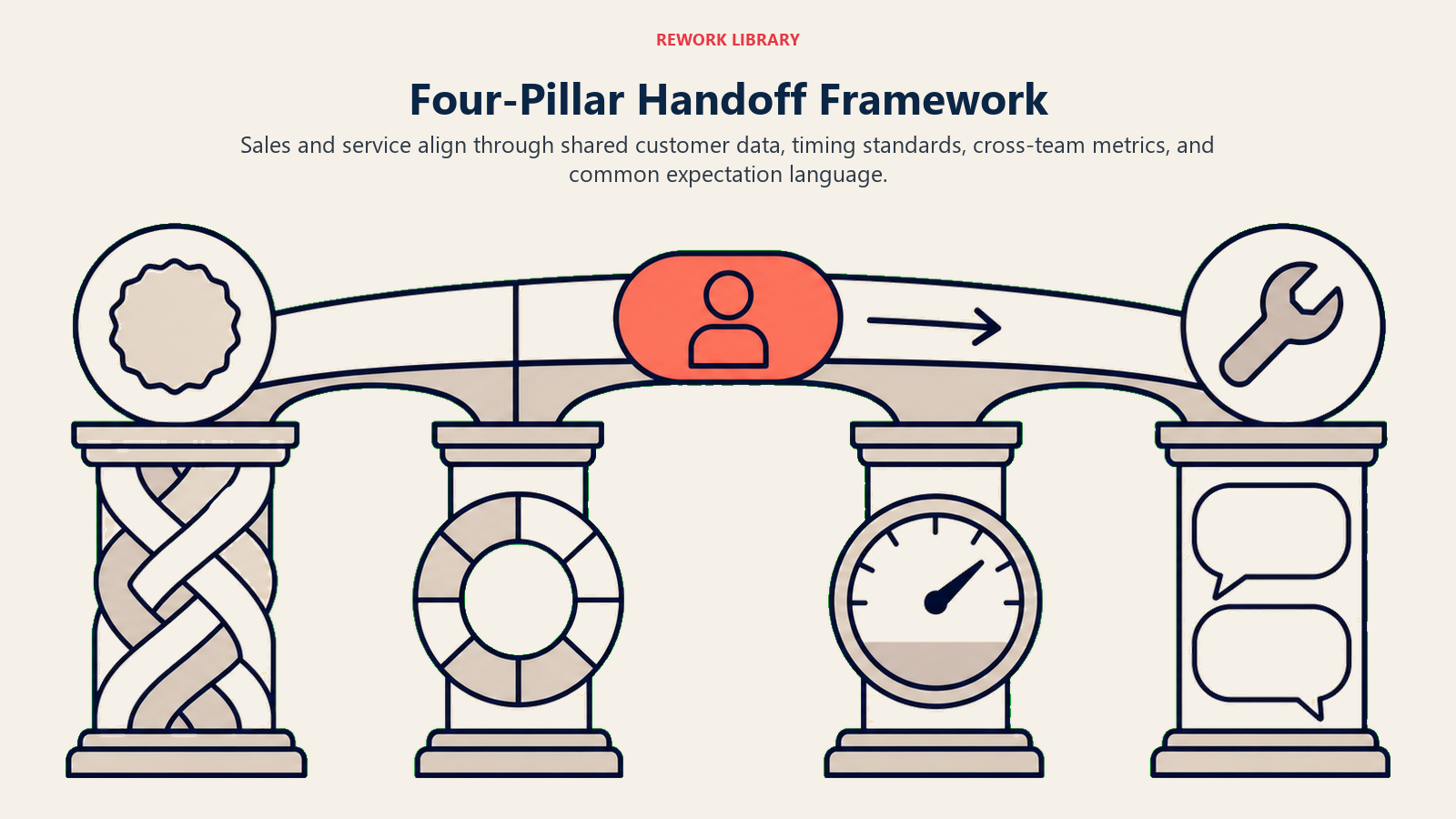
Lasting alignment requires four things to be shared between sales and service: data, timing expectations, accountability, and language.
1. Shared Data at the Point of Handoff
The service team should receive everything the sales rep knows about a new customer at the moment of close, not 48 hours later, not after someone manually updates a spreadsheet. This is the foundation described in sale-to-service-start handoff.
The handoff record should include at minimum:
| Data Point | Why Service Needs It |
|---|---|
| Customer name and contact preference | Basic, but often missing |
| Service address and access instructions | Locked gates, dogs, entry codes |
| What was promised during the sale | Prevents the promise gap |
| Special scheduling requests | Evenings, weekdays only, etc. |
| Customer concerns noted during pitch | Pets, allergies, specific problem areas |
| Rep name and phone number | Customer can ask for them if needed |
| Promotional rate if applicable | Billing team needs to match what was sold |
Most D2D CRM and canvassing apps support a structured handoff form at contract signing. If yours doesn't, a simple intake form filled by the rep at the time of close and automatically routed to the service coordinator is a workable interim solution.
2. Clear Timing Expectations, Written Down
Ambiguity about timing is where most alignment problems start. "We'll call soon" means something different to a rep who says it, a coordinator who hears it, and a customer who waits for it.
Define standards explicitly and make them visible to both teams:
| Event | Standard Timeline | Owner |
|---|---|---|
| Welcome call to new customer | Within 24 hours of close | Service coordinator |
| First service scheduled | Within 5 business days of close | Service coordinator |
| Rep notified of first service date | Same day as scheduling | CRM automation |
| First service completed | Within 10 business days of close | Service team |
| Rep commission trigger | Day of first service completion | Billing/payroll |
Post these standards in both the sales and service team spaces. When everyone knows the expectation, violations are visible rather than ambiguous.
3. Cross-Team Accountability Metrics
If the only metrics sales tracks are closes and revenue, and the only metrics service tracks are completion rates and complaints, they're operating with zero shared accountability.
Add metrics that require both teams to perform:
Early cancellation rate by rep: If a rep's customers cancel at twice the team average in the first 60 days, something happened in the sale. Either expectations were misset, the customer was a poor fit, or the close was coercive. This metric surfaces quality problems in the sales funnel that standard close-rate data never reveals. It connects directly to the principles in ethical selling and buyer's remorse prevention.
Days to first service by service coordinator: If one coordinator consistently takes 12 days to schedule first service while the team average is 5, that gap is creating customer friction and slowing rep commission. Track it and hold it.
First-service satisfaction score: A short post-first-service survey, with results tied back to both the closing rep and the servicing technician. Both teams have skin in the result.
30-day survival rate: The percentage of new customers still subscribed 30 days after their first service. This single metric tells you more about alignment quality than any other.
"The 30-day survival rate, the percentage of new customers still subscribed 30 days after their first service, is the single most diagnostic metric for sales-service alignment quality. It captures promise gaps, scheduling failures, and first-impression breakdowns in one number."
Make these numbers visible across both teams. Monthly reviews where sales and service leadership look at them together, not separately, create the accountability that drives behavior change. HBR's research on subscription business model dynamics confirms that in recurring revenue models, sales success must be measured across the entire customer lifecycle, not just at the point of close, which means shared metrics are not a best practice but a structural requirement.
4. Shared Language About Customer Expectations
Sales reps describe what customers want in sales language. Service teams think in operational categories. Neither set of language is wrong, but they often don't map onto each other.
A rep describes a customer as "really concerned about fire ants in the backyard near the kids' play area." The service system has a field for "service notes" that the technician glances at for 10 seconds before the visit. The concern doesn't make it to the technician in any useful form.
Fix this with shared vocabulary in the CRM:
- Define service types consistently (what "quarterly interior" means, exactly, in terms of what is treated and what products are used)
- Create a short standardized list of customer concern categories that both reps and technicians recognize (pets, children, specific pests, access limitations, etc.)
- Document what each promotional offer includes so service teams can deliver it without re-negotiation
The goal isn't to turn reps into service technicians or technicians into salespeople. It's to give each team enough context about the other's world to avoid stepping on landmines.
Operationalizing Alignment: What to Actually Build
Turn alignment into a working system with a recurring leadership sync, fast escalation routes, and a documented new-customer timeline.
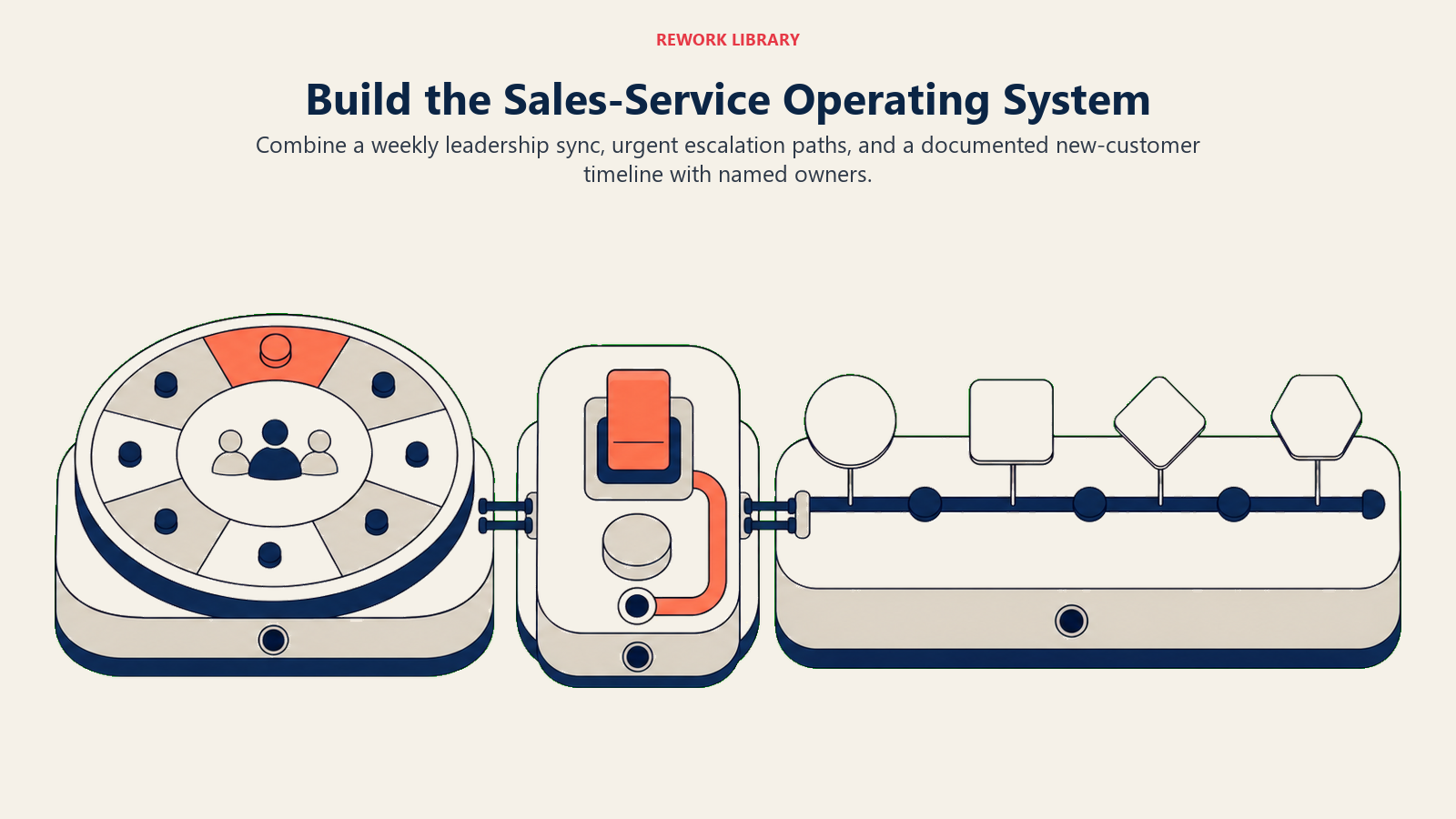
Weekly Sync Between Sales and Service Leadership
A 30-minute weekly call between the sales manager and service manager is the single highest-leverage alignment activity. Agenda:
- New customers added this week: any special cases, concerns, unusual promises?
- First services completed this week: any problems that came up on the first visit?
- Early cancellations or complaints: what's the common thread?
- Scheduling backlog: is the service team able to meet the 5-day standard, or are we backed up?
This isn't a reporting meeting. It's a problem-solving meeting. The output is a short list of actions, assigned to specific people, with deadlines.
If the two leaders don't have this conversation regularly, misalignment compounds silently until a crisis forces it.
Escalation Pathways
Not everything can wait for a weekly meeting. Both teams need a clear escalation path for urgent cases:
- A rep who just closed a particularly complex account (large property, unusual access situation, customer with strong opinions) should be able to flag it directly to the service coordinator before the standard handoff workflow runs.
- A technician who discovers something at a new customer's property that contradicts what was in the service notes should have a direct line to the service manager and the original rep.
- A customer who calls in angry about a scheduling failure should be connected to someone with authority to resolve it, not bounced between departments.
Escalation pathways sound simple. But in D2D companies, especially those running large seasonal sales forces, it's easy for the organizational chart to work against fast resolution. Define the paths and communicate them.
The New Customer Experience Timeline
Document and share the exact sequence a new customer should experience from close to active subscriber:
Day 0 (Close): Welcome text or email from the rep. "Hi [Name], it was great meeting you today. Our service team will call within 24 hours to get your first appointment scheduled."
Day 1: Service coordinator calls to schedule. Captures any remaining customer questions or concerns. Confirms service date.
Day 3-7: First service completed. Technician arrives, completes service, leaves service report. Calls or texts customer afterward: "Just wanted to make sure everything looks good. Any questions?"
Day 7-10: Service manager or customer success rep calls to check in. "How did your first visit go? Anything we should know for next time?"
Day 30: First invoice. Clear, itemized, matches what was quoted during the sale.
Day 90: Proactive satisfaction check-in. Part of the welcome and onboarding process for new customers.
When this sequence runs cleanly, early cancellation rates drop. When it breaks down at any point, the probability of cancellation in months one through three spikes.
The Commission Timing Problem
One alignment issue that deserves its own attention is commission timing and its effect on sales rep behavior.
In many D2D comp structures, reps don't receive full commission until the first service completes. This creates a natural incentive: reps want service to happen fast. When service is slow, reps start calling coordinators, sometimes daily. This friction is real and worth designing around.
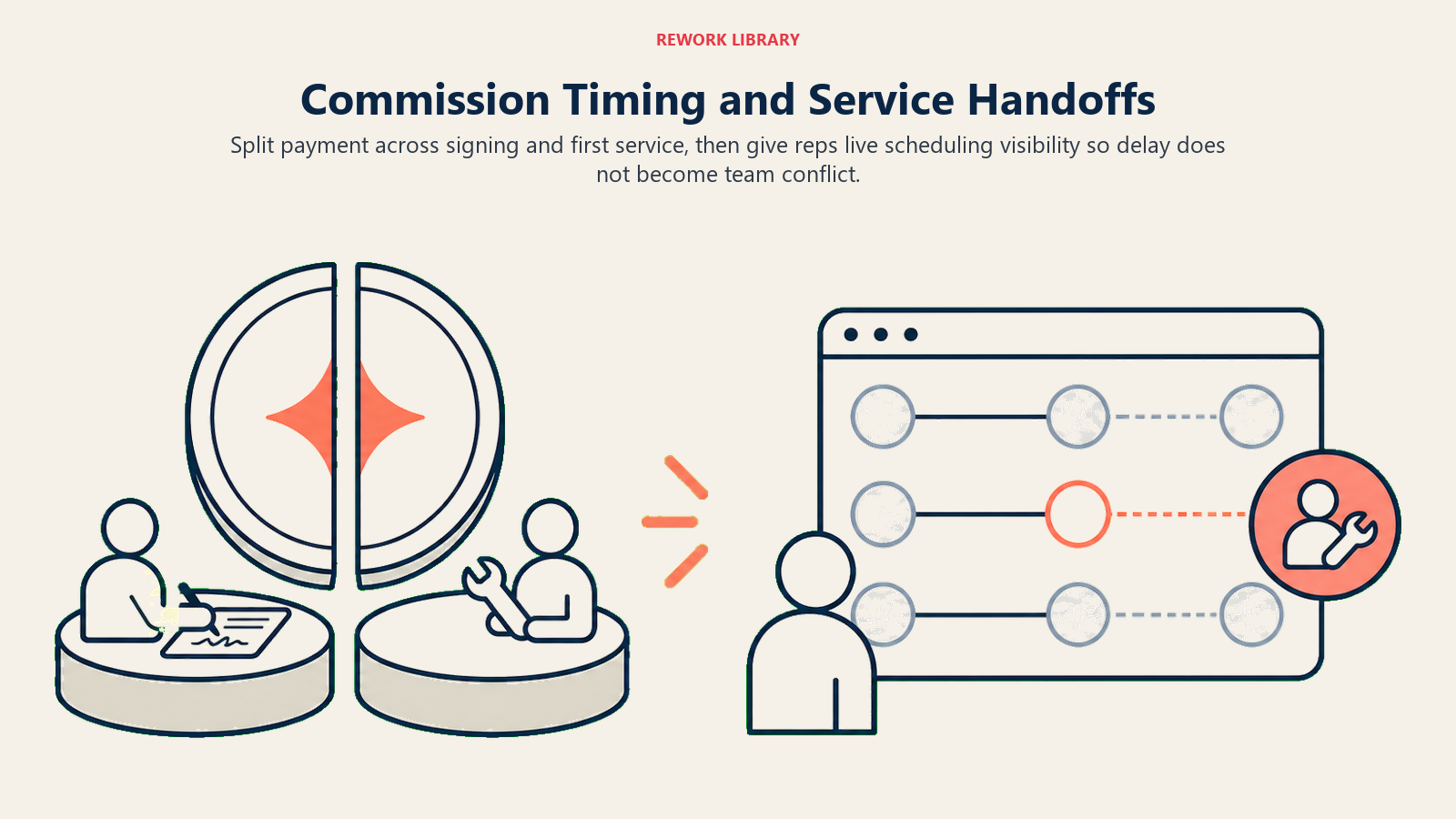
Two approaches work well:
Partial advance commission: Pay 50% of commission at contract signing, 50% at first service. This reduces the urgency somewhat and gives reps a reason to set correct expectations at close (a cancelled customer before first service means commission clawback).
Service scheduling SLA (service level agreement) with rep visibility: Give reps real-time visibility into where their new customers are in the scheduling queue. If a rep can see that a new account is scheduled for day 4, they stop calling to check. The anxiety comes from the unknown.
"Sales reps calling service coordinators daily to track new account scheduling is not a personnel problem. It is a systems problem. When reps can see their new account's scheduling status in real time, inquiry calls drop to near zero without any change in urgency."
The sales billing and collections alignment article addresses the broader payment structure issues, but scheduling visibility specifically resolves most of the sales-to-service friction.
Alignment During Seasonal Ramp
Alignment failures are particularly acute during summer sales programs, when D2D companies rapidly expand their field force. 50 new reps generating contracts in June, all promising "fast scheduling," while the service team hasn't yet staffed for the volume is a recipe for chaos.
Plan for this: running a summer sales program should include service capacity planning as part of the launch. What's the maximum number of new accounts the service team can schedule for first service within 5 business days? That number is your effective sales capacity for the week. If your reps close 200 accounts and service can handle 140 first appointments that week, 60 customers are getting a subpar experience no matter how good your intentions are.
Cap weekly new-customer volume at service capacity, or add service capacity proactively before the cap is hit. This conversation has to happen between sales and service leadership before the summer launch, not after the backlog appears.
What Does Good Alignment Produce?
When sales and service are genuinely aligned, the results are measurable:
- Early cancellation rates (first 90 days) drop 20 to 40%
- Rep commission disputes decrease
- First-service satisfaction scores improve
- Customer support call volume in the first 30 days falls
- Reps spend more time selling and less time chasing down service coordinators
These aren't soft benefits. They're revenue and margin improvements directly attributable to operational coordination. Bain's analysis of churn dynamics in subscription services found that for every 50-basis-point reduction in monthly churn, a 5-million-customer business generates roughly $240 million in incremental lifetime value over 18 months, which puts the financial stakes of early-stage cancellation prevention in concrete terms.
Good alignment also makes retention and early-cancellation programs more effective, because those programs work with customers who actually had the experience they were promised. You can't retain a customer against a broken first impression.
Keeping a customer starts at the moment of sale, not 90 days later when the contract is up. And just as consistent, relevant touchpoints convert prospects into customers, the new-customer sequence above converts a signed contract into a loyal subscriber through the same logic: the right message at the right time, every time.
The close was your promise. The service delivery is your proof. What happens next, when a customer calls with a complaint instead of a compliment, is where that alignment gets tested for real.
Learn More
- Reducing early cancellations
- Subscription retention fundamentals
- Retention fundamentals
- Lead nurturing programs
Frequently Asked Questions about Sales and Service Operations Alignment in D2D Subscription Companies
Why do D2D companies struggle with sales and service alignment?
The structural mismatch is straightforward: sales reps are incentivized to close accounts today, while service operations are measured on completion rates and scheduling capacity. Neither team is naturally incentivized to think about the other's constraints, so alignment requires deliberate shared data, explicit timing standards, and cross-team metrics that create accountability in both directions.
What is the most common handoff failure in D2D subscription businesses?
The promise gap is the most damaging: a sales rep commits to something during the pitch (quarterly interior treatments, a specific scheduling window, a locked price) that never makes it into the service system. The customer expects the promise, the service team has no record of it, and the resulting friction drives early cancellations.
What data should travel from sales to service at the point of close?
At minimum: customer name and contact preference, service address and access instructions (locked gates, dogs, entry codes), what was promised during the sale, special scheduling requests, customer concerns noted during the pitch (pets, allergies, problem areas), the rep's name and number, and any promotional rate that differs from standard pricing.
What timeline standards should D2D companies set for new-customer onboarding?
A welcome call to the new customer should happen within 24 hours of close. First service should be scheduled within 5 business days. First service should be completed within 10 business days. Rep notification of the first service date should happen the same day it is scheduled, via CRM automation. Clear standards, visible to both teams, eliminate most of the ambiguity that drives sales-to-service friction.
How should rep commission timing be structured to reduce sales-service conflict?
Paying 50% of commission at contract signing and 50% at first service reduces the urgency that drives reps to pester coordinators, while still aligning incentives toward successful delivery. Giving reps real-time CRM visibility into their new account's scheduling queue eliminates most of the anxiety that causes inquiry calls, because the problem is the unknown, not the delay itself.
What shared metrics should both sales and service teams track?
The four most useful cross-team metrics are: early cancellation rate by rep (signals misaligned sales conversations), days to first service by coordinator (signals scheduling bottlenecks), first-service satisfaction score (shared accountability for the first impression), and 30-day survival rate (the most comprehensive single indicator of alignment quality).
How should D2D companies handle the seasonal ramp alignment problem?
The capacity conversation between sales and service leadership must happen before summer launch, not after a backlog appears. Determine the maximum number of new accounts the service team can schedule for first service within 5 business days, and treat that number as the effective weekly sales capacity. Closing above that capacity means a subset of customers will have a subpar experience regardless of effort.

Senior Implementation Consultant
On this page
- What Does Misalignment Actually Look Like in D2D Operations?
- The Alignment Framework: Four Shared Elements
- 1. Shared Data at the Point of Handoff
- 2. Clear Timing Expectations, Written Down
- 3. Cross-Team Accountability Metrics
- 4. Shared Language About Customer Expectations
- Operationalizing Alignment: What to Actually Build
- Weekly Sync Between Sales and Service Leadership
- Escalation Pathways
- The New Customer Experience Timeline
- The Commission Timing Problem
- Alignment During Seasonal Ramp
- What Does Good Alignment Produce?
- Learn More