Same-Visit Close Techniques for Door-to-Door Subscription Sales
Turn this article into takeaways for your work.


Each assistant summarizes the article only for you and suggests best practices for your work.
The same-visit close is the whole point.
You knocked, you qualified, you discovered their need, you presented the solution, you walked through pricing. All of that was preparation. Now someone has to sign. And that someone needs to sign today, before you leave, before they "think about it," before a competing priority takes over and they forget you ever knocked.
This is the part most reps rush or fumble. They've done everything right and then go passive at the close. They wait for the homeowner to decide instead of helping them decide.
This article covers the specific techniques that convert D2D presentations into signed subscription agreements on the first visit.
Why Are Same-Visit Closes Non-Negotiable in D2D?
The economics of door-to-door are unforgiving. Your cost per knock is real. Your time on a route is finite. And the data on callbacks is blunt: close rates on a "let me think about it" drop sharply within 24 hours, for the same reason cold-calling response rates collapse the longer a lead sits untouched (see the Key Facts below). At the door, that decay applies just as fast. The homeowner who was warm during your visit is functionally cold by tomorrow morning because the problem you surfaced has faded back into the background noise of their day.
SPOTIO's sales statistics place the typical D2D knock-to-sale conversion rate at 2 to 3 percent of doors knocked, which means a single wasted warm conversation compounds quickly across a route.
Same-visit closes aren't pressure tactics. They're an acknowledgment that the best window to help this homeowner is right now, and your job is to keep that window open long enough for them to walk through it.
Key Facts: Same-Visit Closes
- D2D sales generates roughly one qualified lead per 50 doors knocked, according to data aggregated by SPOTIO and Zety (2026). Every warm conversation that ends in "I'll think about it" is a meaningful lost opportunity in a low-conversion channel.
- Research from MIT and InsideSales.com found that sales contact odds drop more than 10 times within the first hour after a prospect expresses interest, with a 100x gap between 5-minute and 30-minute follow-up windows. The same decay curve governs same-day callbacks in D2D.
- Field sales reps spend approximately 43% of their working time in face-to-face selling, per SPOTIO's State of Field Sales 2025. Every unresolved visit consumes time from a finite pool.
The Close Starts Before the Ask
Most reps treat the close as a single moment at the end of the presentation. But the most effective closers seed commitment throughout the conversation.
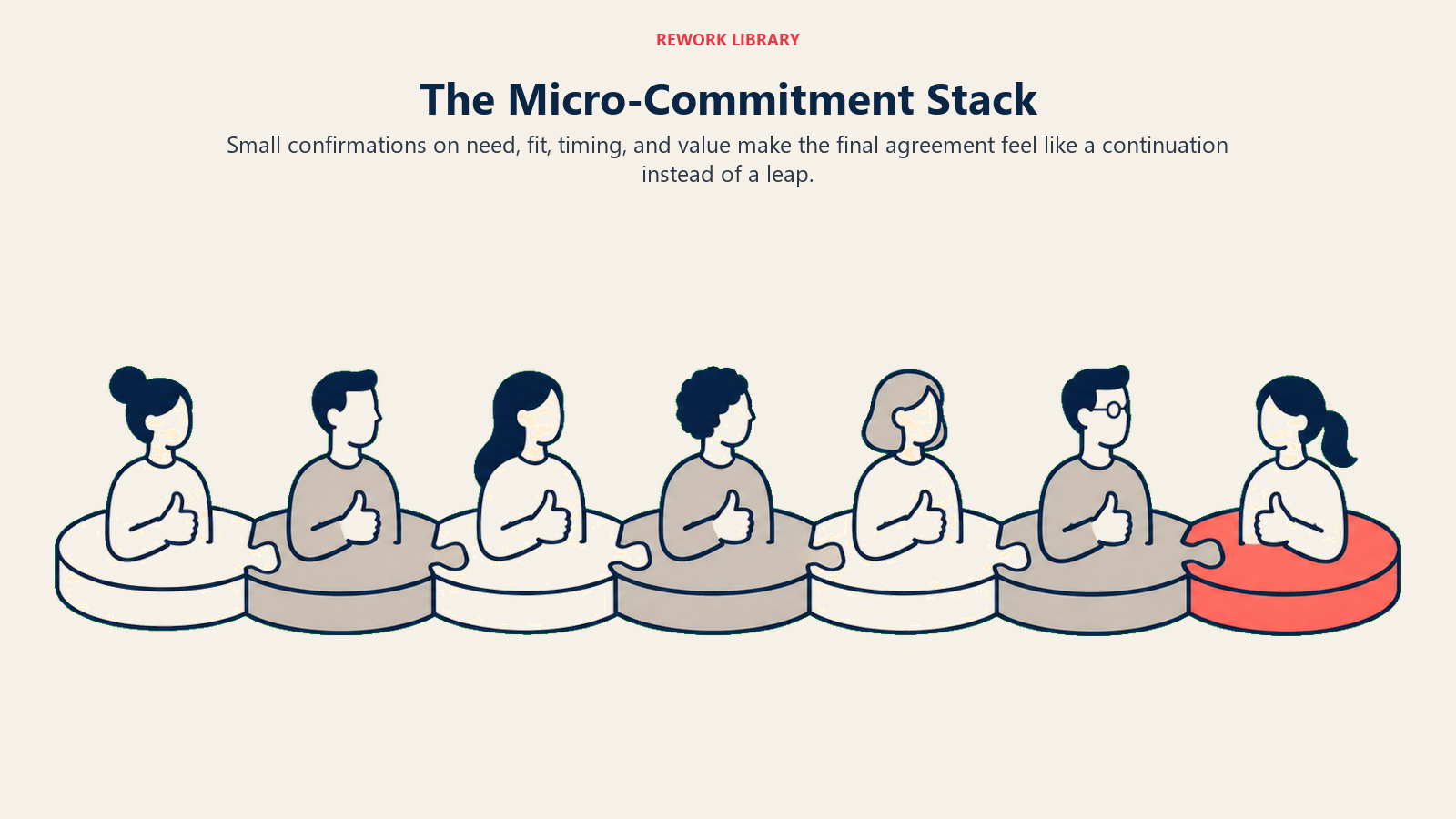
The Micro-Commitment Stack: Trial closes are short, low-stakes questions that test where the homeowner is and move them incrementally toward yes. They sound like:
"That makes sense for your situation, right?" "Based on what you've described, you'd want the quarterly plan over the basic one, wouldn't you?" "So you'd want the first treatment scheduled before the summer really kicks in?"
Each of these is a micro-commitment. The homeowner says yes to small things, which makes saying yes to the agreement feel like a continuation rather than a leap. That's the logic behind the assumptive close: assume each step forward, let the homeowner confirm.
By the time you've completed discovery, presentation, and pricing, you might have four or five micro-commitments in the bank. The homeowner has confirmed the problem, confirmed the solution fits, confirmed the timing matters, and confirmed the value makes sense. The final close is just the paperwork.
Core Same-Visit Close Techniques
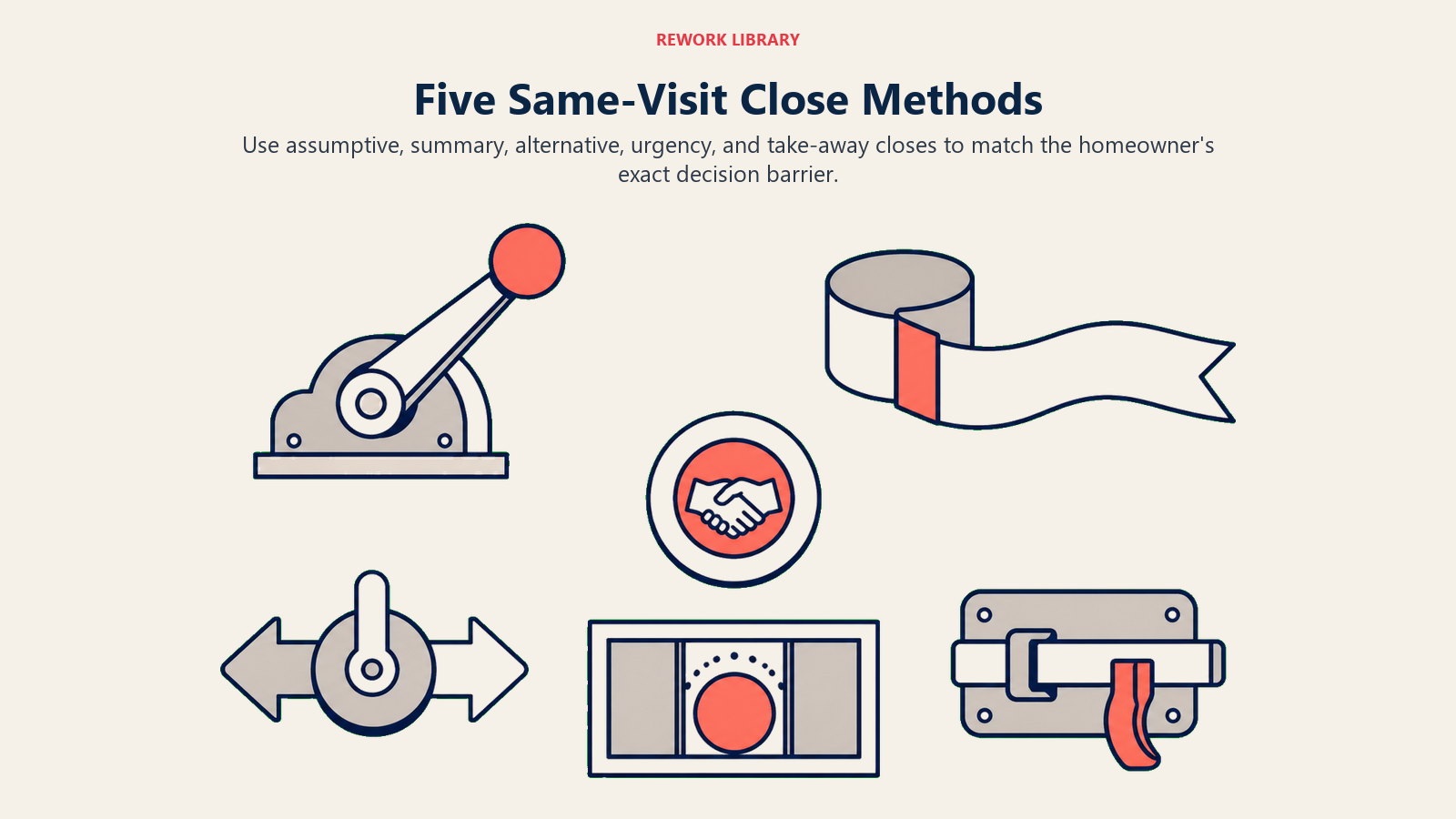
Five methods help a rep match the close to the homeowner's specific decision barrier without repeating the same ask.
The Assumptive Close
Assume the yes and move to logistics.
"Great. Let's get you set up. I just need your address to confirm service and we'll get your first visit scheduled."
You're not asking if they want to sign. You're asking for the information you need to complete the process. The homeowner who hasn't decided yet will either follow along (they've just committed) or pause with a specific concern (now you know what to address).
The assumptive close works because it removes the awkward "so, do you want to buy?" moment that makes both the rep and the homeowner uncomfortable. Instead, you're simply proceeding with something practical and concrete.
The Summary Close
Recap what you've learned and present the next step as the logical conclusion.
"So here's what we've got. You've had ongoing pest activity that store treatments haven't solved. Our quarterly plan covers the full perimeter and any interior entry points, and if you see anything between visits, we come back free. For $49 a quarter that's about $16 a month, and the first treatment can go in this week. Does that work for you?"
The summary close is powerful because it reminds the homeowner of everything they agreed with during the conversation. You're not introducing anything new. You're tying together what they already believe.
This pairs well with the pricing and contract structure covered in pricing and contract presentation.
The Alternative Close
Give the homeowner two options, both of which move forward.
"Would you want us to schedule the first visit this week or next?" "Do you want to start with the quarterly plan or add the interior coverage?" "Would you prefer to pay quarterly or annually?"
The alternative close shifts the question from "yes or no" to "which one." It's not manipulation; it's clarity. Many homeowners stall not because they don't want the service but because they're not sure what the next step looks like. The alternative close makes the next step concrete.
The Urgency Close
Create a legitimate reason to decide today. This only works if the urgency is real.
"We're doing your street this week as part of our route expansion. If you sign up today, I can get the first treatment scheduled for Thursday. After this week, availability in your area might be two to three weeks out."
Or: "I can include a free interior sweep with the first visit if we sign you up today. That offer is specific to this initial rollout."
Fake urgency backfires. Homeowners who sign under pressure and later discover the urgency wasn't real cancel fast, tell their neighbors, and generate charge-backs. Use urgency only when it's true. Be specific about what it is and why it's time-limited.
The Take-Away Close
Used carefully, pulling back can create momentum.
"I want to make sure this is actually the right fit for you. If you're not sure about the commitment, I'd rather we not set you up with something that doesn't work. Is there a specific concern that's making you hesitate?"
This technique signals confidence and removes the pressure dynamic. The homeowner who was hesitating because they didn't want to feel pushed often relaxes at this point and tells you exactly what's holding them back. Then you have something to work with.
Don't overuse the take-away. Once per conversation, maximum. And mean it. If the homeowner says "I'm really not sure," take that seriously and either address the concern or agree to revisit another time.
Managing Momentum Through the Close Sequence
Momentum in a D2D conversation is fragile. You build it through a strong approach, good discovery, a tight presentation, and confident pricing. You lose it through long pauses, fumbled paperwork, uncertainty about terms, or anything that gives the homeowner a reason to mentally check out.
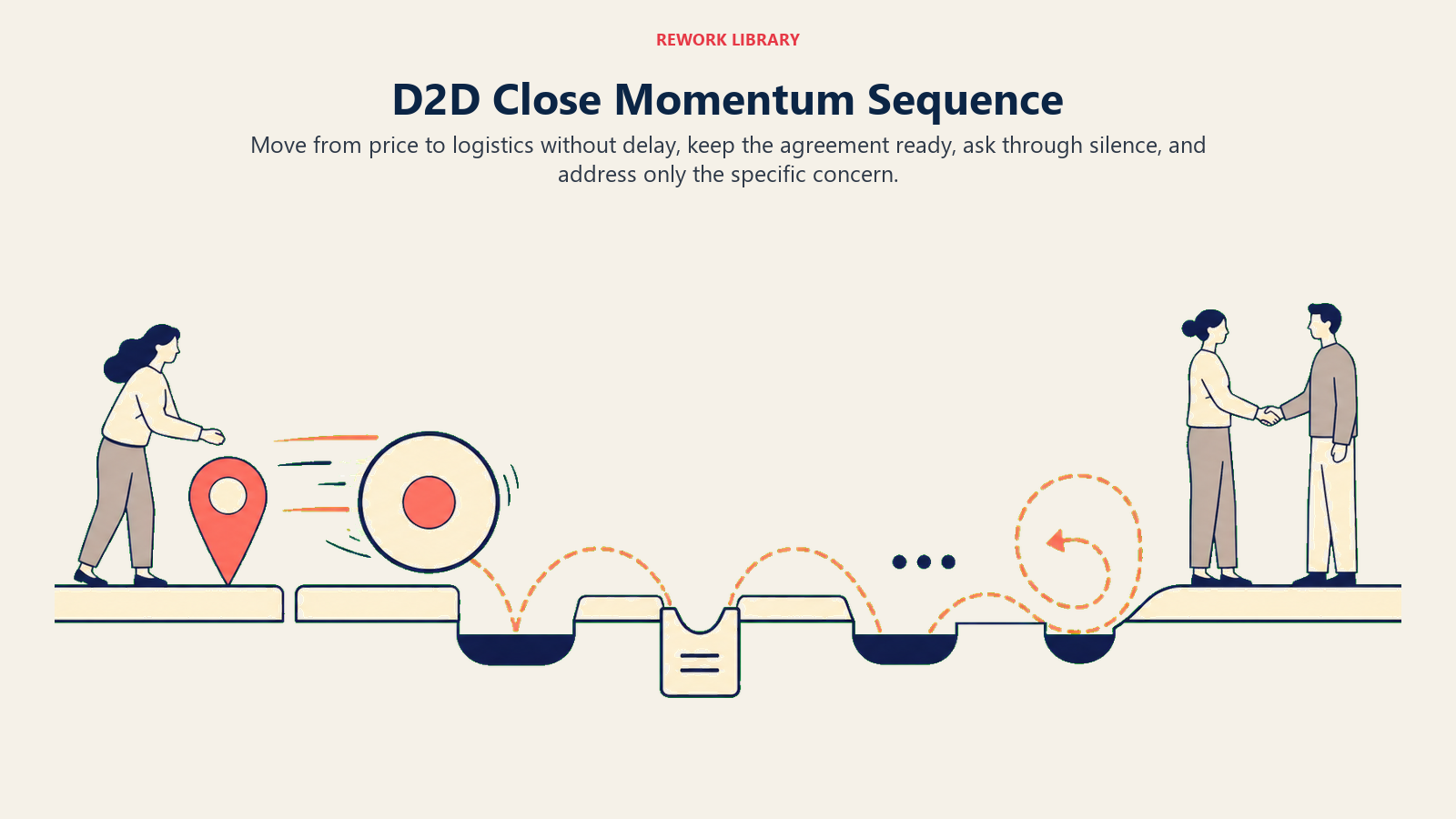
Here's how to keep momentum from the pricing reveal to the signature:
Move immediately from price to next step. Don't pause after you say the price and wait for a reaction. Say the number and move directly: "So let me grab your address to confirm coverage."
Have your agreement ready. Whether it's a tablet or paper, it should be in your hand before you start the close sequence. Digging in your bag for a form kills momentum.
Stay on your feet. Standing creates energy. Sitting down at a kitchen table shifts the dynamic toward deliberation and raises the odds of "let me think about it." Close standing when you can.
Fill silence with questions, not explanations. If the homeowner goes quiet, ask a question: "What's your thinking?" or "Is there a part of this you want me to go over?" Silence is often just processing. Don't interpret it as rejection and start backtracking on price or terms.
Don't restart the pitch. Once you're in the close, don't go back to explaining the service. If a concern comes up, address that specific concern. Reps who restart the pitch when they feel resistance lose the close.
Reading Close-Readiness
Not every homeowner signals close-readiness the same way. Some are verbal: "That actually sounds really good." Others are non-verbal: they lean in, they look at the tablet, they nod along with the summary.
Signs a homeowner is ready:
- Asking logistics questions ("How long does the first visit take?", "Will you call ahead?")
- Referencing the problem in the present tense ("Yeah, we've been dealing with this for months")
- Showing the agreement to a spouse who's appeared at the door
- Asking about referrals before they've signed (a strong indicator)
Signs a homeowner needs more work:
- Arms crossed, looking away, giving short answers
- Asking comparative questions without expressing preference ("What does a competitor charge for this?")
- Bringing up a past bad experience with any service company
- Saying "maybe" without a specific timeframe
The second group isn't lost. They just need a different approach, usually one more question about their specific concern before you attempt the close again.
Close Attempts: When and How Many
Most D2D trainers recommend three close attempts before pivoting. The first is your primary close. The second is your response to the first objection. The third is your final attempt after addressing the second objection.
After three genuine attempts, if the homeowner still hasn't committed, you have two options: set a specific follow-up ("I'll be back in this area Thursday, I'll stop by and give you a couple days to think it over") or recognize that today isn't the right day.
Don't force a fourth or fifth close attempt. It damages trust and makes the rep look desperate. The close plan development framework is useful here for knowing which technique to use at which attempt.
The Toughest Close Scenario: The Undecided Household
Two adults in the household and only one is at the door. The other one "isn't here" or "is working." This is one of the most common same-visit close challenges in D2D subscription sales.
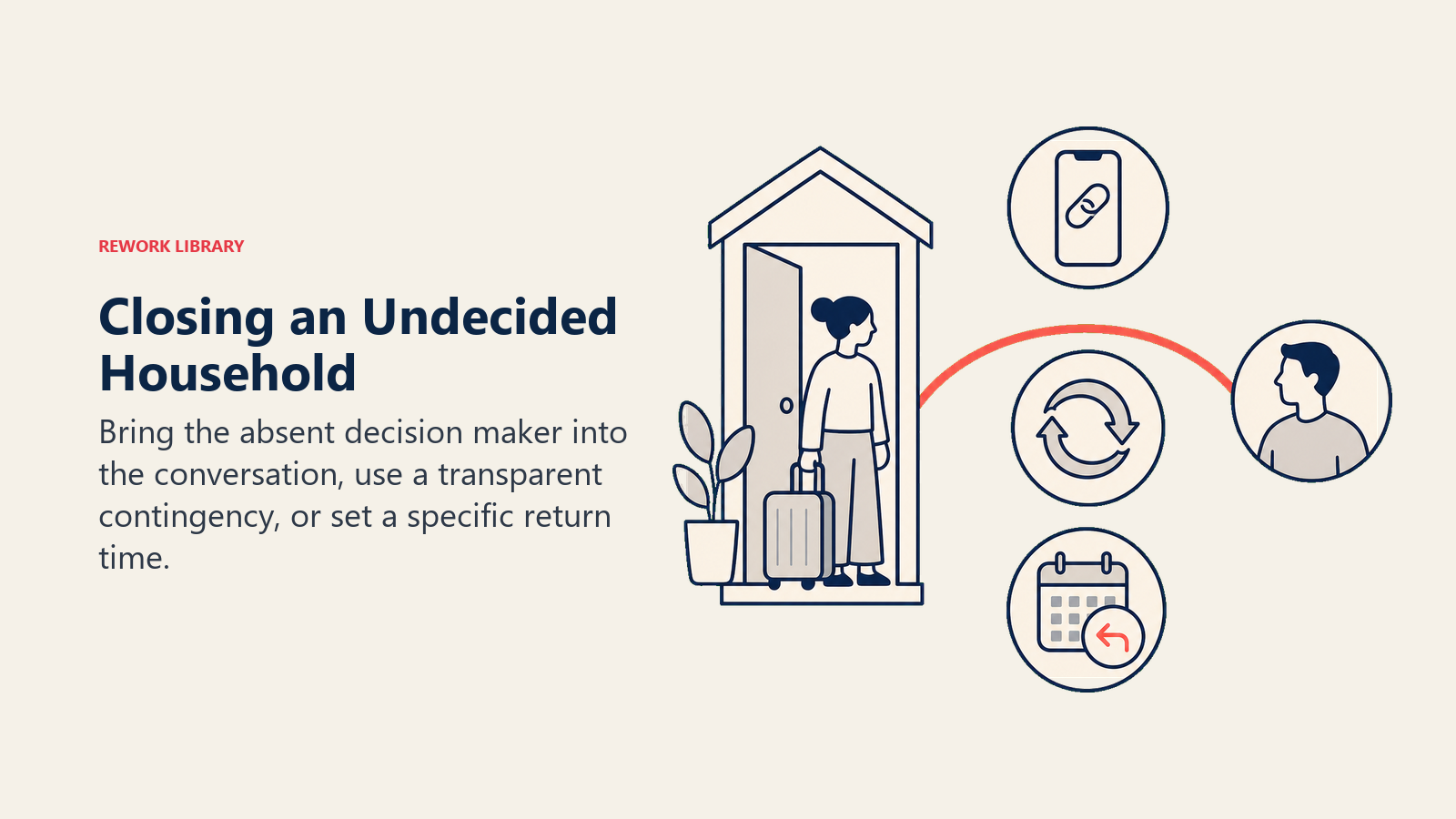
Options:
Option 1: "Is there a way to reach them for two minutes? I can give them a quick summary on the phone so you both feel good about it."
Many reps hesitate to suggest this. Don't. If the homeowner is genuinely interested, they'll often call their spouse or text them. A brief three-way conversation often resolves it same-visit.
Option 2: Get a commitment with a contingency. "Go ahead and get set up. If your spouse has any concerns or wants to change the plan, you can call us within 48 hours to adjust or cancel at no charge."
This works when your service agreement has a brief cancellation window, which many D2D subscription contracts do for compliance reasons (and which is worth using as a selling point, not hiding from). Under the FTC's Cooling-Off Rule, homeowners already have three business days to cancel a D2D purchase over $25, so leading with that transparency strengthens trust rather than undermining the close.
Option 3: Set a hard return time. "I'll be in the neighborhood again Thursday evening around 6. I'll stop by when you're both home, takes five minutes." Then show up.
After the Close: What Happens Next Matters
The close isn't the end of the conversation. What happens in the first 30 seconds after a homeowner signs determines whether they feel good about that decision or start second-guessing it.
Congratulate them briefly and move to confirmation. "Great. You're going to love having this handled. Let me confirm your first visit details."
Give them a tangible next step. A confirmation number, a text message, a calendar invite, anything that makes the service feel real and underway.
Set expectations for the first visit. "The tech will call 30 minutes ahead. The first visit takes about 45 minutes. You don't need to be home for the exterior treatment but you'll want to be there for the interior."
Don't oversell once they've signed. Some reps, relieved by the close, start talking too much. Keep post-close brief and positive. The homeowner needs to feel confident, not oversold.
This handoff moment is the foundation for everything that comes after. See sale to service start handoff and welcome and onboarding for new customers for how the close connects to long-term retention.
Key Takeaways
- Same-visit closes are non-negotiable in D2D because callback close rates drop dramatically within 24 hours.
- Seed commitment with trial closes throughout the conversation, not just at the end.
- Use the assumptive close to move from pricing to logistics without an awkward "so do you want to buy?" moment.
- The summary close recaps what the homeowner already agreed to and presents the next step as the natural conclusion.
- Alternative closes ("this week or next?") replace yes/no with a choice between two forward steps.
- Keep momentum by moving immediately from price to next step, having paperwork ready, and staying on your feet.
- Attempt the close up to three times. After that, pivot to a hard follow-up or recognize today isn't the day.
- For the two-adult household: offer the phone option, a contingency commitment, or a specific return time.
- Post-close, keep it brief, give a tangible next step, and set expectations for the first visit.
The same-visit close isn't about pressure. It's about building enough value and trust in one conversation that saying yes feels obvious. Do the work earlier in the visit, and the close takes care of itself.
For the underlying principles on how value and timing interact at the final ask, see negotiation fundamentals.
The 24-Hour Decay: Research from MIT and InsideSales.com shows that lead contact odds drop more than 10 times within the first hour after a prospect expresses interest. In D2D terms: the homeowner who told you about their ant problem at 4 PM on Tuesday is significantly less likely to sign a callback on Wednesday morning. The problem feels vivid at the door. It fades fast.
The Micro-Commitment Principle: By the time a rep has completed discovery, presentation, and pricing with four to five trial-close confirmations along the way, the final signature isn't a new decision. It's the paperwork version of choices the homeowner already made. That's why closing rate data from D2D practitioner benchmarks consistently shows that reps who seed micro-commitments throughout a visit outperform those who rely on a single closing ask at the end.
The Momentum Rule: Moving immediately from the price reveal to the next concrete step ("Let me grab your address to confirm coverage") keeps the homeowner in forward motion. Pausing after price to gauge reaction is where most same-visit closes leak momentum.
Frequently Asked Questions about Same-Visit Close Techniques for Door-to-Door Subscription Sales
What is a same-visit close in door-to-door sales?
A same-visit close is when a homeowner signs the service agreement during the initial sales visit, before the rep leaves the door. It's the primary goal of D2D subscription sales because callback close rates drop sharply within 24 hours. A same-visit close captures the homeowner while the problem your service solves feels most vivid and urgent.
What is a trial close and how does it work?
A trial close is a low-stakes question embedded during the conversation that tests commitment and collects a micro-yes. Examples include "That makes sense for your situation, right?" or "You'd want the first treatment scheduled before summer, wouldn't you?" Each yes makes the final signature feel like a continuation rather than a new decision. By the close, the homeowner has already committed five times in small ways.
What is the assumptive close and when should you use it?
The assumptive close skips the "so do you want to sign?" question and moves directly to the practical next step: "Let me grab your address to confirm coverage and get your first visit scheduled." Use it after your summary close, when the homeowner has expressed agreement throughout the conversation and you've confirmed the solution fits their situation. It removes the awkward binary moment and treats the close as a natural continuation.
How many times should a rep attempt the close before pivoting?
Most D2D trainers recommend three close attempts before pivoting. The first is your primary close after the pricing presentation. The second follows your response to the first objection. The third comes after addressing a second concern. After three genuine attempts, move to either a hard follow-up ("I'll be back Thursday at 6") or accept that today isn't the right day. Forcing a fourth or fifth attempt typically damages trust rather than advancing the sale.
How do you handle a two-adult household where only one person is at the door?
Three options, in order of preference. First, offer to call the absent spouse for a two-minute summary right now. Many homeowners take you up on it. Second, offer a contingency commitment: sign up now with a brief window to adjust or cancel after speaking with the spouse. Under the FTC Cooling-Off Rule, the homeowner already has three business days to cancel anyway, so this is legitimate and transparent. Third, set a hard return time when both will be home and show up on time.
What is the alternative close?
The alternative close replaces "yes or no" with a choice between two forward-moving options: "Would you want us to schedule the first visit this week or next?" or "Do you want to start with the quarterly plan or add interior coverage?" It works because most homeowners who stall aren't opposed to the service. They're uncertain about what the next step looks like. A concrete binary makes the next step obvious.
What should a rep do in the 30 seconds immediately after a homeowner signs?
Congratulate briefly, then move immediately to confirmation. Give them a tangible next step: a confirmation number, a text message confirmation, a date for the first visit. Set clear expectations for what happens at that first visit. Don't over-explain or resume selling. The homeowner needs to feel confident about the decision they just made, not persuaded of it again. This 30-second handoff is one of the highest-leverage moments for early retention.

Senior Implementation Consultant
On this page
- Why Are Same-Visit Closes Non-Negotiable in D2D?
- The Close Starts Before the Ask
- Core Same-Visit Close Techniques
- The Assumptive Close
- The Summary Close
- The Alternative Close
- The Urgency Close
- The Take-Away Close
- Managing Momentum Through the Close Sequence
- Reading Close-Readiness
- Close Attempts: When and How Many
- The Toughest Close Scenario: The Undecided Household
- After the Close: What Happens Next Matters
- Key Takeaways