Sales and Customer Support Alignment in Recurring Door-to-Door Services
Turn this article into takeaways for your work.


Each assistant summarizes the article only for you and suggests best practices for your work.
A pest control company in Phoenix had a problem their managers couldn't quite name. Sales numbers looked solid. New accounts kept rolling in. But 90-day cancellations were creeping up, and the support team was drowning in angry calls from customers who felt deceived.
The actual issue: sales reps were promising things support couldn't honor. Free re-treatments whenever the customer wanted. Price locks for three years. Guaranteed same-day callbacks. None of it was in the contract. None of it was communicated to support. And every broken promise became a support ticket, a credit, a cancellation.
This is the most common alignment failure in recurring door-to-door businesses. It's not malicious on either side. Sales reps are under pressure to close. Support agents are under pressure to reduce churn. But without a shared understanding of what was promised and what's operationally possible, both teams end up working against each other.
Why Does Sales and Support Conflict Happen?
The tension is structural, not personal. Sales reps earn commissions on new accounts. Their incentive is to close at the door, today. Customer support earns nothing from a new sale, but takes the call when a customer feels misled six weeks later.
This misalignment creates predictable friction:
- Reps make verbal commitments support can't find in the system
- Support agents learn to distrust sales-generated accounts ("another one of those")
- Customers get caught in the middle, escalating churn
- Management blames whichever team is most convenient
For security, pest control, lawn care, and fiber companies running subscription models, this isn't a soft culture problem. It's a revenue leak. A customer who cancels at 90 days had a lifetime value of almost zero after acquisition costs. Every misaligned close is a loss. HBR research on the risk of misaligned sales incentives found that companies accumulate "sales debt" when reps prioritize short-term closes over customer fit, creating operational drag that compounds over time and quietly undermines the customer support function.
Key Facts: Sales and Support Alignment
- Aligned organizations achieve 2.4 times higher revenue growth and 2 times higher profitability growth than misaligned peers, according to Forrester research.
- Existing customers account for a third to half of total revenue growth at top-quartile SaaS vendors, according to McKinsey's Customer Success 2.0 research.
- The inability to align sales and service teams around shared processes costs B2B companies 10% or more of annual revenue, according to IDC research.
The Three Promises That Break Things
After looking at support ticket patterns across recurring D2D services, three categories of verbal promises account for the majority of disputes.
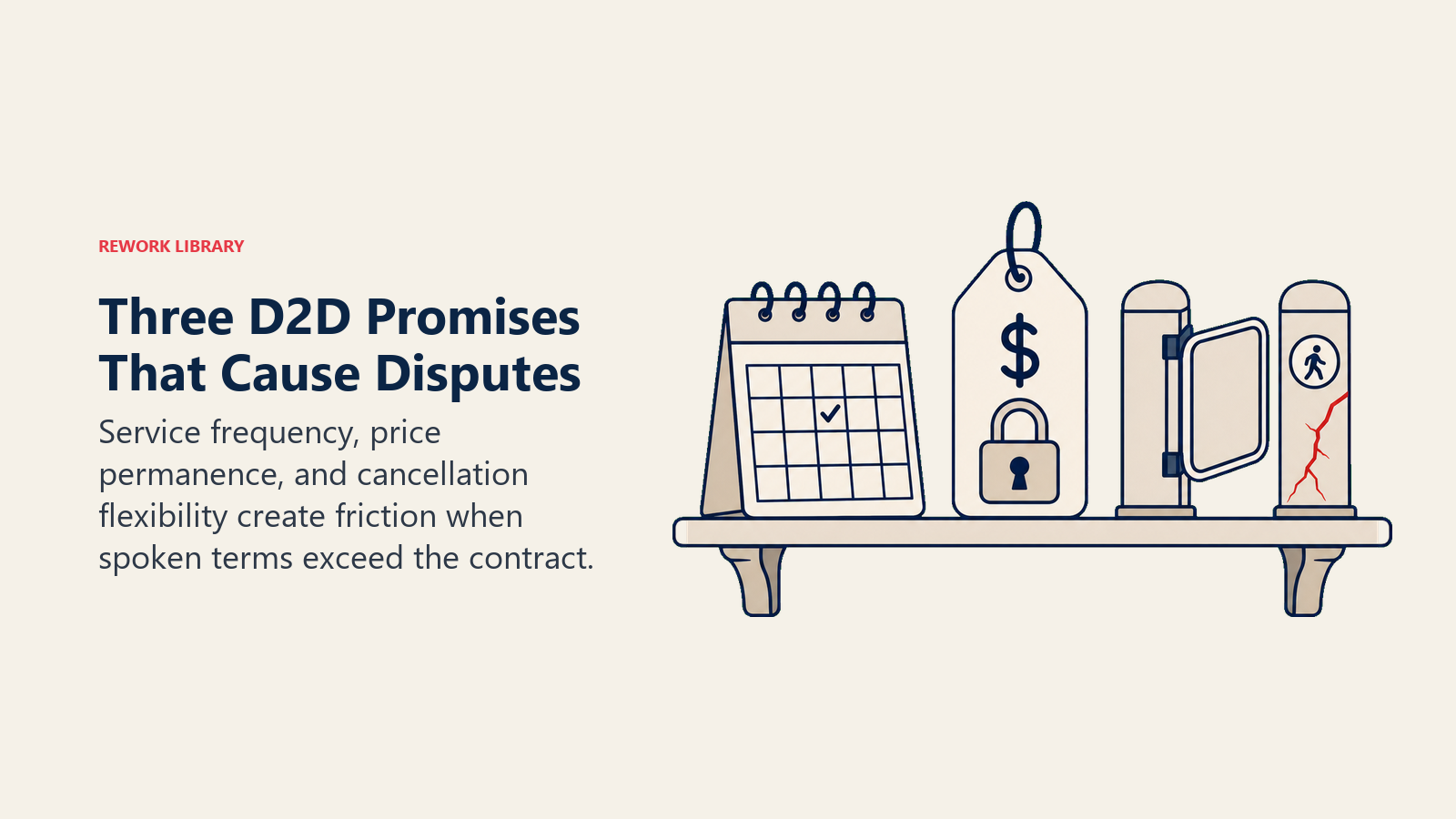
"In recurring D2D services, the three categories of verbal promise that generate the most support disputes are service frequency, price permanence, and cancellation flexibility. A rep who overstates any one of these does not just create one bad call. They create a pattern that support has to defend for the life of the account."
Service frequency promises. Reps say "we'll come every month" when the contract says quarterly. Pest control reps are especially guilty here. Customers hear monthly, sign a quarterly agreement, and call support at week five expecting a technician.
Price promises. "Your rate won't go up" is said at thousands of doors every day. It contradicts almost every recurring service contract in existence, which typically allow annual increases. When the renewal invoice arrives 2-4% higher, support gets the call.
Cancellation and flexibility promises. "You can cancel anytime, no problem" versus a contract that requires 30-day written notice and possibly an early termination fee. This one generates the most acrimony because customers feel legally trapped after being told they weren't.
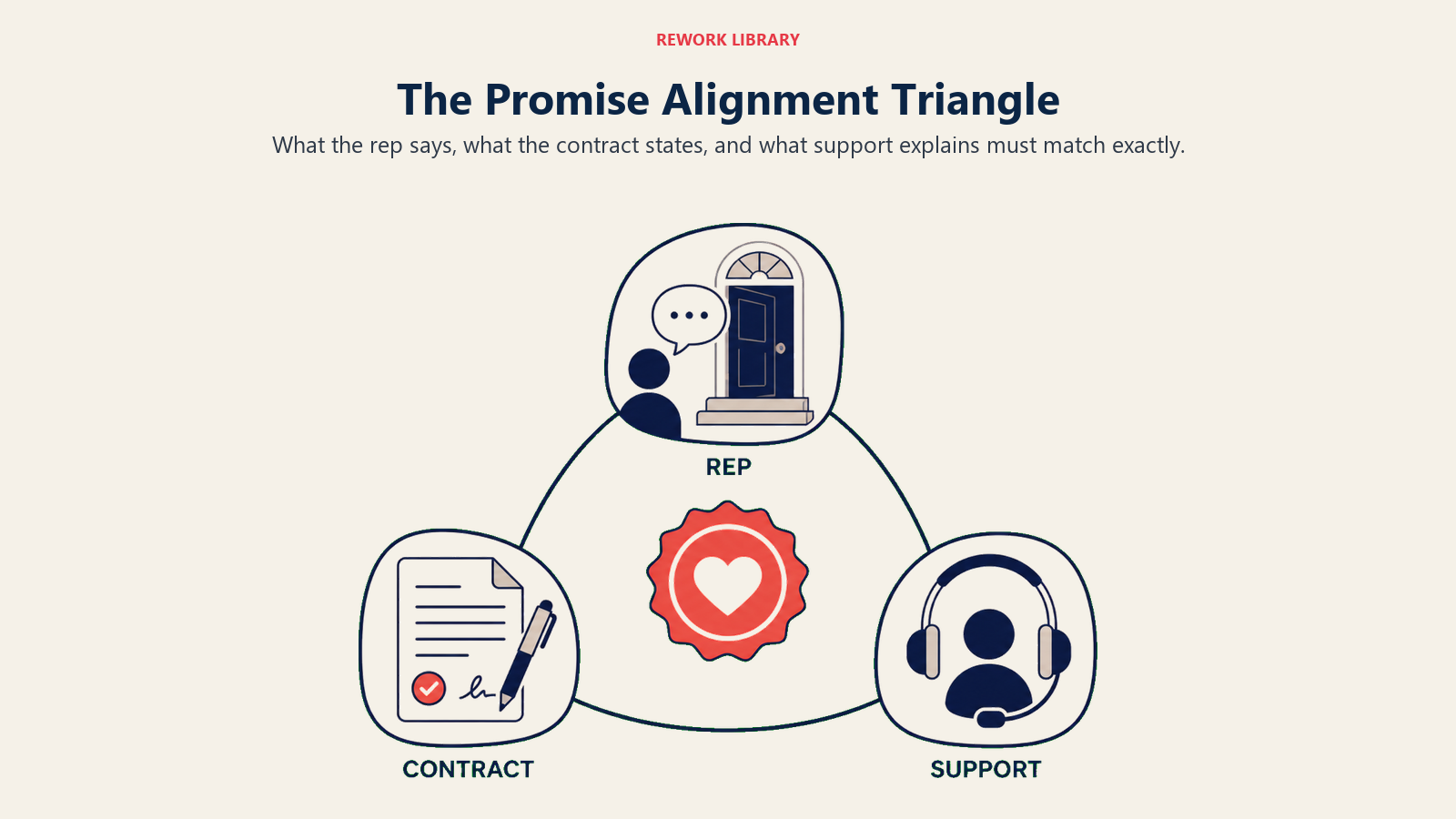
None of these promises necessarily need to disappear. Some companies do offer genuine price locks. Some do allow easy cancellation. The point is that whatever is true needs to be accurate in three places: what the rep says, what the contract states, and what support knows to tell callers.
Building a Shared Promise Standard
The Promise Alignment Triangle: A sales-support alignment framework that requires three elements to match exactly: what the rep says at the door, what the contract states, and what support knows to tell callers. When all three corners of the triangle align, promise disputes drop to near zero. When any one corner diverges, customer experience degrades and support call volume rises, because the customer holds whoever answers the phone accountable for what was said at the door.
The fix starts with documenting what reps are actually authorized to promise. This is different from what the contract says. Contracts are written by legal teams to protect the company. Your authorized promise standard is written for reps in plain language.
A simple version looks like this:
| Topic | What Reps Can Promise | What They Cannot Promise |
|---|---|---|
| Service frequency | The scheduled visit cadence in the agreement | Ad-hoc visits outside the schedule |
| Pricing | Today's rate for the initial term | No price increases ever |
| Cancellation | The cancellation process (notice period, any fees) | Fee-free cancellation unless that's your actual policy |
| Response times | Your standard callback window (e.g., 24 hours) | Same-day calls unless guaranteed in writing |
| Re-service | What's included per the agreement | Unlimited free visits |
This table goes into rep training, into ride-along coaching, and into the onboarding materials for new support agents. Both teams should know it exists and know it's the same document.
See ethical selling and buyers remorse prevention for how to close firmly without making promises that poison the account.
Getting Support Into the Sales Data
Most support teams in D2D companies work from minimal information. They know the customer's name, address, service type, and billing status. They often don't know:
- Which rep sold the account
- What was said at the door
- Whether anything non-standard was offered
- What the customer's stated reason for signing was
This information gap is fixable. The CRM entry created at close should include a brief notes field where reps log any commitments made outside the standard offering. It takes 30 seconds. Most companies don't require it, so it doesn't happen.
When support can see what the rep wrote at close, they can contextualize calls. A customer calling at day 45 claiming they were promised monthly service is easier to handle if support can see the rep's note from the close: "Customer asked about monthly, explained quarterly schedule, accepted."
That note either confirms or challenges the customer's claim. Either way, support has something to work with other than the customer's word against the absent rep's.
Connect this to your sale-to-service start handoff process. The notes that travel from close to service scheduling should also reach support, not sit in a rep-only field.
The Callback Loop: Making Support Data Useful for Sales
Alignment doesn't just mean pushing data from sales to support. It has to run both directions.
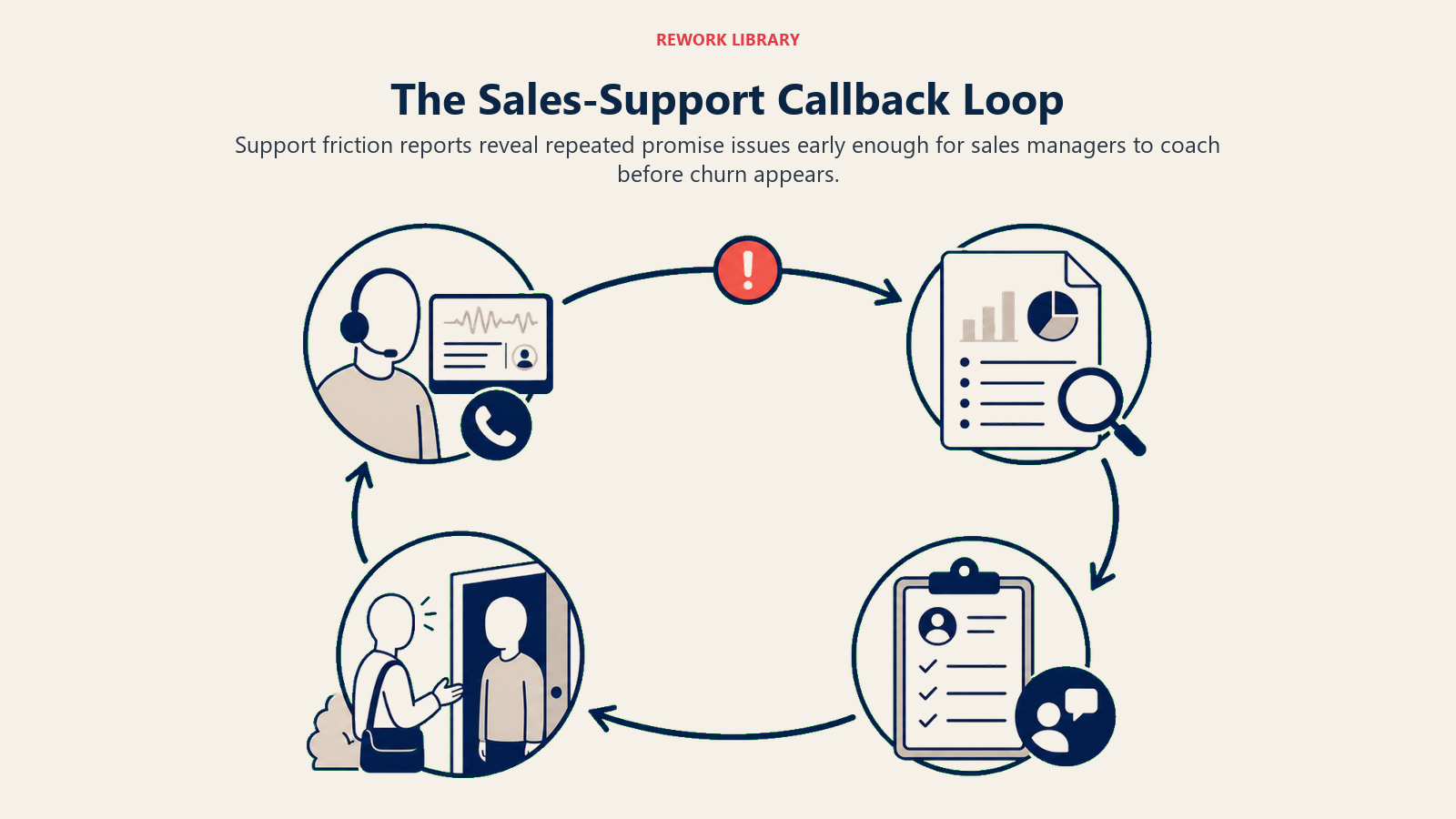
Support teams know things sales managers need to know. They know which zip codes generate the most complaints. They know which rep names show up on angry calls. They know which service promises trigger the most disputes. But that information rarely makes it back to sales leadership in any structured way.
A weekly or bi-weekly friction report from support to sales leadership doesn't have to be complicated. It just answers three questions:
- What were the top three customer complaints this week?
- Which promise-related issues came up more than once?
- Are there any rep names appearing repeatedly in dispute tickets?
Sales managers use this to target coaching. If one rep is generating 40% of the price dispute calls, that rep needs a specific conversation about what they're saying at the door. Without the data loop, managers don't know until the rep's cancellation rate tanks months later.
"Support teams in D2D businesses know which rep names appear repeatedly on angry-call transcripts months before that information surfaces in cancellation data. A bi-weekly friction report from support to sales leadership is a leading indicator that closes the coaching loop before the rep's cancel rate tanks."
This also feeds your D2D sales KPIs and metrics tracking. Cancel rate by rep, broken down by cancel reason, tells you which reps are overpromising before churn becomes obvious.
Handling the "I Was Promised" Call
Support agents need a protocol for handling promise disputes. Without one, they improvise, and improvisation usually means either caving immediately, which costs money, or arguing with the customer, which generates escalations and cancellations.
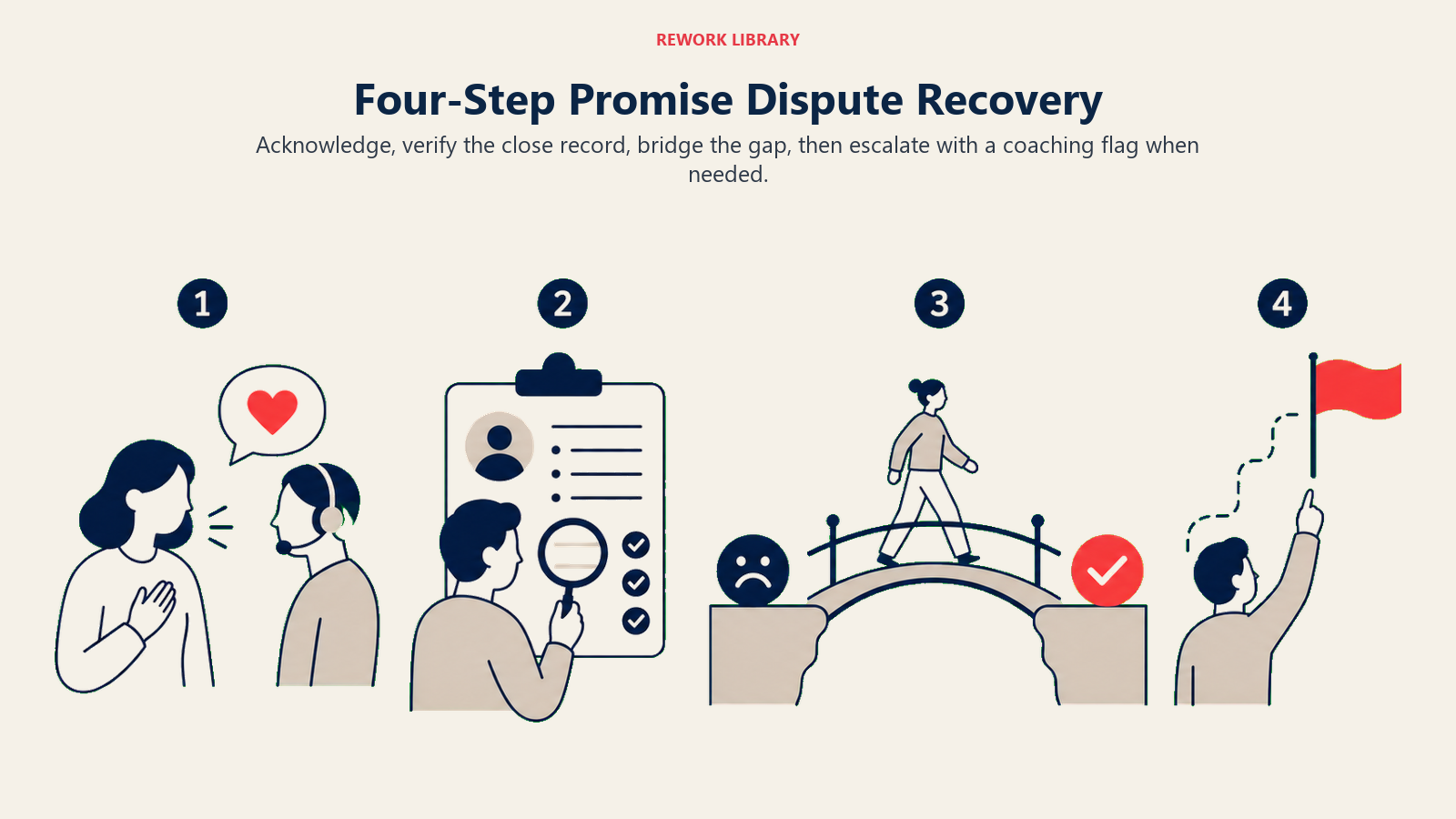
A structured protocol looks like this:
Step 1: Acknowledge without admitting. "I can hear that's frustrating, and I want to make sure we get this right." Don't say "I'm so sorry our rep lied to you" until you've verified anything.
Step 2: Check the CRM notes. Pull the close record. Did the rep log anything? What does the signed agreement say?
Step 3: Match or bridge. If the contract supports the customer's expectation, honor it and confirm it. If there's a discrepancy, bridge rather than fight: "Your agreement shows quarterly service. What I can do is schedule a complimentary check-in visit before your next regular service to make sure everything is covered."
Step 4: Escalate with a rep flag. If the customer's claim can't be resolved and they're frustrated, escalate to a retention specialist. And flag the rep in the system for follow-up.
Step 4 is often skipped. Companies don't want to create a culture where support is reporting on sales. But if you don't track which reps generate disputable accounts, you can't fix the behavior. Call it a quality flag, not a disciplinary flag, and make clear to reps that it's used for coaching.
Joint Training: Getting the Two Teams in a Room
One of the most effective interventions is also one of the simplest: get sales and support in the same room a few times a year. Not for a lecture from management, but for actual exchange.
"When sales reps listen to a single support call per quarter, the most common reaction is surprise. They had no idea the promise they made was creating downstream friction. Empathy between the two teams is not a culture initiative. It is a training outcome."
Support agents present two or three real call transcripts from the quarter. They walk through what the customer expected versus what the contract said. They explain what they had to do to save the account, or what they couldn't do and why.
Sales reps listen and respond. Sometimes they have context support didn't know. Sometimes they realize they've been saying something that creates problems weeks later.
This builds empathy in both directions. Sales reps stop seeing support as the people who "give away discounts." Support agents stop seeing sales reps as people who "leave messes." They start seeing each other as parts of the same revenue cycle.
Tie this to your subscription retention fundamentals work. The best retention programs treat acquisition and retention as two phases of the same process, not separate departments.
Shared Metrics That Actually Create Alignment
Teams align around shared accountability. If sales is measured purely on new accounts and support is measured purely on handle time, they'll optimize for those numbers in isolation. McKinsey's customer success research found that in aligned organizations, sales and customer-success roles share accountability for both revenue and adoption, reinforced by team incentives and joint operating processes, and that SaaS vendors in the top revenue quartile consistently invest more in customer-success initiatives than peers.
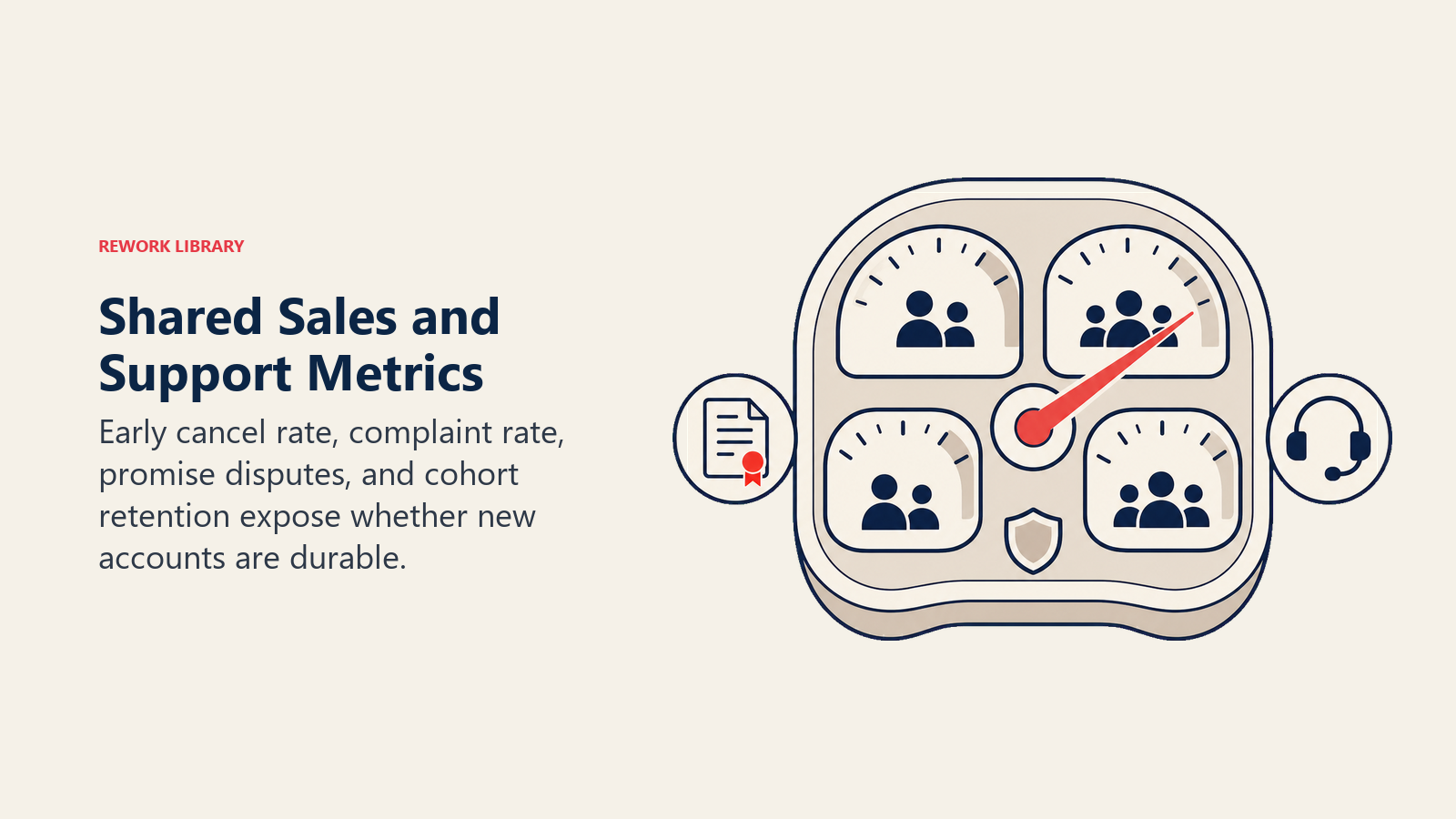
Consider adding these shared metrics to both teams' dashboards:
| Metric | What It Reveals |
|---|---|
| 30/60/90-day cancel rate by rep | Whether sales reps are generating durable accounts |
| Complaint rate per 100 new accounts | Quality of the sales conversation |
| Promise dispute tickets as % of new accounts | Frequency of misaligned expectations |
| Retention rate at 12 months by sales cohort | Long-term durability of a rep's book |
When a sales rep sees their 90-day cancel rate on a shared dashboard alongside their close volume, the conversation changes. And when support leadership can show that certain reps' accounts retain at 85% while others' retain at 60%, the coaching target becomes obvious.
For how to structure these dashboards for rep-level accountability, tracking new accounts, cancel rates, and friction flags in one view makes patterns visible before they become expensive.
When Things Go Wrong: Escalation Without Blame
Even with good systems, disputes happen. A support agent eventually faces a customer who has a real grievance: a rep genuinely overpromised, the contract doesn't reflect what was said, and the customer is considering a chargeback.
Support needs authority to resolve these cases without escalating every one to a manager. A simple resolution authority matrix:
- Support agent: can offer one complimentary service visit (cost: $0, retention value: high)
- Support lead: can offer a one-month credit (cost: controlled, prevents cancellation)
- Retention specialist: can waive an early termination fee in cases of documented misrepresentation (cost: real, but worth it to preserve relationship and avoid refund disputes)
Chargebacks and dispute filings cost more than any of the above. Giving front-line agents modest authority to resolve prevents the escalation spiral.
When a rep's misrepresentation is confirmed, the flag goes to their sales manager for a coaching conversation. It's not a punitive system unless the behavior repeats. It's a feedback loop. And feedback loops, when they work, are how you build a sales culture that doesn't leak subscribers.
How Do You Build a Culture Where Both Teams Win Together?
The long-term goal isn't policies and escalation matrices. It's a culture where sales reps understand that a cancelled account is a loss for everyone, and support agents understand that growth depends on the sales team's ability to close.
You get there by:
- Celebrating retention milestones alongside sales numbers (a rep whose 12-month retention is 80% should be recognized as loudly as a rep who hit quota)
- Including a support team member in sales all-hands meetings occasionally, to share what they're hearing
- Inviting sales reps to listen to one support call per quarter (with customer consent or anonymized recordings)
- Running close rate and retention rate together in reporting, so managers see both sides of the account lifecycle
Support teams can also move from reactive firefighting to proactive outreach well before accounts reach the cancellation point, giving agents something to work with so they're not always responding to damage already done. And the same way a deliberate sequence of touchpoints converts cold prospects, well-run support aligns those touchpoints after the sale so the customer feels cared for at every stage.
The companies that get this right don't just retain more customers. They build a feedback culture where both teams get smarter over time, and where the stories support hears at 90 days change the conversations happening at doors today. That feedback loop is what turns a support ticket into a coaching opportunity instead of a lost account.
Learn More

Senior Implementation Consultant
On this page
- Why Does Sales and Support Conflict Happen?
- The Three Promises That Break Things
- Building a Shared Promise Standard
- Getting Support Into the Sales Data
- The Callback Loop: Making Support Data Useful for Sales
- Handling the "I Was Promised" Call
- Joint Training: Getting the Two Teams in a Room
- Shared Metrics That Actually Create Alignment
- When Things Go Wrong: Escalation Without Blame
- How Do You Build a Culture Where Both Teams Win Together?
- Learn More