Sales and Billing Alignment for Door-to-Door Subscription Services
Turn this article into takeaways for your work.


Each assistant summarizes the article only for you and suggests best practices for your work.
The call came into a fiber internet company's billing department on a Tuesday morning. The customer was furious. Their bill was higher than they expected. They weren't going to pay it. And they were filing a dispute with their bank.
The rep who sold the account had quoted a lower promotional rate, then explained the rate would increase after the first year. But in the customer relationship management system (CRM), the rep had entered the promotional rate as the permanent monthly charge, with no note about the increase. Billing charged correctly per the contract. The customer heard the lower number as permanent. The contract said otherwise.
The outcome: a billing dispute, a customer threatening to cancel, and a billing agent on the phone for 45 minutes trying to reconstruct what was said weeks earlier at a door.
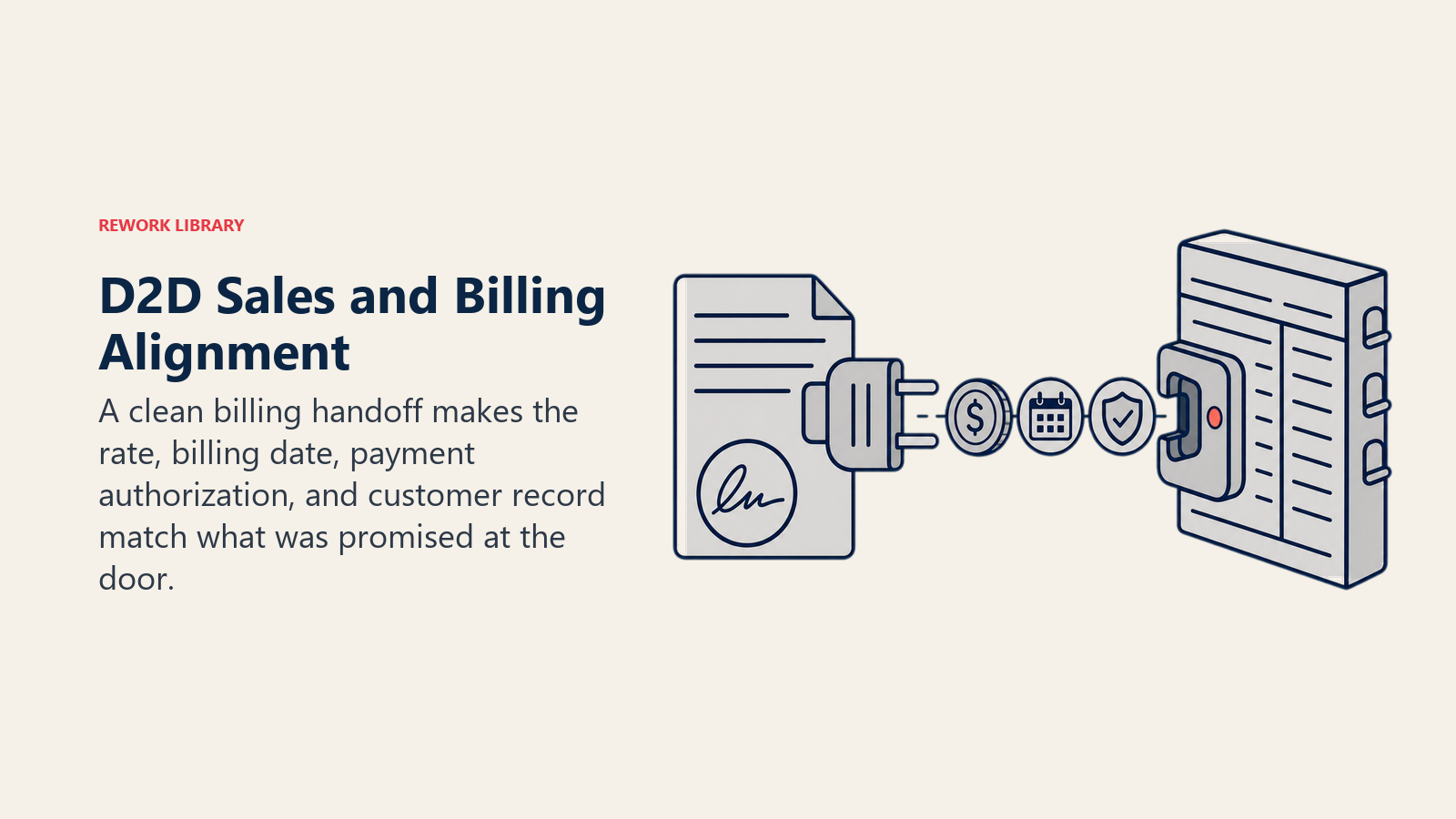
This is the billing alignment problem in recurring door-to-door services. It's not about billing errors or collections incompetence. It's about what happens when the expectation set at the door doesn't match what shows up in the system.
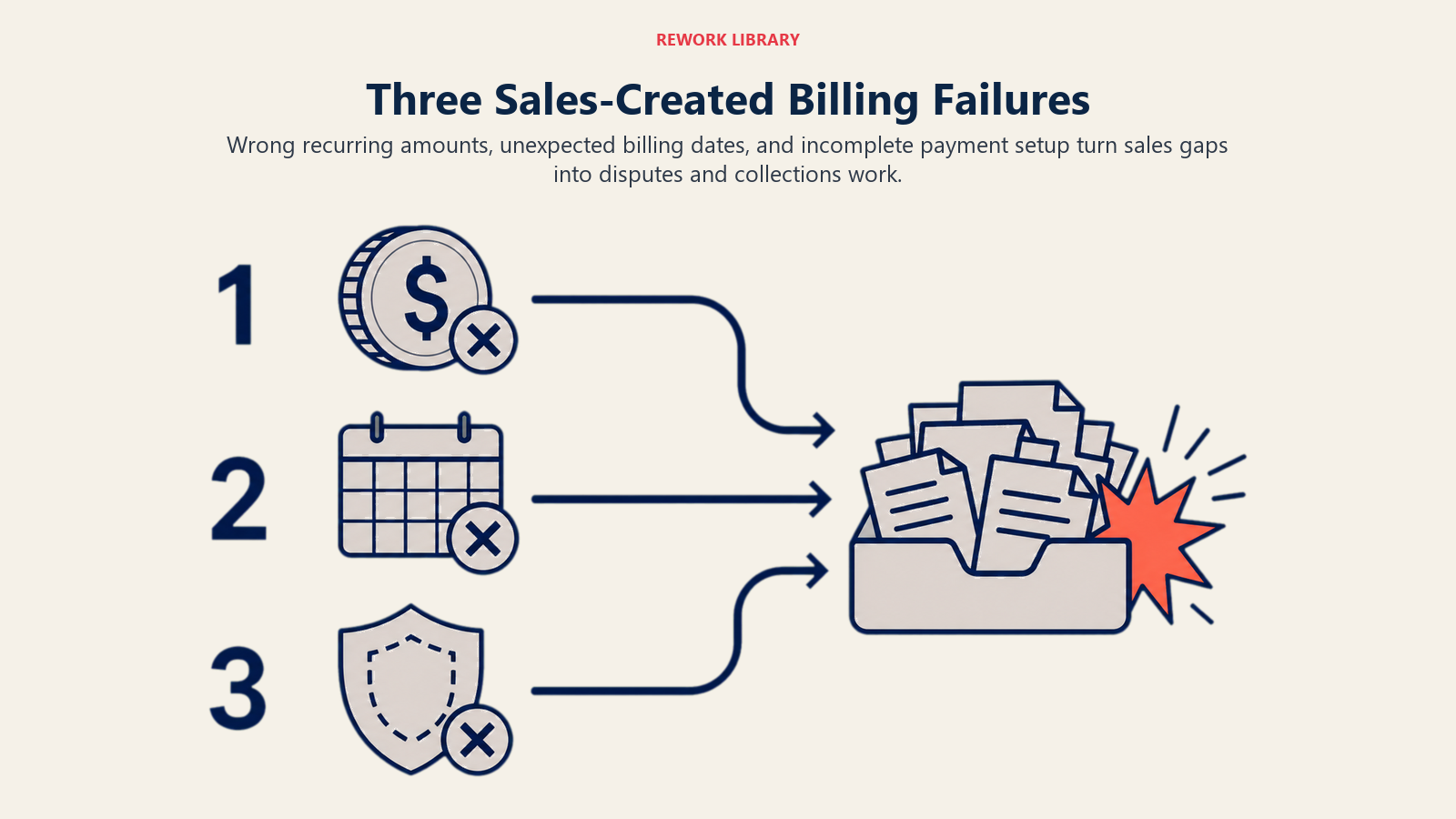
What Are the Three Ways Sales Creates Billing Problems?
Billing and collections teams in D2D subscription businesses deal with a handful of recurring issues. Almost all of them trace back to something that happened, or failed to happen, at the close.
Key Facts: D2D Billing Alignment
- Federal consumer protection rules require companies to obtain explicit written authorization before initiating automatic debits, and to give customers advance notice of the charge amount, frequency, and date. (Consumer Financial Protection Bureau (CFPB), 2023)
- Customers have 60 days from the statement date to dispute an unauthorized or incorrect automatic charge under federal rules; after that window closes, the dispute right typically lapses. (CFPB consumer guide)
- Research on subscription commerce found that involuntary churn from failed payments accounts for roughly 20% to 40% of total subscription cancellations in recurring-service businesses. (Planning benchmark based on subscription industry reporting; verify with your own cohort data)
Wrong billing amount in the CRM. Reps sometimes enter the promotional rate, the first-month rate, or a miscalculated rate instead of the recurring rate. Billing charges what's in the system. The customer disputes what they were told. The gap is almost never documented.
Wrong billing date expectations. A customer signs on the 17th. They assume billing starts the next month. The contract actually pro-rates and bills within days. The charge shows up at an unexpected time and the customer assumes it's an error. They dispute it, especially if they don't remember signing an authorization for recurring billing.
Payment method confusion. Reps sometimes accept verbal or informal payment commitments at the door ("we'll send you a form and you add your card details"). The payment setup step doesn't happen before the first billing cycle. The account bills with no valid payment on file, the charge fails, and collections chases the customer from day one.
Each of these is a sales process failure that billing has to absorb. The billing team didn't create the problem, but they spend disproportionate time resolving it.
Quotable Nuggets "When reps skip the billing conversation at the close, billing teams absorb the cost in dispute resolution time, typically 30 to 60 minutes per account for a billing expectation mismatch that a 90-second door conversation would have prevented. (Operational estimate based on D2D subscription billing practices)"
"Federal rules give customers 60 days to dispute an automatic charge they believe was unauthorized. The shorter the gap between a soft payment failure and your outbound contact, the lower the chance it escalates into a formal dispute. (CFPB)"
"Exception tracking by rep (logging every billing override tied to the rep who sold the account) is one of the most reliable early signals that a rep is overpromising at the door, since overpromises rarely appear in close rate data alone."
The Five-Point Billing Close Framework: A standardized five-step billing conversation embedded in the sales close that covers (1) exact recurring charge with taxes, (2) billing date and cycle, (3) payment method confirmation, (4) failed-payment process, and (5) how to update payment details. Every step is completed before leaving the door. This framework turns billing alignment from an afterthought into a close checkpoint.
Aligning on the Billing Conversation at the Door
The most effective intervention happens before the customer signs. Reps need a standardized billing conversation as part of the close, not as an afterthought.
A complete billing close covers five things:
- The exact recurring charge amount including taxes and fees, stated clearly in numbers: "Your monthly charge will be $79.99 including all fees."
- The billing date or billing cycle, explained before the customer provides payment: "Your first charge will be on [date], and then on the same date each month."
- The payment method being enrolled, confirmed as the customer enters it: "You're setting up auto-pay with the Visa ending in 4412?"
- What happens if a payment fails: "If a charge doesn't go through, you'll get an automated notification and we'll retry in three days."
- How to update payment information: "You can update your payment method online at [URL] or call our billing line."
This conversation takes about 90 seconds. Most reps skip it because they're focused on getting the signature and moving to the next door. But skipping it costs the billing team hours of recovery work per account.
Build this into your door approach and close process as a non-negotiable close checkpoint, not an optional explanation.
The Payment Setup Problem
Failed first payments are a specific category of billing problem that creates a cascade of bad outcomes. When an account bills for the first time and the payment fails, you have:
- A service that may have already been delivered
- A customer who may not understand why their card was declined
- A collections team chasing money before the customer relationship has even fully formed
- A high risk that the customer will cancel rather than resolve the payment issue
Most failed first payments happen because payment setup was rushed, incomplete, or deferred during the sale.
Rushed setup: The rep was in a hurry, the customer typed their card number quickly, a digit was wrong. The rep moved on without confirming the payment was successfully saved.
Incomplete setup: The app showed a "payment added" confirmation but didn't actually validate the card. The billing team discovers the issue at first charge.
Deferred setup: Customers are told to "set up payment online later." Many don't. The account exists with no valid payment method on file.
The CFPB requires companies to obtain explicit consumer authorization before initiating automatic debits, and to provide customers with written documentation of the amount, frequency, and timing of the payments. That standard makes "set it up later" an operational and compliance gap simultaneously.
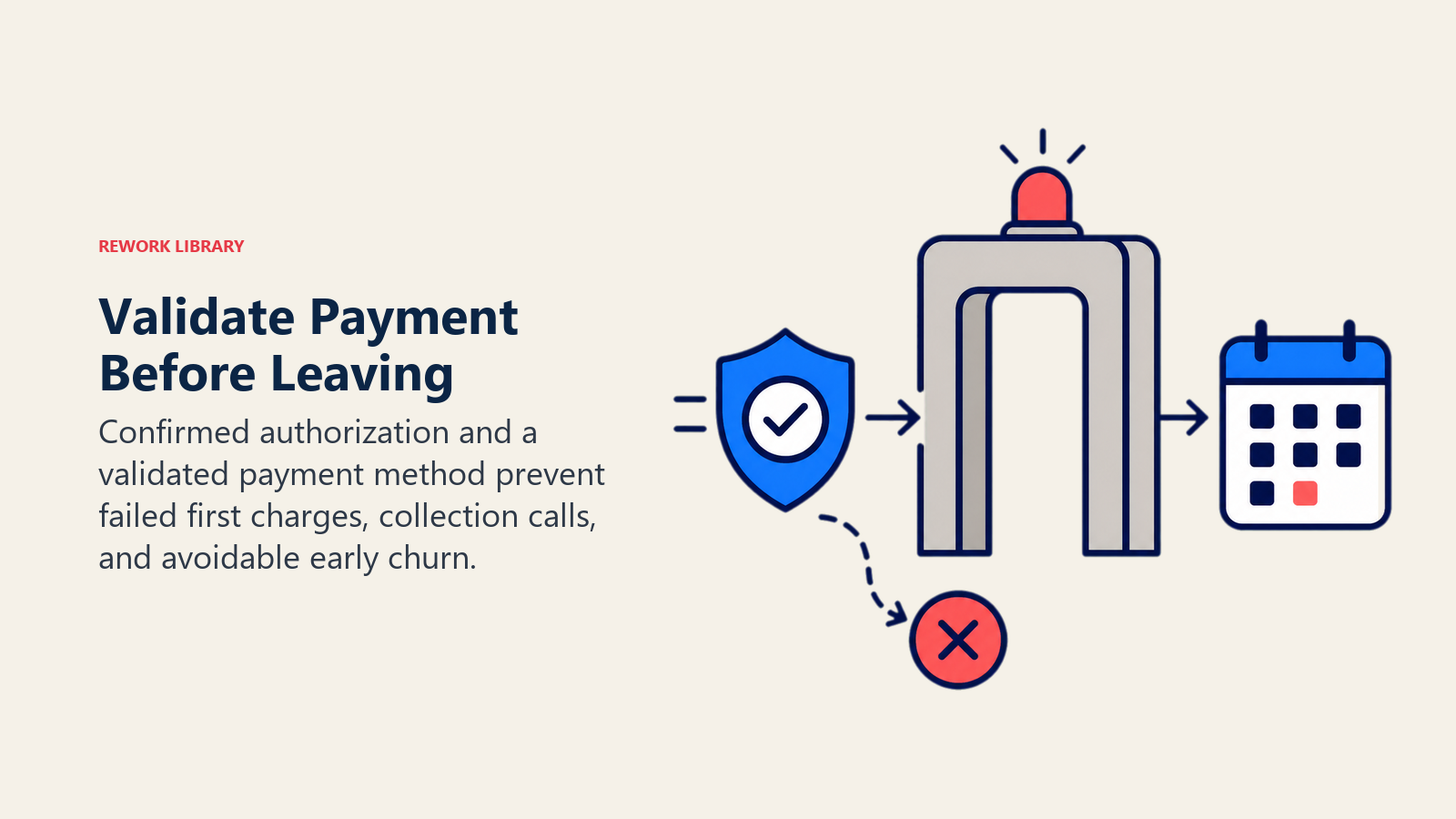
The fix for all three is requiring confirmed, validated payment before leaving the door. If your current system doesn't validate card numbers in real time, that's a system problem worth solving. A rep should see a green confirmation before leaving a new account.
Connect payment validation to the sale to service start handoff checklist. Payment method confirmed and valid should be a required field before the account moves to scheduled status.
Communicating Rate Changes and Price Increases
Recurring D2D service contracts almost universally allow for annual price increases. Pest control, security, lawn care, and fiber providers all use them. But the way reps explain this at the door varies enormously, and that variation creates billing disputes months or years later.
Some reps explain it clearly: "Your rate will stay at $59 for the first year, then increase to $79 from month 13 forward. That's in your agreement on page two." Other reps gloss over it or skip it entirely.
The customer who was never told about the increase receives an invoice for $79 in month 13 and calls billing to dispute a "billing error." Billing sees a valid rate increase per the contract. The customer sees a company charging them more than they agreed to.
This dispute is almost always the rep's fault, but billing has to resolve it. And the resolution options are all bad: eat the increase (sets a precedent), lose the customer (wastes the acquisition cost), or have an ugly argument about what was said at the door 13 months ago.
Build rate change disclosure into your close script as a mandatory step. Require reps to initial an acknowledgment in the contract that the rate change was explained. Some companies have the customer initial a specific line in the agreement that says "I understand my rate may increase annually per Section X." This is both good practice and useful protection if disputes arise.
Your pricing and contract presentation training should cover how to explain rate changes in a way that doesn't kill the close but does set honest expectations.
Why Should Sales Managers Have Billing Visibility?
Sales managers in D2D companies monitor close rate, pipeline activity, and territory coverage. Most of them have almost no visibility into what happens to their accounts in the billing system after the close.
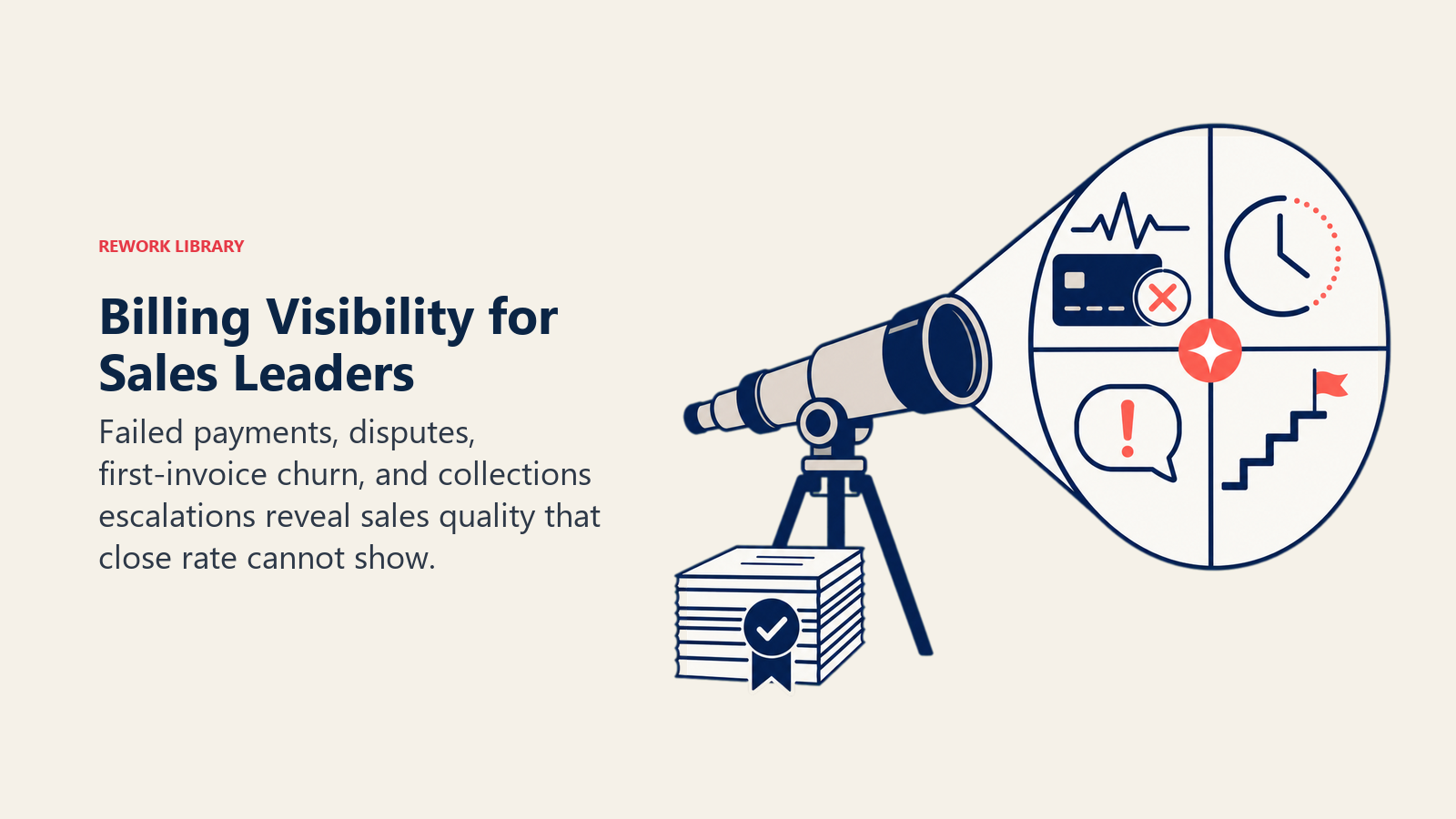
That's a problem, because billing data reveals things about sales quality that close rate doesn't.
| Billing Metric | What It Tells Sales Leadership |
|---|---|
| Failed first payment rate by rep | Which reps are rushing payment setup or creating billing setup errors |
| Days to first payment by cohort | Whether new accounts are billing on schedule or stalling |
| Dispute rate by rep | Which reps are creating billing expectation mismatches |
| Churn at first invoice by territory | Whether certain areas have higher price shock response |
| Collections escalation rate by sales cohort | Which rep cohorts generate accounts that become collection problems |
None of these require the sales manager to manage billing. They just need visibility into the data. A weekly or monthly report from billing to sales leadership covering these five metrics creates accountability without micromanagement.
This also connects to D2D sales KPIs and metrics. A rep's performance scorecard shouldn't end at the close. Including a 90-day billing health metric, the percentage of accounts billing successfully at 90 days, ties compensation and recognition to account quality, not just account volume.
Collections Protocols That Don't Destroy Retention
When an account falls into collections or payment delinquency, how it's handled matters for retention. A customer whose card declined because it expired has a very different relationship with your company than a customer who is intentionally not paying.
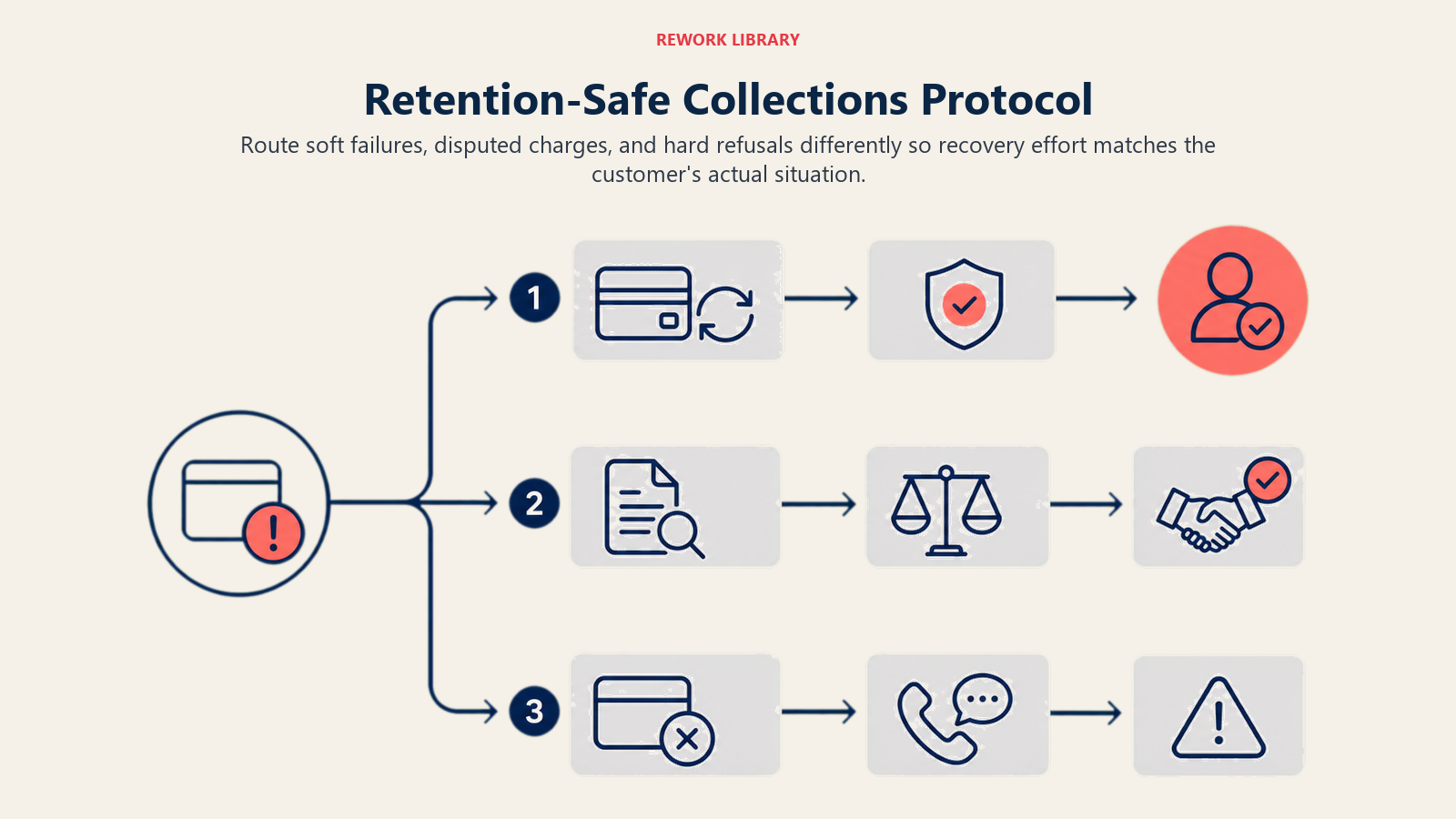
The difference in how you treat them should be significant.
Soft fail, meaning a card expired, was updated, or the bank changed: Automated notification first. Friendly outbound call second. The framing is "we want to make sure your service isn't interrupted" not "you owe us money." Most customers with soft failures resolve it on the first contact. These aren't collection problems. They're administrative ones. The faster you reach a customer about a soft fail, the less likely they are to escalate it into a formal dispute.
Disputed charge, where the customer believes they were overcharged: Billing takes the call and reviews the account history. If there was a misrepresentation at the door, the escalation goes to the relevant sales manager with a documentation request. If the charge is correct and the customer simply forgot, a clear explanation with contract reference usually resolves it.
Hard fail, where the customer is refusing to pay: This is the true collections scenario. Before escalating to a collections agency, a retention specialist should have the account for one last contact. The goal is to understand why. If there's a service quality issue, service recovery might resolve the non-payment. If the customer genuinely wants to cancel and leave, processing that cleanly is better than an account in collections, which is expensive and rarely recovers more than pennies.
The churn prevention strategy and collections protocol should share a playbook for accounts in delinquency. Some customers who stop paying are actually attempting to cancel and don't know how. Meeting them there and offering a clean exit often preserves the relationship better than sending them to collections.
Understanding retention fundamentals also helps here. The same principles that keep healthy subscribers engaged apply to recovering at-risk ones before they hit a hard fail state.
What to Do When Reps Overpromise on Billing
At some point, a customer will have a legitimate billing dispute because a rep genuinely promised them something the billing system doesn't support. It happens. Reps are under pressure to close. They say things.
When this is confirmed, the company has a choice. Honor the promise and document it as an exception. Apologize and offer a reasonable compromise. Or hold the line and risk losing the customer.
Most companies should honor the promise for the current term when the rep's representation is documented or credible. Then two things need to happen:
The exception is tracked. Billing logs it with the rep's name and the nature of the override. Too many exceptions from the same rep signals a pattern, not a one-off.
The coaching conversation happens. The sales manager and the rep talk specifically about what was said and why it's a problem. Not punitive on a first offense, but explicit. "You promised a price lock. We honored it this time. If you promise something outside the standard terms again, we'll need to revisit your commission on that account."
Over time, exception tracking by rep becomes one of the most useful signals for identifying reps who are overpromising to close. It's much harder to see in close rate data alone.
Creating a Billing FAQ for Reps
One practical tool that's often missing: a billing FAQ written for sales reps, not customers.
Reps get questions at the door that they answer from memory. Memory is unreliable and inconsistent. A written FAQ they can reference in their canvassing app or rep portal reduces improvisation.
A billing FAQ for reps should cover:
- "When will I be charged?" (billing cycle explanation, how proration works)
- "Can I choose my billing date?" (yes or no, and how)
- "What payment methods do you accept?" (cards, ACH, what's excluded)
- "What happens if my payment fails?" (retry schedule, service suspension policy)
- "Can I pay annually and save?" (if applicable)
- "What if I need to update my payment info?" (steps and where)
- "Can I get a paper bill?" (if applicable)
Reps who have accurate answers to these questions at the door don't generate billing disputes from information gaps. They also close faster because hesitant customers get answers on the spot rather than being told "billing can explain that."
Connect this to the canvassing fundamentals and knock training process. Billing literacy should be part of rep onboarding, not something reps figure out after their first customer dispute.
Aligning Incentives Across the Boundary
The deepest alignment issue between sales and billing is incentive structure. Sales reps earn their commission at close. After that, the account is someone else's problem. There's no built-in reason for a rep to care whether the billing goes smoothly.
A few compensation adjustments can change that:
Clawback on failed first payments. If an account doesn't successfully bill in the first 60 days, a portion of the commission is held back. This makes reps care about payment setup completeness.
Quality bonus on 90-day billing health. A small bonus per batch of accounts that are all billing successfully at 90 days rewards reps for creating durable accounts, not just signed ones.
No commission on disputed accounts until resolved. If a billing dispute is pending, the commission is pending. Reps who want their money have an incentive to help resolve the dispute, often by confirming what was actually said at the door.
None of these are punitive by design. They're alignment mechanisms. When a rep's paycheck is tied to whether their accounts are actually billing, they start having better billing conversations at the door. And billing teams stop spending their day cleaning up sales process gaps.
The goal is a sales team that thinks of a closed account as the beginning of the customer relationship, not the end of their job. When billing and collections flow cleanly from what was set up at the door, everyone wins: the customer knows what to expect, billing isn't chasing money, and the subscription revenue the whole D2D recurring revenue model depends on actually comes in.
Learn more: Retention fundamentals covers the principles behind recovering at-risk subscribers. D2D sales KPIs and metrics walks through how a 90-day billing health metric fits into a rep's broader scorecard.

Senior Implementation Consultant
On this page
- What Are the Three Ways Sales Creates Billing Problems?
- Aligning on the Billing Conversation at the Door
- The Payment Setup Problem
- Communicating Rate Changes and Price Increases
- Why Should Sales Managers Have Billing Visibility?
- Collections Protocols That Don't Destroy Retention
- What to Do When Reps Overpromise on Billing
- Creating a Billing FAQ for Reps
- Aligning Incentives Across the Boundary