Territory Design and Assignment for Door-to-Door Home Services Sales
Turn this article into takeaways for your work.


Each assistant summarizes the article only for you and suggests best practices for your work.
Most D2D sales managers think they have a rep performance problem when they actually have a territory design problem. A rep working a low-density suburban sprawl with long drives between neighborhoods will always underperform a rep working a tight, walkable grid of qualified homes, even if the first rep is objectively more talented. Territory design is that powerful.
In home services door-to-door sales, where recurring subscription revenue depends on efficiently building dense clusters of service customers, territory design isn't a map-drawing exercise. It's a revenue architecture decision.
This article covers how to design territories that maximize productive door time, how to assign those territories fairly, and how to keep your zone map current as your customer base grows.
What Makes a Good D2D Territory
A good door-to-door territory has three properties: enough qualified homes to sustain a full day of knocking, enough physical density to minimize walking and driving time between doors, and enough demographic fit to make the conversation worth having.
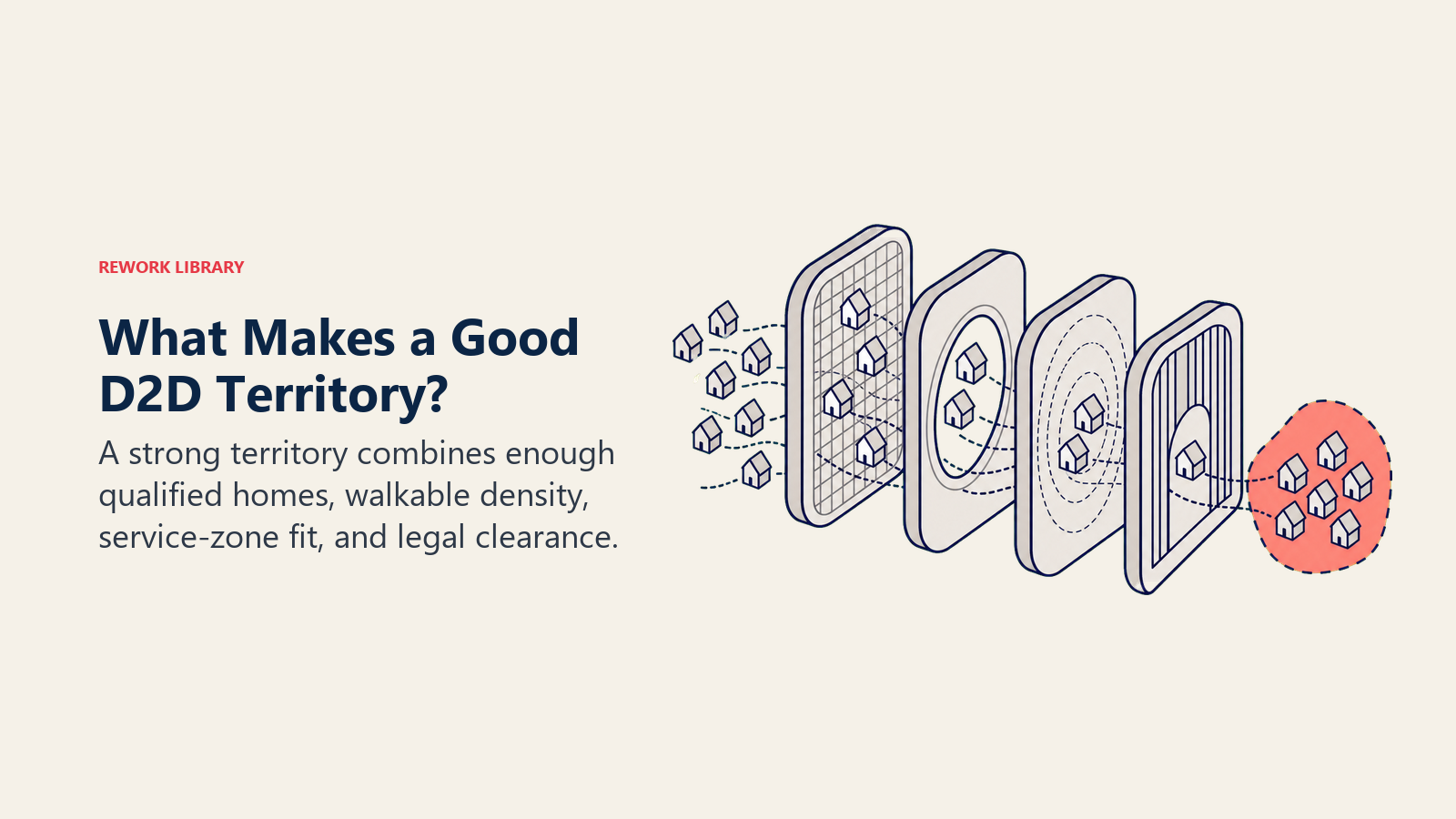
Density: The single biggest driver of rep productivity is how many doors they can knock per hour. A territory where homes are 100 feet apart on a grid street produces four to five times the door count of a rural territory where each address is a quarter mile from the next. Before you draw any territory, run a density map of residential addresses in your target area. Most canvassing apps let you overlay this data.
Qualification fit: Density is meaningless if the households aren't prospects. For a lawn care subscription, dense apartment complexes are a waste of time. For a home security or pest control service, homeowners with established homes are the target. Your territory design needs to filter for the property type and demographic profile that matches your product. The same attributes that predict lead quality in inside sales, income band, homeownership, tenure in residence, can rank-order blocks before you deploy a single rep.
Service coverage alignment: In recurring subscription models, the territory your reps sell into should align with your service delivery zones. Nothing kills a subscription faster than long-distance service routes that make scheduling a nightmare. Work with your operations team to confirm service reach before finalizing territory boundaries.
Legal clearance: A territory that looks great on a density map might be off-limits due to local permit requirements, Do-Not-Knock registries, or green-river ordinances. Territory design must always include a compliance review before any rep touches it. Federal rules add another layer: the FTC's Cooling-Off Rule requires door-to-door sellers to give buyers a three-business-day cancellation right on sales of $25 or more, and sellers must provide two written cancellation notices at the time of the sale. Getting this wrong in any territory is a legal liability, not just a rep training gap. Legal and licensing compliance for D2D covers the full checklist.
Key Facts
- The U.S. homeownership rate sits at approximately 65.3% nationally (Q1 2026), but suburban census tracts run closer to 73% owner-occupied while dense urban cores can drop below 50%, making tract-level filtering essential for D2D territory targeting. (U.S. Census Bureau, Housing Vacancies and Homeownership, Q1 2026)
- Only 35% of field sales teams have more than 70% of their reps consistently hitting quota, a gap that territory design directly affects: a rep working a low-density zone with long drive times between doors will underperform a rep in a tight residential grid even if they're more skilled. (SPOTIO State of Field Sales 2026)
- The FTC Cooling-Off Rule (16 CFR Part 429) requires door-to-door sellers to provide written cancellation notice on sales of $25 or more. Territory clearance must confirm no legal barriers exist before a rep touches a door. (FTC)
Knowing what makes a territory good is only half the job. You still need a method for actually drawing the lines.
The Four Territory Design Methods
There's no single right way to design D2D territories. The best method depends on your company size, your market density, and how much data you have on your existing customer base.
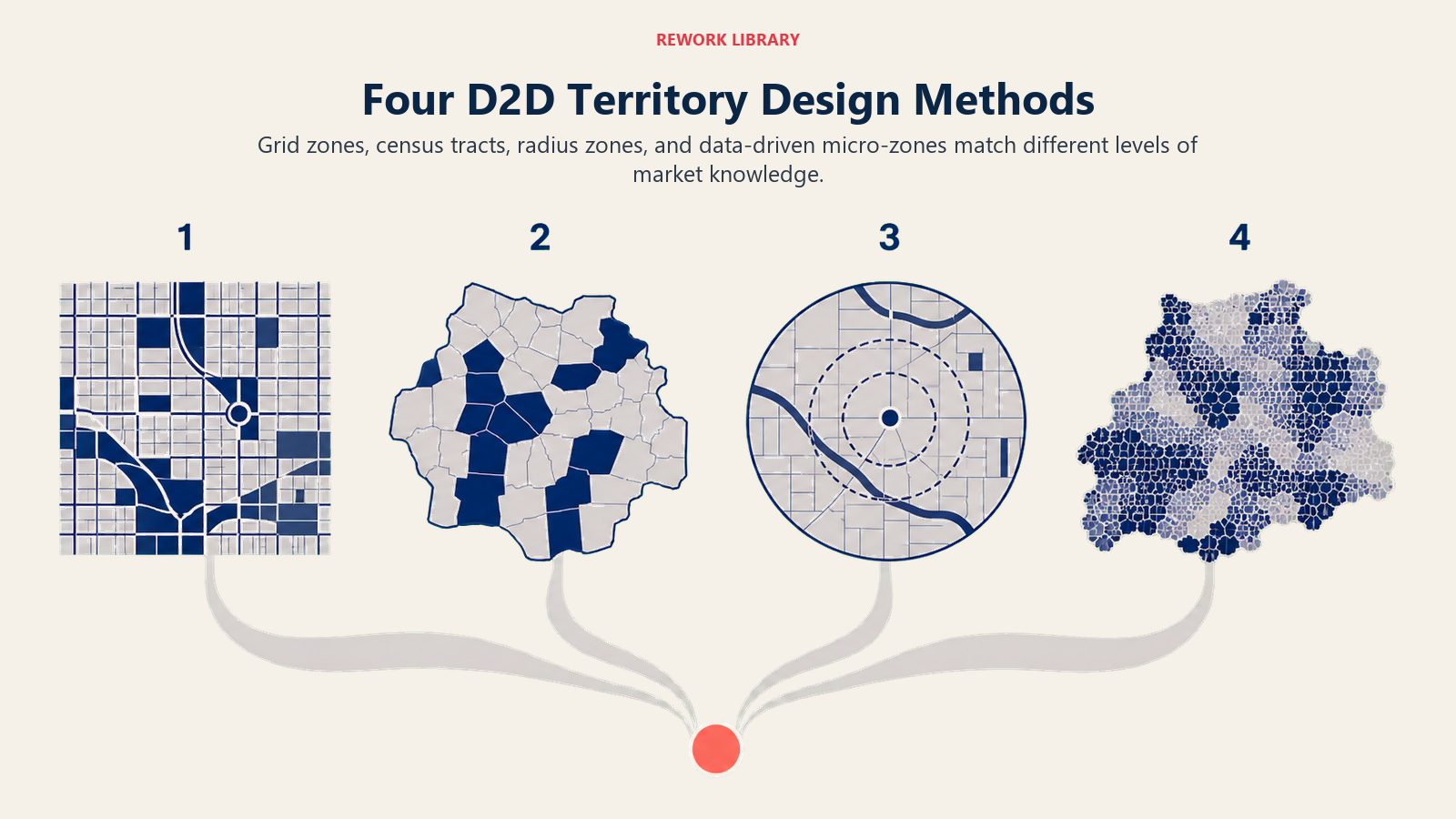
Method 1: Grid-Based Zones
Draw territories on a street grid, using major roads as natural boundaries. Reps work all streets within a defined grid square before moving to the next.
Best for: New markets where you have limited conversion data. Grid zones are easy to explain, easy to assign, and easy to audit for coverage.
Drawback: Grid squares can vary significantly in quality. A square that includes a park, a commercial strip, and two apartment complexes has far fewer qualifying homes than a square that's pure single-family residential.
Method 2: Census Tract or ZIP Code Zones
Use census boundaries or ZIP codes as your territory unit. Census tracts are especially useful because they come with demographic data (income, homeownership rates, household size) that you can filter against your customer profile.
Best for: Companies with a clear demographic target. A pest control company targeting homeowners with household incomes above $75,000 can use census income and homeownership data to rank-order tracts before assigning them. The U.S. Census Bureau's Housing Vacancies and Homeownership survey shows the national homeownership rate sits around 65%, but that figure masks wide local variation: suburban areas run closer to 73% owner-occupied versus under 50% in dense urban cores, so tract-level filtering matters more than metro-level averages.
Drawback: Census tracts and ZIPs don't follow walkable street patterns. A tract boundary might cut across the middle of a neighborhood, leaving your rep confused about which side of the street they own.
Method 3: Radius Zones
Center each territory on a high-value neighborhood or anchor address, then draw a radius outward to create a circular territory. The rep works the anchor neighborhood first, then spirals outward.
Best for: Targeting specific communities or developments where you know the product fit is strong.
Drawback: Radius zones overlap badly when you have multiple reps in the same market. Without careful management, two reps end up at the same door within hours of each other.
Method 4: Data-Driven Micro-Zones
Use your existing customer and conversion data to build a predictive model: which block-level attributes (homeownership rate, home age, income range, competitor service density) predict conversion? Then assign territories that score highest on your model.
Best for: Mature operations with at least six to twelve months of conversion history. This method produces the highest ROI but requires data infrastructure to execute.
The practical path for most companies: Start with grid or census zones, overlay your conversion data as it accumulates, and progressively refine toward data-driven micro-zones as your sample size grows.
The Grid-to-Data Territory Maturity Model: the four-stage territory design progression that matches method complexity to organizational readiness. Stage 1 (Grid Zones) works for new markets with limited conversion history. Stage 2 (Census Tract Zones) adds demographic filtering as a company identifies its target customer profile. Stage 3 (Radius Zones) layers in known high-value communities as the customer base grows. Stage 4 (Data-Driven Micro-Zones) applies block-level conversion prediction once enough historical data exists to train a model. Most companies operate between stages 1 and 2 and mistake their current method for the best available one. The model's value is in giving operators a clear upgrade path rather than a permanent answer.
Territory Sizing: How Many Doors Per Rep
Sizing a territory correctly is as important as drawing it correctly. A territory that's too large gives reps an excuse to cherry-pick easy neighborhoods and skip the rest. A territory that's too small gets saturated quickly, creating diminishing returns and rep frustration.
Standard sizing benchmarks:
| Market type | Homes per territory | Expected daily door count | Typical tenure before rotation |
|---|---|---|---|
| Dense urban / suburban | 800 to 1,200 | 80 to 120 doors/day | 4 to 6 weeks |
| Standard suburban | 1,200 to 1,800 | 60 to 90 doors/day | 6 to 10 weeks |
| Mixed suburban/rural | 1,800 to 2,500 | 40 to 70 doors/day | 8 to 14 weeks |
"Doors per day" reflects actual knock attempts, not addresses passed. Weather, time of day, and conversation length all affect it. Build your productivity targets around what your D2D sales KPIs and metrics tell you about historical performance, not what sounds reasonable on paper.
The recurring subscription model changes territory sizing calculus in one important way: as you close subscribers within a territory, those homes come off the knocking list (existing customers, not prospects) but add referral potential. Track net available doors, not just total addresses, when deciding when to rotate a rep to a fresh zone.
Assigning Territories to Reps
Territory assignment is as much a people decision as it is a logistics decision. How you assign territories affects rep motivation, competition dynamics, and retention.
Three common assignment models:
Fixed assignment: Each rep owns a specific territory for a defined period (typically four to ten weeks). They're responsible for full penetration of that zone before moving on.
Advantages: Reps build neighborhood familiarity, can return to previous knocks at different times, and develop a sense of ownership. Better for subscription products where a second or third visit often closes the deal.
Rotational assignment: Territories are assigned weekly or by campaign, with reps rotating through zones in a structured sequence. No rep owns a zone long-term.
Advantages: Prevents cherry-picking, gives every rep exposure to both good and difficult zones. Better for fairness in compensation when territory quality varies significantly.
Choice-based assignment: High performers get first pick of available territories as a performance incentive.
Advantages: Powerful motivator for competitive reps. Disadvantage: concentrates your best reps in the best zones, potentially leaving weaker zones under-covered. Works best when territory quality differences are modest.
What most growing D2D companies do: A combination of fixed primary territories with rotational supplements. Reps have a home zone they're responsible for, but on slow days or in the back half of a zone's lifecycle, they can work secondary territories from a shared pool.
For seasonal and summer sales programs with large temporary teams, rotational assignment is almost always the right model because you don't have the management bandwidth for fixed-zone accountability at scale.
Managing Territory Conflicts
Rep conflicts over territory are a leading cause of team culture problems in D2D operations. They're also entirely preventable with clear rules.
Common conflict scenarios:
- Two reps knock the same address on the same day
- A rep works outside their assigned boundary to poach a lead from a neighbor they saw getting a quote
- A seasonal rep gets assigned a territory that a year-round rep considers "theirs"
Resolution framework:
Define "ownership" clearly in your territory policy. Who gets credit for a sale that occurs at an address on the boundary between two zones? What happens when a homeowner calls in from a rep's zone but was previously visited by a different rep?
Most companies use a "first-registered contact" rule: the first rep to log a door attempt in your CRM system owns that address for the duration of that canvassing cycle. This creates a clear, auditable rule that removes judgment from conflict resolution.
Your D2D CRM and canvassing app needs to enforce this at the data level, not just as a policy. If reps can't see that an address is already registered to another rep in real time, the rule can't work.
How Do You Know When to Retire a Territory?
Territories don't stay productive forever. As conversion rates drop and the density of existing customers (who you can't re-sell to) rises, a zone's value declines. Knowing when to retire a territory and move reps on is a key management skill.
Signals that a territory is past its peak:
- Contact rate (doors opened) dropping below 40%
- Same-visit close rate falling more than 15 percentage points from peak
- Rep is knocking the same addresses for the third time in a cycle
- Subscriber density in the zone exceeds 20 to 25% of qualifying homes (creates saturation effects where new prospects have seen too many of your customers and are either already sold or actively avoiding your reps)
When a zone hits end-of-life, it doesn't become worthless. High-subscriber zones are excellent for referral generation from existing subscribers. Your reps' final role in a saturated zone is often to run structured referral campaigns through existing customers, not to cold-knock new prospects.
Building a Territory Map That Stays Current
Territory maps go stale fast. New developments open, permit restrictions change, and your subscriber density shifts block by block. A static territory map drawn at the start of a season is out of date by week four.
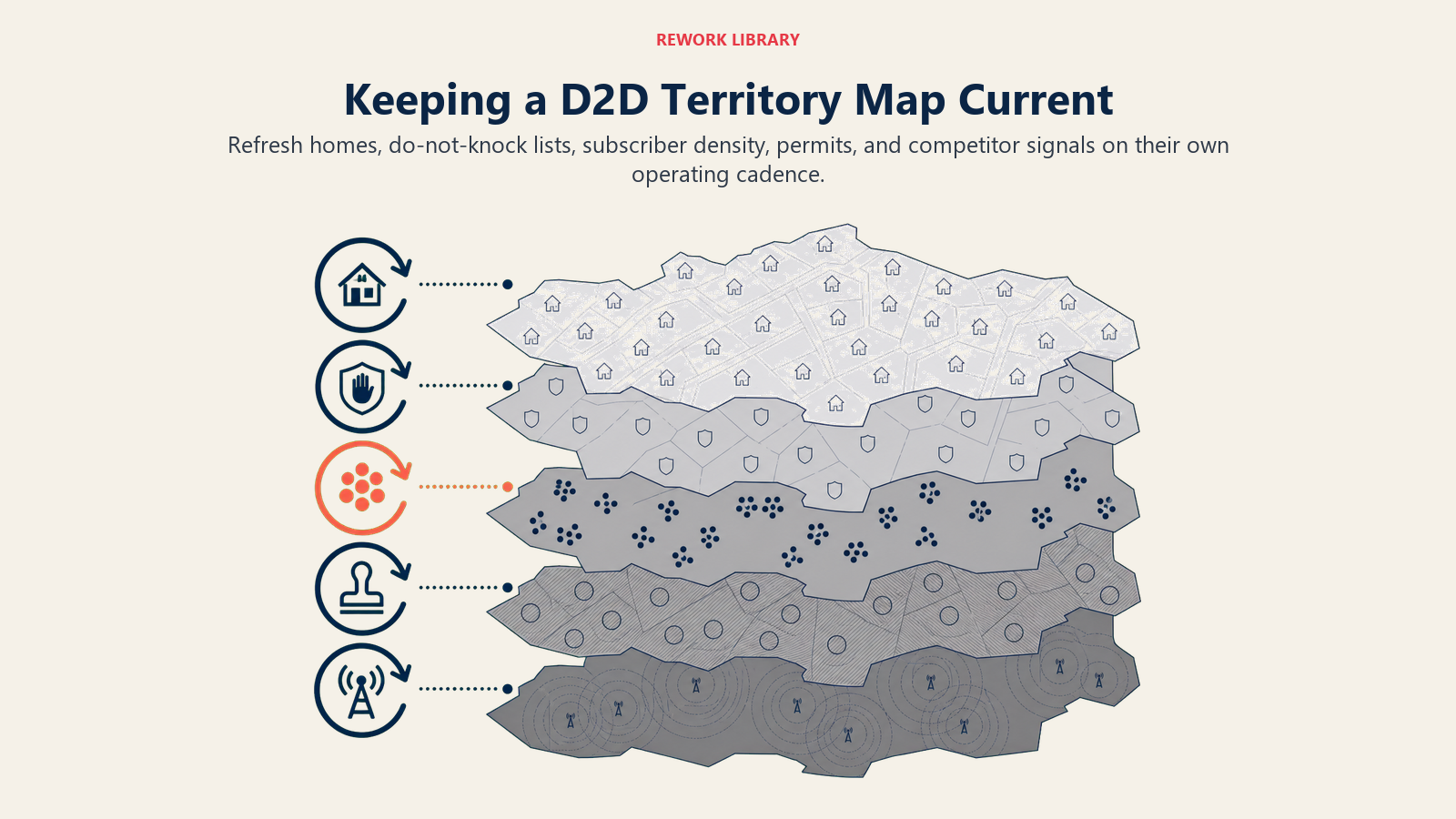
What to update and when:
| Data layer | Update frequency | Source |
|---|---|---|
| Available homes (new builds, demolitions) | Quarterly | County assessor records or GIS data |
| DNK registry (Do-Not-Knock) | Before each deployment | Municipal DNK portal |
| Subscriber density by block | Weekly | CRM/canvassing app export |
| Permit status by city | Monthly | Compliance calendar |
| Competitor conversion data | Ongoing | Rep field reports |
Treat your territory map as a living document, not a map you draw once at the start of a season. The territory knock analytics article covers the metrics framework for tracking territory health over time.
On the closing side, reps working high-density zones often face homeowners who've already been approached by competitors. Assumptive close techniques are especially effective in these situations, where the prospect has already thought about the category and hesitation is about commitment rather than awareness.
Learn more:
- Lead scoring systems (lead management library)
- Sales and service operations alignment
- Seasonal and summer sales programs
- Referral generation from existing subscribers
- Route and time management
- Weather, timing, and density planning
- Assumptive close (deal-closing library)
Quotable Nuggets
"Many D2D teams assign territories and assume coverage. When managers pull canvassing app data, they often find reps missed 30-50% of assigned addresses. Territory design that looks good on a map is only effective if you can verify it was actually worked."
"When a zone exceeds 20-25% subscriber density among qualifying homes, you start seeing saturation effects: new prospects have seen too many of your customers and are either already sold or actively avoiding your reps. That's the signal to shift from cold knocking to referral campaigns."
Frequently Asked Questions about Territory Design and Assignment for Door-to-Door Home Services Sales
What is a D2D territory and how is it defined?
A territory is a defined geographic area containing a set of residential addresses that a rep or team is responsible for canvassing during a given assignment period. Good territories have three properties: enough qualified homes to fill a full day of knocking, enough physical density to minimize transit time between doors, and a demographic profile that matches the product's target buyer.
How many homes should a D2D territory contain?
It depends on market density. Dense urban and suburban territories typically run 800 to 1,200 homes, producing 80-120 doors per day. Standard suburban territories run 1,200 to 1,800 homes and yield 60-90 doors per day. Mixed suburban or rural territories may reach 2,500 homes but produce only 40-70 doors per day because of longer walking or driving distances.
How long should a rep work the same territory before rotating?
Dense territories typically cycle in 4-6 weeks before penetration rates drop and the same-visit close rate falls. Standard suburban territories run 6-10 weeks. The signal to rotate is when contact rate drops below 40% or the same-visit close rate falls more than 15 percentage points from its peak, not the passage of a fixed time period.
What is territory penetration rate and why does it matter?
Penetration rate is the percentage of assigned addresses a rep actually knocked. Many D2D teams discover through canvassing app data that reps cover only 50-60% of assigned territory, skipping long driveways, apartment complexes, or less accessible blocks. A target of 80%+ ensures the funnel is as wide as the territory allows before conversion rates are blamed.
How do Do-Not-Knock registries affect territory design?
DNK registries remove specific addresses from the available knock list. Before a territory goes live, the current DNK list for that municipality must be downloaded and loaded into your canvassing app. Because registries update periodically, this check needs to happen before each deployment to that territory, not just the first time you enter a market.
What is the difference between fixed and rotational territory assignment?
Fixed assignment gives each rep a primary territory for a defined period (4-10 weeks) and holds them accountable for full coverage. Rotational assignment cycles reps through territories on a scheduled basis with no permanent ownership. Fixed assignment builds neighborhood familiarity and often improves close rates on second and third visits. Rotational assignment prevents cherry-picking and is better for fairness in seasonal programs with large temporary teams.
When should a high-density zone shift from cold knocking to referral campaigns?
When subscriber density in a zone exceeds 20-25% of qualifying homes, saturation effects appear: close rates fall and prospects who've already declined multiple visits become more resistant. At that point, reps' most productive role is running structured referral campaigns through existing customers rather than cold-knocking new prospects.
Related reading: Canvassing Fundamentals and the Knock covers what reps should do once they're deployed into a well-designed territory. D2D Legal and Licensing Compliance covers the compliance review that must happen before any territory goes live.

Senior Implementation Consultant
On this page
- What Makes a Good D2D Territory
- The Four Territory Design Methods
- Method 1: Grid-Based Zones
- Method 2: Census Tract or ZIP Code Zones
- Method 3: Radius Zones
- Method 4: Data-Driven Micro-Zones
- Territory Sizing: How Many Doors Per Rep
- Assigning Territories to Reps
- Managing Territory Conflicts
- How Do You Know When to Retire a Territory?
- Building a Territory Map That Stays Current