The On-Site Sales Presentation: How to Close Subscriptions at the Door
Turn this article into takeaways for your work.


Each assistant summarizes the article only for you and suggests best practices for your work.
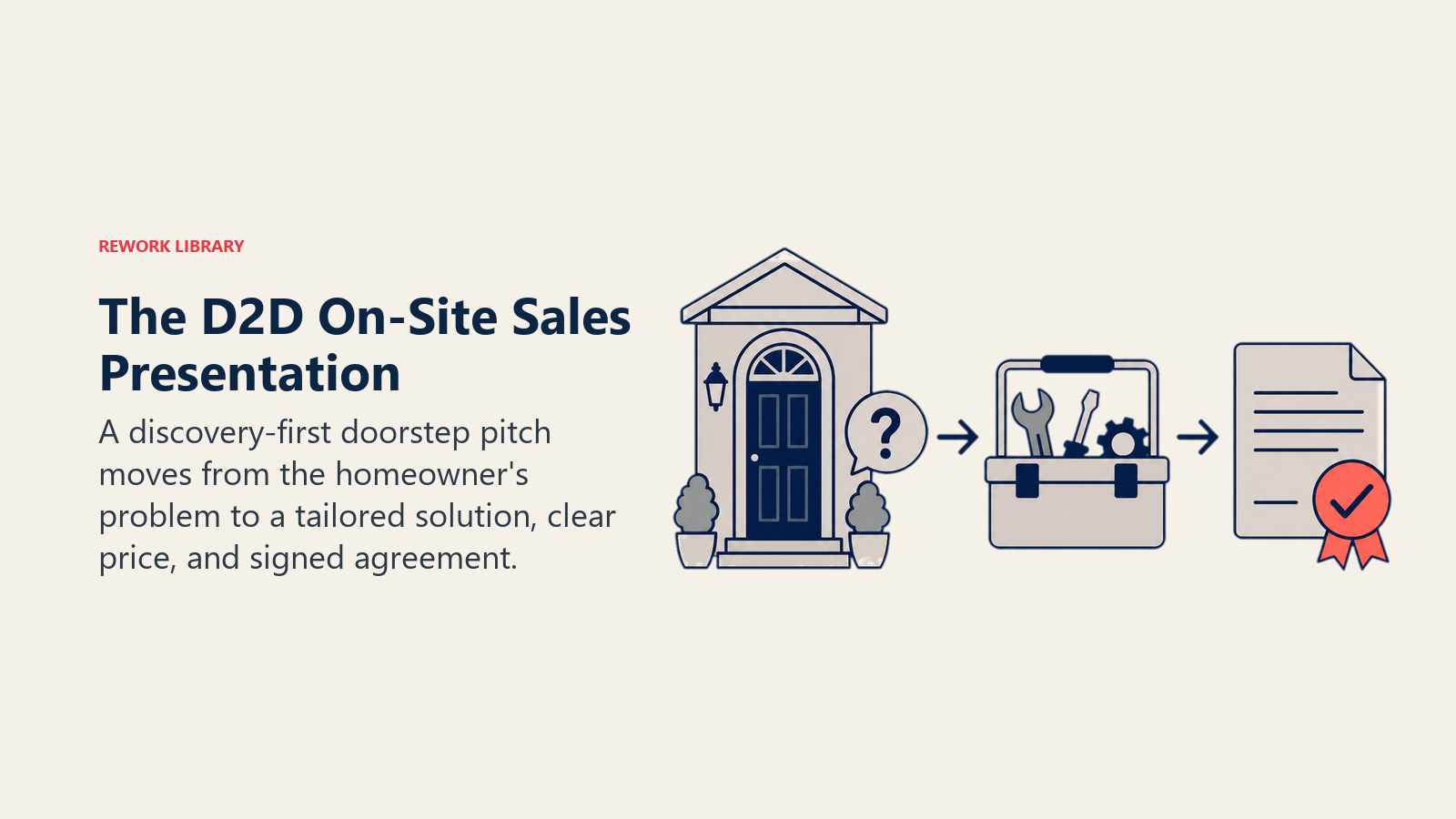
The moment a homeowner opens the door and says "okay, tell me more," you have somewhere between 10 and 20 minutes. Ten to twenty minutes to understand their situation, build trust, explain your service, handle objections, and close a subscription. All of that happens on their front step or in their living room. No slide deck. No conference room. No follow-up meeting to hide behind.
That's the on-site door-to-door, or D2D, pitch. It's one of the most demanding sales formats there is.
This guide breaks down how to structure it. Not as a rigid script, but as a framework that gives you the flexibility to respond to each homeowner while still moving predictably toward a signed agreement.
SPOTIO's field sales data shows D2D teams convert at 2 to 5 percent of doors knocked, which means every minute in front of a willing homeowner carries serious weight.
The Structure That Works
The Five-Phase D2D Pitch Framework: a repeatable sequence that moves a homeowner from first question to signed subscription in a single visit, built around discovery before product and value before price.
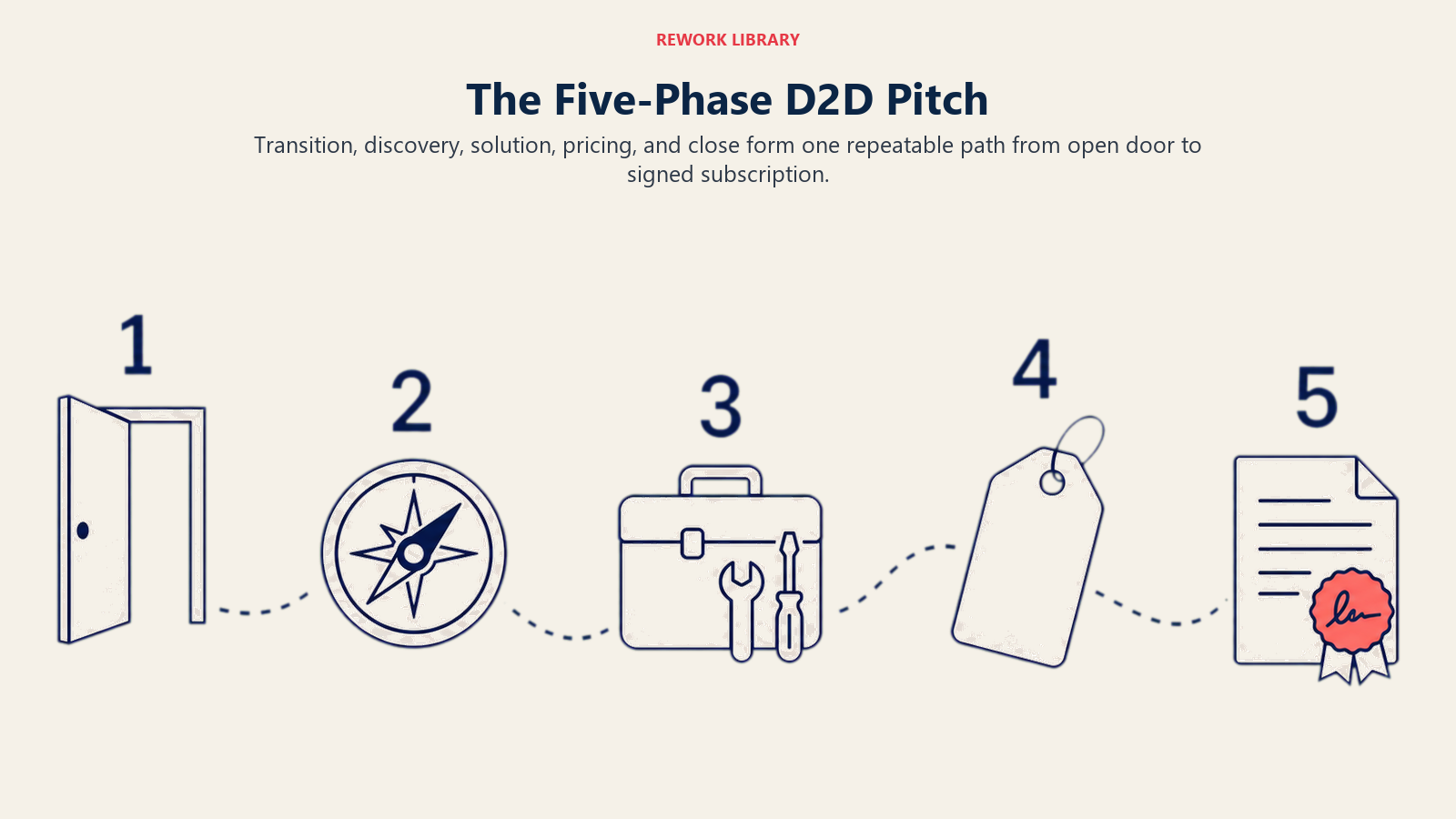
Every effective D2D subscription pitch has five phases. The proportion of time you spend on each shifts based on what you learn in the conversation, but the sequence doesn't change.
- Transition from opener to discovery
- Needs discovery at the doorstep
- Solution presentation
- Pricing and contract walkthrough
- Close and agreement
A lot of reps have been trained on product-first pitches: here's what we do, here's what it costs, do you want it? That order fails in D2D because it starts with information the homeowner doesn't care about yet. They care about their problem. Start there.
Key Facts: D2D On-Site Pitch
- Field reps spend 37% of their workweek in face-to-face selling, making every on-site minute count (SPOTIO 2026 State of Field Sales)
- A healthy D2D contact rate is 30 to 40% of doors knocked, so rep performance in front of willing homeowners is the primary lever on revenue (SPOTIO)
- Teams that schedule 3 or more hours of coaching and ride-along feedback per week retain reps 30% longer (SalesRabbit 2025 Field Sales Report)
Phase 1: Transition from Opener to Discovery
You've already passed the qualification stage. You know they own the home, you know there's no active competing contract blocking you, and they're still talking to you. Now you need to shift from your door approach into a real conversation.
The transition line is critical. It sets the frame for everything that follows. A product-first rep says: "So like I mentioned, we offer home security systems with 24/7 monitoring..."
A discovery-first rep says: "Before I tell you anything about what we offer, I want to make sure it actually makes sense for your situation. Can I ask you a couple of quick questions?"
Almost every homeowner says yes to that. It's a respectful, consultative opening that signals you're not going to waste their time. And it buys you the next 90 seconds to run a quick discovery.
Phase 2: Needs Discovery at the Doorstep
Discovery doesn't require a long sit-down. In D2D, you do a compressed version of needs discovery in three to five questions. The goal is to surface the specific pain or situation that makes your service relevant to this person, in their own words.
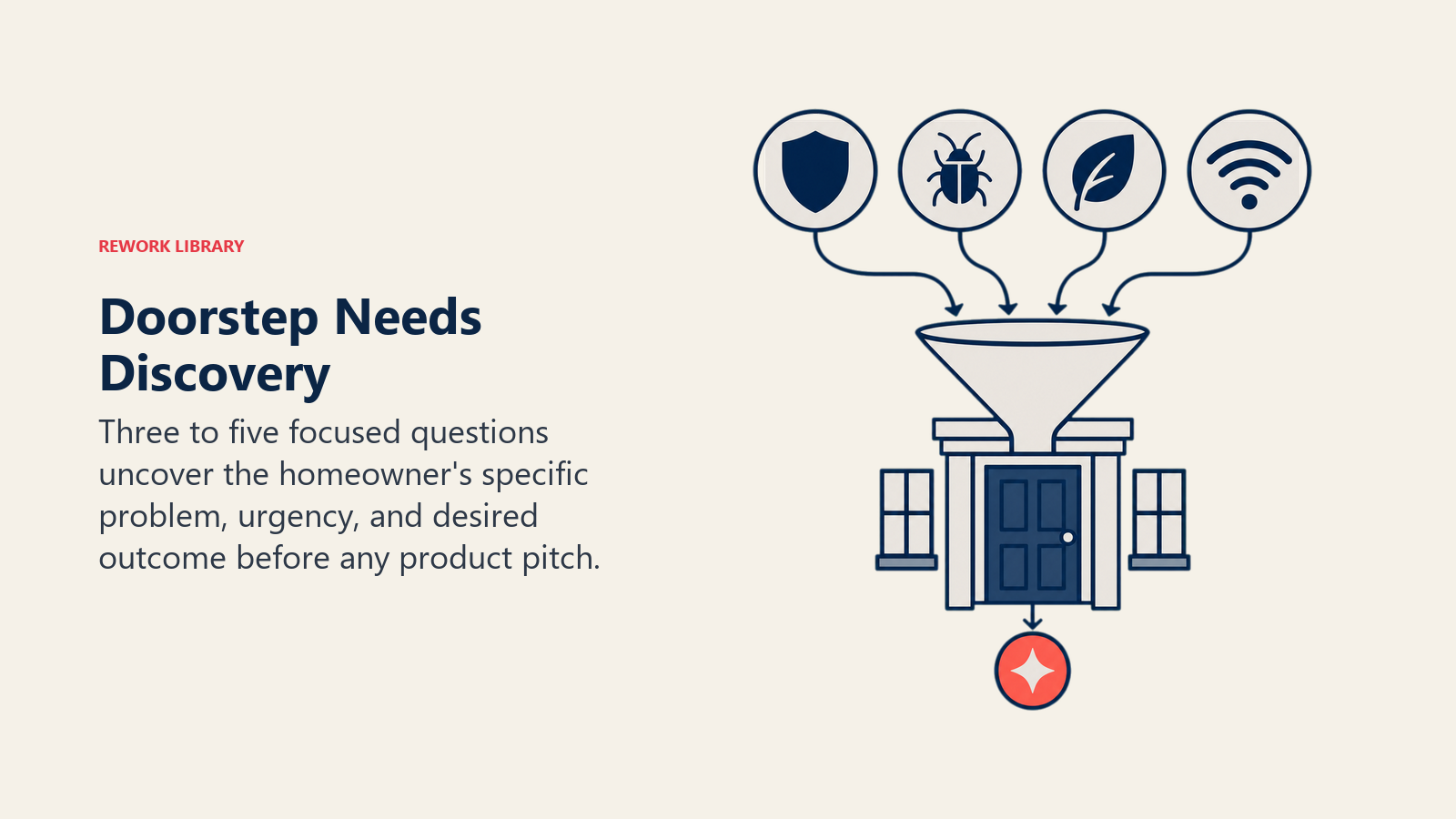
For each vertical, here are the discovery questions that matter most:
Security:
- "Have you had any concerns about safety in the neighborhood lately?"
- "Do you have anything set up right now for monitoring the home when you're away?"
- "What's your biggest worry when you leave for vacation?"
Pest control:
- "Have you been seeing anything in the yard or inside this season?"
- "Have you ever had a professional service out here before?"
- "Is there a time of year when it gets worse?"
Lawn care:
- "What are the main frustrations you've had with your lawn over the last season?"
- "Are you handling it yourself right now or have you tried a service?"
- "Is there a specific area that's been giving you trouble?"
Fiber internet:
- "What provider are you on right now?"
- "How are speeds at home? Any spots where it drops or gets slow?"
- "How many people are streaming or working from home regularly?"
Two things to listen for in the answers: specificity and emotion. A homeowner who says "yeah, we've been seeing ants in the kitchen for three weeks and I don't know what to try next" is ready for a solution. A homeowner who says "it's fine, no real issues" is telling you the pain isn't there yet. Adjust your presentation accordingly.
For a more detailed look at doorstep discovery methodology, see needs discovery at the doorstep.
Reps who open with discovery questions instead of product descriptions are signaling something the homeowner notices immediately: you are here to solve their problem, not to fill your quota.
Phase 3: Solution Presentation
This is where most D2D training focuses, and most of it is fine. But the thing that separates good presenters from great ones isn't how much they know about the product. It's how directly they connect the product to what the homeowner just told them.
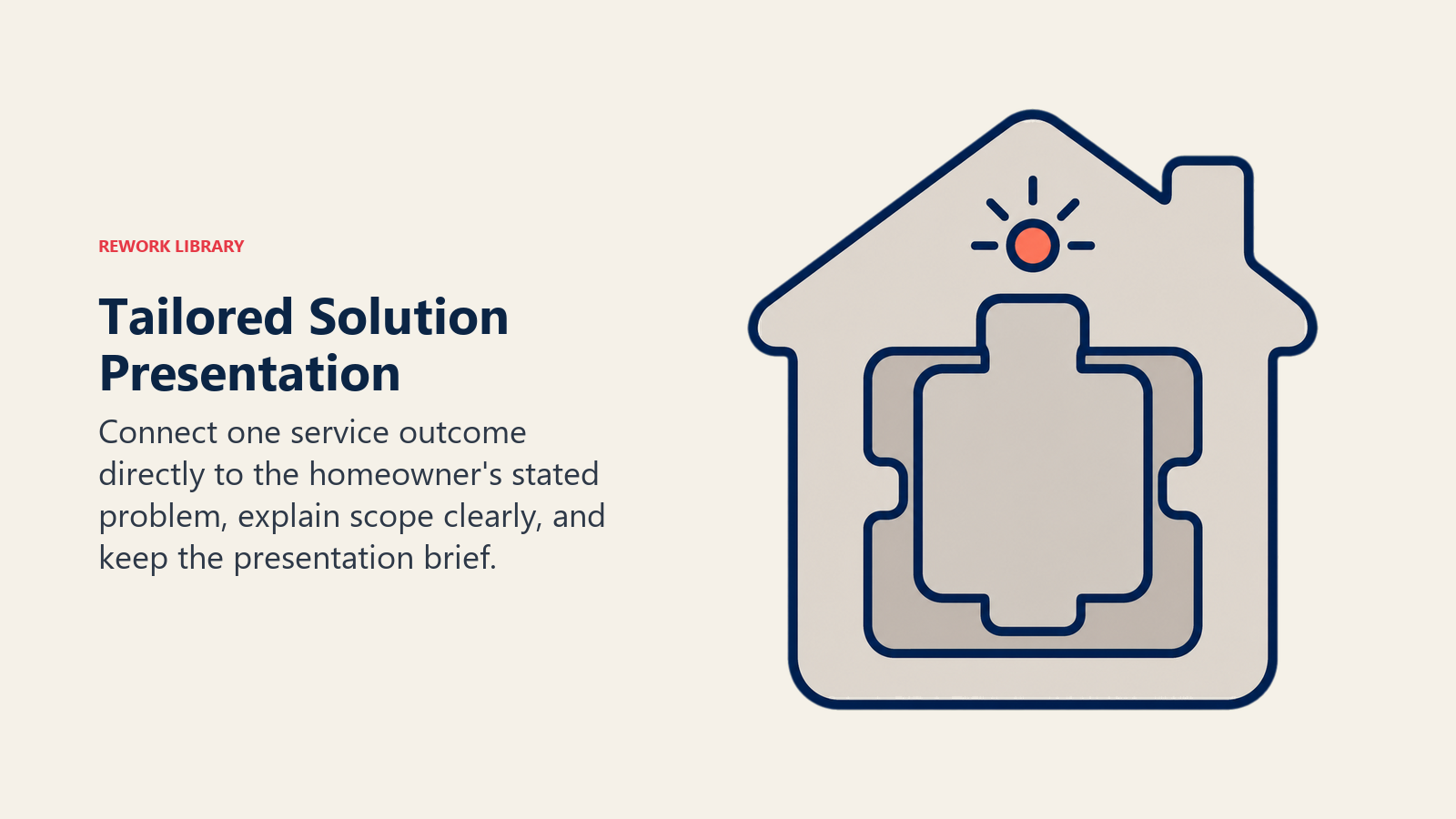
The formula is simple: "You mentioned [specific thing they said]. That's exactly why [service component] matters..."
Don't pitch features. Pitch outcomes that match the problems they named.
What to cover in the solution presentation
Lead with the outcome, not the mechanism. "You'll stop worrying about mosquitoes in the backyard" lands better than "we use a permethrin barrier spray applied to the perimeter." Both might be true. Only one the homeowner cares about before they've signed.
Be specific about your service scope. Vague promises create cancellations. Tell them exactly what they get: how often, what's covered, what's not, who comes out when there's a problem. Specificity builds trust.
Use comparisons to anchor value. "Most people with a system like this pay $X with another provider, and they don't get [specific feature you offer]." This helps homeowners contextualize the price before you've named it. It's a version of the value-selling approach that works well in D2D.
Keep it short. A good solution presentation at the door is 4-6 minutes. If you're still presenting at 10 minutes, you've lost them. The goal is to give enough information that the objections can surface, not to cover every possible detail.
Presentation structure for each vertical
Security (6-minute version):
- What triggered this (their safety concern) + why the timing matters
- What the system includes (sensors, monitoring, response time)
- What happens when something triggers (live response, dispatch, app alert)
- One comparison or story of a similar neighbor
- Transition to pricing
Pest control (5-minute version):
- Validation of their problem (species, seasonal cycle, why it keeps coming back)
- What the treatment includes (initial service + recurring schedule)
- What the guarantee looks like (retreatment, escalation)
- Transition to pricing
Lawn care (5-minute version):
- What you saw in their lawn + why it's happening
- What the program includes (applications, timing, what changes they'll see)
- One specific result to expect by a specific time
- Transition to pricing
Fiber internet (4-minute version):
- Their current problem (speeds, dead zones, bundled billing)
- What they'll get instead (speeds, installation, price clarity)
- How installation works and what the switch looks like
- Transition to pricing
Phase 4: Pricing and Contract Walkthrough
This is where a lot of reps lose confidence, because they anticipate resistance. The fix is to present pricing as information, not a request. You're not asking them to approve a budget. You're explaining what they get and what it costs.
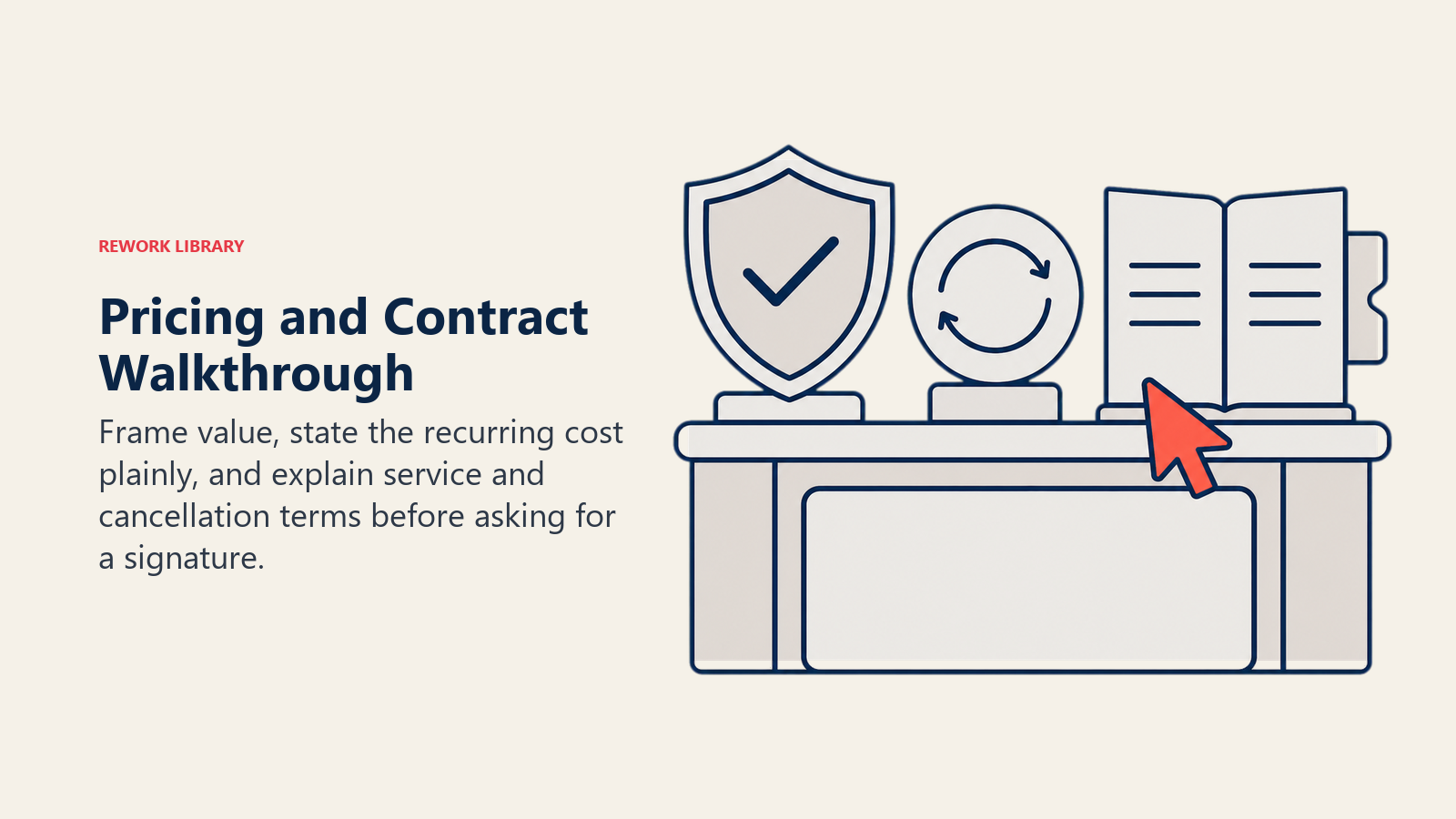
The pricing conversation has three parts:
1. Frame the value before naming the price. "So for everything I just described, including [recap the 2-3 most relevant things they mentioned], here's what it looks like..."
2. Present the monthly cost, not the total cost. Subscription services sell better as a monthly number. "$49 a month" feels manageable. "$588 a year" feels like a decision. Even though they're identical, the framing matters in a doorstep sale.
3. Walk through the agreement, don't hide it. Pull out the contract or agreement and walk through it point by point. What's included. What triggers the service start. How to cancel. How billing works. Homeowners who feel surprised by the contract later become early cancellations, so transparency here protects your first-year retention rate. Federal law reinforces this: the FTC's Cooling-Off Rule requires D2D sellers to notify buyers of their right to cancel within three business days of a sale over $25, and reps who skip this disclosure create compliance risk for the company.
See pricing and contract presentation for a full treatment of how to handle the pricing conversation across different homeowner profiles.
Phase 5: The Close
In subscription D2D, the close isn't a dramatic moment. It's the natural next step after you've built the case, surfaced their pain, and walked through the agreement. The assumptive close works particularly well here because it frames signing as the logical conclusion, not a decision the homeowner still has to make.
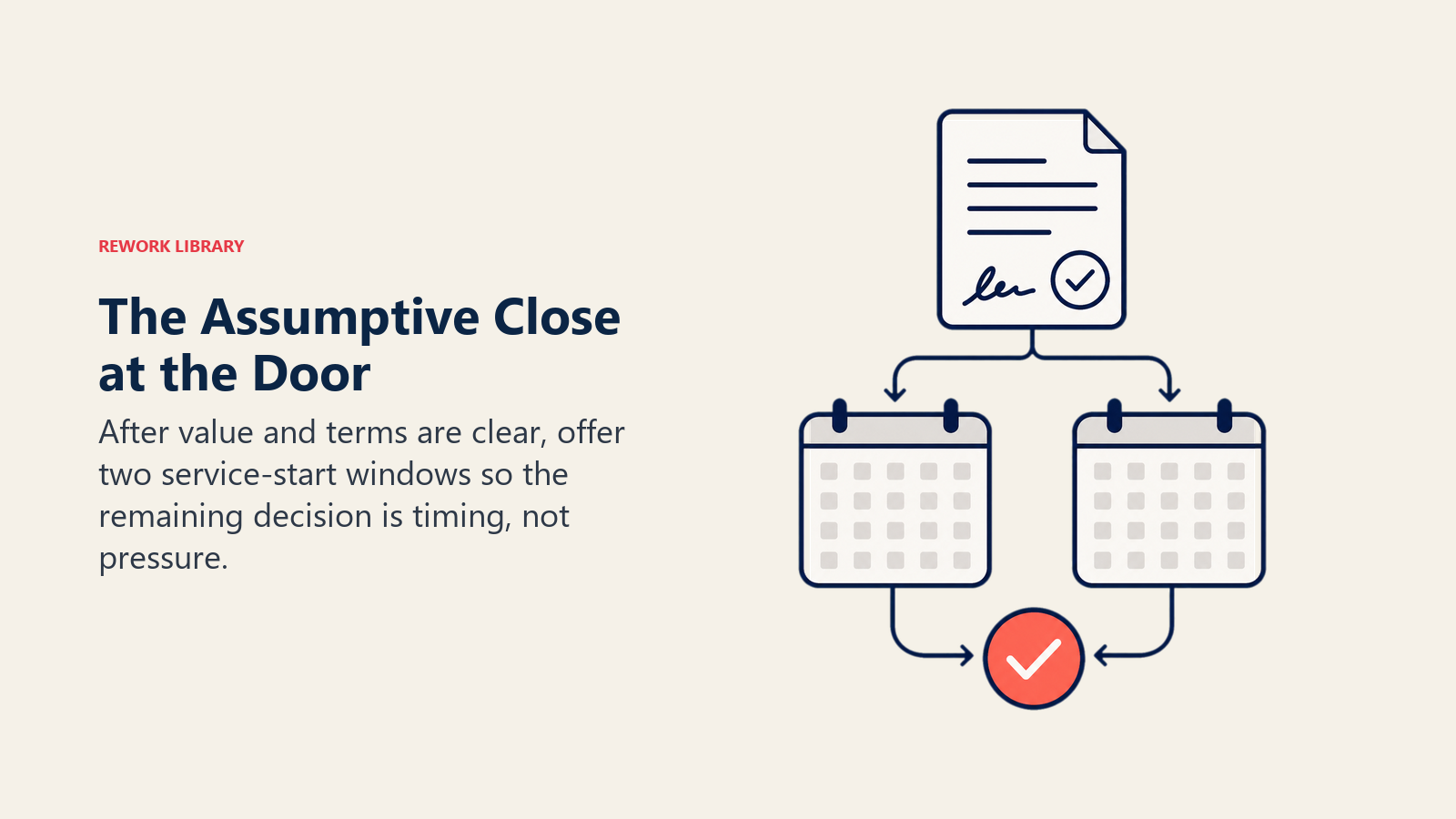
An assumptive close for a recurring home service sounds like this:
"The only thing left is to pick your start date. Does next week work, or would the following week be better?"
You're not asking "do you want to sign?" You're asking when. That's a much easier question to answer, and it advances the sale without pressure.
If they hesitate, that's your cue to surface the objection directly: "It sounds like you might have a question before we confirm. What's on your mind?"
Most of the time, a homeowner who's still talking to you at the pricing stage has one or two specific concerns left. Get them out in the open and address them. Common same-visit objections in D2D:
- "I need to talk to my spouse." Handle by checking if the spouse is home and offering a 5-minute conversation together, or by asking what specific thing they'd want their spouse's input on and addressing it now.
- "I want to think about it." Handle by asking what specifically they want to think through. Then either address it or offer a 48-hour callback.
- "It's more than I wanted to spend." Handle with a smaller tier, a promotion if available, or a direct value comparison to what they're currently paying or not solving.
See same-visit close techniques and objection handling at the door for deeper coverage of each of these.
The assumptive close works because it respects the homeowner's intelligence: you've covered everything together, the decision is already made, and the only variable left is a start date.
What Happens When Two Decision-Makers Are Present?
When both partners are present, your presentation has to work for two different people who may have different priorities. One partner might care about cost. The other might care about reliability or trust. Address both directly.
"For [partner 1], the monthly cost is predictable, no surprise bills. For [partner 2], the thing I'd highlight is [trust/reliability element]."
If only one partner is present but the other needs to be involved, don't force a close. Instead, do a "planted close": walk through the whole presentation, leave them with a physical summary (a one-page agreement, a written quote, or a card with the pricing noted), and set a specific time to come back when both are home.
"I'll come back [specific day/time]. I'll just take 10 minutes and you'll be able to decide together." This keeps the momentum alive without creating buyer's remorse from a unilateral decision.
Presentation Discipline: What Not to Do
Don't over-explain. The longer you talk, the more comfortable the homeowner gets with the idea of not deciding today. A sharp, focused presentation creates momentum. A sprawling one loses it.
Federal law gives buyers three business days to cancel any D2D purchase over $25. Reps who skip this disclosure don't protect the sale; they create compliance risk and a cancellation that lands weeks later instead of at the door.
Don't argue. If they raise a concern, don't debate it. Validate it and redirect. "That's fair. A lot of people feel that way at first. What changed it for them was..."
Don't leave without a next action. Even a "no" at the door should have a follow-up. Get their email or phone number and tell them when you'll follow up. "I'll send you a quick note with what we covered and a way to reach me if you have questions."
Don't promise what you can't deliver. Every overpromise becomes an early cancellation. The service-start handoff is only as smooth as the expectations you set at the door.
How Do You Get Better at the On-Site Pitch?
The best D2D reps treat every presentation as data. After each pitch, whether it closed or not, ask yourself:
- Where did the homeowner's attention shift?
- What question did they ask that I wasn't fully prepared for?
- What part of the presentation felt flat?
- What would I change for the next house on the same block?
Over time, this informal debrief sharpens every phase of the presentation. It's the same mindset that coaches reinforce on ride-alongs, and managers who want to evaluate presentation quality at scale can track close rates, pitch-to-close conversion, and same-visit versus callback ratios so coaching is based on real numbers instead of gut feel.
The on-site presentation is the moment everything else in your D2D operation builds toward. Territory planning, canvassing, qualification, and route management all funnel to this: a rep and a homeowner, having a real conversation about a real problem, ending with a signed subscription. Nail the structure, personalize the content, and close same-visit. The questions reps ask most often once they've internalized this structure are below.
Frequently Asked Questions about The On-Site Sales Presentation
How long should a D2D on-site presentation take?
Most effective D2D pitches run 10 to 20 minutes from opener to signed agreement. The solution presentation itself should be 4 to 6 minutes. If you are still presenting at the 10-minute mark without having entered a pricing conversation, the homeowner's attention is likely drifting.
What is the biggest mistake reps make during the on-site pitch?
Leading with product features before surfacing the homeowner's problem. A feature-first pitch gives homeowners nothing to anchor the service to their own life, which makes the price feel abstract and the decision feel optional. Discovery first, solution second.
Should I use a physical contract during the presentation?
Yes. Walking through the agreement at the door, rather than emailing it later, reduces early cancellations by setting clear expectations. Homeowners who are surprised by contract terms after signing are far more likely to cancel in the first 30 days.
How do I handle a homeowner who says they need to talk to their spouse?
First, check if the spouse is home. If they are, offer a brief joint conversation. If not, ask what specific thing the spouse would want input on and address it directly. This often reveals the real objection sitting behind the "need to ask" delay.
What is the FTC Cooling-Off Rule and how does it affect my pitch?
The FTC requires D2D sellers to disclose the buyer's right to cancel within three business days of any sale over $25. This disclosure belongs in the contract walkthrough phase. Skipping it creates compliance risk for your company and, if the homeowner discovers the right later, gives them a reason to cancel that you could have neutralized at the door.
What close technique works best in D2D subscription sales?
The assumptive close performs well because it frames the signed agreement as the logical next step rather than an open question. Instead of "do you want to move forward?" ask "does next week work for the start date, or is the following week better?" This narrows the decision to timing, not whether.
How can managers evaluate presentation quality across a rep team?
Track close rate, pitch-to-close conversion time, and the ratio of same-visit closes to follow-up callbacks at the rep level. Reps with longer average pitch times and high callback ratios are often over-explaining in the solution phase. Reps with low close rates despite high contact rates may be skipping discovery. Both patterns are visible in rep performance dashboards before they show up in revenue numbers.
Learn more: Value selling · Reducing early cancellations · Sale to service start handoff · Coaching, ride-alongs, and rep culture · Rep performance dashboards

Senior Implementation Consultant
On this page
- The Structure That Works
- Phase 1: Transition from Opener to Discovery
- Phase 2: Needs Discovery at the Doorstep
- Phase 3: Solution Presentation
- What to cover in the solution presentation
- Presentation structure for each vertical
- Phase 4: Pricing and Contract Walkthrough
- Phase 5: The Close
- What Happens When Two Decision-Makers Are Present?
- Presentation Discipline: What Not to Do
- How Do You Get Better at the On-Site Pitch?