D2D Recurring Revenue Sales Model: How Home Services Companies Build Subscription Revenue Door to Door
Turn this article into takeaways for your work.


Each assistant summarizes the article only for you and suggests best practices for your work.
A pest control rep closes a deal on a front porch in 12 minutes. She walks away with a signed 12-month agreement worth $600. A solar rep closes a deal in the same neighborhood after a two-hour site visit and a follow-up call, and he walks away with a $35,000 one-time sale.
Both reps "won." But the pest control company will collect that $600 customer's money again next year, the year after that, and for as long as they deliver service. The math compounds in their favor. The solar company starts at zero every January.
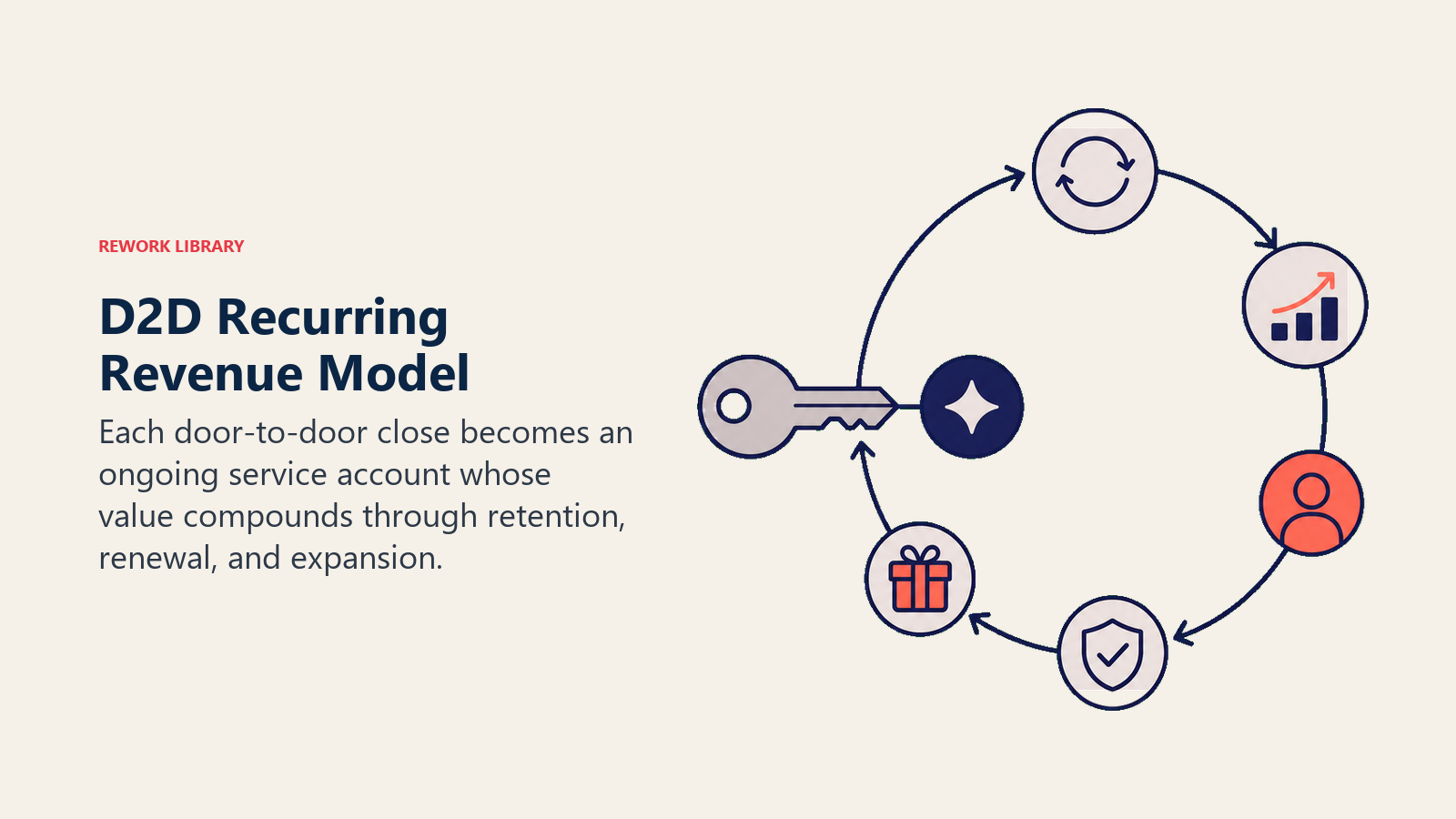
That's the core insight behind the D2D recurring revenue model: you're not selling a product; you're selling an ongoing relationship. Every closed door becomes a monthly or annual cash flow unit. Scale the team, manage churn, and the business builds equity the same way a SaaS company does.
This article explains how the model works structurally, why it changes how you sell, and what it takes to sustain it.
What Makes Home Services D2D Different from One-Time Sales
Most door-to-door sales training was built for industries where the rep's job ends at the signature. Sign the contract, collect the check, move on. That's still how some D2D verticals work.
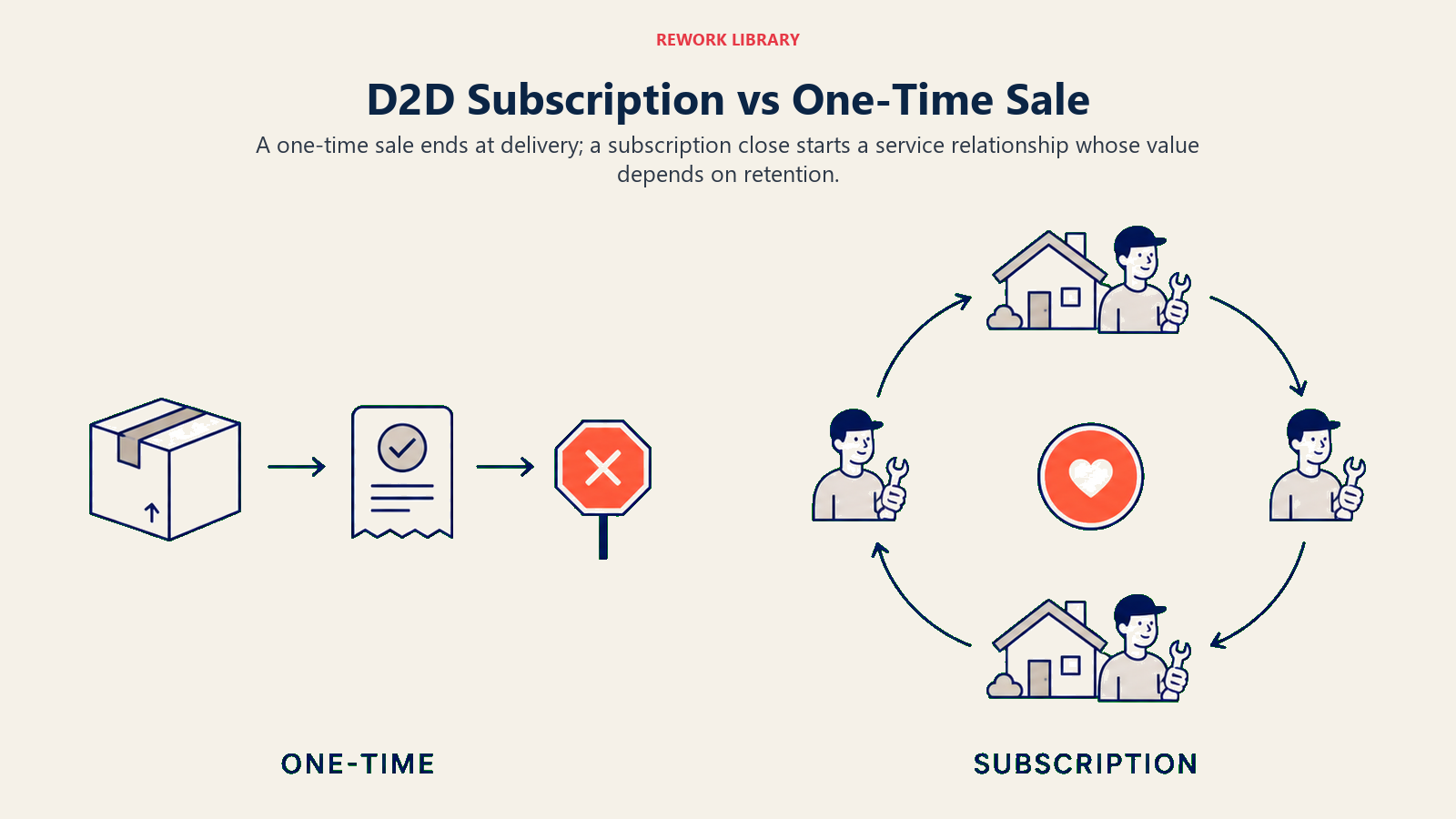
But pest control, lawn care, security monitoring, and fiber/telecom subscriptions don't follow that pattern. The rep closes a service agreement, not a product delivery. The customer is buying access to ongoing service, and every month they don't cancel is revenue the company earned again.
This creates a different set of pressures:
The rep's close is just the beginning. If a pest control technician misses a visit or does sloppy work, the customer cancels. The rep who sold that account might not find out for weeks. In a traditional D2D sale, that doesn't matter to the rep's commission. In a subscription model, it can matter a great deal if reps share in renewal bonuses or if quality metrics affect territory access.
Churn erodes the rep's past work. A rep who closes 60 accounts in a summer and watches 20 of them cancel by December didn't actually produce 60 revenue units. She produced 40. Companies that ignore this create a leaky bucket: the sales team pours accounts in the top while they drain out the bottom. According to SPOTIO's State of Field Sales 2026, 41% of B2C field sales organizations report annual rep turnover above 50%, which compounds the churn problem as institutional knowledge walks out the door with every rep who leaves.
Customer lifetime value matters more than the sale price. A $49/month pest control account is worth roughly $1,500 over a 30-month average retention span. That LTV calculation should drive how much you're willing to invest in acquiring the customer and how much you pay the rep who closed it. See the subscription unit economics and LTV breakdown for the full math.
Key Facts
- Recurring revenue accounts for 85.2% of residential pest control service revenue in the U.S., confirming that subscriptions have displaced one-time treatments as the dominant model. (NPMA, 2024)
- 41% of B2C field sales organizations report annual rep turnover above 50%, which compounds the churn problem as institutional knowledge walks out with every departing rep. (SPOTIO State of Field Sales 2026)
- A 5% increase in customer retention can boost profits by as much as 95%, a range that reflects how powerfully retention leverage varies by margin structure. (Bain & Company)
So how do you actually pull those levers day to day? The next section breaks down the three that matter most.
The Three Revenue Levers in D2D Subscriptions
Every subscription-based D2D business has three levers that drive top-line revenue growth. Understanding which lever you're pulling at any given time helps you allocate resources correctly.
Lever 1: New Account Acquisition
This is what most people mean when they say "D2D sales." Canvassers knock doors, qualify homeowners, deliver a pitch, and close a service agreement. The output is a new subscription unit added to the book of business.
New acquisition is how you grow the customer base. It's the most expensive lever per dollar of revenue because you're paying rep commissions, covering training and management overhead, and absorbing the cost of early cancellations (the first 60 to 90 days see the highest churn in most home services verticals).
Lever 2: Retention and Renewal
Keeping a customer for a second year costs a fraction of what it took to acquire them. A lawn care company spending $120 per new customer acquisition might spend $15 per retention call. The margin profile on retained accounts is dramatically better.
Retention isn't passive. In subscription home services, it means proactive outreach before contracts expire, quality service delivery that makes renewal an easy yes, and save campaigns for customers who call in to cancel. The subscription retention fundamentals guide covers the tactical side of this.
Lever 3: Upsell and Service Expansion
A pest control customer on a quarterly plan might upgrade to monthly service after they see evidence of a rodent problem. A security monitoring customer adds cameras to their initial door-sensor package. A lawn care customer adds aeration to their mowing plan.
These upsells don't require acquiring a new customer. They expand revenue from someone who already trusts you, and they increase LTV without adding acquisition cost. Many D2D teams don't train reps to upsell systematically, which means they leave revenue on the table at every service visit.
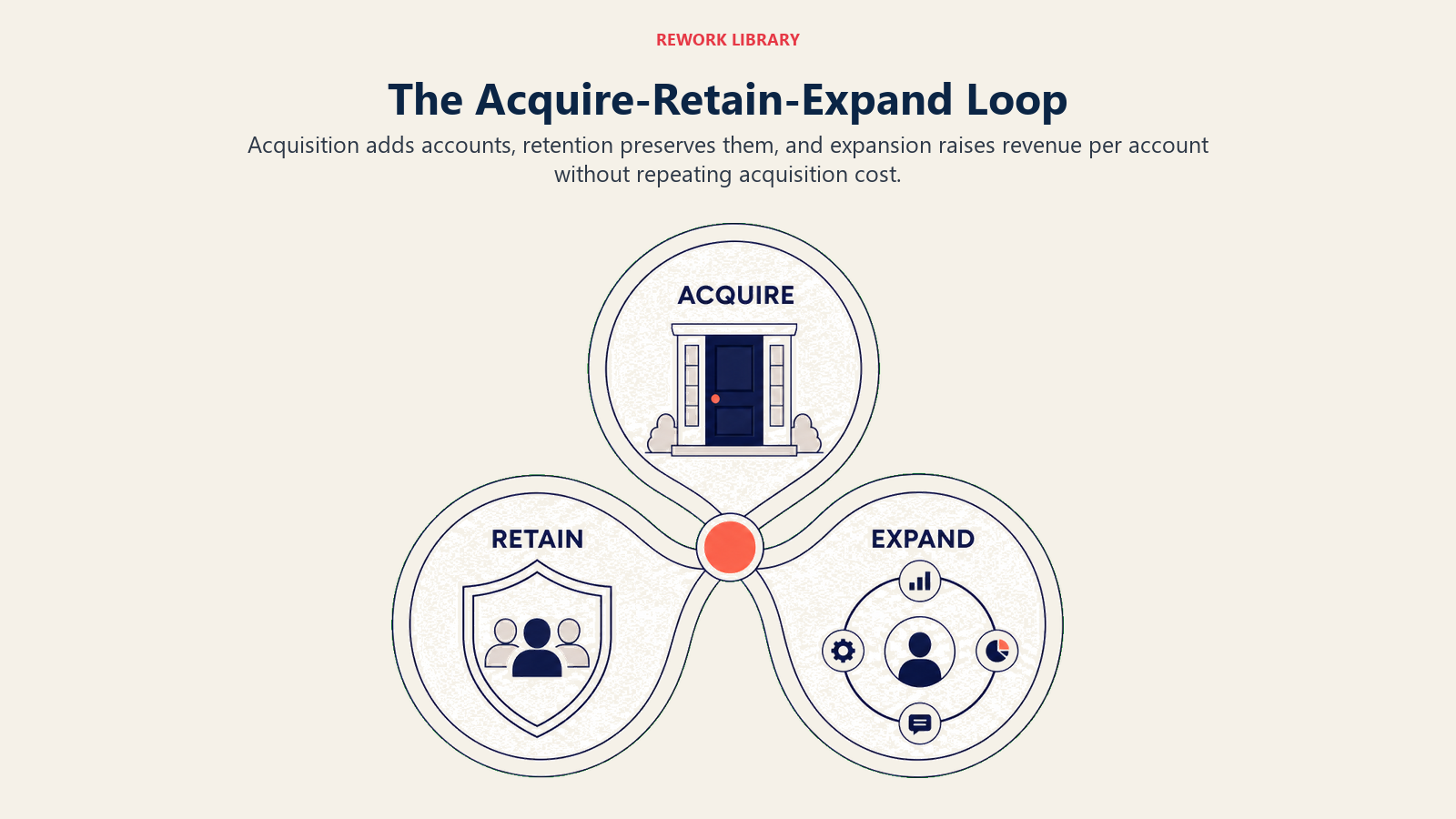
The Acquire-Retain-Expand (ARE) Loop: the model the best D2D subscription businesses run, whether or not they name it. Acquisition fills the top; Retention keeps accounts from draining out the bottom; Expansion grows revenue per account without raising headcount. Each loop reinforces the others: retained customers expand more readily, and expanded customers churn less because they're more invested in the service. A team that optimizes only acquisition without closing the retention and expansion sides of the loop is, in practice, running a leaky bucket business.
None of these three levers matter if the pitch itself doesn't hold up at the door.
Why the Sales Pitch Changes When You're Selling a Subscription
A rep selling a one-time product has one job: get the signature today. A rep selling a subscription has a different framing task: help the homeowner see why ongoing service creates value they can't get from a one-time treatment.
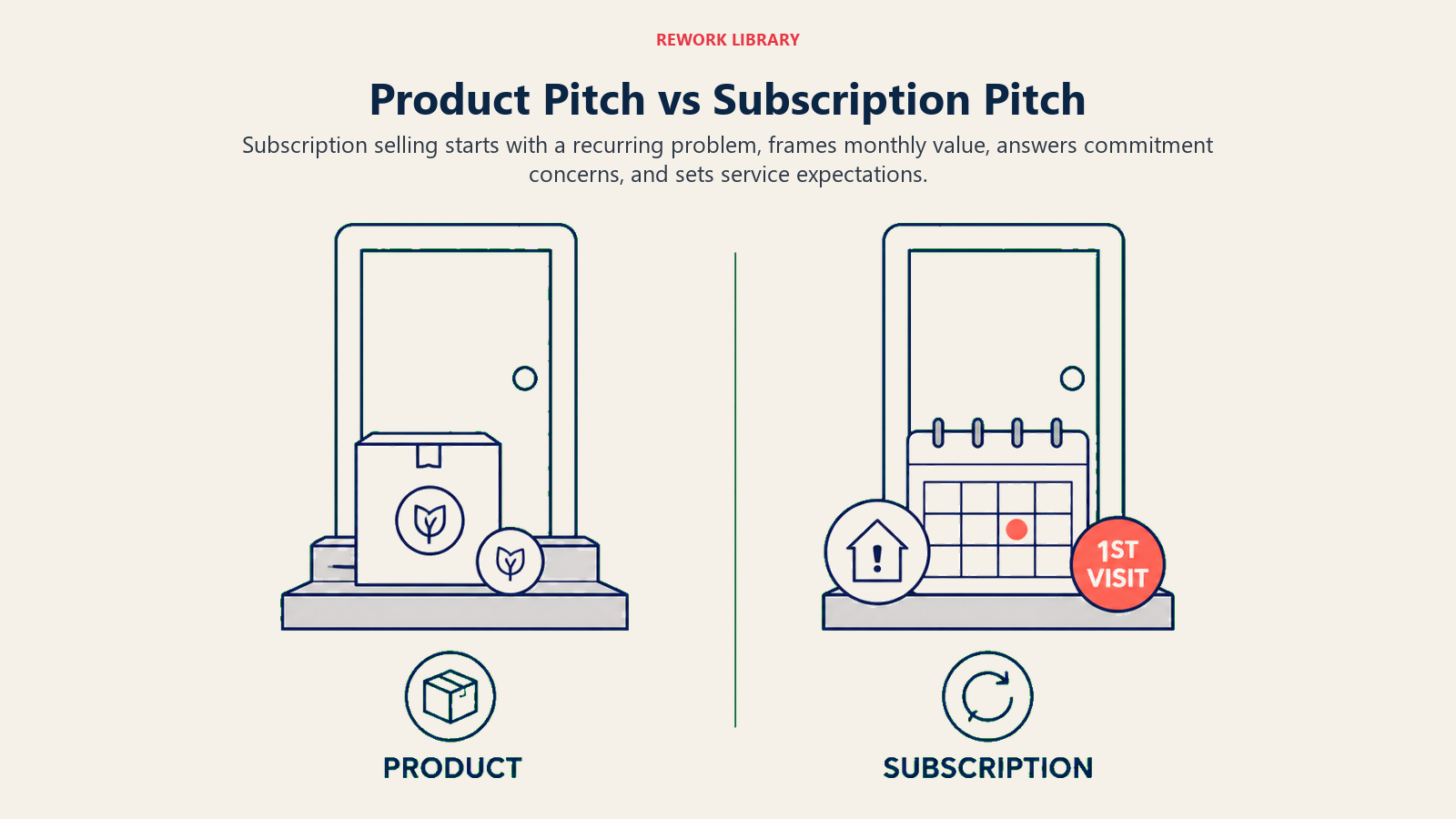
This shifts the pitch in concrete ways:
Lead with the problem, not the product. A pest control rep who opens with "We offer quarterly treatments starting at $49" is pitching a product. A rep who opens with "Have you noticed any ant trails near your kitchen or garage this season?" is diagnosing a recurring problem that justifies a recurring solution. The problem-first frame makes the subscription feel like a logical answer rather than a sales tactic.
Anchor the monthly cost, not the annual commitment. "It's about $16 a month, less than a dinner out, and you won't worry about pests all summer" lands differently than "It's $189 per year." Both are the same number. One feels like a small ongoing choice; the other feels like a commitment.
Address the cancellation question before the customer asks it. Many homeowners hesitate on subscriptions because they're worried about being locked in. Proactively telling them "You can pause or cancel anytime, though most customers stay because the service works" removes the objection and signals confidence. The same-visit close techniques section of this collection covers how to handle this at the door.
Establish service expectations clearly. A homeowner who doesn't know when their first pest visit will happen, who will show up, or how to contact someone if they have a problem is a cancellation risk. Reps who close AND set clear expectations during the pitch produce higher retention rates than those who only focus on the signature.
A well-run pitch still only tells you what happened on one door. Zoom out, and a different question takes over: how healthy is the whole book of business?
How Do D2D Teams Measure Portfolio Value Over Time?
One of the mental model shifts that separates strong D2D subscription businesses from struggling ones is thinking in terms of the account book, not just this week's closings.
An account book is the living portfolio of active subscriptions the company (or the individual rep, depending on comp structure) holds. It has:
- Active accounts: paying, in-service subscribers
- New accounts: recently closed, in onboarding or first service
- At-risk accounts: near contract expiration, have missed payments, or have complained
- Cancelled accounts: churned units that represent lost LTV
Sophisticated D2D teams track account book health just like SaaS companies track their MRR dashboard. They know their current active count, their monthly adds, their churn rate, and their net growth. A team adding 40 new accounts per month but losing 35 to cancellation has a growth problem that raw close numbers hide.
| Metric | What It Tells You |
|---|---|
| Gross new accounts/month | Sales team output |
| Early cancellation rate (0-90 days) | Pitch quality and service handoff quality |
| 12-month retention rate | Service quality and customer fit |
| Net new accounts/month | True business growth |
| Average account age | Portfolio stability |
Why Does Comp Design Determine Whether Reps Care About Retention?
Here's where many D2D subscription businesses get the model wrong: they pay reps on the close and nothing else. The rep's incentive ends when the customer signs. The company's incentive extends for years.
That misalignment creates predictable problems. Reps close anyone, including customers who are clearly on the fence or who don't really need the service. They oversell, promising visits or response times the service team can't deliver. They rush the close without setting expectations, because expectations don't show up in their commission calculation.
There are a few comp structures that better align rep incentives with long-term account health:
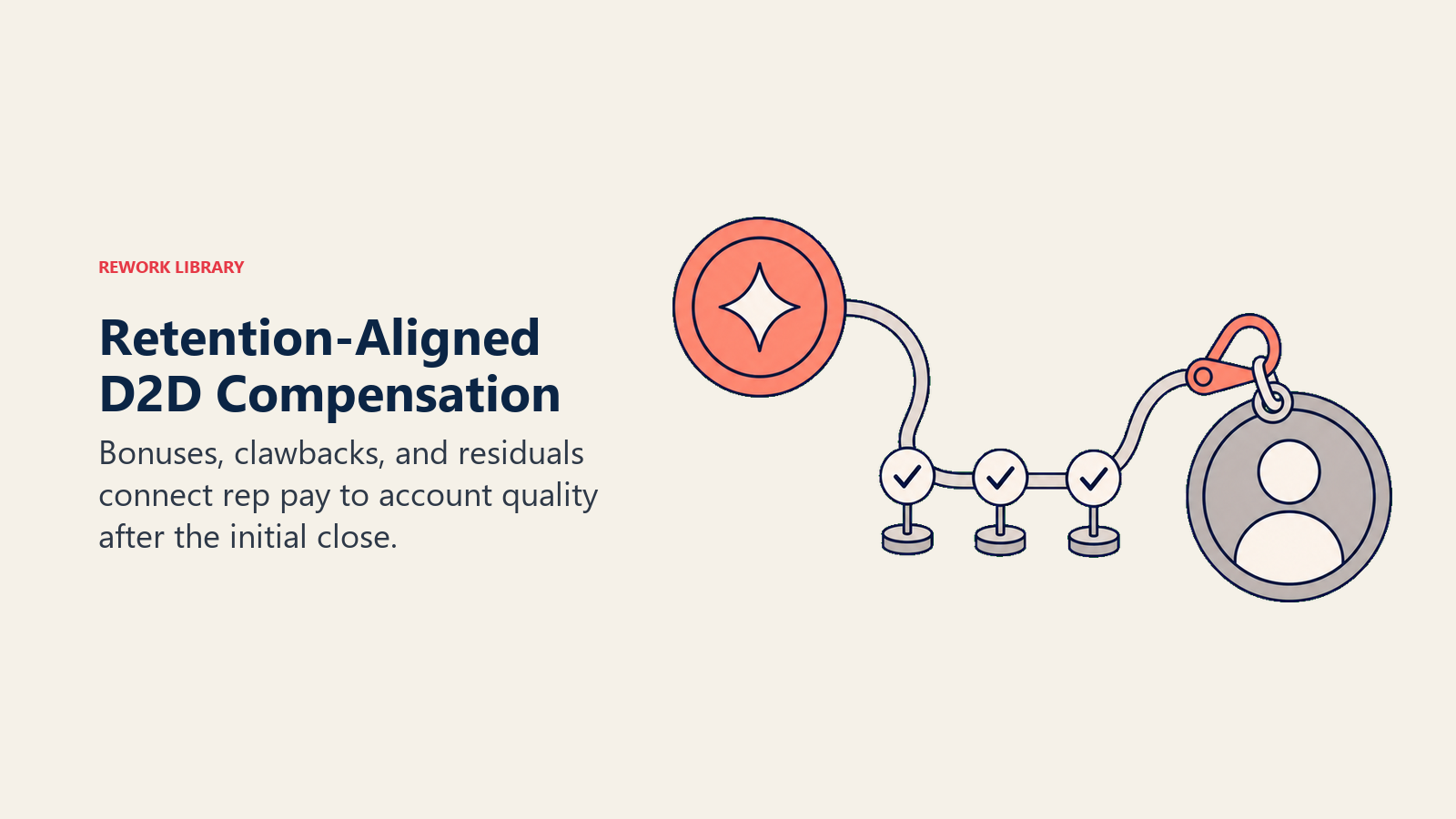
Tiered commission with retention bonus. Base commission paid at close, with a second payment (or a multiplier) if the account is still active at 90 days or 6 months. This gives reps a financial reason to care about what happens after they walk away.
Clawback on early cancellations. If an account cancels within the first 60 days, a portion of the commission is recovered. This is common in security and pest control. It's aggressive but effective at filtering out reps who close unsuitable customers.
Residual commission on renewals. Reps earn a smaller percentage on accounts that renew without intervention. This creates a literal stake in account retention and rewards reps who close quality accounts over reps who chase volume regardless of fit.
The commission and comp design for D2D guide covers structure options in more detail, including how to implement clawbacks without destroying team morale.
Structural Differences Across D2D Subscription Verticals
Not all home services subscriptions work the same way. The model's fundamentals are shared, but the specifics differ meaningfully by vertical.
Pest Control: Monthly or quarterly service cycles. Relatively low monthly price ($40-80 typical). High volume of accounts per rep. Churn concentrated in late fall when customers don't see bugs and question the need. Retention strategy centers on proactive communication ("We treated, here's what we found") rather than product upgrades. The National Pest Management Association reports that recurring revenue accounts for 85.2% of residential service revenue across the industry, which underscores how completely the subscription model has replaced one-time treatments in this vertical.
Lawn and Turf Care: Seasonal structure in most markets, with annual contract value concentrated in 6-8 months. Higher churn risk at the end of season. Upsell opportunities (aeration, overseeding, fertilization add-ons) are significant revenue drivers. Visual results make the service easy to demonstrate on the pitch.
Security and Alarm Monitoring: Higher monthly price ($30-60 for monitoring, more with cameras). Equipment costs often bundled into the agreement term (3-5 years common). The subscription commitment is longer, which means higher customer lifetime value but also more resistance at the door. Regulatory licensing requirements affect where and how reps can operate. See D2D legal and licensing compliance for what varies by state.
Fiber and Telecom: Often sold under a utility-style 12 or 24-month contract. Very high lifetime value if the customer stays, because switching costs are significant. First-visit close rates are high because the decision is relatively low-risk for the customer (no equipment purchase, clear pricing). Competition with existing providers shapes the pitch dramatically.
From Individual Closes to a Sustainable Business Model
The D2D recurring revenue model works at scale when the company builds systems, not just a sales team. Individual reps close accounts, but the business sustains them.
That means investing in:
- Service delivery quality that makes customers want to renew, not just customers who signed under pressure
- A handoff process that turns a closed account into a scheduled service without the customer having to chase anyone
- A retention operation that proactively contacts at-risk accounts before they cancel
- Referral systems that let happy subscribers become new lead sources
The companies that win in D2D subscriptions aren't the ones with the slickest closers. They're the ones where a closed account reliably becomes a satisfied customer, which reliably becomes a renewal, which reliably becomes a referral. That compounding is the actual business model.
The door-to-door close is the starting point. The account book is the business.
Learn more:
- Sale-to-service-start handoff
- Referral generation from subscribers
- Retention fundamentals (post-sale management library)
- Lead scoring systems (lead management library)
Quotable Nuggets
"Subscription contracts account for approximately 67% of lawn care revenue in the U.S., making recurring revenue the dominant structure even in a historically transactional service category." (Reported by multiple lawn care industry analysts; see Amra & Elma, 2025)
"A 5% increase in customer retention can boost profits by as much as 95%, a spread that shows how much margin is locked inside the accounts D2D teams already have." (Bain & Company)

Senior Implementation Consultant
On this page
- What Makes Home Services D2D Different from One-Time Sales
- The Three Revenue Levers in D2D Subscriptions
- Lever 1: New Account Acquisition
- Lever 2: Retention and Renewal
- Lever 3: Upsell and Service Expansion
- Why the Sales Pitch Changes When You're Selling a Subscription
- How Do D2D Teams Measure Portfolio Value Over Time?
- Why Does Comp Design Determine Whether Reps Care About Retention?
- Structural Differences Across D2D Subscription Verticals
- From Individual Closes to a Sustainable Business Model