Field Sales and Marketing Alignment for Door-to-Door Growth
Turn this article into takeaways for your work.


Each assistant summarizes the article only for you and suggests best practices for your work.
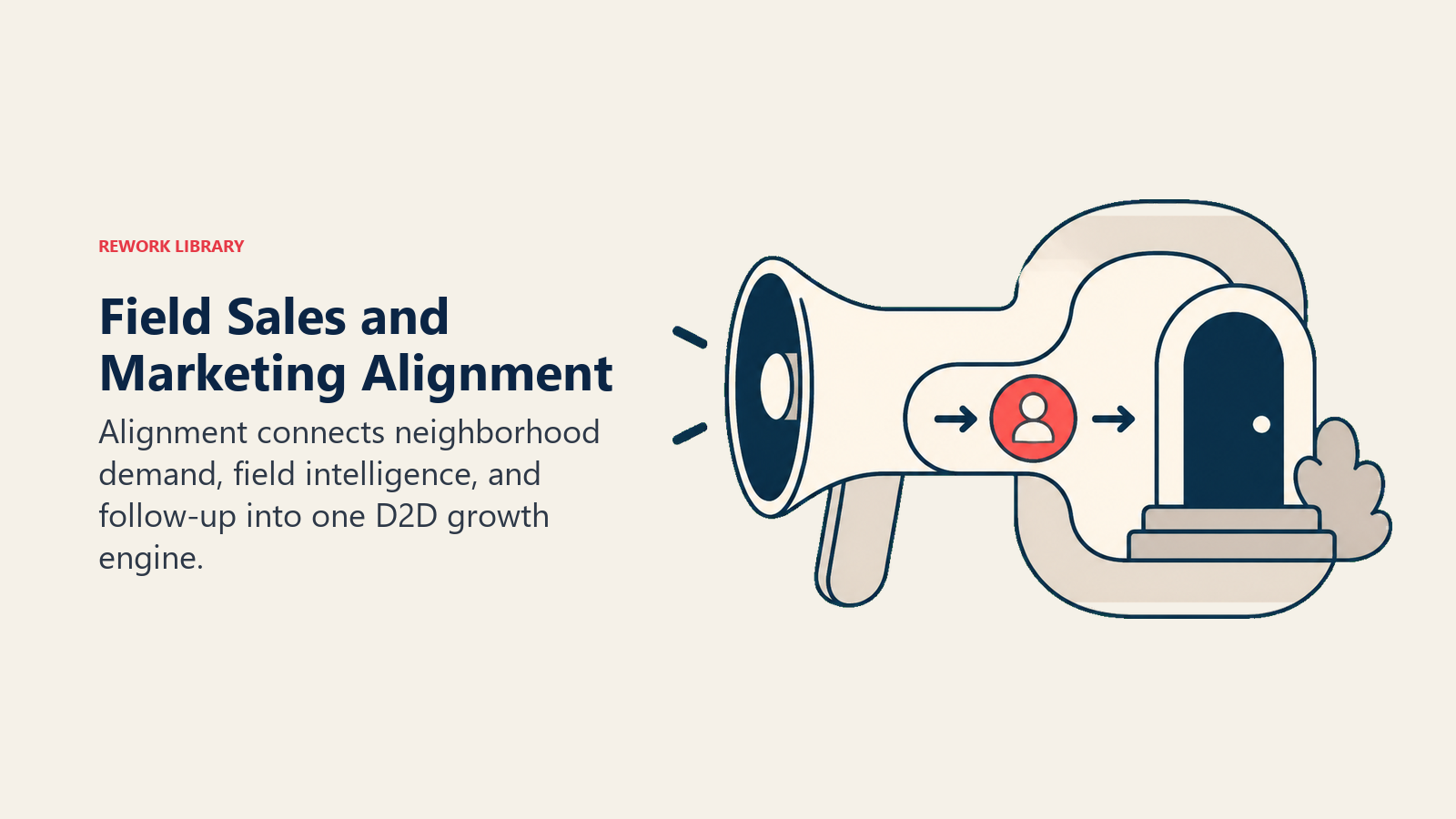
Picture a lawn care company running a summer campaign. Marketing runs Google Ads and the leads roll in. Field reps knock doors across three counties, working street by street. Two teams, two engines, both grinding away at growth.
Neither one talks to the other. The rep knocking a street has no idea marketing already generated a warm lead two doors down. Marketing has no idea which neighborhoods the field team already covers. Most of those digital leads sit untouched for a day or more. Most of those knocked doors get no help from what marketing already knows about local demand.
This is the standard state for most D2D businesses. It's not a failure of either team individually. It's an organizational design problem. In the lawn care example above, marketing generated 340 inbound leads through a single Google Ads campaign in June. Field sales closed 18 of them. The rest went uncontacted for 24 hours or were marked "no answer" after a single call attempt, while the canvassing team knocked 9,000 doors that same week with zero visibility into which of those addresses had already converted online. HBR's research on sales and marketing alignment found that misalignment costs businesses more than $1 trillion each year across lost revenue and wasted spend, with the coordination breakdown becoming especially acute when teams operate under different managers with different metrics.
Why Don't Field Sales and Marketing Teams Talk?
In most recurring home service companies, marketing and field sales evolved separately. Marketing was hired to do brand and digital. Field sales was built from the ground up as a boots-on-pavement operation. The two teams have different managers, different metrics, and often different physical locations.
Marketing judges success by lead volume, click-through rates, and cost per lead. Field sales judges success by doors knocked, demos pitched, and contracts signed. Neither metric requires the other team to exist.
The result is predictable:
- Marketing buys digital leads that sales doesn't follow up on (or follows up too slowly)
- Sales canvasses neighborhoods where the company already has digital saturation
- Neither team knows what the other is tracking
- Customer acquisition cost is higher than it needs to be because neither engine is amplifying the other
For a recurring D2D revenue model, where the acquisition cost has to be paid back across months or years of subscription revenue, wasted acquisition spend compounds into serious margin pressure.
Key Facts: Field Sales and Marketing Alignment
- Only 8% of companies report strong alignment between their sales and marketing departments, according to ZoomInfo's pipeline research.
- 65% of sales and marketing professionals experience a lack of alignment in their organization, even as 82% of C-level executives believe their teams are already in sync (Forrester, 2024).
- Misaligned companies see an average 4% annual revenue decline, while aligned organizations grow revenues at 20% annually, according to cross-study alignment research.
What Marketing Needs from Field Sales
Marketing can't optimize without feedback from the field. But field reps rarely think of themselves as sources of market intelligence. They're focused on the next knock, the next pitch, the next close.
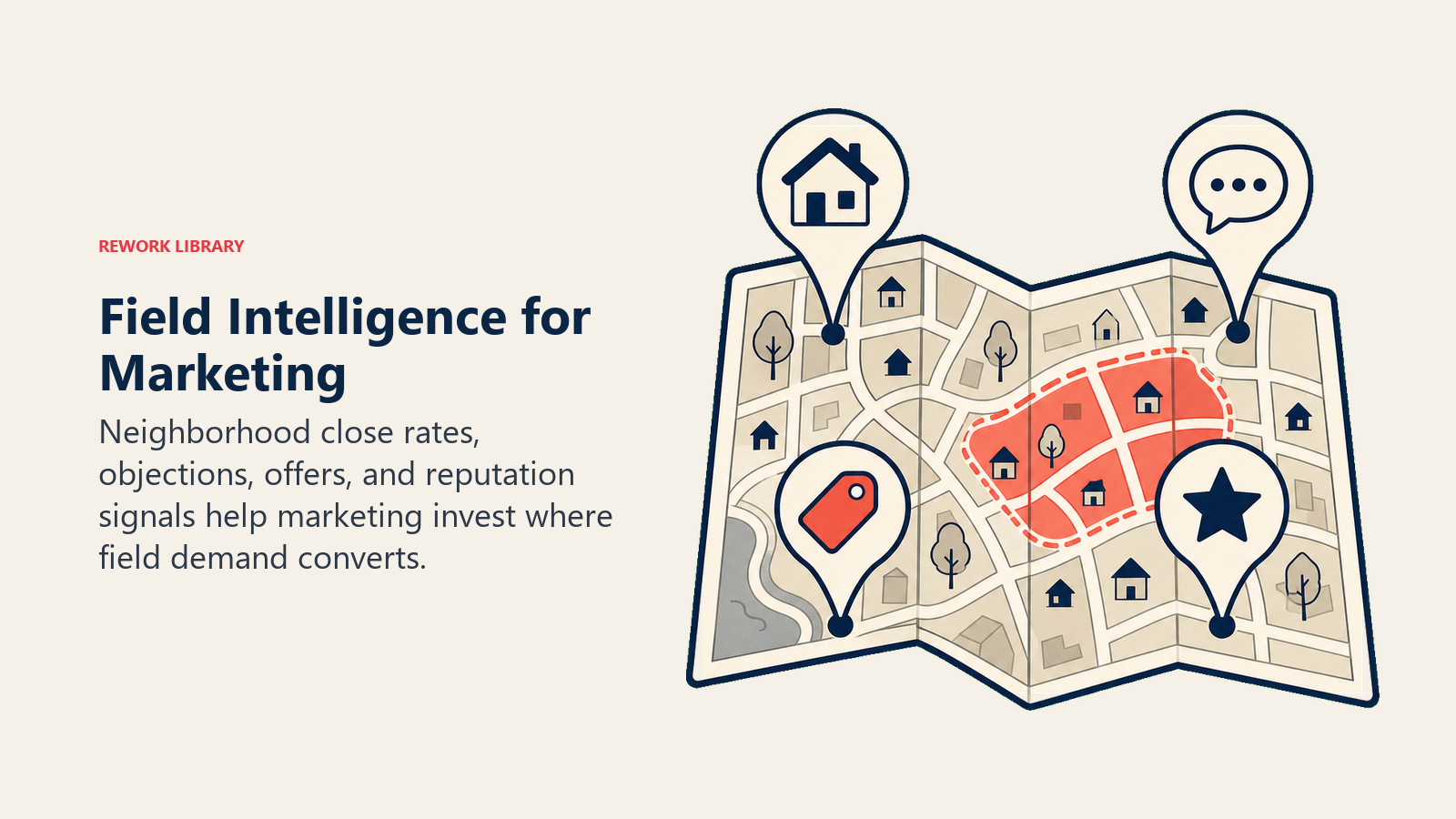
Here's the specific data marketing needs, and why it matters:
Close rate by neighborhood. If reps are closing at 18% in one ZIP code and 7% in another, digital ad spend should weight toward the high-converting area. Marketing can't discover this from Google Analytics.
Common objection themes by area. "People keep saying they already have a pest company" tells marketing something about competitive saturation in that zone. A digital campaign there might need a different angle.
Which offers resonate at the door. If reps have noticed that a particular discount structure or bundled service closes faster, marketing should know. It can test those angles in digital creative.
Service quality reputation signals. Field reps hear from customers about what the company is known for in a neighborhood. Positive word-of-mouth in a zone is a signal that digital spend there will convert better.
None of this data flow happens unless you create a mechanism for it. A weekly "field intelligence" note shared from a sales manager to the marketing team is a start. A shared field where reps can log neighborhood-level observations in the CRM is better.
"Close rate by neighborhood is the most underused piece of market intelligence in D2D businesses. When field reps close at 18% in one ZIP code and 7% in another, digital ad spend should weight toward the high-converting area but that signal rarely reaches marketing because there is no mechanism to send it."
What Field Sales Needs from Marketing
The data flow has to go the other direction too. Field reps make routing decisions every day. Which block do they knock next? Which neighborhood do they spend Tuesday morning in? Marketing has information that should influence those decisions.
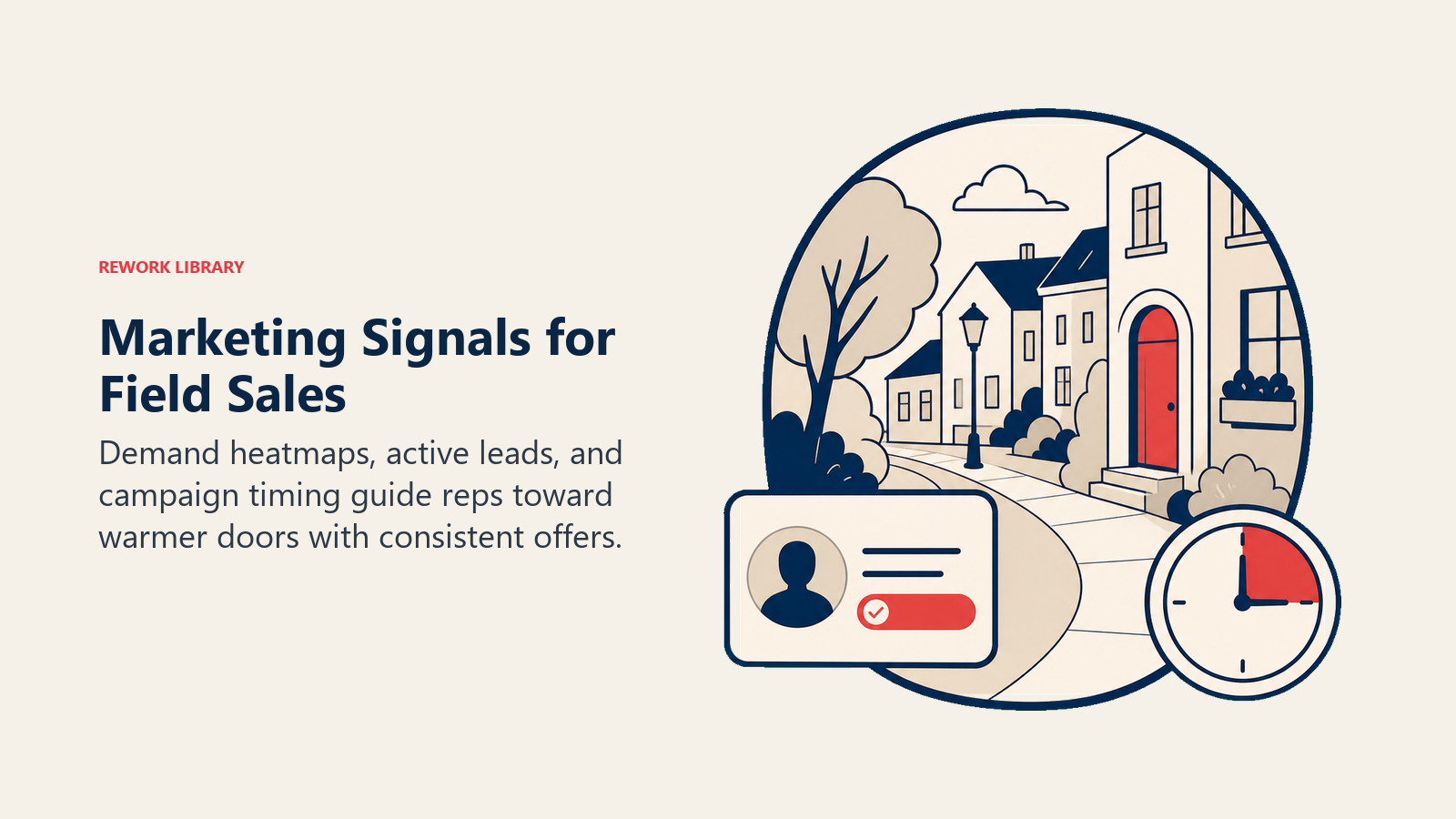
Digital demand heatmaps. Where are people searching for your service right now? Where are Google Ads converting? Where has the company's review volume spiked? Marketing can build this from existing data sources. A simple weekly overlay of digital interest by ZIP code or neighborhood, shared with territory managers, helps reps prioritize knocking where warm demand exists.
Active lead lists. If someone filled out a web form and no one has reached out yet, a rep driving near that address should be routing to that door. Not to pitch cold, but to introduce themselves as the local rep: "Hi, you reached out to us online. I was in the neighborhood and wanted to stop by personally." That kind of visit converts at much higher rates than a pure cold knock.
Campaign timing coordination. If marketing is running a "half off first month" digital offer in a metro area, field reps shouldn't be knocking the same area with a different offer. Inconsistent messaging confuses prospects and undermines close rates.
The territory design and assignment process should pull in digital demand data so that new territory maps reflect where actual customer intent is highest, not just where roads are convenient.
Building the Integration: Practical Steps
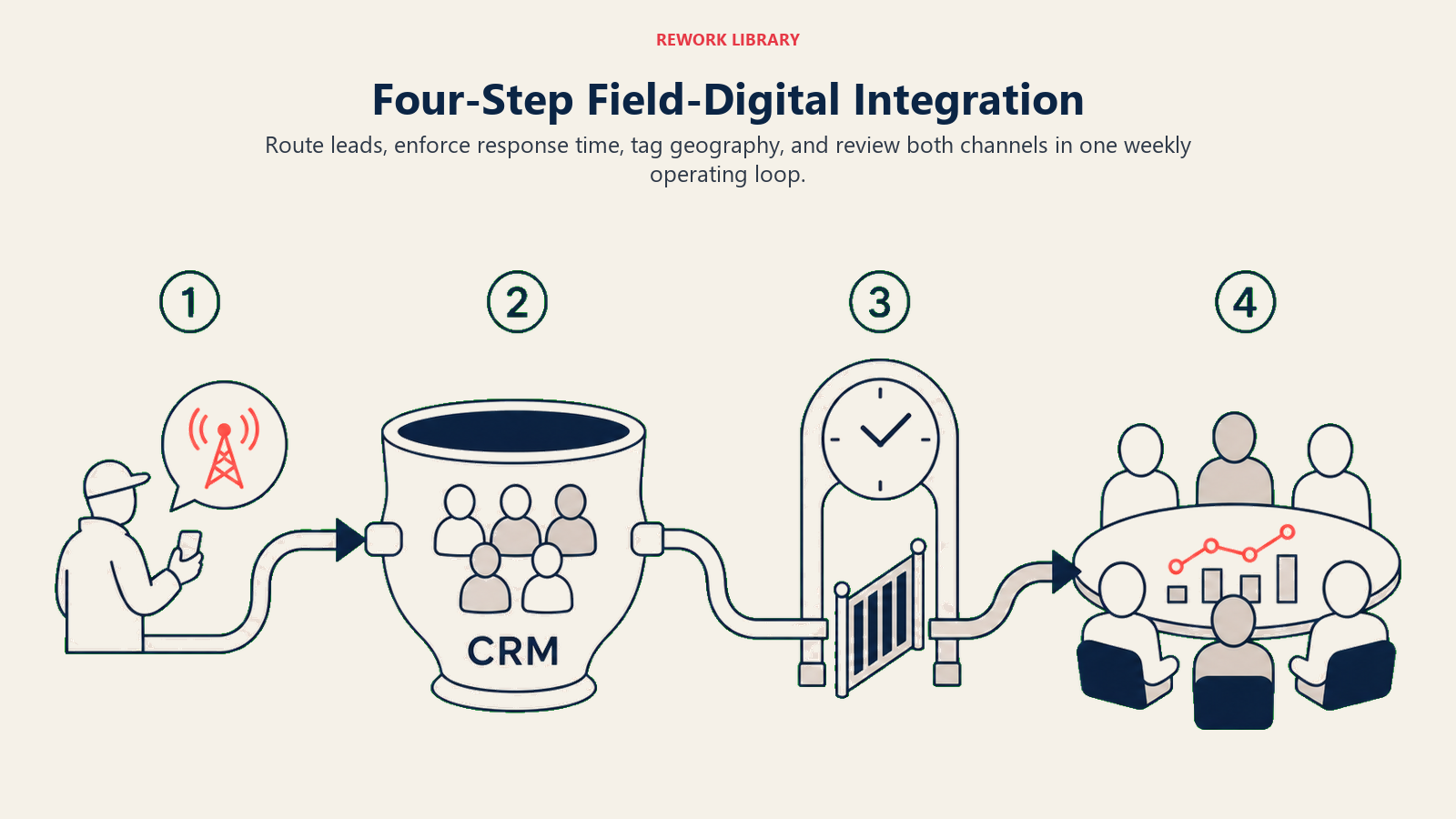
The Four-Step Field-Digital Integration Protocol is a practical framework for connecting field sales and marketing operations in D2D businesses. Step 1: Route all inbound digital leads directly to the same CRM field reps use. Step 2: Set a written response SLA for digital leads (call within 30 minutes during business hours, field visit within 48 hours if no phone contact). Step 3: Tag close location in every deal so close rate by geography is calculable. Step 4: Run a weekly 30-minute sync between sales manager and marketing lead to review digital lead conversion alongside field close rates.
Alignment doesn't require a major systems overhaul. Most companies can get to a functional state with a few relatively simple changes.
Step 1: Connect the CRM to digital leads immediately. Inbound web leads should hit the same CRM field sales uses, not sit in a separate marketing platform. If your marketing team uses HubSpot and your field team uses a canvassing app, you need an integration. A lead that sits in HubSpot for two days while a rep knocks 400 doors nearby is wasted acquisition spend.
Step 2: Set a response SLA for digital leads. D2D companies that pick up an inbound lead within five minutes close at dramatically higher rates than those who call back the next day. HBR's landmark study on lead response found that most companies are not responding nearly fast enough to customer inquiries, and that the odds of qualifying a lead drop sharply after the first hour. Write down a policy: digital inbound leads get an outbound call attempt within 30 minutes during business hours, and a local rep routes to the address within 48 hours if no phone contact is made.
"In D2D businesses that route inbound digital leads to a field rep within 30 minutes, conversion rates on those leads are dramatically higher than in businesses that call back the next day. The internet lead was generated by intent. That intent decays by the hour."
Step 3: Tag close location in every deal. Field reps should log which street or neighborhood the account came from, not just the delivery address. That data, aggregated weekly, becomes your close rate by geography, which drives marketing allocation.
Step 4: Create a shared weekly sync. It doesn't need to be long. Sales manager and marketing lead, 30 minutes, once a week. Review where digital leads came in, which ones converted, which fell through, and what's happening in the field. That conversation, done consistently, generates more alignment than any dashboard.
For tracking performance across both channels, a consolidated lead and rep performance dashboard should show digital lead conversion alongside door-to-door conversion, so management sees total acquisition efficiency in one view.
Territory Planning as a Joint Exercise
The biggest alignment opportunity sits at territory planning time. Most D2D companies plan territories the same way they always have: look at a map, divide by geographic area, assign reps. Marketing isn't in the room.
A better model brings marketing data into territory design:
- Where has digital interest been highest in the last 90 days?
- Which neighborhoods have the highest concentration of existing customers (good for referral density)?
- Where are competitors advertising heavily (may indicate high competition and lower close rates)?
- Which areas have had positive service quality feedback (word-of-mouth amplifies canvassing)?
Marketing can answer all four questions with existing data. If those answers inform which neighborhoods become premium territory for your highest-performing reps, you're compounding acquisition efficiency.
The territory design process and the weather, timing, and density planning process both benefit from marketing's neighborhood-level data. A rep knocking a neighborhood where 12 people have Googled your service in the last two weeks has a very different starting point than a rep in a cold zone.
Coordinating Seasonal Campaigns
Seasonality hits hard in pest control, lawn care, and home security. Marketing typically runs seasonal digital campaigns around these peaks. Field sales ramps up with summer programs. But the timing rarely syncs.
Marketing launches a spring pest control campaign in March because digital interest peaks. Field sales doesn't hit full staffing until May because the summer sales program ramps then. The digital leads sit in a queue for weeks, losing temperature.
Coordination requires planning the seasonal calendar together. By January, marketing and field sales leadership should have agreed on:
- When digital campaigns launch and in which markets
- When canvassing programs ramp in those same markets
- What offer the field is leading with and how it relates to the digital creative
- How inbound digital leads from the campaign get routed to field reps in the same area
This sounds basic. Most companies don't do it because marketing and sales report to different people who don't plan together. The fix is usually a joint planning meeting at the start of each season, not a technology change.
Why Does Aligning on the Customer Story Matter?
One underrated alignment issue is messaging. Marketing writes one story about who the customer is and why they buy. Field reps develop a completely different narrative from their daily experience. Neither story is wrong, but they're not always the same story.
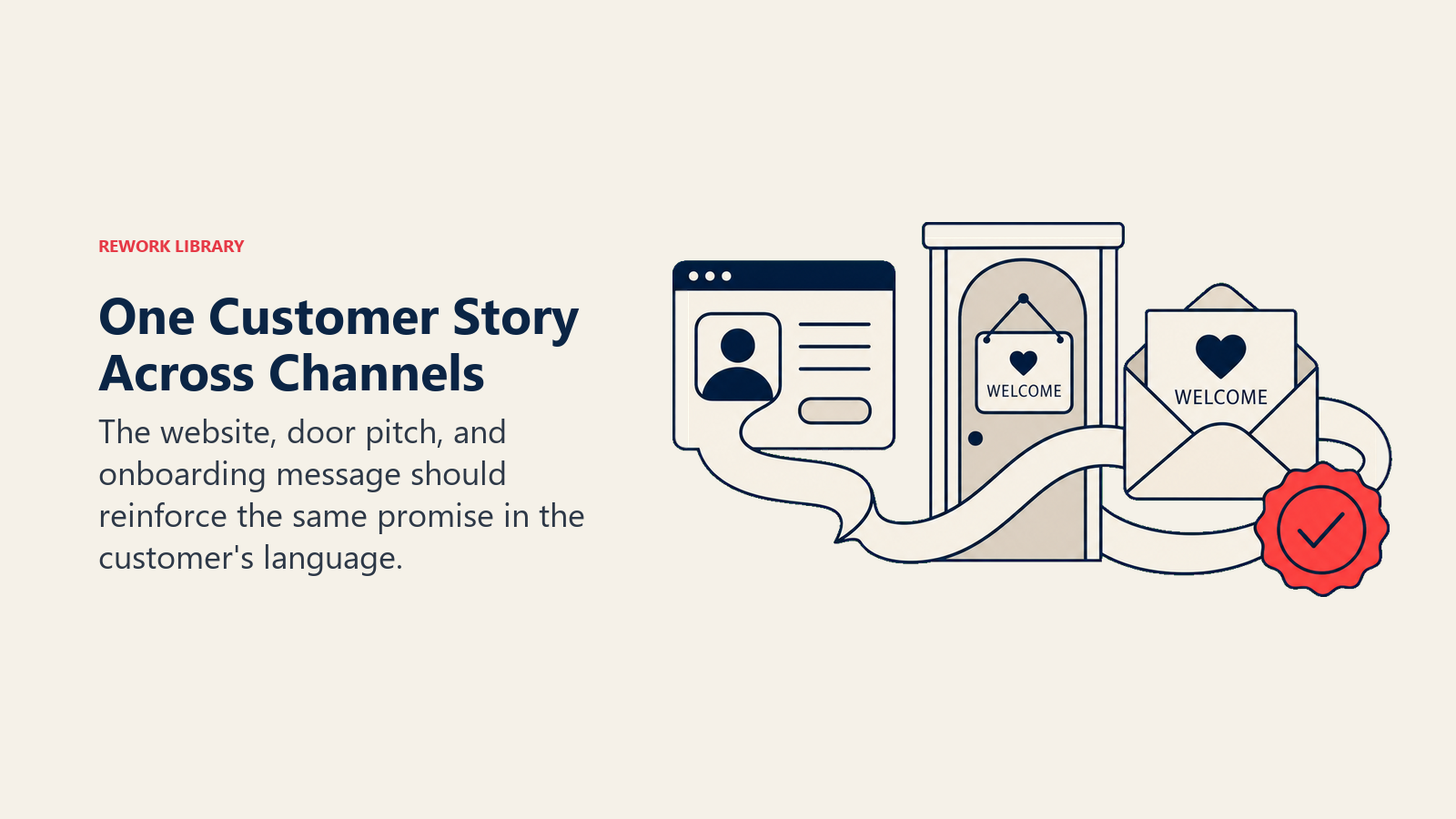
When a customer visits your website after a door knock and reads copy that sounds nothing like what the rep said, there's friction. When a rep hears a marketing angle on a radio ad and thinks "that's not what actually makes people sign," alignment is broken at the message level.
A simple fix: marketing should interview two or three field reps every quarter. Not to write about them, but to understand what objections they hear, what reasons customers give for signing, what words customers use when they're genuinely interested. That language should find its way into digital copy.
Field reps should see the marketing materials their prospects will see before signing. If the company sends a welcome email after a customer signs up, the rep should know what it says. If there's a customer testimonial video running in their territory, the rep should be able to reference it.
Consistency in story across channels makes both channels more effective. A prospect who saw the digital ad remembers it when the rep knocks. A customer who just signed finds the welcome email familiar. The experience hangs together.
Connect this to your welcome and onboarding process for new customers. The onboarding sequence that follows a field sale should reflect what the customer heard at the door, not a generic drip campaign built for digital leads.
Tracking Blended Acquisition Cost
Most companies track cost per lead (marketing) and close rate (sales) separately. Neither number tells you what you need to know: what does it actually cost to acquire a subscriber?
Blended customer acquisition cost (CAC) combines both:
Blended CAC = (Total marketing spend + Total sales cost) / Total new subscribers
When you calculate this number and break it down by acquisition channel (digital, canvassing, referral), you can make real decisions about where to invest.
| Channel | New Subscribers | Channel Cost | CAC |
|---|---|---|---|
| Digital inbound | 48 | $12,400 | $258 |
| Field canvassing | 312 | $41,600 | $133 |
| Referral | 67 | $8,700 | $130 |
In this example, canvassing and referral deliver lower CAC than digital. But that doesn't mean digital is a bad investment. Digital converts faster, generates warmer leads for field follow-up, and builds brand in the territory. The right answer is usually a portfolio that uses each channel for what it does best.
"Blended customer acquisition cost, total marketing plus total sales spend divided by total new subscribers, is the only CAC number that tells you whether your growth engine is healthy. Channel-specific CAC is useful for optimization. Blended CAC is the health check."
Knowing your blended CAC against your average subscriber lifetime value tells you whether your growth model is healthy, not just whether individual campaigns look good in isolation.
Making Attribution Work in a Hybrid Model
One reason field sales and marketing don't integrate well is attribution. When a customer signs up, who gets credit? If a prospect saw a Facebook ad, Googled the company, and then signed with a rep who knocked their door two weeks later, which channel sourced them?
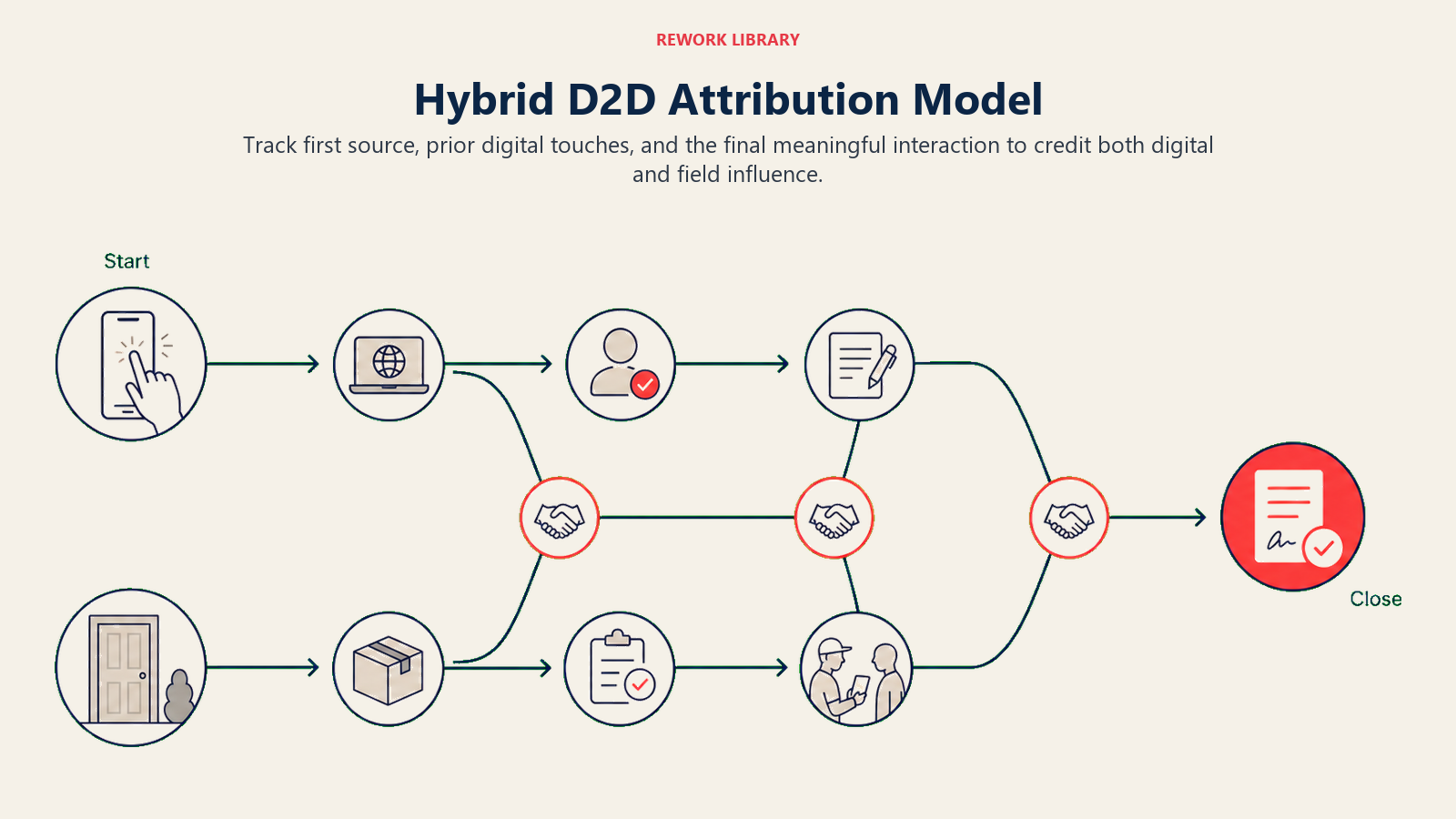
The answer matters for budget decisions, and the honest answer is often "both." Multi-touch attribution is hard in any sales environment. It's especially hard in D2D because the final conversion happens off-screen.
A practical approach:
- Ask every new customer at close: "How did you first hear about us?" Log the answer in the CRM.
- Track whether the address had any prior digital interaction (website visit, ad click, form fill) in the 60 days before the door knock.
- Credit the deal to the channel that had the last meaningful interaction (either digital or field), but note the other touchpoints.
This isn't perfect attribution, but it's far better than the default of "rep closed it, sales gets credit, marketing never knows if their campaigns helped."
Field sales managers who see that 22% of their closes had prior digital exposure will start valuing the marketing investment differently. Marketing managers who see that digital-assisted deals close at higher rates in the field will understand why canvassing matters.
Applying lead scoring to inbound digital leads can help prioritize which ones get same-day field follow-up versus a standard callback sequence. Not every web form submission is equal. And pairing that scoring with opportunity qualification criteria from your field team closes the loop: marketing knows what good looks like at the door, and the field gets routed to the leads most likely to close.
The goal isn't perfect attribution. It's enough information to make smarter decisions about where to point both teams. Get that right, and the two channels stop competing for the same customer and start compounding each other's results.
Learn More
- Subscription unit economics and LTV
- Lead scoring systems
- Opportunity qualification
- Weather, timing, and density planning
Frequently Asked Questions about Field Sales and Marketing Alignment for Door-to-Door Growth
Why do field sales and marketing teams in D2D companies operate in silos?
They evolved separately. Marketing was built for brand and digital. Field sales was built from the ground up as a door-to-door operation. They have different managers, different metrics, and often different physical locations. Marketing measures leads and cost per click. Field sales measures doors knocked and contracts signed. Neither metric requires the other team to exist, so alignment has to be deliberately engineered.
What data should field sales share with marketing on a regular basis?
Four types of field data transform marketing's ability to allocate spend: close rate by neighborhood or ZIP code (tells marketing where digital ads will amplify canvassing), common objection themes by area (signals competitive saturation or messaging gaps), which offer structures close fastest at the door, and service quality reputation signals (positive word-of-mouth in a zone predicts better digital conversion in that area).
What data should marketing share with field sales teams?
Marketing should share a weekly digital demand heatmap (where people are searching for your service and where ads are converting by geography), active lead lists (prospects who filled out web forms and haven't been contacted), and campaign timing (so reps know when a digital offer is running in their territory and can align rather than conflict with the message).
What is blended customer acquisition cost and why does it matter?
Blended CAC is total marketing spend plus total sales cost divided by total new subscribers. It gives you the true cost of acquiring a subscriber regardless of which channel closed the deal. Channel-specific CAC is useful for optimization decisions within a channel. Blended CAC is the health check that tells you whether your overall growth model is generating positive unit economics.
How quickly should D2D companies respond to digital inbound leads?
Response within 30 minutes during business hours is the target. Research on lead response time across sales channels consistently shows that conversion rates drop sharply after the first hour. In D2D markets where digital leads are often generated by homeowners who just searched and are ready to decide, a same-day call-back-the-next-morning approach leaves most of that intent on the table.
How should multi-channel attribution work in a D2D hybrid model?
Ask every new customer at close how they first heard about you, and log the answer in the CRM. Also track whether the address had any prior digital interaction in the 60 days before the door knock. Credit the deal to the channel with the last meaningful interaction, but note the other touchpoints. This is not perfect attribution, but it is enough to show field managers that digital-assisted deals close at higher rates and help marketing understand why canvassing matters for their conversion metrics.
How should D2D companies coordinate seasonal digital campaigns with canvassing ramp-up?
By January, marketing and field sales leadership should agree on when digital campaigns launch and in which markets, when canvassing programs ramp in those markets, what offer the field is leading with and how it relates to the digital creative, and how inbound leads from campaigns get routed to field reps in the same area. Seasonal misalignment, where a digital campaign peaks weeks before canvassing reaches capacity, is the single largest source of wasted acquisition spend in the industry.

Senior Implementation Consultant
On this page
- Why Don't Field Sales and Marketing Teams Talk?
- What Marketing Needs from Field Sales
- What Field Sales Needs from Marketing
- Building the Integration: Practical Steps
- Territory Planning as a Joint Exercise
- Coordinating Seasonal Campaigns
- Why Does Aligning on the Customer Story Matter?
- Tracking Blended Acquisition Cost
- Making Attribution Work in a Hybrid Model
- Learn More