The Door-to-Door Sales Funnel: From Canvass to Closed Subscription
Turn this article into takeaways for your work.


Each assistant summarizes the article only for you and suggests best practices for your work.
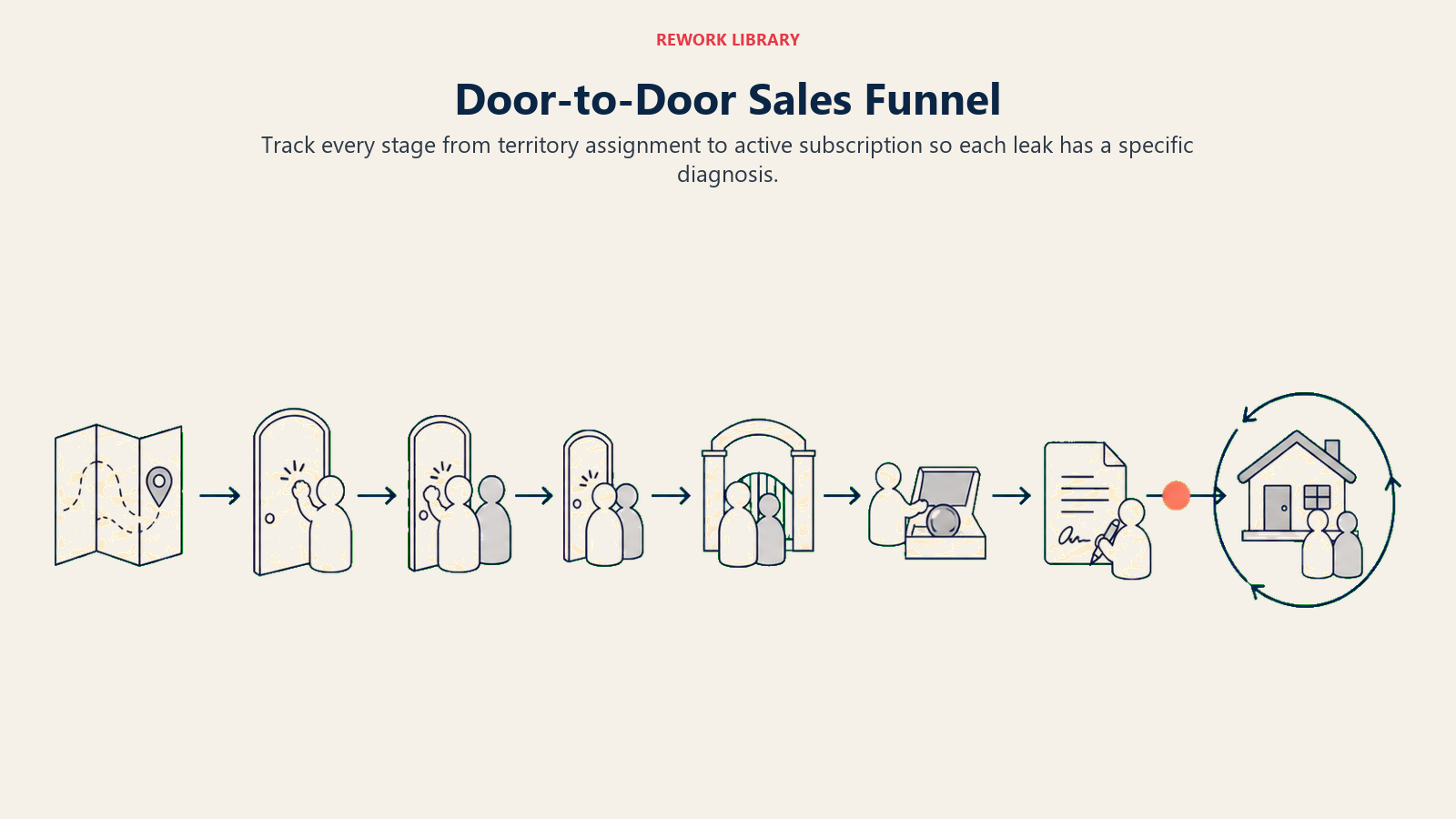
Most D2D sales managers track one number: how many accounts did the rep close today? That's the output. But the output is the result of five or six earlier decisions and interactions, and if you only measure the output, you can't tell why a rep is struggling or where the team is losing deals.
A door-to-door sales funnel maps every stage from "we assigned a territory" to "service is active and the customer is retained." Each stage has a conversion rate. Each conversion rate tells you something specific about what's working and what isn't.
This article walks through the full funnel, stage by stage, with industry benchmarks where they're available and diagnostics for when a stage is underperforming.
Why Funnel Thinking Changes D2D Management
Traditional field sales management in D2D is intuitive and experiential. A manager rides along, watches a rep pitch, gives feedback, and sends them back out. That approach produces competent reps over time, but it doesn't scale, and it doesn't identify systemic problems.
Funnel management does both. SPOTIO's State of Field Sales 2026 found that only 35% of field sales teams have more than 70% of reps consistently hitting quota, a sign that most organizations are managing outputs without understanding where in the funnel the leaks actually are. When you track stage-by-stage conversion rates across the whole team, you can answer questions like:
- Is the team knocking enough doors, or are they cherry-picking easier-looking streets?
- Are they getting doors to open but failing to qualify, or qualifying well but losing at pitch?
- Is the close rate strong but early cancellations high, suggesting pitch misalignment?
These questions have different solutions. A team with a knock-to-door-open problem needs different coaching than a team with a pitch-to-close problem. Without funnel data, you're guessing which problem you have.
Key Facts
- Only 35% of field sales teams have more than 70% of their reps consistently hitting quota, which means most organizations are managing outputs without understanding where in the funnel the leaks actually are. (SPOTIO State of Field Sales 2026)
- 41% of field sales organizations report annual rep turnover above 50%, compounding funnel performance problems as experienced reps take institutional knowledge with them. (SPOTIO State of Field Sales 2026)
- The FTC's Cooling-Off Rule (16 CFR Part 429) gives buyers three business days to cancel any door-to-door sale of $25 or more, meaning the period between signed agreement and first service is a legal rescission window, not just an operational handoff. (FTC)
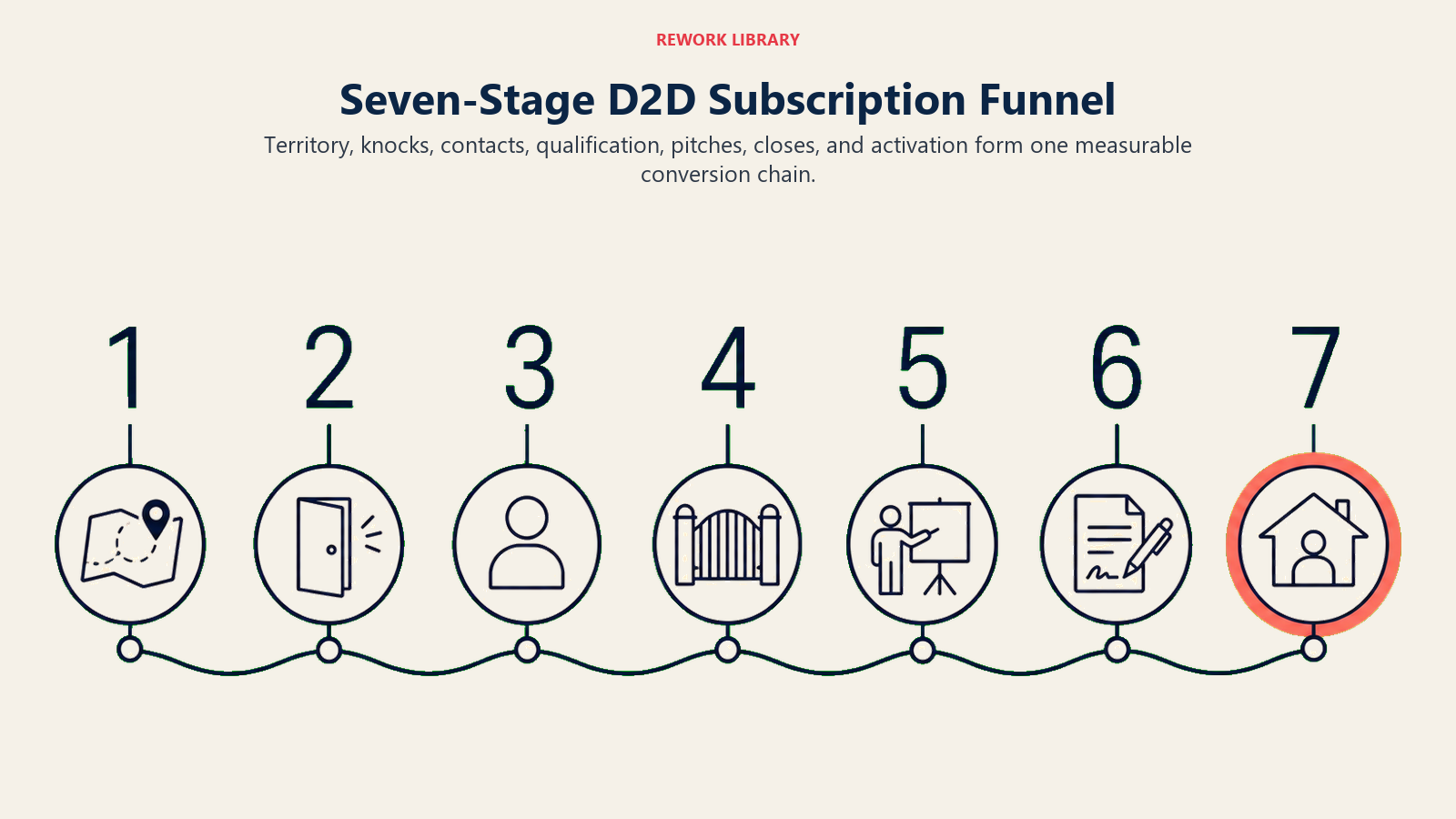
The seven stages below are where those questions get answered.
The D2D Subscription Funnel: Seven Stages
Stage 1: Territory Assigned and Worked
The funnel starts before any rep knocks a door. A territory is selected, assigned to a rep or a team, and then physically worked. "Worked" means reps have covered the addresses, not just driven through the neighborhood.
The relevant metric here is penetration rate: what percentage of addresses in the assigned territory were actually knocked? Many D2D teams assign territories and assume coverage. When managers pull data from canvassing apps, they often find reps missed 30% to 50% of addresses by sticking to easy-access blocks and skipping apartment complexes, gated streets, or long driveways.
Low penetration rate means the funnel is narrow at the top. No amount of conversion optimization further down the funnel fixes a team that isn't knocking enough doors.
Benchmark: Aim for 80%+ address penetration in assigned territory per shift.
Stage 2: Doors Knocked
How many doors did the rep physically knock? This is different from addresses assigned because some homes will be empty, inaccessible, or already have "No Soliciting" signs that the rep appropriately avoids.
Doors knocked per hour is a pacing metric. A rep who knocks 6 doors per hour is spending too much time in transit or too much time on unqualified conversations. A healthy pace in a dense residential area is 10 to 15 doors per hour, depending on street layout and the length of the initial qualifying exchange.
Benchmark: 10-15 doors knocked per working hour in residential territory.
Stage 3: Contact Made (Door Opened)
Not every knock gets an answer. Homeowners aren't home, don't answer, or see you through the peephole and decide not to come to the door. The contact rate measures how often a knock results in an actual human-to-human interaction.
Contact rates vary significantly by time of day, day of week, and neighborhood type. Knocking between 5pm and 8pm on weekdays produces significantly higher contact rates than morning knocks. Saturdays are strong in most markets. Sunday afternoons are often underrated.
A rep with a strong contact rate in a given territory is timing their visits well and picking good streets. A rep with a weak contact rate may be working the wrong hours or hitting commercial-heavy blocks where homeowner density is low.
Benchmark: 30-50% contact rate on doors knocked (varies by time and territory type).
Stage 4: Qualified at the Door
Not every conversation becomes a sales opportunity. The rep needs to establish in the first two to three minutes that the person answering is a homeowner (or decision-maker), has the problem the service solves, and isn't currently under a competing contract.
This is the qualifying stage. It shouldn't feel like an interrogation, but it does need to happen. Reps who skip qualification waste time pitching renters, customers who already have the service, or households with zero interest.
For a deeper look at what effective qualification looks like at the door, see qualifying at the door. The principles behind qualification frameworks more generally are worth a look too.
Benchmark: 60-75% of contacts qualify as worth a full pitch.
Stage 5: Full Pitch Delivered
The rep has a qualified prospect. Now they deliver the full presentation: problem framing, service overview, pricing, and terms. In home services D2D, "full pitch" usually means 5 to 15 minutes on the doorstep, depending on vertical.
The conversion rate from qualified prospect to full pitch is usually high (80%+) if the qualifying conversation was handled well. If it drops, look at what's happening in the transition from "you're qualified" to "let me show you what we offer." Some reps rush this pivot and lose rapport; others qualify well but don't know how to move naturally into the presentation.
Benchmark: 80-90% of qualified prospects receive a full pitch.
Stage 6: Close Attempted
The rep asks for the close. They present a service agreement or contract, request the signature, and handle objections if they arise. This is where the sale either happens or doesn't.
Close rate on full pitches is the number most D2D teams obsess over. In subscription home services, a strong close rate is roughly 20-35% of full pitches, depending on vertical and competitive landscape. Security tends to run lower (15-25%) because the commitment is longer. Pest control runs higher (25-40%) because the price point is lower and the same-day close is easier.
A rep with a weak close rate at this stage usually has one of three problems:
- Objection handling is weak. They're losing to "I need to think about it" and "my spouse isn't home" instead of working through those barriers.
- The pitch didn't create enough urgency. The customer isn't convinced they need the service now.
- They're not actually asking for the close. Some reps pitch well and then wait for the customer to volunteer to sign, which almost never happens.
See same-visit close techniques and objection handling at the door for specific frameworks.
Benchmark: 20-35% of full pitches convert to a signed agreement.
Stage 7: Account Activated (Service Starts)
Closing the account and starting the service aren't the same event. In home services, there's a handoff process where the sales rep passes account details to the service operations team, a first appointment gets scheduled, and the customer receives confirmation.
This is where many subscription businesses lose accounts before the service even begins. A customer who signs on Tuesday and doesn't hear from anyone by Friday is second-guessing their decision by Saturday. The rescission window (typically 3 business days for in-home contracts under the FTC's Cooling-Off Rule, 16 CFR Part 429) is when buyers' remorse is highest.
The conversion rate from closed account to active account measures how many signed agreements actually become live subscriptions. In a well-run operation, this should be above 90%. If it's lower, the handoff process has gaps.
Benchmark: 90%+ of signed agreements should become active subscriptions within 5 business days.
Putting the Full Funnel Together
Here's what the funnel looks like with industry-average numbers for a mid-size pest control operation:
| Stage | Input | Conversion Rate | Output |
|---|---|---|---|
| Doors knocked (per rep, per 8-hour shift) | 100 | 100% | 100 doors |
| Contacts made | 100 | 35% | 35 contacts |
| Qualified prospects | 35 | 65% | 23 prospects |
| Full pitches delivered | 23 | 85% | 20 pitches |
| Signed agreements | 20 | 30% | 6 closes |
| Active accounts | 6 | 92% | 5.5 accounts/rep/day |
A rep closing 5-6 new pest control accounts per shift is performing well. A rep closing 2-3 accounts on the same volume of doors has a problem somewhere in the funnel. The table shows you where to look.
The 7-Stage D2D Funnel Model: the structured framework this article describes, where every door-to-door subscription sale passes through Territory Assigned, Doors Knocked, Contact Made, Qualified at Door, Full Pitch Delivered, Close Attempted, and Account Activated. Each stage has its own conversion rate and its own failure mode. The model's diagnostic value comes from tracking all seven stages by rep, not just the close at stage six, because the root cause of a weak output is almost always upstream.
Where Does the D2D Funnel Break, and How Do You Diagnose It?
Leak at Stage 1-2: Low doors knocked. Usually a time management or territory routing problem. Rep is spending too long at each door, walking inefficient routes, or taking extended breaks. Route and time management tools can surface this quickly. See route and time management for optimization approaches.
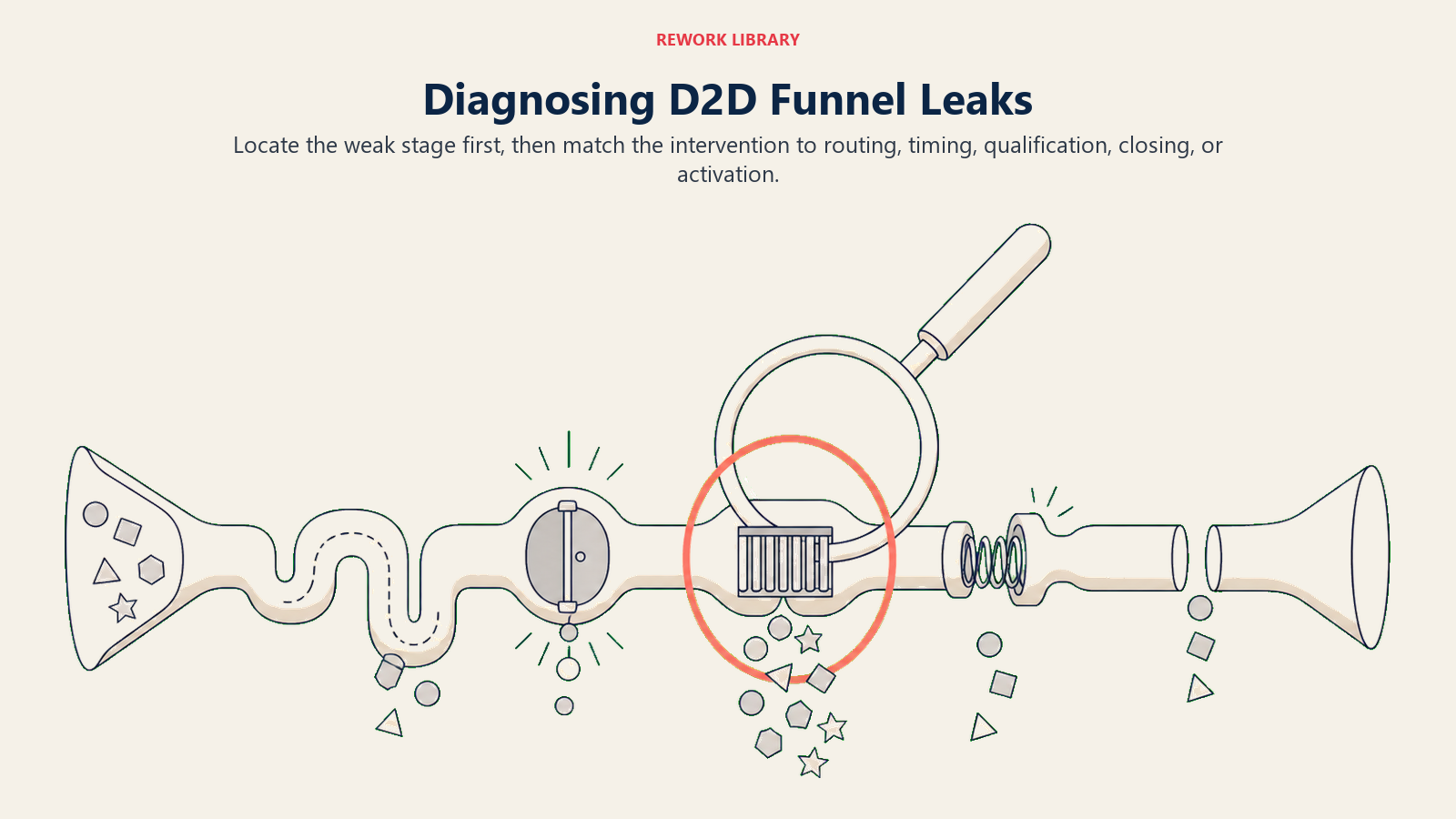
Leak at Stage 3: Low contact rate. Check the hours being worked. If reps are knocking between 10am and 2pm on weekdays, they're missing the majority of homeowners. Shift the schedule. Also check territory type: if the territory is primarily rental units or older demographics who don't answer the door, the territory itself may need recalibration.
Leak at Stage 4: Poor qualification. The rep is either skipping qualification (wasting time on non-buyers) or qualifying too aggressively (disqualifying good prospects). Both problems appear as a weak ratio of pitches to contacts. Listen to ride-along recordings from the first two minutes of each door interaction.
Leak at Stage 5-6: Strong pitch, weak close. This is often an objection handling problem. Identify the three most common objections the rep faces and build specific responses. If "I need to think about it" ends 40% of interactions, the team needs a systematic approach to that specific objection.
Leak at Stage 7: Signed accounts that don't activate. The handoff process is broken. Either the scheduling team isn't reaching out quickly enough, or the confirmation process isn't giving customers enough confidence. This is a sales-to-service handoff problem, not a sales problem.
Using Funnel Data to Coach Reps
Once you have funnel data by rep, coaching conversations change from qualitative ("you need to close harder") to specific ("your contact rate is strong but you're qualifying 20% fewer prospects than the team average, which suggests you're either rushing the qualification or pitching non-decision-makers").
Targeted coaching is faster and more effective than generic feedback. A rep who is weak at stage six doesn't benefit from coaching on canvassing routes. A rep who is weak at stage three doesn't need more objection handling drills.
Build a simple weekly dashboard that shows each rep's funnel metrics for the prior week. Flag any stage where they're more than 15% below team average. That's where the conversation starts. The D2D sales KPIs and metrics guide covers how to structure these dashboards for a field team.
What Happens to the Funnel After the Close?
For subscription businesses, the funnel doesn't end at the close. Early cancellation is a funnel stage.
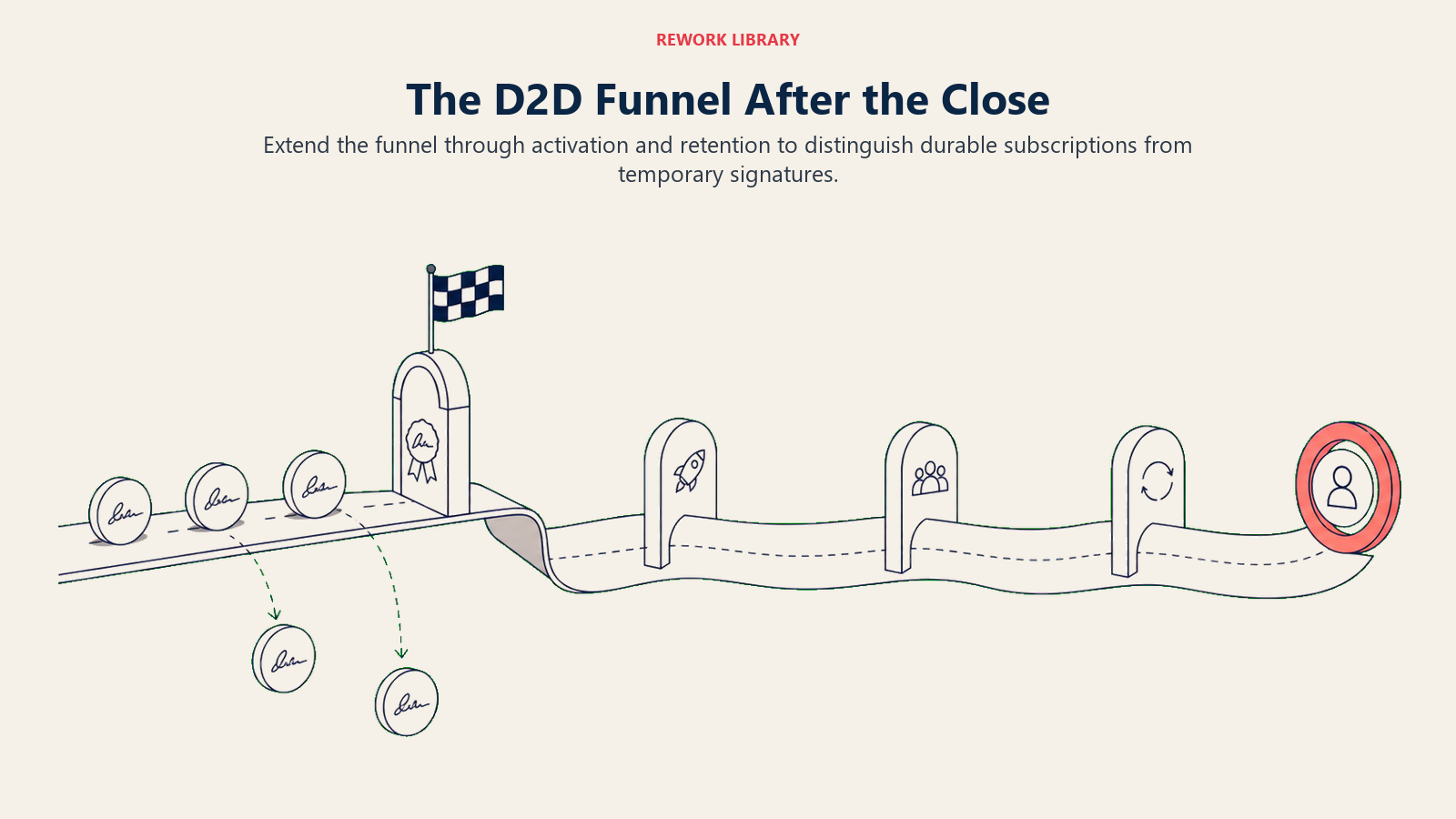
A customer who signs and then cancels within 30 days is a funnel failure. They weren't a real conversion; they were a temporary one. Tracking 30-day, 60-day, and 90-day retention rates by rep reveals which reps are closing quality accounts and which are closing anyone willing to sign in the moment.
High close rate combined with high early cancellation often means a rep is using high-pressure tactics or overpromising service capabilities. The churn prevention strategy guide covers early cancellation patterns and how to address them at the retention stage.
The D2D funnel is a tool for seeing clearly. Once you can see each stage, you can fix each stage. That's how teams turn average performers into consistent contributors and good performers into top earners.
Learn more:
- Sales-to-service handoff
- Opportunity qualification (pipeline management library)
- Lead qualification frameworks (lead management library)
Quotable Nuggets
"The FTC's Cooling-Off Rule (16 CFR Part 429) makes the rescission window a legal reality for every door-to-door sale of $25 or more. Every day between a signed agreement and a confirmed first-service appointment is a day the customer can cancel with full legal protection." (FTC)
"Teams providing at least three hours of weekly coaching report 30% lower rep churn, which means investing in funnel coaching is also an investment in retention of the people who run the funnel." (SalesRabbit 2025 Field Sales Report)
Frequently Asked Questions about The Door-to-Door Sales Funnel
What is a door-to-door sales funnel?
A structured map of every stage between territory assignment and an active subscription, with a conversion rate at each stage. For D2D home services, the standard model has seven stages: territory assigned, doors knocked, contact made, qualified at door, full pitch delivered, close attempted, and account activated.
What's a good close rate for door-to-door subscription sales?
In home services, a strong close rate on full pitches runs 20-35%, depending on the vertical. Pest control typically sees 25-40% because the price point and commitment length favor same-day decisions. Security monitoring runs lower, 15-25%, because the longer contract creates more friction. Close rate benchmarks should always be compared to team median, not top performers.
How many doors should a D2D rep knock per shift?
In dense residential territory, 80-120 doors per 8-hour shift is a healthy pace. Below 80 usually signals routing inefficiency or extended time per interaction. The doors-per-hour rate matters more than the daily total because it reveals whether the problem is effort or territory layout.
What contact rate should a D2D team expect?
A realistic contact rate in suburban residential territory is 30-50% of doors knocked. Evening hours (5pm to 8pm on weekdays) push this toward the top of that range. Midday knocking on weekdays can drop it below 20%. Time-of-day discipline is one of the fastest wins for improving funnel throughput.
Why do signed accounts sometimes fail to activate?
The gap between close and first service is where buyers' remorse forms. Under the FTC Cooling-Off Rule, customers have three business days to cancel without penalty. If the service team doesn't reach out with a scheduled appointment within 24 hours of the close, rescission risk spikes. A 90%+ signed-to-activated rate is achievable with a strong handoff process.
How do you use funnel data to coach reps?
Start by identifying which stage each rep deviates most from team median. A rep 15% below median on contact rate needs time-management coaching, not objection-handling drills. A rep 20% below on close rate needs pitch and close coaching, not canvassing route optimization. Stage-specific data produces stage-specific interventions.
What does early cancellation tell you about funnel quality?
A lot. High gross closes with high 30-day cancellation usually means a rep is closing unqualified prospects or overpromising service delivery. Track early cancellation rate by rep alongside close rate, and you get a more accurate picture of output quality than close count alone provides.

Senior Implementation Consultant
On this page
- Why Funnel Thinking Changes D2D Management
- The D2D Subscription Funnel: Seven Stages
- Stage 1: Territory Assigned and Worked
- Stage 2: Doors Knocked
- Stage 3: Contact Made (Door Opened)
- Stage 4: Qualified at the Door
- Stage 5: Full Pitch Delivered
- Stage 6: Close Attempted
- Stage 7: Account Activated (Service Starts)
- Putting the Full Funnel Together
- Where Does the D2D Funnel Break, and How Do You Diagnose It?
- Using Funnel Data to Coach Reps
- What Happens to the Funnel After the Close?