Secondary Sales Tracking and Pull-Through: Measuring What Actually Leaves the Pharmacy Shelf
Turn this article into takeaways for your work.


Each assistant summarizes the article only for you and suggests best practices for your work.
A pharma commercial team can post strong primary sales numbers for a full quarter while simultaneously watching real market demand erode. Primary sales, the volume sold from manufacturer to distributor or distributor to pharmacy, tells you what entered the channel. It does not tell you what patients actually received. That second number is secondary sales, and in most field-force organizations it is the most underused growth lever available.
The gap between primary and secondary sales is where phantom revenue lives. A pharmacy holding six months of stock because a rep sold aggressively to hit a target looks fine in primary data. But those units are sitting on a shelf. No prescription is being filled against them. No patient is on therapy. And when that stock eventually clears or expires, the commercial team will see a primary sales cliff they did not see coming because they were not watching secondary.
This article is a practical guide to building secondary sales tracking and turning that data into pull-through action for field teams. It is not about data science. It is about building a commercial feedback loop that tells reps and their managers where prescriptions are failing to convert into dispensed product, and what to do about it.
Primary vs. Secondary Sales: Why the Distinction Defines Revenue Reality
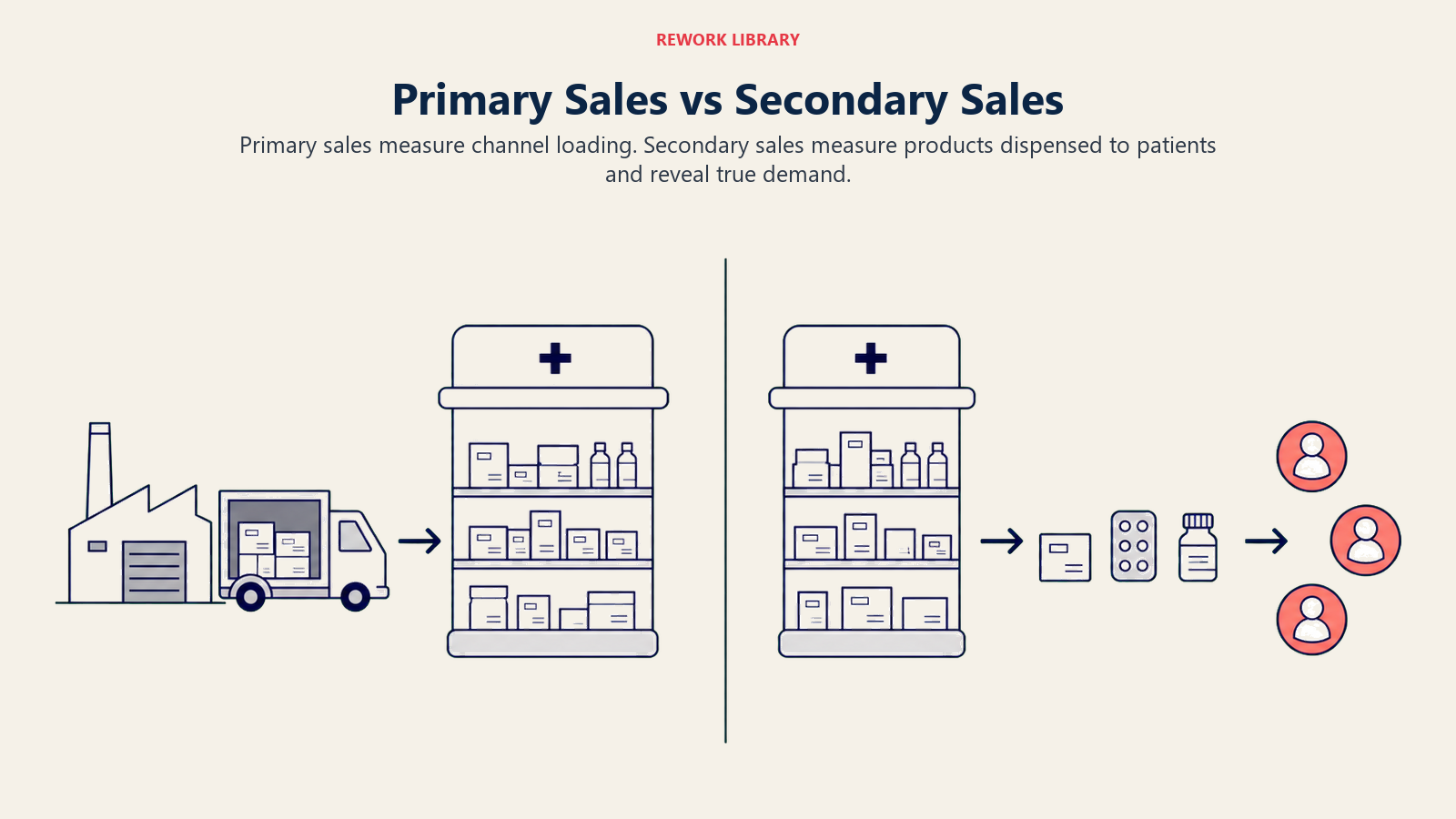
The difference between primary and secondary sales is the difference between what the channel bought and what patients consumed.
Key Facts: Secondary Sales and Pull-Through
- Prescription fill rates average 73-76% across common medication classes, meaning roughly one in four patients does not collect a written prescription (PMC, 2018).
- Channel stuffing creates a predictable primary sales cliff: when pharmacies hold excess inventory, reorders stop until that stock clears, causing a revenue gap that appears to commercial teams weeks after the underlying problem was created.
- Rep-conducted sell-through audits, when done consistently on every pharmacy visit, produce usable account-level consumption rates within two to three visit cycles and at no additional data cost.
| Dimension | Primary Sales | Secondary Sales |
|---|---|---|
| Definition | Manufacturer or distributor sells to pharmacy or hospital | Pharmacy sells to patient (dispenses) |
| Data source | Invoice and order records | POS, sell-out reports, audits |
| Availability | Immediate and complete | Lagged, partial in many markets |
| Commercial signal | Channel loading | True demand |
| Failure mode | Masks channel stuffing | Reveals prescriber conversion gaps |
| Field force lever | Rep visits drive primary orders | Patient adherence and pharmacist behavior drive secondary |
When field teams optimize for primary alone, three things tend to happen. First, channel stuffing: reps push inventory into accounts beyond what demand supports, creating short-term primary gains and medium-term primary cliffs when reorders stop because inventory is still moving. Second, stockout cycles: uneven loading means some accounts hold too much while others run out, creating availability gaps that interrupt prescriptions and damage prescriber confidence. Third, prescriber churn: when patients cannot consistently access the product or when poor adherence rates make prescribers question real-world efficacy, prescription intent shifts away from the brand even while primary sales still look acceptable.
Secondary sales data breaks this illusion. It shows what is actually happening at the point of patient contact. And it is the metric that connects the field force's effort to actual patient outcomes and sustained revenue.
Data Sources for Secondary Sales
The quality and completeness of secondary sales data varies significantly by market. But commercial teams in every market have at least some access to secondary data, and building a tracking capability means systematically using what is available.
| Data Source | Coverage | Accuracy | Availability |
|---|---|---|---|
| Third-party auditors (IQVIA, MIDAS, IMS) | Broad, panel-based | Estimated, not exact | Subscription, quarterly or monthly |
| Distributor sell-out reports | Distributor network only | Good where available | Negotiated access |
| Pharmacy POS (point-of-sale) integration | Account-specific | Exact | Varies widely by market |
| Rep-conducted sell-through audits | Rep-visited accounts only | Approximation | Available every visit |
| Prescription data panels | Prescriber level | High | Subscription, varies by market |
In mature markets with established data infrastructure, commercial teams often have access to third-party audit data (from providers such as IQVIA) at the therapy category and molecule level, supplemented by distributor sell-out reports and some pharmacy-level POS feeds. In emerging markets, distributor reports and rep-conducted audits may be the primary sources.
Rep-conducted audits deserve more credit than they receive. A rep who consistently records shelf stock levels at the start and end of each visit period, combined with order quantity data, can produce a reliable approximation of sell-through at the account level. This is not as precise as POS integration, but it is available in every market and it is current.
The practical approach for most commercial teams is to layer sources. Use third-party audit data for territory-level trend direction. Use distributor reports for account-level volume tracking. Use rep-conducted audits to fill gaps and validate third-party estimates at key accounts. And use prescription data, where available, to benchmark sell-through against the expected dispensing volume from written scripts.
Building a Pull-Through Dashboard
A pull-through dashboard translates secondary sales data into decision support for field force managers. It should answer four operational questions: Where are prescriptions converting into dispenses at low rates? Which accounts have inventory sitting stagnant? Where are stockouts occurring or at risk? And where should rep coverage be increased or redirected?
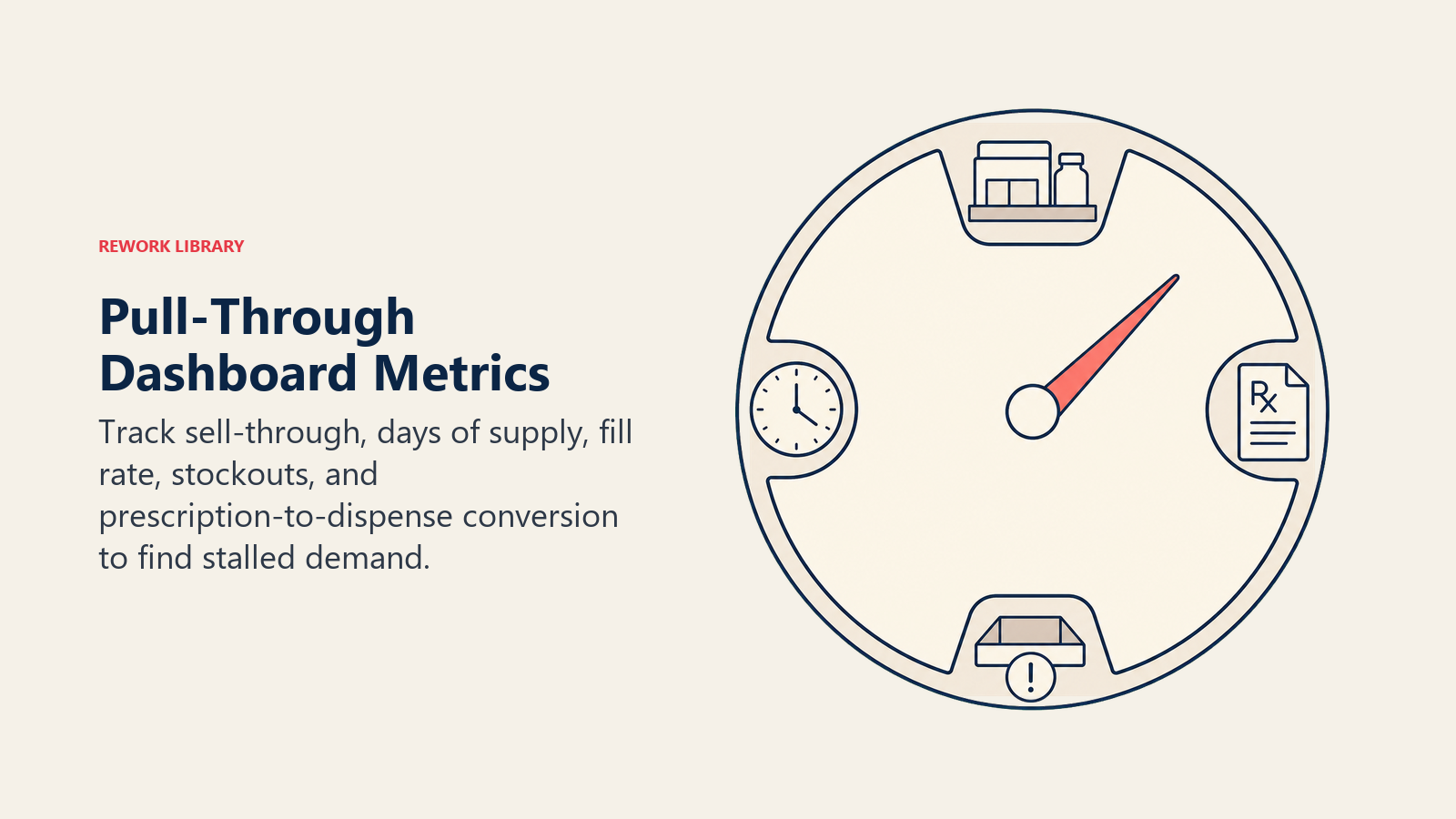
The core metrics for a pull-through dashboard:
| Metric | Definition | Illustrative Alert Threshold |
|---|---|---|
| Sell-through rate by SKU by account | Secondary units as a percentage of inventory received | Below 80% in 30 days warrants investigation |
| Days of supply | Current stock divided by average daily consumption | Below 7 days signals reorder risk; above 60 days may indicate channel loading without matching demand |
| Fill rate vs. script volume | Dispensed units compared to prescriptions written in the area | A material gap below the 73-76% national average fill rate signals a pull-through problem |
| Prescription-to-dispense conversion | Percentage of scripts that result in a dispense | Benchmark varies by therapy area; track directional trend over time |
| Stockout frequency | Number of zero-stock events per account per quarter | Target: zero at high-prescribing accounts |
| Secondary sales growth rate | Period-over-period change in sell-through volume | Declining rate signals emerging problem |
Note: the thresholds above are practical starting points for alert calibration, not industry standards. Each commercial team should set its own triggers based on historical performance data and therapy-area norms.
The structure of a pull-through dashboard closely parallels a revenue operations dashboard in B2B sales: both exist to surface where pipeline is converting and where it is stalling, so leaders can redirect activity before the quarter is lost. Pharma teams can use the same design principles even though the underlying data sources differ.
The most commercially powerful metric is fill rate versus script volume. Research published in PMC shows prescription fill rates average 73-76% across common medication classes, meaning one in four patients does not collect a written prescription. When this ratio deteriorates further, it means prescribers are writing but patients are not filling. The causes range from patient cost concerns to pharmacy stockouts to patient ambivalence about starting therapy. Each cause has a different field response, which is why the metric needs to be investigated rather than simply reported.
For territory managers, the dashboard should present a secondary sales heat map: a visual representation of sell-through performance by account and by sub-territory. High-prescribing accounts with low sell-through rates are the priority. These are places where the field force has already succeeded at the prescriber level but is losing at the pharmacy or patient level.
How Should Field Forces Act on Secondary Data?
Secondary sales data should drive rep coverage decisions. Not every account deserves equal attention, and not every account's problem is the same. The heat map created from secondary tracking creates a directed coverage model.
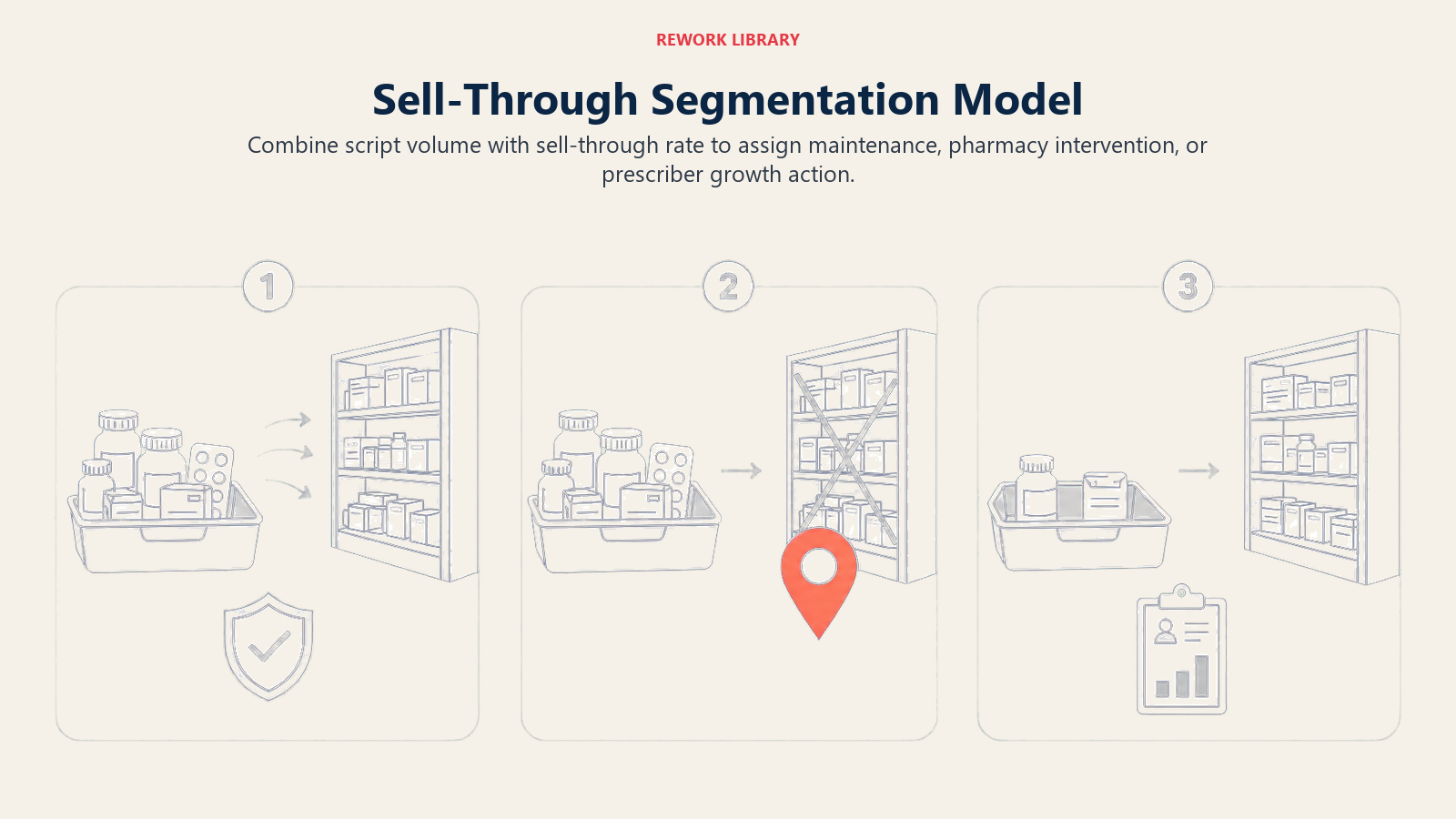 The Sell-Through Segmentation Model structures this clearly: classify every account by script volume and sell-through rate, then assign a distinct field response to each of the three resulting quadrants. Three account situations require different field responses.
High script volume, high sell-through: these accounts are working well. Rep effort here should focus on maintaining the relationship and defending against competitive pressure. A maintenance call cadence is appropriate.
High script volume, low sell-through: this is the pull-through priority. Prescriptions are being written but not converting. The rep should investigate at the pharmacy level to determine whether the issue is a stock problem (the product is not available when patients arrive), a cost problem (patients are declining the prescription at point of dispense due to price), a pharmacist behavior problem (staff are not actively dispensing the product), or an adherence problem (patients are collecting the first fill but not returning for refills). Each requires a different response.
Low script volume, adequate sell-through: the volume is small but what is selling is moving through. The opportunity here is at the prescriber level. Rep detailing effort should focus on increasing prescription intent rather than pharmacy operations.
Reps who walk into pharmacy calls armed with secondary data have fundamentally different conversations than those relying on relationship and intuition alone. When a rep can say "your sell-through rate on this product has been running at 55% for the last two months, and I want to understand what's happening when patients arrive to collect," the pharmacist recognizes a commercial partner who understands their business.
The Pull-Through Action Loop
When secondary sales lag behind primary, the commercial team has a structured decision: what is the cause, and who is responsible for fixing it?
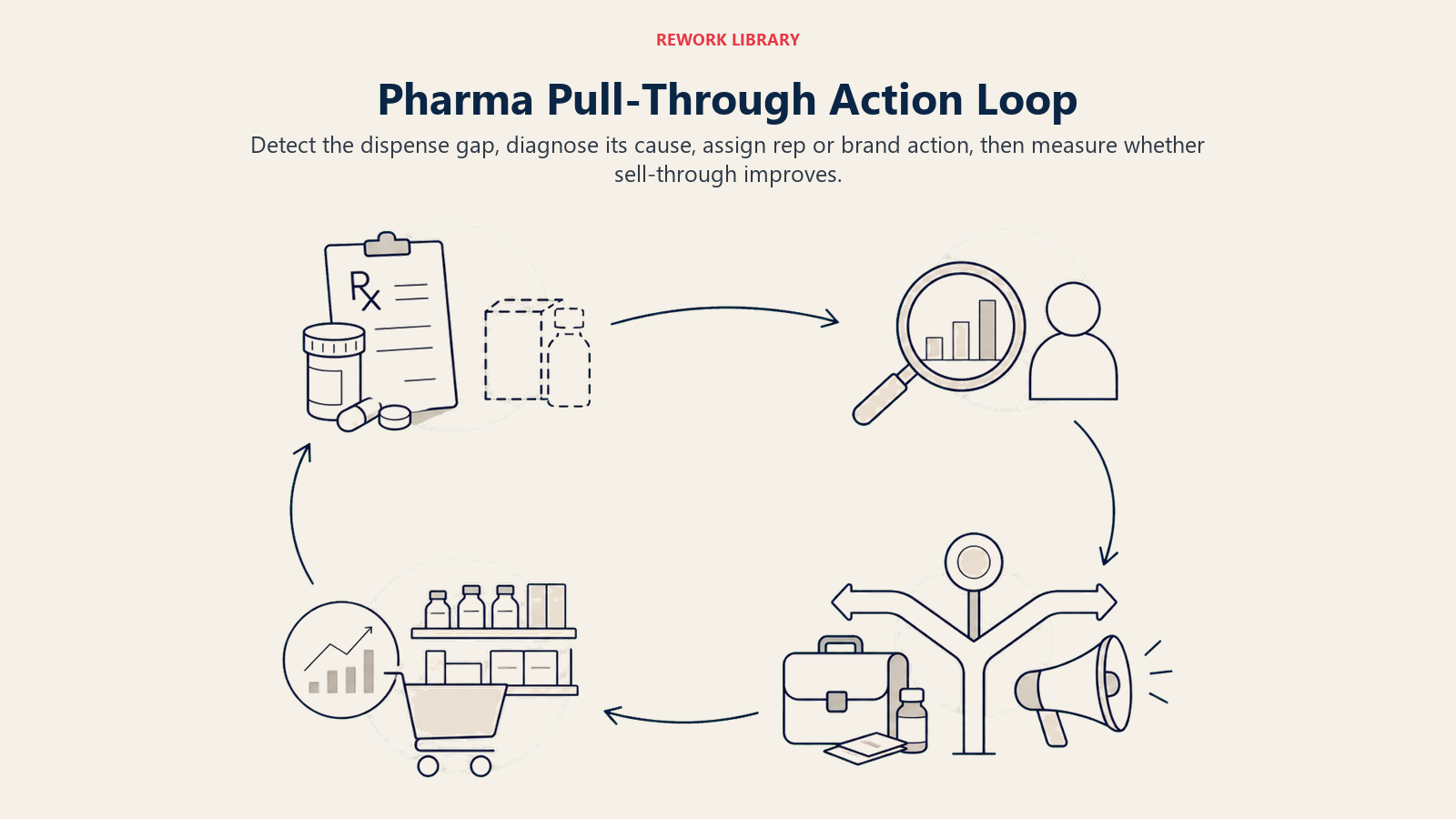 The pull-through action loop separates rep-level responses from brand team responses.
Rep-level pull-through actions (execute during field visits):
- Pharmacist training: ensure pharmacy staff understand the product's indication, appropriate patient candidates, and common questions patients ask at point of dispense
- Patient counseling support: provide pharmacists with patient-facing materials that address the most common reasons for first-fill abandonment
- Price visibility check: confirm whether any cost-access barrier exists at the account and escalate to the market access team if a patient assistance mechanism is not being applied
- Stock and visibility audit: ensure the product is stocked, priced correctly, and visible to patients and pharmacy staff at point of dispense
- Refill reminder system: work with the pharmacist to implement any available mechanism for proactive refill outreach to patients
Brand team pull-through actions (activated when account-level issues reflect a systemic problem):
- Push campaign: if sell-through rates are low across a broad territory, a targeted campaign to drive prescriber intent may be needed
- Patient program activation: if fill-rate-to-script-volume gaps suggest patient-level barriers, activating a patient awareness and adherence program addresses the dropout mechanism
- Market access intervention: if cost is identified as a systemic barrier at dispense, pricing or patient assistance programs need review
- HCP communication: if prescribers are writing scripts that are not being filled, understanding whether they are aware of this pattern and what they think the cause is can surface information that the secondary data alone cannot provide
The action loop needs to be documented and reviewed. It is not enough to identify that pull-through is lagging. The rep, the territory manager, and the brand team need to agree on what action is being taken, by whom, and when the impact will be measured.
Reporting Cadence and Accountability
Secondary sales data has the most commercial value when it is reviewed regularly, not archived. The reporting cadence should match the pace of the business.
Weekly review (territory manager level): review secondary sales by account for key products in the territory. Flag any accounts where sell-through has deteriorated significantly week over week. Identify whether any stockout events occurred and whether reorder systems responded appropriately. This review takes 20 to 30 minutes with a well-designed dashboard.
Monthly review (commercial leadership level): assess secondary sales trends at the territory and regional level. Compare actual secondary performance to primary sales to identify channel loading concerns. Review pull-through action plans that were initiated in prior weeks and assess whether the metrics have moved.
Quarterly review (strategic level): compare secondary sales growth rates to prescription data and market audit data. Assess whether the gap between scripts written and units dispensed is narrowing or widening, and whether the field force's activity is aligned with the accounts showing the largest pull-through opportunities.
Rep scorecards should include a secondary sales component. A rep who posts strong primary sales by pushing inventory into accounts without corresponding secondary performance is creating a short-term illusion, not building territory value. Including sell-through rate or secondary sales growth as a scorecard metric creates accountability for outcomes at the patient level, not just outcomes at the pharmacy buyer level.
Common Pitfalls in Secondary Sales Tracking
Several common mistakes reduce the value of secondary sales programs even in commercial teams that have invested in data access.
Data lag. Third-party audit data is typically one to three months old by the time it reaches commercial teams. Decisions made on that data are responding to conditions from two quarters ago. Supplement audit data with more current sources such as distributor sell-out and rep-conducted audits to reduce the lag, and be explicit with the field force about the data age when presenting trends.
Account-level blind spots. Territory-level secondary sales numbers hide enormous account-level variation. A territory with good average sell-through might have two high-volume accounts with chronic stockout problems that are being masked by strong performance elsewhere. Always review secondary data at the account level for top accounts, not just at the aggregate.
Over-reliance on distributor reports. Distributor sell-out reports show what the distributor has sold to pharmacies. They do not show what pharmacies have sold to patients. A pharmacy that is receiving consistent distributor deliveries may still be accumulating dead stock if the product is sitting on the shelf. Distributor data needs to be paired with pharmacy-level sell-through data to produce a complete picture.
Treating secondary tracking as a reporting function rather than a decision function. The most common failure mode is building a secondary sales report and distributing it without connecting it to field force behavior. Secondary data generates commercial value only when it changes what reps do during their calls and what territory managers direct them to focus on.
Connecting secondary tracking to territory analytics and sales dashboards is what transforms raw data into directed action.
Secondary Sales and Supply Chain Visibility
Pull-through failures are not always demand-side problems. Sometimes the pharmacy wants to sell the product and the patient wants to buy it, but the product is not available because the supply chain has failed to replenish stock in time.
Secondary sales data needs to be paired with supply chain visibility to distinguish between demand failures (prescriptions not being filled because patients or pharmacists are not engaging) and supply failures (prescriptions not being filled because the product is not there). The response to each is completely different.
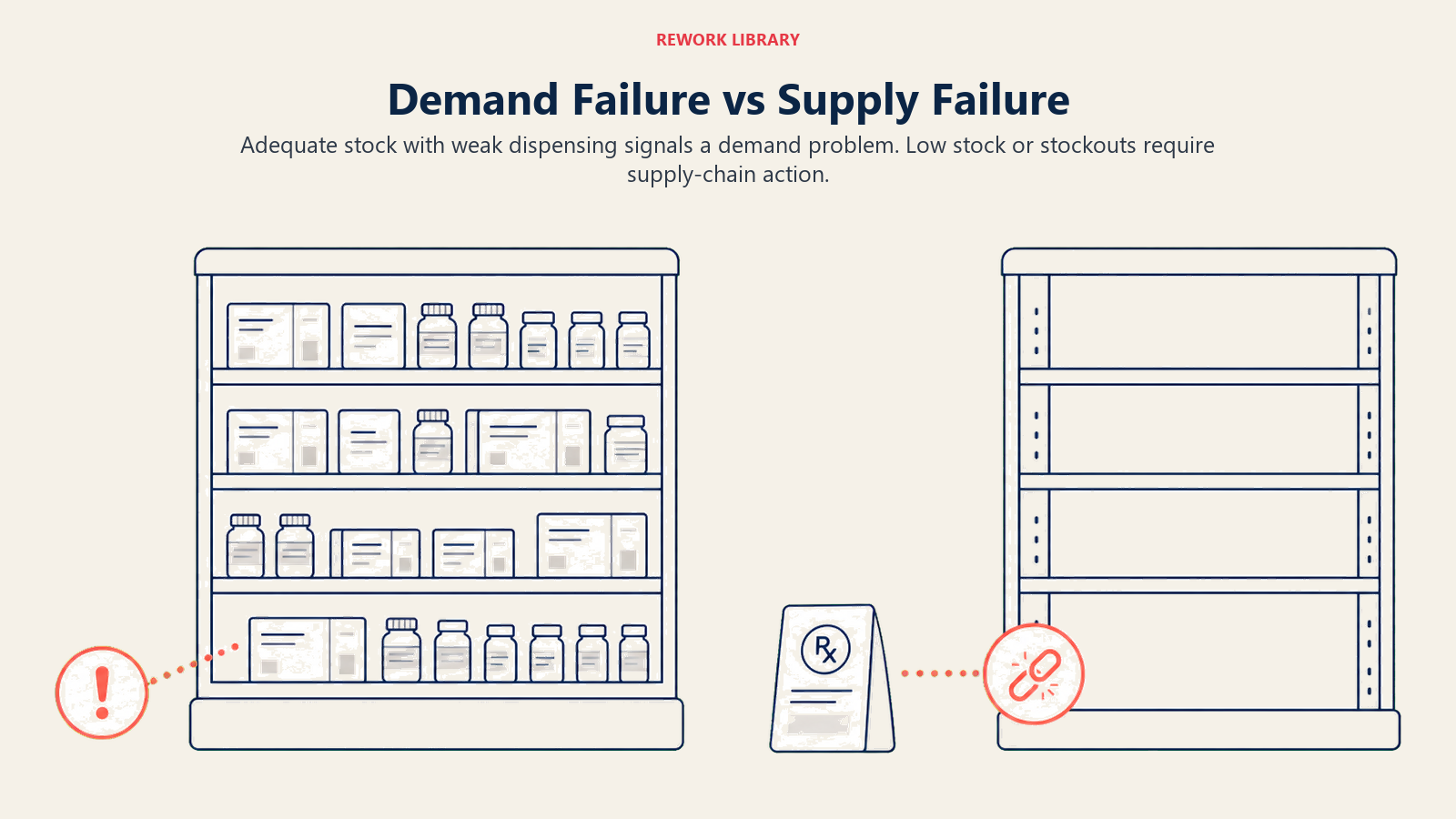
When secondary sales gaps are concentrated at accounts that also show stockout events or low stock levels, the problem is supply chain, not demand. The field response should focus on repeat order and reorder systems and on escalating to the supply chain team, not on training pharmacists or activating patient programs. Connecting to pharma supply chain and inventory visibility data closes this diagnostic loop.
When secondary sales gaps exist at accounts with adequate stock levels, the problem is demand-side. Patient behavior, pharmacist behavior, prescriber follow-through, or cost barriers are the likely causes. The field response should be patient and pharmacist-facing. Those responses are the territory actions the pull-through action loop is designed to trigger.
Closing the Loop
Secondary sales tracking closes the most important loop in pharma commercial operations: the loop between the investment a field force makes in building prescriber relationships and the revenue that investment actually generates at the patient level.
Without secondary data, commercial teams are flying on half the information. They know how hard they worked at the prescriber level. They do not know whether that work converted into sustained pharmacy volume and patient outcomes. And they cannot optimize their field force activity against reality because they cannot see it.
With secondary data, commercial teams can see exactly where prescriptions are converting and where they are not. They can direct their reps toward the pull-through gaps that represent the highest-value opportunities. They can identify when patient programs need to be activated, when supply chain problems need to be escalated, and when pharmacist training is the missing piece. And they can measure whether the actions they take are actually moving the metrics that matter.
Secondary sales tracking is not a data project. It is the commercial team's clearest window into whether the strategy is working.
Frequently Asked Questions about Secondary Sales Tracking and Pull-Through
What is the difference between primary and secondary sales in pharma?
Primary sales measure volume sold from manufacturer to distributor or pharmacy, reflecting what entered the channel. Secondary sales measure what pharmacies actually dispensed to patients. Primary data is available immediately from invoices; secondary data is lagged and requires third-party audit data, distributor sell-out reports, or rep-conducted audits. Secondary is the true demand signal.
What data sources are available for secondary sales tracking?
Common sources include third-party auditors such as IQVIA for panel-based territory trend data, distributor sell-out reports for account-level volume, pharmacy POS integration where available for exact dispense counts, rep-conducted sell-through audits for current account-level estimates, and prescription data panels for prescriber-level benchmarking. Most commercial teams layer two or three of these to balance accuracy against data lag.
How do you build a pull-through dashboard?
A pull-through dashboard should answer four operational questions: where are prescriptions converting at low rates, which accounts have stagnant inventory, where are stockouts occurring or at risk, and where should rep coverage shift. Core metrics include sell-through rate by SKU and account, days of supply, fill rate versus script volume, and stockout frequency. The most actionable output is a secondary sales heat map showing sell-through performance by account across the territory.
What does a low sell-through rate indicate?
A sell-through rate that drops materially below your historical baseline or falls well below national prescription fill rate averages signals that inventory at the account is not converting to patient dispenses at a healthy rate. The specific threshold that should trigger investigation will vary by therapy area and account type; the 80% figure used in this article's dashboard is an illustrative starting point, not an industry standard. The causes can include channel loading from aggressive primary sales, patient cost barriers at dispense, a pharmacist behavior issue, or a patient adherence gap. Each cause requires a different rep response, which is why investigation at the account level is necessary before acting.
How do you tell whether a pull-through gap is a demand problem or a supply problem?
Check whether the gap accounts also show stockout events or low stock levels. When secondary sales gaps cluster at accounts with stockout history, the problem is supply chain and the response should focus on reorder systems and distributor escalation. When gaps exist at accounts with adequate stock, the problem is demand-side: patient behavior, pharmacist behavior, prescriber follow-through, or cost access are the likely causes.
Should secondary sales appear in rep scorecards?
Yes. Including sell-through rate or secondary sales growth as a rep scorecard metric creates accountability for patient-level outcomes rather than just pharmacy buyer outcomes. A rep who posts strong primary sales by pushing inventory without corresponding secondary performance is building a short-term illusion. Secondary scorecard metrics signal that commercial leadership measures what actually reaches patients, not just what loads the channel.
Learn More

Senior Implementation Consultant
On this page
- Primary vs. Secondary Sales: Why the Distinction Defines Revenue Reality
- Data Sources for Secondary Sales
- Building a Pull-Through Dashboard
- How Should Field Forces Act on Secondary Data?
- The Pull-Through Action Loop
- Reporting Cadence and Accountability
- Common Pitfalls in Secondary Sales Tracking
- Secondary Sales and Supply Chain Visibility
- Closing the Loop
- Learn More