Doctor Detailing Best Practices: How to Earn Two Minutes That Change Prescribing Habits

Turn this article into takeaways for your work.


Each assistant summarizes the article only for you and suggests best practices for your work.
The rep had a beautiful detail aid. Full-color, six-panel fold-out, mechanism-of-action visual that genuinely illustrated why the molecule worked the way it did. He'd memorized the key trial data. He got five minutes with a cardiologist between patients, which is more than most reps get, and delivered what he considered an excellent detail. Clear, confident, accurate.
Three months later, the cardiologist's prescribing data showed zero movement. When a senior field manager asked what had happened, the rep said he thought the appointment went well. The cardiologist, asked informally at a medical education event, said: "He told me things about the drug I already knew. He never asked me about my patients."
That cardiologist wasn't resistant to the brand. She was resistant to feeling sold to instead of consulted. The rep had the product right and the doctor wrong.
The detail is not a product presentation. It's a brief clinical conversation targeted to a specific patient type in a specific doctor's practice. When the rep treats it as a clinical consultation, prescriptions follow. When she treats it as a product pitch, she leaves with a polite handshake and a flat script count.
The HCP Attention Economy
Key Facts: Doctor Detailing Effectiveness
- The average detailing window with a GP or family physician is 90 seconds to three minutes; specialists in hospital outpatient settings run slightly longer but rarely exceed five minutes in a non-scheduled interaction.
- Reps trained to deliver a complete core message in 90 seconds consistently outperform those trained on full-length detail walkthroughs, because they can deliver value regardless of how much time they actually get.
- A detail that opens with a patient type rather than a product name is more likely to hold health care professional (HCP) attention through the evidence stage, because physicians self-select based on immediate relevance to who they are seeing that day.
A busy outpatient clinic doesn't have slack built into it, and ward rounds don't pause for product presentations. Specialists sometimes run slightly longer than GPs, but not by much.
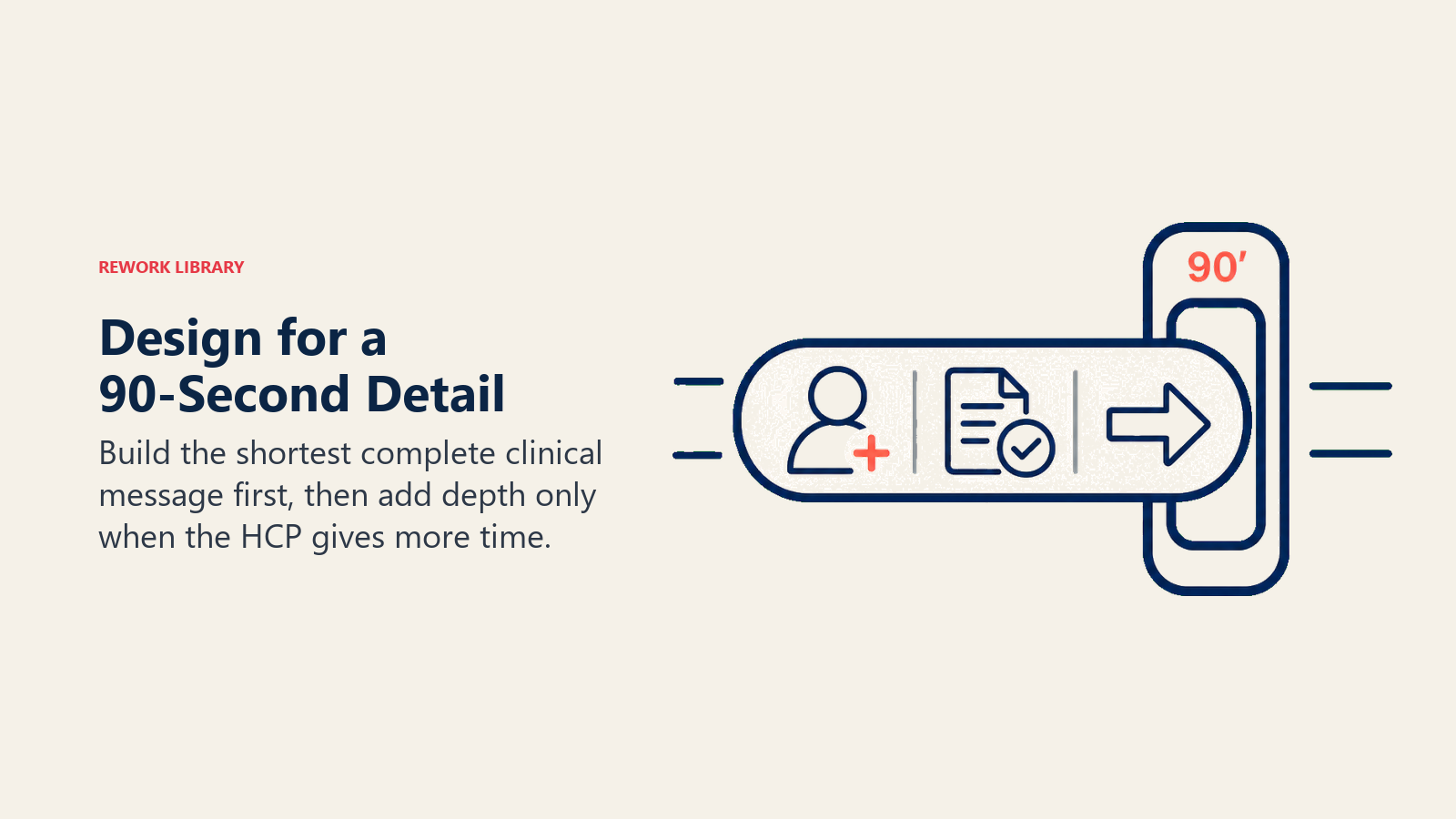
This is not a complaint. It's a design constraint. A rep who walks into a detail expecting five minutes and structures her message for five minutes will fail when she only gets two. A rep who prepares a 90-second core message and uses the additional time when it's available will consistently perform better across a full day of calls.
The implication for training is significant. The standard practice of rehearsing long verbal walkthroughs of detail aids produces reps who are fluent in the full-length version and awkward when interrupted at the two-minute mark. The right practice is to train the shortest version first and work upward. If the rep can deliver the core clinical message in 90 seconds, the three-minute version is just that core plus one follow-up point.
What goes into 90 seconds? One patient type. One clinical insight. One specific ask. That's the unit of an effective detail. Everything else is optional expansion.
The PREP Detailing Structure
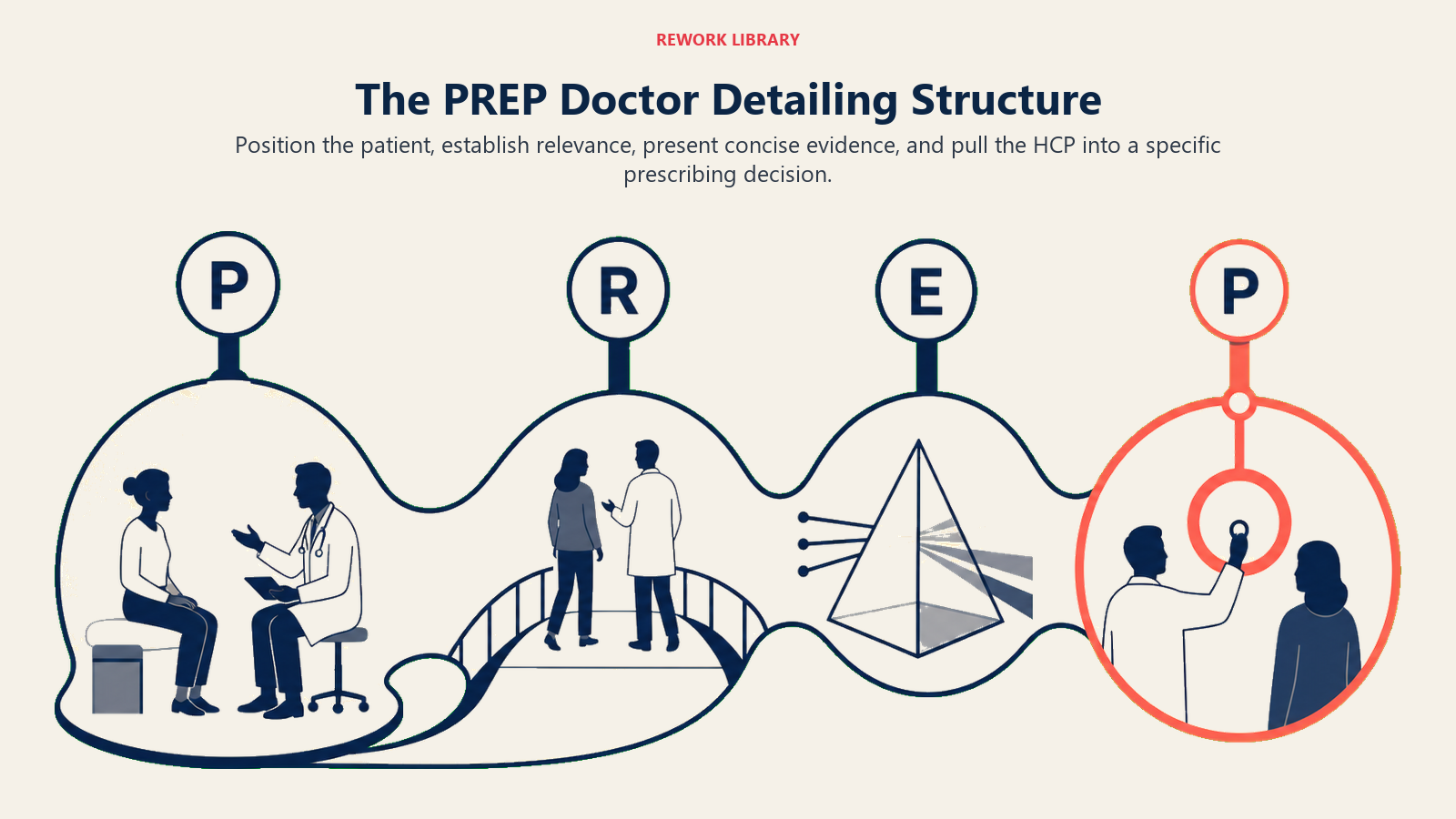
PREP is the four-stage structure that organizes those 90 seconds, or five minutes if you get them, into a sequence that consistently moves prescribing behavior.
Position
Position means opening with the disease area and the specific patient type this conversation is about. Not the product. Not the company. The patient.
"Dr. Hassan, I want to spend a couple of minutes on your COPD patients who are still exacerbating despite being on a LABA. Specifically the ones where you're wondering whether to step up."
That single sentence tells the doctor:
- This is about a patient problem, not a product pitch
- It's specific to a population she already has in mind
- It respects her clinical judgment by acknowledging she's already managing these patients
Doctors self-select their attention based on relevance to their practice. The fastest way to lose a detailing window is to open with a product feature or a company update that has no immediate connection to who the doctor is seeing in the next three hours. Position the conversation around a patient type first, and you've earned the next 60 seconds.
Relevance
Relevance is the bridge from the patient type to a single clinical data point that matters specifically to this doctor's practice.
"In patients like that, the most common reason for continued exacerbation despite LABA therapy is eosinophilic inflammation that the LABA isn't addressing. Your practice population, based on the regional respiratory data, has a slightly higher prevalence of eosinophilic phenotype than average."
The second sentence is only possible if the rep has done the pre-call work: reviewing available data on the practice's patient population, specialty mix, or published prescribing patterns. Not every detail opportunity allows for that level of preparation, but every rep should be aiming for it with A-tier HCP accounts. See pre-call planning and objection handling for how that preparation is structured.
If practice-level data isn't available, relevance shifts to specialty-level knowledge. A conversation with a cardiologist about heart failure patients uses different clinical reference points than the same product conversation with a nephrologist who manages the same patient population. The data may be the same. The entry point is different.
Evidence
Evidence is the core clinical fact that supports the position and the relevance claim. One trial result. One mechanism-of-action point. One patient outcome story pulled from an appropriate real-world data source or a published case summary.
"The EMPOWER study showed that adding an inhaled corticosteroid in the eosinophilic subgroup reduced exacerbations by 42 percent compared to LABA alone over 12 months. That's the population I'm talking about."
The detail aid enters here as a visual anchor. The rep points to the relevant graphic, cites the trial by name, states the primary endpoint result, and stops. She doesn't read the slide. She references it.
Evidence is where many reps over-invest. They present three trials, two mechanisms, and a cost-effectiveness study. The doctor absorbs none of it with enough clarity to change behavior. Research on detailing techniques used by pharma reps found that the most effective interactions combined specific clinical evidence with targeted influence framing, rather than broad product monologues. The principle is one strong evidence point per detail, deployed precisely, leaves a clearer clinical impression than three weaker ones spread across a six-panel fold-out.
Pull
Pull is the ask. It's specific, it names a patient type, and it's framed around a clinical action rather than a product transaction.
"For your eosinophilic COPD patients who are exacerbating on LABA, would you consider trying [product] in the next patient who fits that profile? The data suggests you'd expect to see a meaningful change in exacerbation rate within the first three months."
Compliant asks follow the specific patient type framing without making guarantees beyond what's approved in the prescribing information. The ask is not "prescribe more of [product]." It's "try it in a specific patient who fits a specific clinical description." That framing is both more likely to produce a genuine trial prescription and more defensible under promotional compliance review. The underlying principle maps closely to value selling: leading with the outcome the decision-maker cares about (patient response) rather than the feature they're being asked to accept (product switch).
How Does the PREP Structure Adapt Across Different HCP Specialties?
The PREP structure holds across specialties. What changes is the clinical vocabulary, the evidence references that carry weight, and the pace of the conversation.
| HCP Type | Opening Patient Type | Evidence Anchor | Detail Length | Pace |
|---|---|---|---|---|
| GP / Family Physician | Broad, practice-common ("patients you see weekly") | Single large trial, simple endpoint | 90 seconds to 2 minutes | Faster; ready for interruption |
| Specialist (cardiologist, pulmonologist, endocrinologist) | Narrow, specialty-specific ("your HFrEF patients with eGFR above 45") | Sub-group data, mechanism discussion | 2 to 4 minutes | Slower; expects more depth |
| Hospital Consultant | Protocol-level patient criteria | Head-to-head trial, formulary-relevant data | 3 to 5 minutes in a scheduled meeting; 60 seconds on a ward round | Very compressed on ward rounds; detailed in scheduled slots |
GPs value simplicity. Give the primary result, the patient type, and the ask. Specialists expect depth: a pulmonologist who asks about the primary endpoint and p-value and gets a fumbled response won't prescribe. Hospital consultants on ward rounds get 45 seconds at most. The full PREP structure still applies, compressed to one sentence per stage: "Dr. Okonkwo, for your CKD stage 3 patients on ACE inhibitors: the DAPA-CKD data showed 39 percent reduction in the composite renal endpoint. Worth trying in your next eGFR-declining patient?" Hand over the leave-behind and step back.
Using the Detail Aid Without Reading It
A detail aid is a visual anchor, not a teleprompter.
Reps who read from the aid signal two things: they're not confident enough to speak without the page, and they're not watching the doctor because they're watching the paper. Both erode credibility fast.
The correct relationship: the rep references the visual at the Evidence stage ("here's the trial outcome graph"), points to the specific data point, then holds the aid so the doctor sees the image without reading the text. The rep should be able to complete Position, Relevance, and Pull without the aid at all. If those stages require reading, the prep wasn't deep enough.
See detail aid and visual aid usage for aid selection, handling, and leave-behind protocols.
The Medical-Commercial Balance
Some clinical questions exceed the scope of a medical rep's promotional role: complex interactions, unapproved indications, pharmacovigilance concerns. The rep's job is to acknowledge the question, confirm it's outside promotional scope, and offer a clean medical science liaison (MSL) hand-off. Off-label promotion remains a significant enforcement risk: the HHS OIG compliance guidance for pharmaceutical manufacturers identifies off-label marketing as one of the primary fraud and abuse categories, and reps who stray outside the approved indication expose their company to material liability.
Physicians respect reps who know the line. A rep who attempts to answer outside her training does more damage than simply deferring: "That's exactly the kind of question our MSL is set up for. I'll arrange a call with Dr. [MSL name] this week."
See medical MSL and commercial alignment for the escalation protocol.
Compliant Requests: How to Ask Without Violating Promotional Codes
The Pull stage has to land inside the promotional code framework. In most markets, this means:
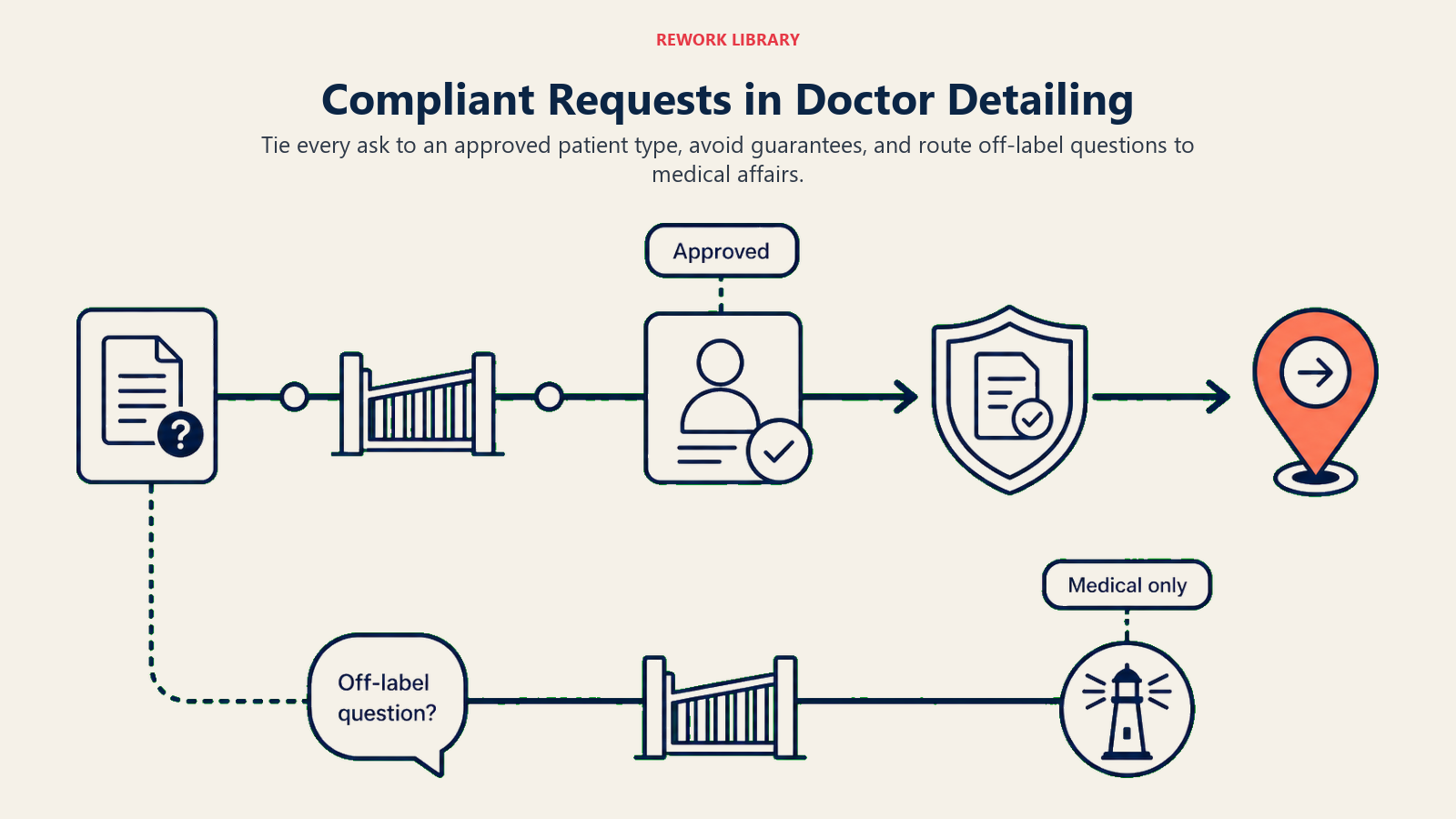
- The ask must be tied to a patient type within the approved indication
- The rep cannot promise or imply a clinical outcome that isn't supported by the prescribing information
- The ask cannot involve off-label use, even if the rep believes the clinical data supports it
- Any reference to sample provision must follow the sample accountability process (see sample-to-script conversion for the full protocol)
Compliant asks are not timid asks. "For your next patient with Type 2 diabetes and established cardiovascular disease who isn't at HbA1c target, would you consider [product]?" is specific, compliant, and action-oriented. "Prescribe more [product]" is non-specific and invites regulatory scrutiny. The PhRMA Code on Interactions with Health Care Professionals sets the industry standard for what compliant promotional conduct looks like, and reps should be familiar with it as a practical guardrail, not just a compliance checkbox.
Compliant ask examples by scenario:
| Scenario | Non-compliant version | Compliant version |
|---|---|---|
| Introducing a new product | "Try [product] for your diabetes patients" | "For your T2D patients with eGFR above 45 who aren't at target on metformin alone, would you consider [product]?" |
| Following up after a sample | "Did the samples work? Are you prescribing yet?" | "I left samples for a hypertensive patient with stage 2 CKD. Did you have a patient who fit that profile? I'd love to hear how it went." |
| Defending against a competitor switch | "Don't switch your stable patients" | "For the patients who've been stable for 12 months, the data suggests that switching introduces adherence risk. I can leave the persistence data from the 12-month extension study." |
Post-Detail Follow-Up
Three actions determine whether the detail converts to a prescription or fades.
Leave-behind. One piece of approved material: the most relevant page from the detail aid, or a reprinted trial summary if it was cited in Evidence. Not three items. One clear thing for the doctor to read after the visit.
Next appointment. Confirm the next slot before leaving, not from the car park later. Predictable rep presence earns faster order decisions and warmer access over time. The same logic applies beyond pharma: professional network development shows how sustained, scheduled touchpoints convert occasional contacts into reliable referral sources.
Sample accountability. Samples go into the log at the point of provision. The follow-up detail at the next visit asks about the specific patient type the sample was for, not a generic "did the samples work?" See sample-to-script conversion for the full protocol.
Coaching Checklist for Managers: What to Observe on a Double Call
A double call is the most effective coaching format a field manager has. One afternoon of joint HCP visits produces more durable behavior change than a day of classroom training, but only if the observation is structured and the debrief is rigorous.

Manager's detailing observation scorecard:
| Stage | What to observe | Score (1-3) |
|---|---|---|
| Pre-call preparation | Did the rep review HCP prescribing data, practice profile, and previous visit notes before entering? | 1 = No / 2 = Partial / 3 = Full review visible |
| Position | Did the rep open with a patient type, not a product? Was it specific to this doctor's practice? | 1 = Product-led open / 2 = Patient mentioned but generic / 3 = Specific patient type, practice-relevant |
| Relevance | Did the rep bridge to a clinical data point relevant to this HCP's specialty or patient mix? | 1 = No bridge / 2 = Generic relevance / 3 = Practice or specialty-specific |
| Evidence | Was one clear data point cited with trial name and endpoint result? Was the aid used as anchor, not script? | 1 = Read from aid / 2 = Cited but multiple points / 3 = One clear point, aid as visual support |
| Pull | Was the ask specific to a patient type? Was it compliant? | 1 = No ask / 2 = Generic or non-compliant / 3 = Specific patient, compliant |
| Time management | Did the rep control the time? Did the core message land before any interruption? | 1 = Lost control / 2 = Partial / 3 = Core landed in first 90 seconds |
| Medical-commercial boundary | Did the rep recognize out-of-scope questions and defer appropriately? | 1 = Tried to answer / 2 = Hesitated / 3 = Deferred cleanly with MSL offer |
| Post-detail actions | Was a leave-behind selected and left? Was the next appointment confirmed? | 1 = Neither / 2 = One / 3 = Both |
A total score below 14 triggers an immediate coaching conversation on the same afternoon. A score of 18 or above is proficient execution. The debrief should focus on one improvement priority per visit, not a comprehensive list. Reps who leave a coaching conversation with three things to fix usually change none of them. One priority, practiced on the next three calls, produces real behavior change.
Training the 90-second version of a detail first, then building up to three or five minutes, produces reps who are fluent at every time constraint rather than reps who know the full script and stumble when cut off at two minutes.
One strong evidence point deployed precisely leaves a clearer clinical impression on an HCP than three weaker data points spread across a six-panel detail aid. Physicians hearing multiple trial names and endpoint percentages in quick succession retain fewer of them than physicians who hear one result explained clearly and tied to a specific patient type.
A hospital consultant on a ward round gets a maximum of 45 seconds. The full PREP structure still applies, compressed to one sentence per stage: position the patient, state the relevant evidence, and make the specific ask before stepping back. Reps who have not practiced this compression consistently fail the test when a consultant says "go ahead" while already walking to the next patient's bed.
The PREP Detailing Structure is the four-stage sequence described in this article: Position (opening with a specific patient type, not the product), Relevance (bridging from that patient type to a clinical data point specific to this HCP's practice or specialty), Evidence (one clear trial result cited by name), and Pull (a compliant ask framed around a clinical action for a named patient type). The structure holds across all HCP types and all available time windows.
Conclusion: Two Minutes of Clinical Relevance Outperform Ten Minutes of Product Monologue
The cardiologist who heard the mechanistically accurate but clinically irrelevant detail didn't prescribe more because she wasn't given a reason to. The rep had the product right and the doctor wrong. That's the central failure mode of most underperforming detailing programs: reps who know the molecule but don't know the patient, and don't know the specific clinical reality of the doctor they're talking to.
The PREP structure fixes this by forcing every detail to start with a patient type and a clinical relevance claim before a single product data point is mentioned. The evidence follows the relevance. The ask follows the evidence. The whole sequence takes 90 seconds and leaves the doctor with one clear clinical impression instead of a blur of trial names and endpoint percentages.
Train the 90-second version first. Measure the stages, not just the visit count. Coach on double calls and score against the rubric above. The reps who consistently top HCP engagement scores aren't the ones with the deepest product knowledge. They're the ones who walk into every consulting room knowing exactly which patient they're there to talk about, and who ask for exactly one specific action before they leave.
Frequently Asked Questions about Doctor Detailing Best Practices
What is the PREP detailing structure?
PREP stands for Position, Relevance, Evidence, and Pull. Position opens the conversation with a specific patient type in the doctor's practice, not with a product feature. Relevance bridges that patient type to a clinical data point meaningful to this HCP's specialty or patient mix. Evidence deploys one clear trial result by name, with the detail aid as a visual anchor rather than a script. Pull closes with a compliant ask tied to a named patient type and a specific clinical action.
How long should a doctor detail last?
The core message should be deliverable in 90 seconds. That's the minimum viable detail: one patient type, one clinical insight, one specific ask. If the HCP has more time, the rep expands by adding a second evidence point or addressing a likely objection. Training the 90-second version first ensures reps can deliver value regardless of how much time the consultation room actually gives them.
What is the difference between a compliant and non-compliant detailing ask?
A compliant ask names a specific patient type within the approved indication and frames the request as a clinical action, not a sales volume push. "For your eosinophilic COPD patients who are exacerbating on LABA, would you consider trying this in the next patient who fits that profile?" is compliant. "Prescribe more of this product" is not. The difference matters both for regulatory compliance and for conversion: specific asks tied to identifiable patient types produce more genuine trial prescriptions than broad product pitches.
How should a rep use a detail aid without reading it?
The detail aid enters at the Evidence stage as a visual anchor, not as a script. The rep points to the specific data point being discussed, maintains eye contact during the verbal statement, and references the visual together with the HCP. Positions, Relevance, and Pull should be deliverable without the aid at all. Reps who need the aid to complete those stages haven't prepared deeply enough on the specific clinical context for this HCP.
When should a rep defer a clinical question to the MSL?
Any question that falls outside the approved promotional scope, including off-label indications, complex drug interactions not covered in labeling, or pharmacovigilance concerns, should be deferred cleanly and confidently to the medical science liaison. The right response is: "That's exactly what our MSL is set up for. I'll arrange a call with [MSL name] this week." Physicians respect reps who know the line. Attempting to answer outside training does more damage than a clean deferral.
What should a field manager score on a doctor detailing double call?
Eight elements matter in the observation rubric: pre-call preparation, opening with a patient type rather than a product, bridging to specialty-specific relevance, citing one clear evidence point with the aid as anchor rather than script, making a specific and compliant pull ask, controlling the time so the core message lands in the first 90 seconds, recognizing and deferring out-of-scope questions, and completing post-detail actions (leave-behind plus next appointment confirmed). A total score below 14 out of 24 triggers an immediate coaching conversation that same afternoon.
Learn More

Senior Implementation Consultant
On this page
- The HCP Attention Economy
- The PREP Detailing Structure
- Position
- Relevance
- Evidence
- Pull
- How Does the PREP Structure Adapt Across Different HCP Specialties?
- Using the Detail Aid Without Reading It
- The Medical-Commercial Balance
- Compliant Requests: How to Ask Without Violating Promotional Codes
- Post-Detail Follow-Up
- Coaching Checklist for Managers: What to Observe on a Double Call
- Conclusion: Two Minutes of Clinical Relevance Outperform Ten Minutes of Product Monologue
- Learn More