New Pharmacy and Drug Store Acquisition: How Pharma Field Teams Win First Orders and Build Distribution
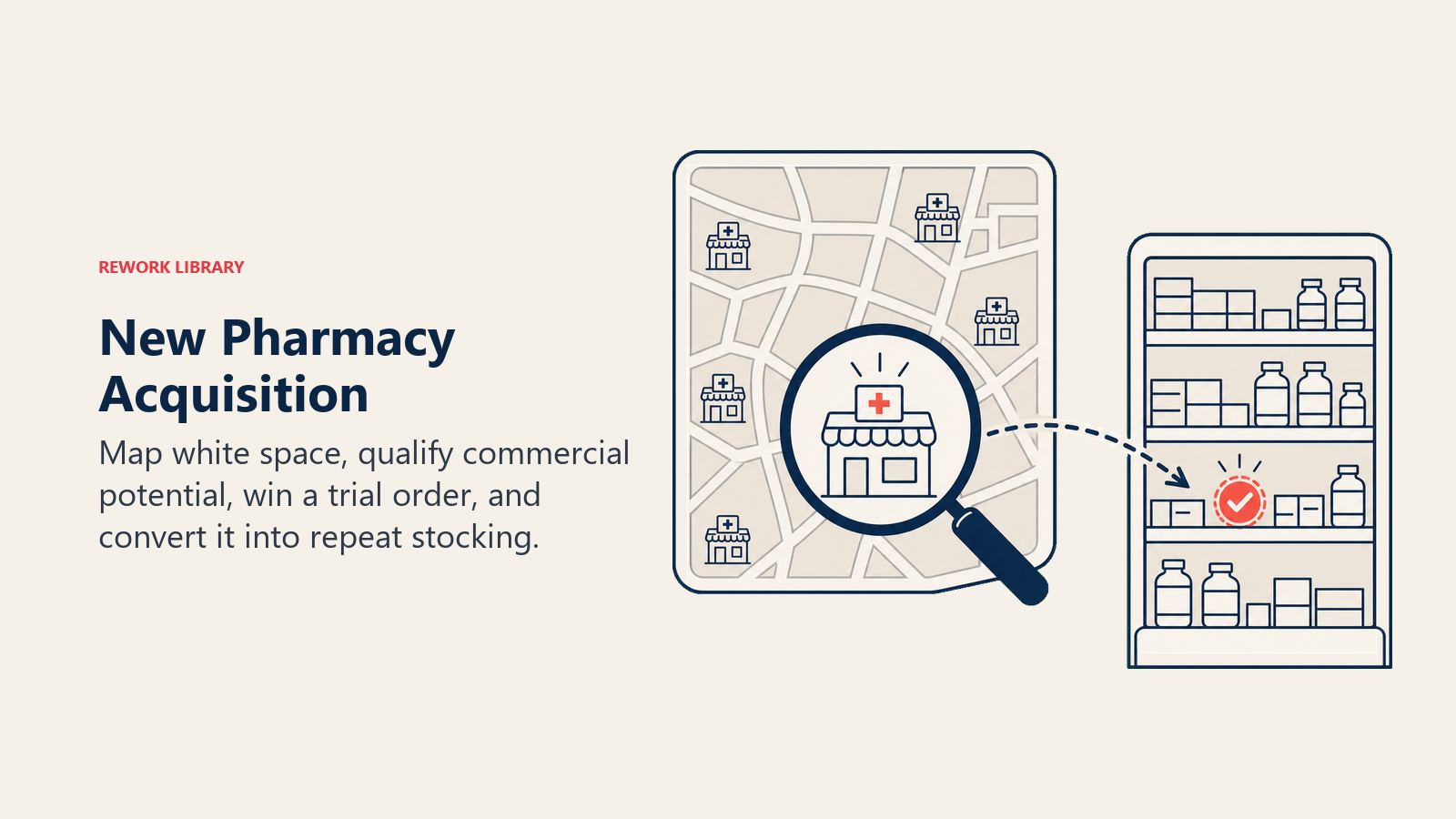 Distribution coverage is the floor, not the ceiling, of prescription volume. A product that isn't on the shelf can't be dispensed, and a pharmacy that's never been called on is a guaranteed zero in your territory sales data. For pharma commercial leaders, new pharmacy acquisition is often the fastest lever available to expand coverage without waiting on HCP conversion cycles.
But most field teams don't have a systematic approach. Reps tend to service familiar accounts, avoid cold conversations with new pharmacy owners, and default to the same circuit every cycle. The result: white-space outlets sit unserved, competitor brands fill the shelf, and distribution gaps persist quarter after quarter.
Distribution coverage is the floor, not the ceiling, of prescription volume. A product that isn't on the shelf can't be dispensed, and a pharmacy that's never been called on is a guaranteed zero in your territory sales data. For pharma commercial leaders, new pharmacy acquisition is often the fastest lever available to expand coverage without waiting on HCP conversion cycles.
But most field teams don't have a systematic approach. Reps tend to service familiar accounts, avoid cold conversations with new pharmacy owners, and default to the same circuit every cycle. The result: white-space outlets sit unserved, competitor brands fill the shelf, and distribution gaps persist quarter after quarter.
Turn this article into takeaways for your work.


Each assistant summarizes the article only for you and suggests best practices for your work.
This article gives pharma field force managers a practical acquisition playbook, from mapping unserved outlets and qualifying prospects to converting first orders into active stocking partnerships.
Why New Pharmacy Acquisition Matters More Than Account Deepening
Key Facts: Pharmacy Distribution
- A prescription that can't be filled at the nearest pharmacy has a high chance of converting to a competitor substitute, not a delayed fill. Field teams that close distribution gaps before running HCP detailing campaigns reduce this substitution risk at the catchment level.
- In the US, independent pharmacies represent roughly 35% of all retail pharmacy locations but are disproportionately under-served by pharma field teams relative to chain outlets (NCPA Digest, 2023).
- Territories with broader distribution coverage demonstrate more stable quarterly revenue, since concentration in three or fewer legacy accounts creates significant revenue fragility when those accounts shift supplier relationships.
It's tempting to focus on increasing sell-in at existing accounts. The relationship is already established, the order process is familiar, and there's something to build on. But there's a ceiling to how much an existing pharmacy will stock, and that ceiling drops when patient footfall doesn't grow.
New pharmacy acquisition does something different. It expands the total distribution footprint, which directly expands the pool of patients who can access the product when a doctor prescribes it. A prescription written by an HCP whose local pharmacy doesn't stock your product is a lost sale, not just a delayed one. The patient fills with a substitute, often a competitor, and may never switch back.
Done well, acquisition also reduces concentration risk. A territory where 60% of volume runs through three legacy accounts is fragile. One change of ownership, one wholesaler contract switch, or one competitor promotion can crater quarterly numbers. A broader account base distributes that risk and creates more stable, predictable territory performance.
The goal isn't account volume for its own sake. It's systematic coverage: making sure every viable outlet in the territory carries the product, at the right stock level, so patient demand converts into dispensed units. The question is which outlets you don't yet know about.
How Do You Identify Unserved Pharmacies in Your Territory?
You can't acquire an account you don't know exists. Mapping the territory's outlet universe against current customers reveals the white space, but most field teams rely on incomplete data. Licensing registries and regulatory records are the most comprehensive source. Most markets maintain pharmacy licensing databases through their health ministry or pharmacy council. In the United States, the National Association of Boards of Pharmacy coordinates these records across state boards, and cross-referencing its licensing infrastructure against CRM account records surfaces every licensed outlet not yet in the account universe. Distributor outlet lists are practical and often updated more frequently than regulatory records. Wholesale distributors know which outlets they supply. Research on pharmaceutical supply chain weaknesses highlights that secondary wholesalers are the least visible layer in drug distribution, which means distributor contacts can surface accounts that never appear in formal registries. A conversation with your primary distributor's sales coordinator can reveal pharmacies in the territory that are buying competitor brands or buying nothing at all.
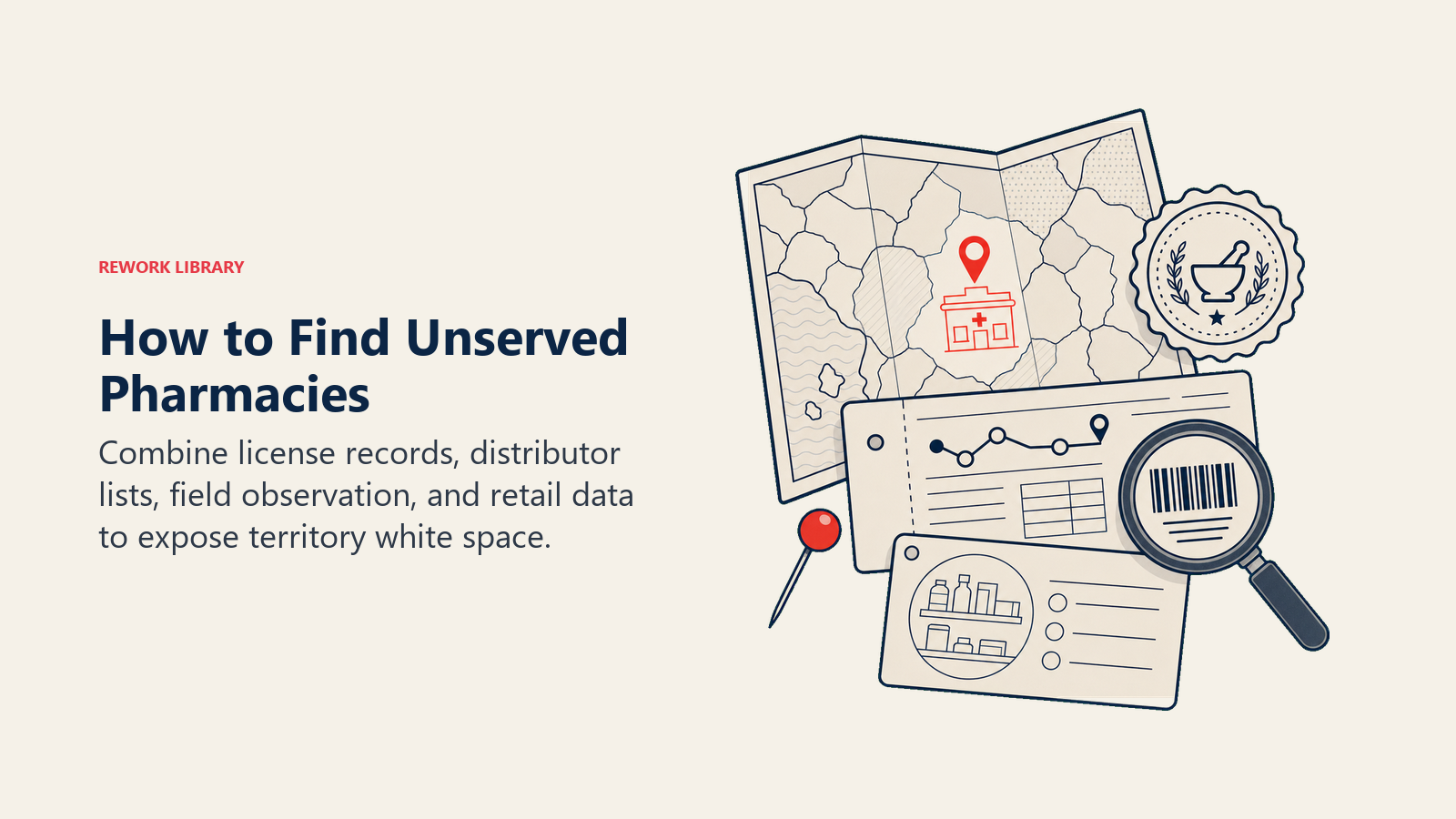
Rep field observation captures what no database records. New signage, recently opened drug stores in developing neighborhoods, pharmacies added to new commercial developments, and outlets that competitors have begun calling on. Reps who build field observation into their daily routing discover accounts before they appear in any formal registry.
Retail audit data, where available through providers like Nielsen or IQVIA's prescription tracking datasets, maps outlet density by geography and category. For larger commercial organizations, this data can feed a formal coverage gap analysis by territory.
Once you have a complete outlet list, the next step is prioritization. Not every unserved pharmacy is worth acquiring, and chasing low-potential accounts wastes rep capacity.
Prospect Qualification: Choosing the Right Targets
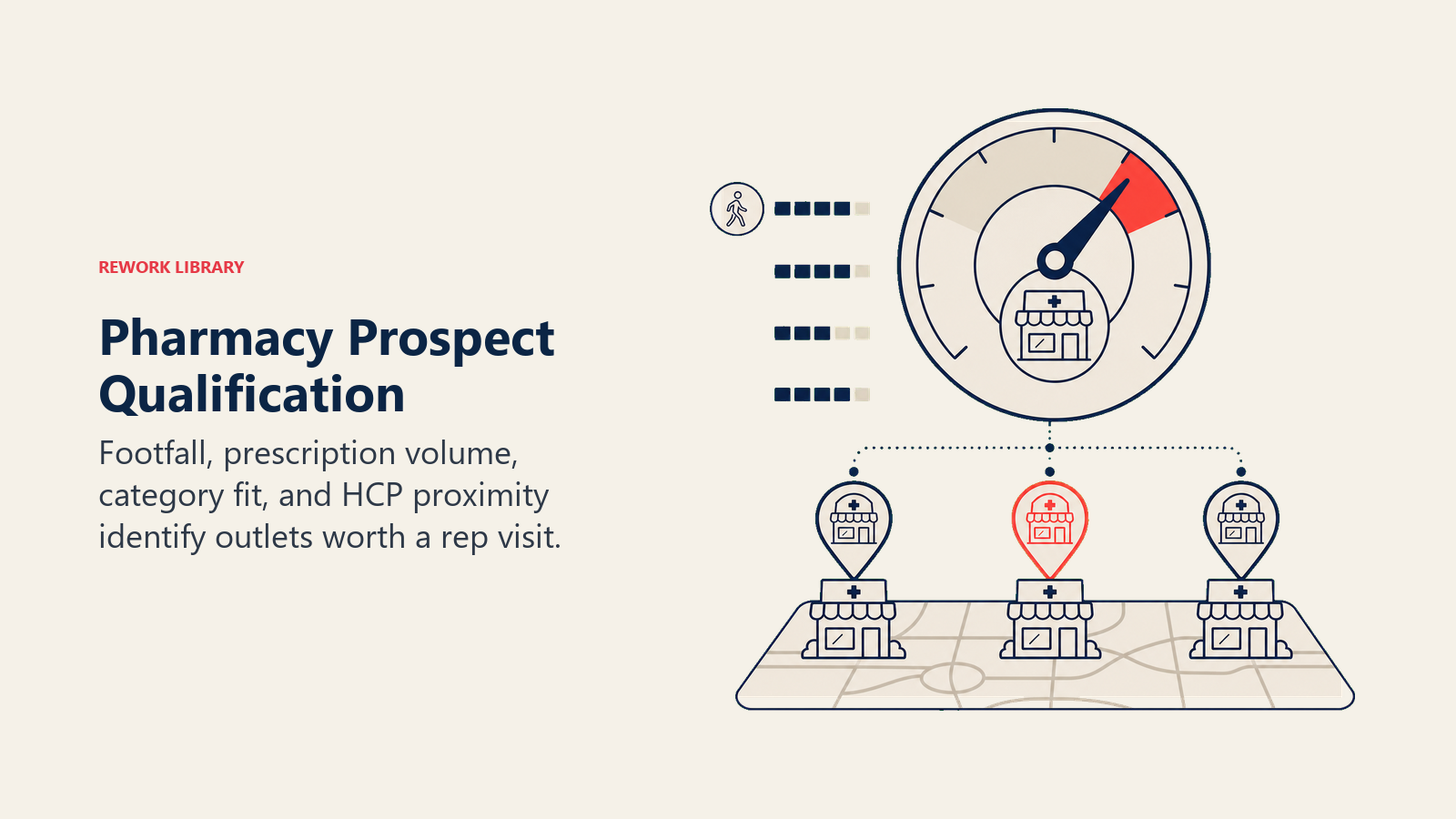
Pharmacy prospect qualification uses a different lens than HCP targeting. You're not evaluating prescribing behavior. You're evaluating commercial potential: how much product this outlet is likely to move if it stocks your brand. Use this checklist to score new pharmacy prospects before committing rep visit time. The same logic that underlies a B2B ideal customer profile applies here: you define the characteristics of a high-value account in advance, then score prospects against those criteria rather than relying on gut feel in the field.
Pharmacy Prospect Qualification Checklist
| Criterion | What to Assess | Weight |
|---|---|---|
| Daily footfall | Estimated customer traffic (observe at peak hours) | High |
| Prescription volume | Rx-to-OTC ratio, number of dispensing counters | High |
| Category fit | Does current shelf mix include your therapy area? | High |
| Geographic location | Near hospital, clinic, or HCP hub? | Medium |
| Ownership structure | Owner-operator vs chain outlet vs franchise | Medium |
| Current supplier relationships | Exclusive distributor agreements? Strong competitor presence? | Medium |
| Credit standing | Known payment history with distributors | Low |
| Competitive gap | Are key competitor SKUs present but yours absent? | Low |
Outlets scoring high on footfall, prescription volume, and category fit deserve immediate rep attention. Outlets near HCP hubs are particularly valuable because prescription pull-through is more direct: a doctor sends a patient to the adjacent pharmacy, and stock availability determines whether the script converts.
Understanding which accounts to prioritize connects directly to your sales territory mapping and account universe. A well-designed territory plan allocates rep time to acquisition targets in proportion to their potential, not just their proximity.
The First-Visit Playbook
The first visit to a new pharmacy determines whether you'll ever get a second one. Most first visits fail for the same reason: the rep walks in, introduces the company and product, and pitches before the pharmacist or owner has any reason to trust them. Preparation: Portfolio relevance before you arrive Pull the outlet's observable data before the call. What therapy categories are visible on the shelf? What competitor brands are prominently placed? What's the dispensing counter setup? This preparation lets you open with a relevant conversation rather than a generic pitch.
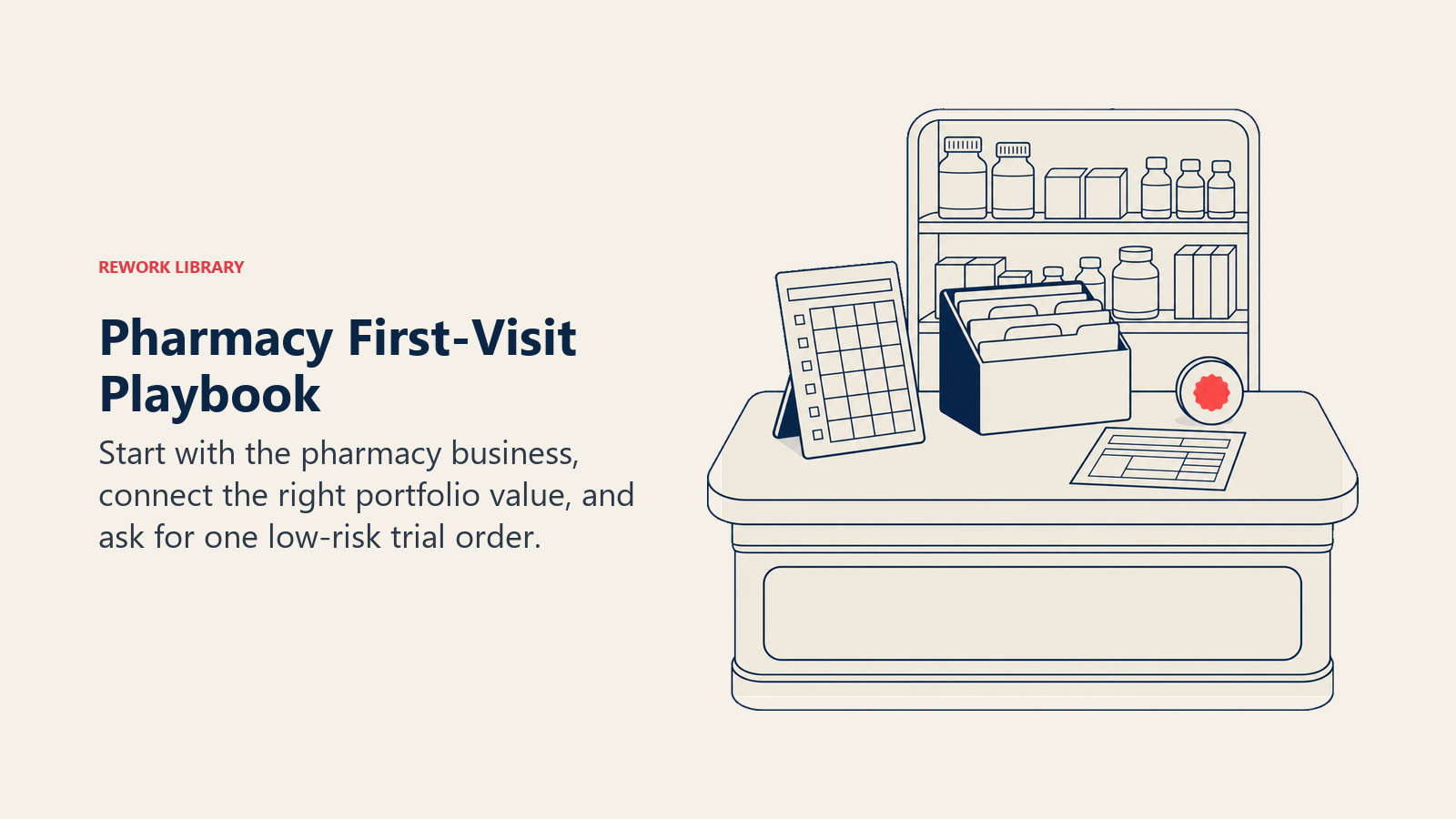
Identify one or two products from your portfolio that fit the pharmacy's evident category focus. A pharmacy with a strong diabetes shelf needs your antidiabetic product presented first, not your dermatology line.
Opening: Business conversation before product conversation
The most effective opening for a new pharmacy visit sounds like this: "I've been covering this area for [company] and noticed we haven't been working together yet. I'd like to understand how your business is structured before I talk about our products."
This shifts the dynamic. Instead of a rep selling to a pharmacist, you're a commercial partner doing a needs assessment. Ask about their top-selling therapy categories, which patient types they see most often, and whether they have any supply gaps in specific areas. Listen before presenting.
Value proposition: What pharmacies actually care about
Pharmacy owners and managers care about margin, movement rate, and patient demand. Clinical efficacy matters less to them than it does to prescribing doctors. Your value proposition should address:
- Margin: What's the retail markup on your product relative to the competitor alternative?
- Movement rate: How quickly is this category turning? What's the realistic monthly sell-out for a pharmacy this size?
- Patient demand: Are local HCPs already prescribing your brand? Do patients ask for it by name?
- Marketing support: What pull-through activities support sell-out? Patient leaflets? Doctor engagement programs nearby?
For outlets with strong OTC category presence, add visibility support: display materials, shelf talkers, and promotional programs that help the pharmacy drive consumer traffic.
The Coverage-Before-Demand Sequencing Model is the core acquisition principle at work here: ensure distribution coverage in a geography before, or concurrent with, HCP detailing in that same geography. Reps who run acquisition calls in sync with nearby HCP rep activity convert trial orders into active accounts faster, because prescription pull-through begins immediately after stocking rather than weeks later.
Objection Handling at the Pharmacy Counter
New pharmacy acquisition calls generate predictable objections. The reps who convert most effectively have pre-planned responses that acknowledge the objection, validate the concern, and redirect to value. Objection-Handling Framework for Pharmacy Acquisition Calls
| Objection | Underlying Concern | Response Approach |
|---|---|---|
| "We already have a supplier for this category" | Don't want to manage multiple vendors | "Understood. Many pharmacies here carry us alongside their current supplier for [specific SKU] because patients ask for it by name. Would it help to start with just that one product?" |
| "There's not enough demand for your brand here" | Risk of dead stock, cash tied up | "I can check what the nearest HCPs are prescribing. If [doctor name nearby] is already writing it, we'll move from their patients alone. Can we start with a trial order of [small quantity]?" |
| "Your price is too high" | Margin concern or competitor comparison | "Let me show you the margin calculation. At [price] retail, your gross margin on each unit is [X]%, which is [above/comparable to] the category average. The key question is movement rate." |
| "We'll think about it" | No urgency, not sold on the opportunity | "What would need to be true for this to make sense for you? I'd rather know what's missing than leave it open-ended." |
| "We don't have shelf space" | Competing priorities for visibility | "I can start you with a small stock position, no display required. Once we see movement in 30 days, we can revisit positioning." |
The goal in objection handling isn't to win the argument. It's to identify the specific concern blocking the first order and address that concern with a targeted, low-risk offer. Trial orders, small quantities, and specific SKU starts all reduce the perceived risk for a pharmacy owner who's skeptical.
Your pharmacy visit playbook should include these objection responses in the pre-call preparation section so reps aren't improvising under pressure.
Conversion Milestones: From First Contact to Active Partner
New pharmacy acquisition isn't a single event. It's a progression through conversion stages, each with specific actions required to advance the account. Conversion Milestone Tracker
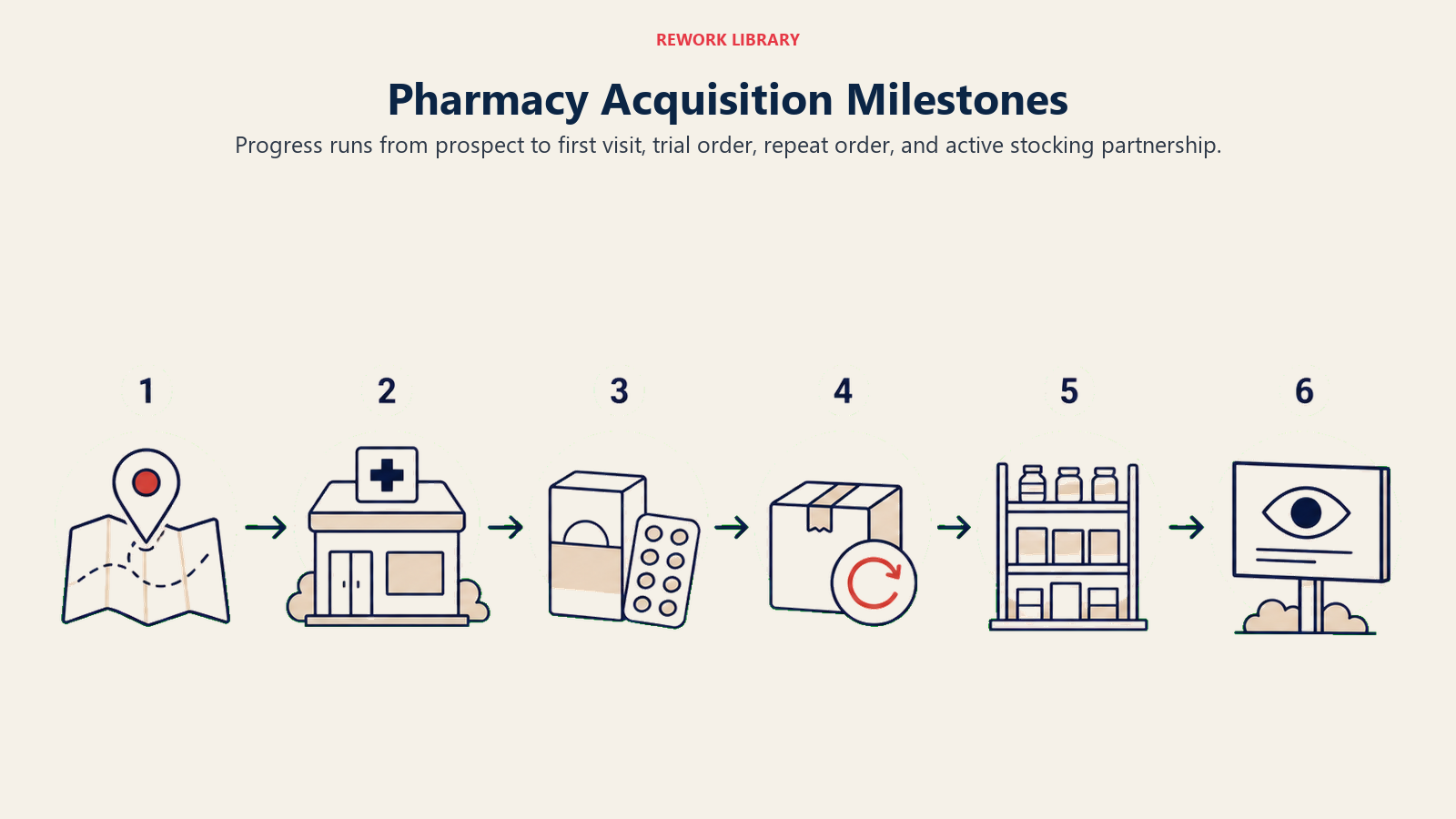
| Stage | Definition | Key Action Required | Success Signal |
|---|---|---|---|
| Prospect | Identified, not yet called | Initial qualification visit | Pharmacist/owner engaged in conversation |
| First-visit complete | Initial call made, relationship opened | Follow up within 5 business days | Request for product information or pricing |
| Trial order | First purchase order placed | Deliver on time, check stock placement | Product on shelf within 48 hours of delivery |
| First repeat | Second order placed within 60 days | Review movement data, discuss next order | Order placed without rep prompting |
| Active stocking account | Consistent ordering, product in range | Maintain call frequency, visibility programs | Account appears in monthly distributor sales report |
| Display and visibility partner | Product has dedicated shelf or display | Provide display materials, share sell-out data | Branded display installed, product visible from entrance |
The most critical transition in this sequence is from trial order to first repeat. A trial order means the pharmacist was willing to take a small risk. A repeat order means patient demand converted, movement was satisfactory, and the pharmacist trusts the product will turn. The same conversion logic applies in B2B sales: opportunity qualification frameworks distinguish between surface-level interest and genuine buying intent, and the criteria map almost exactly onto what separates a trial order from a committed stocking account. Reps should visit the account within two weeks of the trial order delivery to check stock levels, confirm placement, and review any patient or doctor inquiries about the product.
If there's been no movement from the trial order in 30 days, investigate before restocking. Is the product in an accessible location? Have nearby HCPs been detailing this pharmacy? Is there a pricing or substitution issue at the counter? Understanding the conversion problem is more valuable than pushing another order that will also sit.
Tracking New Pharmacy Acquisition in CRM
Acquisition progress needs to be visible in your CRM to be manageable. Without structured tagging and tracking, reps' acquisition activity becomes invisible to field managers, and the territory's coverage progress is impossible to assess.
CRM Tagging Protocol for Pharmacy Accounts
Tag every pharmacy account with one of four status labels:
- Prospect: Identified, not yet visited or visited with no order placed
- First-Order: Trial order placed, awaiting repeat
- Active: Consistent ordering, in the stocking account universe
- Lapsed: Previously active, no order in 90-plus days
At the territory level, field managers should review monthly:
- Total prospects identified vs. prospects visited
- First-order conversion rate (prospects visited to first order placed)
- Repeat conversion rate (first order to active status)
- Lapsed account count and reason codes
Rep KPIs for New Pharmacy Acquisition
| KPI | Target (example) | Measurement Frequency |
|---|---|---|
| New pharmacy prospects identified per cycle | 10-15 | Monthly |
| First-visit completion rate | 80% of prospects | Monthly |
| Trial order conversion rate | 40-50% of visited prospects | Quarterly |
| Active account conversion | 60% of trial orders within 90 days | Quarterly |
| New active accounts opened per cycle | 3-5 per rep | Quarterly |
These numbers will vary by market maturity, product lifecycle stage, and territory density, but the principle is consistent: acquisition activity needs to be measured separately from account maintenance activity, or reps will default to the familiar.
Customer segmentation and targeting frameworks help field managers determine which pharmacy segments to prioritize for acquisition effort in each cycle, particularly when territory resources are limited.
Distribution Coverage as a Competitive Moat
Once you've built systematic acquisition capability, the competitive dynamic shifts. It's not just about what's on your shelf; it's about how quickly you can fill white space before competitors do. A territory with 90% coverage of viable pharmacy outlets is fundamentally more defensible than one with 60% coverage, even if individual account volume is similar. Competitors face higher acquisition costs when your product is already stocked and a patient relationship is established at each outlet.
Visibility is part of the moat. Accounts that have progressed to display and visibility partnerships, with shelf talkers, branded dispensing counters, or patient education materials, reinforce brand presence at the point of dispensing. Retail merchandising and shelf visibility programs work significantly better when the account relationship is already strong from a systematic acquisition process.
Systematic acquisition also supports pull-through from HCP detailing. When a doctor prescribes your product, the patient needs to find it at the nearest pharmacy. If your acquisition program ensures coverage within the catchment area of every key HCP, you capture a much higher proportion of written prescriptions than a team that only holds legacy accounts.
Pharmacy relationship management practices that build owner loyalty over time convert the initial acquisition into a durable commercial partnership, not just a transactional purchase.
As a rough planning benchmark, independent pharmacies stocked within the catchment area of an actively detailing HCP rep tend to fill more prescriptions for that brand than pharmacies outside that catchment. That coordination case is what drives the Coverage-Before-Demand Sequencing Model described earlier, and it makes the argument for aligned HCP and pharmacy rep activity more concisely than any internal memo.
The NCPA Digest (2023) reports that independent pharmacy owners in the US cite "relationship with the sales representative" as the second most important factor in brand stocking decisions, after margin. A structured acquisition visit that opens with a business conversation rather than a product pitch directly addresses that relationship dynamic from the first interaction.
Territories that track acquisition KPIs separately from account maintenance KPIs tend to show higher new account opening rates than territories where acquisition activity is reported alongside general call data, because the separation makes acquisition effort visible and therefore manageable.
Conclusion
New pharmacy acquisition is a discipline, not a one-time campaign. Field teams that build systematic prospecting, qualification, first-visit conversion, and repeat-order tracking into their operational rhythm consistently expand territory coverage faster and more durably than those relying on relationship inertia with existing accounts.
The playbook is straightforward: map the white space, qualify by commercial potential, prepare a tailored first visit, handle objections with low-risk trial offers, track conversion milestones, and manage acquisition KPIs with the same rigor applied to revenue targets. The payoff is a broader, more resilient distribution base that supports prescription pull-through across the full territory.
Distribution gaps don't close themselves. Systematic pharmacy acquisition is how field teams close them.
Frequently Asked Questions about New Pharmacy and Drug Store Acquisition
How many new pharmacy prospects should a field rep identify each month?
A reasonable benchmark for most markets is 10 to 15 new prospects identified per cycle, with 80% of those receiving a first visit within the same cycle. The exact number varies by territory density and product lifecycle stage, but the discipline of tracking identification separately from conversion is universal. Reps who combine identification and first-visit metrics in a single "calls made" figure tend to underinvest in genuine prospecting.
What's the typical conversion timeline from first visit to active stocking account?
Most territory data shows that a pharmacy visited for the first time will place a trial order within one to three subsequent visits if the opening call established a genuine commercial conversation. The transition from trial order to active stocking account (first repeat order) typically takes 30 to 60 days, with the rep visit two weeks after delivery being the critical intervention point. If there's no movement from the trial order by day 30, investigate placement and HCP prescription pull rather than pushing another order.
Should pharmacy acquisition calls be made by the same rep as HCP calls?
In most pharma commercial structures, pharmacy reps and HCP reps operate as separate functions. The key coordination requirement is geographic and temporal: pharmacy reps should complete stocking calls in a given geography before or concurrent with HCP reps running detailing campaigns in that same area. A weekly coordination touchpoint between the two rep functions, sharing geography and call activity data, is the minimum operating standard.
How do I qualify a pharmacy prospect without wasting a visit?
Pre-visit qualification relies on three observable factors: daily footfall (observed at peak hours), proximity to prescribing HCPs, and category presence (does the current shelf include your therapy area or close substitutes). A pharmacy near a busy diabetes clinic that already carries a competitor antidiabetic is a stronger prospect than a pharmacy with no evident specialty category presence, regardless of the pharmacy's overall size. Build a brief qualification checklist into the pre-visit preparation step so reps invest face time where commercial potential is genuinely present.
What CRM fields matter most for pharmacy acquisition tracking?
At minimum, every pharmacy account needs a status tag (Prospect, First-Order, Active, Lapsed) and a last-visit date. Beyond that, the most useful fields are first-order date, first-repeat date (to calculate trial-to-active conversion speed), and a reason code for lapsed accounts. These four data points let field managers diagnose conversion problems at the territory level without needing individual call reports for every account.
How do I handle a pharmacy owner who has an exclusive relationship with a competitor brand?
Exclusivity in pharmacy stocking is rarely contractually enforceable at the retail level. What looks like exclusivity is usually a strong relationship built over time by a competitor rep. The approach is not to challenge the existing relationship but to introduce a complementary case: "I'm not asking you to drop [competitor]. I'm asking whether there's one or two patient types where our formulation might be a better fit." Starting with a specific SKU and a small trial quantity reduces the psychological cost of "switching" to something that isn't actually a switch.
Learn More

Senior Implementation Consultant
On this page
- Why New Pharmacy Acquisition Matters More Than Account Deepening
- How Do You Identify Unserved Pharmacies in Your Territory?
- Prospect Qualification: Choosing the Right Targets
- The First-Visit Playbook
- Objection Handling at the Pharmacy Counter
- Conversion Milestones: From First Contact to Active Partner
- Tracking New Pharmacy Acquisition in CRM
- Distribution Coverage as a Competitive Moat
- Conclusion
- Learn More