Beat and Route Journey Planning: How Pharma Field Teams Cover Every Account That Matters
Turn this article into takeaways for your work.


Each assistant summarizes the article only for you and suggests best practices for your work.
Picture two reps covering adjacent territories. Rep A drives two hours each day to reach the same accounts Rep B visits in forty minutes. Rep A gets four calls done before lunch. Rep B gets seven. By the end of the quarter, that gap in face time compounds into a meaningful prescription volume difference, and it has nothing to do with selling skill. It's a beat design problem.
Beat and route planning is one of the least glamorous topics in pharma commercial strategy and one of the highest-leverage. A rep who covers 15 priority accounts per week instead of 10 has 50% more selling opportunities, and the only input that changed was how their territory is organized and how their week is sequenced. Commercial leaders who treat beat design as an administrative detail rather than a commercial decision are leaving measurable productivity on the table.
What a Beat Is
Key Facts: Field Rep Productivity and Beat Design
- A commonly used planning benchmark across pharma markets allocates at least 70% of rep time to field calls, with the remainder for travel buffer and admin; beats that consistently produce travel ratios above 30% signal a design problem, not a territory difficulty problem.
- Urban pharma reps with well-designed beats typically average 8 to 12 accounts per day; suburban reps 6 to 9; rural reps 4 to 7. These are planning ranges, not hard rules, and reps operating well below them are usually carrying beat design problems rather than productivity problems.
- IQVIA's field force operations data cites territory workload, drive times, and account value as key variables used to optimize sales force size and distribution in pharma commercial organizations.
A beat is a geographic cluster of accounts assigned to one medical representative, designed for repeatable coverage without wasted travel time. The word "beat" comes from the law enforcement concept of a walking patrol: a defined area that one officer covers on a regular rotation, knowing every corner and every establishment in it.
In pharma field force terms, the beat contains the full account universe a rep is responsible for: hospital pharmacies, retail drug stores, independent pharmacies, specialist clinics, GP practices, and any other customer type relevant to the product portfolio. The key word is "cluster." A well-designed beat contains accounts that are genuinely close to each other, so a rep can move between them without burning the day on the road.
A poorly designed beat looks like a map with accounts scattered across a 200-kilometer radius. The rep spends more time in the car than in front of customers. A well-designed beat looks like a tight cluster where most accounts are within a 20-to-30-minute drive of each other, and the rep can visit six to ten accounts in a working day without rushing.
How Do You Design a Beat That Maximizes Selling Time?
Good beat design is a decision about commercial priorities, not just a mapping exercise. The Geography-First, Priority-Second Beat Design Method is the approach that prevents the most common beat design errors: cluster accounts by physical proximity first, then apply the A/B/C tier weighting to determine visit frequency within that cluster. Applying tier labels before clustering geography produces beats where high-value accounts are spread across an unworkable area. Three principles govern it:
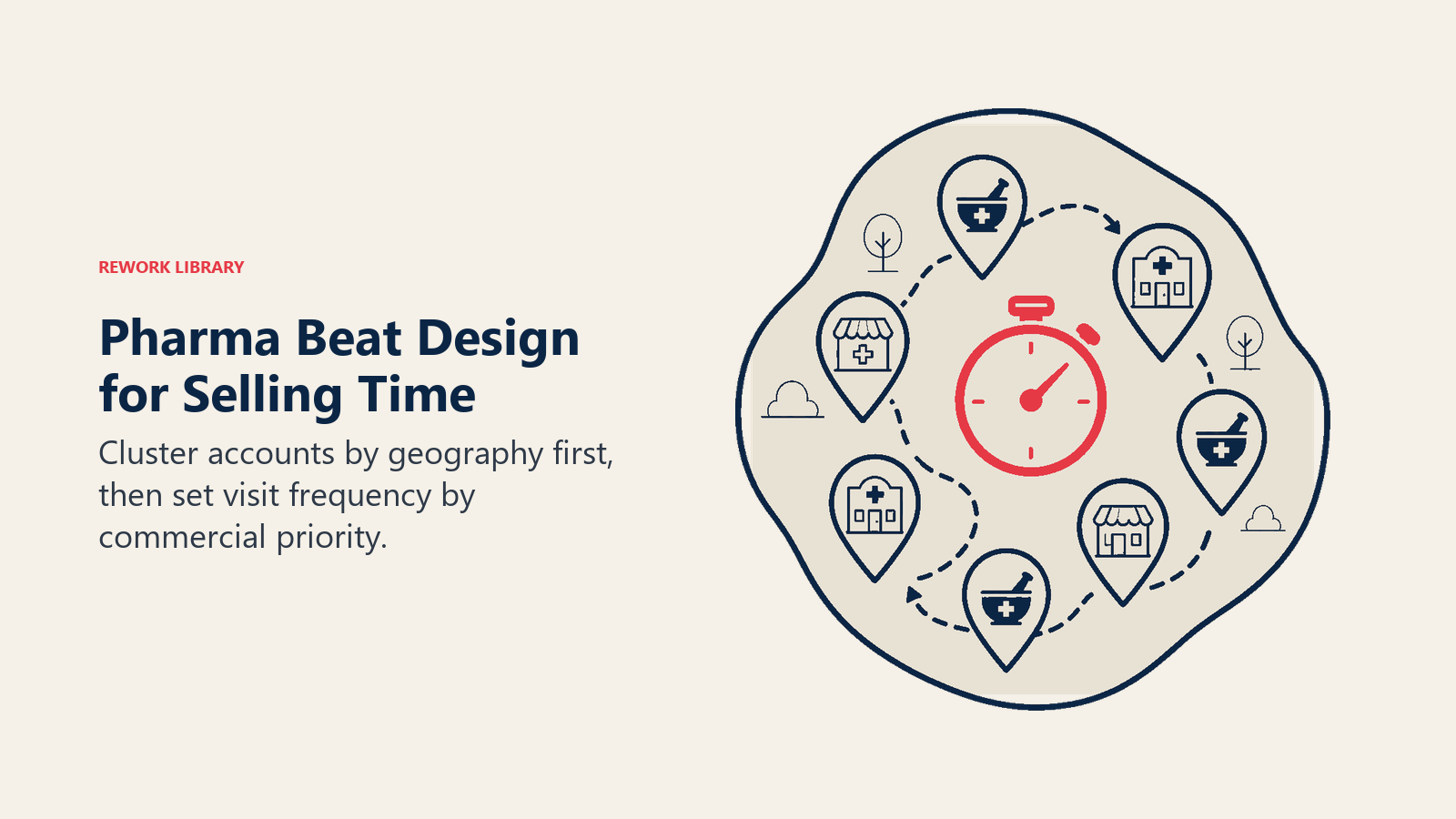
Account density versus account priority trade-off. The temptation in beat design is to maximize the number of accounts per beat, giving each rep as many customers to call on as possible. But density without priority weighting means reps spread time evenly across accounts with very different commercial value. A high-prescribing specialist clinic should receive far more visits than a small pharmacy that generates minimal volume, but if both are in the beat and the beat is too large, neither gets adequate coverage. Priority drives the visit frequency framework, and visit frequency drives beat size.
Drive-time ceilings per day. Commercial leaders should set a maximum daily travel time for reps in each territory type. A rule of thumb used across pharma markets allocates at least 70% of rep time to field calls, leaving the remainder for admin and travel buffer:
| Territory Type | Maximum Daily Drive Time | Expected Daily Calls |
|---|---|---|
| Dense urban | 60-90 minutes | 8-12 accounts |
| Suburban / mixed | 90-120 minutes | 6-9 accounts |
| Rural / dispersed | 120-180 minutes | 4-7 accounts |
These are benchmarks, not hard rules. But if a rep's average daily drive time consistently exceeds these thresholds, it signals a beat design problem, not a territory difficulty problem. The fix is a beat redesign, not telling the rep to drive faster.
Clustering by geography, not by account name or customer type. A surprisingly common beat design mistake is organizing accounts by category (all hospitals in one group, all pharmacies in another) rather than by physical proximity. The result is a rep who drives across town to visit pharmacies in the morning and then drives back across town to visit hospitals in the afternoon. Geography first, account type second. Always.
Route Sequencing Inside a Beat
Once the beat is designed correctly, the route sequence within a given day determines how efficiently the rep converts geography into selling time. Random sequencing creates unnecessary backtracking. Structured sequencing follows the natural flow of the territory and the opening hours and traffic patterns of different account types.
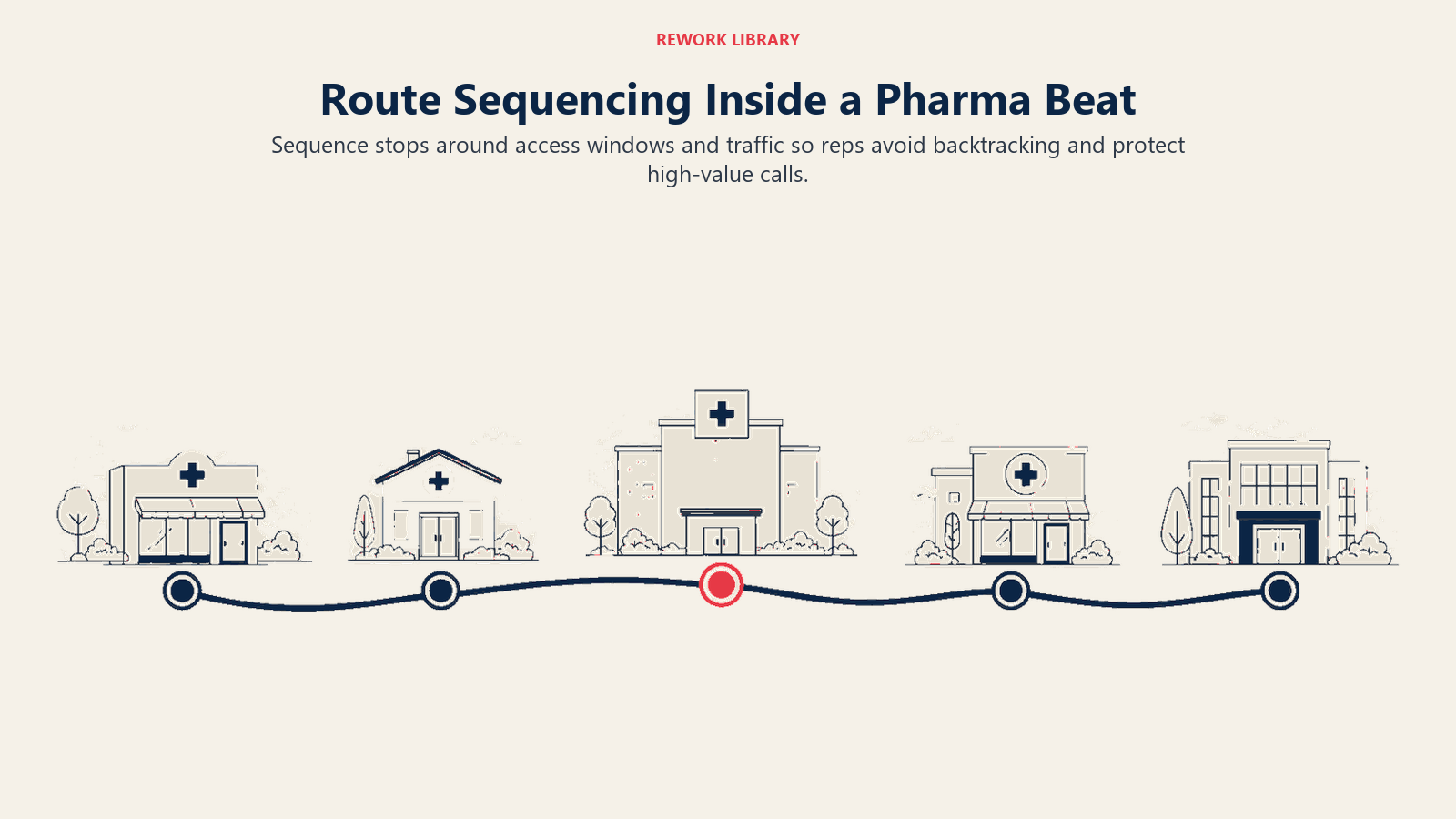
A framework that works across most pharma territory types:
Morning anchor: high-traffic pharmacy before the lunch rush. Retail pharmacies and drug stores are typically busy during the lunch hour and again in the late afternoon. Early morning visits catch pharmacists and pharmacy managers before the front-of-store rush begins and when they have time for a genuine conversation. A major chain pharmacy or high-volume independent pharmacy is a strong morning anchor account.
Mid-morning: specialist clinics and doctor's offices. Most specialist and GP offices have the most staff availability between 9:30 and 11:30 before patient volumes peak. Visiting during this window increases the probability of getting face time with the prescriber rather than just with a receptionist. The rep should sequence specialist clinics geographically, not alphabetically, moving in a direction that avoids backtracking.
Mid-day doctor visits: hospital outpatient departments and academic clinics. Hospital-based accounts often have distinct windows when physicians are accessible: after morning ward rounds but before afternoon procedures or clinics. The specific window varies by specialty and institution. Reps who learn the rhythms of their key hospital accounts can time visits to catch physicians during natural breaks.
Afternoon: remaining pharmacy and drug store calls. Afternoon slots suit pharmacy top-up calls well. Pharmacists have typically processed the morning's prescription rush and are more available for a detail. Retail drug stores may also have promotional or merchandising activities that benefit from afternoon timing when store traffic is lower.
End-of-day: administrative accounts and new prospect calls. Account types with flexible availability (wholesale contacts, procurement, practice managers) fit naturally at the end of the day when peak calling windows for clinical staff have passed.
This sequencing structure isn't rigid. Territory-specific patterns matter more than any generic framework. But the principle holds: route sequencing should follow the availability rhythms of different account types, not the convenience of the rep's home address or the alphabetical order of the customer list.
Sample Weekly Journey Plan
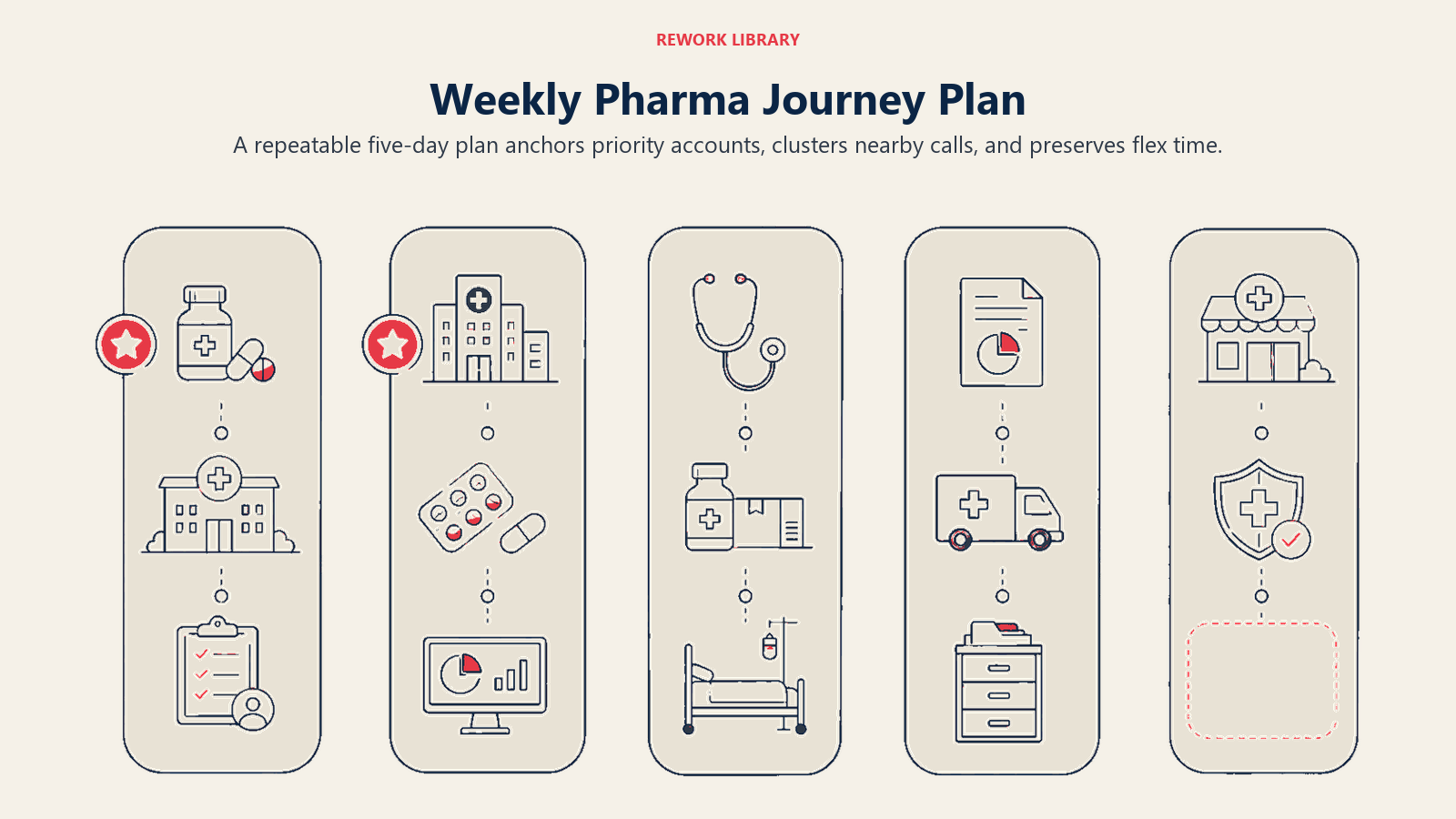
A well-structured weekly journey plan translates beat design and route sequencing into a repeatable daily pattern. Here's what a sample weekly plan looks like for a suburban pharma rep covering a mixed territory:
| Day | Morning Anchor | Mid-Morning Block | Afternoon Block | End-of-Day |
|---|---|---|---|---|
| Monday | Chain pharmacy (A-tier) | 3 x specialist clinic visits | 2 x drug store calls | Admin, CRM update |
| Tuesday | Independent pharmacy cluster (3 accounts) | Hospital outpatient dept (A-tier) | 2 x GP practice visits | New prospect call |
| Wednesday | Chain pharmacy (A-tier, different location) | 2 x specialist clinic visits | Drug store visits (B-tier) | Field manager ride-along prep |
| Thursday | Hospital pharmacy (A-tier) | 3 x GP practice visits (B-tier cluster) | Independent pharmacy (B-tier) | Post-call notes, next-week planning |
| Friday | Remote pharmacy calls (C-tier cluster, 4 accounts) | Flexible (catch-ups, re-visits, new accounts) | Internal meeting / training | End-of-week CRM reconciliation |
The plan above cycles through A-tier accounts twice per week (Monday and Wednesday chain pharmacy, Tuesday and Thursday hospital accounts), hits B-tier accounts once per week, and groups C-tier accounts into a single geographic block on Friday. This cadence reflects a call frequency framework where A-tier accounts receive two to four visits per month, B-tier accounts receive one to two, and C-tier accounts receive monthly or fortnightly coverage.
Journey Plan Cadence: A, B, and C Account Rotation
The call frequency cadence that drives journey plan design follows directly from account segmentation. Not all accounts in a beat deserve equal visit frequency, and trying to visit all accounts at the same frequency either means visiting high-value accounts too rarely or wasting time on low-value accounts too often.
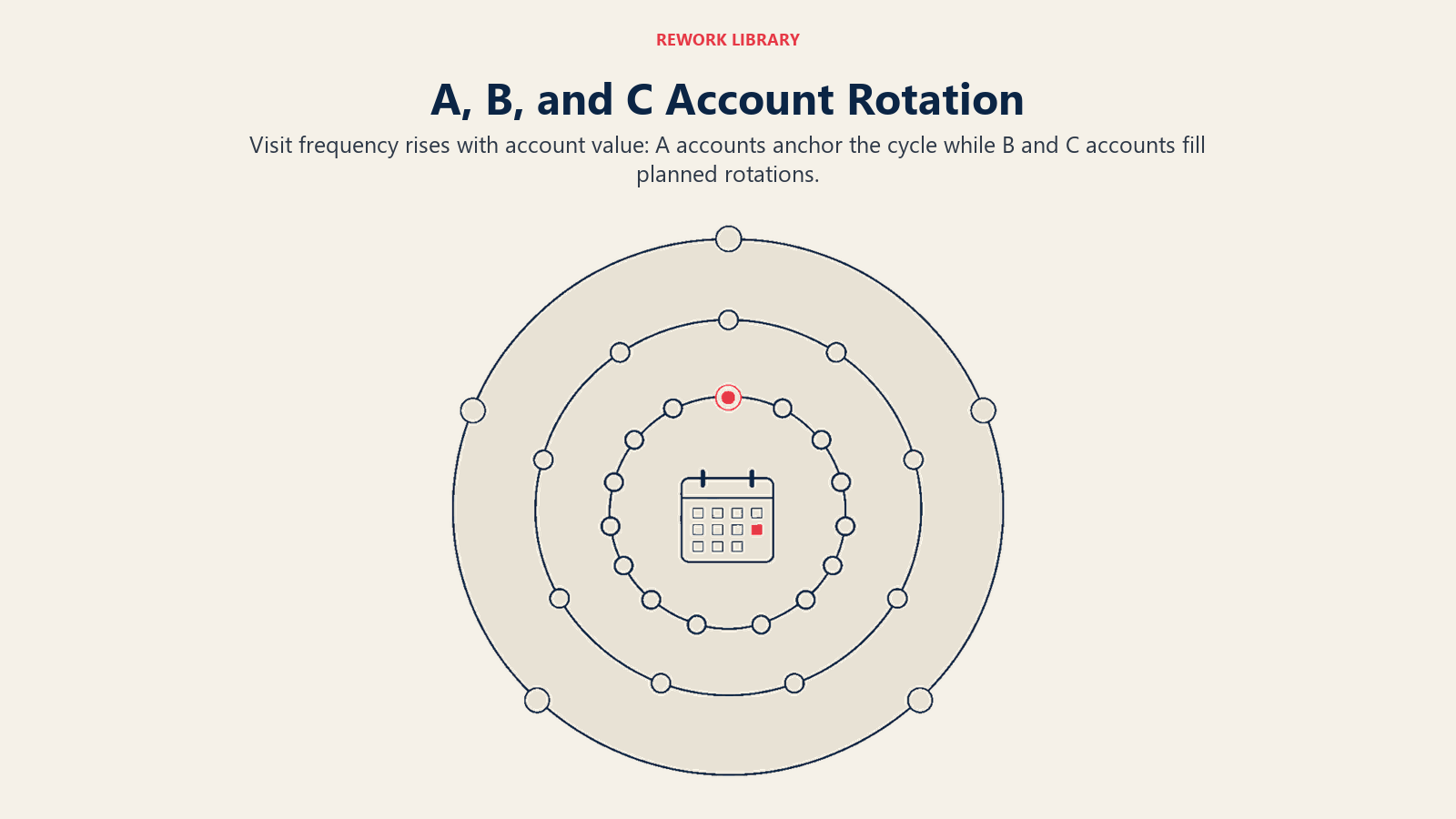
The standard rotation logic for most pharma territory types:
A-tier accounts (highest prescribing or commercial potential): Two to four visits per month minimum. These accounts should anchor the journey plan and get the rep's best calling windows (morning and mid-day, not last call on a Friday).
B-tier accounts (moderate prescribing or growing potential): One to two visits per month. These accounts appear in the regular weekly cycle but not at every anchor slot.
C-tier accounts (lower current value but worth maintaining relationships): Fortnightly to monthly visits, often grouped geographically to cover multiple C-tier accounts in a single geographic block.
Crucially, the A/B/C designation should reflect strategic priority, not just current prescribing volume. A newly identified specialist clinic with high patient volume in the relevant therapeutic area might be C-tier on current prescribing data but A-tier on commercial potential. Beat and journey plan design should capture both dimensions. This connects directly to the broader framework in customer segmentation and targeting, and the geographic dimension of account assignment maps closely to territory-based routing principles used in B2B sales operations.
Common Beat Design Mistakes
The most expensive beat design mistakes in pharma field forces:
Oversized beats. A beat that contains 150 accounts sounds comprehensive. In practice, a rep visiting 150 accounts monthly at one visit each can only average about 6-7 accounts per working day, and every account gets visited once per month regardless of tier. Oversized beats produce thin coverage across too many accounts rather than meaningful frequency with priority ones.
Ignoring traffic patterns. A route that looks efficient on a static map at 10pm may be a nightmare during rush hour. Urban beats especially need to account for morning commute patterns, lunch hour congestion, and afternoon school-zone delays. Reps who plan routes without checking traffic patterns regularly find themselves stuck in traffic during their best calling windows.
Ignoring account tier when setting visit order. Sequencing a day by geographic convenience rather than account priority means low-value accounts may consume the best calling windows. The morning slot is typically the most productive for clinical conversations. A-tier accounts should anchor the morning, not fill the afternoon when the rep is already tired and the best windows have passed.
Redesigning beats too frequently. Beat design requires time to optimize, and frequent redesign disrupts the relationship-building that makes field force activity effective. Reps who know their beat intimately, know the rhythms of each account, and know the personal preferences of key contacts convert more calls into outcomes than reps who've just been handed a new territory map.
Underestimating administrative time. Journey plans built on 8 hours of pure calling time are unrealistic. Pre-call preparation, parking, waiting rooms, post-call documentation, and travel buffer all consume time. A realistic journey plan for a suburban rep allocates 5-6 hours for actual calls and the rest for necessary overhead.
Beat Design Checklist
Use this checklist when designing or reviewing a beat:
Geography:
- Accounts cluster geographically rather than being scattered across a wide area
- Maximum daily drive time fits the territory type benchmark (urban/suburban/rural)
- Traffic patterns have been reviewed for key routes during peak calling hours
- No significant physical barriers (rivers, highways, restricted zones) fragment the beat unnecessarily
Account Coverage:
- Total number of accounts is achievable within the visit frequency framework
- A-tier accounts can receive 2-4 visits per month within the journey plan
- B-tier accounts can receive 1-2 visits per month
- C-tier accounts are grouped geographically to maximize coverage efficiency
- Account tiers reflect both current prescribing and commercial potential
Journey Plan Structure:
- Morning slots are reserved for highest-priority accounts (A-tier anchors)
- Route sequence follows account availability rhythms, not alphabetical order
- Weekly plan has built-in flex time for cancellations, new prospects, and re-visits
- Administrative time is realistically allocated (CRM, planning, travel buffer)
KPI Tracking:
- Planned vs. actual accounts visited is tracked weekly
- Call frequency by account tier is reported monthly
- Drive-time-per-call ratio is monitored as an efficiency indicator
Drive-Time Benchmarks by Territory Type
Commercial leaders can use these benchmarks to identify underperforming beats before they become a sustained productivity drag:
| Territory Type | Total Weekly Drive Time (Target) | Drive Time as % of Working Time | Red Flag Threshold |
|---|---|---|---|
| Dense urban | Under 5 hours | Under 12% | More than 8 hours/week |
| Suburban / mixed | 6-9 hours | 15-22% | More than 12 hours/week |
| Rural / dispersed | 10-15 hours | 25-37% | More than 20 hours/week |
When a rep spends 40% of their working week in the car, the fix is a beat redesign, not a coaching conversation. The solution is territory consolidation, account reprioritization, or account transfer to a better-positioned rep. IQVIA's field force operations data shows that territory workload, drive times, and account value are among the key variables used to optimize sales force size and distribution.
Tools and Templates for Beat Management
Most modern pharma field forces use CRM platforms with territory management and route optimization capabilities (Veeva CRM, IQVIA Orchestrated Customer Engagement, and similar systems). These tools can:
- Generate optimized drive routes based on account locations and time constraints
- Track planned versus actual visit completion rates
- Flag accounts that are falling behind frequency targets
- Provide heat maps of territory coverage for manager review
Even without sophisticated software, a structured approach works. A simple beat map template requires only:
- A geographic map with all accounts pinned and color-coded by tier
- A weekly journey plan template with day-by-day account sequences
- A monthly call frequency tracker showing planned versus actual visits by tier
The template doesn't need to be complicated. It needs to be used consistently. A journey plan that sits in a spreadsheet and isn't reviewed weekly is not a journey plan; it's a wish list. Field managers who review journey plan compliance alongside call report data in their regular one-on-ones close the loop between planning and execution.
The broader territory and account framework that beat planning sits within is covered in sales territory mapping and account universe and call frequency and coverage optimization.
A rep who visits 10 A-tier accounts per week instead of 7 because their beat is well-clustered generates more selling opportunities with priority accounts over a quarter, without changing their call skills, product knowledge, or messaging. Beat design produces productivity gains that look like sales performance improvements but are actually structural ones.
Beats that are redesigned too frequently create a different productivity problem: reps lose the institutional knowledge of each account's rhythms, the receptionist's preferences, and the pharmacist's scheduling patterns. That tacit knowledge accumulates over months and converts calls into outcomes more reliably than any training program. Stability in beat design, within a range that keeps coverage efficient, is a commercial asset worth protecting.
A rep spending 40% of working time in the car is not a performance problem. It's an operations problem. The first diagnostic question for any underperforming territory is drive-time ratio, not call quality.
Connecting Beat Design to the Full Field Force System
Beat design doesn't exist in isolation. It sits at the foundation of everything else the field team does:
A rep with a well-designed beat covering 60 accounts in a manageable geographic cluster can execute on a call frequency plan that gives A-tier accounts meaningful face time. That face time enables the relationship quality needed for pharmacy visit playbook execution. The consistent coverage that comes from a well-designed beat also means reps show up on a predictable schedule, which pharmacists and physicians actually prefer. Reliability builds relationship capital.
Conversely, a rep with a poorly designed beat is perpetually catching up. They miss accounts, violate call frequency targets, and arrive at important accounts too tired and too rushed to have meaningful conversations. The beat is the upstream problem that manifests as sales performance issues downstream.
When field managers investigate productivity problems, beat design should be one of the first hypotheses to test. Before concluding that a rep needs more coaching or a different territory mix, check: how much time is this rep spending in the car? How many accounts are in the beat? Are A-tier accounts being visited with appropriate frequency? The answers often point to a structural problem that coaching can't fix.
The medical rep daily call plan builds on beat design by structuring what happens within each call, but none of that structure matters if the rep doesn't reach the right accounts at the right frequency.
Conclusion
A well-designed beat is the foundation every other field activity rests on. Call quality matters. Messaging matters. Relationship-building matters. But none of those things happen with the right frequency if the rep's territory is too large, their route sequences backtrack across town, and they spend two hours a day in the car between calls.
Beat design is a commercial decision, and it deserves commercial leadership attention. The field manager who reviews beat maps alongside call reports, who tracks drive-time ratios alongside call frequency data, and who redesigns beats based on territory evolution rather than historical inertia will see productivity gains that look like sales technique improvements but are actually operational ones.
Get the beat right, and everything else the field team is trained to do becomes more likely to happen at the accounts that matter most.
Frequently Asked Questions about Beat and Route Journey Planning
What is a beat in pharma field force management?
A beat is a geographically clustered set of accounts assigned to one medical representative for repeatable coverage. The defining characteristic is that accounts within the beat are physically close to each other, so the rep can move between them without excessive travel time. A well-designed beat allows a rep to visit 6 to 12 accounts per working day depending on territory type, while a poorly designed beat with the same account count might only permit 3 to 5 daily calls due to drive time between scattered locations.
How many accounts should be in a pharma rep's beat?
The right account count depends on the call frequency framework and territory type. A suburban rep targeting 2 visits per month for A-tier accounts, 1 visit per month for B-tier, and fortnightly visits for C-tier can manage 60 to 80 accounts per beat while hitting frequency targets. Beats with 120 or more accounts almost always produce thin coverage across all tiers rather than meaningful frequency with priority ones. When the account count goes up, the call frequency per account comes down, and A-tier accounts pay the price.
What's the difference between a beat and a route?
A beat is the geographic account cluster a rep is responsible for. A route (or journey plan) is the specific sequence in which the rep visits those accounts on a given day or week. Beat design is a structural decision made by field managers, typically reviewed quarterly. Route sequencing is a weekly execution decision made by the rep, ideally using the availability rhythms of different account types rather than geographic convenience or alphabetical order.
How do you handle accounts at the edge of two beats?
Boundary accounts are best resolved by primary HCP or pharmacy affiliation: which rep has the strongest relationship with the pharmacist or prescriber should determine the assignment, not which side of the geographic line the account sits on. When there's no existing relationship, assign boundary accounts to the beat where the account is geographically closest to the highest number of other accounts, maximizing cluster density. Document boundary account assignments explicitly in the territory management system so they don't create coverage gaps or duplicate calling between adjacent reps.
When should beats be redesigned?
Beats should be reviewed annually as part of territory planning and redesigned when drive-time ratios consistently exceed benchmarks, when account additions or deletions materially change geographic density, or when rep reassignments create obvious coverage inefficiencies. Avoid redesigning beats more frequently than once per year absent a major territory event (new product launch, significant account acquisition, rep departure). The disruption cost of a redesign in relationship-building and institutional knowledge loss is real and typically underestimated.
Learn More

Senior Implementation Consultant
On this page
- What a Beat Is
- How Do You Design a Beat That Maximizes Selling Time?
- Route Sequencing Inside a Beat
- Sample Weekly Journey Plan
- Journey Plan Cadence: A, B, and C Account Rotation
- Common Beat Design Mistakes
- Beat Design Checklist
- Drive-Time Benchmarks by Territory Type
- Tools and Templates for Beat Management
- Connecting Beat Design to the Full Field Force System
- Conclusion
- Learn More