New HCP Doctor Prospecting: How Medical Reps Build a Prescriber Pipeline from Scratch
Turn this article into takeaways for your work.


Each assistant summarizes the article only for you and suggests best practices for your work.
Most medical reps spend the majority of their call cycle visiting the same 20 to 30 doctors. The relationships are comfortable, access is predictable, and the conversations feel productive. The problem is that a fixed prescriber base is a shrinking one. Doctors retire, relocate, change specialties, or shift allegiances to competitor brands. A rep who doesn't constantly add new HCPs to the pipeline is managing a declining book of business, not a growing territory.
New health care professional (HCP) prospecting is the growth activity that expands the prescriber base over time. It's uncomfortable because the first call on an unknown doctor carries more uncertainty than the fourteenth call on a familiar face. But it's essential, and field force managers who build prospecting discipline into their rep teams consistently outperform those who treat the existing account base as a ceiling rather than a floor.
This article lays out a structured approach to HCP prospecting: how to identify new targets, qualify them against commercial criteria, execute productive first detailing calls, and track progression through a prescriber pipeline.
The Cost of Not Prospecting
Key Facts: Prescriber Attrition and Pipeline
- Annual physician attrition rates in the US rose from 3.5% to 4.9% between 2013 and 2019, with psychiatry and OB/GYN seeing the steepest departures (Annals of Internal Medicine, 2025).
- A territory that loses prescribers to retirement, relocation, or specialty change without replacing them is generating scripts from a shrinking base by year three. The math compounds quickly.
- Structured prospecting with explicit qualification criteria consistently produces higher prospect-to-trial conversion rates than unqualified cold calls, because reps invest time where commercial potential is genuine.
Before building the process, it helps to understand the cost of neglecting it.
Natural attrition removes prescribers from every territory. A general practice doctor retires and isn't replaced. A cardiologist moves to a different city. A hospital reassigns its outpatient prescribing to a new clinic network that falls in a different rep's territory. A nationwide longitudinal analysis tracking over 712,000 physicians found that annual physician attrition rates in the US rose from 3.5% to 4.9% between 2013 and 2019, published in the Annals of Internal Medicine, with psychiatry and OB/GYN seeing the steepest departures by specialty. The trend has continued climbing. As a rough planning benchmark, territories that lose prescribers without actively replacing them tend to see their active prescriber base contract meaningfully over a three-year period.
If rep teams aren't continuously identifying and converting new HCPs, territory revenue erodes even when call execution on existing accounts is excellent. The math is straightforward: a territory with 40 active prescribers that loses 8 to 10 per year without replacing them is generating prescriptions from a shrinking base by year three.
The reps who understand this treat new HCP prospecting as a monthly maintenance activity, not a quarterly emergency. The target isn't to find hundreds of new doctors at once. It's to add a consistent flow of new contacts to the pipeline every cycle, so the prescriber base grows steadily even as attrition removes doctors from the active list. The underlying discipline is the same one covered in prospecting strategy: define your target, work your source systematically, and measure conversion at each stage.
Where Do Medical Reps Find New HCPs to Prospect?
Finding new HCPs requires more than intuition. Systematic identification uses multiple data sources to build a complete picture of which doctors in the territory aren't currently in the CRM.
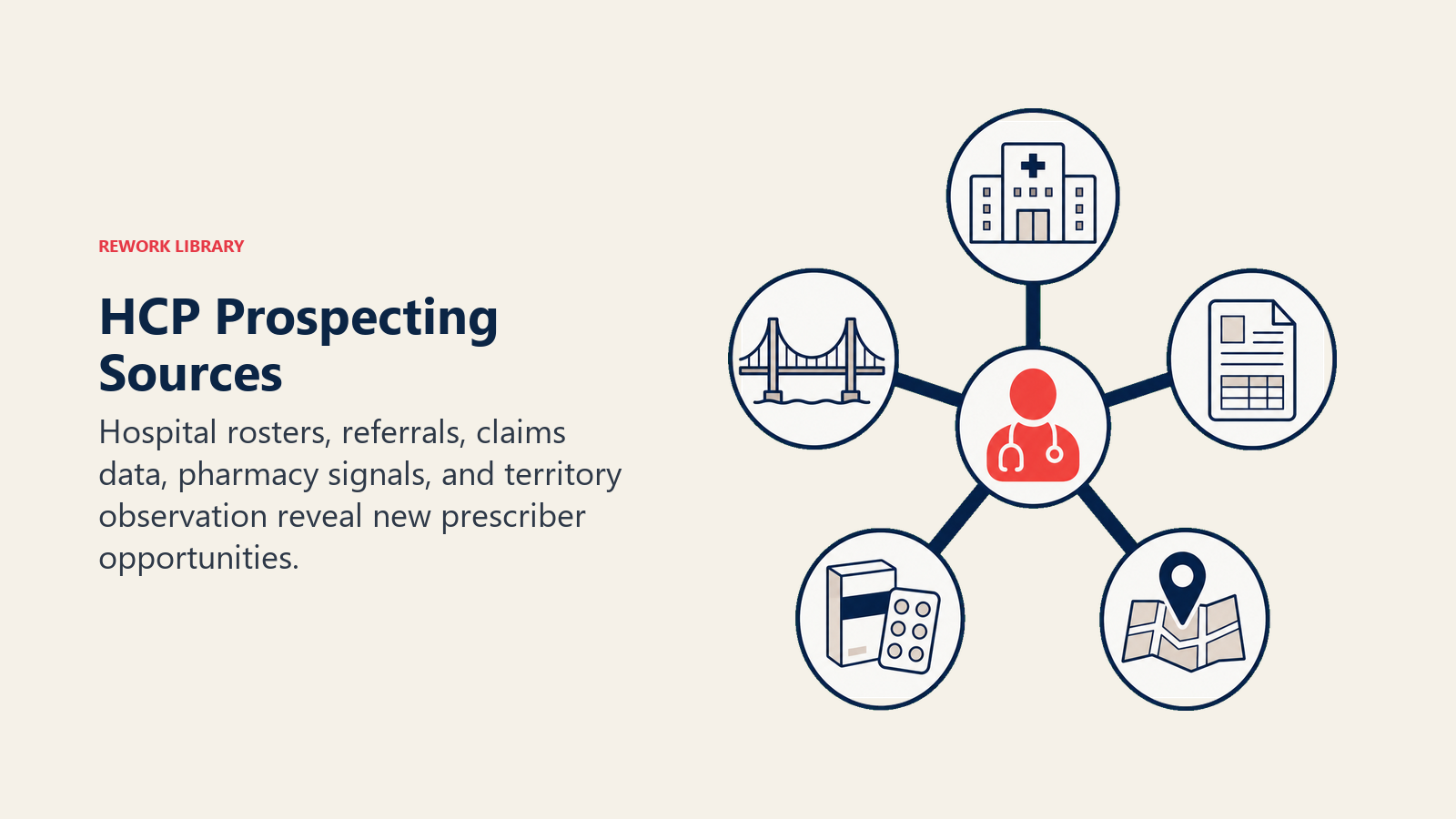
Medical council directories and specialty registers are the most reliable starting point. In most markets, medical councils publish lists of licensed practitioners by specialty and registration location. These directories tell you which specialists are practicing in your territory, even if your company has never called on them. Commercial tools like IQVIA's Prescriber Profiler layer prescription volume and therapy-area data on top of those base lists, helping teams rank new targets by actual prescribing behavior before the first call.
Hospital and clinic staff lists reveal HCPs attached to specific institutions. Hospitals publish their attending physician lists on websites or in annual reports. New additions to these lists, especially in relevant specialties, are immediate prospecting targets. A newly credentialed specialist at a regional hospital is unlikely to have existing loyalty to any brand and is genuinely open to relationship-building.
Key opinion leader (KOL) referrals and peer networks are an underused prospecting source. When a key opinion leader mentions a colleague doing interesting work in your therapy area, that's a warm introduction that reduces cold-call barriers significantly. Building peer referral into your KOL relationship strategy creates a prospecting channel that doesn't require registry searches.
Rep field observation picks up what databases miss. New clinic signage on a commercial street, a recently opened specialist center in a developing suburb, a pharmacist who mentions that a new doctor has started sending patients to the pharmacy. Reps who pay attention to their territory's physical environment find accounts before they appear in any formal data source.
Continuing medical education (CME) event and conference attendee lists identify HCPs who are actively engaged in professional development. A doctor who attends a symposium on your therapy area has already signaled relevant clinical interest. That's a meaningful qualification signal before the first call. The ACCME accredits over 1,500 CME providers in the US, meaning structured events are widely available across specialties and easy to track as a prospecting data source.
HCP Qualification: Focusing Prospecting Effort Where It Counts
Not every new HCP is worth the same investment of prospecting time. Qualification before the first call focuses rep energy on the targets most likely to convert into meaningful prescribers.
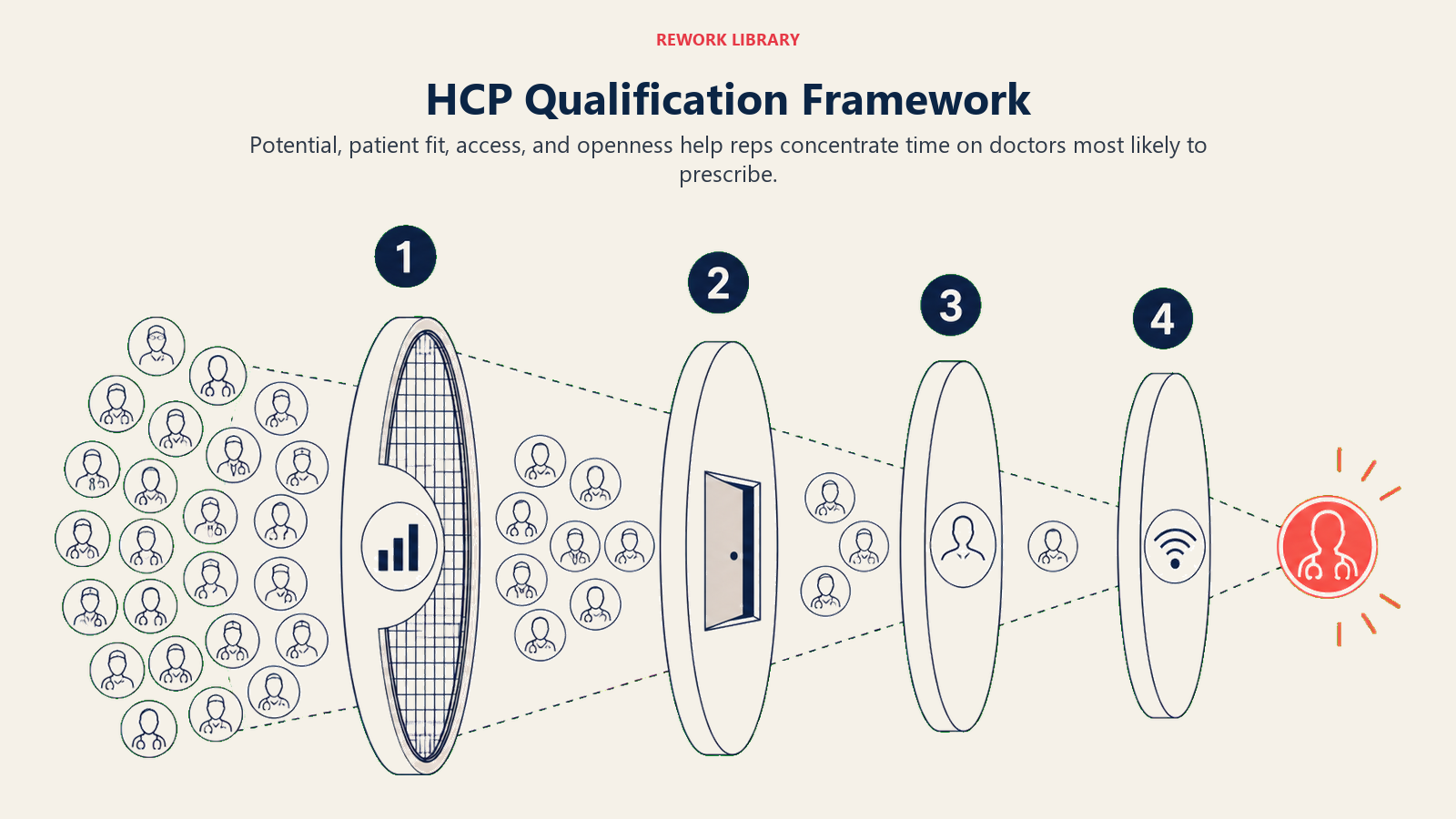
HCP Qualification Scorecard
| Criterion | Assessment Method | Score (1-3) |
|---|---|---|
| Specialty match | Does the doctor's specialty align with the product's indicated patient population? | 3 = primary specialty, 1 = peripheral |
| Patient panel size | Estimate from clinic type, location, and observation | 3 = high volume, 1 = small practice |
| Current prescribing behavior | Any intel on competitor loyalty or openness to new options? | 3 = open/neutral, 1 = strongly competitor-loyal |
| Accessibility | Solo practice, group clinic, or hospital-based? | 3 = accessible solo/group, 1 = restricted hospital access |
| Geographic location | Is this HCP near your other call targets, reducing route inefficiency? | 3 = efficient routing, 1 = significant detour |
| Clinical engagement | Attends CME events, publishes, participates in peer groups? | 3 = actively engaged, 1 = low engagement signals |
Doctors scoring 14 and above deserve immediate first-visit priority. Scores of 10 to 13 belong in the near-term pipeline. Scores below 10 should be deprioritized unless capacity exists.
This prioritization isn't about ignoring low-scoring doctors permanently. It's about sequencing prospecting effort so the highest-potential HCPs receive attention first. As conversion progresses with Tier 1 targets, the rep works down the qualification hierarchy.
Customer segmentation and targeting frameworks complement this scorecard by providing the therapy-area-specific criteria that determine whether a particular specialty represents a strong or weak commercial fit. Once the right targets are locked in, the quality of the first call determines everything that follows.
The First Detailing Call on a New Doctor
The first call on a new doctor is different from a maintenance call on an existing prescriber. The relationship starts at zero. There's no shared history, no established trust, and no reason for the doctor to prioritize this rep's visit over the competing demands on their time.
Pre-call research: Know before you go
Spend 10 to 15 minutes on preparation before a first call. What's the doctor's specialty and primary patient focus? What does their clinic or practice look like (solo, group, affiliated with a hospital)? Is there any publicly available information about their clinical interests, affiliations, or conference participation?
This preparation serves two purposes. It prevents generic, tone-deaf opening conversations that waste the doctor's limited time. And it gives the rep specific questions to ask that signal genuine curiosity about the doctor's practice, not just a product pitch.
Opening: Listen before presenting
The strongest opening for a first HCP call is built around questions, not statements. "I've been covering this area and wanted to understand your practice better before talking about our portfolio. What patient types make up most of your day?" is more effective than "I'm from [company] and I'd like to introduce you to [product]."
Listening in the first call accomplishes three things. It reveals the doctor's practice profile in detail you couldn't get from a directory. It identifies which product from your portfolio is most relevant to their patient mix. And it establishes that this rep is different from the standard-pitch reps who come through with a brochure and a leave-behind.
Selecting the right product for a first impression
Don't present everything on the first call. Select the one product most relevant to what you've learned about the doctor's patient population. A targeted, relevant presentation is more memorable than a portfolio overview that's too broad to act on.
If the doctor treats high volumes of patients with a condition your product addresses directly, lead with the clinical case for that specific patient type. Make the conversation feel tailored, because it should be.
Doctor detailing best practices provide the core skills framework for structuring this call. New HCP prospecting applies those same skills in a relationship-building context rather than a maintenance context.
Building Prescribing Intent: Visit 1 to First Script
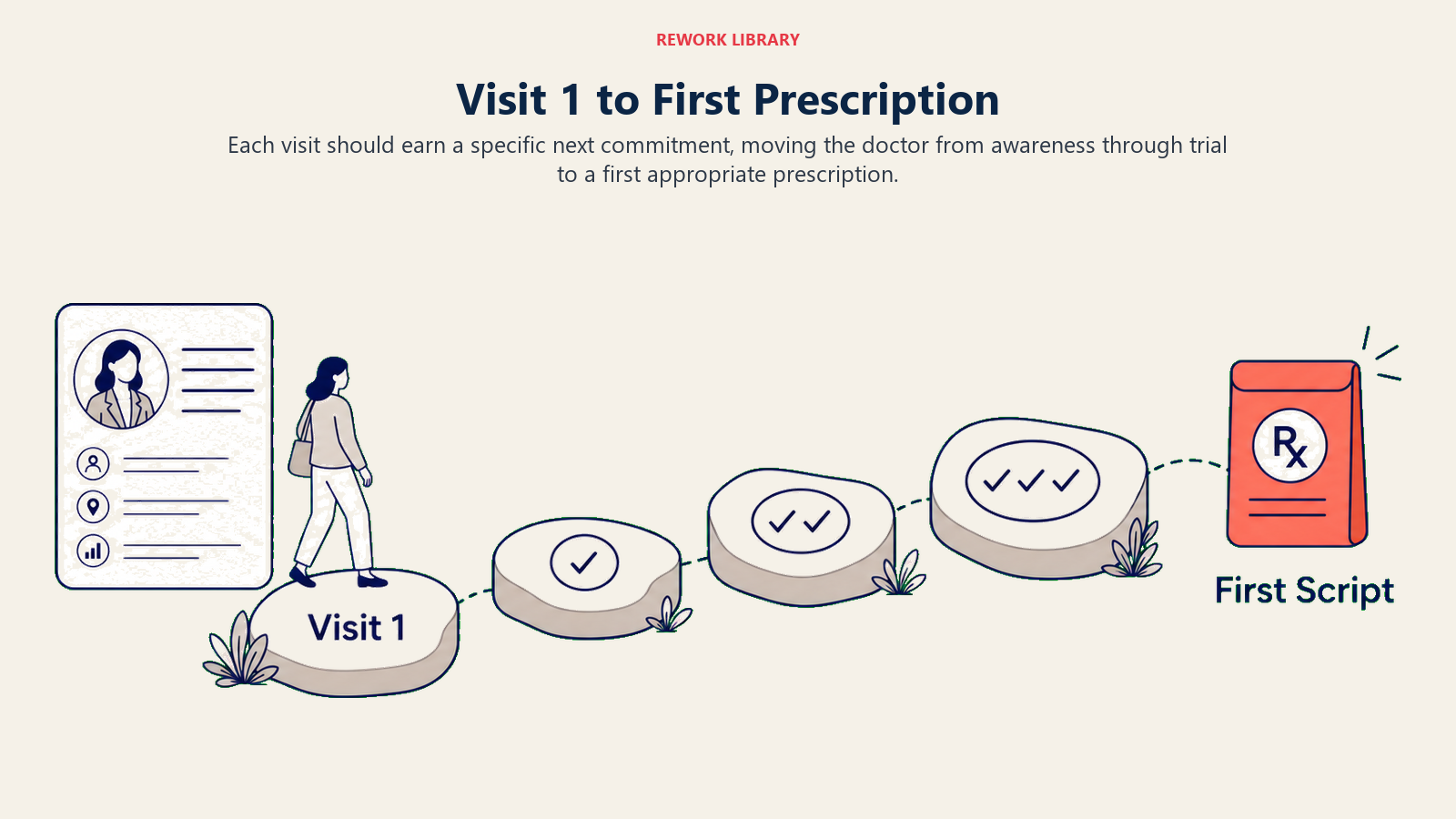
The first call rarely produces a prescription. It produces a relationship. The next two to four calls convert that relationship into a trial prescription, and trial prescriptions into consistent prescribing behavior.
Clinical evidence delivery matched to practice focus
New HCPs need to understand the clinical rationale for the product before they're willing to write it for a patient. The evidence you present should match the doctor's patient population and clinical priorities. A primary care physician with a large diabetic panel wants data on A1C reduction and renal safety. A cardiologist wants data on cardiac outcomes. Don't present the full prescribing information unless asked. Present the evidence that's most relevant to the patients they see every day.
Plan your clinical evidence delivery across visits 1 to 3. Visit 1: therapeutic area overview and product positioning. Visit 2: key clinical trial data relevant to their patient type. Visit 3: specific patient case discussion and first prescription opportunity.
Sample strategy for new HCPs
Samples serve a specific function with new prescribers: they lower the barrier to writing a first prescription. A doctor who's uncertain about a new medication is more likely to try it if a patient receives an initial supply at no cost, allowing both doctor and patient to assess tolerability and response before commitment to a full course.
Structure your sample strategy deliberately. Provide starter samples on visit 2 or 3, once the clinical conversation has established the right patient type. Discuss specifically which patient the doctor might consider for the first trial, so the sample isn't sitting in a drawer waiting for an ambiguous use case.
Sample-to-script conversion frameworks track whether samples placed with new HCPs are converting into prescriptions, giving field managers visibility into prospecting effectiveness beyond call counts.
Setting a realistic conversion timeline
Visit 1 to first script typically takes 3 to 6 calls over one to two sales cycles, depending on the therapy area complexity and the doctor's prescribing conservatism. Reps who expect a prescription after the first or second call become frustrated and deprioritize doctors who don't convert immediately. Reps who understand the typical conversion timeline set appropriate expectations and maintain call consistency without manufacturing urgency.
Prospecting Frequency and Rep Pipeline Targets
New HCP prospecting needs to be a mandated activity, not an opportunistic one. Without explicit targets, reps fill their schedule with existing accounts and prospecting falls away.
Prescriber Pipeline Stage Definitions
| Stage | Definition | Rep Action Required |
|---|---|---|
| Suspect | Identified through directory/observation, not yet qualified or visited | Qualify using scorecard |
| Prospect | Scored 10 or above, first visit scheduled or planned | Complete first call |
| Trial prescriber | First prescription written, relationship established | Maintain regular call cadence, review sample usage |
| Regular prescriber | Writes 2 or more prescriptions per cycle for eligible patients | Deepen relationship, introduce additional indications |
| Loyal prescriber | Defaults to product as first-line choice for appropriate patients | Maintain loyalty, use as peer reference |
Prospecting Activity KPI Table
| KPI | Recommended Target | Measurement Frequency |
|---|---|---|
| New HCP suspects identified per cycle | 15-20 per rep | Monthly |
| Prospects qualified and visited per cycle | 8-12 per rep | Monthly |
| First-call completion rate | 90% of planned prospect visits | Monthly |
| Suspect-to-prospect conversion | 60-70% of identified suspects | Quarterly |
| Prospect-to-trial prescriber conversion | 30-40% within 6 months | Quarterly |
| Trial-to-regular prescriber conversion | 50-60% within 12 months | Annually |
| Net new active prescribers per rep per year | 10-15 | Annually |
These targets should be calibrated to the market's prescriber density and the product's lifecycle stage. A recently launched product in a new therapeutic category will need higher prospecting targets and longer conversion timelines than a product with established market presence.
Field managers should review the prospecting pipeline monthly, not just conversion outcomes. If a rep's suspect list isn't growing, the problem is identification. If suspects aren't converting to prospects, the problem is qualification or call completion. If prospects aren't converting to trial prescribers, the problem is call quality. The stage-gate review logic is the same as in pipeline stages design: each stage has entry criteria, and reviewing where volume stalls tells you exactly which part of the system needs attention.
The Prescriber Pipeline Replacement Rule is a practical operating principle for field force managers: for every prescriber lost to attrition this quarter, the territory needs at least two new doctors in the trial prescriber stage to maintain flat prescription volume by year-end. This ratio accounts for the 50 to 60% trial-to-regular conversion rate and the typical 6-to-12-month conversion timeline.
Common Prospecting Mistakes
Even teams with good prospecting intentions make consistent errors that reduce conversion rates.
Visiting too many low-potential doctors. Prospecting effort spread thin across a large list of marginal targets produces weak results. The qualification scorecard exists precisely to prevent this. A rep who spends equal time on all prospects ignores the concentration principle: high-potential targets deserve disproportionate attention.
Neglecting follow-up after the first call. The first call opens the door. Not following up within two weeks closes it. Doctors don't remember reps who visit once and disappear. Consistent follow-up cadence is what differentiates a rep who builds relationships from one who generates call counts.
Leading with product before building rapport. A doctor's willingness to prescribe a product depends on their trust in the rep as a reliable source of clinical information. That trust is built by demonstrating knowledge, asking good questions, and listening to the doctor's clinical priorities. Reps who lead with product pitches on a first call compress this trust-building process and reduce their chances of conversion.
Not connecting prospecting activity to conversion tracking. Prospecting effort that isn't tracked against prescription outcomes tells managers nothing about which identification sources work best, which doctor segments convert most efficiently, and where the pipeline is breaking down.
Pre-call planning and objection handling provides the call-level skills to avoid these mistakes in practice. Prospecting is most effective when the rep enters each call with a clear objective, prepared questions, and pre-mapped responses to likely objections.
The Prescriber Pipeline as a Leading Indicator
Here's why field force managers should care about prescriber pipeline metrics beyond the quarterly sales number: prescription volume is a lagging indicator. It reflects what happened in the last 60 to 90 days. Prescriber pipeline is a leading indicator. It tells you what prescription volume will look like 6 to 12 months from now.
A territory where the rep has 15 active trial prescribers working through the conversion sequence is a territory with growing volume. A territory where the rep has 3 trial prescribers and no new prospects in the pipeline is a territory heading for decline, even if current prescription numbers look acceptable.
Building this leading-indicator visibility requires systematic pipeline tracking, not just prescription data. Field managers who monitor the full pipeline from suspect to loyal prescriber can intervene early: adding resources to territories where prospecting activity is low, coaching reps on call quality where trial-to-regular conversion lags, and adjusting target lists where suspect identification is stalling.
HCP relationship retention practices that maintain loyalty among existing prescribers work best when they're paired with consistent new HCP prospecting. The two activities together keep the prescriber base growing at the top while protecting volume at the base.
Territories where reps add 10 to 15 net new active prescribers annually grow prescription volume faster than territories relying on existing accounts, because new prescribers contribute incremental volume on top of the existing base rather than redistributing the same total demand across a smaller prescriber pool.
A first call that opens with clinical questions about the doctor's practice profile creates a stronger foundation for a follow-up conversation than a first call that leads with product presentation. The reason is straightforward: listening reveals the doctor's patient mix, which determines which product is actually relevant to show them next.
IQVIA's Prescriber Profiler and similar commercial tools can rank new target HCPs by therapy-area prescribing volume before the first call, making qualification faster and reducing the rate of wasted prospecting visits on low-potential doctors.
Conclusion
A healthy prescriber pipeline requires constant prospecting. Reps who only service existing accounts aren't managing their territory: they're managing its decline. The doctors in a rep's current base will continue to prescribe, until they don't. Retirement, relocation, changing clinical priorities, and competitor encroachment reduce every territory's active prescriber count over time.
New HCP prospecting fills that gap. It requires a systematic identification process, a disciplined qualification framework, a relationship-first first-call approach, and consistent follow-up through the conversion sequence. It requires targets that mandate the activity rather than leaving it to discretion, and pipeline tracking that surfaces conversion problems before they show up as revenue misses.
The reps who build prospecting into their rhythm as a standard weekly activity, not a special project, consistently build larger and more resilient prescriber bases than those who don't. For field force managers, the job is to make prospecting the expectation, not the exception.
Learn More

Senior Implementation Consultant
On this page
- The Cost of Not Prospecting
- Where Do Medical Reps Find New HCPs to Prospect?
- HCP Qualification: Focusing Prospecting Effort Where It Counts
- The First Detailing Call on a New Doctor
- Building Prescribing Intent: Visit 1 to First Script
- Prospecting Frequency and Rep Pipeline Targets
- Common Prospecting Mistakes
- The Prescriber Pipeline as a Leading Indicator
- Conclusion
- Learn More