Pharmacy Visit Playbook: What High-Performing Reps Do at the Counter Every Time
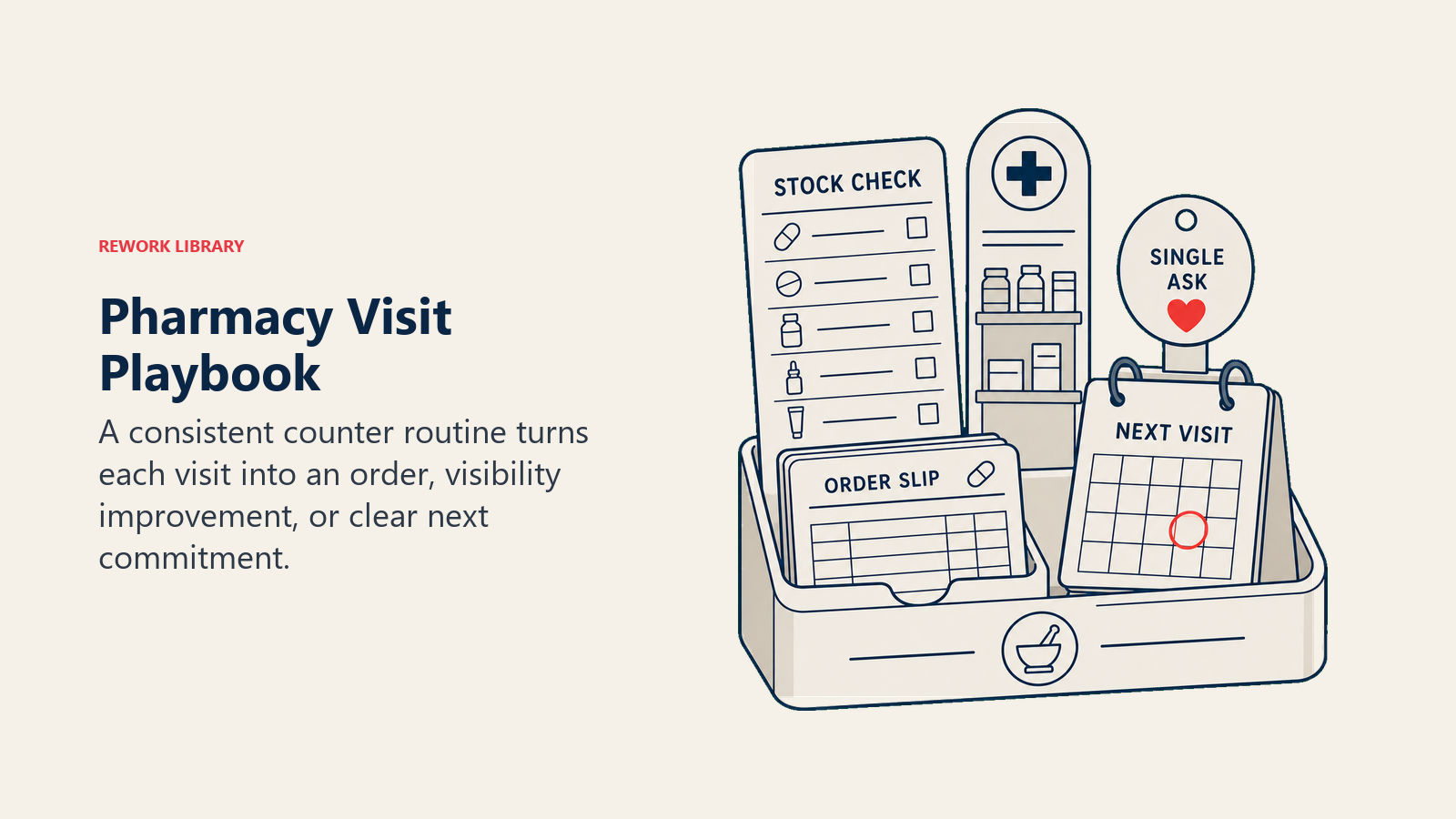 There's a rep most field managers have coached at some point. Friendly, likable, genuinely liked by the pharmacy staff. She visits on schedule, logs the call, and moves on. Ask her what came out of the visit and the answer is usually "good chat, they're happy with us." Ask to see her order confirmation rate or her average shelf facing improvement per month, and the numbers don't match the warmth.
The problem isn't effort. It's structure. A pharmacy visit without a defined sequence is a social call dressed up as a commercial activity. And in a territory with a heavy pharmacy call load, the difference between a structured visit and an unstructured one compounds into thousands of dollars of missed orders by the end of the quarter.
There's a rep most field managers have coached at some point. Friendly, likable, genuinely liked by the pharmacy staff. She visits on schedule, logs the call, and moves on. Ask her what came out of the visit and the answer is usually "good chat, they're happy with us." Ask to see her order confirmation rate or her average shelf facing improvement per month, and the numbers don't match the warmth.
The problem isn't effort. It's structure. A pharmacy visit without a defined sequence is a social call dressed up as a commercial activity. And in a territory with a heavy pharmacy call load, the difference between a structured visit and an unstructured one compounds into thousands of dollars of missed orders by the end of the quarter.
Turn this article into takeaways for your work.


Each assistant summarizes the article only for you and suggests best practices for your work.
This playbook gives field reps and their managers a repeatable five-stage structure that works whether the rep has three minutes at a busy counter or fifteen minutes in the back office with the head pharmacist. The stages don't change. The pace does.
The Five-Stage Pharmacy Visit
Key Facts: Pharmacy Visit Execution
- In territories with high pharmacy call density, the gap between structured and unstructured visits compounds into thousands of dollars of missed orders per quarter, making visit consistency one of the highest-return behavioral investments a field manager can address.
- A thorough stock check at a busy pharmacy counter takes under three minutes when the rep knows which SKUs to check and where the back-room count sits, far less time than the fumbling that happens when a rep arrives without reviewing account data first.
- CRM updates completed immediately after a visit, before the rep starts the car, have significantly higher accuracy than end-of-day logging, where a full day of calls blurs the morning details and order specifics go unrecorded.
Every high-performing pharmacy visit follows the same sequence. Reps who internalize this structure don't need to think about what comes next. They adapt the depth and duration of each stage to what the counter is giving them that day, but the sequence never varies.
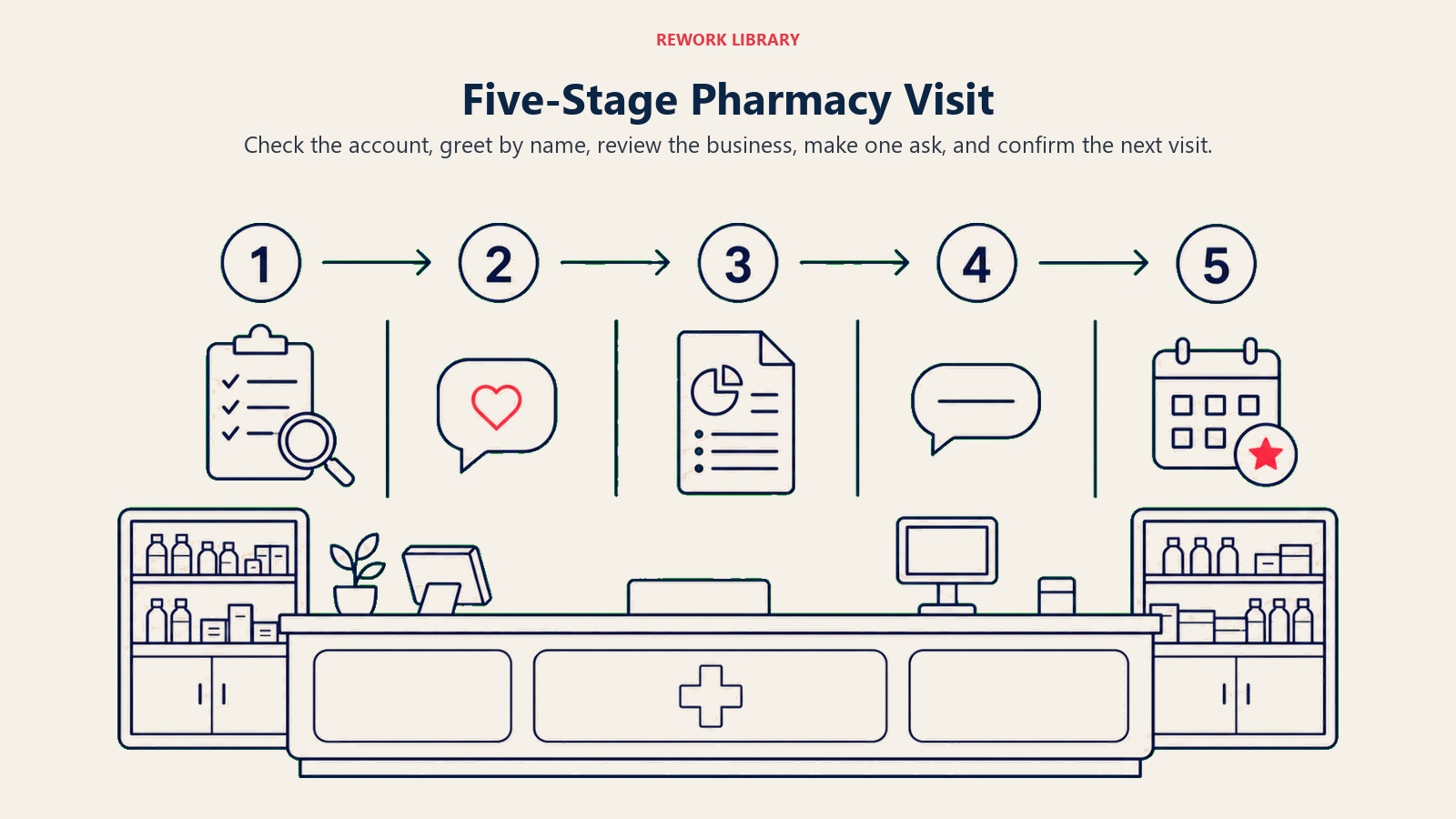
Stage 1: Pre-Visit Check
This stage happens before the rep walks through the door, ideally in the car park or at the previous stop.
A pre-visit check covers three things:
Stock status. What was the last recorded stock level for your top two or three SKUs at this account? If the CRM shows they ran low on 20mg packs last visit, that's the lead item for the conversation today. Arriving without knowing the stock situation forces the rep to discover it in real time at the counter, which takes longer and often happens while the pharmacist is busy.
Last order date and order size. If the account ordered three weeks ago and their typical sell-through rate is two weeks on a standard pack size, they're either understocked or they haven't been moving product. Either scenario shapes the ask in Stage 4.
Shelf position on last visit. Was the brand in the top-shelf priority position or buried on the second shelf behind a competitor? If position slipped, the visit needs to include a merchandising conversation, and the rep should come prepared with a reason (updated patient-facing material, promotional activity, new pack design) to request a move.
The pre-call planning and objection handling process covers this in depth, but the short version is that a two-minute pre-visit review prevents the fumbling at the counter that eats into every visit. Do it every time, without exception.
Stage 2: Greeting and Rapport
The rep walks in with the pharmacist's name ready. Not "hi there" or "good morning everyone" in the general direction of the dispensary. By name. To the specific person the visit is for.
"Morning, Khaled. Looks like a busy one today."
That's it. One sentence that uses the name, acknowledges the reality of what's happening at the counter, and signals that this rep pays attention. If the pharmacy is quiet, the sentence is different: "Khaled, good timing, I've got something quick to show you." If it's slammed, the sentence is shorter: "Khaled, two minutes when you're clear, I've got something on the Amoxil order."
The personal anchor is optional and should be used carefully. A personal anchor is a brief connection to something remembered from the last visit: a mention of the staff member who was training, a follow-up on a patient query the pharmacist raised, a comment on the new front-of-store display they were setting up. It signals that the rep treats this as a relationship, not a transaction. But it only lands if it's genuine and specific. Generic small talk (how was your weekend, how's business going) reads as filler and often triggers the "I'm busy" brush-off that shuts down the commercial conversation before it starts.
Stage 3: Business Review
This is where the rep and pharmacist look at what's actually happening commercially at this account. It's not a monologue from the rep. It's a quick, structured fact-share that sets up the ask in Stage 4.
Secondary sales trend. What's the sell-through on the brand's key SKUs? Is it trending up or flat? If the rep has access to account-level sell-out data through a pharmacy loyalty program or data partnership, this is the moment to reference it. "Your Amoxil 500 has moved 40 percent faster in the last four weeks compared to the previous cycle. I want to make sure you're not running short during the school-term peak." Pharmacists serve as critical gatekeepers in the dispensing chain, meaning their confidence in a product's supply reliability directly shapes whether they recommend it to patients at the point of dispense.
Competitor shelf observation. Before walking to the counter, the rep took three seconds to scan the OTC section and the relevant prescription shelf area. Are competitor brands taking up more space than on the last visit? Is a new generic occupying the first-eye position? This observation becomes a fact in the business review. "I noticed Competitor X has added a second facing on the nasal spray section. I want to talk about how we protect our position there."
This stage should last two to four minutes. It's not a full category review. It's enough context to make the ask in Stage 4 feel logical and commercial rather than opportunistic.
Stage 4: The Ask
This is the stage that separates productive visits from social calls. The ask is specific, singular, and always present. Every pharmacy visit ends with one of three categories of ask:
Order confirmation. "Based on your sell-through rate and current back stock, I'm suggesting we set up an order for [SKU and quantity] today. Does that work?"
Facing improvement. "I'd like to get the 20mg pack into the first position on the second shelf before I go. Can I take five minutes to tidy the section and move it up?"
Loyalty program or promotional activation. "The pharmacy loyalty program is offering double points on the full range through the end of the month. Can we register you for that today so your customers see the offer at the counter?"
The ask is built from what was uncovered in Stages 1 and 3. If the stock review showed depletion risk, the ask is an order. If the shelf observation flagged competitor encroachment, the ask is facing improvement. If neither of those is urgent, the ask is a program activation or a next-step commitment on a pending promotional agreement.
One ask per visit. Reps who try to ask for an order, a facing improvement, and a promotional sign-up in the same breath dilute all three. Pick the one with the highest commercial value at this account on this day, and ask for it clearly. This same discipline of the singular, high-value ask is documented more broadly in closing strategy principles: concentrate commitment on one specific action rather than splitting the conversation across multiple requests.
Handling "We Have Enough"
This objection comes up at well-stocked accounts and should be reframed immediately around sell-out rate rather than stock-on-hand. "I hear you on back stock. I'm not worried about what you have right now. I'm looking at the sell-through speed and what you'll need going into next week, especially if the usual scripts from the GPs across the road hold at the same rate as last month." Medication non-adherence is a significant driver of avoidable health costs, and stockouts at the pharmacy counter are one of the preventable contributors: patients who find a product unavailable often switch brands rather than wait.
Stock-on-hand is a backward-looking number. Sell-out rate is forward-looking. Reps who shift the conversation from the first to the second almost always find more room to discuss an order than the pharmacist initially offered.
Stage 5: Close and Next-Visit Commit
Every visit ends with two things confirmed out loud: the agreed action from today, and the date of the next visit.
"So we're confirming the order for 36 units of the 500mg pack and I'll get the new patient-information cards onto the shelf before I go. I'll be back in two weeks, which puts me here on the 12th. Is the morning still the better time for you?"
The next-visit commit does more than block the calendar. It signals to the pharmacist that this rep is reliable and organized. Over multiple visits, that reliability is what earns access during busy periods, earns a quicker yes on orders, and earns the pharmacist's willingness to recommend the brand when patients ask.
How Do You Read the Counter Before Launching the Visit?
Before a rep launches into Stage 2, she reads the counter for three signals: Is the pharmacist available? Is she rushed? Is she resistant? Available: The pharmacist is at the dispensary counter with no active patient transaction, minimal queue, and eye contact made when the rep entered. Full five-stage visit, normal pace.
Rushed: Two or more patients at the counter, the pharmacist is mid-prescription check, or staff are visibly managing a queue. The rep makes eye contact, gives a brief "I'll wait five minutes" hand signal if the relationship permits, or immediately compresses to a 90-second visit covering only the ask. Stage 2 is shortened to a name greeting, Stages 3 and 5 are dropped, Stage 4 is a single direct ask with a leave-behind. "Khaled, quick one: I'm proposing we refill the 500mg stock before end of week given the pace you've been running. I've left the order form with your dispenser. I'll confirm on Thursday." Then leave.
Resistant: The pharmacist says "not today" or offers a visible brush-off at the door. This is a data point, not a rejection. Note it, note whether it's the first or third consecutive brush-off at this account, and flag it for a manager-accompanied visit if the pattern repeats.
The Stock Check Ritual
A thorough stock check at a busy pharmacy takes under three minutes if the rep knows where to look and what to count.
Start at the shelf. Count facings for each of your key SKUs: how many units are visible, in what position, and whether any are expired or near-expiry (pull those immediately). Note the competitor shelf configuration in the same breath: it takes five additional seconds and produces data that informs both Stage 3 and future competitive reporting.
Move to the dispensary window. Ask the dispenser (not the head pharmacist if they're busy) for the back-room count on the top one or two SKUs. Most dispensers will give a quick number or point to the shelf behind them. You're looking for a below-safety-stock signal: if their back room holds fewer than seven days of supply at current sell-through and you're two visits away from the next cycle, that's an order conversation. Research on pharmacy inventory control confirms that structured stock-level monitoring, even at the rep-visit level, reduces stockout frequency compared to ad-hoc reordering triggered only when product runs out.
The stock check should be built into the pre-visit if data is available in the CRM or a pharmacy data platform. The in-person check confirms it and catches the discrepancies between what was ordered and what's actually on the shelf, which happen more often than most commercial teams track.
See pharmacy order and stock management for the full framework on managing stock data between visits.
Visit Notes and CRM Update
The CRM update happens before the rep starts the car. Not that evening. Not at the end of the day. Before driving away from the pharmacy car park. A consistent post-visit logging habit is also what makes standard operating procedures for field teams actually work: the value compounds only when every rep follows the same documentation sequence on every call. Recall is highest in the two minutes after a visit. By 5 pm, a rep who made 12 calls has blurred the details from the morning visits. Orders get mis-logged, objections go unrecorded, and the next-visit commitment isn't captured with enough specificity to be useful.
A standard CRM update for a pharmacy visit covers five fields: call result (order, facing, program activation, or no action taken), action items committed to by the rep and by the pharmacy, stock levels observed, next visit date, and one sentence of contextual note ("pharmacist mentioned competitor running a 15-percent promotion on competing brand; worth flagging to manager before next cycle").
The pharma CRM and sales force automation system should have a quick-entry template that makes this a 90-second task, not a five-minute typing exercise. If it doesn't, that's a configuration problem worth raising.
Coaching the Visit: What a Field Manager Observes and Scores on a Joint Visit
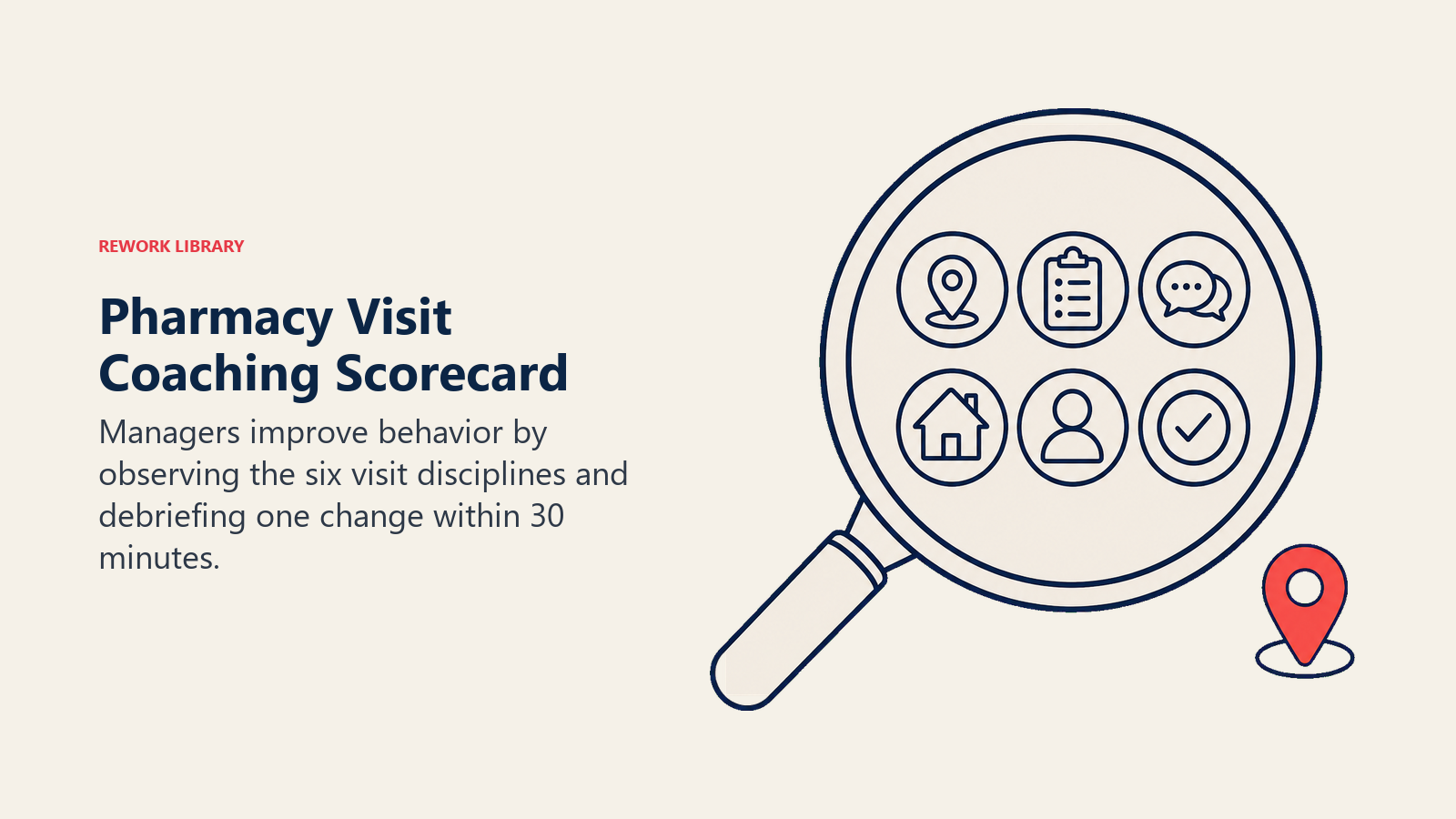
A double call is the highest-leverage coaching activity a field manager has. One joint visit per rep per month, against a structured observation rubric, produces more behavior change than any training session. Field manager observation scorecard (pharmacy visit):
 | Stage | What to observe | Score (1-3) |
|---|---|---|
| Pre-visit check | Did the rep review stock status and last order before entering? | 1 = No / 2 = Partial / 3 = Full review |
| Greeting | Was the pharmacist greeted by name? Was the personal anchor genuine and specific? | 1 = No name / 2 = Name only / 3 = Name plus anchor |
| Business review | Did the rep use a specific sell-through or shelf observation to set context? | 1 = No data / 2 = Generic / 3 = Account-specific data |
| The ask | Was there a single, specific ask? Was the "we have enough" objection handled by reframing to sell-out rate? | 1 = No ask / 2 = Ask made but not specific / 3 = Specific ask, objection handled |
| Close and commit | Was the next visit date confirmed out loud? Was the action summarized? | 1 = No close / 2 = Close without date / 3 = Close with confirmed date |
| CRM update | Was the update completed in the car park before departure? | 1 = No / 2 = Partial / 3 = Complete |
| Stage | What to observe | Score (1-3) |
|---|---|---|
| Pre-visit check | Did the rep review stock status and last order before entering? | 1 = No / 2 = Partial / 3 = Full review |
| Greeting | Was the pharmacist greeted by name? Was the personal anchor genuine and specific? | 1 = No name / 2 = Name only / 3 = Name plus anchor |
| Business review | Did the rep use a specific sell-through or shelf observation to set context? | 1 = No data / 2 = Generic / 3 = Account-specific data |
| The ask | Was there a single, specific ask? Was the "we have enough" objection handled by reframing to sell-out rate? | 1 = No ask / 2 = Ask made but not specific / 3 = Specific ask, objection handled |
| Close and commit | Was the next visit date confirmed out loud? Was the action summarized? | 1 = No close / 2 = Close without date / 3 = Close with confirmed date |
| CRM update | Was the update completed in the car park before departure? | 1 = No / 2 = Partial / 3 = Complete |
A score of 15 or above is competent execution. Below 12 is a coaching conversation. The debrief after a joint visit should happen within 30 minutes, at a coffee shop or in the manager's car, never rushed into the next call. What did the rep do well? What's the one thing she changes next visit?
The consistent use of retail merchandising and shelf visibility practices, applied visit after visit, is what compounds into shelf position leadership over a six-month period.
A rep who confirms the next visit date out loud before leaving earns faster access during busy periods, quicker order decisions, and warmer pharmacist receptivity over time, because predictable rep presence reads as professionalism, not persistence.
Managers who score pharmacy visits against a structured rubric and debrief within 30 minutes of the call see faster behavior change than those who wait for a formal coaching session a week later; the closer the feedback to the behavior, the more durable the improvement.
The Five-Stage Visit Structure is the repeatable sequence described throughout this article: Pre-Visit Check, Greeting and Rapport, Business Review, The Ask, and Close and Next-Visit Commit. The stages do not change regardless of available time; what adapts is the depth and duration of each stage based on what the counter is giving the rep that day.
Conclusion: Consistency at the Counter Compounds Into Market Share
Pharmacy visit quality doesn't pay off in a single call. It pays off in the accumulation of calls executed to a consistent standard across an entire territory over an entire quarter.
A rep who completes 280 pharmacy visits in a quarter with a structured five-stage approach and a logged outcome for every visit generates a different commercial outcome than a rep who completes 300 visits with no consistent structure and inconsistent CRM data. Volume without structure is noise. Structure without volume isn't enough. The combination, applied with discipline on every beat and route journey, is how market share is built at the pharmacy counter.
Give reps the playbook. Measure the stages, not just the call count. Coach the structure on joint visits. And watch whether the pattern holds under pressure: the best reps run the same sequence when the counter is busy as when it's quiet. That consistency is the whole point.
Learn More

Senior Implementation Consultant
On this page
- The Five-Stage Pharmacy Visit
- Stage 1: Pre-Visit Check
- Stage 2: Greeting and Rapport
- Stage 3: Business Review
- Stage 4: The Ask
- Stage 5: Close and Next-Visit Commit
- How Do You Read the Counter Before Launching the Visit?
- The Stock Check Ritual
- Visit Notes and CRM Update
- Coaching the Visit: What a Field Manager Observes and Scores on a Joint Visit
- Conclusion: Consistency at the Counter Compounds Into Market Share
- Learn More