Pharmacy Loyalty and Incentive Programs: Driving Reorders Without Cutting Margins
Turn this article into takeaways for your work.


Each assistant summarizes the article only for you and suggests best practices for your work.
Discounts get attention. Loyalty programs keep accounts.
Every pharma commercial team has watched the same pattern: run a trade promotion, see a short-term volume spike, watch orders return to baseline the moment the discount expires. Repeat. The accounts that were buying before the promotion buy more during it and then revert. No lasting change in brand preference. No reduction in competitor switching. And the margin spent on the promotion is gone.
The commercial teams that build durable pharmacy relationships don't rely on discounts as the primary retention mechanism. They build structured loyalty programs that give pharmacy accounts reasons to stay, rewards for consistent volume, and benefits that a competitor promotion can't instantly replicate.
But loyalty programs in pharma operate inside a compliance environment that punishes careless design. The line between a legitimate trade incentive and an inducement to recommend a product can narrow quickly. Commercial leaders need programs that drive measurable results and survive regulatory scrutiny.
The Spectrum of Pharmacy Incentives
Not all incentives work the same way or carry the same compliance profile. Understanding the full spectrum helps commercial teams design programs that are both effective and defensible.
Incentive Type Comparison Table
| Incentive Type | Commercial Mechanism | Compliance Sensitivity | Durability |
|---|---|---|---|
| Volume rebates | Reward order quantity | Low, if properly structured | Low, price-driven behavior reverts |
| Early payment discounts | Reward prompt settlement | Low | Low |
| Stock rotation support | Offset expiry losses | Low | Moderate |
| Training certification incentives | Reward staff education | Low | High |
| Co-branded patient education materials | Support dispensing education | Low | High |
| Priority stock allocation | Supply reliability reward | Low to moderate | High |
| Cash bonuses for dispensing volume | Direct prescribing influence | High risk, often non-compliant | Not applicable |
The distinction that matters for compliance is whether the incentive rewards purchasing behavior or influences dispensing behavior. Volume rebates tied to purchase orders are generally compliant. Payments or rewards tied to the number of prescriptions dispensed cross into inducement territory in most regulatory environments. The OIG safe harbor regulations at 42 CFR § 1001.952 set out the specific conditions under which rebate arrangements avoid anti-kickback liability.
Commercial leaders must work with their regulatory and legal teams before launching any incentive program. The framework below describes commonly compliant structures, but specific market regulations vary.
Key Facts: Pharmacy Loyalty Programs
- Research on worldwide pharma promotion codes confirms that training and education benefits consistently receive the most favorable compliance treatment across industry self-regulatory frameworks, making CPD certification incentives one of the lowest-risk ways to build long-term account loyalty.
- Tiered rebate programs that reward incremental purchasing (Bronze/Silver/Gold thresholds) are designed to generate stronger behavioral change than flat rebates on total volume: a flat rebate cannot incentivize accounts already purchasing at the qualifying level to change their behavior, whereas a tiered structure creates forward momentum at every purchase level.
- The OIG safe harbor regulations at 42 CFR § 1001.952 set out the specific conditions under which rebate arrangements avoid anti-kickback liability, and the distinction that matters for compliance is whether the incentive rewards purchasing behavior or influences dispensing behavior.
Compliant Incentive Structures
Volume rebates are the most widely used transactional incentive. They reward the pharmacy for reaching purchase thresholds within a defined period, typically quarterly or annually. The rebate is calculated on verified purchase volume, not dispensing data, which keeps it on the right side of trade practice regulations in most markets.
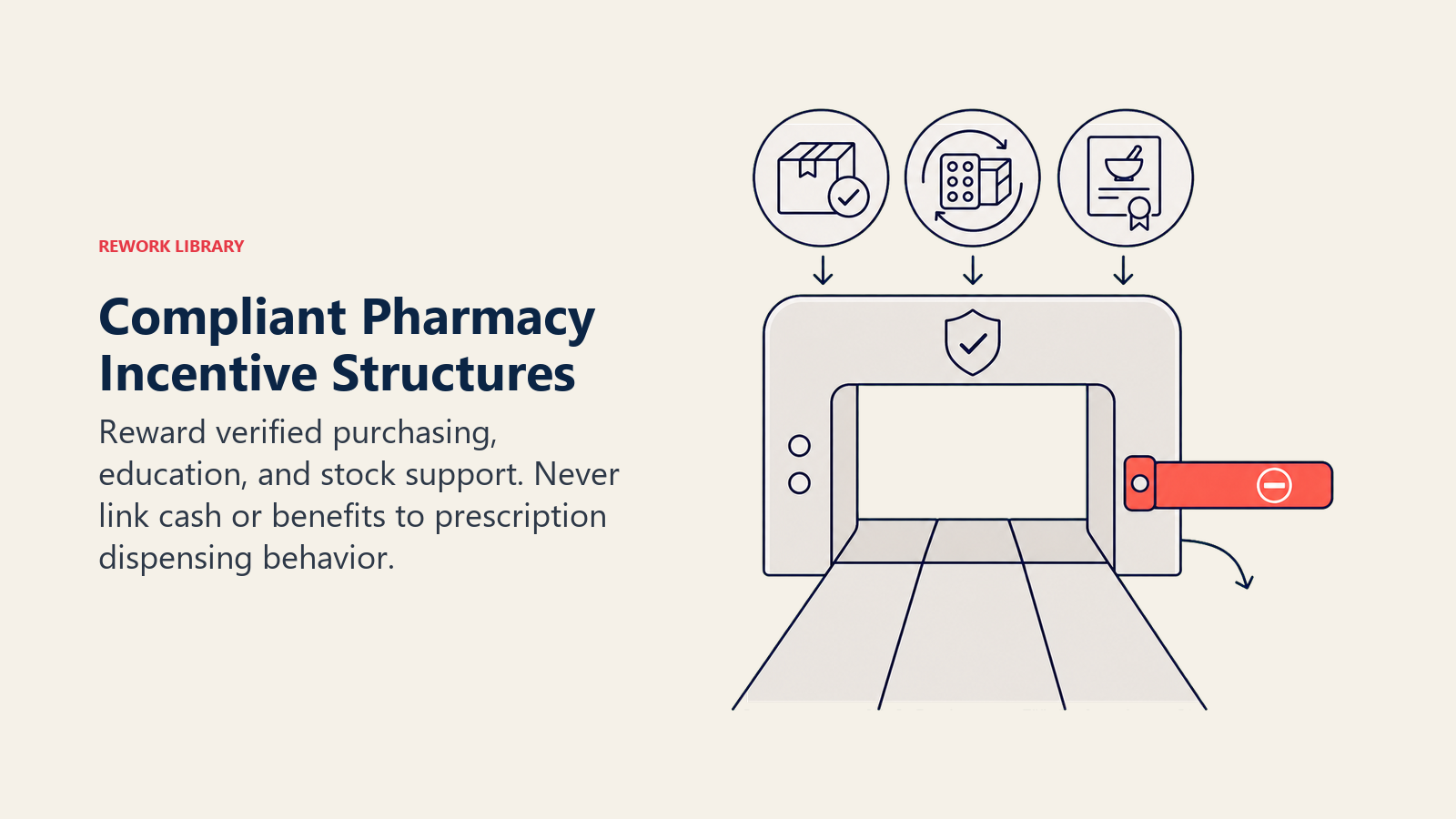
For rebates to do more than reward volume they'd have already purchased, the threshold design matters. Flat rebates on total volume are less effective than tiered rebates that reward incremental purchasing. An account that was buying 200 units per month doesn't change behavior for a rebate triggered at 200. Set the Bronze threshold at 200, Silver at 260, and Gold at 340, and the commercial incentive structure pulls behavior upward.
Stock rotation support addresses a practical pain point for pharmacy owners: expired stock that they're carrying at their own cost. Offering credit or replacement for near-expiry product reduces the risk pharmacies associate with increasing their order volume. It's a particularly effective tool for new product launches where pharmacies are hesitant to order deeply until they've established demand.
Training certification incentives reward pharmacy staff for completing product knowledge training. These can take the form of access to continuing professional development credits, recognition certificates, preferred partner status, or small non-monetary benefits tied to training completion. The compliance profile is favorable because the incentive is clearly linked to education rather than dispensing behavior.
What crosses the line. Payments linked to prescription dispensing volumes, gifts with meaningful monetary value, entertainment expenses without a legitimate educational purpose, and rebates that can only be triggered by influencing the patient toward a branded product rather than a generic: these are the structures that attract regulatory attention. The PhRMA Code on Interactions with Health Care Professionals codifies these boundaries for US manufacturers, and comparable frameworks exist across most regulated markets. A compliance checklist before program launch is not optional.
Compliance Checklist for Pharmacy Incentive Programs
- Incentive tied to purchase volume, not dispensing volume
- No cash payments linked to prescription recommendation behavior
- All benefits documented with clear commercial rationale
- Non-monetary benefits within regulatory value thresholds for your market
- Training incentives clearly tied to educational content, not product recommendation
- Program terms documented, accessible, and consistently applied across accounts
- Legal and regulatory sign-off prior to launch
- Audit trail for all benefit payments and redemptions
See pharmaceutical marketing compliance and ethics for the full regulatory framework that governs trade incentive design in pharma markets.
Designing a Loyalty Program Tier
Tiered programs outperform flat programs because they create forward momentum. An account at Bronze isn't just earning a current benefit; it's working toward something better. That forward pull sustains engagement across the program year.
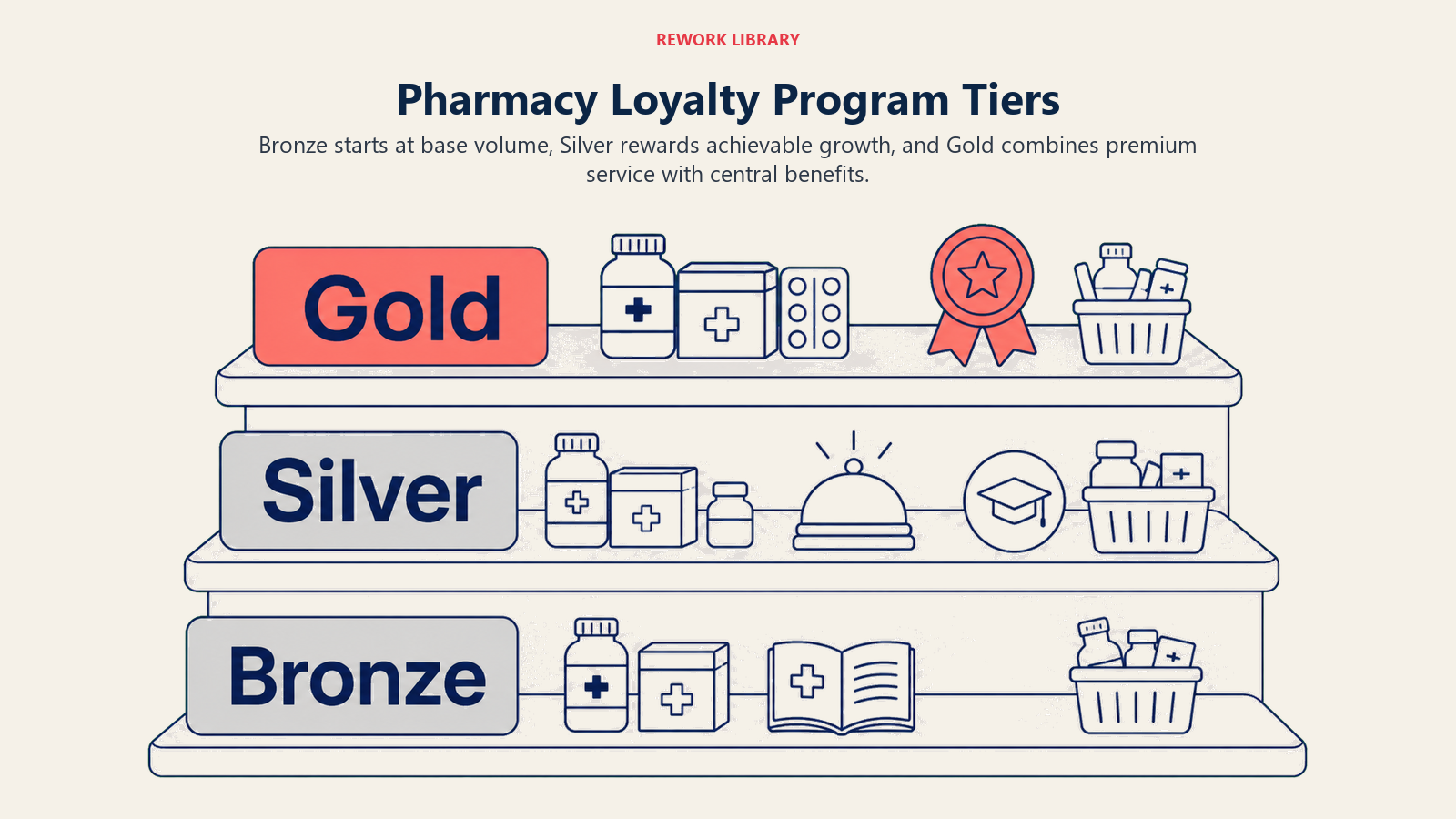 Loyalty Tier Design Template
| Tier | Annual Purchase Threshold | Rep-Managed Benefits | Centrally Managed Benefits |
|---|---|---|---|
| Bronze | Base volume (current average) | Priority service response, basic training materials | Access to patient education toolkit |
| Silver | 30% above base | Dedicated account rep, expedited order processing | Co-branded patient materials, CPD credit program |
| Gold | 60%+ above base | Quarterly business review with commercial manager, early access to new products | Priority stock allocation during shortages, annual pharmacist recognition award |
The threshold percentages above are illustrative. Your specific program thresholds should be built from territory-level volume data, so each account's tier targets represent genuinely achievable stretch goals rather than arbitrary numbers.
Rep-managed vs centrally managed benefits is an important design decision. Benefits that a rep can deliver directly, like priority service response or bringing training materials on the next visit, keep the rep central to the relationship. Centrally managed benefits like rebate payments or stock allocation decisions require back-office processing but carry more weight in a pharmacy's commercial decision-making.
The most effective loyalty programs blend both. The rep delivers the relational and educational benefits that reinforce the account relationship visit by visit. The central program delivers the commercial benefits that give the pharmacy financial reasons to maintain and increase their commitment. The question then is which non-monetary benefits actually stick.
Which Non-Monetary Incentives Create Durable Pharmacy Loyalty?
The most durable pharmacy loyalty comes from benefits that a competitor can't immediately match with a promotional price. Non-monetary incentives, when well-designed, create exactly this kind of stickiness.
Co-branded patient education materials give the pharmacy something genuinely useful to offer patients. A pharmacist who has clear, accurate, professional-looking materials to hand patients asking about managing a chronic condition, understanding a drug interaction, or tracking their adherence is better equipped to do their job. The pharmacy's name on those materials also reinforces their professional identity in the patient community. Your brand association with quality patient care is the commercial benefit.
Pharmacist training certification. Offering accredited continuing professional development modules for pharmacists and dispensary staff on relevant therapeutic areas provides real professional value. Research on worldwide pharma promotion codes confirms that training and education benefits consistently receive the most favorable compliance treatment across industry self-regulatory frameworks. Pharmacists who completed your certified training on chronic kidney disease management, for example, are more confident dispensing your nephrology brand and more likely to counsel patients appropriately. The CPD credit has value to their professional registration regardless of your product, which makes it a legitimate and genuinely useful benefit.
Priority stock allocation during shortages. When distribution constraints or manufacturing delays create stock shortfalls, which account gets their order filled first? If the answer is "whoever calls the most" rather than "our most loyal accounts," you're wasting a powerful loyalty lever. A clearly communicated policy that Gold-tier accounts receive priority allocation during shortage periods gives pharmacies a concrete reason to invest in the relationship before the shortage happens.
Early access to new products and samples. Pharmacies at higher loyalty tiers get early access to new product launches, clinical samples for appropriate patient evaluation, and first notification of new indications. For pharmacies that pride themselves on being current, this is a meaningful benefit.
Program Mechanics: Enrollment, Tracking, and Communication
A well-designed program that nobody understands or engages with achieves nothing. The operational design of how pharmacies join the program, how benefits are tracked, and how reps communicate progress is as important as the benefit design itself.
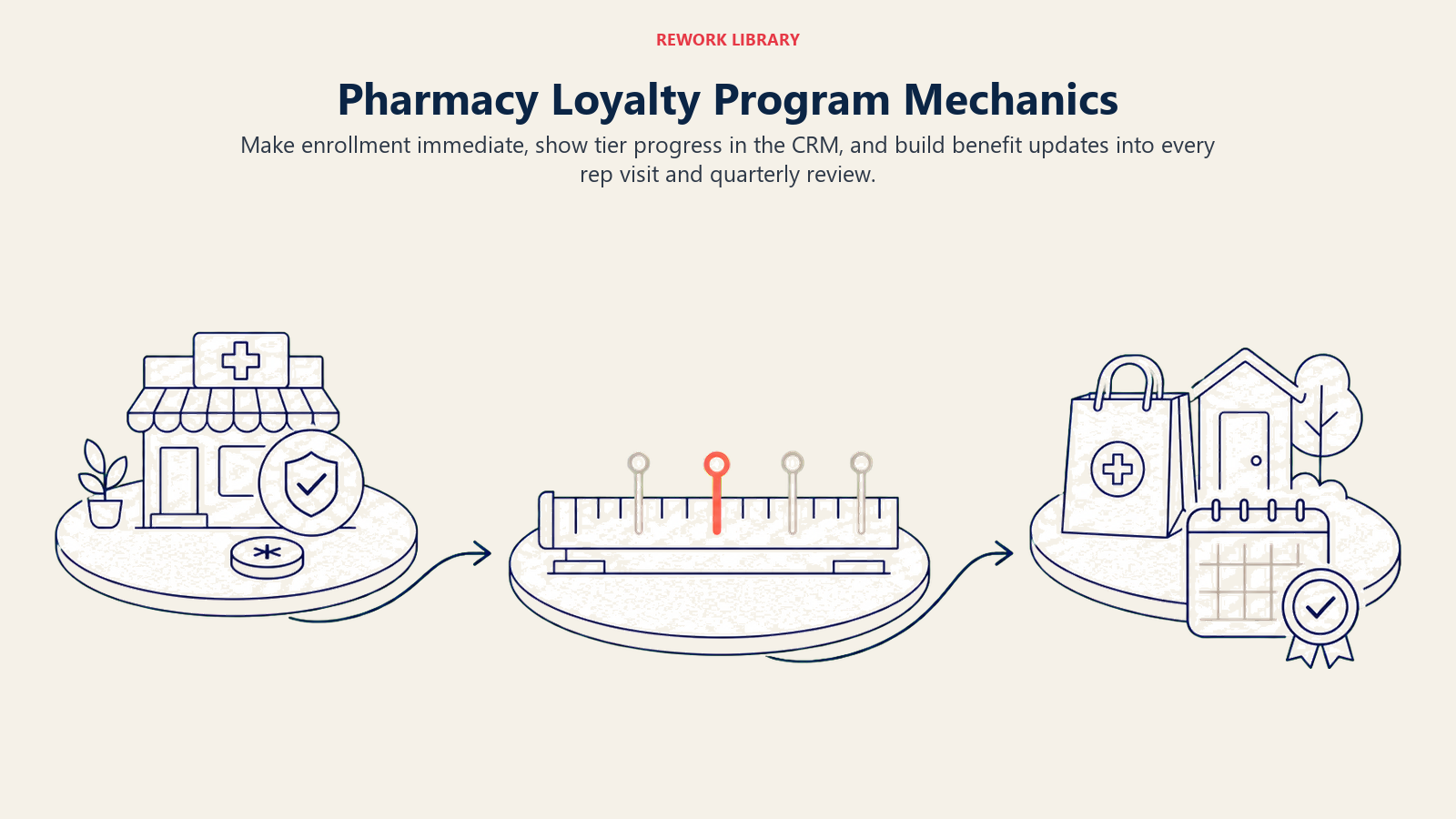 Enrollment should be frictionless. If joining the program requires a pharmacy owner to complete a lengthy form, wait for approval, and receive a card in the mail, most won't bother. The rep-initiated enrollment, where the rep registers the account in the CRM during a visit and the pharmacy receives immediate confirmation of their starting tier, is both simpler and faster.
Tracking requires visibility at two levels: the rep needs to see each account's current tier, their year-to-date progress toward the next tier, and when they last received a benefit delivery. The commercial leadership team needs aggregate data on program enrollment rates, tier distribution across the territory, and whether tier movement correlates with order volume changes.
Communication cadence for the program should be built into the rep's standard visit routine. At each visit, the rep acknowledges the account's current tier, updates them on their progress toward the next tier if they're close, and delivers any pending benefits. Quarterly, the commercial team sends a program summary to enrolled accounts showing their cumulative benefits received and their standing going into the next quarter.
The repeat order and reorder systems framework connects program milestones to automated reorder triggers, so the commercial incentive and the operational convenience reinforce each other. Once the mechanics are running, the remaining question is whether the spend is actually paying off.
Measuring ROI on Loyalty Spend
Loyalty programs cost money. Volume rebates, training materials, co-branded assets, and CPD program development all carry direct costs. Commercial leaders need a clear ROI framework to evaluate whether the spend is generating returns that justify the investment.
ROI Calculation Framework
Incremental order volume. Compare the order volume of enrolled vs non-enrolled accounts, and the order volume of higher-tier vs lower-tier accounts, controlling for account size and territory. If enrolled accounts show meaningfully higher volume growth than comparable non-enrolled accounts, the program is generating commercial return.
Brand switching reduction. Track the rate at which enrolled accounts introduce competitor products or reduce your brand's share of their dispensary. Compare this to the switching rate in non-enrolled accounts. If enrolled accounts show lower switching rates, the program is protecting revenue that would otherwise have been lost.
Cost per retained account. Divide the total annual program spend (rebates paid, materials produced, training programs delivered) by the number of accounts that maintained or increased their tier over the program year. This gives you a retention cost per account that you can compare against the estimated revenue value of those accounts.
Tier upgrade rate. What percentage of Bronze accounts move to Silver within 12 months? What percentage of Silver accounts reach Gold? A program where accounts aren't moving up isn't driving incremental behavior. Either the thresholds are too high, the benefits aren't attractive enough, or the rep isn't actively managing tier progress conversations. Accounts that feel invested in a tiered relationship generate more value, and more advocacy, than accounts kept on a flat discount.
The secondary sales tracking and pull-through data is the essential input for calculating whether loyalty program investment translates into actual downstream prescription volume, not just forward purchases that build inventory without moving product to patients.
Building Programs That Survive Regulatory Audits
The commercial pressure on loyalty programs in pharma is real: drive more volume, increase reorder frequency, reduce competitor switching. But the regulatory pressure is equally real, and programs that cut corners on compliance create risk that far outweighs the short-term commercial gain.
The programs that survive regulatory scrutiny share a few consistent characteristics. They're documented: program terms, benefit schedules, and eligibility criteria are in writing and consistently applied. They're transparent: pharmacy owners know exactly what they'll receive and under what conditions. They're educationally grounded: benefits that support clinical education, patient care, or professional development have a clearer compliance rationale than pure cash payments. And they're auditable: every benefit payment, training completion, and tier upgrade is logged with a commercial rationale.
The independent vs chain pharmacy strategy influences program design because the regulatory scrutiny and commercial dynamics differ across account types. Chain head office negotiations often involve different compliance requirements than rep-managed independent programs.
A loyalty program designed around these principles doesn't need to choose between compliance and commercial impact. Done right, it achieves both: a program the regulatory team can defend, and a commercial team can measure.
That's the standard worth building to.
Frequently Asked Questions about Pharmacy Loyalty and Incentive Programs
What is the compliance boundary between a trade incentive and an illegal inducement?
The critical distinction is whether the incentive rewards purchasing behavior or influences dispensing behavior. Volume rebates tied to verified purchase orders are generally compliant in most markets. Payments, cash bonuses, or rewards linked to the number of prescriptions actually dispensed cross into inducement territory and attract anti-kickback scrutiny. Before launching any program, legal and regulatory sign-off is required, not optional.
Why do tiered loyalty programs outperform flat rebates?
Tiered programs create forward momentum that flat programs do not. An account already purchasing at the flat rebate qualifying volume has no incentive to increase orders. An account at Bronze tier is actively working toward Silver because the next tier offers better benefits. That forward pull sustains engagement across the full program year. Effective tier thresholds are built from territory-level volume data so they represent achievable stretch goals: a Bronze threshold set at an account's current average, Silver at 30 percent above that, and Gold at 60 percent or more above base.
What non-monetary incentives work best in pharmacy loyalty programs?
Co-branded patient education materials, accredited continuing professional development modules, priority stock allocation during shortage periods, and early access to new product launches are the most effective non-monetary incentives in terms of durability and compliance profile. They work because they cannot be instantly replicated by a competitor running a promotional price: a competitor can match a rebate in a day, but it cannot immediately offer a pharmacist's staff CPD credits or guarantee priority allocation when supply is constrained. Non-monetary benefits create stickiness that pure price incentives do not.
How should a loyalty program handle stock shortage situations?
Priority stock allocation during shortage periods should be an explicit, clearly communicated benefit of the highest loyalty tiers, not an informal arrangement managed on the fly. When the program documentation states that Gold-tier accounts receive priority fulfillment during supply constraints, pharmacies have a concrete, forward-looking reason to invest in the relationship before a shortage occurs. This transforms an operational challenge (managing allocation during a shortage) into a loyalty lever that deepens commitment during normal trading conditions.
What data do I need to measure loyalty program ROI?
Three comparisons drive the ROI calculation. First, compare order volume of enrolled versus non-enrolled accounts controlling for account size, and enrolled accounts at higher versus lower tiers. Second, track brand switching rates in enrolled versus non-enrolled accounts: if enrolled accounts show lower switching rates, the program is protecting revenue. Third, calculate cost per retained account by dividing total annual program spend by the number of accounts that maintained or increased their tier over the program year. Secondary sales tracking data is the essential input for confirming that loyalty program investment translates into downstream prescription volume, not just forward purchasing that builds inventory without moving product to patients.
What makes a loyalty program survive a regulatory audit?
Programs that pass regulatory scrutiny share four characteristics: they are documented (terms, benefit schedules, and eligibility criteria in writing and consistently applied); they are transparent (pharmacy owners know exactly what they receive and under what conditions); they are educationally grounded (benefits tied to clinical education or professional development have clearer compliance rationale than pure cash payments); and they are auditable (every benefit payment, training completion, and tier upgrade logged with a commercial rationale). A compliance checklist reviewed and signed off before launch is the minimum standard for any program design.
The Tiered Loyalty Program Model is the core framework this article describes: three tiers (Bronze at current base volume, Silver at 30 percent above base, Gold at 60 percent or more above base), each with a defined mix of rep-managed benefits and centrally managed benefits that increase in commercial and relational value as accounts move up. The model works because it connects the rep's daily account interactions (relational and educational benefits delivered in person) with back-office commercial mechanics (rebate payments, stock allocation, CPD program access) that give pharmacy owners financial reasons to maintain and increase their commitment.
The most common design failure in tiered programs is setting thresholds that do not reflect actual territory data. An account with a consistent monthly volume of 200 units placed on a Bronze tier that triggers at 300 faces an unachievable gap. That account stays disengaged rather than motivated. Tier thresholds built from the actual distribution of account volumes in the territory produce the forward momentum the model depends on.
Learn More

Senior Implementation Consultant
On this page
- The Spectrum of Pharmacy Incentives
- Compliant Incentive Structures
- Designing a Loyalty Program Tier
- Which Non-Monetary Incentives Create Durable Pharmacy Loyalty?
- Program Mechanics: Enrollment, Tracking, and Communication
- Measuring ROI on Loyalty Spend
- Building Programs That Survive Regulatory Audits
- Learn More