Pharmacy Relationship Management: Building Long-Term Partners, Not One-Time Buyers
Turn this article into takeaways for your work.


Each assistant summarizes the article only for you and suggests best practices for your work.
There are two kinds of pharmacy accounts on every medical rep's route. The first reorders without prompting, asks the rep for clinical updates before a generic enters the market, and keeps your brand stocked even when distributor pricing fluctuates. The second switches at the first meaningful discount from a competitor, stocks whatever is cheapest, and treats every rep visit as an interruption.
The difference isn't the product. It's the relationship.
Pharma commercial leaders often treat pharmacy management as a logistics function: place the order, confirm the stock, move on. But the accounts that deliver consistent reorder volume and resist brand substitution aren't just buying a product. They're operating inside a relationship that gives them reasons to stay. Building that kind of account base requires a structured system, not social instinct or rep personality.
Relationship Tiers in the Pharmacy Channel
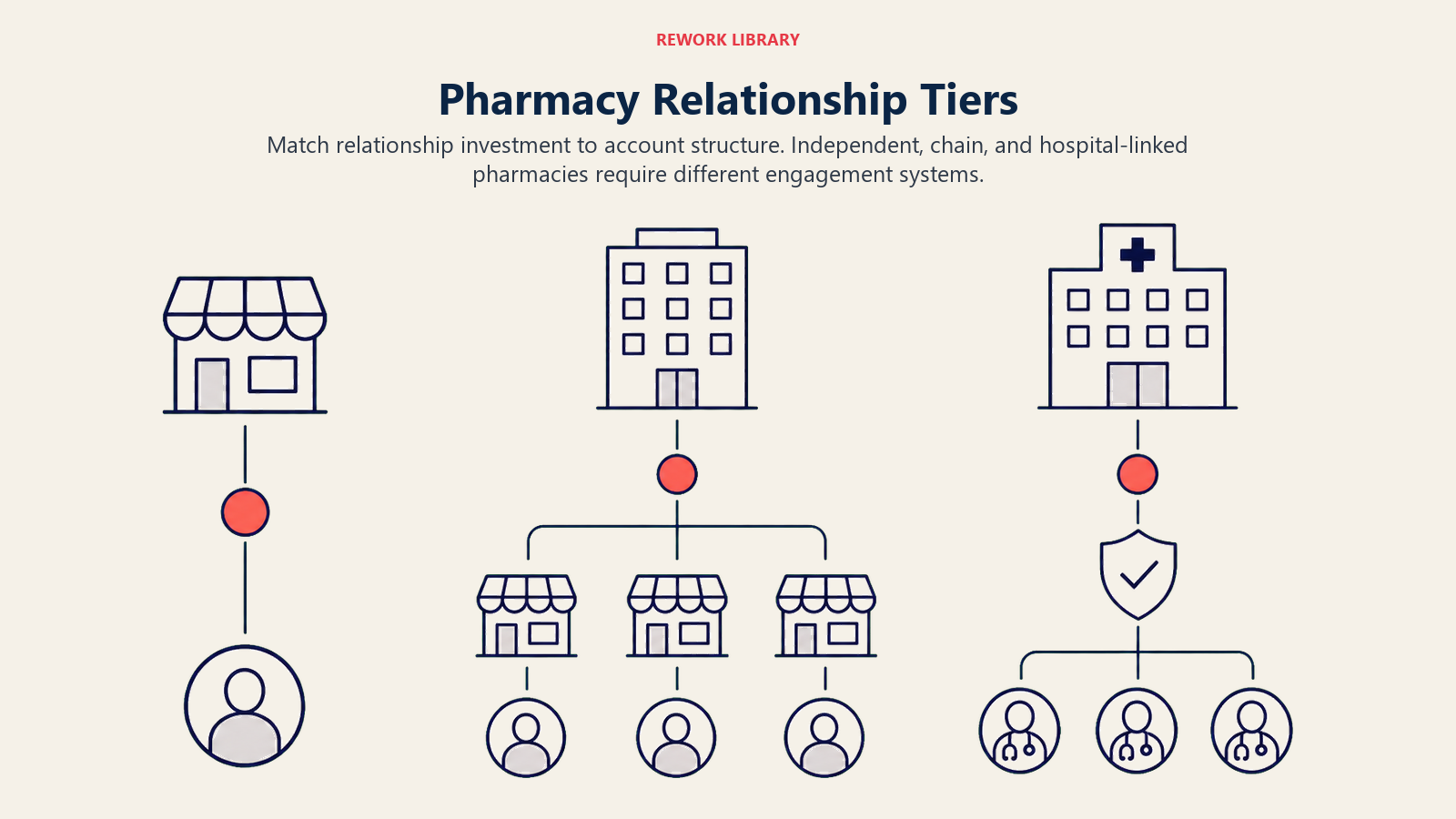
Not every pharmacy deserves the same relationship investment. Before building a management system, commercial leaders need to map their accounts across three tiers that reflect both commercial potential and relationship complexity.
Independent Pharmacies
Independent pharmacy owners are often the prescriber and business decision-maker in one. They control their own stock lists, negotiate directly with distributors, and are frequently influenced by personal relationships with medical reps. What they value: access to the rep, fast resolution of service issues, and practical support for running a profitable dispensary.
A well-managed independent account can become a brand advocate in the local prescriber community. According to the NCPA 2024 Digest, independent community pharmacies represent approximately 35% of all US retail pharmacies, with an even larger share in rural markets. Pharmacists at independent shops often advise patients on brand substitution at the counter. If they trust your product and your rep, that influence runs in your favor.
Chain and Retail Pharmacies
Chain accounts operate on centrally negotiated contracts. The on-floor pharmacist has limited authority over which brands get stocked, but significant authority over what gets dispensed when generic alternatives exist. The relationship here splits across two levels: commercial negotiation with the head office or category buyer, and operational engagement with the store pharmacist who handles the day-to-day.
Reps who focus only on the commercial contract and ignore store-level relationships miss the pull-through conversion that happens at the dispensing counter.
Hospital-Linked and Institutional Pharmacies
Hospital pharmacies operate under formulary decisions made by pharmacy and therapeutics committees. The relationship work here is different: it involves clinical liaison, formulary support materials, and engagement with both the hospital pharmacist and the prescribing physicians who influence formulary inclusion. These accounts have the longest sales cycles and the most durable contract relationships once established.
Relationship Tier Matrix
| Account Type | Decision Authority | Key Relationship Targets | Primary Value Drivers |
|---|---|---|---|
| Independent pharmacy | Owner/pharmacist | Owner, dispensing pharmacist | Trust, service reliability, clinical support |
| Chain pharmacy | Head office + store level | Category buyer + floor pharmacist | Contract compliance, operational support |
| Hospital-linked | Formulary committee | Hospital pharmacist, clinical pharmacy leads | Clinical evidence, formulary materials |
Key Facts: Pharmacy Relationship Management
- According to the NCPA 2024 Digest, independent community pharmacies represent approximately 35% of all US retail pharmacies, with an even larger share in rural markets, making them a commercially significant segment where personal rep relationships directly influence dispensing decisions.
- Research on pharmacist counseling during generic substitution shows that patient uncertainty about medication equivalency is among the most common counter-level questions, which means a rep who provides clear counseling support materials becomes a resource rather than a vendor.
- A systematic review of generic drug utilization across 67 studies identifies pharmacists, formulary managers, and prescribers as the key actors shaping substitution outcomes, confirming that the relationship a rep builds with dispensing staff directly affects whether patients receive the branded product or its generic.
The Pharmacy Partner Profile
Relationship management without information is guesswork. Every account on a rep's route should have a documented partner profile that captures what that account actually needs, not just what it orders.
A useful pharmacy partner profile includes:
Owner motivations. Is the pharmacist owner primarily margin-driven, volume-driven, or service-quality driven? An owner who competes on convenience and patient service responds differently to incentives than one focused purely on distributor pricing. Understanding this shapes every conversation.
Pharmacist influence on dispensing. The dispensing pharmacist, particularly at the counter level, holds genuine influence over whether a patient fills a brand prescription or is switched to a generic. Knowing who that person is, what they believe about your product, and what questions they regularly get from patients is commercially relevant.
Patient mix. A pharmacy that predominantly serves elderly patients with chronic conditions has different inventory needs and counseling demands than one adjacent to a pediatric clinic. The rep who understands the patient mix can offer relevant clinical support rather than generic product information.
Competitor products stocked and promoted. What does the pharmacy actively promote from your competitors? Where is your product positioned in the dispensary, and what's stocked beside it? This intelligence shapes how your rep positions the brand and where to invest additional support.
Historical order patterns. Seasonality, order frequency, return volume, and stock-out history reveal both commercial performance and operational pain points that a well-prepared rep can address proactively.
Touch Cadence by Pharmacy Tier
Visit frequency without visit quality is wasted mileage. But visit quality without sufficient frequency means a competitor fills the relationship gap between your rep's calls.
Touch Cadence Table by Pharmacy Type
| Account Type | Recommended Visit Frequency | Call Types | Engagement Depth |
|---|---|---|---|
| High-value independent | Weekly or fortnightly | Relationship + clinical update + order review | Deep: owner + dispensing staff |
| Standard independent | Monthly | Order review + service check | Moderate: owner or senior staff |
| Chain (store level) | Monthly or per campaign | Product update + stock check | Moderate: floor pharmacist |
| Chain (head office) | Quarterly | Commercial review + program updates | High: buyer + commercial team |
| Hospital-linked | Monthly or per formulary cycle | Clinical liaison + formulary support | High: hospital pharmacist + P&T liaison |
Visit types matter as much as visit frequency. A relationship-building call is different from an order review call, which is different from a clinical update call. Reps who treat every visit as an order-taking exercise underinvest in the relationship capital that protects accounts during competitive pressure.
The pharmacy visit playbook outlines how to structure each call type by tier so reps arrive with a clear agenda and leave with a logged outcome.
Value-Add Interactions: Beyond the Order Book
The reps who build the deepest pharmacy relationships are rarely the ones with the biggest discount authority. They're the ones who make pharmacists better at their jobs.
Patient counseling support. Pharmacists field questions from patients about side effects, dosing, drug interactions, and adherence. Research on pharmacist counseling during generic substitution shows that patient uncertainty about medication equivalency is among the most common counter-level questions, which means a rep who provides clear, practical counseling support materials and answers to common patient questions becomes a resource rather than a vendor.
Staff product training. Dispensary staff who understand your product's mechanism, patient profile, and common questions are better positioned to counsel patients correctly and prevent unnecessary brand switches. Scheduling short training sessions, particularly when new staff join or a new indication is approved, deepens your presence in the account beyond the rep visit.
Compliance reminders and patient programs. Connecting pharmacies with patient adherence support tools, refill reminder programs, or patient education campaigns extends your value into the pharmacy's relationship with its patients. This is particularly relevant for chronic disease brands where adherence directly affects repeat dispensing volume. See the repeat order and reorder systems article for how pull-through programs connect to pharmacy-level engagement.
Market intelligence sharing. Pharmacists are often curious about what's happening in the broader market: new products coming, competitor availability issues, regulatory changes. Reps who treat these conversations as intelligence exchanges, offering relevant updates and asking good questions in return, build credibility and trust that transactional reps never access. That credibility matters most when something goes wrong.
Handling Pharmacy Complaints and Stock Issues
Service recovery is one of the highest-return relationship activities available to a medical rep. A stock issue or billing error handled poorly erodes trust. The same problem handled promptly and transparently builds it.
The key principles of service recovery in pharmacy accounts:
Acknowledge before explaining. The pharmacist who ran out of your product on a busy Monday morning doesn't want a supply chain explanation first. They want confirmation that you've heard the problem and are taking ownership of it.
Commit to a specific resolution timeline. "I'll look into it" is not a resolution. "I'll have a confirmed stock delivery date to you by 3pm today" is. Specificity signals accountability.
Follow up after resolution. Most reps close the loop on the transaction and move on. The rep who calls back to confirm the stock arrived and asks if there were any further issues has just created a memory the pharmacist will recall the next time a competitor makes a pitch.
Document service incidents. Patterns of stock complaints, billing issues, or distribution failures in a specific territory signal systemic problems that commercial leadership needs to address. Field-level documentation turns individual incidents into actionable intelligence.
What Are the Leading Indicators of Pharmacy Relationship Health?
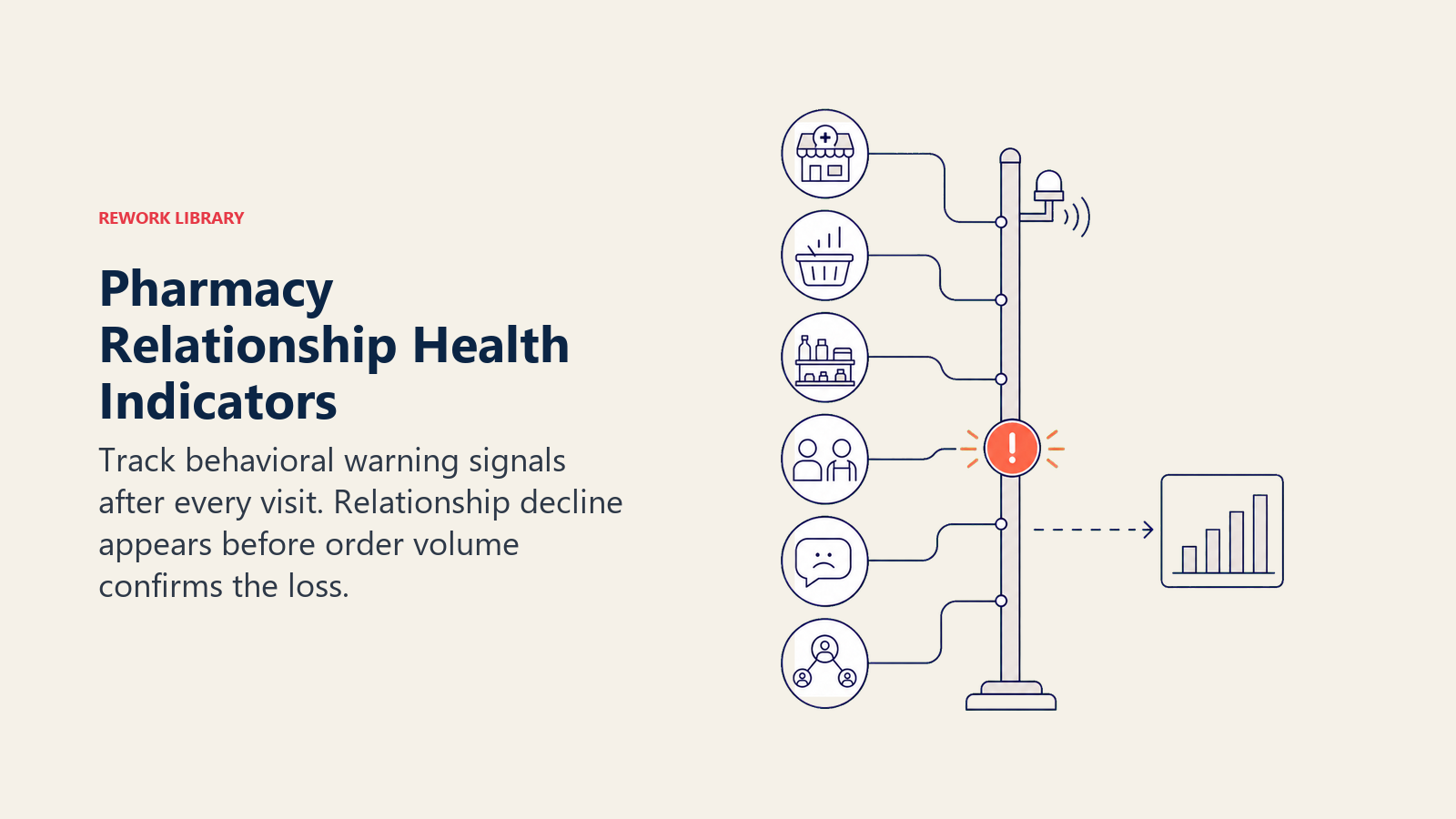
Order volume is a lagging indicator. By the time a pharmacy reduces its orders, the relationship has already deteriorated. Commercial leaders who want to protect accounts need leading indicators that reveal relationship risk before revenue impact shows up in the data. The signals that predict churn are almost always visible in engagement behavior weeks before a cancellation or a switch is formally decided.
Relationship Health Scorecard
| Indicator | Healthy Signal | Warning Signal | Action Required |
|---|---|---|---|
| Visit responsiveness | Pharmacist available, engages freely | Rep redirected, visits shortened | Investigate relationship friction |
| Order frequency change | Stable or increasing | Declining over 2+ months | Rep escalation, value-add review |
| Competitor product visibility | Your brand prominently displayed | Competitor brand in primary position | Competitive response plan |
| Staff engagement quality | Staff ask questions, seek updates | Staff disengaged or dismissive | Relationship recovery program |
| Complaint volume | Low, infrequent | Repeated issues, same complaints | Service recovery priority |
| Referral behavior | Pharmacist recommends your brand to patients | Active substitution at counter | Clinical re-engagement |
These signals should be logged in the CRM after every visit, not reconstructed from memory at quarterly review. The pattern across visits reveals account trajectory more accurately than any single data point.
Secondary sales tracking and pull-through metrics connect pharmacy-level relationship health to downstream prescription conversion data, giving commercial leaders a complete picture of where relationship investment is driving market share.
Independent vs Chain: Different Relationship Systems
The relationship playbook that works for an independent pharmacist owner fails at a chain account, and vice versa. Understanding the structural difference shapes how commercial teams invest their relationship-building resources.
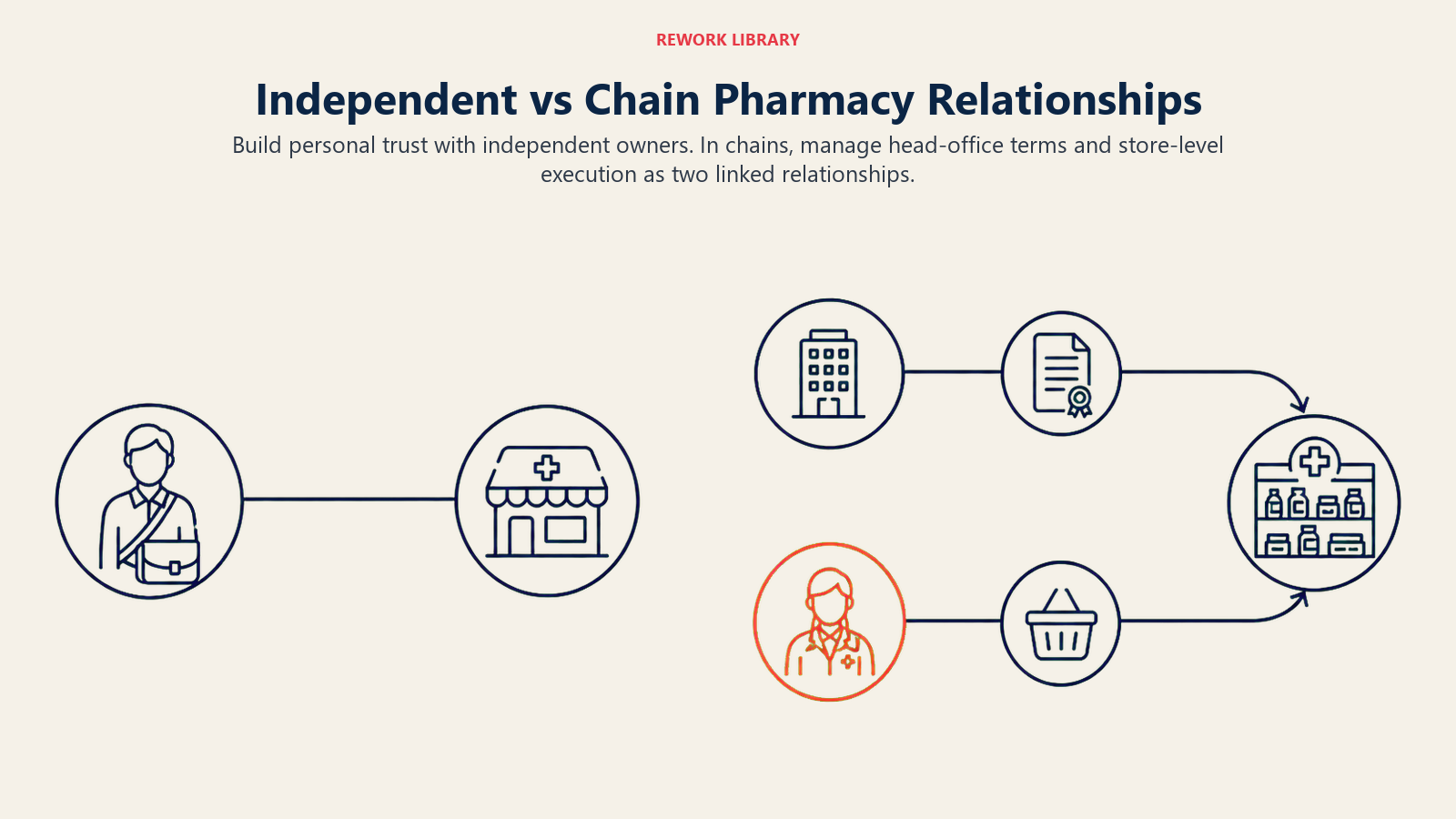
At independent pharmacies, the relationship is primarily personal. The owner is present, involved in day-to-day operations, and makes stocking decisions based partly on trust. Reps who invest in genuine, consistent personal relationships with independent owners build accounts that are highly resistant to competitor disruption. The independent vs chain pharmacy strategy article covers how to allocate field force resources across these structurally different account types.
At chain pharmacies, the relationship is institutional. The commercial contract is negotiated centrally, but execution happens at the store level. The most effective chain account strategy maintains both: a commercial relationship at head office that secures favorable contract terms, and an operational relationship at the store level that ensures the contract is actually implemented in dispensing behavior. Which brings the next question: how do you know whether the relationship is holding or starting to slip?
Relationship Depth as a Moat Against Generic Substitution
Generic substitution is the primary commercial threat in most pharma markets. A systematic review of generic drug utilization across 67 studies identifies pharmacists, formulary managers, and prescribers as the key actors shaping substitution outcomes. When a generic enters, price-driven pharmacies switch immediately. But pharmacies with deep relationships don't automatically follow.
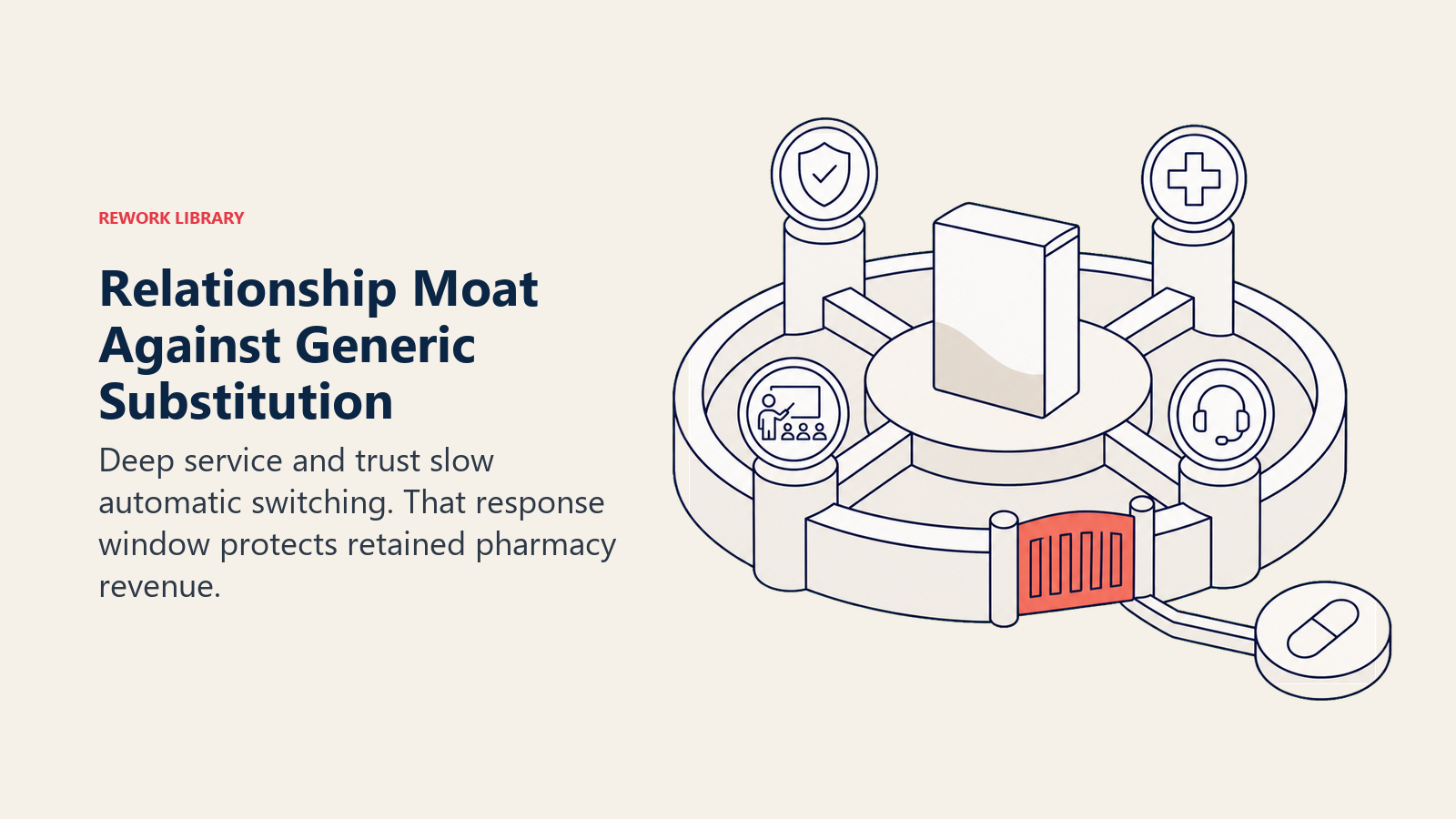 A pharmacy that trusts your brand's quality, values your clinical support, relies on your staff training, and has a history of good service experiences will give you time to respond before switching. In competitive markets, that time is commercially critical.
The commercial case for relationship management isn't abstract. It's this: acquiring a new pharmacy account typically costs more than retaining one, because acquisition requires new coverage, new relationship investment, and time to rebuild ordering patterns that a retained account already delivers. Every account lost to generic substitution requires that replacement effort. Accounts that never switch don't. The same economics underpin the retention fundamentals discipline in B2B, where the arithmetic of acquisition cost versus retention cost is one of the most reliable levers a commercial team has.
Structured relationship management, with documented partner profiles, tiered touch cadences, value-add interactions, and proactive health tracking, converts pharmacy accounts from transactional buyers into genuine commercial partners. That's the moat. And it's built visit by visit, not with a single promotion.
Pharmacy loyalty and incentive programs extend relationship management into structured reward systems that reinforce ordering behavior and deepen account commitment beyond the rep relationship itself.
Frequently Asked Questions about Pharmacy Relationship Management
What is a pharmacy partner profile and what should it include?
A pharmacy partner profile is a documented record of an account's commercial characteristics, decision-maker motivations, and operational context. It should capture the owner's primary motivation (margin, volume, or service quality), the dispensing pharmacist's influence on brand switching decisions, the pharmacy's patient mix, which competitor products are actively stocked and promoted, and the account's historical order patterns including seasonality and return volume. Without this profile, rep visits are based on assumption rather than knowledge. With it, every visit can be tailored to the specific commercial and clinical needs of that account.
How often should a rep visit different types of pharmacy accounts?
High-value independent pharmacies warrant weekly or fortnightly visits with deep engagement covering the owner and dispensing staff. Standard independent pharmacies typically require monthly visits for order review and service checks. Chain pharmacies at the store level are best served monthly or per campaign cycle with moderate engagement. Chain head offices need quarterly commercial reviews. Hospital-linked pharmacies should be visited monthly or aligned with formulary committee cycles. Visit frequency without visit quality wastes mileage, but quality without sufficient frequency lets competitors fill the gap between calls.
What are the leading indicators that a pharmacy relationship is deteriorating?
Order volume is a lagging indicator. By the time a pharmacy reduces orders, the relationship has already deteriorated. Leading indicators include: the pharmacist becoming less available or shortening visit times; order frequency declining over two or more consecutive months; a competitor brand moving into the primary shelf position; staff becoming less engaged or dismissive during rep interactions; repeated complaints about the same issues; and the pharmacist actively substituting a competitor brand at the counter. Any two of these signals appearing in consecutive visits should trigger a relationship recovery response, not a standard sales call.
How do you handle a pharmacy complaint effectively?
Service recovery in pharmacy accounts follows three principles. First, acknowledge before explaining: the pharmacist who ran out of stock on a busy Monday doesn't want a supply chain explanation first. Second, commit to a specific resolution timeline ("I'll have a confirmed delivery date to you by 3pm today") rather than vague assurances. Third, follow up after resolution to confirm the problem was fixed and ask if anything else needs attention. Most reps close the transaction and move on; the rep who calls back after resolution creates a memory the pharmacist recalls the next time a competitor makes a pitch.
What is the commercial case for investing in pharmacy relationship management?
Acquiring a new pharmacy account typically costs more than retaining one: it requires new coverage investment, relationship building from scratch, and time to rebuild the ordering cadence a retained account already provides. Every account lost to generic substitution requires that replacement effort. Accounts that never switch don't. A pharmacy that trusts your brand's quality, values your clinical support, and has a history of good service experiences will give you time to respond to competitive pressure before switching. In markets where generic erosion is the primary commercial threat, that time difference is the difference between protecting revenue and losing it permanently.
How do relationship strategies differ between independent and chain pharmacies?
At independent pharmacies, the relationship is primarily personal. The owner is present, makes stocking decisions partly based on trust, and is directly influenced by consistent, well-prepared rep engagement over time. Accounts at this level are highly resistant to competitor disruption when the rep relationship is strong. At chain pharmacies, the relationship is institutional. The commercial contract is negotiated centrally, but dispensing behavior is shaped at the store level. The most effective chain strategy maintains both: a commercial relationship at head office that secures favorable contract terms, and an operational relationship at the store that ensures those terms are implemented in actual dispensing behavior.
The Pharmacy Account Health Scorecard is the relationship monitoring system described in this article: six leading indicators tracked after every visit (visit responsiveness, order frequency change, competitor product visibility, staff engagement quality, complaint volume, and referral behavior), each with defined healthy and warning signals and an action protocol when the warning signal appears. The scorecard converts relationship health from a subjective judgment into a tracked metric that commercial leaders can review across a territory to identify at-risk accounts before revenue impact shows up in order data.
The key insight behind the scorecard is that relationship deterioration is always visible in behavioral signals before it appears in order volume. A pharmacist who shortens visit times and stops asking questions has already changed their perception of the rep's value. An account that started stocking a competitor brand in a prominent position has already opened the door to a switch. The scorecard makes these signals visible and actionable rather than invisible until a quarterly review confirms what was already predictable.
Learn More

Senior Implementation Consultant
On this page
- Relationship Tiers in the Pharmacy Channel
- Independent Pharmacies
- Chain and Retail Pharmacies
- Hospital-Linked and Institutional Pharmacies
- The Pharmacy Partner Profile
- Touch Cadence by Pharmacy Tier
- Value-Add Interactions: Beyond the Order Book
- Handling Pharmacy Complaints and Stock Issues
- What Are the Leading Indicators of Pharmacy Relationship Health?
- Independent vs Chain: Different Relationship Systems
- Relationship Depth as a Moat Against Generic Substitution
- Learn More