Detail Aid and Visual Aid Usage: Turning Approved Promotional Materials Into Prescribing Decisions
Turn this article into takeaways for your work.


Each assistant summarizes the article only for you and suggests best practices for your work.
Here's a scene that plays out in HCP offices more often than commercial teams want to admit. The rep opens the detail aid, sets it on the desk, and begins working through the panels in order. Efficacy data on page one, safety profile on page two, dosing information on page three. The doctor, who has seen this aid four times already, starts checking their phone somewhere around the second panel. The rep finishes the presentation. The doctor says "okay, thanks" and returns to their inbox. Nothing changed.
The problem isn't the detail aid. The problem is that the rep used a conversation tool as a presentation deck.
A detail aid is a visual anchor. Its job is to give the HCP something concrete to look at while the rep makes a specific, relevant clinical point, to reduce the cognitive load of following an abstract verbal argument, and to leave behind a compliant reference the prescriber can review later. It's not meant to carry the conversation. The rep carries the conversation. The aid just supports it.
Getting this distinction right is one of the highest-leverage behavior changes available to field managers. Reps who use visual aids as conversation tools rather than scripts consistently generate more meaningful HCP dialogue, better recall of key messages, and higher conversion to prescription behavior.
What a Detail Aid Is For
Key Facts: Detail Aid and Visual Aid Usage
- Reps who use visual aids as conversation tools rather than scripts tend to generate more meaningful HCP dialogue, higher key-message recall, and better conversion to prescription behavior than those who present aids sequentially regardless of HCP interest.
- Detail calls are often shorter than detail aids are designed for: when an HCP can only give a few minutes and the aid has six or more panels, covering everything without losing attention is impossible; the three-panel rule is the practical resolution.
- Digital CLM (closed-loop marketing) systems provide closed-loop reporting on which panels were shown to which HCPs on which dates, giving commercial teams the first reliable data on which messages are being used versus which are being skipped.
The approved promotional detail aid serves three purposes, and understanding all three helps reps use them correctly.
First, it provides a compliant visual reference for approved clinical claims. Everything in the aid has been reviewed and cleared by medical, legal, and regulatory teams. It's the rep's safest anchor for efficacy and safety discussions, because every claim in it has documentation behind it.
Second, it creates a shared visual focus. When both the rep and the HCP are looking at the same data panel, the conversation has a reference point. This reduces misunderstanding, makes clinical numbers easier to follow, and helps the rep stay on a specific point rather than drifting across topics.
Third, it serves as a leave-behind. The doctor who doesn't have time for a full detail today may review a well-designed one-pager that evening. The pharmacist who was mid-fill when the rep came in might pull out the brochure during a quieter moment. The aid continues working after the rep leaves.
What it's not for: reading aloud to the HCP, filling silence, or proving that the rep covered every approved message.
Types of Visual Aid in Pharma
Commercial teams deploy several distinct formats, and each has a different optimal use case.
Printed detail aid (multi-page leave-behind): The traditional format. Usually four to eight panels covering core efficacy data, safety profile, and dosing. Works well for scheduled appointments with physicians who have time for a structured discussion. The risk is that reps default to presenting every panel sequentially regardless of what's relevant to this particular doctor's patient mix.
Digital CLM (closed-loop marketing) on tablet: Increasingly the standard for primary care and specialist sales forces. Slides are sequenced based on the approved content library, and the system logs which panels the rep displayed, in what order, and for how long. The reporting data is valuable for marketing alignment and compliance auditing. The pitfall: reps can become dependent on the animation and slide flow rather than the clinical conversation, and the technology can feel like a barrier between rep and HCP if handled awkwardly.
Leave-behind card or one-pager: Designed for short visits or drop-ins where there isn't time for a full detail. One key message, one supporting data point, contact information. Ideal for busy pharmacy counters or a thirty-second interaction when the doctor is heading into a patient room.
Patient-facing brochure for adherence conversations: Not a rep sales tool but an HCP tool for use with patients. Effective reps discuss these with doctors in the context of the patient conversation: "This is what patients will see when they fill their first prescription. Here's how to address the questions they're likely to bring back at their follow-up."
The Three-Panel Rule
Most detail aids contain multiple panels. Most detail calls are shorter than the aid is designed for. The math doesn't support covering everything, and trying to do so produces exactly the distracted-doctor scenario described at the opening.
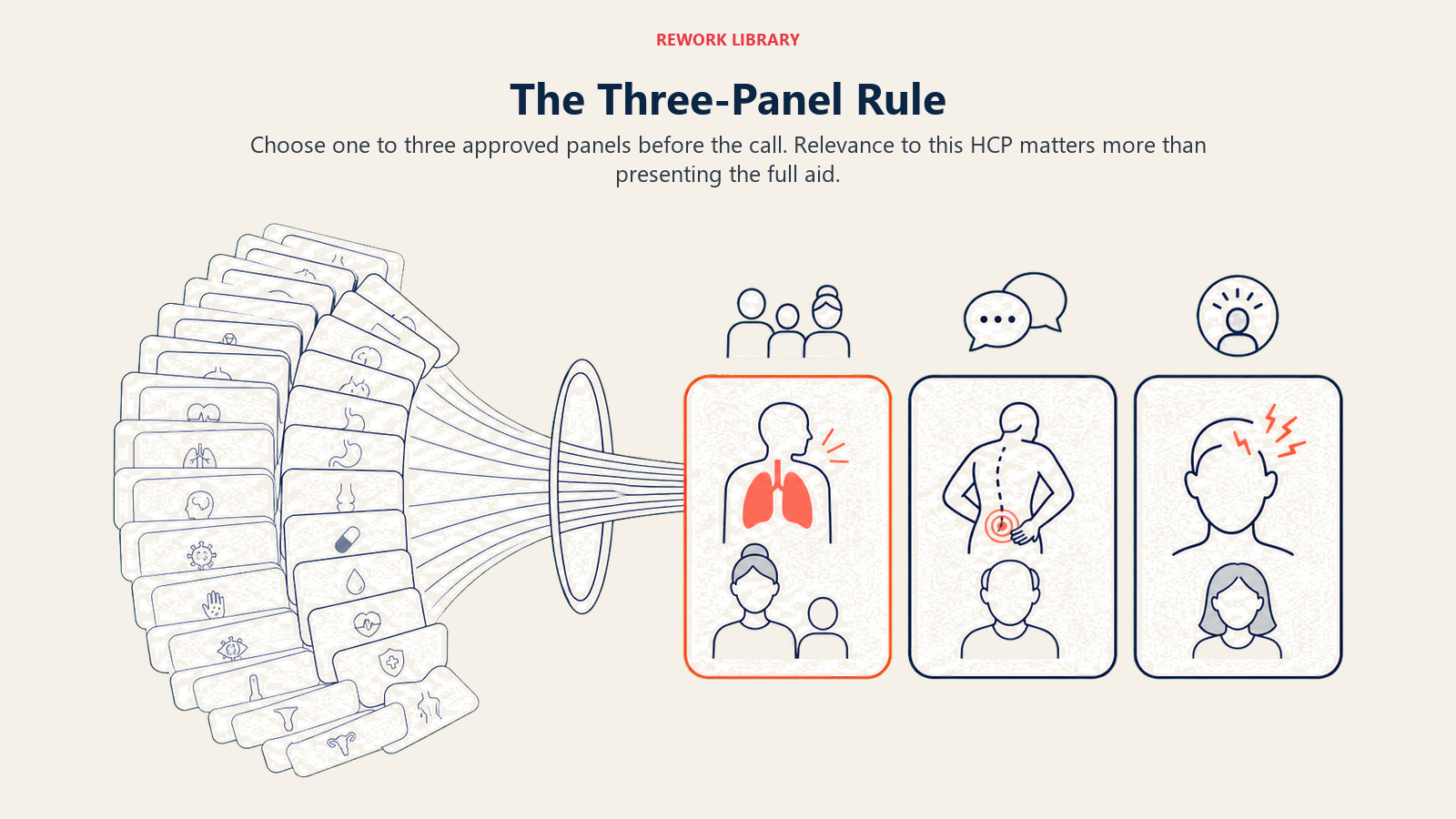 The three-panel rule: before entering the office or pharmacy, the rep selects the one, two, or at most three panels most relevant to this specific HCP at this specific visit.
What drives that selection? Pre-call planning and objection handling is where this decision gets made. During the five-minute pre-call review, the rep identifies the doctor's primary patient population, the last conversation's outcome, and the most likely concern that will come up today. The panel selection follows from that analysis. This is essentially a qualification step applied to visual content: the same thinking behind opportunity qualification in B2B sales, where the rep filters what to lead with based on what the account has already told them about their priorities.
A cardiologist who raised tolerability concerns at the last visit gets the safety profile panel opened first, not the efficacy outcomes page. A general practitioner who treats a high volume of patients with the relevant indication but has been slow to adopt the product gets the patient identification criteria panel. A specialist who's already a moderate prescriber might get the dosing flexibility panel to support broader use across her patient types.
The rule is straightforward: open the aid to the most relevant panel for this HCP today. If the conversation moves naturally to a second panel, go there. If the HCP asks a question that points to a third panel, show it. But don't flip through panels trying to cover everything. It signals that the rep's agenda takes priority over the doctor's time.
Finger-Pointing and Visual Anchoring
This is a small behavior that makes a disproportionate difference.
When a rep opens a detail aid and leaves it flat on the desk, the HCP's eye will scan the entire page rather than focus on the specific data point the rep wants to discuss. The rep is talking about the efficacy endpoint, but the doctor's eyes are on the safety table in the corner.
Pointing to the specific data point being discussed anchors attention. But pointing while looking down at the aid breaks eye contact at the worst moment: when making a key clinical claim.
The technique: point to the relevant figure with one finger, keep eye contact with the HCP, and make the verbal statement while your finger is on the number. Then look at the panel together, confirm the visual, and return to eye contact for the implication. "This is the twelve-week remission rate, ninety-four percent, head to head." Finger on the number. Eye contact. "That's the clinical story your patients in this population are going to experience."
Digital CLM on a tablet adds a layer of complexity. The rep holds the device, which creates a physical barrier. The best practice is to position the tablet so both parties can see it simultaneously, turning it toward the HCP rather than presenting from behind the screen. Pointing to the screen with a stylus or finger applies the same anchoring logic as printed material.
Regulatory and Compliance Boundaries
Field managers are responsible for ensuring reps understand where approved content ends and off-label territory begins. This isn't a legal formality. Violations carry real consequences for both the rep and the organization.
 The OIG compliance guidance library identifies promotional material review as a key risk area for pharmaceutical manufacturers, and the agency's voluntary compliance guidance for pharma specifically flags off-label promotion as one of the highest-risk field activities. The PhRMA Code on Interactions with Health Care Professionals sets the industry standard for what promotional materials may communicate in a detailing context.
Pharmaceutical marketing compliance and ethics standards define what reps may and may not communicate in a promotional context. The table below covers the most commonly encountered boundaries.
| Area | What Reps May Do | What Reps May Not Do |
|---|---|---|
| Efficacy claims | Reference approved indications and clinical data in the detail aid | Discuss unapproved indications or off-label uses, even if published in peer-reviewed literature |
| Safety data | Present the adverse event profile as documented in approved labeling | Downplay or qualify safety data verbally beyond what approved materials state |
| Competitor comparisons | Reference head-to-head data that is approved and included in promotional materials | Make verbal comparative claims not supported by approved materials |
| Patient scenarios | Describe patient types consistent with the approved indication | Suggest the product for patients outside the approved indication profile |
| Pricing and reimbursement | Discuss available co-pay programs and support resources | Guarantee coverage outcomes or make promises about specific payer decisions |
| Unsolicited off-label questions | Acknowledge the question, decline to answer, offer to connect the HCP with medical affairs | Respond with off-label information even if the HCP asks directly |
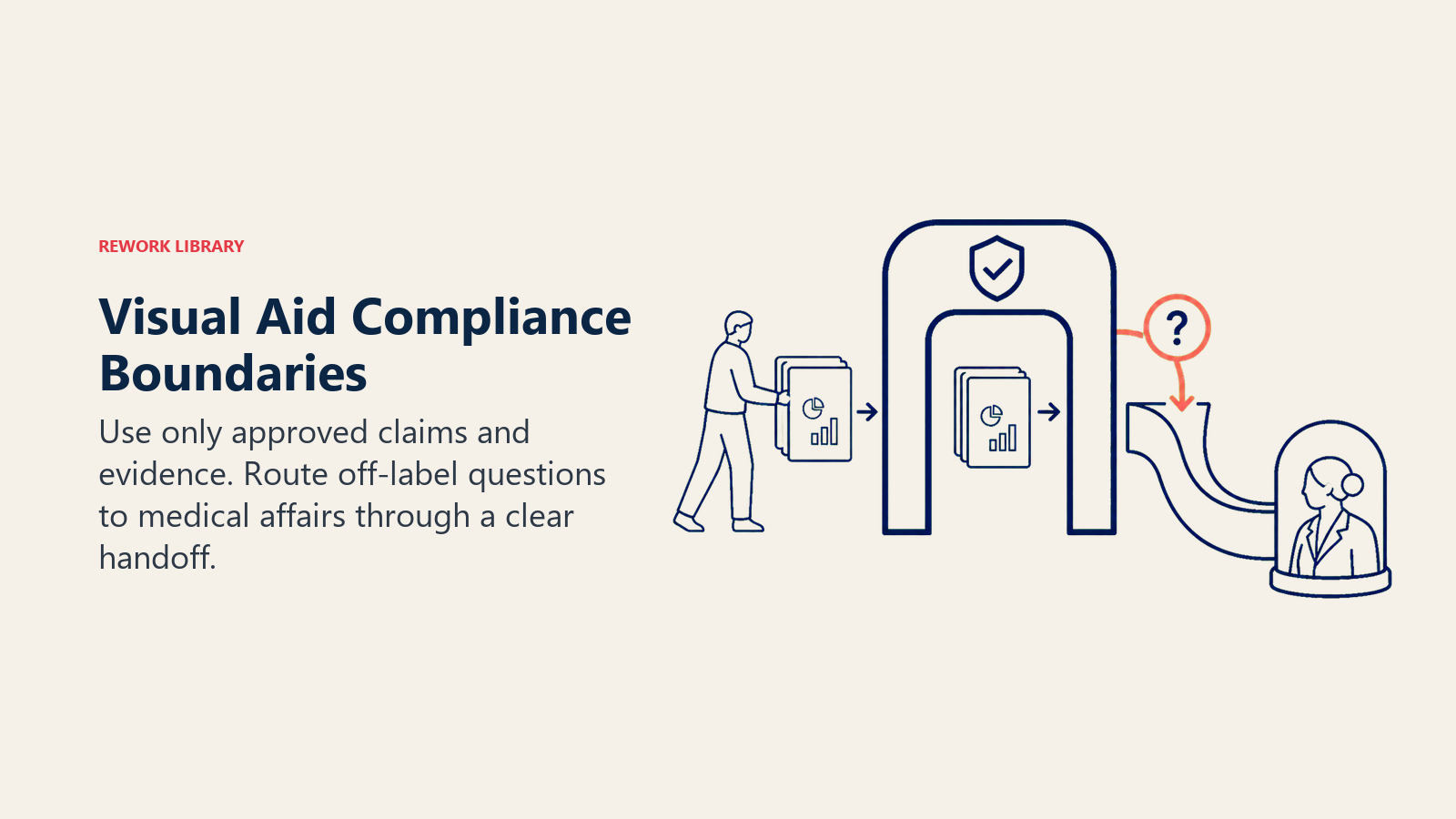
When an HCP asks a question the rep can't answer from approved materials, the correct response is always to acknowledge the question, confirm that it falls outside the approved conversation, and offer to route it to the medical affairs team. This response should feel natural and rehearsed, not defensive or evasive.
Digital CLM Advantages and Pitfalls
Closed-loop marketing systems offer three genuine advantages over printed detail aids.
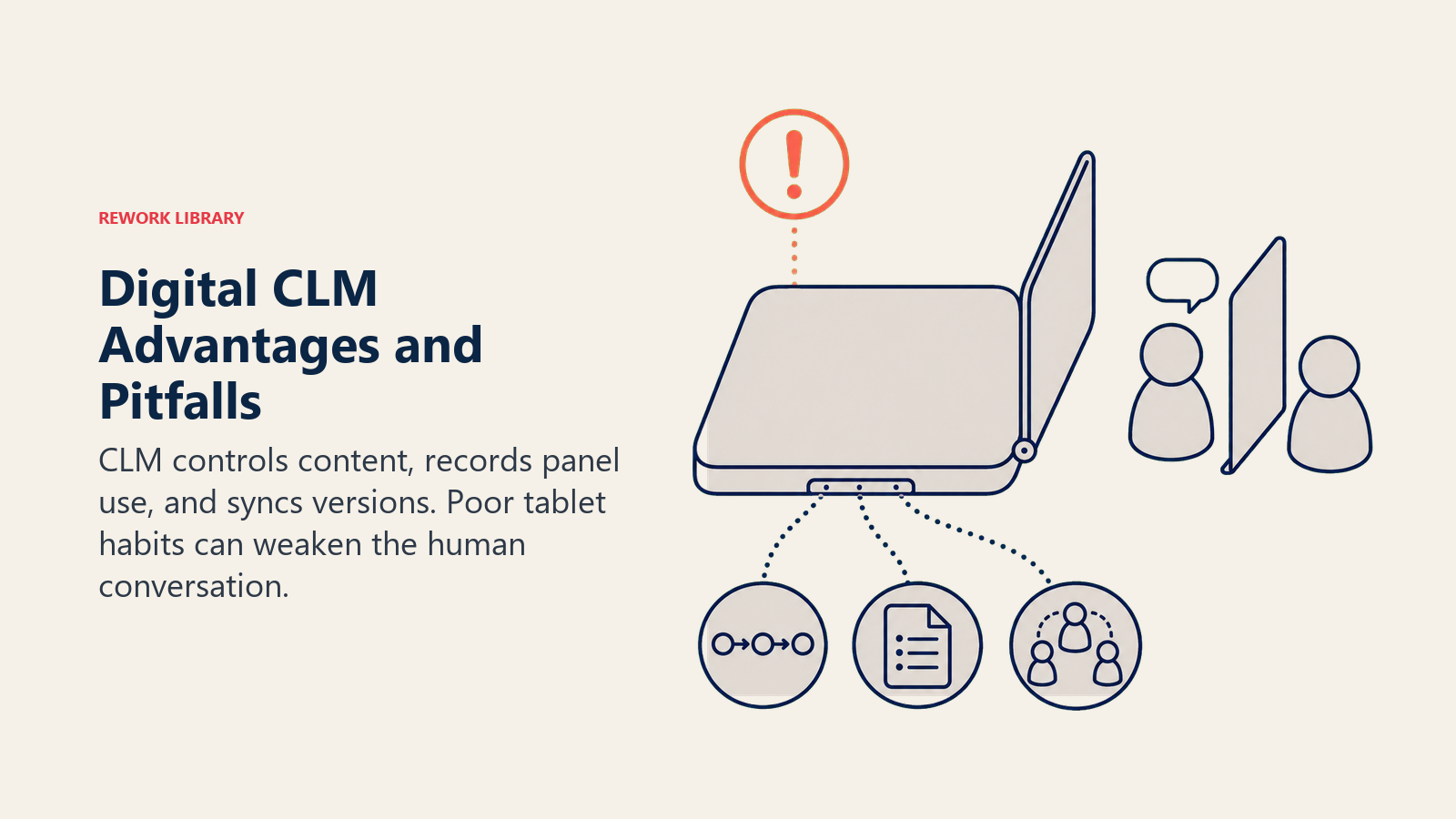
First, sequencing control. Approved slides are organized into modules, and the system prevents reps from improvising non-approved combinations. This reduces compliance risk at scale.
Second, closed-loop reporting. The system captures which slides were shown to which HCPs on which dates. This data feeds into marketing analytics and helps commercial teams understand which messages are landing and which are being skipped. Getting reps to trust the system and log consistently is the same adoption challenge that CRM adoption operating model frameworks address: without deliberate onboarding and manager reinforcement, field teams use technology as a checkbox rather than a source of insight.
Third, version control. When a detail aid is updated because of a new label change or market development, the CLM system deploys the update across all devices simultaneously. No rep is in the field with an expired version.
The pitfalls are real too. The biggest is animation dependency. Some CLM systems use animated slides to present data in a visually dynamic way, and reps who over-rely on the animation stop developing the verbal language to explain what the animation shows. When a tablet battery dies or a connection fails, those reps struggle.
The second pitfall is the device as a social barrier. Reps who stare at their tablet screen while clicking through slides lose the conversational quality that makes detailed visits worth taking. The tablet should be a reference point, not a teleprompter.
Shelf-Life and Version Control
Printed materials expire. Label changes, updated safety data, and revised comparative claims all trigger material withdrawal and replacement. A rep still using a detail aid from two product cycles ago isn't just presenting outdated information. In some markets, they're creating compliance exposure.
Field reporting and closed-loop marketing systems help managers track which material versions are in the field. But field managers also need a physical check-in protocol: when new materials arrive, obsolete versions are collected and destroyed, not left in rep bags or car trunks "just in case."
The version audit should be a standing item on regional meeting agendas. It takes ten minutes and eliminates the risk of a rep pulling out an approved aid with a superseded efficacy claim in front of a detail-oriented specialist.
For digital CLM, version control is largely automated. But managers should confirm that reps are syncing their devices before calls, not relying on cached versions from weeks ago.
Should a Rep Use the Same Detail Aid With a Pharmacist and a Prescribing HCP?
The same detail aid doesn't serve a pharmacist and a prescriber equally well, and reps who adapt their visual aid usage for each audience consistently outperform those who apply the same approach to both.
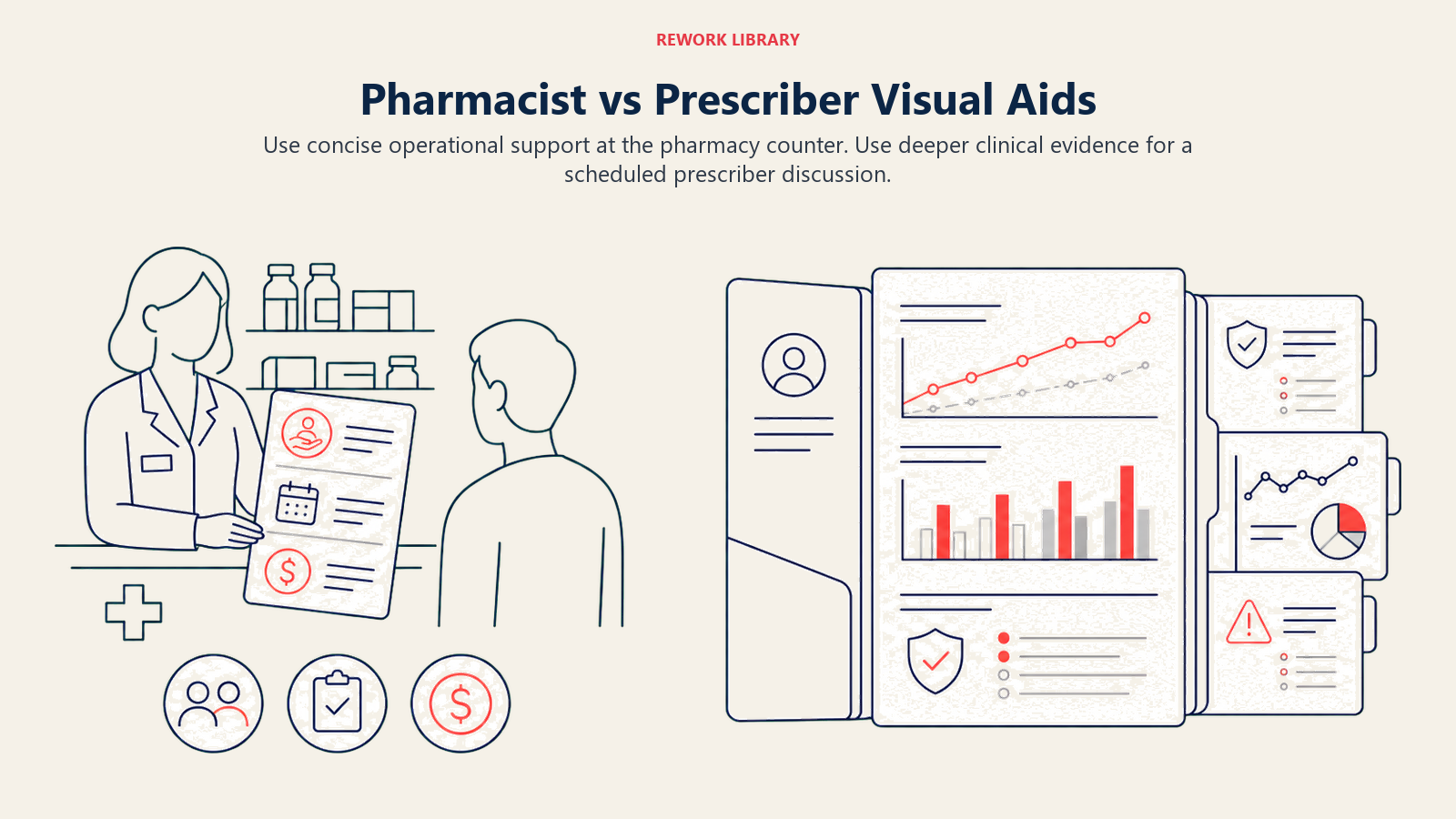
A pharmacist's primary concern at a pharmacy counter is patient outcomes and operational efficiency: will this product cause problems at pick-up (complex dosing instructions, fragile storage requirements), what's the co-pay situation, and are there substitution protocols to know about? The one-pager or leave-behind card is usually the better tool than a multi-page detail aid, because the counter environment doesn't support a structured presentation. A concise patient profile card and a co-pay card with clear enrollment steps will get more attention than six panels of clinical efficacy data.
A prescribing HCP, particularly a specialist, is more likely to engage with clinical depth: comparative efficacy, safety signal context, patient selection criteria. The full detail aid or a specific relevant module within the CLM is appropriate here, especially in a scheduled appointment.
Doctor detailing best practices and marketing and field sales alignment both touch on how materials should be adapted for channel. Commercial teams that produce HCP-specific and pharmacy-specific versions of key materials, rather than repurposing prescriber-facing detail aids at the counter, see meaningfully better engagement with both audiences.
Detail Aid Usage Checklist
Before and during each call, reps should run through this mental checklist.
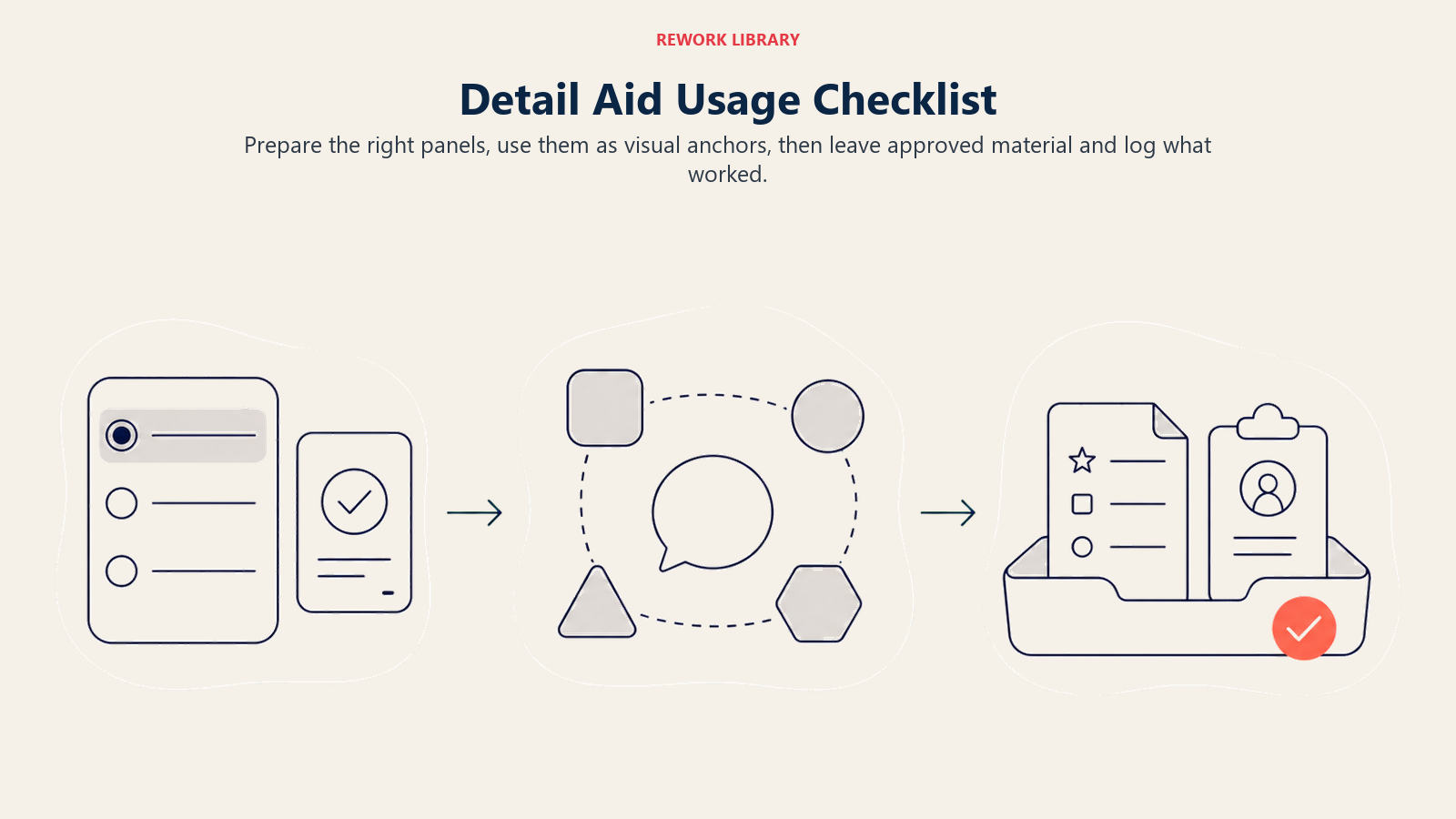 Pre-call (in the parking lot):
- Which panel is most relevant to this HCP's patient mix today?
- Is this the current approved version of the detail aid?
- Is the one-pager or patient brochure available if the call runs short?
- Am I planning to discuss patient-facing materials and how to use them with patients?
During the call:
- Open the aid to the selected panel, not page one
- Keep eye contact during verbal statements, point to data during visual anchors
- Let the HCP's questions guide whether to turn to additional panels
- Don't apologize for or over-explain the aid ("I know this is a lot of information")
- Close the aid when moving to objection response, reopen when a visual will help
After the call:
- Leave the approved leave-behind material
- Log which panels were used and the HCP's response in CRM
- Note any questions that went beyond the approved materials for medical affairs follow-up
A detail aid left flat on the desk allows the HCP's eye to scan the entire page, pulling attention away from the specific data point the rep is discussing. Pointing to the relevant figure while maintaining eye contact anchors that attention without breaking the conversational flow, a behavior that costs nothing to train and makes a disproportionate difference to how much clinical content the HCP actually absorbs.
Reps who rely on CLM animation to explain what the slides show develop a dependency that fails the moment a tablet battery dies or a connection drops. The verbal language to describe the mechanism, the trial outcome, and the patient type needs to be in the rep's head, not embedded in the slide transition.
The Three-Panel Rule is the pre-call discipline described in this article: before entering any HCP office or pharmacy, the rep selects at most three panels from the full detail aid that are directly relevant to this specific HCP's patient mix, the outcome of the previous visit, and the most likely concern that will come up today. The rule prevents the default behavior of opening the aid at page one and working through sequentially, which loses HCP attention long before the most relevant data is reached.
Conclusion: A Great Detail Aid Used Badly Loses to a Mediocre One Used Well
Marketing teams invest significant resources in developing and approving detail aids. Those resources don't translate into prescription behavior automatically. The rep's execution determines the outcome.
A visually sophisticated, data-rich detail aid used as a reading script, deployed panel by panel to an HCP who's stopped listening by page three, produces nothing. A simpler one-pager, opened to the one panel directly relevant to the doctor's most recent patient population, used as the visual anchor for a specific clinical point and a direct question about prescribing behavior, often produces a trial commitment.
Commercial leaders who coach to detail aid usage, who audit the field for version compliance, and who train reps on the distinction between a conversation tool and a presentation deck will see measurable improvement in call quality. That improvement shows up in HCP recall scores, time-per-panel engagement in CLM analytics, and ultimately in prescription data.
Frequently Asked Questions about Detail Aid and Visual Aid Usage
What is the purpose of a detail aid in a pharmaceutical field visit?
A detail aid serves three purposes: it provides a compliant visual reference for approved clinical claims, it creates a shared visual focus between the rep and HCP to anchor specific data points in the conversation, and it functions as a leave-behind that continues working after the rep has left. What it is not for: reading aloud to the HCP, filling silence, or demonstrating that the rep covered every approved message.
What is the three-panel rule for detail aid usage?
Before entering any HCP office or pharmacy, the rep selects at most three panels from the full detail aid that are most relevant to this specific HCP's patient mix and the most likely topic for today's conversation. A cardiologist who raised tolerability concerns last visit gets the safety profile panel first. A GP with a high-volume relevant patient population gets the patient identification criteria page. Opening to page one and working through sequentially is the default behavior the three-panel rule is specifically designed to prevent.
How should a rep use a detail aid during a call without reading it?
The aid enters at the Evidence stage as a visual anchor. The rep points to the specific data point under discussion, maintains eye contact during the verbal statement, and references the figure together with the HCP. Position, Relevance, and Pull in the PREP structure should all be deliverable without the aid. If those stages require reading from the material, the pre-call preparation was not deep enough for this specific HCP.
What are the compliance risks associated with detail aid usage?
Reps using outdated material versions create regulatory exposure even if the clinical data itself is accurate. A label change, an updated safety signal, or a revised comparative claim can render a previous detail aid non-compliant. Field managers need a physical check-in protocol when new materials arrive, requiring obsolete versions to be collected and destroyed rather than left in rep bags. A version audit should be a standing item on regional meeting agendas.
How do digital CLM systems improve detail aid compliance and effectiveness?
CLM systems offer sequencing control (preventing non-approved panel combinations), closed-loop reporting (tracking which slides were shown to which HCPs on which dates), and version control (deploying updates across all devices simultaneously when materials change). The main pitfalls are animation dependency, where reps stop developing the verbal language to explain what the animation shows, and the tablet functioning as a social barrier when the rep stares at the screen rather than the HCP.
When is a leave-behind card better than a full detail aid?
At pharmacy counters, during short drop-in visits, and whenever the HCP indicates time is tight, a leave-behind card or one-pager is the better choice. The counter environment doesn't support a structured six-panel presentation. A concise patient profile card and a co-pay enrollment card with clear steps will get more attention in 90 seconds at the dispensary window than any multi-panel clinical detail aid.
Learn More

Senior Implementation Consultant
On this page
- What a Detail Aid Is For
- Types of Visual Aid in Pharma
- The Three-Panel Rule
- Finger-Pointing and Visual Anchoring
- Regulatory and Compliance Boundaries
- Digital CLM Advantages and Pitfalls
- Shelf-Life and Version Control
- Should a Rep Use the Same Detail Aid With a Pharmacist and a Prescribing HCP?
- Detail Aid Usage Checklist
- Conclusion: A Great Detail Aid Used Badly Loses to a Mediocre One Used Well
- Learn More