Sales Ops and Field Force Alignment in Pharma: Making Data Work Where Decisions Happen
Turn this article into takeaways for your work.


Each assistant summarizes the article only for you and suggests best practices for your work.
Sales operations publishes a 40-tab dashboard every month. It covers primary sales by SKU, secondary sales by district, call activity by rep, coverage rates, productivity indices, and incentive compensation accruals. The field force opens it, confirms their name is spelled correctly, and goes back to their call planner.
This isn't a data literacy problem. And it's not because field teams don't care about performance. It's because the dashboard was built from what data was available, not from what field teams need to make decisions. The data flows from the field into ops, gets processed, and comes back as a report that describes what happened last month. What the rep actually needs is what to do differently this week.
Sales ops alignment with the field force isn't about making dashboards prettier. It's about building a genuine data partnership where the field feeds accurate information upward and receives actionable insight in return. When that partnership works, every other commercial alignment problem gets easier to solve, because the operating picture is shared and trusted.
What Sales Ops Does and Why Field Alignment Is a Commercial Multiplier
In pharma, sales operations owns several functions that directly shape the field force's daily commercial life. Understanding what ops actually delivers (and how the field depends on it) is the starting point for building alignment.
Territory design and quota allocation. Ops draws the geographic and account boundaries that define each rep's work universe. They set the sales targets that determine whether a rep hits incentive compensation. When territory design misaligns with prescriber concentration, reps carry unfair workloads. When quota methodology uses data that doesn't reflect territory potential, targets feel arbitrary, and rep trust in the system erodes.
CRM configuration and data governance. The CRM is the field rep's primary administrative system. Ops configures it, sets the required fields, manages the data governance rules, and maintains the HCP master data (which doctors are in which territory, which are targets). When the CRM is well-configured, it reduces rep administrative burden. When it's configured for what ops needs to report rather than what reps need to plan, compliance drops and data quality degrades.
Incentive compensation calculation. Ops calculates the incentive payouts that are the financial counterpart to field effort. IC disputes, delays, or methodology opacity are among the fastest ways to damage field morale and trust in commercial leadership.
Reporting across the commercial operation. Ops produces the primary sales reports (what shipped to distributors), secondary sales reports (what sold through to outlets), call activity and coverage analysis, and productivity benchmarking. This is the commercial operating picture. It's only useful if the field understands it, trusts it, and can act on it.
All of these functions touch the field's daily life directly. But in most pharma commercial operations, they're managed as ops functions rather than as services to the field. That framing gap is where alignment breaks down. See the analytical dimension of this work in Territory Analytics and Sales Dashboards.
Key Facts: Sales Ops and Field Force Alignment
- Biopharma sales reps spend roughly two-thirds of their workday on non-customer activities, with nearly 70% saying administrative work adds little to no value to their company or client relationships (Deloitte Center for Health Solutions).
- 76% of pharma commercial organizations are still hindered by siloed and outdated data infrastructures, which is why ops-built dashboards rarely match what field teams need to act on (Deloitte, Future of Commercial in Pharma).
- ZS Associates cites McKinsey research indicating companies can achieve up to 50% higher sales impact by adjusting compensation models versus increasing advertising spend, underscoring why quota design and IC transparency rank among the highest-ROI levers in pharma commercial ops (ZS, sales incentive compensation in pharma).
The Alignment Gap in Practice
Four recurring patterns explain most of the dysfunction between sales ops and field teams in pharma.
Reps treat reporting as administrative burden, not decision support. Call logging, outcome recording, and CRM entry are required by policy. But when reps don't see any feedback loop from their data entry (no individualized insight, no actionable output in return), they treat it as a compliance task. Data quality suffers. Ops then has to chase data quality, which reinforces the field's view that ops is an administrative function rather than a commercial partner. A Deloitte Center for Health Solutions survey found that biopharma sales reps spend roughly two-thirds of their workday on non-customer activities like research, scheduling, and post-meeting reports, with nearly 70% saying that administrative work adds little to no value to their company or client relationships.
Ops builds dashboards based on data availability, not field need. Ops reports on what's measurable: primary sales volume, call counts, coverage percentages. These are available in the system. But the rep who wants to know which of their B-tier targets has shown enough prescription uptick to warrant upgrading to A-tier priority doesn't find that answer in a coverage dashboard. The mismatch between what's reported and what's commercially useful is a design problem, not a data problem. A Deloitte survey of 100 pharma commercial leaders found that 76% of organizations are still hindered by siloed and outdated data infrastructures, which helps explain why the dashboards ops builds rarely reflect what the field needs to act on. The same challenge appears in any ops-heavy commercial function: the Revenue Operations Dashboard principles of starting from the decision a manager needs to make and working backward to the metrics that drive it apply directly here.
IC disputes arise when targets feel opaque. If a territory manager doesn't understand how their quota was constructed, a target that looks unattainable feels punitive rather than aspirational. When they miss it and the payout is smaller than expected, they don't trust the calculation. IC disputes are expensive to resolve and corrosive to morale. They're largely preventable with better pre-cycle communication. ZS research on pharma IC design cites McKinsey findings that companies can achieve up to 50% higher sales impact by adjusting their compensation models versus increasing advertising spend, underscoring how much quota design and transparency matter to commercial outcomes. ZS does not link the original McKinsey publication, so treat this as a directional benchmark rather than a precise figure. The design principles behind a fair and legible quota are the same ones that make any sales target credible: the Sales Quota framework is a useful reference for how to document methodology, account for territory variation, and set benchmarks that reps accept as legitimate.
Territory redesigns catch reps off-guard. When ops redraws territory lines without field input, reps lose accounts they've spent years building relationships with. This isn't just a fairness objection: it's a commercial loss. Account relationships are a field asset. Redesigning territories without capturing that relationship data produces a new design that's geometrically efficient and commercially suboptimal.
What Does a Functioning Two-Way Data Contract Actually Look Like?
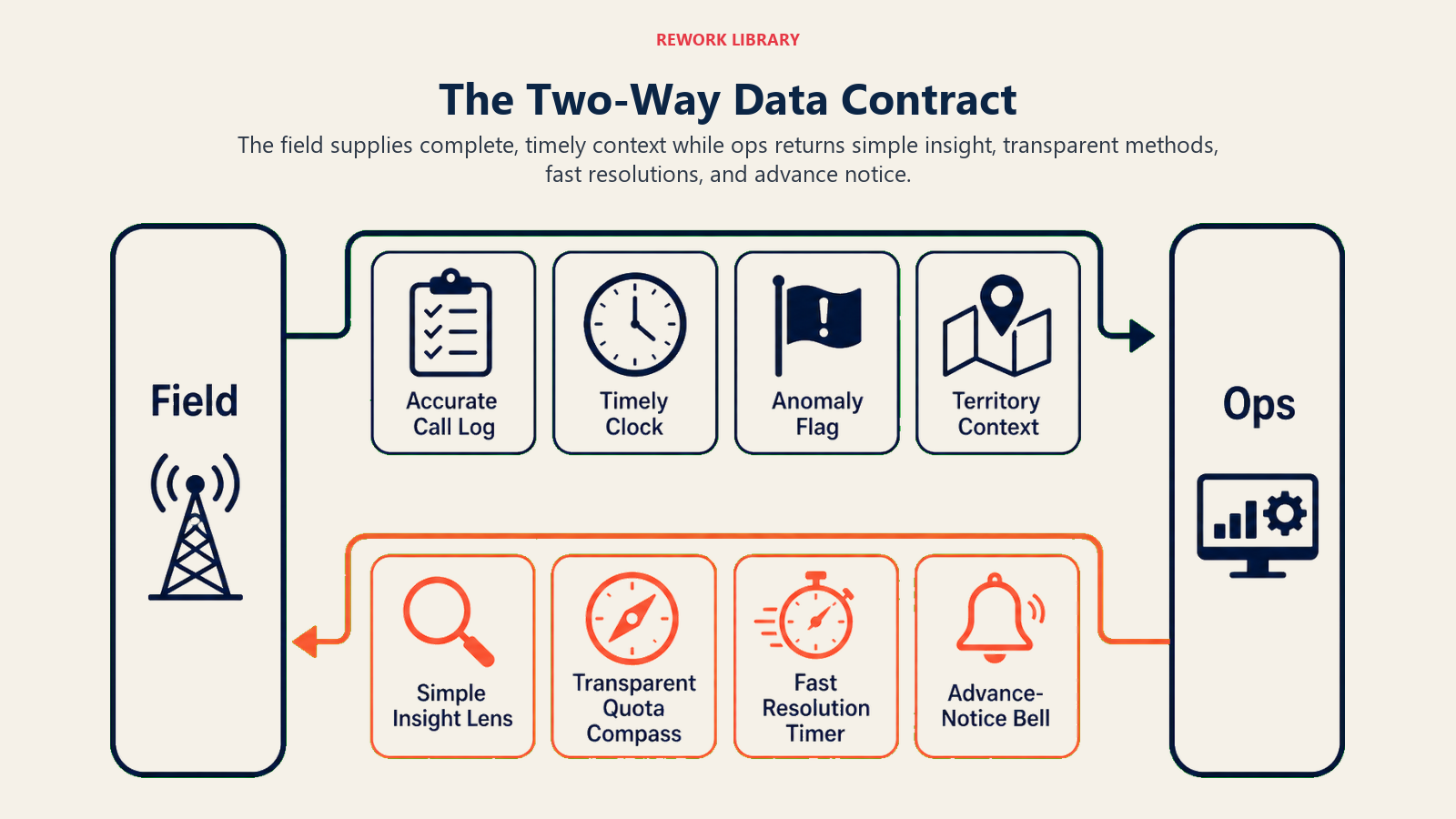
The framing that unlocks alignment is a contract rather than a hierarchy. The Two-Way Data Contract is the named model for this relationship: ops and field each have defined obligations to the other, reviewed at the management level, and measured through proxy metrics like IC dispute rate and CRM completeness. It replaces the implicit expectation that field teams will comply with reporting and ops will produce useful dashboards with an explicit bilateral agreement where both sides can be held accountable. Ops doesn't govern the field; the field doesn't ignore ops. Both sides have obligations to each other, and those obligations are specific.
What the Field Owes Ops
| Obligation | Specifics | Why It Matters to Ops |
|---|---|---|
| Accurate CRM entry | Call logs with correct HCP, date, product, outcome, and next action | Ops can't build territory analysis on incomplete call data |
| Timely reporting | Entries within 24 hours of the call, not batched at week's end | Lagged data delays secondary sales reconciliation |
| Anomaly flagging | Report stock-outs, competitor activities, and outlet closures in real time | Ops can't see these from reporting data alone |
| Quota input | Respond to territory potential surveys before the quota cycle closes | Ops can't adjust for local factors they don't know about |
| Territory redesign input | Identify key account relationships before line changes are confirmed | Redesigns without this data break commercial continuity |
What Ops Owes the Field
| Obligation | Specifics | Why It Matters to Field |
|---|---|---|
| Simplified dashboards | One page per territory, territory-level view (not aggregate), clear action signal | Reps need to act on data, not interpret it |
| Territory-level insight | Not just "region X is down 8%" but "your top 3 target HCPs show declining call frequency" | Generic reporting doesn't support specific decisions |
| Fast IC dispute resolution | Disputes acknowledged within 48 hours, resolved within 10 working days | Unresolved IC disputes destroy trust and effort |
| Pre-brief on quota methodology | Before cycle opens: how targets are built, what data sources are used, what assumptions are made | Reps who understand methodology trust the number |
| Advance notice on territory changes | Field briefed 30 days before redesign is implemented, not after | Reps need time to transition relationships |
This contract isn't aspirational. It's operational. Both sides need to hold each other accountable to it, which means it needs to be explicit and reviewed at the management level. The four touchpoints that make it stick are where most pharma commercial operations fall short.
Four Operational Alignment Touchpoints
Alignment isn't sustained by goodwill. It requires recurring structured touchpoints where both sides exchange what they owe each other. Four moments in the commercial calendar are the highest-leverage opportunities.
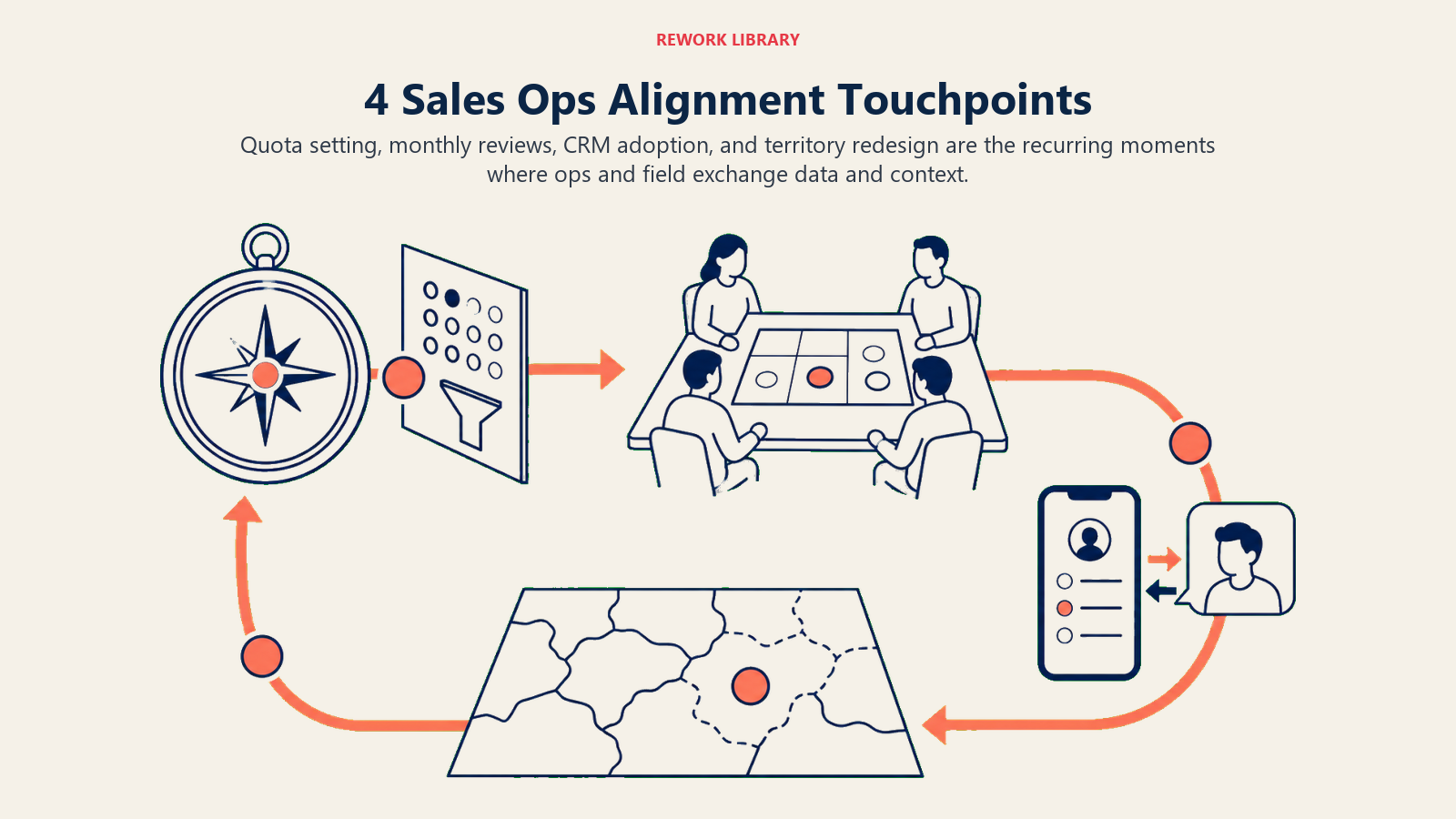
Touchpoint 1: Quota-Setting Cycle (Annual or Semi-Annual)
This is the moment when targets for the coming period are set. Most pharma companies run this as a purely data-driven ops exercise: historical sales, market growth assumptions, and territory size go in; quotas come out. Field managers get informed after the fact.
The aligned model inserts a field input step before targets are finalized. Territory managers receive a territory potential survey 6 to 8 weeks before the quota cycle closes. They're asked to flag: accounts gaining or losing prescribing volume for reasons not visible in historical data, access changes (new hospital listings, payer shifts) that will affect territory dynamics in the coming period, and competitive activity that's compressing or expanding market opportunity.
This input doesn't override the quantitative model. But it allows ops to apply territory-specific adjustments that the model can't see. Reps who participated in quota-setting feel less surprised by their targets. That alone reduces IC disputes significantly.
Touchpoint 2: Monthly Business Review
The monthly business review is where territory performance is discussed. In most organizations, this is a regional manager presenting regional numbers to commercial leadership, with ops data in the background.
The aligned version has ops present territory-level insight directly: which territories are trending ahead, which are behind, and what the data suggests about why. The "why" is where ops needs field input. If territory X is down 12% versus plan but the regional manager knows a key prescriber retired last month, that context belongs in the ops analysis before leadership draws the wrong conclusion and applies the wrong intervention.
The monthly review works when it's a two-way exchange: ops brings data interpretation, field brings context, and together they produce a set of decisions. Not a status report.
Touchpoint 3: CRM Adoption
CRM adoption is perpetually suboptimal in pharma field forces, and the usual response is to enforce it harder. More required fields, more compliance audits, more manager pressure on reps to enter calls.
The aligned approach attacks the problem from both sides. Ops simplifies the CRM configuration: minimum viable fields per call, pre-populated dropdown selections based on the rep's territory and target list, and mobile-first entry that matches how reps actually work. Field management holds reps accountable for data quality, but with the understanding that if the system is friction-heavy, adoption will always be partial.
The quid pro quo matters here: reps who see that their CRM data produces a territory dashboard that actually helps them plan their week are materially more likely to enter it accurately. The field's perception of CRM as a reporting burden vs. a planning tool is determined by what ops does with the data. See the broader technology framework in Field Reporting and Closed-Loop Marketing.
Touchpoint 4: Territory Redesign
Territory redesigns happen every 2 to 3 years in most pharma field forces, triggered by market expansion, field force size changes, or prescriber concentration shifts. They're among the highest-stakes events in commercial operations because they disrupt established HCP relationships that took years to build.
The aligned process inserts field input at two stages. Before the design: territory managers identify their highest-value account relationships, flag accounts where there's a personal relationship that would be lost in a hand-off, and provide context on prescriber behavior that the geographic or quantitative model won't capture. After the draft design is done but before it's finalized: territory managers review the proposed changes and escalate cases where the design breaks a critical relationship.
This doesn't mean field managers veto redesigns. It means their input is systematically captured and weighed before commercial leadership signs off. The result is a design that's both more analytically sound and more commercially executable.
The Sales Ops Field Liaison Model
The structural gap between sales ops and the field is partly organizational: ops sits at headquarters, the field is distributed across territories. Email and reports don't close this gap. What does is assigning a named ops contact to each regional field team.
The liaison model works like this:
Each region gets a dedicated ops liaison. Not a shared inbox: a specific person in sales ops whose portfolio includes that region and who attends the regional monthly business review.
The liaison's role is two-directional. Inbound: they collect field context, anomaly flags, quota input, and relationship data for redesign cycles. Outbound: they translate the ops analytical output into territory-level insight for the regional manager, surface IC disputes through the right channel, and pre-brief regional managers before quota methodology changes are announced.
Liaison performance is measured by field trust, not just data quality. A useful metric is the IC dispute rate in their region (lower is better) and the CRM data completeness score for their region (higher is better). These proxy for whether the two-way contract is actually working.
This model is lightweight: it doesn't require adding headcount to ops. It requires allocating existing ops analytical staff to regional accountability in addition to their functional responsibilities. The payoff is a field force that trusts the ops function, enters CRM data with more accuracy, and uses the monthly dashboard as a planning tool rather than ignoring it. The friction points in CRM adoption that undermine all of this are easier to fix than most commercial leaders assume.
CRM Adoption Friction: The Diagnostic Checklist
Before assuming field resistance to CRM is a behavior problem, diagnose whether the system itself is creating friction. Most field CRM adoption issues trace to one or more of these root causes.
| Friction Source | Diagnostic Question | Fix |
|---|---|---|
| Too many required fields | Does a call log require more than 5 minutes to complete? | Reduce required fields to call date, HCP, product, outcome, next action |
| No pre-population | Does the rep have to type the HCP name rather than select from a territory list? | Load territory-specific HCP list into the system with one-tap selection |
| Desktop-only entry | Do reps have to enter calls at a desk rather than in the field? | Mobile app with offline sync |
| No visible feedback loop | Does entering a call do anything the rep can see or use? | Connect entry to the rep's territory dashboard so they see their coverage rate update |
| Duplicative with manager reports | Do reps also fill out manager reports covering the same data? | Eliminate manager reports in favor of CRM-generated summaries |
| Slow system performance | Does the CRM take more than 10 seconds to load on a phone with average connectivity? | Optimize mobile performance or provide a lightweight field app |
Running this checklist before a CRM compliance push ensures you're solving the actual problem rather than pressuring the field into a system that's genuinely hard to use.
The three patterns above share a root cause: ops was built to produce reports, not to support decisions. The liaison model, the two-way data contract, and the CRM friction checklist are each designed to fix that at the source.
When the Data Partnership Works
The rep who enters accurate CRM data gets a territory dashboard that tells them which targets are cooling and which are warming, enabling smarter weekly planning. The ops analyst who receives complete field data can build a secondary sales reconciliation that actually explains territory variance rather than just reporting it. The regional manager whose quota methodology was explained before the cycle launched doesn't spend the month's first week in IC dispute calls.
These aren't aspirational outcomes. They're the predictable result of a functioning data partnership. Sales ops without field trust produces reports that no one acts on. With field trust, it produces the commercial intelligence that territory-level decisions are built on, and that's where growth comes from.
Frequently Asked Questions about Sales Ops and Field Force Alignment in Pharma
Why does CRM data quality degrade in pharma field forces?
The most common cause is not field resistance but system design. When the CRM was built for what ops needed to report rather than what reps needed to plan, entry becomes a compliance exercise with no perceived return. Reps log the minimum required to avoid manager pressure. Data completeness suffers. Fixing CRM adoption starts with diagnosing friction (too many fields, desktop-only entry, no visible feedback loop) before applying compliance pressure.
What is a reasonable IC dispute rate benchmark?
There is no universal industry benchmark published for pharma IC dispute rates, but a practical internal target is that disputes requiring escalation beyond the first manager level should represent fewer than 5% of rep population in any cycle. Above that threshold, the methodology or communication process has a structural problem. Tracking this by region also surfaces whether specific ops liaisons or territory designs are systematically generating disputes.
How should sales ops deliver quota methodology to the field?
The best practice is a pre-cycle briefing that explains (1) what data sources were used to construct targets, (2) what assumptions were made about territory growth rates, (3) how local factors were accounted for, and (4) the escalation path if a rep believes their territory potential is significantly misrepresented. This briefing should happen six to eight weeks before the cycle opens, while adjustments are still possible, not after targets are already locked.
What is the sales ops field liaison model?
The liaison model assigns a named ops contact to each regional field team rather than routing all communications through a shared inbox. The liaison attends the region's monthly business review, collects field context for quota-setting and territory redesign cycles, translates aggregate ops analysis into territory-level insight, and tracks IC dispute resolution in their region. Performance is measured by IC dispute rate and CRM completeness scores, both proxies for whether the two-way contract is actually working.
When should territory redesigns include field input?
Field input is most valuable at two points: before the design model runs, to capture account relationship data and prescriber context the geographic algorithm can't see; and after the draft is complete but before it's finalized, to flag cases where the proposed lines break critical relationships. Reps don't veto redesigns, but their input should be systematically captured and weighed. Redesigns done without this input tend to be geometrically efficient and commercially suboptimal.
How long should an IC dispute take to resolve?
Acknowledgment within 48 hours of the dispute being filed, and resolution within 10 working days. Disputes that drag beyond two weeks erode trust in the IC system regardless of how the outcome resolves. Fast resolution signals that ops takes the dispute seriously; slow resolution signals that the field's concerns are low priority. Both signals compound over multiple cycles.
Learn More

Senior Implementation Consultant
On this page
- What Sales Ops Does and Why Field Alignment Is a Commercial Multiplier
- The Alignment Gap in Practice
- What Does a Functioning Two-Way Data Contract Actually Look Like?
- What the Field Owes Ops
- What Ops Owes the Field
- Four Operational Alignment Touchpoints
- Touchpoint 1: Quota-Setting Cycle (Annual or Semi-Annual)
- Touchpoint 2: Monthly Business Review
- Touchpoint 3: CRM Adoption
- Touchpoint 4: Territory Redesign
- The Sales Ops Field Liaison Model
- CRM Adoption Friction: The Diagnostic Checklist
- When the Data Partnership Works
- Learn More