Medical Rep Daily Call Plan: How Top Pharma Field Teams Structure Their Day
Turn this article into takeaways for your work.


Each assistant summarizes the article only for you and suggests best practices for your work.
There's a rep who visits 8 doctors. And there's a rep who influences 8 prescribers. The difference between those two people isn't territory size or product quality. It's how they structure their day.
Most underperforming reps aren't lazy. They're disorganized. They start late, spend 40 minutes hunting for parking near a hospital, sit in a waiting room for 90 minutes to land a 2-minute detail, then wrap up at 4pm because "there's no one left to see." Their top-quartile colleague in the same territory called the same number of targets. But she sequenced them differently, prepared tighter, logged everything by 5:30pm, and got two add-on lunch-slot opportunities she didn't even plan.
Daily structure isn't administrative overhead. It's the primary lever for territory performance. This guide gives pharma commercial leaders a blueprint their reps can actually use.
The Anatomy of a Productive Field Day
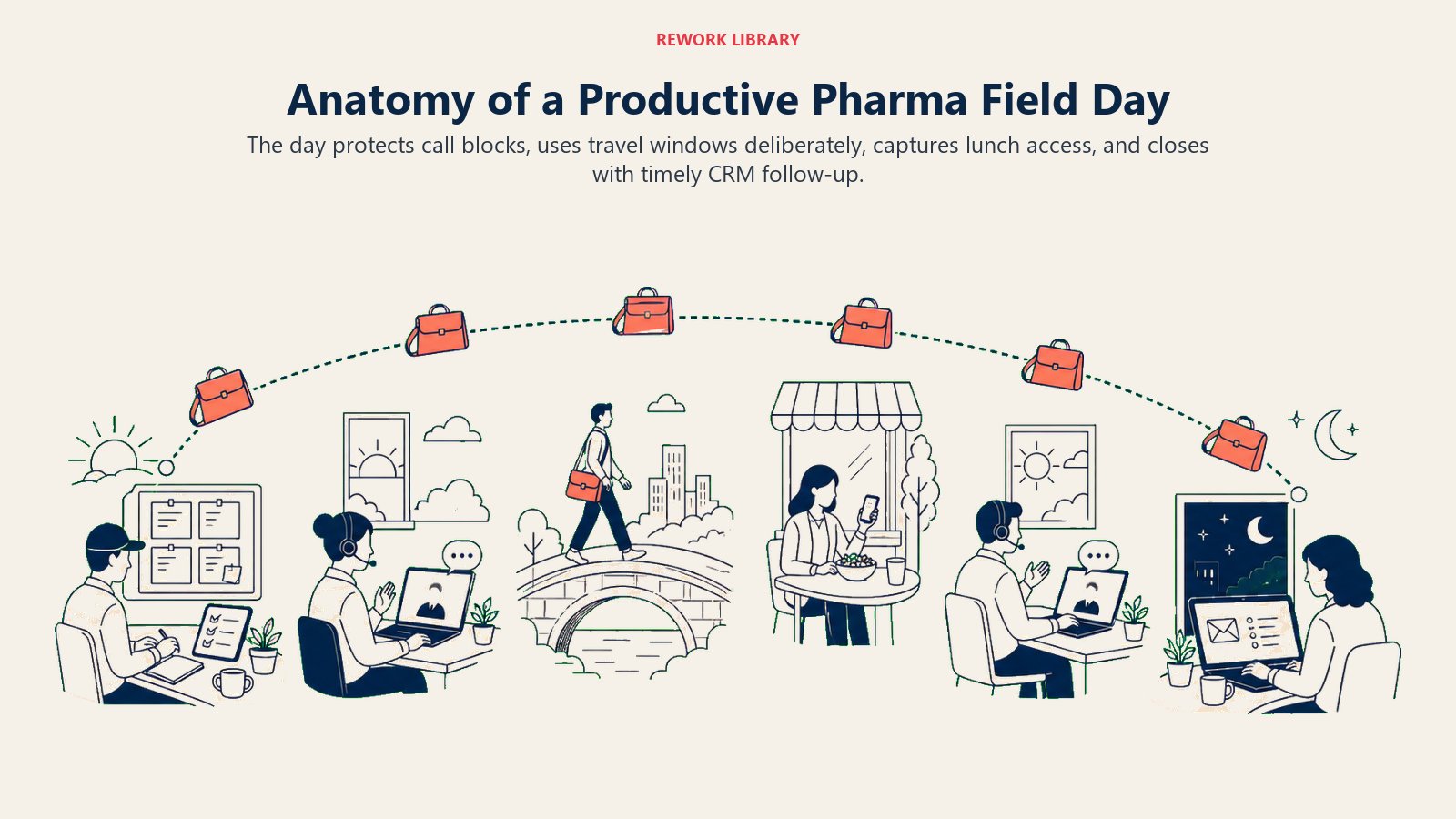
A strong field day has a skeleton, and every rep should know it cold. Here's a time-blocking model that consistently produces 8 to 10 high-quality calls per day:
Key Facts: Medical Rep Time Use
- A Deloitte analysis of biopharma field forces found reps spend roughly two-thirds of their workday on research and administrative tasks rather than direct health care professional (HCP) interaction (Deloitte, 2026)
- Reps without a back-up call list can easily lose 30 to 45 minutes in reception areas when primary targets are unavailable, time that structured back-up protocols redirect to productive calls
- Reps who skip the night-before route review typically absorb an extra 15 to 20 minutes of unplanned driving each day, roughly the time of one additional pharmacy call
| Time Block | Activity | Duration |
|---|---|---|
| 07:00 - 07:30 | Morning prep: route review, message review, sample count, visual aid check | 30 min |
| 07:30 - 08:15 | Drive to first stop, arrival before clinic opens | 45 min |
| 08:15 - 09:30 | First call block (GP clinic or hospital rounds) | 75 min |
| 09:30 - 10:00 | First pharmacy visit in the route | 30 min |
| 10:00 - 11:30 | Second call block (specialists or secondary GP targets) | 90 min |
| 11:30 - 12:00 | Admin window: quick CRM notes, adjust afternoon route | 30 min |
| 12:00 - 13:00 | Lunch slot (sponsored lunch meeting or informal HCP catch-up) | 60 min |
| 13:00 - 15:00 | Afternoon call block (hospital detailing or clinic second visits) | 120 min |
| 15:00 - 15:30 | Second pharmacy stop, wholesaler if applicable | 30 min |
| 15:30 - 16:30 | Final call block (pharmacist consultation, nurse educator contact) | 60 min |
| 16:30 - 17:30 | CRM update, next-day route prep, sample reconciliation | 60 min |
This isn't a rigid script. It's a framework that keeps time from evaporating. What separates reps who consistently hit 8 to 10 quality calls from those who don't is rarely talent. It's how deliberately they protect each time block.
Priority Call Sequencing
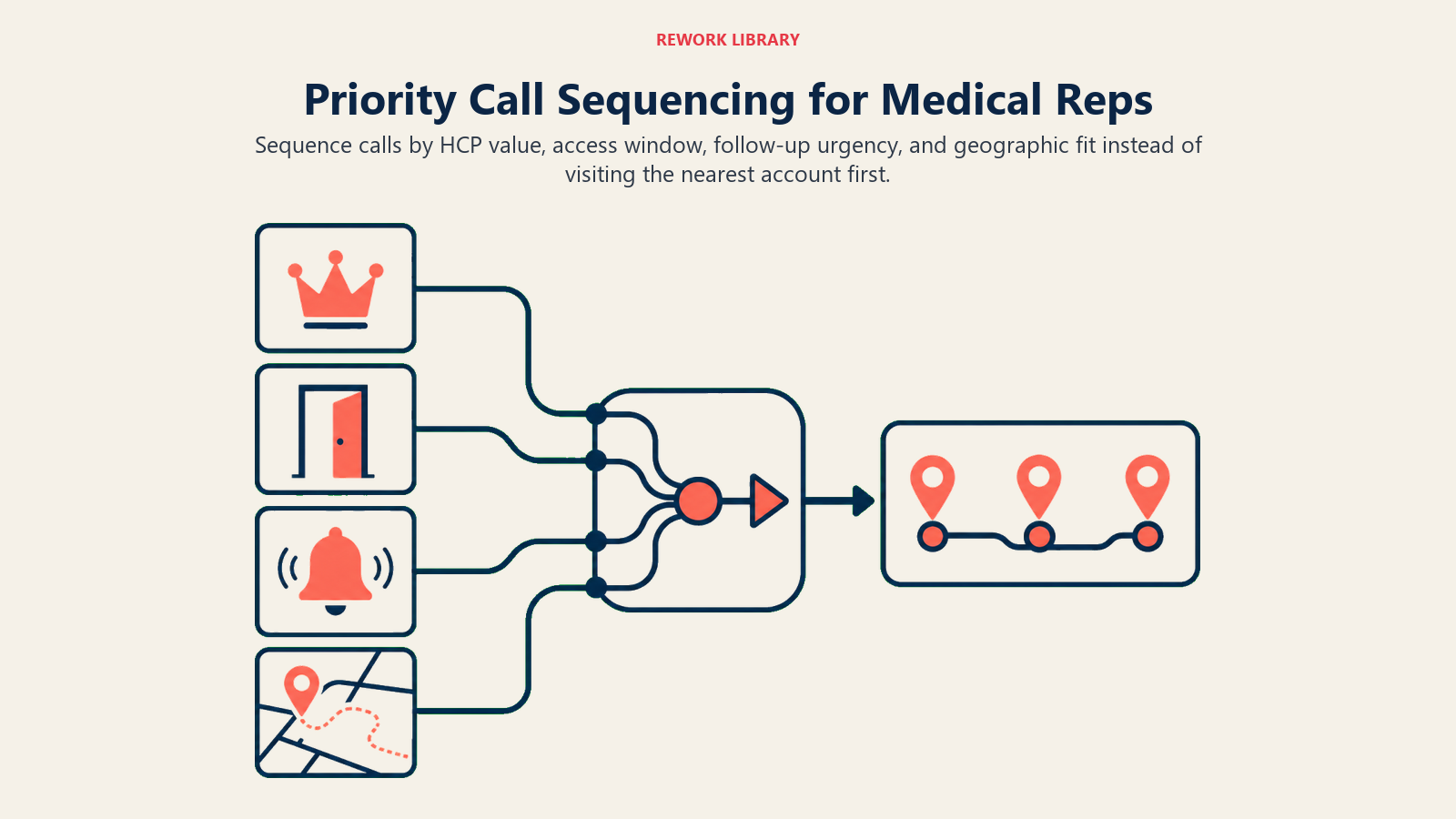
Not all calls are equal, and your sequencing decisions before leaving home each morning determine whether you hit your high-value targets or run out of day before you get to them.
A/B/C Tiering
Every rep should classify their accounts by prescribing potential and relationship stage:
- A accounts: High prescribers or high-potential targets who need regular contact. These get seen first in the day, when the rep is fresh and the HCP is still energized. Don't let A accounts become afternoon afterthoughts.
- B accounts: Mid-tier prescribers or growth opportunities. Mix these into call blocks between A accounts to keep territory coverage balanced.
- C accounts: Low-potential accounts or newly identified prospects. See these when routing efficiency allows, but don't sacrifice A-account time for C-account convenience.
Beat and route journey planning should embed this tiering logic into the weekly territory rhythm. If your rep's route consistently prioritizes C accounts because they're closer together, that's a planning failure, not a geography problem.
Mixing HCP Detailing Calls with Pharmacy Visits
Segmenting the day into "doctor days" and "pharmacy days" is a common error. Pharmacy visits take 15 to 25 minutes and can slot neatly between clinic blocks. A rep calling on a GP practice can include the pharmacy two doors down in the same stop. This isn't just time efficiency. Pharmacists often see the same patients as your HCP targets and can reinforce your product's key messages.
Build at least two pharmacy touchpoints into every field day, timed to fit between detailing blocks rather than bolted on at the start or end.
Back-Up Call List
Reps without a back-up list often find themselves sitting in reception for an hour waiting for a doctor who left early for a conference or is running three hours behind. Every rep should maintain a live back-up list of 5 to 8 contacts within 10 minutes of any given territory zone. When a primary target isn't available, the rep pivots immediately instead of sitting.
The back-up list should pull from B accounts or pharmacy targets that don't require appointment booking. Every territory hour should have a productive use, and the back-up list is what makes that possible. Call frequency and coverage optimization gives you the framework to set the right contact rates per tier.
Pre-Call Preparation Checklist
Preparation done in the car park or lift lobby is not preparation. It's improvisation. But top reps complete their pre-call work before they leave home or the office.
The morning pre-call checklist:
- Review last call note for each target (what was discussed, what was committed)
- Confirm key message for the visit based on HCP's prescribing behavior and known objections
- Check sample inventory against today's plan (never run out of samples mid-route)
- Confirm visual aid materials are current (no expired promotional items)
- Review any recent CME content or clinical study relevant to today's HCP targets
- Check HCP availability signals (appointment confirmations, clinic schedule notes in CRM)
Pre-call planning and objection handling is where win rates actually get set. A rep walking into a rheumatologist's office with the latest real-world evidence for your biologic, knowing she previously objected to tolerability data, will outperform a rep walking in with a generic brochure every time.
Pre-call prep doesn't need to be long. Twenty minutes of focused preparation covers a full day's calls. A rep who walks in knowing the HCP's last objection and the relevant clinical study is a different conversation than one who reads the account notes in the car park.
In-Call Execution Standards
Time-per-call benchmarks matter because reps often either rush through high-value calls or spend too long in low-yield conversations. Here are realistic targets by customer type:
| Customer Type | Target Time | Key Deliverable |
|---|---|---|
| GP / Family physician | 3 to 5 minutes | One key message landed, next call hook set |
| Specialist (cardiologist, oncologist, etc.) | 5 to 8 minutes | Clinical data exchange, patient case discussion |
| Hospital pharmacist | 10 to 15 minutes | Formulary status, dispensing patterns, tier discussion |
| Community pharmacist | 15 to 20 minutes | Stock levels, patient referral support, OTC education |
| Nurse educator / practice nurse | 10 to 15 minutes | Patient adherence resources, injection technique support |
The goal for a GP detail is not to share everything you know. It's to land one message that moves the needle on one product. Doctor detailing best practices consistently show that reps who try to cover three products in four minutes land zero messages clearly. One message, delivered cleanly, remembered.
For specialist calls, clinical evidence is currency. These are physicians who read journals, attend congresses, and will push back on weak data. Arrive with the study, know the methodology, and be ready for a real clinical conversation.
Research published in PMC on pharma rep and physician interactions found that skeptical specialists who favor evidence over charm respond best to reps who arrive with clinical reprints and can discuss the methodology behind the data, not just the headline efficacy numbers (Sah and Fugh-Berman, PLoS Med, 2013; see also the foundational detailing ethnography at PMC1876413).
Lunch Slot and Out-of-Hours Opportunities
The 12:00 to 13:00 window is underused by most reps and overdone by others. Used correctly, it's one of the highest-yield touchpoints in the field week.
Sponsored lunch meetings: A small group lunch with 3 to 8 GPs or specialists allows for 20 to 30 minutes of structured clinical discussion that's impossible to achieve in individual detailing slots. These aren't events for large territories or once-a-quarter occasions. Well-organized reps run one lunch meeting per week with different subsets of their target list.
Informal catch-ups: Not every lunch slot needs a formal event. A rep who stops by a clinic at 12:30 when the morning patients have cleared and the HCP is unwinding can get 10 minutes of relaxed, genuine conversation that builds more relationship equity than six rushed waiting-room details.
CME and evening events: Hospital grand rounds, departmental clinical meetings, and evening speaker programs are high-yield out-of-hours opportunities. Reps who attend one or two per month build deeper specialist relationships and reinforce product messages in a clinical education context rather than a sales context. These touchpoints don't replace field calls. They complement them. The PhRMA Code on HCP Interactions sets the voluntary industry standard governing how reps should conduct themselves at meals, educational events, and other touchpoints with physicians.
Post-Call Logging and CRM Discipline
CRM data is only as good as the rep's logging discipline. And that discipline degrades sharply when logging is left until the following morning.
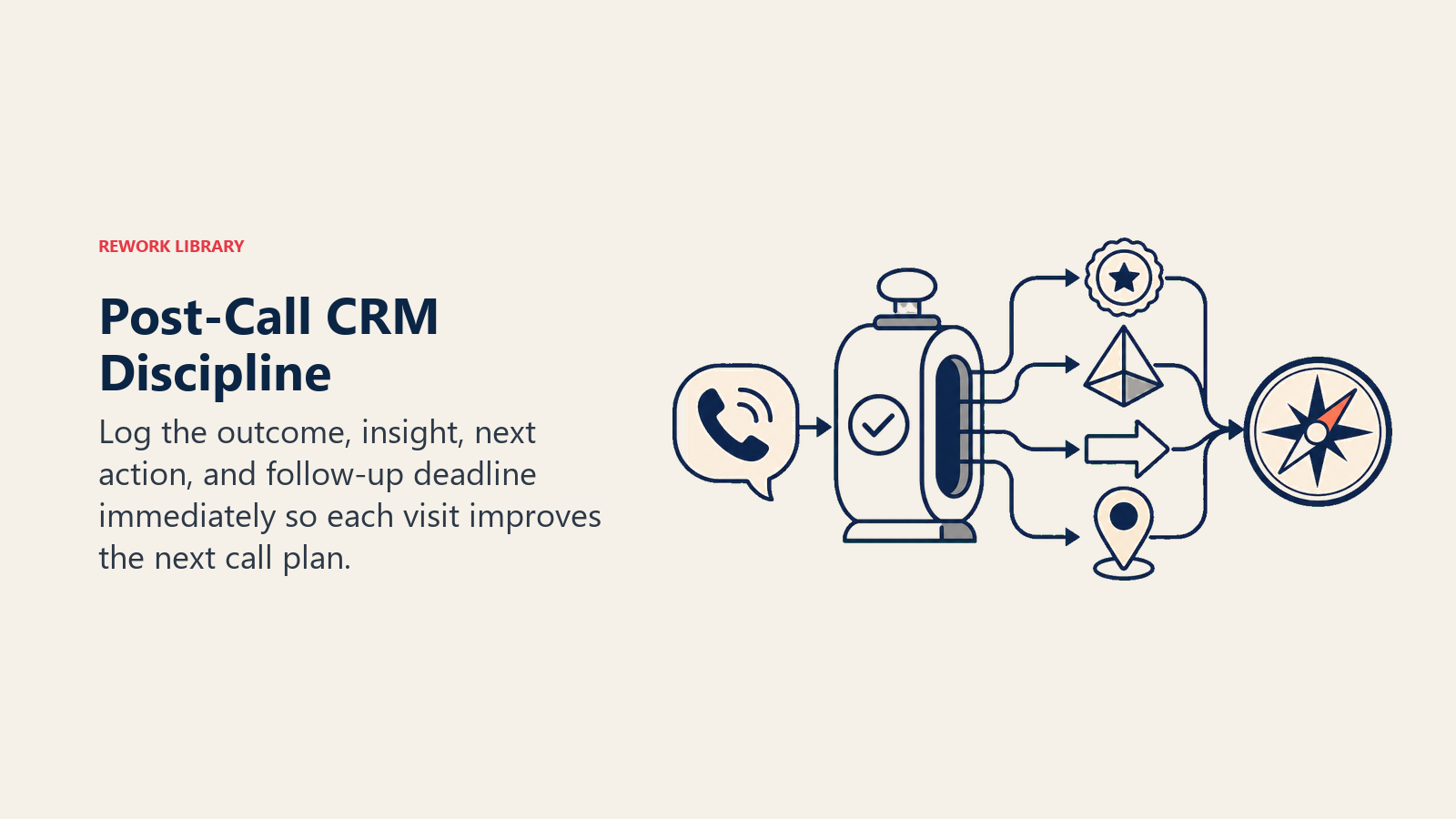
Minimum same-day CRM standards:
- Call date, time, location, and HCP name confirmed within the tool
- Key message discussed and HCP response noted (not "visit completed," but "discussed RESOLVE trial data, HCP interested in tolerability profile, requested patient case study")
- Samples distributed recorded with batch numbers where required per the FDA Prescription Drug Marketing Act, which sets federal requirements for sample accountability and record-keeping
- Next call objective set and next visit date estimated
- Any objections, competitor mentions, or clinical questions flagged for follow-up
Pharma CRM platforms like Veeva CRM or IQVIA OCE are only useful when reps actually fill them in properly. And the data reps enter is only as valuable as the hygiene standards enforcing it downstream. CRM data hygiene discipline at the field level is what keeps territory analytics trustworthy. A field manager reviewing a territory report full of "call completed" notes has no data to coach from. A territory report with detailed call narratives, objection patterns, and response tracking is a coaching and forecasting asset.
Set a non-negotiable rule: CRM is updated before the rep leaves the last call location or within 30 minutes of the working day ending. Not next morning. Same day.
Field teams with same-day CRM logging standards consistently outperform those that allow batch end-of-day reporting on data completeness, a pattern pharma CRM practitioners widely report. Completeness gaps between same-day and next-morning logging can be substantial enough to compromise coaching and forecasting quality.
Common Time Killers and How to Eliminate Them
High-performing reps ruthlessly protect their productive field hours. Here are the most common time killers, and how good field managers tackle them:
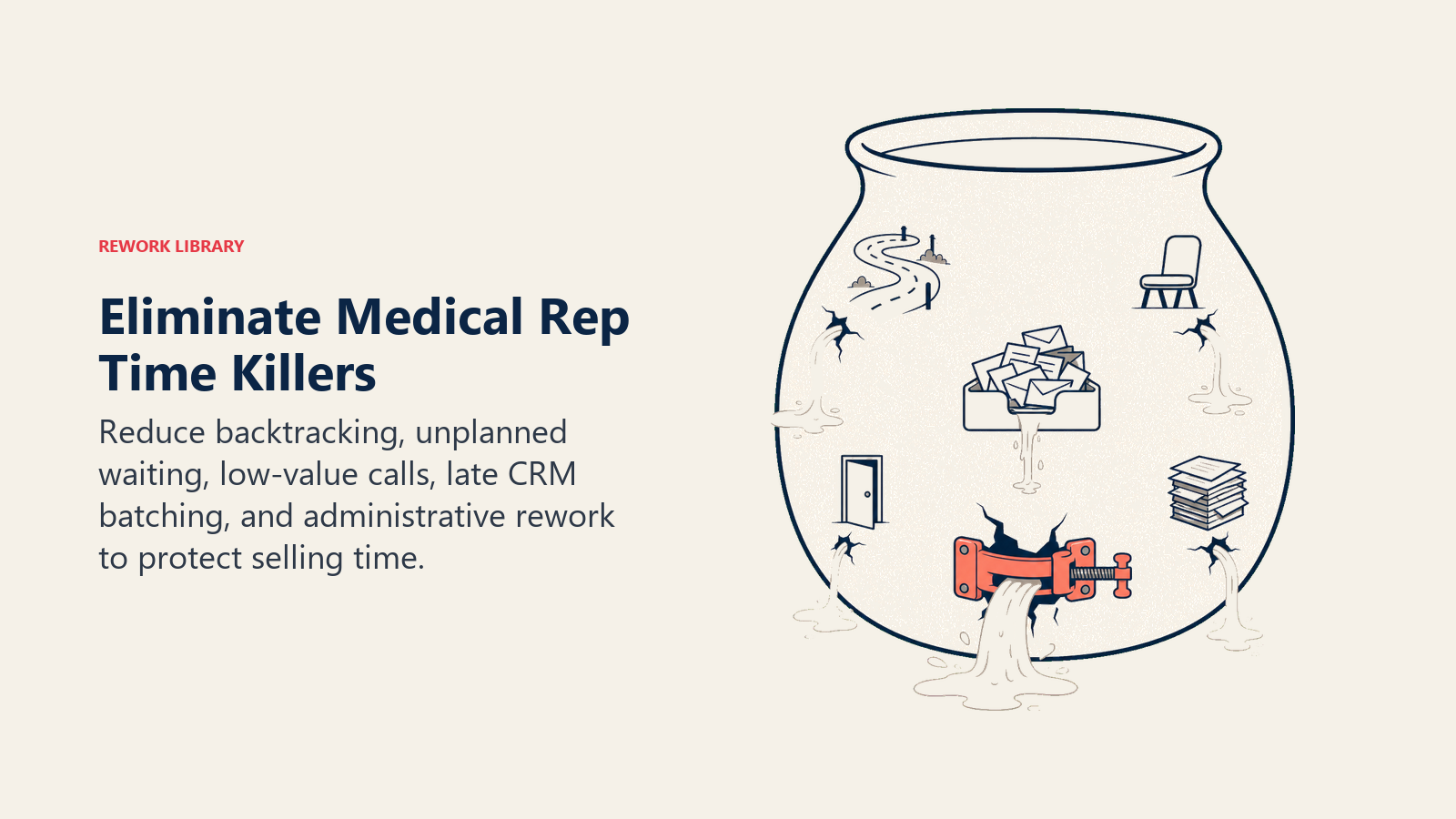
Waiting room waste: The average medical rep spends 35 to 45 minutes per day waiting in reception areas that yield no call. Fix: introduce a territory-specific "waiting room protocol" where reps who've waited more than 20 minutes without a confirmed slot either request a specific time from reception staff and return, or pivot to the back-up list. Sitting and waiting is not field work.
Unplanned routing: Route planning the night before is the simplest time multiplier in field work. Thirty minutes of travel time saved is one additional pharmacy call or one completed CRM update. Require reps to submit next-day routes as part of CRM discipline.
Admin overload before 9am: Reps who spend 90 minutes in the morning on email, internal reports, and meeting prep before their first call are consuming their highest-energy window on non-revenue tasks. Establish a team-wide policy: field first, admin last. Internal emails and reports belong in the 4:30 to 5:30pm window, not the morning.
Unplanned sample distribution: Reps who haven't counted samples before leaving home can run short during the day or carry excess stock that adds to drive weight and slows them down. A 5-minute morning sample check prevents this.
Poorly timed hospital visits: Hospitals have dead zones where HCPs are in procedures, ward rounds, or outpatient clinics and are genuinely unreachable. Reps who learn the rhythms of their target hospitals (when registrars are most accessible, when outpatient clinics finish) stop wasting visits on unreachable windows.
What Makes or Breaks a Field Rep's Daily Output?
The Time-Blocking Field Day Model is a structured daily schedule that assigns each hour of the field day to a specific activity category (prep, A-account calls, pharmacy visits, CRM update), ensuring high-value HCP targets are seen first when rep energy is highest and administrative tasks are batched at the end of the day rather than distributed across productive selling hours.
Key Habits That Separate Top-Quartile Reps
The gap between an average rep and a top performer in the same territory often comes down to a handful of daily habits rather than talent:
They protect their first two hours. Top reps are at their first A-account call before 8:30am. They don't warm up to the day. They start it.
They plan backwards from close of business. Instead of starting the day and seeing how much fits, they plan from 5:30pm backwards: CRM logged, samples reconciled, next-day route confirmed. This prevents the 4pm "I'll finish this tomorrow" drift.
They treat every no-see as information. When a doctor isn't available, the best reps note it in the CRM with a timestamp and contact reception to book a specific slot. They don't just tick "not seen" and move on.
They know their numbers. Top reps know their weekly call rate, their A-account coverage percentage, and their sample utilization rate without being asked. A Deloitte analysis of biopharma field forces found that reps spend roughly two-thirds of their workday on research and administrative tasks rather than direct HCP interaction, making time discipline the single biggest performance variable a manager can influence. These aren't metrics their manager tracks. They're the rep's own scoreboard. Reps who tie this self-awareness to a clear opportunity qualification lens on every call get even sharper: they can rank their HCP conversations not just by activity but by genuine prescribing potential.
They debrief themselves. At the end of each day, the best reps spend five minutes reviewing what landed and what didn't. Which message got a positive HCP response? Which objection came up again? What will they do differently tomorrow? This micro-feedback loop compounds over months into genuine expertise.
A GP specialist spending 8 full minutes with a rep discussing a clinical trial is a different conversion opportunity than a GP who accepted a 2-minute waiting-room detail. Reps who log both as "call completed" in their CRM are throwing away their own coaching data. That detail is what makes the next call sharper.
Frequently Asked Questions about Medical Rep Daily Call Plan
How many HCP calls should a medical rep aim for each day?
The realistic benchmark for most field roles is 8 to 10 productive calls per day. Primary care reps in dense urban territories can push toward 10 to 12; hospital-focused specialty reps typically achieve 5 to 7 because individual calls take longer and access is more restricted. The number only matters when paired with call quality: 10 rushed calls with no message landing outperforms 8 calls when those 8 are focused, prepared, and followed up.
How should a rep prioritize which HCPs to see first?
A accounts, your highest-prescribing or highest-potential targets, should almost always be seen in the first half of the day. Rep energy and HCP availability are both higher in the morning. Leaving A accounts as afternoon calls means your most important visits happen when you're most likely to be fatigued and when clinic waiting rooms are longest. Sequence your day by account priority, then optimize for routing efficiency within that constraint.
What is the right length for a GP detailing call?
Three to five minutes is the realistic target for a GP detail. That's enough time to open with a relevant patient scenario, deliver one focused key message, handle one objection, and close with a specific ask. Reps who try to cover three products in a four-minute slot land zero messages clearly. One message, delivered well and confirmed, is more commercially valuable than a full portfolio overview the doctor won't remember.
How often should call reports be completed?
Best practice is within 30 minutes of each call, using an offline-capable mobile CRM app. Reps who batch their reporting at the end of the day lose the accuracy of immediate recall and miss the window for same-day manager coaching on difficult calls. The benchmark for high-performing field teams is a data completeness rate of 95% or better with same-day submission.
What is a back-up call list and why does it matter?
A back-up call list is a standing list of 5 to 8 contacts within 10 minutes of any territory zone, used when a primary target is unavailable. Without one, reps who encounter an unavailable doctor either wait in reception or abandon the call slot entirely. With a back-up list, a rep pivots immediately to a B account, pharmacy, or nurse educator and preserves the time value of the call block.
How should lunch slots be used in a medical rep's schedule?
The 12:00 to 13:00 window has two high-value uses: small group sponsored lunches with three to eight HCPs, which provide 20 to 30 minutes of structured clinical discussion impossible in individual detailing slots, and informal clinic visits when morning patients have cleared and HCPs are less pressured. Reps who run one organized lunch meeting per week with rotating subsets of their target list gain meaningful access that queued waiting-room calls can't replicate.
What should a rep do when a doctor runs behind schedule?
The waiting room protocol for high-performing reps is simple: wait no more than 20 minutes without a confirmed slot. After that, request a specific future appointment from reception and move on to the back-up list. Sitting in a waiting room for 60 to 90 minutes is not field work. It's time that belongs to a B account, a pharmacy visit, or CRM catch-up that the end of the day won't have room for.
Learn More
Build your medical rep's daily call discipline into a complete field-force operating system:

Senior Implementation Consultant
On this page
- The Anatomy of a Productive Field Day
- Priority Call Sequencing
- A/B/C Tiering
- Mixing HCP Detailing Calls with Pharmacy Visits
- Back-Up Call List
- Pre-Call Preparation Checklist
- In-Call Execution Standards
- Lunch Slot and Out-of-Hours Opportunities
- Post-Call Logging and CRM Discipline
- Common Time Killers and How to Eliminate Them
- What Makes or Breaks a Field Rep's Daily Output?
- Key Habits That Separate Top-Quartile Reps
- Learn More