Pharmaceutical Marketing Compliance and Ethics: A Field-Force Leader's Practical Guide
Turn this article into takeaways for your work.


Each assistant summarizes the article only for you and suggests best practices for your work.
Compliance is not a legal department problem that occasionally spills onto your field force. It's a commercial competency, and the companies that treat it that way outperform the ones that don't.
That's not idealism. It's mechanics. A health care professional (HCP) who trusts that your rep won't push the edge is more open to the next detail. A pharmacy manager who sees consistent, professional conduct from your team gives your brand more face time. Regulatory violations, on the other hand, can pull a product, freeze a field force, and destroy years of relationship equity in a single news cycle.
The goal here isn't to turn sales leaders into compliance lawyers. It's to give you a working map of where the lines are, what the most common violations look like, and how to build a field culture that stays clean while still hitting numbers. Because those two things aren't in conflict, unless you let them be.
The Regulatory Landscape
The rules governing pharma field promotion vary by market, but the intent is consistent everywhere: protect healthcare professionals and patients from misleading, coercive, or inappropriate commercial influence.
In the US, the FDA drug promotion rules under the Federal Food, Drug, and Cosmetic Act require that promotional materials be truthful, not misleading, and consistent with the approved label. The OIG Anti-Kickback Statute covers anything that could be seen as remuneration to induce referrals or prescriptions.
In the UK and EU, the ABPI Code of Practice sets standards for interactions with HCPs, including hospitality, educational grants, and speaker arrangements. Many Asian markets have their own frameworks, from India's UCPMP (Uniform Code for Pharmaceutical Marketing Practices) to country-specific advertising regulations in Southeast Asia.
For field-force leaders, the practical implication is this: your reps operate under at least two layers of rules at any time, the regulatory framework of the country and your company's own internal policy, which is usually stricter. Internal policy is your operational standard. Regulatory rules set the legal floor.
Key Facts: Pharma Compliance Stakes
- The OIG has issued special fraud alerts specifically on pharmaceutical speaker programs, warning that arrangements lacking genuine educational purpose risk Anti-Kickback Statute liability, per the US Department of Health and Human Services OIG.
- The FDA requires that all promotional materials for prescription drugs be truthful, not misleading, and consistent with the approved label under the Federal Food, Drug, and Cosmetic Act.
- In the US, PhRMA-aligned company policies typically cap working meals with HCPs at $100 to $150 per person per occasion; the ABPI Code in the UK caps hospitality at modest amounts for legitimate educational meetings only. Limits vary by market and internal policy.
HCP Interaction Rules
This is where most violations happen, not because reps are corrupt, but because the rules around hospitality, gifts, and speaker programs are detailed and the line can feel arbitrary until you understand the logic behind it.
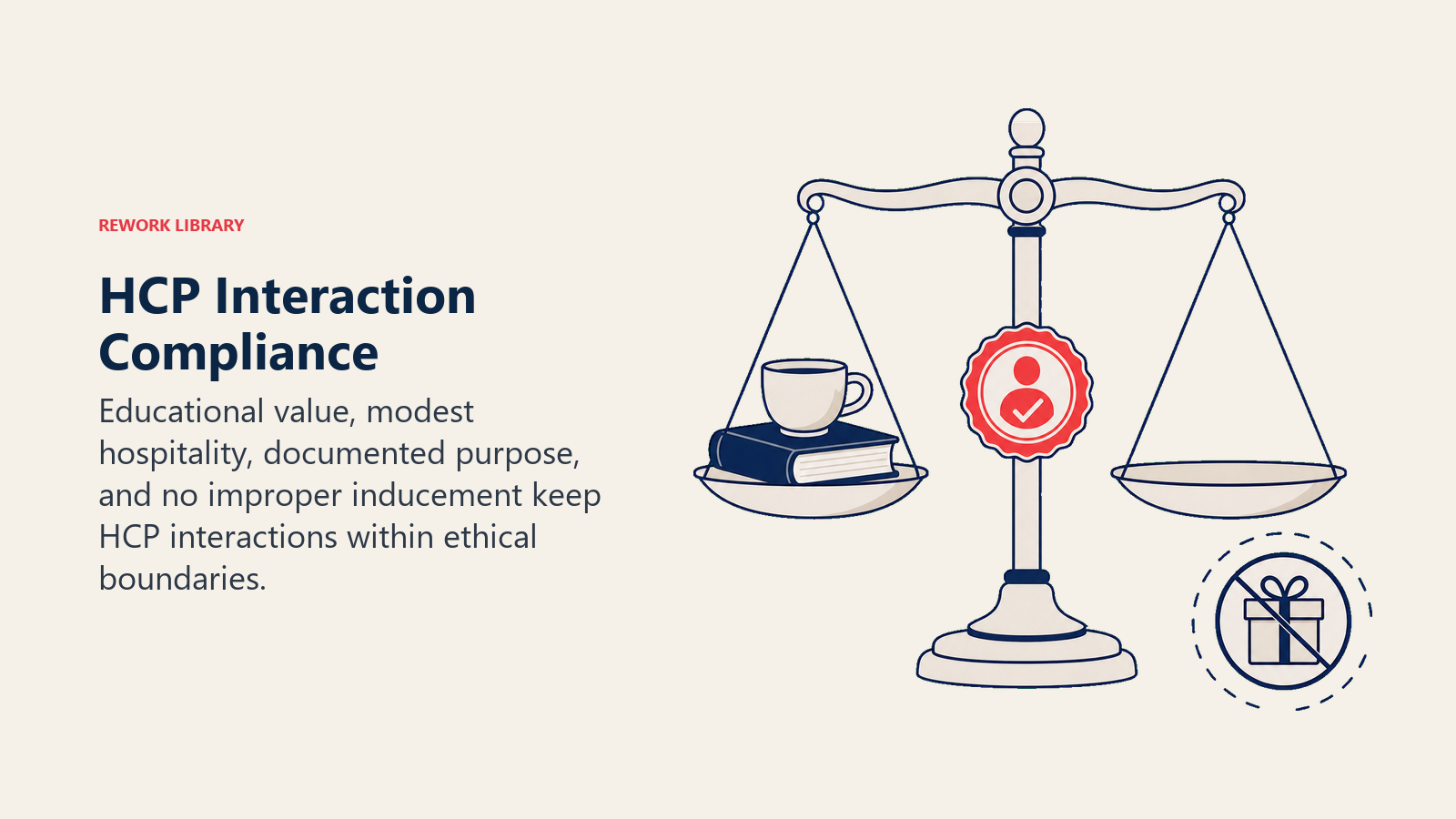
The logic is this: anything of value transferred to an HCP that could influence their prescribing behavior is suspect. The question regulators ask is whether the transfer has legitimate educational purpose and fair market value, or whether it's essentially a payment for prescribing.
Permissible vs. Impermissible Transfers of Value
| Transfer Type | Permissible | Impermissible |
|---|---|---|
| Meals with educational content | Yes, within local limits | Lavish meals, entertainment, no educational component |
| Branded promotional items | Low-value, patient-benefit items (pens, notepads) in markets that allow them | High-value gifts, cash equivalents, personal items |
| Samples for patient use | Yes, with documentation and sign-off | Samples given as gifts or for personal use |
| Speaker fees | Yes, at fair market value with legitimate program | Above-FMV fees, speaking programs with no actual content |
| Advisory board participation | Yes, when genuine scientific input is needed | Advisory roles that function as payment for prescribing |
| CME sponsorship | Yes, through accredited independent organizations | Direct sponsorship with strings attached to prescribing |
Most markets set hospitality limits for meals with HCPs. In the US, PhRMA-aligned company policies typically run in the $100 to $150 per person range for working meals; the ABPI Code in the UK caps hospitality at modest amounts for legitimate educational meetings. Limits vary by market. Your company policy will specify the applicable figure. Know it cold.
Speaker Programs and Advisory Boards
Speaker programs are legitimate commercial tools when run properly. Problems arise when speaker bureaus become de facto reward programs for top prescribers, with speaker fees disconnected from any actual educational value delivered.
Guardrails that protect you: fair market value rates documented against the HCP's specialty and qualifications, genuine program need (a real audience, a real educational gap), attendance tracking, and separation between the sales rep's call activity and the speaker program invitation process. The OIG has issued special fraud alerts on speaker programs warning that arrangements lacking genuine educational purpose risk Anti-Kickback Statute liability.
Advisory boards follow the same logic. When a company genuinely needs clinical input, bringing in external HCPs at fair compensation is appropriate. When the advisory board is six dinners a year with the same fifteen high-volume prescribers, it looks like what it is. Sampling programs operate under a different framework, and the documentation requirements are more specific.
Sampling Compliance
Samples are one of the most effective tools in pharma field promotion (see Sample-to-Script Conversion for conversion mechanics), and also one of the most heavily regulated.
The basic framework in most markets:
Who can receive samples. Only licensed prescribers, or in retail pharmacy contexts, licensed pharmacists under applicable regulations. Reps cannot leave samples at a reception desk without confirming they went to a qualified recipient.
Documentation requirements. Sample signatures, lot numbers, quantities, and recipient identifiers must be logged at the point of transfer. Many field-force platforms capture this electronically. If yours doesn't, paper logs must be complete and retained.
Controlled substances. In the US, Schedule II controlled substances cannot be distributed as promotional samples at all. The DEA's closed-system distribution rules prohibit sales representatives from carrying or distributing Schedule II drugs (such as opioid analgesics or stimulants) as samples, regardless of documentation. Schedule III-V products face stricter sampling requirements than non-controlled drugs, including rep-level licensing where required, tighter reconciliation, and more frequent audits. If your US portfolio includes any controlled substances, confirm the applicable schedule before building any sampling program.
Sample reconciliation. Reps carry sample inventory and must reconcile it on a defined schedule, typically monthly. Unexplained discrepancies, whether shortage or excess, trigger a corrective action process.
The rep self-audit checklist later in this article includes a sample compliance section. Make sure your field managers are spot-checking rep sample bags during co-travels.
What Are the Promotion Boundaries Reps Must Know?
On-Label vs. Off-Label Promotion
This is the one that creates the most anxiety, and for good reason: off-label promotion is the most serious violation in pharmaceutical marketing, with the largest enforcement history and penalties.
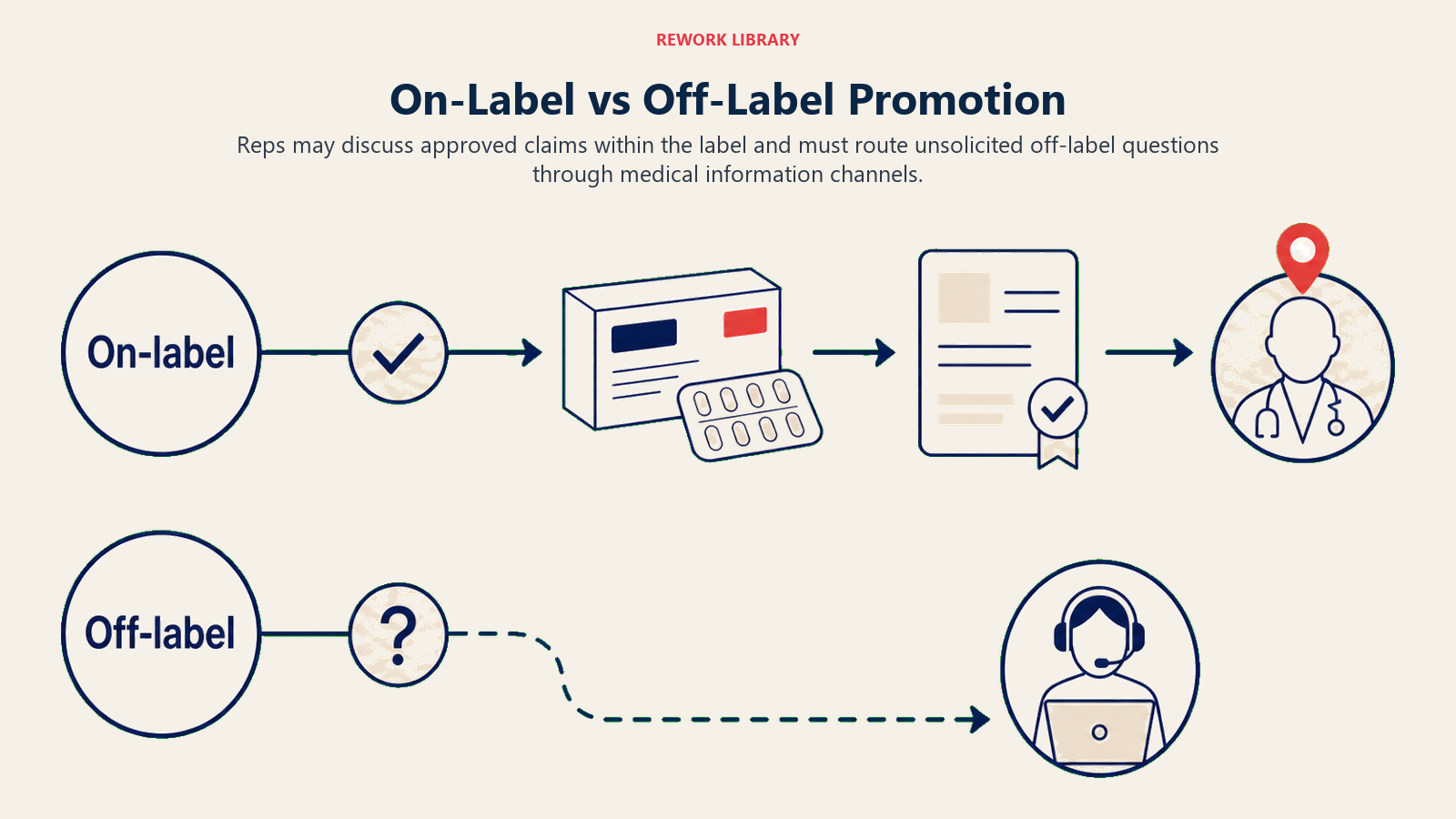
On-label means promoting the drug for the indications, patient populations, dosages, and administration routes approved in its product label. Off-label means anything outside that.
Reps cannot proactively promote a drug for off-label uses. Period. That includes mentioning it as a "clinical benefit that's well-known," implying it with disease state education that happens to describe an unapproved indication, or sharing peer-reviewed publications that support off-label use in an unsolicited way.
What reps can do: respond to genuine, unsolicited HCP questions about off-label use by referring the HCP to medical affairs or providing approved medical information on request. The word "unsolicited" matters. If a rep has been steering a conversation toward a specific off-label question, the response to that question isn't unsolicited.
Approved vs. Unapproved Promotional Materials
Reps should only use materials that have passed through your company's promotional review process (often called PARC, PRC, or MLR, depending on the organization). This includes detail aids, leave-behinds, visual aids, reprints, and digital materials on tablets or apps.
Using a published journal article as a detail aid without going through review is a violation, even if the article is favorable and the science is solid. Review processes exist to ensure the context and framing of that material is compliant, not just the original content. For detailed guidance on using approved materials, see Detail Aid and Visual Aid Usage.
Social Media and Digital Rules for Reps
Personal social media is a growing compliance risk. A rep who posts about a positive patient outcome with a drug, mentions prescribing trends they're seeing in their territory, or shares unapproved content about a product from their personal accounts is creating liability for the company and for themselves.
Most company policies require reps to disclose their employment affiliation if posting about products, avoid sharing clinical claims, and not engage in product promotion on personal channels unless using pre-approved content through a managed platform.
Digital promotion via approved rep channels, whether a CRM-integrated email tool or an approved HCP portal, is governed by the same rules as printed materials. Approved content only, accurate attribution, no off-label messaging.
Building a Compliant Field Culture
The Trust-Transparency-Consistency (TTC) Framework is the practical model for building compliance culture in a field force: Trust is built when reps know the rules clearly and believe management enforces them fairly. Transparency is maintained when violations are reported immediately and investigated openly. Consistency is what compounds the commercial advantage, because HCPs who see the same professional conduct over years give deeper access and longer conversations than those who encounter reps who push the edge.
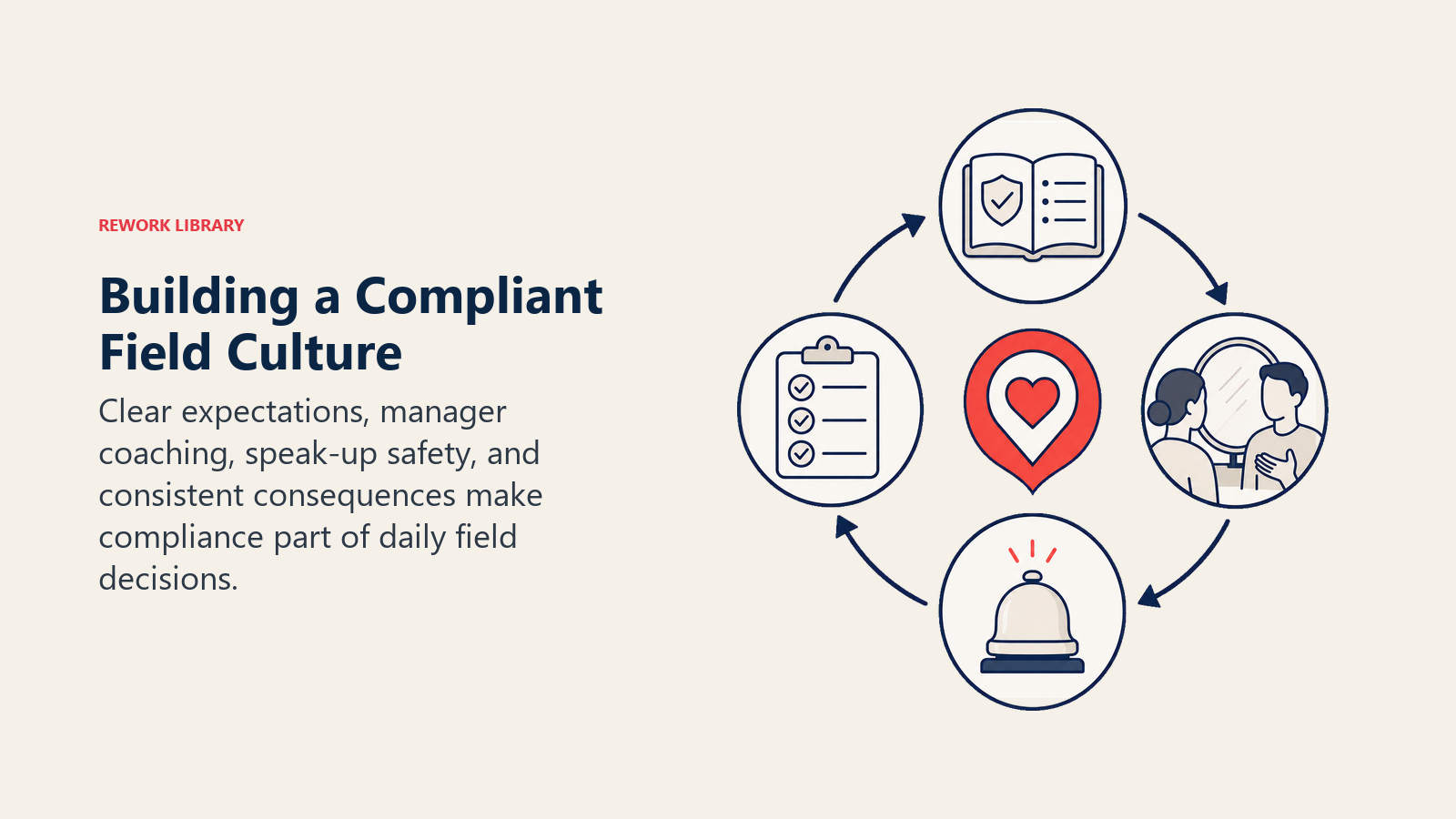
Here's the uncomfortable truth about field compliance: most violations don't happen because a rep decided to break the rules. They happen because a rep felt pressure to perform and didn't have a clear enough mental map of where the line was.
That's a leadership failure, not a rep failure.
Training Cadence
Annual compliance training is the legal floor, not the standard. High-performing field forces run compliance refreshers quarterly, covering recent enforcement actions, scenario-based questions, and any policy updates. This keeps compliance top-of-mind and signals that leadership takes it seriously.
New rep onboarding should include at least one full day on compliance before a rep makes their first call. Not a checkbox e-learning module: a live session with scenarios, discussion, and Q&A.
Manager Accountability
Field managers set the culture. If a district manager is overheard telling a rep to "just emphasize the off-label benefit, the HCP already knows about it," that DM is creating liability for the whole organization.
Manager accountability works through observation and coaching during co-travels, compliance-specific questions in performance reviews, and making it explicit that a rep's compliance record is a factor in territory and career advancement decisions, not just an administrative footnote.
Rep Self-Certification
Quarterly self-certification programs ask reps to confirm their compliance with specific program requirements. Done well, self-certification isn't just a form to sign. It's a structured reminder that walks the rep through the key rules and asks them to affirm adherence.
Use the checklist below as a starting framework.
Rep Quarterly Compliance Self-Audit Checklist
- All sample transfers documented with required signatures and lot numbers
- Sample inventory reconciled and discrepancies reported
- Only approved promotional materials used in details
- No proactive off-label promotion conducted
- Unsolicited off-label questions referred to medical affairs
- Meals with HCPs within company hospitality policy limits
- No gifts provided outside approved patient-benefit items
- Speaker program invitations not used as prescribing incentives
- Personal social media does not contain unapproved product references
- Any compliance concerns reported to manager or compliance line
Handling Pressure from Brand Teams
Brand teams want results. Compliance teams want clean records. Sometimes these goals create friction, and that friction lands on the field force.
The right frame for field leaders: brand requests that push against compliance boundaries are not a field force problem to solve by stretching the rules. They're a signal to escalate through proper channels. Document the request, flag it to compliance, and let the organization resolve the tension at the right level. Reps can borrow from the same discipline used in objection handling: acknowledge the pressure, separate the legitimate business goal from the problematic method, and redirect to an approved path rather than shutting the conversation down.
Reps who feel squeezed between brand ambitions and compliance rules need explicit permission from their managers to push back. Give them that permission clearly and often. The cost of a single significant violation, whether a DoJ investigation, an FDA warning letter, or a civil settlement, dwarfs any revenue benefit from cutting corners.
When Things Go Wrong
Violations happen. The question is what happens next.
Immediate reporting. Most company policies require reps and managers to report potential violations to compliance as soon as they become aware of them. This includes incidents they caused, witnessed, or were informed about. Delayed reporting compounds the problem.
Investigation process. Compliance teams will typically conduct a review that includes interviewing the rep and manager, pulling CRM and sample records, reviewing any materials used, and assessing whether the incident was isolated or systematic.
Corrective action. Depending on severity, corrective action ranges from mandatory retraining and a written record in the rep's file to territory reassignment, termination, or, in the most serious cases, cooperation with regulatory investigators.
Protecting the rep and the company. The best protection is documentation and transparency. Reps who come forward proactively, who can show they followed approved processes, and who cooperate fully with investigations are in a materially better position than those who wait to be caught.
An HCP who trusts that your rep won't push an off-label claim gives that rep longer, more substantive conversations than one who has been burned by a compliance issue from a competitor. That access differential compounds over a multi-year commercial relationship and shows up in prescribing frequency, NtB referrals, and willingness to speak at peer education programs. Compliance isn't a constraint on relationship-building, it's the mechanism that makes deep relationships possible.
Compliance as Competitive Advantage
The framing that compliance constrains commercial performance misunderstands how HCPs actually make prescribing decisions.
A doctor who trusts your rep's scientific credibility, who knows the rep won't push an off-label claim or embarrass the practice, gives that rep longer, more substantive conversations. A pharmacy manager who has never had a sampling problem with your team processes your rep's visits more efficiently. These relationship dynamics compound over months and years.
The cleanest field forces build the deepest commercial relationships. That's not a coincidence.
The link between a compliant culture and long-term commercial results runs through trust, and trust runs through consistency. When reps know the rules, believe the company enforces them fairly, and see that managers model compliant behavior, they operate with confidence. That confidence shows in HCP interactions, and it shows in the numbers. Explore how this connects to the broader Pharmaceutical Sales Growth Model and what the best Doctor Detailing Best Practices look like in practice.
The same dynamic applies in any customer-facing role: relationships built on consistent, professional conduct compound over time, while relationships built on short-term incentives erode the moment those incentives shift. So the practical question for any field leader is: does your current compliance program build that kind of trust, or just satisfy the audit checklist?
The companies that win HCP and pharmacy trust over the long run aren't the ones who found the most creative interpretations of the rules. They're the ones who built field forces that HCPs actually want to see walk through the door. Those relationships are an asset. Compliance is how you protect it. Learn how Medical Education Events can extend that trust-building into legitimate demand creation.
Frequently Asked Questions about Pharmaceutical Marketing Compliance and Ethics
What is off-label promotion and why is it such a serious violation?
Off-label promotion means promoting a drug for uses, patient populations, dosages, or administration routes not approved in the product label. It's the most serious category of pharmaceutical marketing violation because it bypasses the clinical evidence and regulatory review that determine whether a use is safe and effective. Enforcement history includes FDA warning letters, Department of Justice investigations, and civil settlements that have cost companies hundreds of millions of dollars. The rule is categorical: reps cannot proactively promote off-label, even if the use is widely practiced or the science appears supportive.
What counts as an impermissible transfer of value to an HCP?
Anything of value transferred to an HCP that could influence prescribing behavior and lacks legitimate educational purpose at fair market value. This includes high-value gifts, lavish meals without substantive educational content, speaker fees above fair market value for the HCP's specialty, and advisory board participation that functions as payment for prescribing rather than genuine scientific input. The test regulators apply is whether the transfer could induce a referral or prescription.
How should a rep handle an unsolicited off-label question from a doctor?
The rep can respond by referring the HCP to medical affairs or providing approved medical information on request. The key word is unsolicited: the question must genuinely originate with the HCP, not result from a conversation the rep has steered toward an off-label indication. If there's any ambiguity about whether the question was truly unsolicited, the safest course is to refer to medical affairs rather than respond directly.
What are the documentation requirements for pharmaceutical sampling?
Sample transfers must be logged with the recipient's name and licensing credentials, sample lot numbers, quantities transferred, and the date and location of transfer. Most field-force platforms capture this electronically at the point of transfer. In the US, Schedule II controlled substances cannot be distributed as promotional samples; Schedule III-V products that are sampled face stricter documentation requirements, including rep-level DEA number verification and more frequent inventory reconciliation. Unexplained discrepancies in sample inventory, whether shortage or excess, must be reported through a corrective action process.
What is the minimum compliant standard for rep compliance training?
Annual compliance training is the regulatory floor in most markets. High-performing field forces run quarterly refreshers that cover recent enforcement actions, policy updates, and scenario-based questions. New reps should receive at least one dedicated live compliance session with discussion and Q&A before making their first HCP call, not just a checkbox e-learning module. Manager accountability for compliance culture, including observation during co-travels and compliance questions in performance reviews, is as important as the formal training cadence.
When a brand team asks a rep to emphasize a benefit that's close to the compliance line, what should the rep do?
Escalate through proper channels rather than stretching the rules to meet the business request. The right process is to document the request, flag it to the compliance function, and let the organization resolve the tension at the appropriate level. Reps need explicit manager permission to push back on such requests, and that permission should be communicated clearly and often. The cost of a significant violation, whether a DoJ investigation or an FDA warning letter, far outweighs any short-term revenue benefit from the compromise.
Learn More

Senior Implementation Consultant
On this page
- The Regulatory Landscape
- HCP Interaction Rules
- Permissible vs. Impermissible Transfers of Value
- Speaker Programs and Advisory Boards
- Sampling Compliance
- What Are the Promotion Boundaries Reps Must Know?
- On-Label vs. Off-Label Promotion
- Approved vs. Unapproved Promotional Materials
- Social Media and Digital Rules for Reps
- Building a Compliant Field Culture
- Training Cadence
- Manager Accountability
- Rep Self-Certification
- Handling Pressure from Brand Teams
- When Things Go Wrong
- Compliance as Competitive Advantage
- Learn More