Scrum Master vs Product Owner: Roles Compared
Turn this article into takeaways for your work.


Each assistant summarizes the article only for you and suggests best practices for your work.
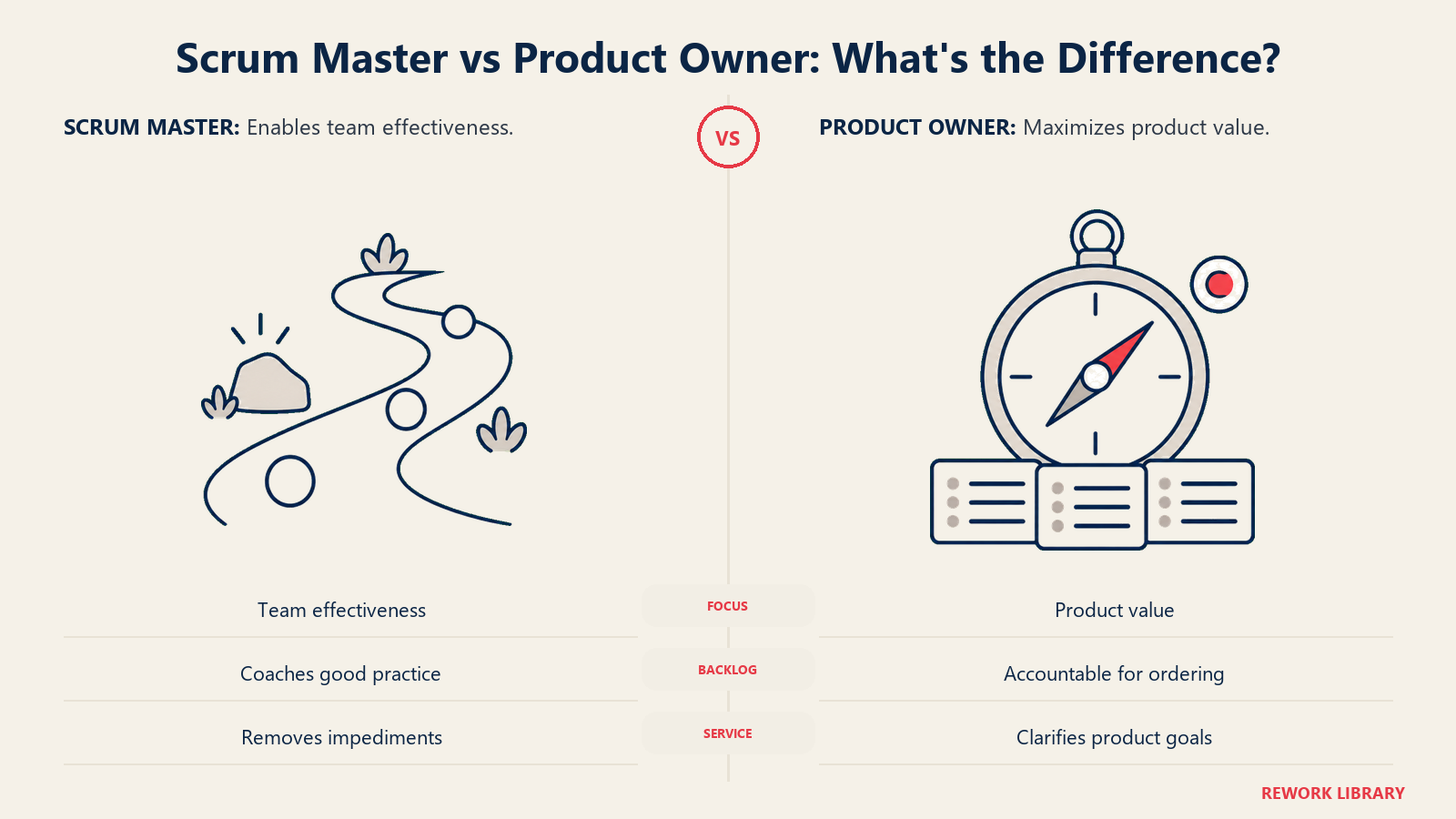
A Product Owner is accountable for maximizing the value of the product and managing what goes into the backlog: the "what" and the "why." A Scrum Master is accountable for the Scrum Team's effectiveness and for how the team works: the "how," not the "what." Mix those two up, and almost every other point of confusion about the two jobs follows from it.
That confusion is common enough that it's worth being precise from the start, because the two jobs get blurred constantly in practice, whether that's a Scrum Master quietly reordering the backlog because the Product Owner is slow, or a Product Owner running the Daily Scrum like a status meeting because nobody told them not to.
Key Facts
- The 2020 Scrum Guide states Scrum "defines three specific accountabilities within the Scrum Team: the Developers, the Product Owner, and the Scrum Master," language that replaced "roles" in earlier editions.
- Per the Guide, the Product Owner "is accountable for maximizing the value of the product resulting from the work of the Scrum Team," while the Scrum Master "is accountable for the Scrum Team's effectiveness."
- A Scrum Team is "typically 10 or fewer people," per the 2020 Scrum Guide, small enough that both accountabilities sit inside one team rather than in a layer of management above it.
- Large-Scale Scrum (LeSS) keeps exactly one Product Owner across every team building a single product, on the reasoning that splitting the backlog across multiple Product Owners fragments priorities.
Two accountabilities, not two roles
Most comparisons of these two positions start in the wrong place: a symmetrical list of "the Scrum Master does X, the Product Owner does Y," as if the two sit on equal, parallel tracks. They don't, and the 2020 Scrum Guide actually changed its wording to make that clear. Earlier editions called Product Owner, Scrum Master, and Developers "roles." The current edition doesn't use that word for any of them. It says Scrum "defines three specific accountabilities within the Scrum Team," a deliberate change that a lot of competing explainers still get wrong by defaulting back to "roles" out of habit.
The word choice matters. "Role" implies a job description: a set of tasks assigned to a person. "Accountability" implies something narrower and heavier: one person answers for an outcome, whether or not they personally did the work behind it. Read that way, the difference between these two jobs stops being a task list and becomes a question of what each person is on the hook for when something goes wrong.
If you're new to how Scrum fits together as a framework, that's worth reading before this comparison, since everything below assumes the Sprint, the three artifacts, and the small, self-managing Scrum Team it defines. Both accountabilities only exist inside that structure. Take Scrum away, and neither title means anything specific anymore.
Scrum Master vs Product Owner at a glance
| Scrum Master | Product Owner | |
|---|---|---|
| Accountable for | The Scrum Team's effectiveness, how the team works | Maximizing product value, what gets built and in what order |
| Primary artifact | Owns none directly; supports all three (Product Backlog, Sprint Backlog, Increment) | Product Backlog |
| Who they serve | Developers, the Product Owner, and the wider organization | Stakeholders, customers, and the Developers who build what they order |
| Main events | Facilitates every Scrum event; owns none of the content | Attends every event; drives Sprint Planning and Sprint Review content |
| Success measured by | Fewer impediments, healthier events, better team self-management | Value delivered: backlog health, stakeholder trust, product outcomes |
| Typical failure mode | Becomes a meeting scheduler or status reporter with no coaching impact | Becomes a ticket-writing proxy with no real authority to say no |
| Where the accountability lives | Inside the team and its process | Inside the product and the backlog |
What the Product Owner is actually accountable for
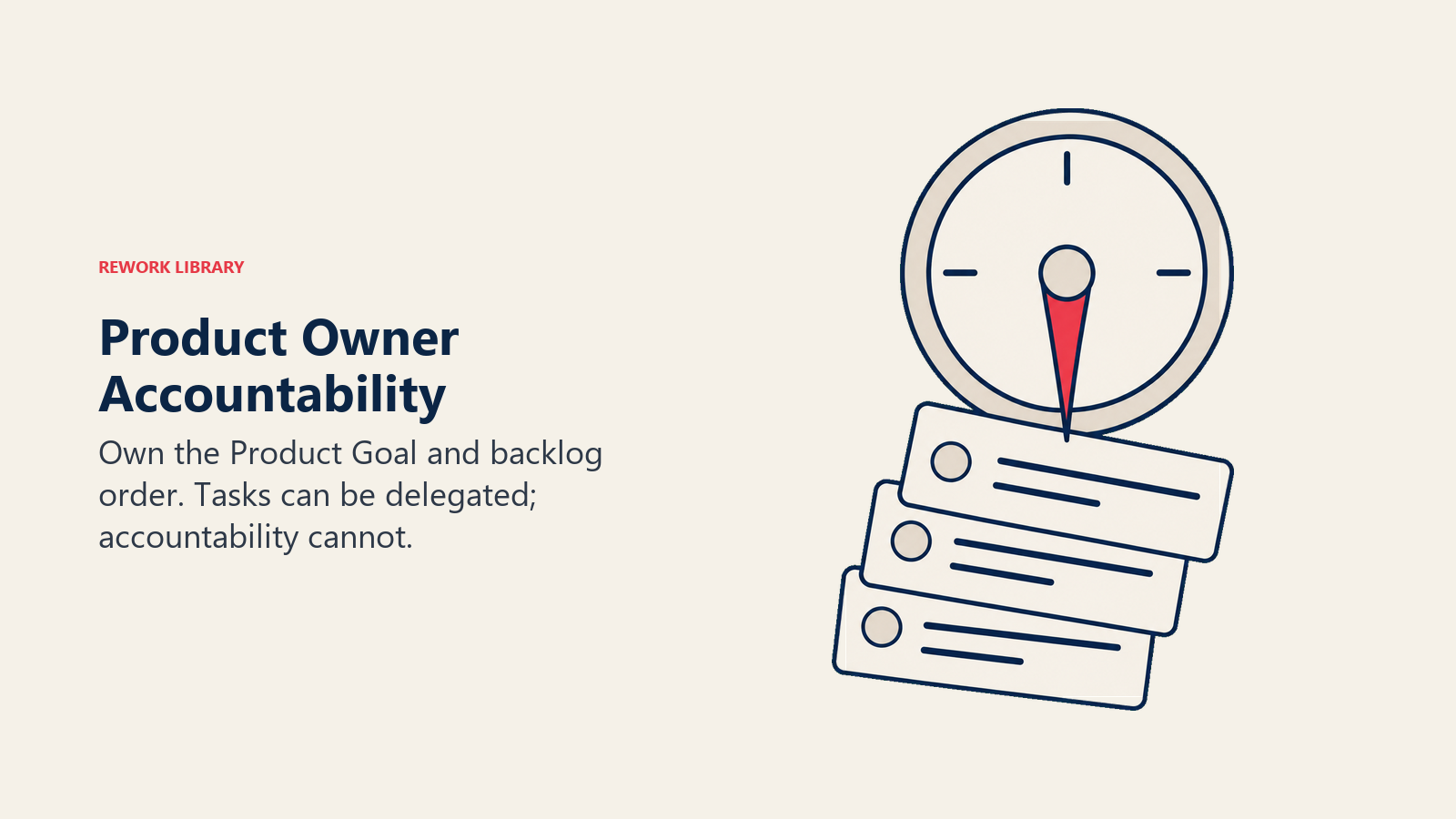
Per the Guide, "the Product Owner is also accountable for effective Product Backlog management," which breaks down into four specific duties: developing and communicating the Product Goal, creating and communicating backlog items, ordering the backlog, and keeping it transparent and understood. Translated into an actual week, that list looks less like paperwork and more like a string of judgment calls.
| Scrum Guide language | What it looks like week to week |
|---|---|
| "Developing and explicitly communicating the Product Goal" | Writing (and re-explaining) the one paragraph that says what this product is trying to achieve next, so every backlog refinement conversation has a filter |
| "Creating and clearly communicating Product Backlog items" | Turning a stakeholder request into a well-formed user story with a clear outcome, not just a feature name |
| "Ordering Product Backlog items" | Saying no, in public, to the loudest stakeholder in the room, because something else is worth more right now |
| "Ensuring that the Product Backlog is transparent, visible and understood" | Keeping the backlog readable enough that a Developer can pick up the next item without a meeting to decode it |
Two lines in the Guide do more work than they first appear to. The first: "the Product Owner may do the above work or may delegate the responsibility to others. Regardless, the Product Owner remains accountable." A Product Owner can have someone else write the actual user stories or run the intake process. They can't hand off the accountability itself, which means the buck stops with them even when the pen doesn't.
The second: "for Product Owners to succeed, the entire organization must respect their decisions." That's not a courtesy; it's a structural requirement. A Product Owner whose backlog order gets overridden by whoever complains to a VP isn't really accountable for anything, no matter what their title says. If that's happening on your team, the title is decorative.
What the Scrum Master is actually accountable for
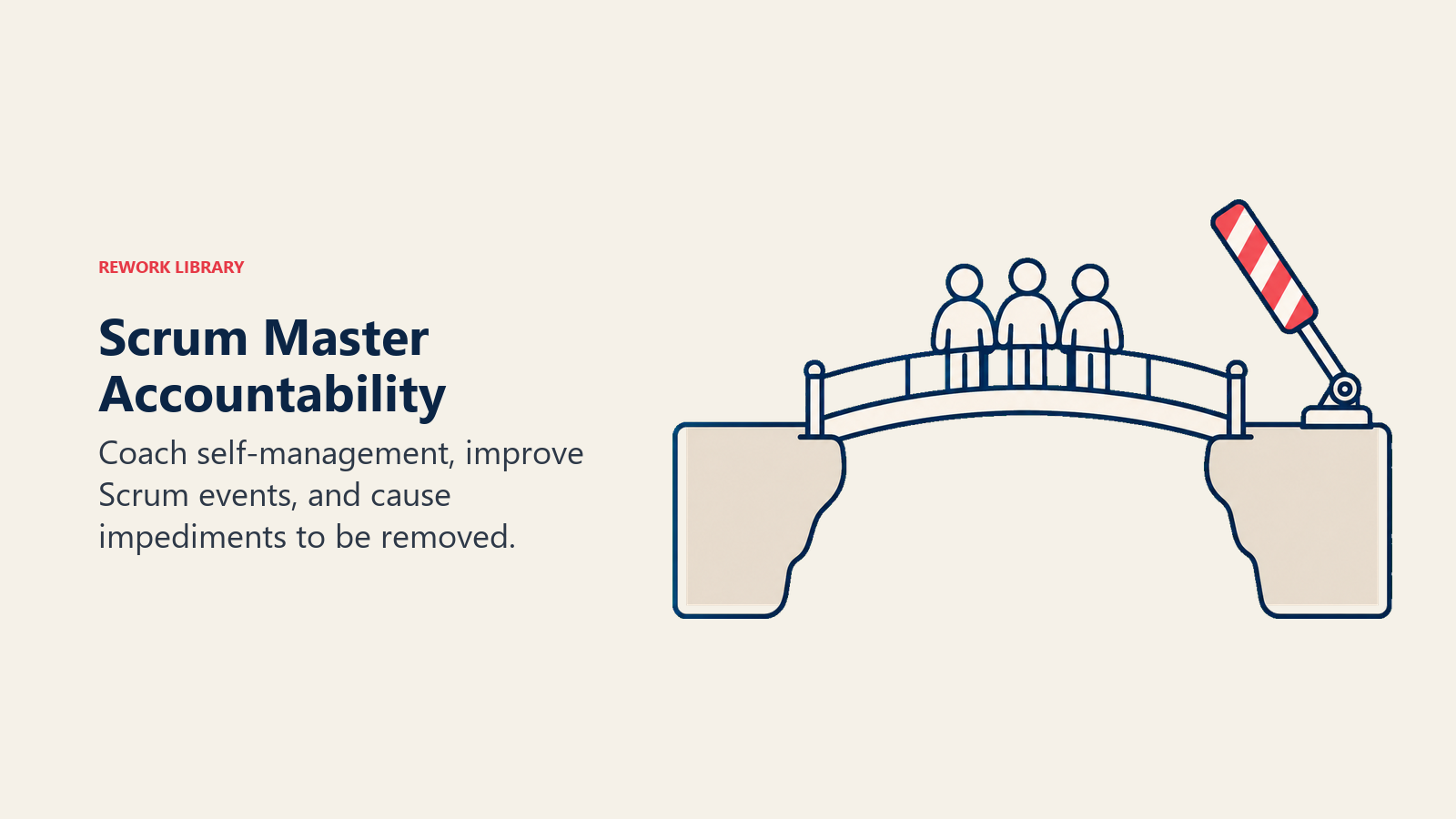
The Scrum Master's accountability splits into service to three different audiences: the Scrum Team, the Product Owner, and the organization. That three-way split is easy to miss if you only think of a Scrum Master as "the person who runs the standup."
| Serves | Scrum Guide language | Day to day |
|---|---|---|
| The Scrum Team | "Coaching the team members in self-management and cross-functionality"; "causing the removal of impediments" | Sitting with a blocked developer to unstick a dependency, instead of just logging the blocker in a status report |
| The Scrum Team | "Ensuring that all Scrum events take place and are positive, productive, and kept within the timebox" | Keeping the Daily Scrum at 15 minutes and steering it back to a planning conversation, not a status readout |
| The Product Owner | "Helping find techniques for effective Product Goal definition and Product Backlog management" | Suggesting a lighter refinement format once items start piling up unrefined |
| The Organization | "Leading, training, and coaching the organization in its Scrum adoption"; "removing barriers between stakeholders and Scrum Teams" | Pushing back when an executive tries to drop new work into a sprint mid-cycle, so the team doesn't have to fight that battle alone |
Notice what isn't on that list: writing status reports up to management, owning a delivery date, or deciding what the team builds. Those tasks get absorbed into the role constantly in practice, which is exactly how a Scrum Master turns into a project coordinator with a different job title. Per the Guide, the accountability is the team's effectiveness, full stop, not a reporting function attached to it.
Where the two collide, and how healthy teams resolve it
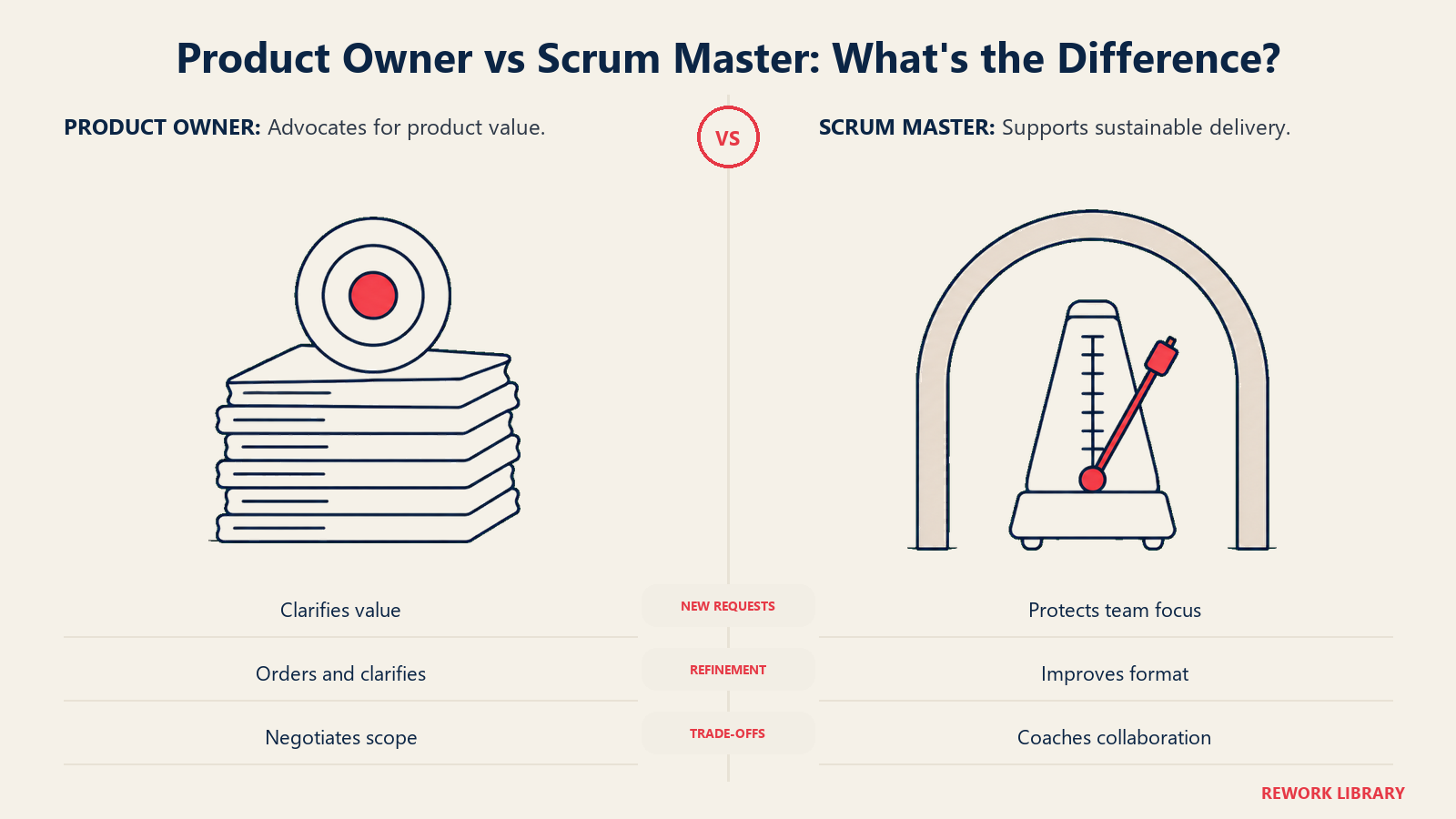
This is the part most comparisons skip, and it's the part that actually matters day to day. The two accountabilities aren't adversarial by design, but they pull in different directions often enough that friction is normal, not a sign something's broken.
| Flashpoint | Product Owner's instinct | Scrum Master's instinct | How healthy teams resolve it |
|---|---|---|---|
| A stakeholder asks to slot new work in mid-sprint | Wants to say yes fast to keep a relationship warm | Wants to protect the Sprint Goal and the team's focus | The trade gets discussed with the whole team, not decided unilaterally; new scope waits for the next Sprint Planning unless everyone agrees to swap something out |
| Backlog refinement keeps running long | Wants to get through more items so the backlog stays ahead of the team | Wants to protect the timebox and the team's energy | The Scrum Master proposes a lighter format (smaller batches, async pre-reads) instead of just cutting the meeting short and leaving the backlog thin |
| A stakeholder tries to go straight to Developers, skipping the backlog | Worried about losing control of priority | Worried about the team getting pulled in two directions at once | The Scrum Master redirects the stakeholder to the Product Owner, consistently and publicly, until it stops happening |
| Sprint Review reveals the team over-committed | Wants to manage the stakeholder conversation about what slipped | Wants the retrospective to surface why the estimate was wrong | Both half-solve it: the Product Owner owns the stakeholder message, the Scrum Master owns the process fix, and neither one skips their half |
| The Definition of Done gets quietly loosened to hit a date | Wants to ship visible progress before the deadline | Is accountable for the team meeting its own Definition of Done | The Scrum Master has the stronger claim here. A quality bar the whole team agreed to isn't a target the Product Owner gets to waive unilaterally |
The pattern underneath all five rows: the Product Owner's job is to advocate for value and move fast, and the Scrum Master's job is to protect the team's capacity to actually deliver that value sustainably. Neither instinct is wrong on its own. The friction is the system working, not failing, as long as one person doesn't just override the other's accountability to make the tension go away.
Scrum event by event: who does what
Both accountabilities show up in every event, but in different postures. One brings content, the other protects the container it happens in.
| Event | Product Owner | Scrum Master |
|---|---|---|
| Sprint Planning | Brings the top of the ordered backlog and a Sprint Goal proposal; answers Developer questions about intent | Facilitates the timebox and makes sure the Sprint Goal is actually agreed to, not just assumed |
| Daily Scrum | Attendance is optional per the Guide; usually skips it unless invited to answer something specific | Not required to attend either, but coaches Developers to keep it a planning huddle rather than a status report upward |
| Backlog refinement | Leads the session: orders items, clarifies acceptance criteria, makes the value case for what's next | Facilitates format and timeboxing; steps in if refinement turns into re-litigating settled decisions |
| Sprint Review | Presents what shipped, gathers stakeholder feedback, updates the backlog based on what's learned | Keeps the event a working session, not a one-way demo or a performance review of the team |
| Sprint Retrospective | Attends as a team member; their own decisions are fair game for feedback like anyone else's | Facilitates the format and the follow-through; accountable for the team actually improving, not just talking about it |
Can one person do both?
Sometimes, and it usually doesn't hold up for long. The two accountabilities pull against each other structurally: the Product Owner's job rewards saying yes to value and moving quickly, while the Scrum Master's job rewards protecting the team's pace and pushing back when speed threatens quality. Put both incentives in one person's head, and one side almost always wins by default, usually whichever side has the louder, more immediate pressure attached to it (a stakeholder deadline usually beats an unglamorous coaching conversation).
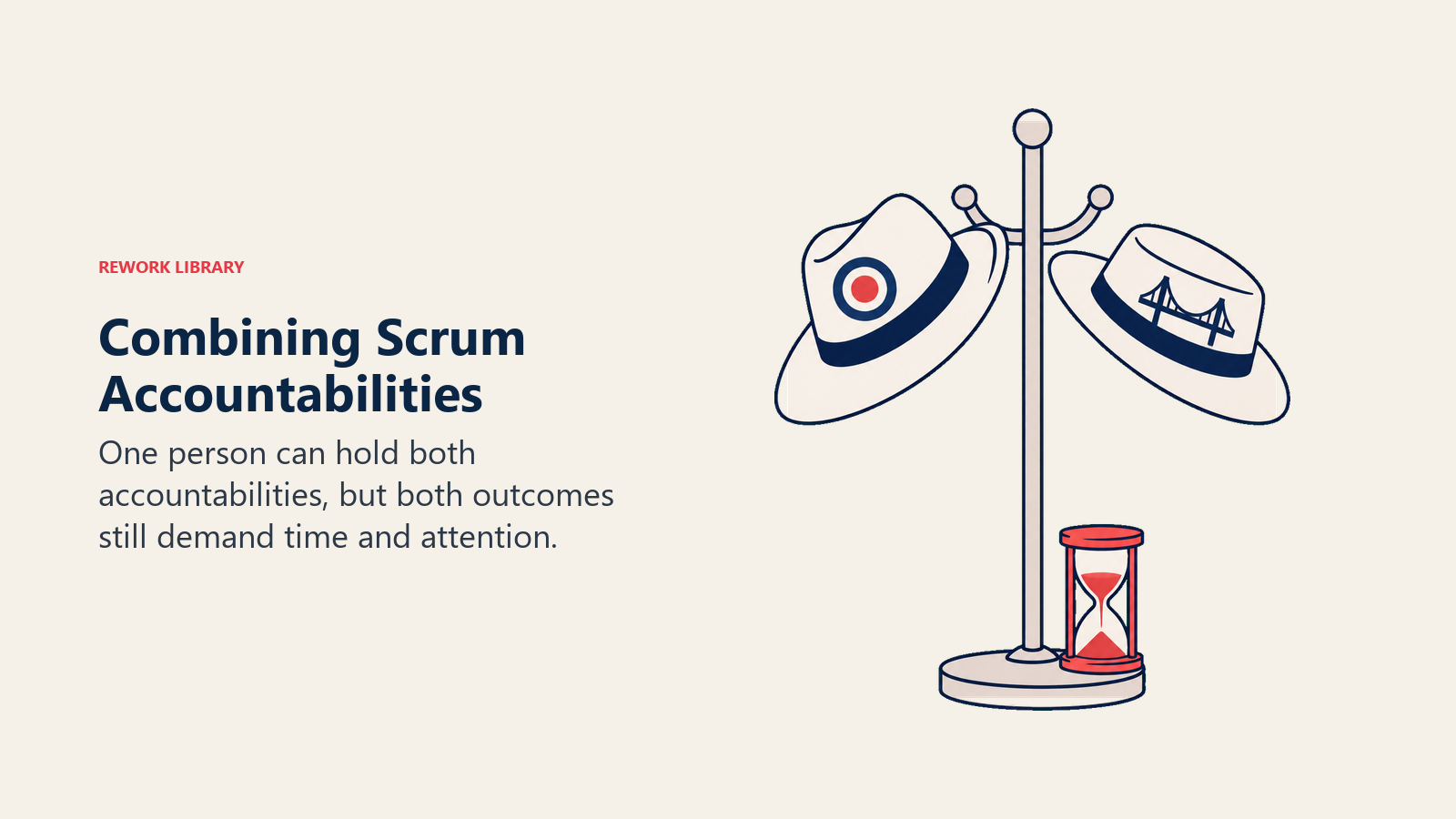
The Guide's delegation clause makes this worse, not better, for a combined role. Delegating tasks doesn't reduce total accountability, it just concentrates two separate kinds of accountability into one calendar. A combined Product Owner and Scrum Master isn't doing half of two jobs; they're fully accountable for both, with the hours of one person.
It's worth separating this from a different kind of role compression. Large-Scale Scrum (LeSS) deliberately keeps a single Product Owner across many teams building one product, but for the opposite reason: to stop priorities from fragmenting across competing backlogs, not to save headcount. That's one Product Owner covering more teams, not one person covering two different accountabilities. If your organization is scaling past a single team, LeSS and similar scaling approaches are worth reading before anyone improvises a combined role out of necessity.
| Where combining is tried | Why it's tempting | Why it usually breaks |
|---|---|---|
| Very small startups, one team, one product | Budget covers one salary, not two | The person ends up under-serving stakeholders or under-coaching the team, because both jobs compete for the same hours |
| Internal tools teams with few external stakeholders | Low outside pressure on the Product Owner side makes the Scrum Master side dominate by default | Backlog discipline drifts, since "no urgent stakeholder" quietly becomes "no backlog discipline" |
| Teams brand new to Scrum | Neither accountability feels fully staffed yet, so combining looks efficient on paper | The team never sees what a properly facilitated Scrum Master actually does, since the combined person defaults to backlog work under deadline pressure |
| A developer holding both alongside their coding work | Maximum headcount efficiency | Impediment removal and stakeholder management both lose to shipping code, since neither is the person's primary identity |
Where it does hold up: very small, low-conflict teams, treated explicitly as a temporary arrangement, revisited the moment the team or the stakeholder list grows. The failure mode isn't trying it. It's never planning to un-combine it.
Scrum Master and Product Owner vs Project Manager and Product Manager
Neither Scrum Master nor Product Owner is a project manager under a different name, even though both quietly absorb pieces of that job in practice. And Product Owner already has a full comparison against Product Manager elsewhere: read Product Owner vs Product Manager for the accountability-versus-job-title asymmetry that drives most of that confusion (short version: Product Owner is defined by one document, Product Manager isn't defined by any).
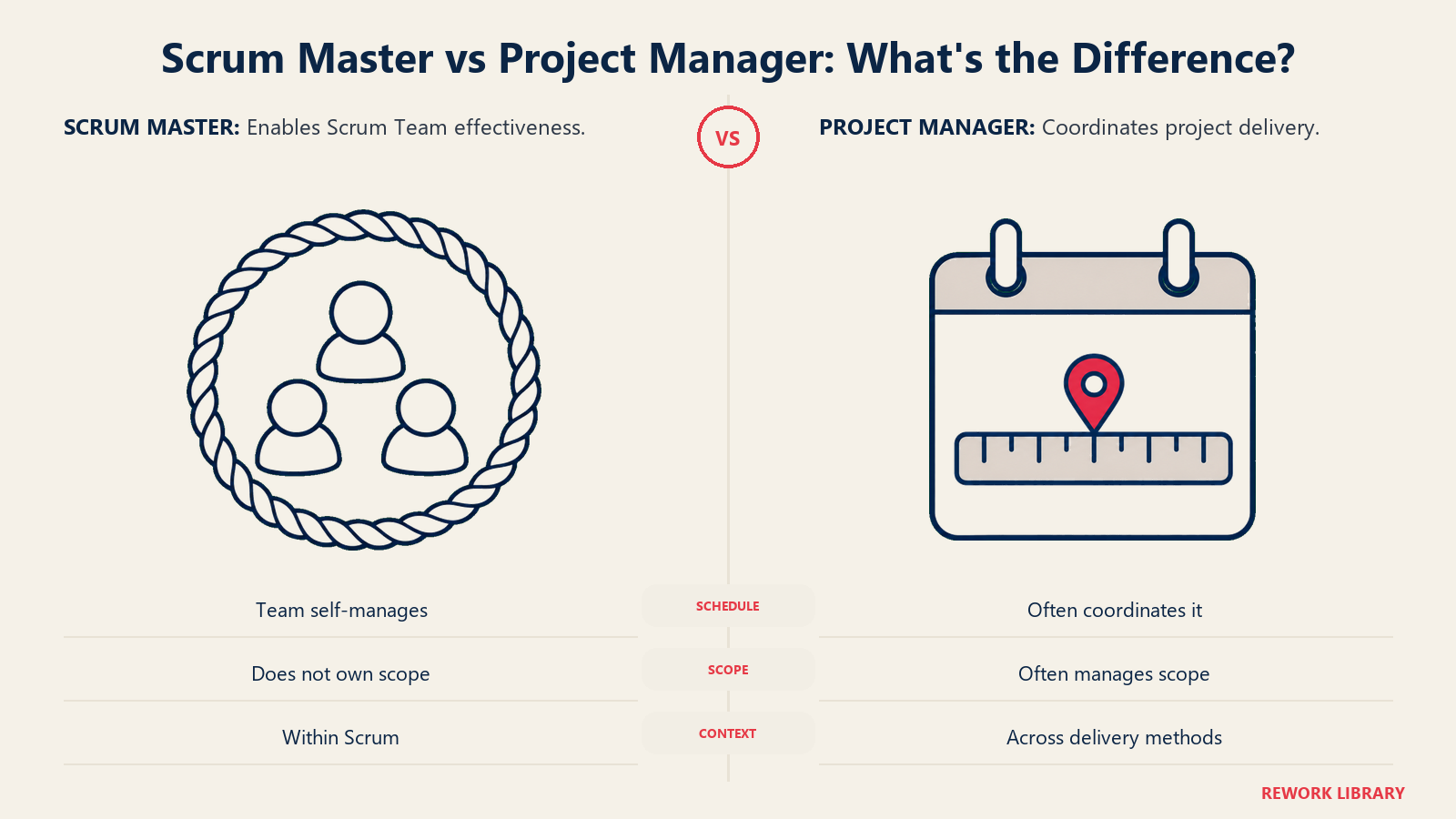
The Scrum Master comparison against project manager is a cleaner split, because the two jobs barely overlap in what they own.
| Scrum Master | Project Manager | |
|---|---|---|
| Defined by | The Scrum Guide, one external standard | No single owning standard; PMI's PMBOK is the closest reference, but the title exists with or without it |
| Owns a schedule? | No. The team self-manages its own work inside the Sprint | Often, especially in program-level or waterfall-adjacent settings |
| Authority over scope | None. Scope belongs to the Product Owner | Frequently, alongside budget and timeline |
| Reports status upward? | Not the job. The Sprint Review and the artifacts do that transparently, without a separate report | Frequently, through status reports and steering committees |
| Exists outside Scrum? | No | Yes, across nearly every delivery methodology |
For the fuller picture of where project and program management diverge from either Scrum accountability, see our program vs project management comparison.
Which should you hire first, or which should you become
| Your situation | What to prioritize |
|---|---|
| The backlog has clear direction, but sprints keep missing their goals, events run long, and impediments pile up unaddressed | A Scrum Master. The team has direction; it needs the process fixed |
| The sprint cadence runs smoothly, but nobody can explain why the team is building what it's building | A Product Owner. The process works; the "why" is missing |
| You're standing up your very first Scrum Team from zero | A Product Owner first, even informally, so there's something worth sprinting on. A Scrum Master with no backlog to protect has nothing to facilitate yet |
| You're a developer drawn to coaching, facilitation, and organizational friction more than backlog strategy | Lean toward Scrum Master as a career path |
| You're a developer drawn to customer conversations, prioritization tradeoffs, and owning outcomes more than process | Lean toward Product Owner as a career path |
| You're choosing between the two with an eye on long-term career direction | Product Owner tends to sit closer to product strategy work later on, though plenty of Scrum Masters move into agile coaching or delivery leadership instead |
Common anti-patterns
| Anti-pattern | What it looks like | Fix |
|---|---|---|
| Scrum Master as secretary | Sends calendar invites, takes notes, reports status upward, never coaches or removes an impediment | Redirect toward facilitation and impediment removal; status reporting isn't in the Guide's accountability at all |
| Scrum Master as report writer | Spends most of the week building velocity charts and burndown reports for management instead of working with the team | Hand reporting to a self-serve dashboard off the board; the Scrum Master's time belongs to the team |
| Product Owner as ticket-writing proxy | Relays a manager's or committee's decisions into backlog items with no real say in what gets prioritized | Push the organization to give the Product Owner actual authority; a Product Owner who can't say no isn't accountable for anything |
| Product Owner who's never available | The backlog goes stale because refinement and clarifying questions sit unanswered for days | Set explicit office hours or a standing refinement slot the Product Owner protects like any other ceremony |
| Scrum Master who quietly owns the backlog | Steps in to reorder or write backlog items because the Product Owner is slow, blurring both accountabilities at once | Coach the Product Owner instead of doing their job; if the gap is structural, escalate it, don't absorb it |
| Product Owner who runs the Daily Scrum | Turns a team self-management event into a status meeting reporting to the Product Owner | Product Owner attendance is optional per the Guide; if they attend, they listen, they don't run it |
None of this settles into a permanent org chart decision made once and forgotten. Teams change size, products change stage, and the friction points in the collision table above show up again every time something shifts, whether that's a new stakeholder, a growing backlog, or a team that's outgrown a combined role it started with out of necessity. The fastest way back to clarity when that happens isn't a new debate about titles. It's going back to the one sentence each accountability was actually built on: who is on the hook for the product's value, and who is on the hook for the team's ability to deliver it.
Frequently Asked Questions about Scrum Master vs Product Owner
Is a Scrum Master the same as a Product Owner?
No. The 2020 Scrum Guide defines them as two separate accountabilities within the same Scrum Team. The Product Owner is accountable for maximizing product value and managing the backlog. The Scrum Master is accountable for the Scrum Team's effectiveness and how the team works. They're peers within the team, not a hierarchy, and neither one manages the other.
Can a Scrum Master become a Product Owner, or the other way around?
Yes, and both moves happen regularly. Scrum Masters who want to own product outcomes rather than facilitate a team's process often move into Product Owner roles once they've built enough domain and customer knowledge. Product Owners who want to move away from stakeholder pressure and closer to team coaching sometimes move the other direction, deliberately.
Who has more authority, the Scrum Master or the Product Owner?
They have authority over different things, not more or less of the same thing. The Product Owner has sole authority over backlog content and order, per the Scrum Guide. The Scrum Master has no authority over what the team builds, but is accountable for how the team works and can push back on process, timeboxes, and impediments. Neither one outranks the other.
Does a small team really need both, separately?
Not always, at least not as two separate people. Very small teams sometimes combine the accountabilities in one person, and it can work for a while. The two jobs pull in different directions, though (advocating for value versus protecting team capacity), so the arrangement tends to strain as the team, the backlog, or the stakeholder list grows.
What's the real difference between a Scrum Master and a project manager?
A Scrum Master has no authority over scope, budget, or schedule; the Scrum Team self-manages its own work inside each Sprint. A project manager typically does own schedule, scope, and status reporting, and the title exists across nearly every delivery approach, not just Scrum. The Scrum Master role only exists inside a Scrum Team.
Do these roles exist outside of Scrum, in Kanban or other frameworks?
The titles "Scrum Master" and "Product Owner" are specific to Scrum and don't formally exist outside it. Teams running Kanban or a different framework still need someone accountable for prioritization and someone paying attention to team flow and process, they just don't carry these exact titles or the exact accountabilities the Scrum Guide assigns to them.
Whichever side of this you're sorting out, whether you're hiring, untangling a blurred team, or picking a career lane, the sentence to keep coming back to is the one the Guide actually wrote: one person is accountable for the product's value, the other for the team's effectiveness. Everything else is detail.

Senior Operations & Growth Strategist
On this page
- Two accountabilities, not two roles
- Scrum Master vs Product Owner at a glance
- What the Product Owner is actually accountable for
- What the Scrum Master is actually accountable for
- Where the two collide, and how healthy teams resolve it
- Scrum event by event: who does what
- Can one person do both?
- Scrum Master and Product Owner vs Project Manager and Product Manager
- Which should you hire first, or which should you become
- Common anti-patterns