Project Baseline: Scope, Schedule, and Cost Explained
Turn this article into takeaways for your work.


Each assistant summarizes the article only for you and suggests best practices for your work.
A project baseline is the formally approved version of your project plan that you use to measure performance throughout delivery. Without one, you have no reliable way to tell whether the project is on track, drifting, or quietly heading for a blowup.
Most teams know they should set a baseline. Fewer understand that there are three distinct baselines, each covering a different dimension of the project, and that they interlock to form something called the performance measurement baseline.
What Is a Project Baseline?
A project baseline is the approved, time-phased plan against which actual project performance is measured. It captures what the project is supposed to deliver (scope), when it is supposed to deliver it (schedule), and what it is supposed to cost (cost). Once the project sponsor and relevant stakeholders formally approve this plan, it becomes the fixed reference point for the life of the project.
The word "approved" matters here. A draft schedule sitting in a spreadsheet is not a baseline. A baseline exists only after the project goes through a formal authorization process, typically documented via a project charter or a signed scope document, and the plan is locked at that point in time.
Changes after that point require a formal change request. If you skip that discipline and keep adjusting the plan informally, the baseline becomes meaningless because it no longer represents any agreed version of reality.
Key Facts
- PMI's Pulse of the Profession 2021 report found that organizations with high project management maturity complete 77% of their projects on time and 76% within budget, compared to 56% and 52% for lower-maturity organizations.
- The PMBOK Guide (7th edition) defines the performance measurement baseline (PMB) as the integrated scope, schedule, and cost plan used for comparison in earned value management.
- A 2020 KPMG global project management survey found that 69% of organizations reported at least one project failure in the previous three years, with scope creep and poor baseline management cited among the top root causes.
The Three Project Baselines
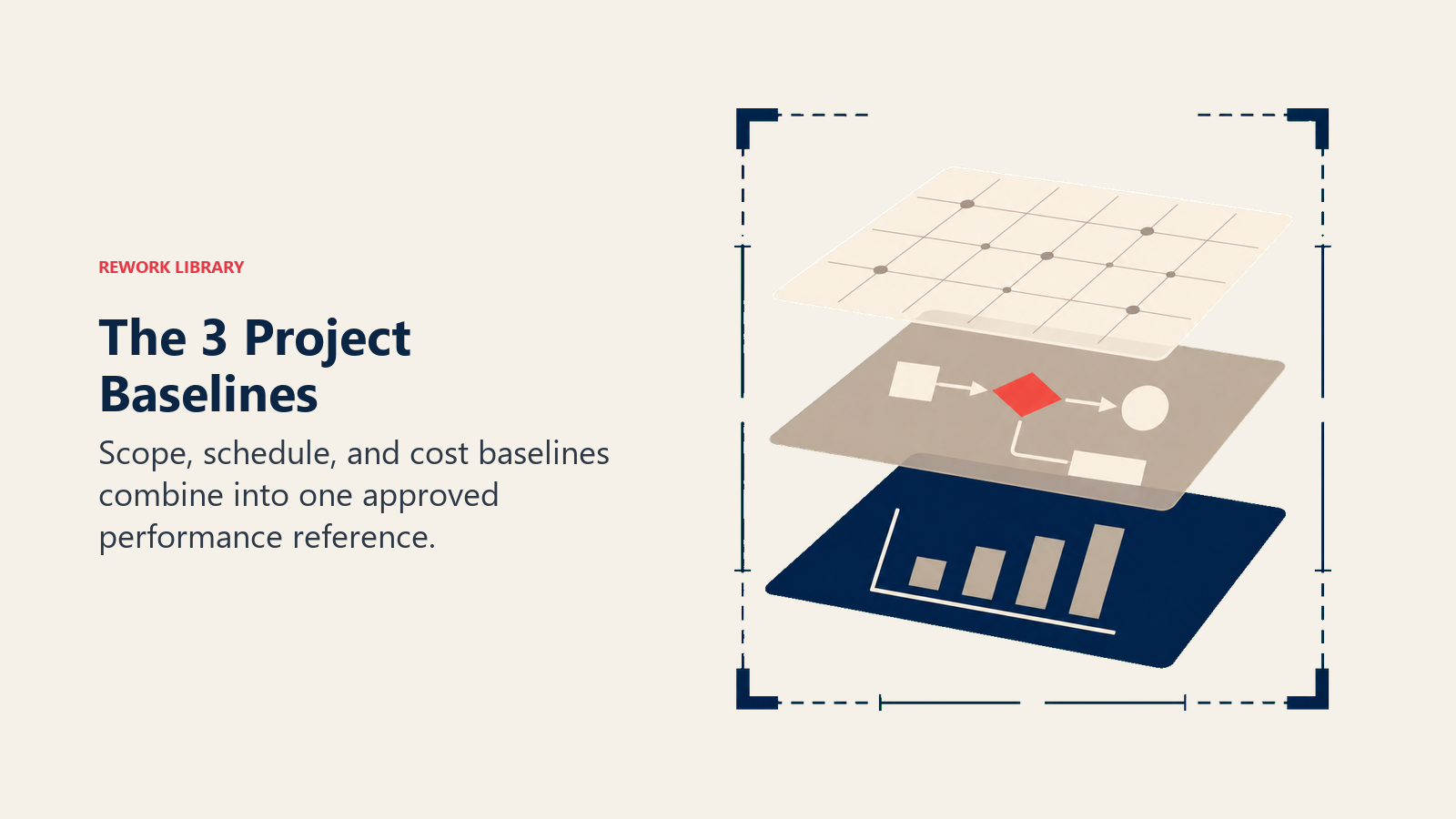
A full project baseline is actually three separate baselines working together. Each one covers a specific knowledge area, and each is produced from a different planning artifact.
| Baseline | What it covers | Source document |
|---|---|---|
| Scope baseline | The approved project scope statement, the work breakdown structure (WBS), and the WBS dictionary | Scope management plan + project scope statement |
| Schedule baseline | The approved version of the project schedule, showing planned start and finish dates for each activity | Schedule management plan + Gantt or network diagram |
| Cost baseline | The time-phased budget, showing how planned spending is distributed across the project timeline | Cost management plan + project cost estimation |
Each baseline is approved separately, though in practice they are often reviewed together at the end of the planning phase. Together they form the performance measurement baseline (PMB), which is the input to earned value calculations.
Project Baseline vs. Performance Measurement Baseline
These two terms are close but not identical, and confusing them causes problems when you get into earned value reporting.
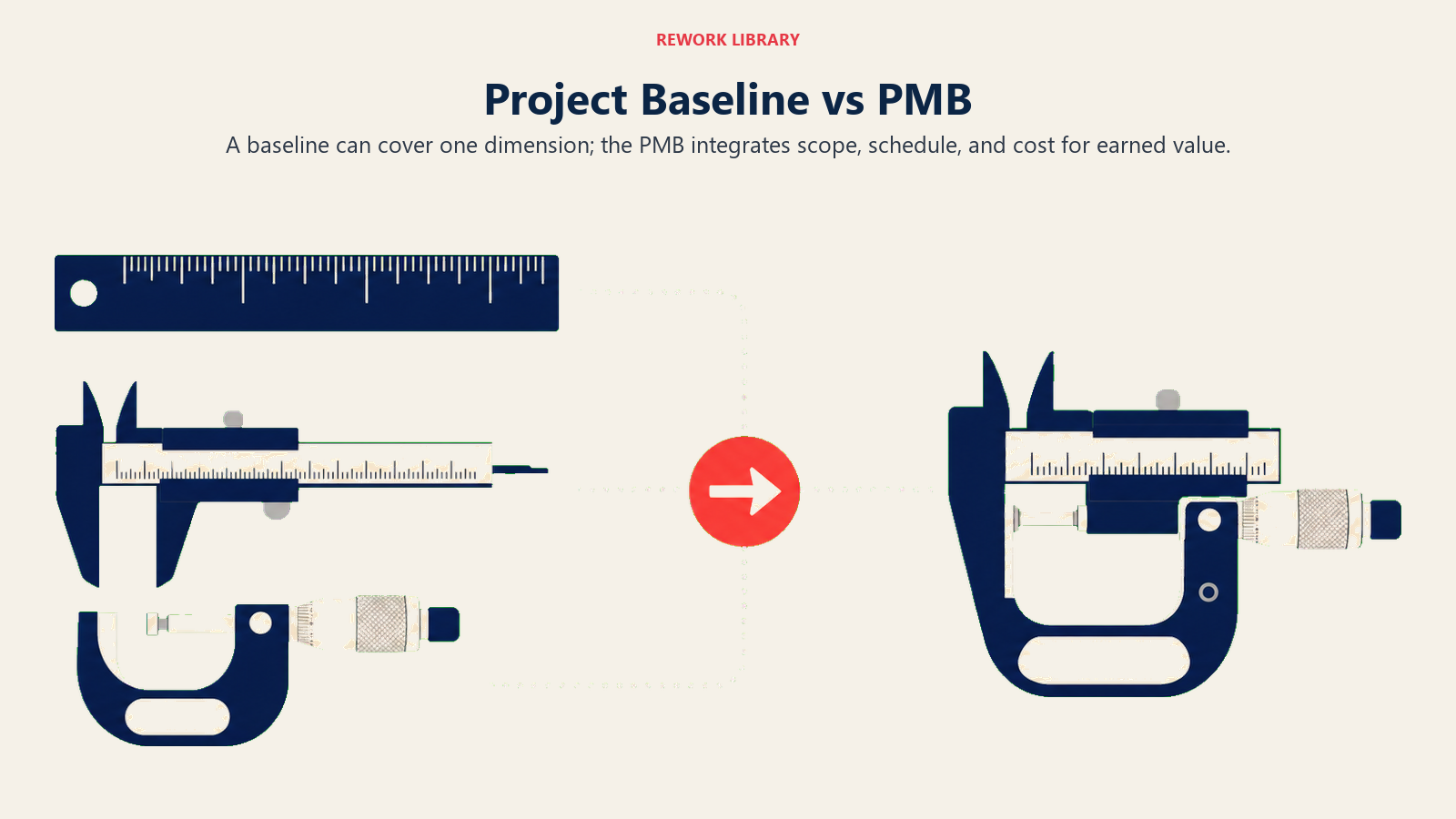
A project baseline is a general term for any approved reference plan. You might hear someone say "the cost baseline" or "the schedule baseline" when referring to a single dimension.
The performance measurement baseline (PMB) is the specific combination of all three baselines, scope plus schedule plus cost, structured as a time-phased budget. It is the thing you actually compare against when computing earned value metrics like schedule variance (SV) or cost performance index (CPI).
Think of it this way: each of the three baselines answers one question in isolation. The PMB answers them together, which is what you need for integrated performance measurement via earned value management.
Why a Project Baseline Matters
A baseline is not paperwork. It is the mechanism that makes accountability possible.
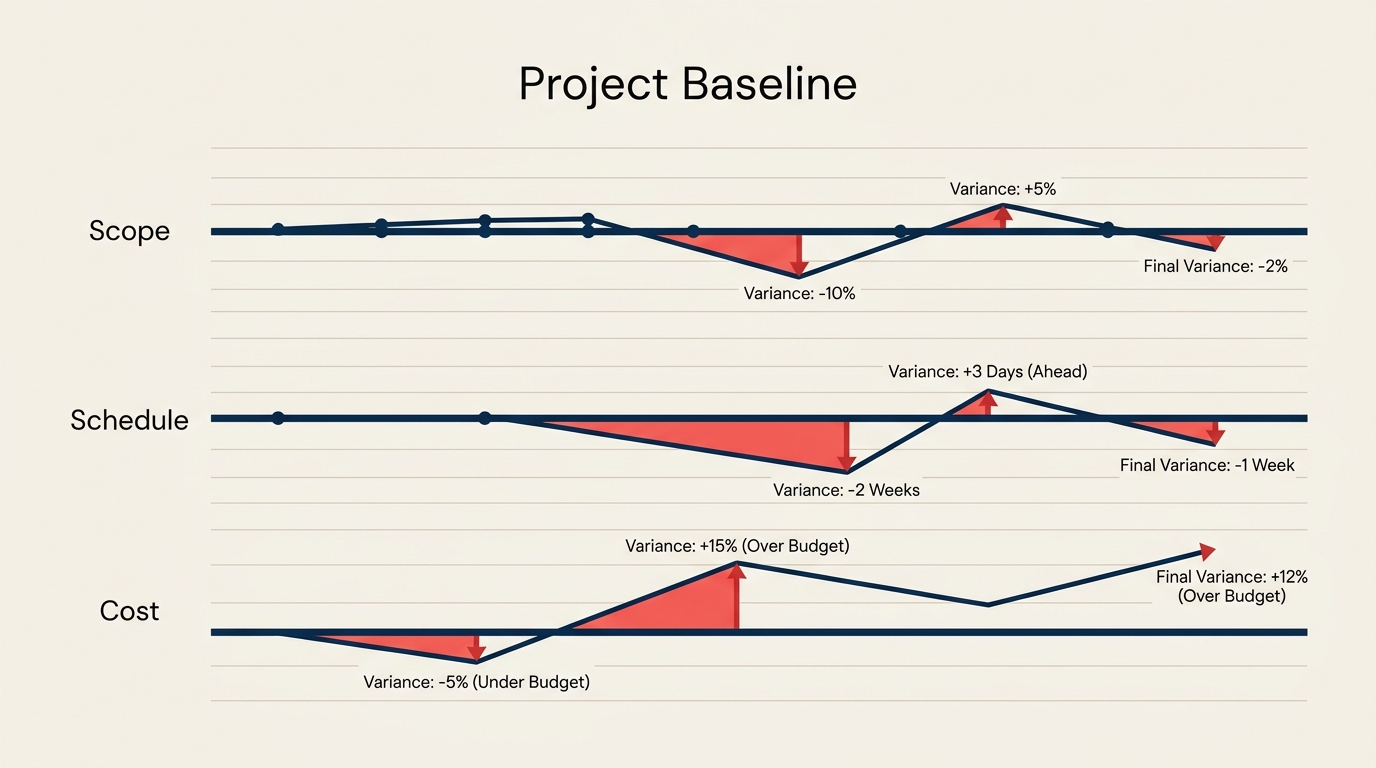
Without a locked baseline, every conversation about "are we on track?" becomes an argument about what "on track" means. The project manager says they are ahead. The sponsor thinks the original plan was different. The finance team is working from an updated budget that the project manager never saw. No one is lying. They just have no shared reference point.
With a baseline, you can answer three specific questions with numbers:
- Are we delivering the right scope? Compare deliverables completed against the scope baseline to catch creep early.
- Are we on schedule? Compare actual finish dates against the schedule baseline. A single metric like schedule variance (SV) tells you the magnitude, not just the direction.
- Are we within budget? Compare actual costs against the cost baseline period by period. A cost variance (CV) figure is more useful than a vague sense that spending is "a bit high."
These comparisons also feed into the triple constraint analysis that most project sponsors expect at status reviews. When scope, schedule, or cost baseline deviates significantly, you have an early warning before a minor drift becomes a delivery crisis.
How to Set a Project Baseline
Setting the baseline is a sequential process. Each step depends on the one before it.
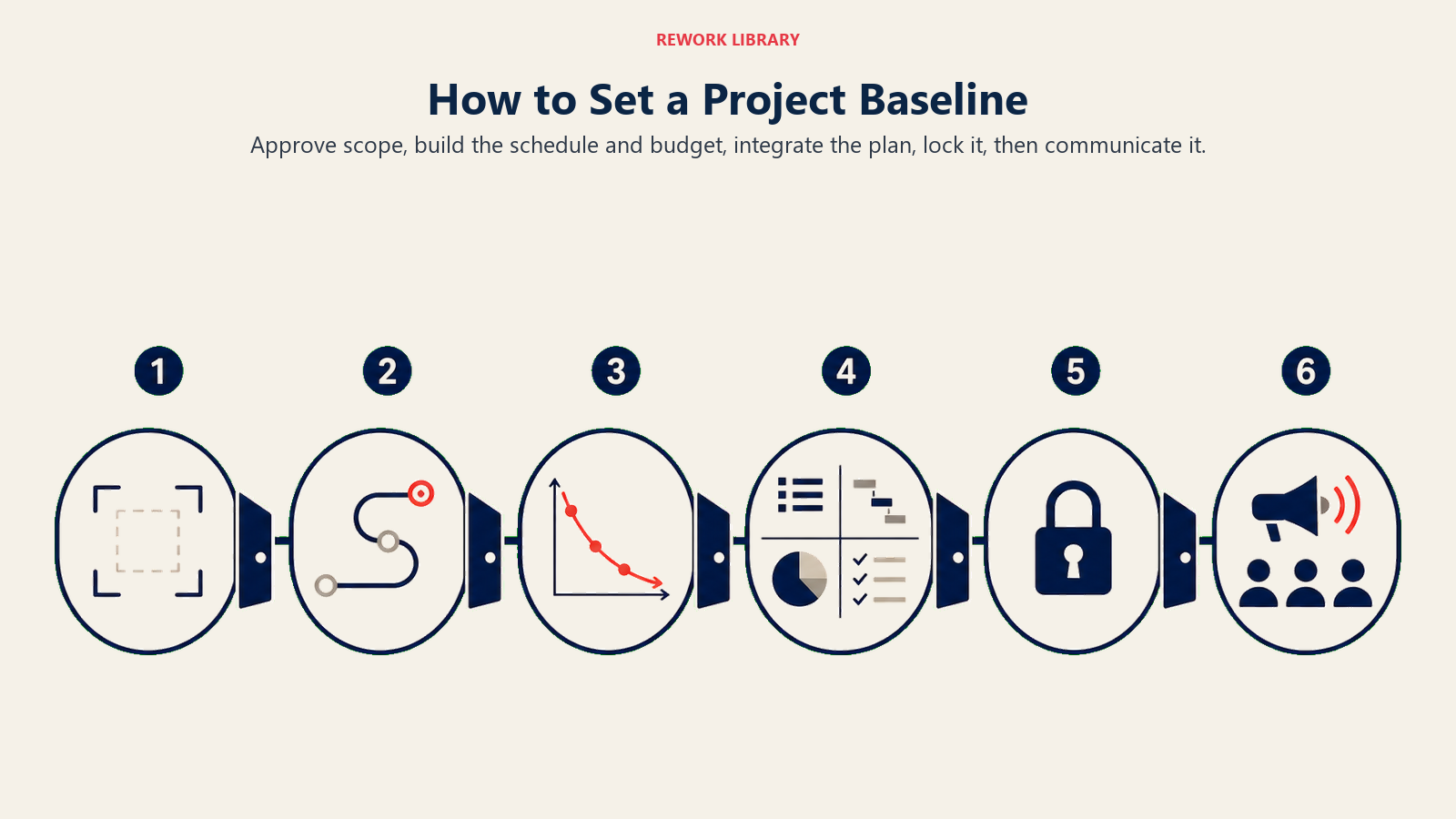
Step 1: Define and approve scope
Document everything the project will deliver and everything it will not deliver. The output is the project scope statement plus the work breakdown structure. The WBS decomposes the scope into work packages small enough to estimate and assign. Get formal sign-off from the project sponsor before moving on.
Step 2: Develop the schedule
Sequence the work packages from the WBS into a project schedule. Identify dependencies, estimate durations, assign resources, and calculate the critical path. The result is the schedule baseline: a document that shows planned start and finish dates for every activity and milestone. This is often the most debated part of baseline-setting, because stakeholders frequently want timelines that the work cannot support.
Step 3: Estimate and approve the budget
Build the cost baseline by attaching dollar estimates to each work package and spreading them across the project timeline. The result is a time-phased budget that shows how much money is planned to be spent in each reporting period. This is not a lump-sum "budget approved" figure. It is a curve, sometimes called the S-curve, that reflects the natural ramp-up and ramp-down of project spending.
Step 4: Document and formally approve the integrated plan
Bring all three baselines together into the project management plan. Present them to the project sponsor and relevant stakeholders. Get written approval, whether that is a signature on a project charter, a formal stage gate sign-off, or a documented decision in your project management tool. The date of that approval is the baseline date.
Step 5: Lock the baseline in your project management tool
Record the baseline in your scheduling and cost tracking software. Most tools have a "save baseline" function that freezes the planned values so they remain visible alongside actuals as the project progresses. If you do not lock it in the tool, the baseline will get overwritten the moment someone updates the schedule.
Step 6: Communicate the baseline to the team
Every person on the project team should understand what the baseline is and why it matters. They need to know that deviations should be reported, not hidden, and that informal changes to scope or schedule need to go through the change control process before they appear in the plan.
How to Manage Baseline Changes
A baseline is not permanent. Projects change. Clients change their minds. Suppliers miss deliveries. New risks materialize. The question is not whether the baseline will need to change but how those changes are handled.
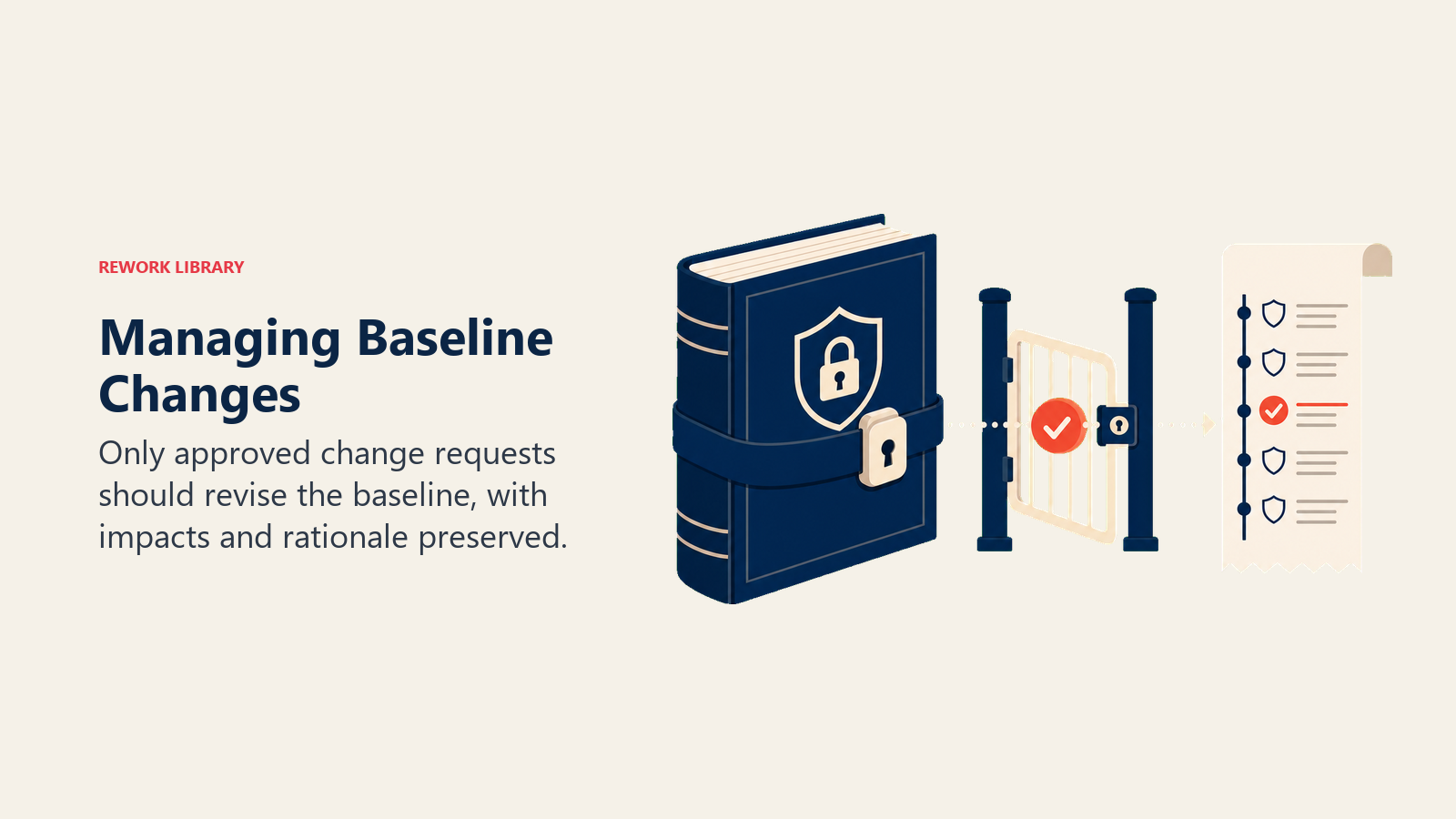
Changes must go through formal change control. Every proposed change to scope, schedule, or cost should be submitted as a formal change request, evaluated for impact on all three baselines, approved or rejected by the appropriate authority, and then documented. The change control process and integrated change control procedures exist specifically for this purpose.
When a change is approved, you update the baseline. This is called a baseline revision (or re-baselining in extreme cases). The key discipline is that you record the change and its rationale, so future readers can understand why the baseline shifted. A project that has been formally re-baselined twice for documented reasons is in a much better position than a project where the "baseline" is quietly updated every time something slips.
What you never do is update the plan to match actuals without a change request. That practice, sometimes called "rubber-baselining," eliminates the ability to measure variance and effectively destroys the accountability function of the baseline.
Common Mistakes
Setting the baseline before scope is stable. If stakeholders are still negotiating what the project delivers, the scope baseline is premature. Locking a schedule and budget on top of undefined scope just creates a document that will be revised within weeks.
Treating the baseline as a one-time event. Some teams set the baseline at project start and then never look at it again. The baseline only has value if it is actively compared against actuals in every reporting cycle.
Skipping the WBS. Cost and schedule baselines built without a proper work breakdown structure tend to miss work. Missing work means the cost baseline is underestimated, which guarantees budget overruns even before the project encounters real problems.
Informal baseline changes. A project manager who adjusts the schedule "just this once" without a change request is eroding the baseline. After a few informal adjustments, the baseline no longer reflects anything agreed to by the sponsor, and earned value metrics become unreliable.
No documentation of approved changes. Even when change control is followed, teams sometimes update the plan without recording why. Six months later, no one can explain why the schedule baseline shows a date different from the original plan.
Frequently Asked Questions about Project Baseline
What is a project baseline in simple terms?
It is the approved version of your project plan, covering what you will build, when you will build it, and what it will cost. Once approved, it serves as the fixed reference point you compare actual performance against throughout the project.
When should you set the project baseline?
Set the baseline after scope, schedule, and cost have been fully planned and formally approved by the project sponsor. That is typically at the end of the planning phase and before execution begins. Setting it too early, before scope is stable, creates a baseline that will need immediate revision.
Can you change a project baseline after it is set?
Yes, but only through formal change control. A change request must be submitted, evaluated for impact, and approved before the baseline is updated. Changing the baseline without that process is called rubber-baselining and makes performance measurement meaningless.
What is the difference between a project baseline and a project plan?
The project plan is a living document that gets updated throughout the project. The baseline is the approved snapshot of that plan at a specific point in time, frozen so it can serve as a stable reference. The plan evolves; the baseline changes only through formal change control.
How does a project baseline relate to earned value management?
The performance measurement baseline, made up of the scope, schedule, and cost baselines together, is the input to all earned value calculations. Metrics like schedule variance, cost variance, and the cost performance index are all computed by comparing actual performance against this integrated baseline. Without a locked baseline, earned value has nothing to measure against. Setting a project baseline is one of the more careful acts in project management. It requires discipline at the start, when the temptation is to start building rather than planning, and throughout execution, when the temptation is to quietly adjust the plan to match what is actually happening. Teams that hold the line on both get something valuable in return: a project record they can actually learn from, and numbers that tell them the truth about where delivery stands.

Senior Operations & Growth Strategist
On this page
- What Is a Project Baseline?
- The Three Project Baselines
- Project Baseline vs. Performance Measurement Baseline
- Why a Project Baseline Matters
- How to Set a Project Baseline
- Step 1: Define and approve scope
- Step 2: Develop the schedule
- Step 3: Estimate and approve the budget
- Step 4: Document and formally approve the integrated plan
- Step 5: Lock the baseline in your project management tool
- Step 6: Communicate the baseline to the team
- How to Manage Baseline Changes
- Common Mistakes