Sprint Review: How to Run One (Agenda and Examples)
 A sprint review is where the team shows what they actually built. Done well, it's one of the most valuable hours in a sprint: a real conversation between the people who built the product and the people who use or fund it.
Turn this article into takeaways for your work.


Each assistant summarizes the article only for you and suggests best practices for your work.
What Is a Sprint Review?
A sprint review is a formal Scrum event held at the end of every sprint. The team inspects the increment (everything done during the sprint) and collaborates with stakeholders to adapt the product backlog based on what they learn.
The Scrum Guide (Schwaber and Sutherland, 2020) defines it as a "working session" rather than a status report or a one-way demo. The distinction matters. Stakeholders aren't an audience; they're participants who help the team decide what to build next.
The sprint review is timeboxed to a maximum of four hours for a one-month sprint. Shorter sprints get proportionally shorter reviews; most two-week sprint teams keep it to one or two hours.
Key Facts
- The Scrum Guide (2020) specifies a four-hour timebox for a one-month sprint, scaled down for shorter sprints.
- The sprint review is one of five Scrum events: sprint planning, daily scrum, sprint review, sprint retrospective, and the sprint itself.
- A 2023 State of Agile report (Digital.ai) found that 71% of respondents used Scrum or a Scrum-hybrid, making sprint review one of the most widely practiced structured feedback meetings in software.
A useful framing: the sprint review answers "Did we build the right thing?" The sprint retrospective answers "Did we build it the right way?"
Sprint Review vs Sprint Retrospective
These two events happen back-to-back at the end of every sprint, so teams often blur them together. They're fundamentally different conversations.
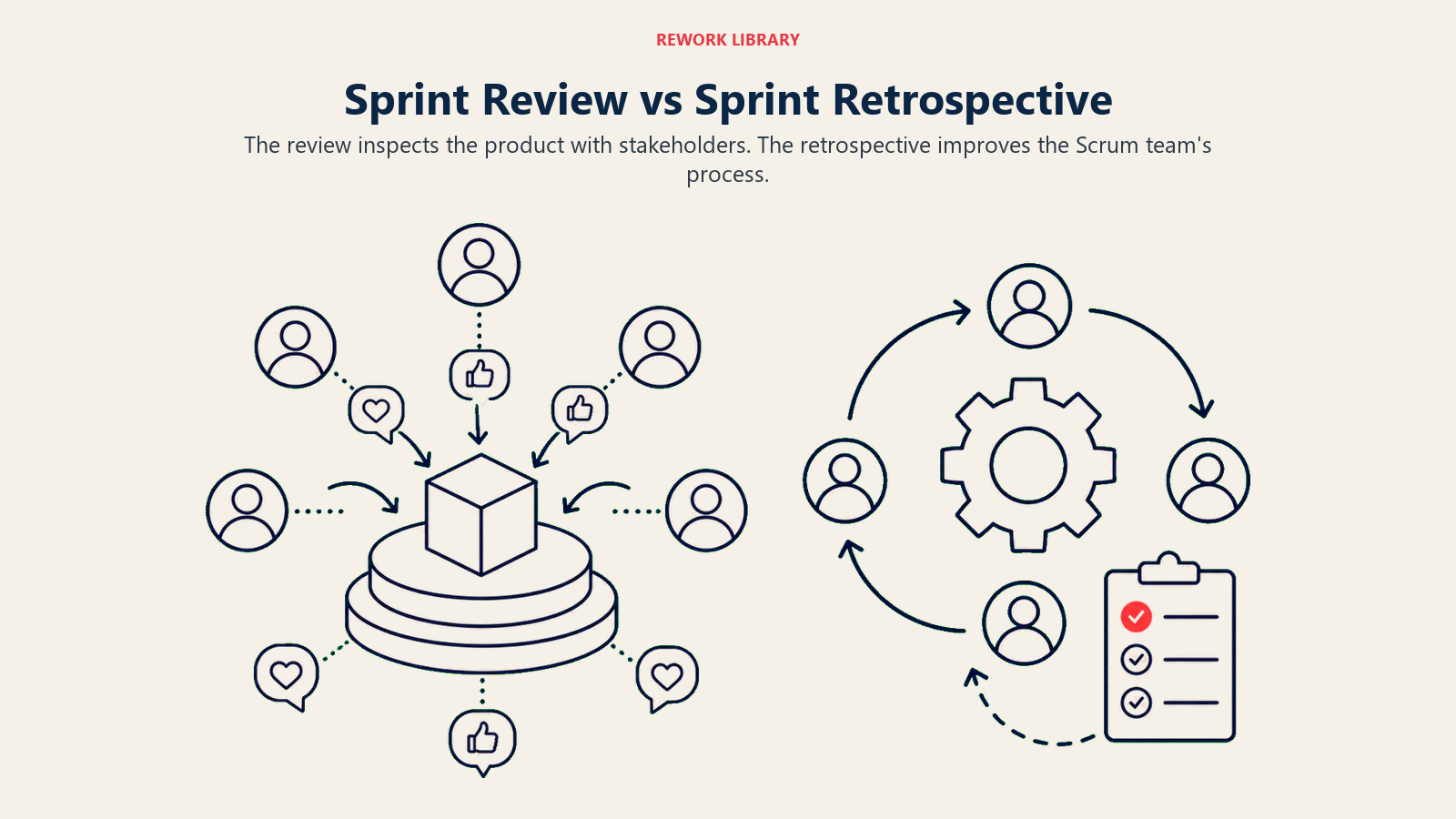
| Sprint Review | Sprint Retrospective | |
|---|---|---|
| Focus | The product: inspect the increment, gather feedback | The team's process: what worked, what to improve |
| Attendees | Scrum team + stakeholders, customers, sponsors | Scrum team only (developers, Scrum Master, Product Owner) |
| Primary output | Updated product backlog reflecting stakeholder input | Specific process improvement commitments for the next sprint |
| Question it answers | Did we build the right thing? | Are we working the right way? |
| Timebox (2-week sprint) | Typically 1-2 hours | Typically 45 min to 1.5 hours |
| Who runs it | Product Owner facilitates, Scrum Master supports | Scrum Master facilitates |
For a full breakdown of the retrospective format and questions, see the sprint retrospective guide.
Who Attends a Sprint Review?
The Scrum Guide lists the following participants:
- Scrum Team: the developers who built the increment, the Product Owner, and the Scrum Master
- Stakeholders: anyone the Product Owner invites, such as customers, users, executives, or business sponsors
- Subject matter experts: optionally, specialists whose input is relevant to decisions about what to build next
The Product Owner typically invites the stakeholders. The Scrum Master ensures the event stays productive and within the timebox. Developers present the increment and answer questions directly. This directness is intentional. Stakeholders get unfiltered information; developers get unfiltered reactions.
Sprint Review Agenda
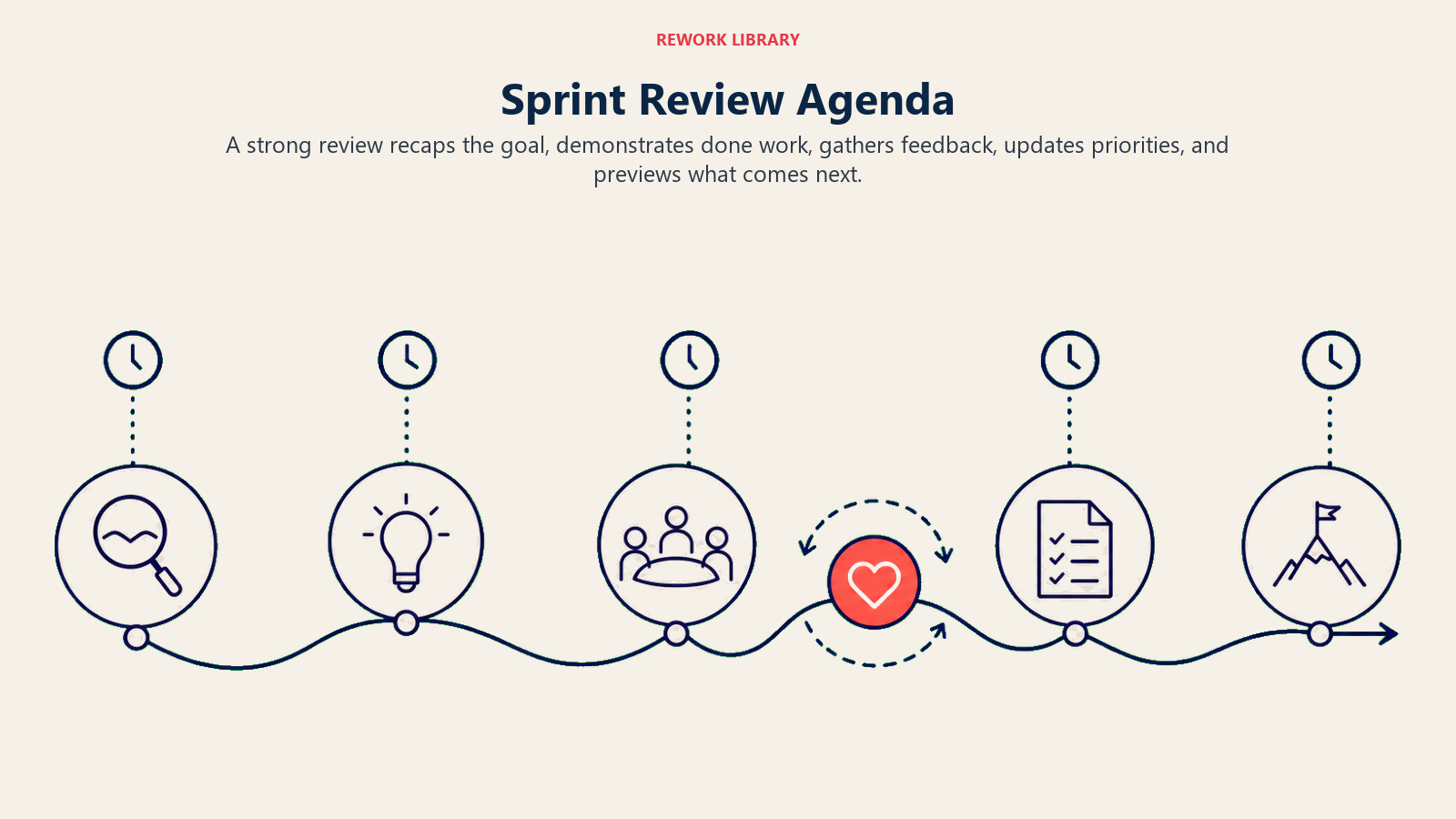
A well-structured sprint review moves through five parts. Here's a sample agenda for a 90-minute review (typical for a two-week sprint):
| Time | Activity |
|---|---|
| 0:00 - 0:10 | Opening: sprint goal recap, what was planned, what got done |
| 0:10 - 0:50 | Increment demo: developers show working software against acceptance criteria |
| 0:50 - 1:10 | Stakeholder feedback: open discussion, questions, reactions |
| 1:10 - 1:25 | Backlog review: Product Owner walks the updated backlog, priorities discussed |
| 1:25 - 1:30 | Close: next sprint goal preview, date of next review |
Part 1: Opening (10 minutes)
The Product Owner opens by recapping the sprint goal and listing the items planned for the sprint. Don't skip this. Stakeholders who weren't in sprint planning need context before seeing the demo.
Part 2: Increment Demo (40 minutes)
Developers demonstrate the working software. Real software, not slides. The demo should map directly to the sprint goal and show acceptance criteria being met. Each feature should be demoed in a realistic scenario, not a sanitized walkthrough.
Tip: assign each developer the features they built. They explain the context and walk through the functionality. This is more credible than having one person demo everything.
Part 3: Stakeholder Feedback (20 minutes)
This is the core of the sprint review. The Product Owner facilitates an open conversation. Questions to prompt useful feedback:
- Does this solve the problem you had in mind?
- What would make this more useful?
- What should we focus on next?
- Is anything missing or wrong?
Document everything. Stakeholder input directly shapes the next backlog update.
Part 4: Backlog Review (15 minutes)
The Product Owner walks through the updated product backlog. This is where the sprint's learning gets translated into future work. New items surface. Priorities shift. The team and stakeholders align on what matters most next.
Part 5: Close (5 minutes)
Preview the next sprint goal, confirm the next review date, and thank stakeholders. Short and clear.
How to Run an Effective Sprint Review
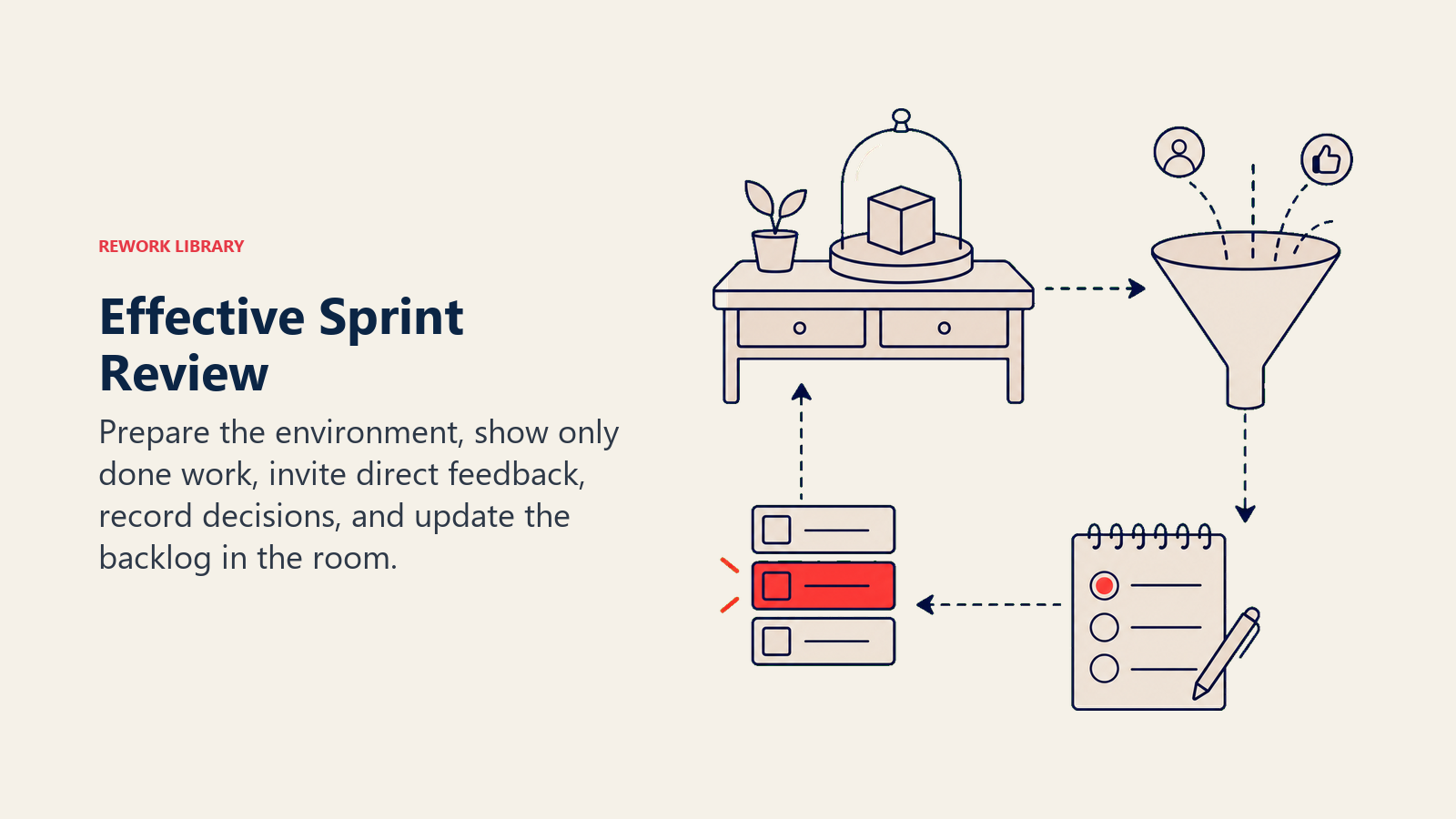
Step 1: Prepare the demo environment in advance
Don't wait until the morning of the review. Set up a staging environment, confirm demo accounts work, and test any live integrations the day before. A broken demo wastes everyone's time and erodes trust.
Step 2: Brief stakeholders before the meeting
Send a short pre-read: the sprint goal, what's being demoed, and any relevant context (a user workflow you're improving, a bug you fixed). Stakeholders give better feedback when they understand the starting point.
Step 3: Stick to working software
Show only what's done by the Definition of Done. If something is 80% complete, don't demo it. Showing incomplete work creates confusion and misaligned expectations. The increment is only what meets the team's standard for "done."
Step 4: Invite the right stakeholders
More isn't always better. Invite people with decision-making power or direct user insight. A focused group of five engaged people generates better feedback than a passive audience of twenty.
Step 5: Capture feedback in real time
Assign one person to document stakeholder input during the discussion. Actionable items go straight into the backlog before the session ends, or at minimum get flagged for the Product Owner to process immediately after.
Step 6: End with a clear next step
Before the room clears, state the likely focus for the next sprint. It doesn't have to be final. But leaving without any shared direction is a missed opportunity. The sprint review should feel like a chapter closing and a new one opening.
Sprint Review Best Practices
- Keep the demo realistic. Use real data or close-to-real scenarios. Artificial demos don't surface real usability problems.
- Time-box each demo segment. If a team has five items to show, allocate time per item. Without structure, demos run long and feedback gets squeezed.
- Rotate who presents. Each developer presenting their own work builds team confidence and gives stakeholders a clearer picture of the team.
- Don't mix retrospective topics in. Process issues belong in the retro. If a stakeholder raises a team-process concern during the review, note it and defer to the retro.
- Record key decisions. What did stakeholders approve? What got deprioritized? What new requests emerged? These decisions need a paper trail.
Common Mistakes
Treating the review as a one-way demo. If stakeholders are just watching and clapping, you're leaving value on the table. The sprint review is a collaborative session, not a theater performance.
Demoing features that aren't done. Showing work-in-progress as if it's complete erodes trust. If something isn't ready, say so. Skip it or show it briefly with clear caveats.
Skipping the backlog discussion. Teams that demo and dismiss miss the most important part: what changes because of what they just learned. The backlog discussion is where the sprint's output turns into the next sprint's input.
Running it without the right stakeholders. A sprint review with only internal team members is just a team sync. The value comes from external perspectives and real user feedback.
No prep. Ad hoc demos often fail or run over time. A short preparation checklist, reviewed the day before, prevents most sprint review disasters.
The sprint review is one of the simplest Scrum events to run and one of the easiest to run badly. A short, well-prepared demo with the right stakeholders in the room turns every sprint into a real feedback loop. And that's what keeps teams building the right product, not just building fast.
For the other Scrum events, start with agile ceremonies and the daily standup.

Senior Operations & Growth Strategist
On this page
- What Is a Sprint Review?
- Key Facts
- Sprint Review vs Sprint Retrospective
- Who Attends a Sprint Review?
- Sprint Review Agenda
- Part 1: Opening (10 minutes)
- Part 2: Increment Demo (40 minutes)
- Part 3: Stakeholder Feedback (20 minutes)
- Part 4: Backlog Review (15 minutes)
- Part 5: Close (5 minutes)
- How to Run an Effective Sprint Review
- Step 1: Prepare the demo environment in advance
- Step 2: Brief stakeholders before the meeting
- Step 3: Stick to working software
- Step 4: Invite the right stakeholders
- Step 5: Capture feedback in real time
- Step 6: End with a clear next step
- Sprint Review Best Practices
- Common Mistakes