LeSS: The Large-Scale Scrum Framework Explained
Turn this article into takeaways for your work.


Each assistant summarizes the article only for you and suggests best practices for your work.
Every organization that outgrows one Scrum team eventually asks the same question: how do you coordinate ten, thirty, or eighty teams without losing what made Scrum work in the first place? SAFe answers by adding structure: more roles, more ceremonies, more layers to keep everyone aligned. Large-Scale Scrum (LeSS) answers by doing the opposite.
LeSS is Scrum applied to many teams building one product together, and it gets there by descaling the organization rather than layering something new on top of it. Instead of asking how to do agile at scale, it starts from a smaller, harder question: how simple can the organization get while staying genuinely agile.
Key Facts
- Large-Scale Scrum was shaped by Craig Larman and Bas Vodde, who have worked together on scaling Scrum since 2005.
- less.works defines two frameworks: LeSS for 2 to 8 teams, and LeSS Huge for more than 8, with the eight-team line described as "just an upper-limit empirical observation," not a hard rule.
- less.works names ten LeSS principles, not nine, a count several secondhand summaries get wrong.
- In LeSS Huge, a Requirement Area holds 4 to 8 teams by design, never fewer.
What is LeSS (Large-Scale Scrum)?
Large-Scale Scrum (LeSS) is Scrum applied to multiple teams building one product together, and it gets there by descaling the organization instead of adding a coordination layer on top of it. Where a lot of scaling frameworks ask how to do agile at scale, less.works frames the LeSS question differently: how can we simplify the organization, and be agile, rather than just perform the motions of it.
Craig Larman and Bas Vodde built the framework out of client work that started in 2005. Years of scaling Scrum with real organizations became the LeSS rules the framework publishes today. Two frameworks came out of that work. Plain LeSS covers 2 to 8 teams. LeSS Huge picks up from there for more than 8. less.works is upfront that the eight-team line isn't a hard rule, calling it "just an upper-limit empirical observation," the point where they've seen the smaller structure start to need help, not a number baked into the framework's logic.
Both frameworks keep the same non-negotiables: one Product Backlog, one Definition of Done, one Sprint, one Product Owner, and one Potentially Shippable Product Increment, no matter how many teams are contributing to it.
The ten LeSS principles
less.works is explicit about the count: ten principles, not nine. That trips people up because a fair number of secondhand summaries round down to nine, dropping one along the way. The distinction matters less as trivia and more because these are the ideas the LeSS rules actually come from. less.works says the principles "guided us in creating LeSS," and that they should guide an implementation the same way: they're what you fall back on when a situation the rules don't cover shows up.
| Principle | What it means in practice |
|---|---|
| Large-Scale Scrum is Scrum | Every LeSS decision starts from one-team Scrum and asks how to keep its purpose intact at scale, not from a blank page |
| More with LeSS | Fewer roles, fewer artifacts, fewer defined processes on purpose, so teams carry more responsibility instead of process doing it for them |
| Systems Thinking | Look at the whole delivery system before optimizing any single team or step inside it |
| Lean Thinking | Manage flow and cut waste at the organizational level, not only inside one team's backlog |
| Empirical Process Control | Decisions come from inspecting real, working product, not from a plan written months earlier |
| Transparency | Make real progress and real problems visible, not a status report that only looks clean |
| Continuous Improvement Towards Perfection | Treat "good enough" as a waypoint, not the destination, and keep improving after the obvious fixes are done |
| Customer-Centric Thinking | Every team, at every level, orients toward the customer's problem instead of an internal handoff |
| Whole-Product Focus | One product, one backlog, one Sprint, so no team optimizes its slice at the expense of the whole |
| Flow and Queueing Theory | Smaller batches and shorter queues move work faster than large batches, at any team count |
That last principle is worth sitting with if you've spent time in SAFe or another framework that leans on parallel workstreams: queueing theory says adding more work in progress slows everything down, even when it feels like more parallel effort should speed things up. LeSS applies that logic to the whole organization, not just a single team's board.
LeSS vs LeSS Huge: what actually changes past eight teams
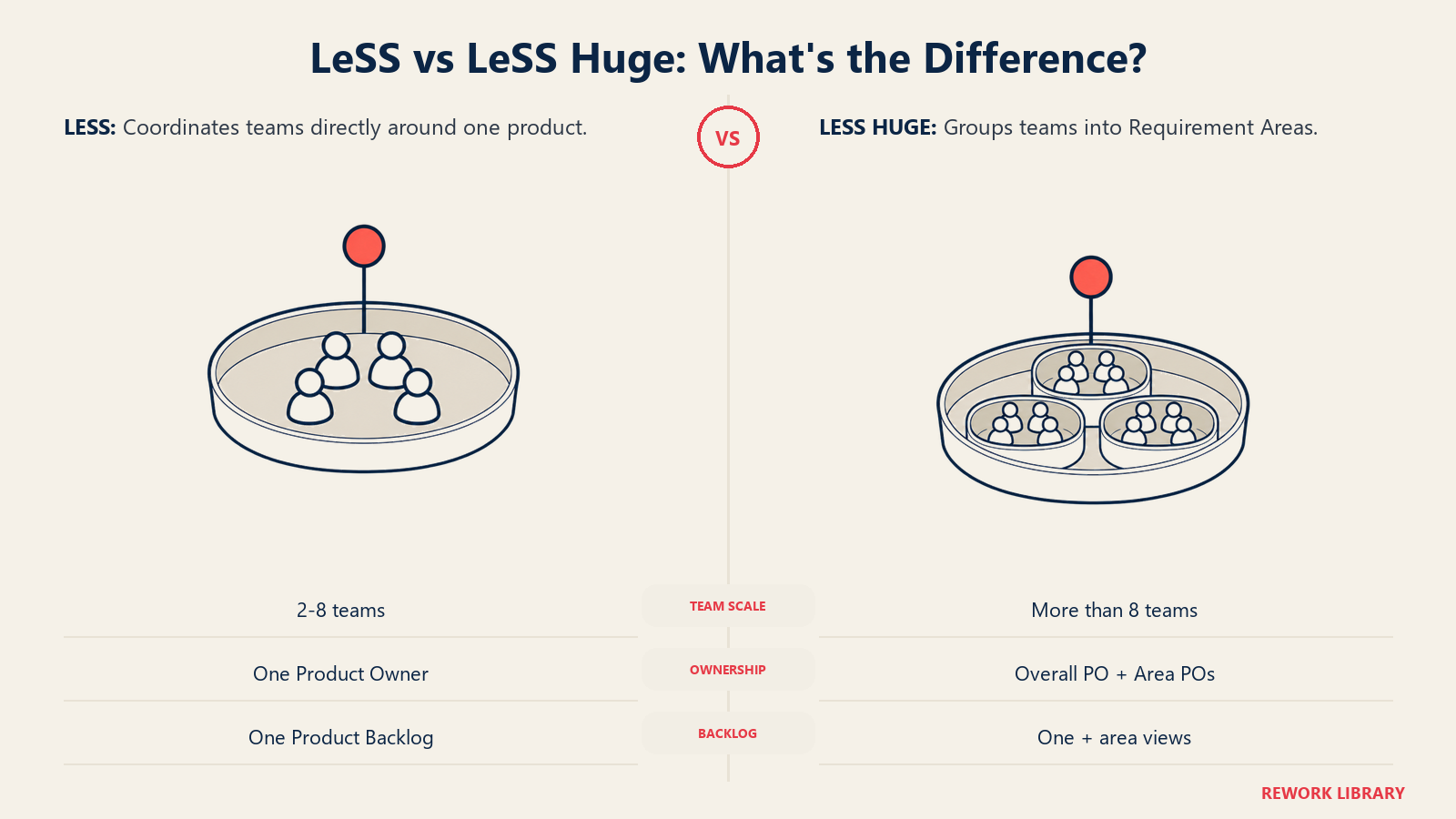
Two to eight teams is where plain LeSS lives, and inside that range nothing about coordination changes structurally: one Product Backlog, one Product Owner working directly with every team, one Sprint. Past eight teams, LeSS Huge adds the machinery needed to keep a whole-product view when no single Product Owner can plausibly track every team's day-to-day work alone.
| LeSS (2-8 teams) | LeSS Huge (8+ teams) | |
|---|---|---|
| Team count | 2-8 teams | More than 8 teams, grouped into areas |
| Product Backlog | One, shared by every team | Still one overall Product Backlog |
| Requirement Areas | None | Backlog items and teams grouped by product area, 4 to 8 teams per area, never fewer |
| Product Owner | One PO, working with every team directly | One overall PO, plus one Area Product Owner per Requirement Area |
| Area Product Backlog | Not applicable | Each area keeps its own backlog, derived from and prioritized against the single overall Product Backlog |
| Sprint | One common Sprint | Still one common Sprint across every team, every area |
| Definition of Done | One, shared | Still one, shared across every area |
Area Product Owners specialize in their area and act like Product Owners toward the teams inside it, but the overall Product Owner keeps the final call on the product-wide backlog and vision. The two sync constantly, specifically before Sprint Planning, so an Area PO's local priorities never drift far from what the overall Product Owner has actually decided matters most. That coordination point is where LeSS Huge earns its extra complexity: it exists to protect the whole-product focus once team count outgrows what one person can track alone.
The LeSS Sprint: one Sprint, many teams
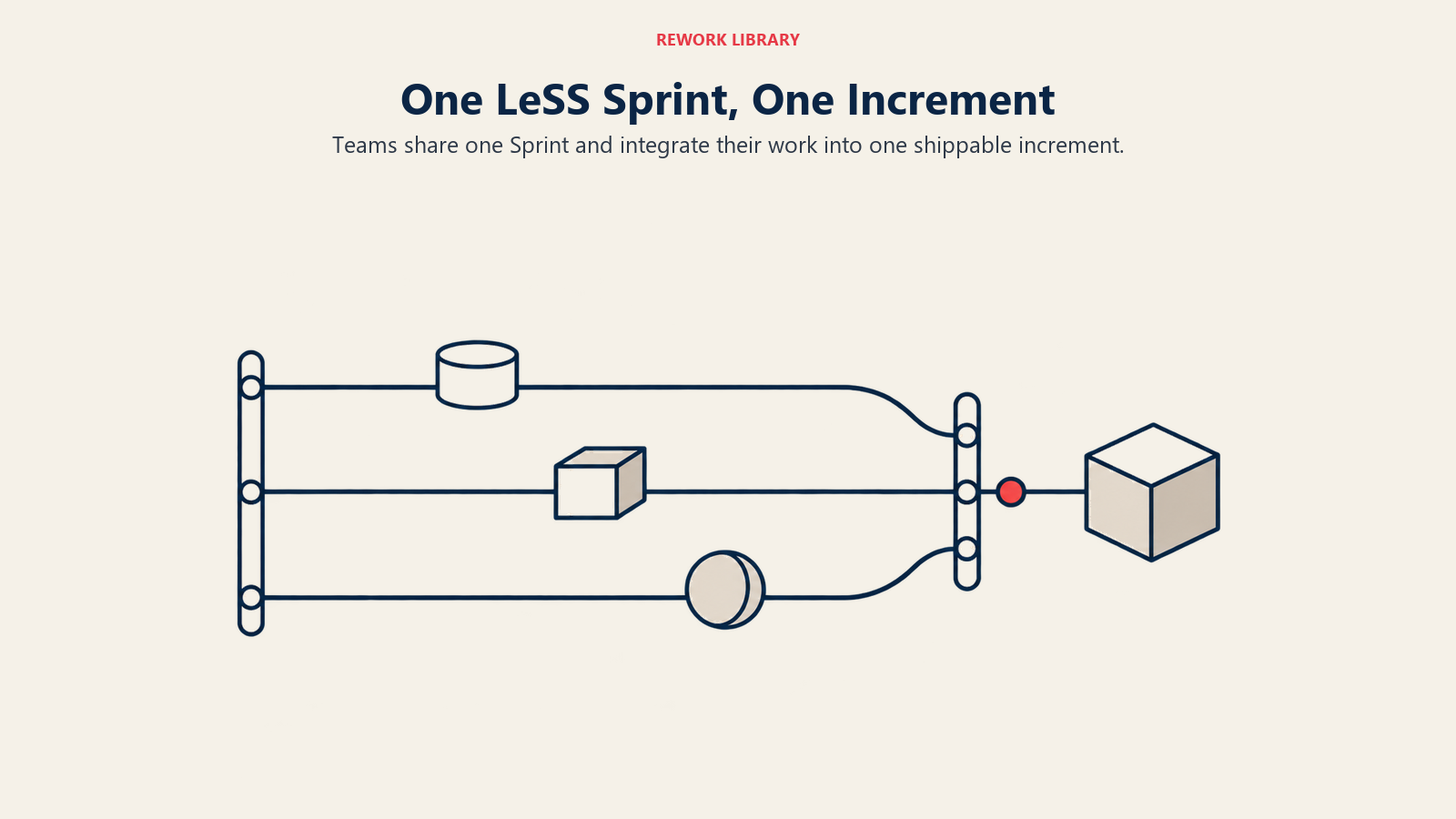
Conceptually, LeSS runs one product-level Sprint for the whole product, not one Sprint per team on its own clock. Every team starts and ends together, and the result is one integrated, potentially shippable product Increment, not a pile of team-level increments someone has to reconcile afterward. Sprint Planning for every team happens at the same time, and so do Sprint Review and the retrospective. What doesn't have to line up is backlog refinement: teams can refine on their own schedule as long as items are ready by the time Sprint Planning starts.
Sprint Planning itself splits into two parts, same as it does at the single-team level, just with more people in the room for the first half.
| Event | Who attends | What happens |
|---|---|---|
| Sprint Planning One | Product Owner and all teams, or team representatives | The PO presents top-priority items, teams work out who takes what, sometimes literally putting the cards on the table, and the group leaves with a Sprint Goal |
| Sprint Planning Two | Each team on its own, sometimes co-located with teams working related items | The team turns its selected items into a concrete plan for getting them to Done |
| Overall (multi-team) Product Backlog Refinement | All team members, the PO, and relevant subject-matter experts or customers | Items get split, clarified, and estimated together, often with people rotated across items from different teams so understanding spreads |
| Sprint Review | All teams, the PO, and stakeholders or customers | A bazaar-style walkthrough: each team staffs its own area, stakeholders move between them, then the group converges to talk about what comes next |
| Overall Retrospective | PO, Scrum Masters, team representatives, and managers where they exist | Cross-team and organizational problems, the kind no single team's retro can fix on its own, usually held early in the next Sprint once people have had a beat to step back |
Refinement is where LeSS asks for the most discipline, since it's easy to let it slide when nothing forces it onto the calendar the way Sprint Planning does. less.works calls the multi-team version "arguably the most important event in LeSS," and teams typically spend something like a tenth of their Sprint capacity on it. Skip it, and Sprint Planning One turns into a meeting spent clarifying instead of selecting, which is the opposite of what it's for.
The Sprint Review deserves its own mention, because it's easy to run it like a single-team demo just stretched across more people. LeSS treats it as a genuine inspect-and-adapt point on the whole product, not a Product Owner approval gate, which is a subtler distinction than it sounds. A demo that's really an approval checkpoint trains teams to perform for the PO. A bazaar that lets stakeholders wander, ask questions, and shape what happens next trains the organization to actually look at the product it built.
One Product Owner for the whole product (the part everyone doubts)
This is the detail that stops most people cold the first time they hear it: one Product Owner, for the entire product, across every team, no matter how many teams that turns out to be. It sounds like a bottleneck waiting to happen. In practice, LeSS makes the math work by being precise about what the Product Owner actually has to do.
| PO time commitment | Roughly, per two-week Sprint |
|---|---|
| Sprint Planning One | About 1 hour |
| Overall Product Backlog Refinement | About 4 hours |
| Sprint Review | About 2 hours |
| Overall Retrospective | About 1.5 hours |
| Total | Roughly 8 hours |
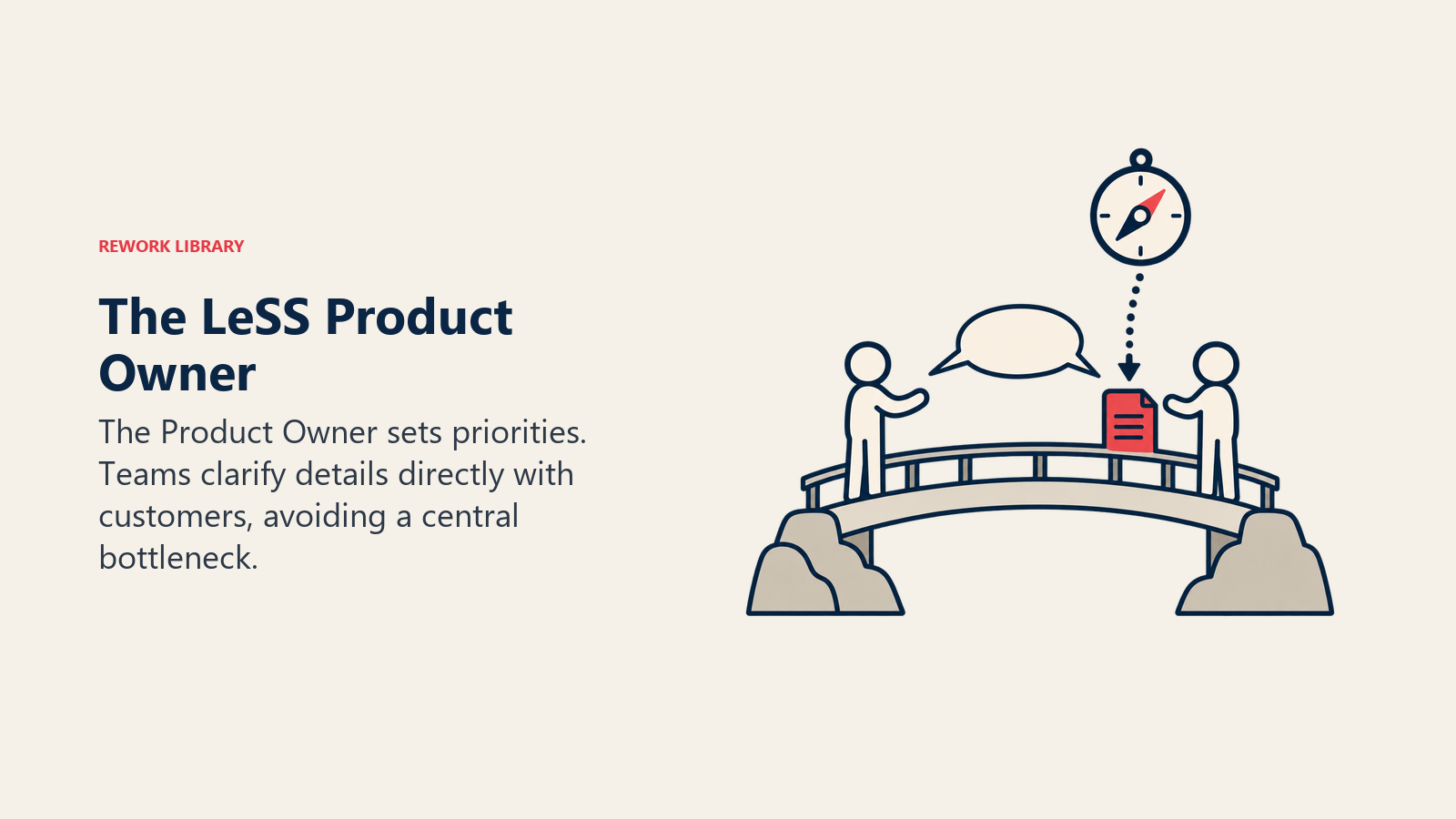
That leaves the Product Owner out of Sprint Planning Two, Daily Scrums, and team-level retrospectives entirely. Those meetings belong to the teams, not the PO. LeSS pulls that off by separating two jobs that a lot of organizations bundle into one role: prioritization and clarification. The Product Owner owns prioritization, deciding what matters most and why. Clarification, the back-and-forth about exactly how an item should behave, happens directly between the team and the customer or stakeholder, with the PO available but not required as a go-between. less.works describes the intended role as "a connector, not an intermediary," a meaningfully different job than being the single approved channel for every question a team has.
It's also a different shape than a lot of readers assume walking in. This isn't a Product Manager sitting above several Product Owners, coordinating a team of coordinators. It's one person doing the Scrum Product Owner job, at product scale, with the specific parts of the job that don't scale handed off to the teams.
That split also protects team autonomy in a way that's easy to miss. If every clarifying question had to route through one person, LeSS would recreate exactly the bottleneck critics assume it has. Instead, teams that can talk to customers directly move faster on the details, and the Product Owner spends the freed-up time on the thing only one person can do for the whole product: deciding what gets built next. If you're weighing this role against the coordination job a Scrum Master handles at team level, the split is the same one that already exists in single-team Scrum, just applied across more teams instead of inside one.
LeSS vs SAFe: descaling vs adding structure
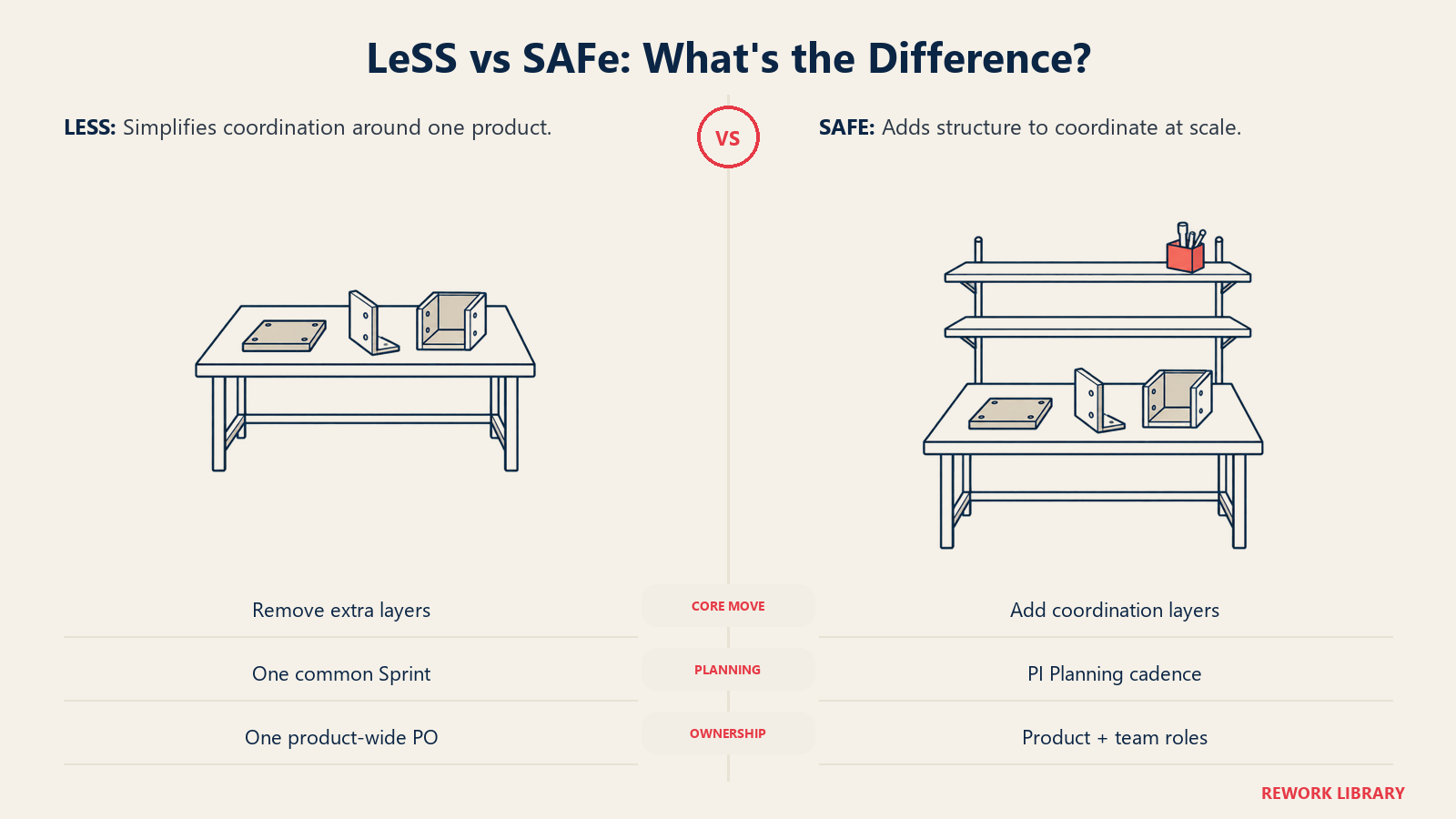
Readers land on this page after they've usually already read about SAFe, and the fair way to compare them is to say what each one is actually optimizing for. SAFe keeps teams roughly as they are and adds layers, roles, and a scaled planning cadence to coordinate them. LeSS goes the other direction: it asks the organization to reorganize around feature teams, strip out extra roles, and coordinate through one Sprint and one Backlog instead of a stack of planning events.
| LeSS | SAFe | |
|---|---|---|
| Core move | Descale the organization, extend one-team Scrum outward | Add coordination structure on top of existing teams |
| Team range | 2-8 teams (LeSS Huge past that) | Roughly 50-125 people per Agile Release Train, more via Large Solution and Portfolio layers |
| New roles at scale | One: the Area Product Owner, and only in LeSS Huge | Several: Release Train Engineer, System Architect, Business Owners, Lean Portfolio Management, and more |
| Product Owner model | One PO for the whole product | Product Management at program level, plus a Product Owner per team |
| Scaled planning event | None separate; Sprint Planning One does that job inside the normal Sprint | PI Planning, a dedicated two-day event every 8-12 weeks |
| Backlog structure | One Product Backlog (plus Area Backlogs in LeSS Huge) | Portfolio, program, and team backlogs, layered |
| What it asks of leadership | Give up management layers and titles the framework says aren't needed | Train leadership, fund an Implementation Roadmap, keep most existing roles |
| Best fit | Organizations with strong one-team Scrum already, willing to reorganize | Large enterprises wanting a structured, well-supported rollout |
Neither side of that table is wrong, and neither framework is more agile than the other by some objective measure. They're solving the same coordination problem with opposite instincts: SAFe assumes coordination needs more scaffolding, and LeSS assumes most of that scaffolding is the problem it's trying to solve. Where SAFe uses PI Planning as its synchronization event, LeSS uses Sprint Planning One, the same event a single team already runs, just with every team in the room. That's the philosophical gap in one comparison: one framework built a new event to handle scale, the other scaled the event it already had.
LeSS vs the Spotify model vs plain multi-team Scrum
Two more comparisons come up often enough to cover briefly. Neither is really a competitor to LeSS the way SAFe is, since they're solving slightly different problems.
| LeSS | Spotify model | Plain multi-team Scrum | |
|---|---|---|---|
| What it is | A published framework with explicit rules | A description of how one company organized itself, since evolved past its original write-up | No named framework, just several teams each running Scrum |
| Product Owner | One, for the whole product | One per squad, no single owner across a tribe | Usually one per team, with no shared prioritization mechanism |
| Coordination mechanism | Common Sprint, joint refinement, Requirement Areas past 8 teams | Chapters and guilds for cross-squad knowledge sharing | Whatever the teams improvise, often an informal Scrum of Scrums |
| Prescriptiveness | High: rules are published in full | Low: descriptive, not prescriptive, easy to adapt | None |
| Common failure mode | Underestimating how much organizational change it actually requires | Adopting the org chart (tribes, squads) without the culture that made it work | Teams quietly diverge on priority and Definition of Done with no one noticing until integration breaks |
The Spotify model was never meant to be copied wholesale, and Spotify itself moved past the original structure years ago. It travels well as vocabulary (squads, chapters, guilds) but poorly as a rulebook, because it never published one. Plain multi-team Scrum, several teams each running standard Scrum with no shared framework layered on top, is what most organizations do by default before they adopt anything else, and it's usually what breaks first: nothing stops two teams' Product Owners from prioritizing in opposite directions, because nothing ties their backlogs together in the first place. LeSS is, in a real sense, what you get when you take that default setup and fix the specific thing that breaks it: one Backlog, one Owner, one Sprint. There is an older answer to the same question worth knowing: Crystal scales by swapping in a heavier member of a methodology family as the team grows, instead of keeping one framework and reshaping the organization around it.
Adoption reality: what a LeSS adoption actually asks for
SAFe sells easier, and it's worth saying plainly why. A SAFe rollout adds things: new roles, a training curriculum, certifications, a named event on the calendar. It looks like progress on an org chart, even before it's delivered anything. A LeSS adoption removes things, and removal is a much harder story to tell a room full of managers whose current job might be one of the things going away.
| What a LeSS adoption removes | What replaces it |
|---|---|
| Component or functional teams | Feature teams that can take a customer-facing item from idea to done on their own |
| Multiple Product Owners or Product Managers per initiative | One Product Owner for the entire product |
| A layer of management between teams and strategy | Direct conversation between teams and customers for clarification |
| Separate scaled planning meetings | Sprint Planning One, done inside the normal Sprint cadence |
| Status reporting up a management chain | The Overall Retrospective and Sprint Review as the two whole-organization checkpoints |
None of that is subtle. Reorganizing around feature teams usually means some people's jobs change shape, and consolidating Product Ownership into one role usually means other people's titles disappear or get redefined. That's a genuinely different ask than SAFe's, which mostly trains people into new roles rather than removing roles that already exist. It's also part of why LeSS adoptions tend to be smaller and slower to spread than SAFe rollouts. Fewer organizations are willing to have that conversation with their own management structure, even when the underlying case for descaling is sound.
LeSS tends to suit organizations that already run one-team Scrum well and have a real backlog to show for it, not ones still learning what a Sprint or a Definition of Done means day to day. It also suits organizations willing to name one Product Owner with real authority over the whole product, and willing to reorganize around feature teams instead of defending the component-team structure they already have. It doesn't suit organizations that need the reporting and role structure a regulated or heavily contracted environment demands, or ones managing several genuinely separate products that don't share one backlog to begin with. Those cases usually fit better under SAFe's portfolio layer or a different model entirely.
When not to use LeSS
| Situation | Why LeSS struggles |
|---|---|
| Teams haven't made one-team Scrum work yet | The first LeSS principle is that large-scale Scrum is still Scrum; scaling a shaky foundation multiplies the shakiness instead of fixing it |
| The organization can't or won't reorganize into feature teams | LeSS assumes teams can build a customer-facing slice end to end; component teams fight that structure at every Sprint |
| Leadership wants to keep the existing management layers | Most of what LeSS saves comes from removing coordination layers; keeping them defeats the principle that made the framework work in smaller pilots |
| You're managing several genuinely separate products | LeSS assumes one Product Backlog for one product; coordinating unrelated products is a portfolio problem, not a team-scaling one |
| Contractual or regulatory reporting needs heavy formal documentation | LeSS keeps artifacts minimal by design, and that gap has to be filled some other way if compliance requires it |
None of these are reasons LeSS is a bad framework. They're reasons a specific organization, at a specific moment, might not be ready for what it asks. The honest version of that sentence also applies to SAFe, or any scaling approach: the framework isn't the hard part. Changing how an organization is actually structured is, and that's true whether the framework adds scaffolding or takes it away.
Frequently Asked Questions about LeSS
What does LeSS stand for?
LeSS stands for Large-Scale Scrum, the multi-team scaling framework developed by Craig Larman and Bas Vodde. It comes in two versions: LeSS for 2 to 8 teams, and LeSS Huge for organizations with more than 8 teams working on one product.
How many teams can use LeSS before you need LeSS Huge?
Plain LeSS covers 2 to 8 teams. Past that, LeSS Huge adds Requirement Areas, groups of 4 to 8 teams each with their own Area Product Owner, while the product still keeps one overall Product Backlog, one Product Owner, and one Sprint.
Does LeSS really use only one Product Owner for every team?
Yes, for the whole product, no matter how many teams are contributing to it. LeSS makes that workable by separating prioritization, which stays with the Product Owner, from clarification, which happens directly between teams and customers. In LeSS Huge, Area Product Owners take on area-level prioritization while the overall Product Owner keeps final say on the whole product.
Is LeSS the same thing as Scrum, just for bigger teams?
Close, but not quite the same claim. LeSS's own framing is that large-scale Scrum is still Scrum: the same principles and purpose, extended to more teams by removing the extra structure many organizations add, rather than by inventing a new layer on top.
How is LeSS different from SAFe?
SAFe adds roles, layers, and a scaled planning event (PI Planning) to coordinate teams that mostly keep their existing shape. LeSS goes the other direction: it asks the organization to reorganize around feature teams and coordinate through one Backlog and one Sprint, with almost no added roles. Both solve the multi-team coordination problem, they just start from opposite assumptions about whether more structure or less structure gets you there.
Why do some sources say LeSS has nine principles instead of ten?
That's usually an error working its way through secondhand summaries. less.works, the framework's own source, lists ten LeSS principles and is explicit that all ten guided the framework's creation and should guide any implementation of it.
LeSS isn't the easier sell, and it was never trying to be. If your organization already runs one-team Scrum well and is willing to reorganize around feature teams and a single Product Owner, descaling is a real option, not just a philosophical stance. If it isn't willing to do that yet, SAFe or a lighter-touch approach will probably get further, faster, and that's a legitimate answer too. The choice isn't about which framework is more agile. It's about which direction of change your organization can actually make.

Senior Operations & Growth Strategist
On this page
- What is LeSS (Large-Scale Scrum)?
- The ten LeSS principles
- LeSS vs LeSS Huge: what actually changes past eight teams
- The LeSS Sprint: one Sprint, many teams
- One Product Owner for the whole product (the part everyone doubts)
- LeSS vs SAFe: descaling vs adding structure
- LeSS vs the Spotify model vs plain multi-team Scrum
- Adoption reality: what a LeSS adoption actually asks for
- When not to use LeSS