Agile vs Waterfall: Which Project Methodology to Choose
Turn this article into takeaways for your work.


Each assistant summarizes the article only for you and suggests best practices for your work.
Agile vs Waterfall is one of the oldest debates in project management, and it still matters because choosing the wrong methodology can derail a project before the first deliverable ships.
Key Facts
- Agile projects have a 64% success rate vs Waterfall's 49% on software work, but Waterfall still leads in regulated and physical-build contexts (Standish Group CHAOS Report, 2024).
- About 71% of organizations use Agile methods in some form, while pure Waterfall remains common in government and construction projects (PMI Pulse of the Profession, 2024).
- The Waterfall model traces back to Winston Royce's 1970 paper, even though Royce himself argued for iteration; the Agile Manifesto was published in 2001 (Software Engineering, 1970; agilemanifesto.org).
What is the difference between Agile and Waterfall?
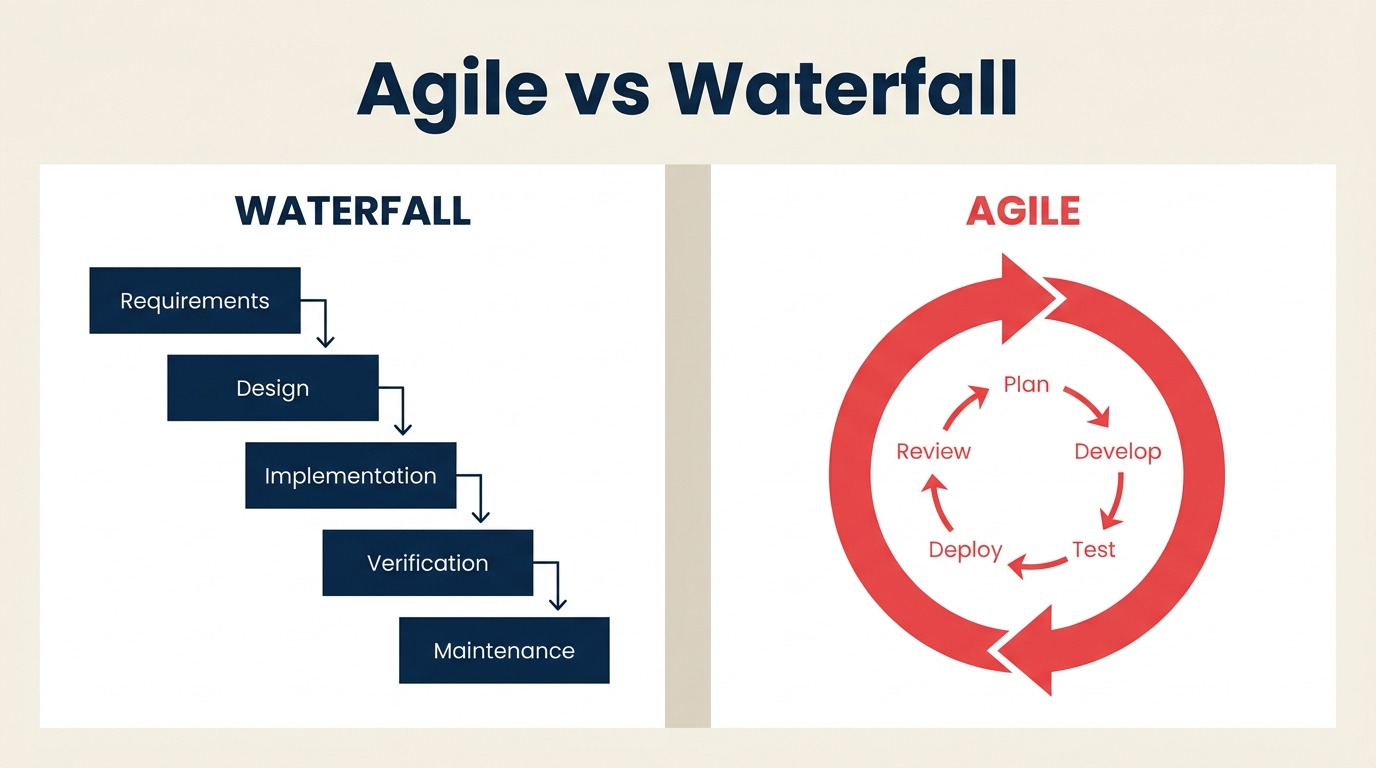
Agile is an iterative, flexible project methodology where work moves in short cycles called sprints and requirements can change throughout the project, while Waterfall is a sequential methodology where each phase must be completed and approved before the next one begins.
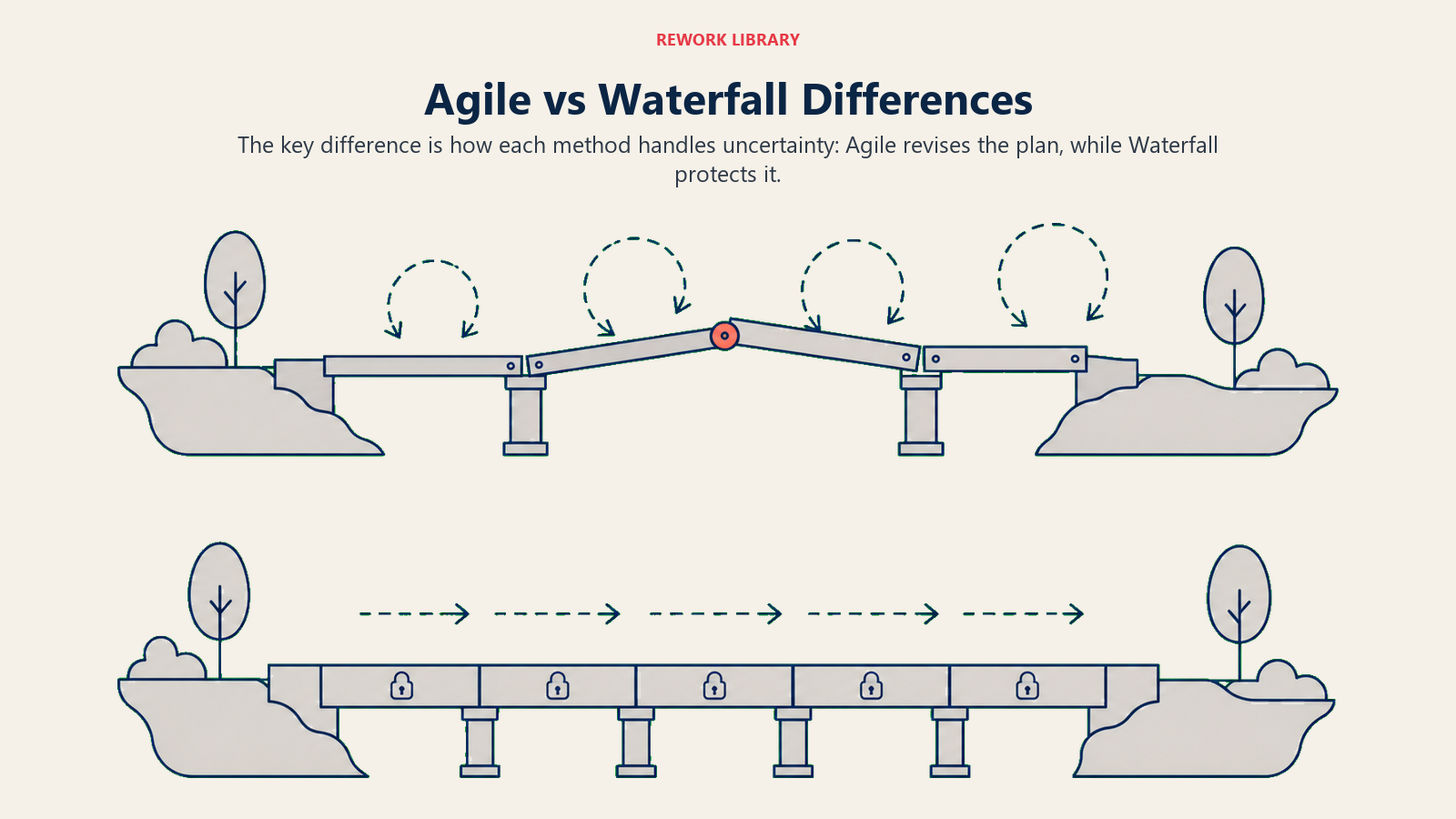
The core tension between the two methods is really about certainty. Waterfall bets that you can define everything upfront: scope, budget, timeline, specifications. That bet pays off when the domain is stable and the requirements genuinely won't change. Agile bets the opposite: that requirements will evolve, that early feedback is valuable, and that shipping a working slice quickly beats a perfect plan delivered late.
Neither bet is wrong by default. The question is which one fits your project. A hospital constructing a new wing has fixed blueprints, regulatory constraints, and a single delivery date. A startup building a mobile app has shifting user feedback, uncertain product-market fit, and a need to validate assumptions every two weeks. Same label (project) but completely different risk profiles and therefore completely different methodology fits.
What is Waterfall methodology?
Waterfall is a linear, phase-gated project management approach where work flows in one direction: requirements lead to design, design leads to development, development leads to testing, and testing leads to release. You finish one phase before touching the next.
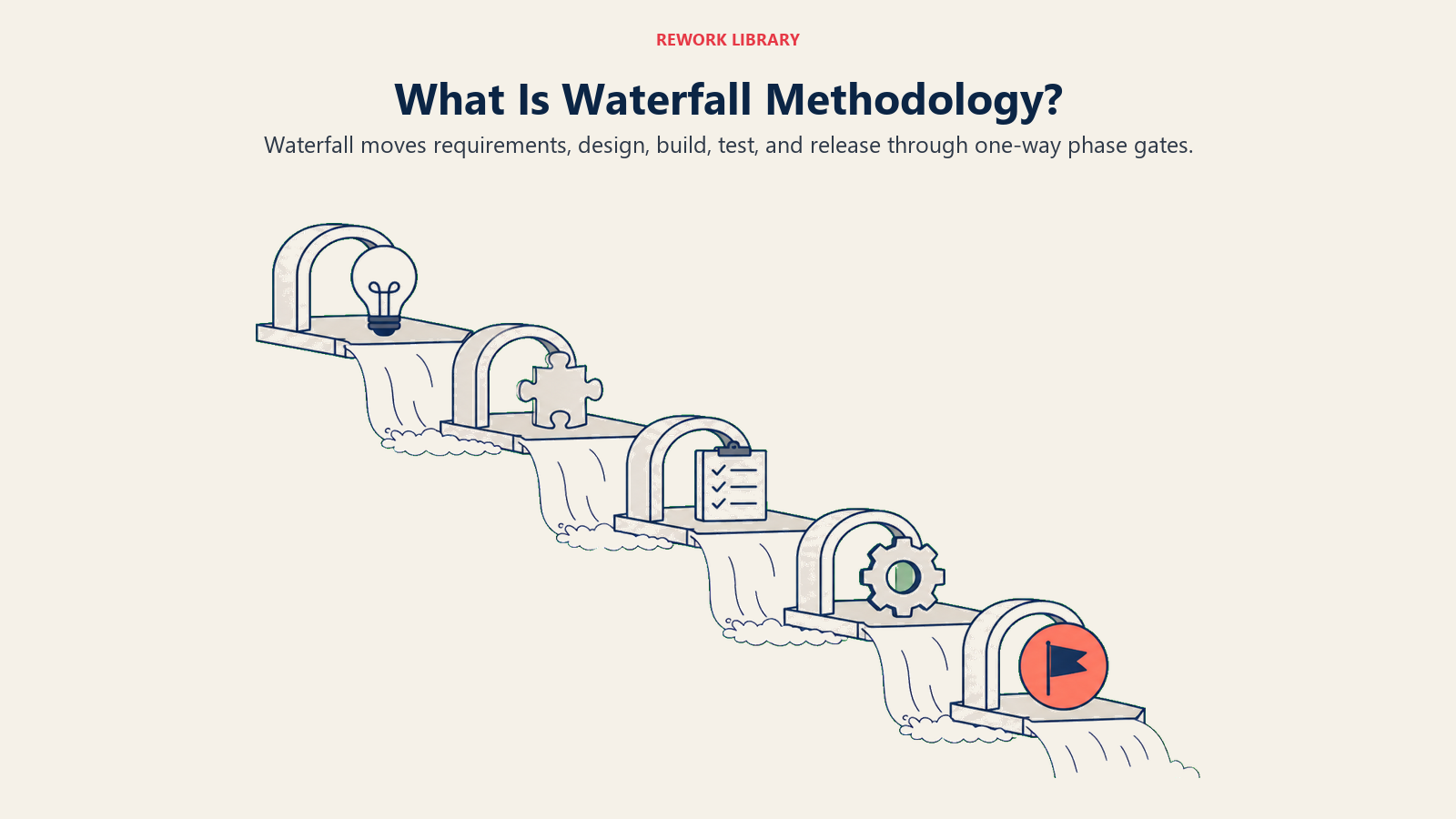
Winston Royce described this model in a 1970 software engineering paper. Royce actually flagged it as risky for software projects and advocated for feedback loops, but the sequential diagram stuck and became the dominant project model for the next three decades.
The five sequential phases in a standard Waterfall project are:
- Requirements, All project requirements are gathered, documented, and signed off before any design begins.
- System design, The technical and functional architecture is planned in full based on the requirements document.
- Implementation, Developers build the system according to the design specification.
- Testing and verification, The completed system is tested against requirements; defects are fixed.
- Deployment and maintenance, The product goes live; ongoing maintenance begins.
For a deeper look at how Waterfall works in practice, see Waterfall methodology in project management.
What is Agile methodology?
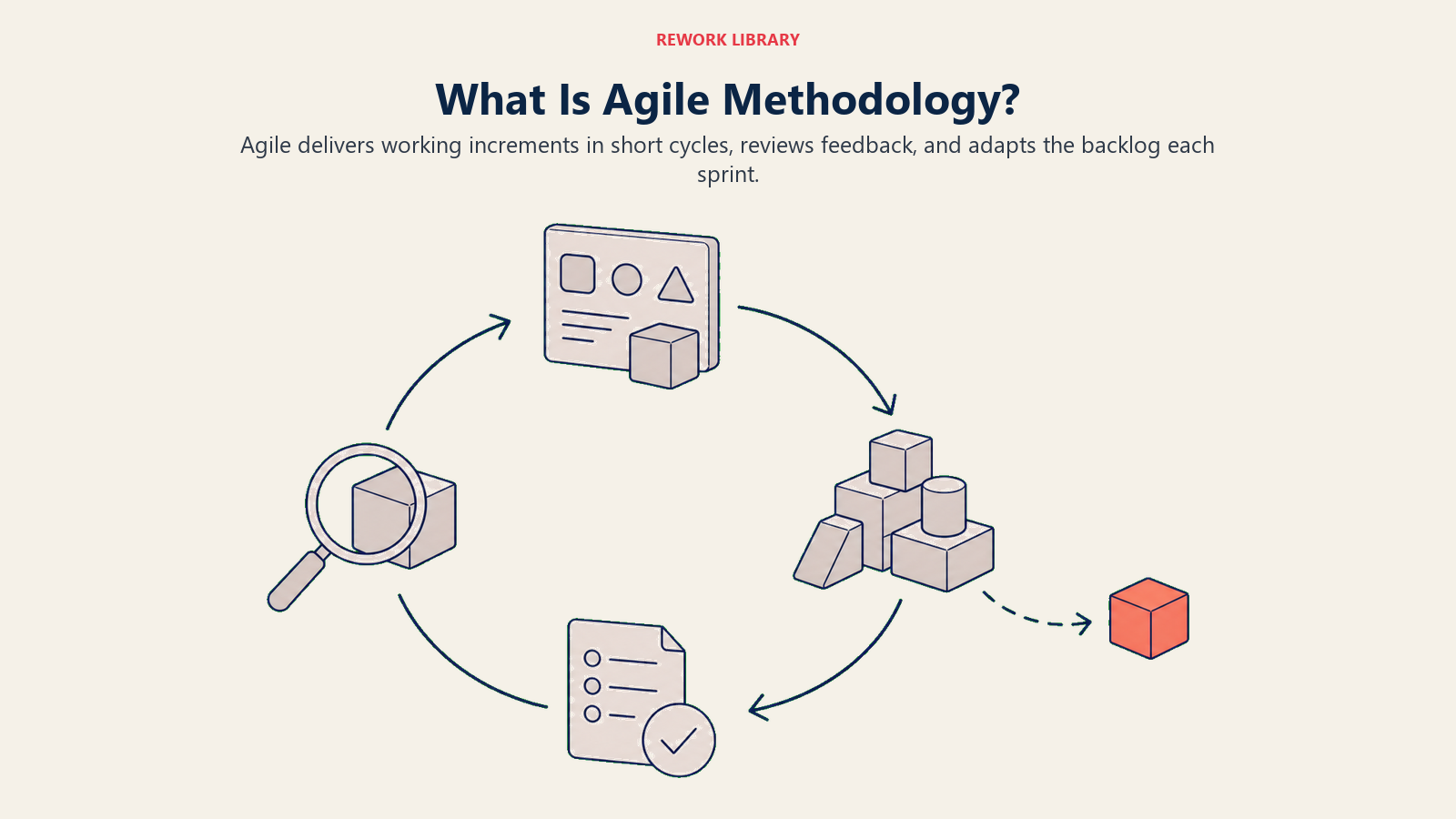
Agile is a set of values and practices for iterative, incremental project delivery. Work is broken into short cycles (sprints or iterations), typically one to four weeks long. At the end of each cycle, the team delivers a working increment, reviews it with stakeholders, and adjusts the plan for the next cycle.
The Agile Manifesto, signed by 17 software developers in 2001, defined four core values that set Agile apart from plan-heavy methods:
- Individuals and interactions over processes and tools
- Working software over comprehensive documentation
- Customer collaboration over contract negotiation
- Responding to change over following a plan
These values don't mean that processes, documentation, contracts, or plans are worthless. They mean the left side of each pair takes priority when the two are in conflict.
Agile is a philosophy, not a single framework. Scrum, Kanban, SAFe, and XP are all implementations of Agile principles. Scrum and Kanban are the two most widely used. For a direct comparison of those two, see Scrum vs Kanban.
For a full breakdown of what Agile means in practice, read What is Agile methodology.
Agile vs Waterfall: head-to-head comparison
Here is how the two methodologies compare across the dimensions that matter most in project planning:
| Dimension | Waterfall | Agile |
|---|---|---|
| Planning | Upfront and comprehensive; full scope defined before work begins | Continuous; high-level roadmap upfront, details emerge each sprint |
| Phases | Sequential and gate-controlled; each phase signed off before next starts | Overlapping and iterative; design, build, and test happen within each sprint |
| Customer involvement | Heavy at start (requirements) and end (acceptance); low in the middle | Continuous; stakeholders review working software every sprint |
| Change handling | Costly and formally controlled; changes require scope amendment | Welcomed; backlog items can be added or reprioritized at sprint boundaries |
| Delivery cadence | Single delivery at end of project | Incremental; working product every 1-4 weeks |
| Documentation | Extensive upfront documentation required | Lightweight; just enough to support the work |
| Team size | Scales well with larger, specialized teams organized by function | Works best with small, cross-functional teams (typically 5-9 people) |
| Risk surfacing | Risks often appear late (integration and testing phases) | Risks surface early (end of first sprint) |
| Best suited for | Fixed scope, regulated industries, physical deliverables, stable requirements | Evolving requirements, software, R&D, fast feedback needed |
The table makes Agile look like the obvious winner, but the "Best suited for" row is the most important. Agile's strengths in flexibility and early risk detection are only advantages if your project actually has uncertain requirements and needs fast iteration.
When Waterfall wins
Waterfall is the right choice when the cost of replanning late is low and the cost of getting requirements wrong is high. Use Waterfall when:
- Requirements are fully defined and contractually fixed before work begins
- Regulatory or compliance frameworks require complete documentation at each phase
- The deliverable is physical (construction, hardware, manufacturing) and can't be iterated mid-build
- The client or sponsor can't participate in continuous review cycles
- Handoffs between separate specialized teams require formal sign-offs
Real examples where Waterfall leads:
Government and defense contracts. A government agency contracting a new data center infrastructure typically requires a full statement of work, signed design documents, and milestone-based payments. The contractor can't "iterate" on a server room. Waterfall's phase-gate structure maps directly onto procurement and compliance requirements.
Medical device development. FDA validation for a Class II medical device requires documented design controls, traceability matrices, and verification testing before any clinical use. Agile's "working software over documentation" value is simply not compatible with 21 CFR Part 820 compliance.
Construction and civil engineering. You can't build floors 3 through 10 before the structural foundation is inspected and approved. The critical path method and Gantt charts are the natural planning tools here, not sprints.
When Agile wins
Agile is the right choice when requirements are uncertain, feedback is available, and speed to validated output matters more than upfront completeness. Use Agile when:
- Requirements are likely to change based on user feedback or market shifts
- You can deliver and test a working increment within 2-4 weeks
- The team is cross-functional and colocated (or effectively remote-colocated)
- Stakeholders are available and willing to participate in sprint reviews
- The cost of a wrong assumption is lower than the cost of late discovery
Real examples where Agile leads:
Software product development. A SaaS company building a new analytics dashboard has no idea which charts users will find most valuable until they see a prototype (a five-day design sprint is one way to get there fast). Running two-week sprints with live user testing lets the team validate and pivot before investing six months in the wrong feature set.
Marketing campaign development. A digital marketing team running a Q4 product launch can test ad creative, landing page variants, and messaging angles in weekly sprints, kill what isn't converting, and double down on what is. Locking in a full campaign plan in January for a December launch ignores three quarters of market learning.
R&D and innovation projects. When the problem itself isn't fully defined, iterative exploration beats sequential planning. A team developing a new AI-powered workflow tool doesn't know the final feature set until it sees how early adopters use the first version.
How to choose: a decision matrix
Work through these questions to find your fit. Each question pushes you toward one methodology:
| Question | If YES | If NO |
|---|---|---|
| Are requirements fully defined and unlikely to change? | Waterfall | Agile |
| Does regulation or compliance require documented phase sign-offs? | Waterfall | Either |
| Is the deliverable physical (construction, hardware, manufacturing)? | Waterfall | Agile |
| Can you deliver a working increment to stakeholders within 4 weeks? | Agile | Waterfall |
| Will stakeholders participate in regular reviews throughout the project? | Agile | Waterfall |
| Is early user or market feedback available and valuable? | Agile | Waterfall |
| Does your team include cross-functional members who can build and test together? | Agile | Waterfall |
| Is the project scope fixed by a contract with penalties for changes? | Waterfall | Agile |
If most of your answers point in one direction, that methodology fits. If they split roughly 50/50, you're in hybrid territory.
One practical test: ask yourself what happens if a key assumption turns out to be wrong at month 3. If you can course-correct without catastrophic rework, Agile is viable. If a wrong assumption means rebuilding the structural steel, Waterfall's upfront rigor is worth the investment.
The project life cycle framing can also help here. Projects with a well-defined life cycle and predictable phase transitions tend to fit Waterfall naturally. Projects with a fuzzy or exploratory life cycle tend to benefit from Agile's continuous replanning.
Hybrid approaches
Neither pure Agile nor pure Waterfall fits every real-world constraint. Three hybrid models have emerged as pragmatic compromises:
| Model | How it works | Best for |
|---|---|---|
| Water-Scrum-Fall | Waterfall for requirements and deployment phases; Scrum sprints for the build phase in the middle | Enterprises that need compliance sign-offs but want iterative development |
| Wagile | Waterfall planning and milestones but with informal Agile practices (standups, retrospectives) embedded | Teams adopting Agile gradually without restructuring governance |
| Scrumban | Scrum's sprint structure combined with Kanban's visual flow and WIP limits | Teams that outgrow pure Kanban but find full Scrum too heavyweight |
The risk with hybrids is picking up the costs of both methodologies without the benefits of either. Water-Scrum-Fall can work well when the Scrum teams have genuine autonomy in the middle phase. It breaks down when the upfront Waterfall requirements phase locks the Scrum teams into a design they can't question. For a step-by-step way to design one, see our guide to hybrid project management.
For a deeper look at how Kanban and Scrum blend, see Scrum vs Kanban.
Common myths about Agile and Waterfall
Both methodologies have accumulated myths that push teams toward the wrong choice:
| Myth | Reality |
|---|---|
| "Agile means no planning" | Agile requires continuous planning. Sprint planning, backlog grooming, and roadmap reviews are all planning activities. Agile shifts planning from one big upfront event to smaller frequent events. |
| "Waterfall is old and obsolete" | Waterfall is still the dominant approach in construction, defense, and regulated industries. It's the right tool for stable-requirement, high-compliance projects. Calling it obsolete misreads the evidence. |
| "Agile teams don't need documentation" | Agile teams produce documentation. They produce what's needed to support the work, not comprehensive spec documents written before work begins. User stories, acceptance criteria, and API docs are all documentation. |
| "Waterfall projects always fail" | The Standish Group data shows Waterfall has a 49% success rate on software projects. That's not stellar, but it's not zero. And in non-software domains, Waterfall's success rate is higher because the methodology fits the work. |
| "You must pick one and stick with it" | Most organizations use a portfolio of approaches. A product team running Scrum sprints may hand off to a Waterfall-style release train for enterprise deployment. Context determines the right blend. |
Best practices for either methodology
These practices apply regardless of which methodology you choose:
- Define "done" before work begins. Whether you're writing acceptance criteria for a sprint story or sign-off criteria for a Waterfall phase, every team needs a shared definition of what done means.
- Match governance to methodology. Don't apply Waterfall-style change control processes to an Agile team. The overhead will kill velocity. Design your approval and escalation processes to fit how the team actually works.
- Use a work breakdown structure to decompose scope. Both Agile and Waterfall benefit from breaking scope into manageable units. In Waterfall, this feeds the project plan. In Agile, it feeds the backlog.
- Assign ownership with a RACI matrix. Unclear accountability slows down both methodologies. Who is responsible, who approves, who gets consulted, these questions matter whether you're in a sprint or a phase.
- Track risks explicitly. Waterfall surfaces risks late by default. Counter this with formal risk registers and phase-gate reviews. Agile surfaces risks early but can deprioritize them under delivery pressure.
- Retrospect regularly. Agile mandates retrospectives. Waterfall teams should run post-phase reviews with the same discipline. Without structured reflection, neither methodology improves.
- Don't over-invest in the wrong layer. Waterfall teams over-invest in upfront documentation that becomes stale. Agile teams sometimes under-invest in architecture, creating technical debt that slows later sprints. Balance the investment.
- Align the methodology with your client's operating rhythm. If your client reviews deliverables monthly, a two-week sprint cadence creates friction. Match your review cycles to how decisions actually get made.
Frequently Asked Questions about Agile vs Waterfall
Is Agile better than Waterfall?
It depends on the project. Agile outperforms Waterfall on software projects with evolving requirements (64% vs 49% success rate per Standish Group, 2024). But Waterfall outperforms Agile in regulated, fixed-scope, and physical-build contexts where iterative delivery is impractical. Neither is universally better.
Can you mix Agile and Waterfall?
Yes. Hybrid models like Water-Scrum-Fall, Wagile, and Scrumban blend elements of both. The key is being deliberate about which parts of each you adopt and why. Mixing them without a plan typically means you inherit the overhead of both without the benefits of either.
Which methodology is faster?
Agile delivers value faster because working increments ship every 1-4 weeks. Waterfall delivers the full product later but may have a shorter total timeline if requirements are stable, because there's no replanning overhead. "Faster" depends on whether you're measuring time to first delivery or time to final delivery.
Which methodology is cheaper?
Waterfall can be cheaper on well-defined projects because there's no replanning cost. Agile is cheaper when requirements are uncertain, because course-correcting during sprints costs less than discovering a wrong assumption at final testing. Budget risk is higher in Agile if scope is poorly managed; budget risk is higher in Waterfall if requirements are wrong.
Which methodology has more risk?
Both carry risk, they just surface it at different times. Waterfall concentrates risk at integration and testing phases, often late in the project. Agile distributes risk across sprints, surfacing problems early when they're cheaper to fix. For projects where late discovery is catastrophic (defense systems, medical devices), Waterfall's upfront rigor reduces late-stage risk despite the integration crunch.
Choosing between Agile and Waterfall isn't a philosophical question. It's a practical one: what does your project's risk profile actually look like, and which methodology handles that profile better? Start with the decision matrix, check your constraints against the "when each wins" criteria, and don't rule out a hybrid if your context genuinely calls for one. The methodology should fit the work, not the other way around.

Senior Operations & Growth Strategist
On this page
- What is the difference between Agile and Waterfall?
- What is Waterfall methodology?
- What is Agile methodology?
- Agile vs Waterfall: head-to-head comparison
- When Waterfall wins
- When Agile wins
- How to choose: a decision matrix
- Hybrid approaches
- Common myths about Agile and Waterfall
- Best practices for either methodology