Project Kickoff Meeting: Agenda, Checklist, and Template
Turn this article into takeaways for your work.


Each assistant summarizes the article only for you and suggests best practices for your work.
A project kickoff meeting is the first official gathering where the whole team and key stakeholders align on what success looks like before any real work begins. Skip it or run it poorly, and you'll spend the rest of the project untangling misaligned expectations. Run it well, and almost everything downstream gets easier.
What is a project kickoff meeting?
A project kickoff meeting is the structured, formal session that launches a project by aligning every participant on goals, scope, roles, timelines, and the working agreement. It's not a status update. It's not a brainstorm. It's the moment where "we're planning to do this project" becomes "we are doing this project, and here's exactly how."
The meeting typically happens after the project charter is approved and after stakeholder analysis is complete, but before task assignments go out. Think of it as the handoff from planning to execution.
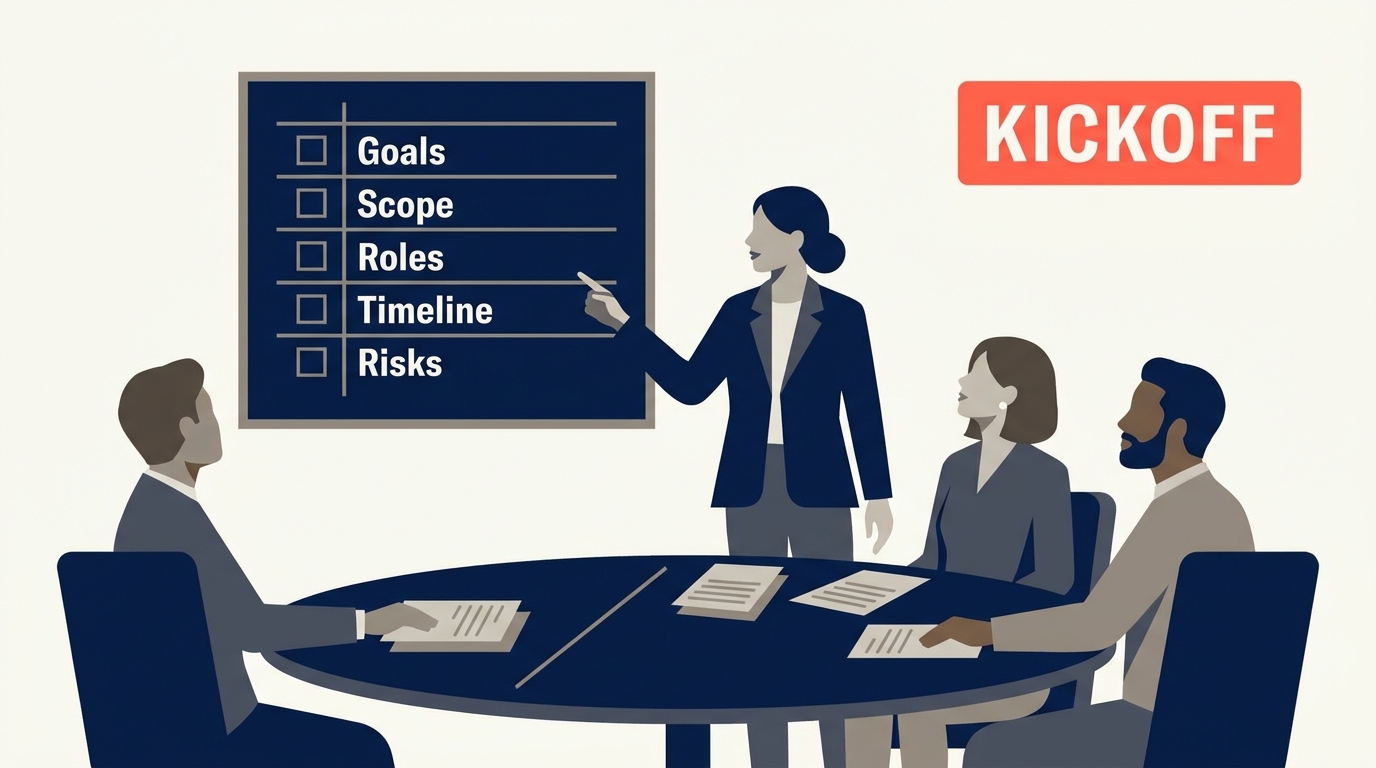
A good kickoff covers five things:
- Purpose and vision so everyone knows why the project exists
- Scope boundaries so the team knows what's in and what's out
- Roles and accountabilities using a framework like RACI
- Timeline and milestones so people can plan their own work
- Communication norms so the team knows how they'll stay coordinated going forward
Key facts
- PMI's Pulse of the Profession research found that 37% of projects fail due to unclear goals and objectives, the exact problem a kickoff is designed to prevent.
- According to PMI, organizations with standardized project management practices (which include formal kickoffs) waste 28 times less money than those without them.
- Research published by the Project Management Institute shows that roughly half of project budget risk is linked to ineffective communications, and the kickoff is where the comms plan gets established.
Internal vs. external (client) kickoff meetings
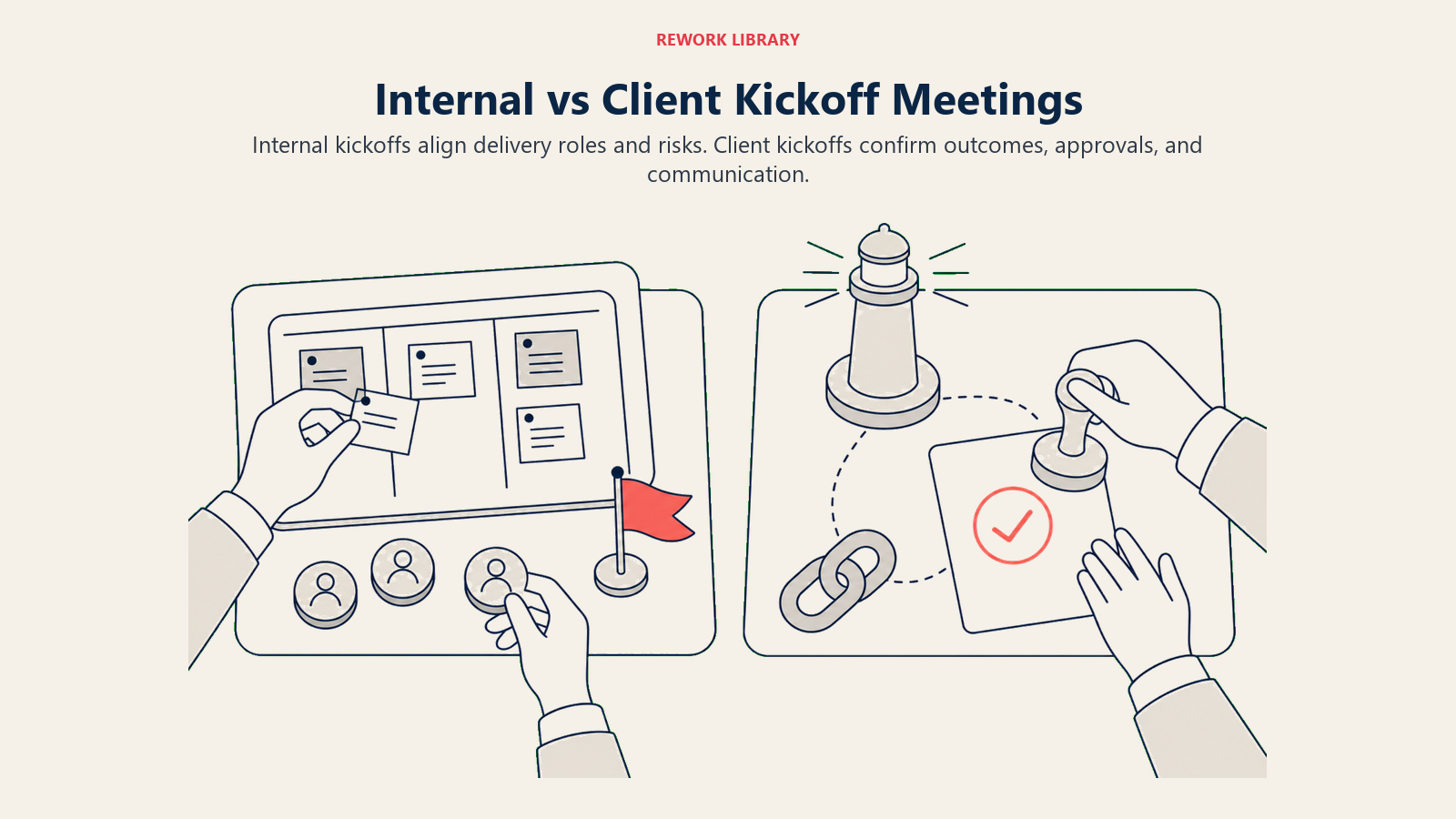
Not all kickoffs are the same. Teams often run two separate sessions: one facing inward for the delivery team, another facing outward for the client or end-user stakeholders. Here's how they differ:
| Dimension | Internal kickoff | External (client) kickoff |
|---|---|---|
| Audience | Core team, PM, functional leads | Client sponsor, business owners, key users |
| Focus | Roles, tasks, process, risk | Goals, deliverables, milestones, approvals |
| Tone | Tactical and candid | Strategic and relationship-building |
| Timing | Usually first | Usually second, after the internal session |
| Outputs | Task board, RACI, issue log | Signed-off scope, escalation path, comms plan |
The internal session gives the team space to surface concerns and agree on how they'll work together. The external session builds confidence with stakeholders that the team has a plan.
For internal projects (no external client), you'll typically run one kickoff that blends both perspectives.
Who should attend
Overcrowding a kickoff kills focus. But leaving out a critical voice creates gaps you'll pay for later. Here's a practical attendance guide:
| Role | Why they're there |
|---|---|
| Project sponsor | Signals organizational priority; approves scope and budget decisions |
| Project manager | Owns the agenda, facilitates the meeting, captures actions |
| Core team members | Understand their assignments and commit to the timeline |
| Functional leads | Represent their discipline (engineering, design, marketing, etc.) |
| Key stakeholders | Anyone whose approval, input, or buy-in the project depends on |
| Client / end users | In external projects: confirm requirements and agree on acceptance criteria |
People who should NOT be in the kickoff: anyone whose only connection to the project is passive awareness. Those people get the meeting notes, not a seat at the table.
Project kickoff meeting agenda
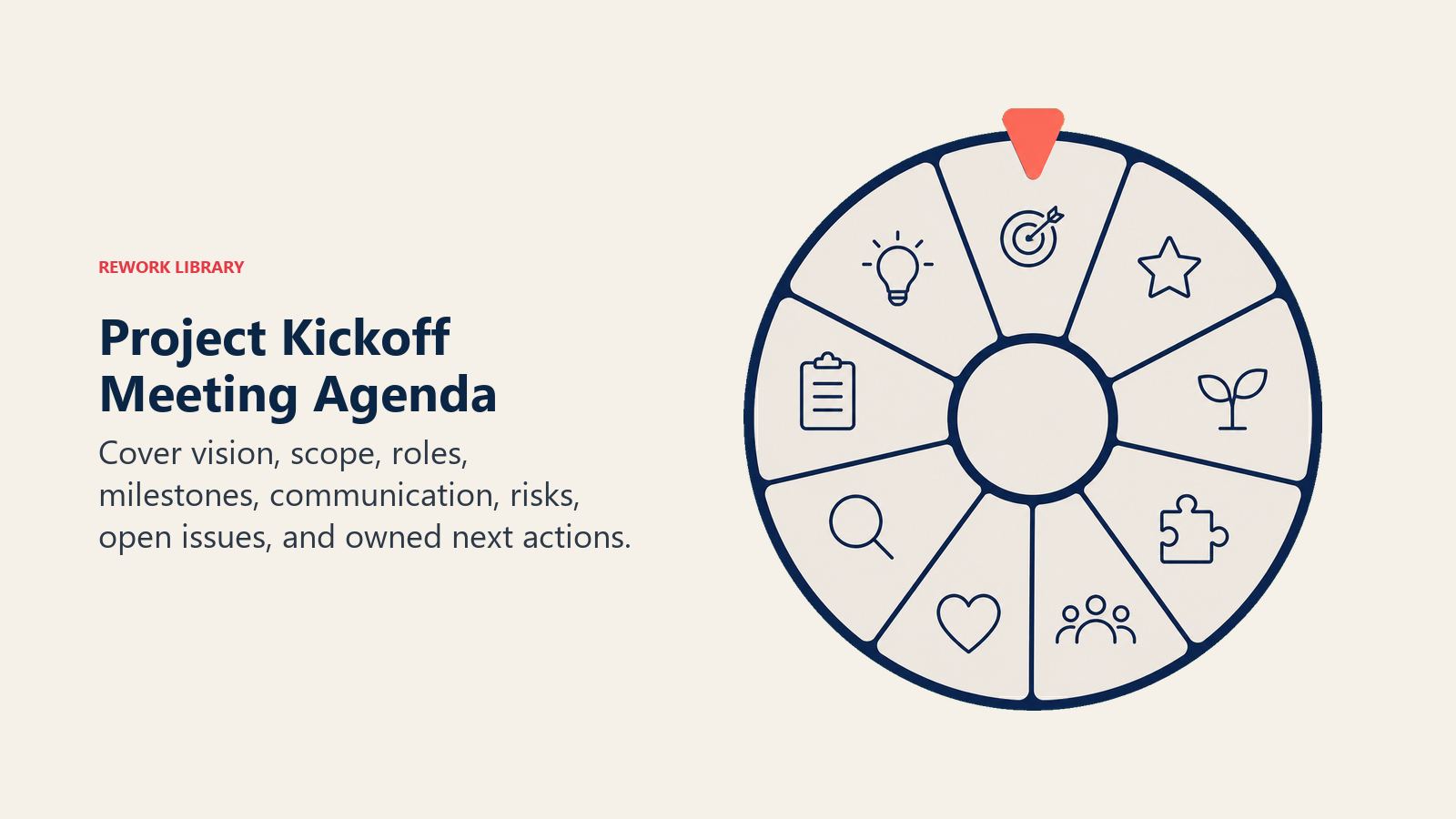
The agenda is the most important document you'll prepare before the meeting. A vague agenda produces a vague outcome. Use this template as a starting point, adjusting item durations to fit your project complexity.
| # | Agenda item | Owner | Time |
|---|---|---|---|
| 1 | Welcome and introductions | PM | 5 min |
| 2 | Project purpose and vision | Sponsor | 10 min |
| 3 | Scope: what's in, what's out | PM | 10 min |
| 4 | Roles and accountabilities (RACI review) | PM + leads | 10 min |
| 5 | Timeline and key milestones | PM | 10 min |
| 6 | Communication plan and meeting cadence | PM | 5 min |
| 7 | Known risks and initial RAID log | PM + team | 10 min |
| 8 | Questions and open issues | All | 10 min |
| 9 | Next steps and action items | PM | 5 min |
Total: 75 minutes for a mid-sized project. Scale down to 45 minutes for small projects, up to 2 hours for complex multi-team initiatives.
Send the agenda at least 48 hours in advance with any pre-read materials (project charter, scope document, draft timeline). People who arrive informed contribute more.
How to run a kickoff meeting
A great kickoff doesn't happen on the day. It's built in the week before it and followed up in the week after.
Step 1: Prepare thoroughly
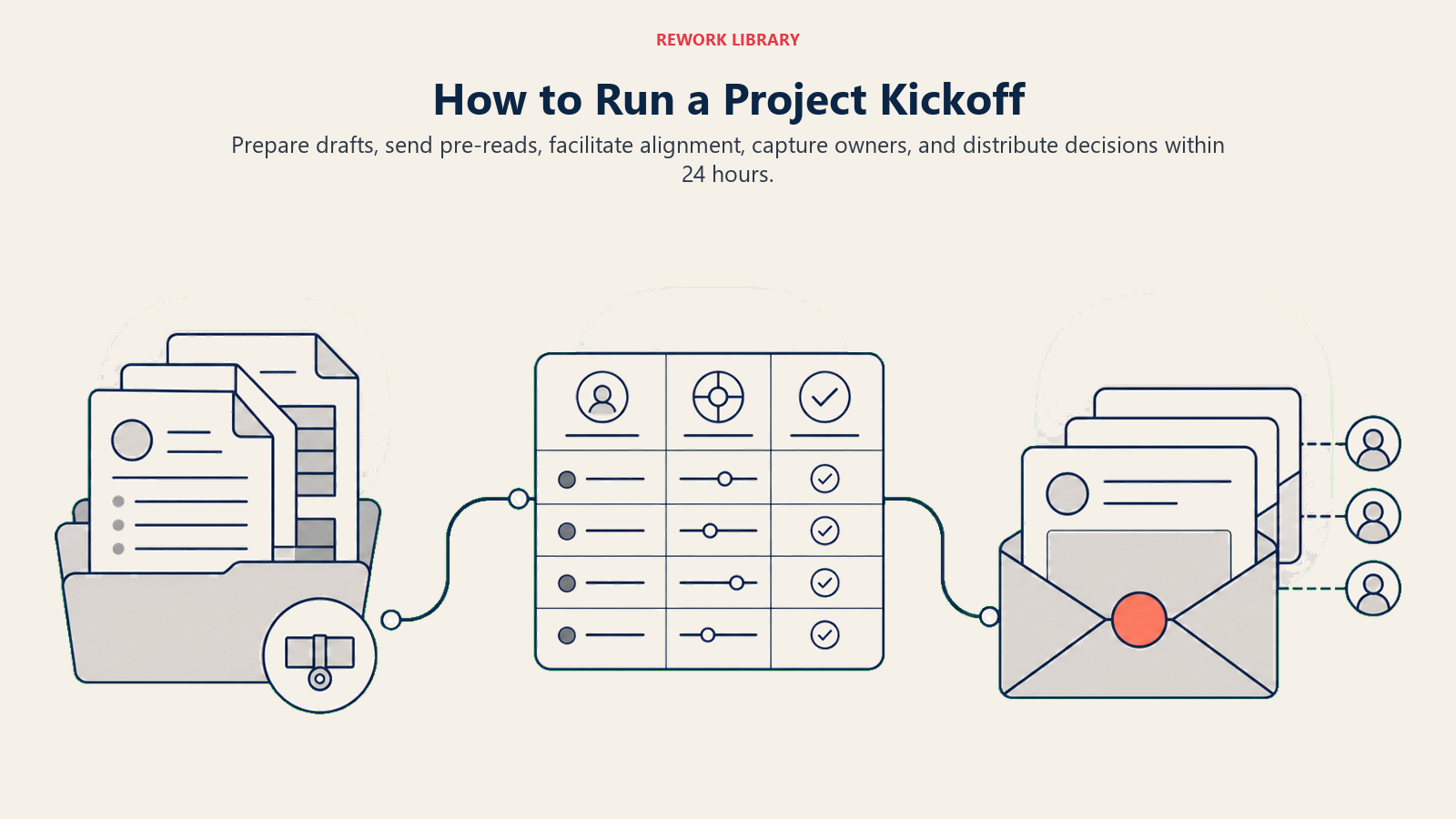
Pull together the project charter, stakeholder list, draft timeline, risk register, and proposed RACI matrix. Don't wait until they're perfect. A draft that the team can react to is more useful than a finished document they receive after the fact.
Create the meeting agenda and decide who facilitates each section. The PM usually facilitates, but having the sponsor open with the "why" gives the meeting strategic weight.
Step 2: Send pre-reads 48 hours out
Attach the relevant documents with a short note asking people to come with one question or concern about their area of responsibility. This prevents the kickoff from turning into a document-reading session.
Step 3: Facilitate, don't lecture
Keep each section tight. Your job as facilitator is to draw out alignment and surface disagreement, not to deliver a presentation. For each major section, close with a direct question: "Does everyone agree on this? Any concerns?"
Capture live on a shared screen so the team can see agreements being recorded in real time.
Step 4: Capture decisions and action items clearly
Every decision made in the room gets written down with a date. Every action item gets an owner and a due date. No owner, no deadline means no action. Use this format:
- Decision: [what was decided]
- Action: [what needs to happen] | Owner: [person] | Due: [date]
Step 5: Distribute the meeting notes within 24 hours
Send the notes while the meeting is still fresh. Include decisions, action items, the agreed scope, and a link to the shared project workspace. Ask for corrections within 48 hours. This short loop turns verbal alignment into documented commitment.
After the kickoff, set up the recurring project status report cadence and activate the communication plan that was agreed on in the meeting.
Project kickoff checklist
Use this checklist to make sure nothing falls through the cracks.
Before the meeting
- Project charter approved by sponsor
- Stakeholder analysis complete
- Agenda drafted and shared 48 hours in advance
- Pre-read documents attached (charter, scope, draft timeline, RACI)
- Meeting room or video link confirmed
- Facilitator and section owners confirmed
- Shared notes document prepared and open
During the meeting
- Introductions done (especially if cross-functional team is new to each other)
- Project purpose and success criteria stated clearly by sponsor
- Scope confirmed: in-scope and out-of-scope items documented
- RACI reviewed and agreed, or assigned for follow-up
- Milestones and key dates visible to all
- Communication plan (cadence, channels, escalation path) agreed
- Initial risks and dependencies captured in the RAID log
- Action items recorded with owners and due dates
After the meeting
- Meeting notes distributed within 24 hours
- Action item tracker set up and shared
- First status report scheduled
- Project workspace (task board, file storage) live and accessible
- Any absent stakeholders briefed directly
- Outstanding decisions flagged for follow-up
Common mistakes
Starting before the kickoff. Teams sometimes begin task work before the meeting happens "to save time." This creates scope assumptions that are hard to undo. The kickoff is the start line.
Skipping the sponsor. A kickoff without the project sponsor present signals to the team that leadership doesn't prioritize the work. Request at minimum a 5-minute sponsor opening, even asynchronously recorded.
No scope boundaries. Defining what the project will deliver without explicitly stating what it won't deliver is a setup for scope creep. Both sides of the line belong in the kickoff conversation.
Treating it as a presentation. If the PM talks for 70 of 75 minutes, the team leaves as passengers, not owners. Build in participation: ask for reactions, surface risks, invite the team to challenge the timeline.
Not following up on actions. The kickoff creates momentum. Letting actions drift in the first week destroys that momentum. Send notes fast and follow up hard in the first two weeks.
Skipping roles clarity. Agreeing on who owns what sounds basic, but teams regularly skip it and assume overlap will sort itself out. It doesn't. A 10-minute RACI walkthrough pays back multiples.
Making it too long. A 3-hour kickoff exhausts the team and buries decisions in noise. If your project complexity demands that much time, break it into two focused sessions.
Frequently Asked Questions about Project Kickoff Meeting
How long should a kickoff meeting be?
For most projects, 60 to 90 minutes is the right length. A small internal project might need only 45 minutes. A large program with cross-functional teams and an external client might justify up to 2 hours. Anything longer should be split across two sessions with a clear break. The goal is focused alignment, not comprehensive documentation. That happens in the follow-up.
What's the difference between a kickoff meeting and a planning meeting?
A planning meeting is where the team works through task-level details: estimates, dependencies, sprint planning, work breakdown. A kickoff meeting operates one level higher. It aligns everyone on why the project exists, what success looks like, who owns what, and how the team will communicate. The kickoff usually comes first and sets the context that planning meetings build on. You can think of the kickoff as answering "what are we doing and why?" while planning answers "how exactly will we do it?"
Who should facilitate a kickoff meeting?
The project manager typically facilitates. But the PM should share the floor: the sponsor opens with the strategic case, functional leads cover their domains, and the PM ties it together and captures actions. Pure solo facilitation by the PM often slides into a presentation rather than a working session.
What should I send before the kickoff?
At minimum: the agenda, the project charter or brief, and a draft timeline. If the RACI is ready, include it as a pre-read too. Ask people to come with one specific question or concern. This shifts the meeting from read-out to real conversation.
What if a key stakeholder can't attend?
Don't delay the kickoff for an indefinitely unavailable stakeholder. Record the session or prepare a short written summary, brief them within 24 hours, and get their documented alignment on scope and roles before the first major milestone. An absent stakeholder who is never looped in is a risk; one who receives a proper briefing and responds is not.
The kickoff meeting is where a project stops being an idea and becomes a commitment. Once it's done, the team has a shared foundation: a scope they agreed to, roles they own, a timeline they can plan against, and a communication plan that keeps everyone aligned through execution. The project life cycle has many phases, but the kickoff is the one that shapes all of them.
Set up the first project status report before the kickoff notes go out. When the team sees that the rhythm starts immediately, they know this project is being run with discipline.

Senior Operations & Growth Strategist
On this page
- What is a project kickoff meeting?
- Key facts
- Internal vs. external (client) kickoff meetings
- Who should attend
- Project kickoff meeting agenda
- How to run a kickoff meeting
- Step 1: Prepare thoroughly
- Step 2: Send pre-reads 48 hours out
- Step 3: Facilitate, don't lecture
- Step 4: Capture decisions and action items clearly
- Step 5: Distribute the meeting notes within 24 hours
- Project kickoff checklist
- Common mistakes