RACI Matrix Template and Examples: Ready-to-Use Formats for Every Project
Turn this article into takeaways for your work.


Each assistant summarizes the article only for you and suggests best practices for your work.
A RACI matrix assigns four roles, Responsible, Accountable, Consulted, and Informed, to every task in a project, so nobody has to guess who owns what. If you want the full definition and the thinking behind each letter, the RACI matrix guide covers that in depth.
This page skips the theory. It's a blank template you can copy right now, six worked examples across different project types, and the rules that keep a matrix useful past week one instead of turning into a document nobody opens again. If ownership of tasks isn't actually your problem, and what you're missing is a structure for decisions instead, jump straight to RACI vs RASCI vs DACI.
Key Facts
- PMI's 2026 Pulse of the Profession found that roughly a third of complex projects fail, "nearly twice the 13% rate of failure for projects overall," and complex projects are exactly the ones where ownership goes unstated.
- The PMBOK Guide, Eighth Edition (PMI, November 2025) is built on six core principles and seven performance domains, and resources, meaning the people doing the work and the roles they hold, is one of the seven.
- PMI states the rule that carries the whole model: "every task has exactly one Accountable person," with Accountable defined as "the single person who owns the outcome and answers for it." Every template below is built to hold that rule.
The blank RACI matrix template
Copy this straight into a spreadsheet or doc. Replace the bracketed labels with your own tasks and roles, then fill each cell with a single letter: R, A, C, or I. Leave a cell blank if that role has no involvement in that row at all.
| Task / Deliverable | [Role 1] | [Role 2] | [Role 3] | [Role 4] | [Role 5] |
|---|---|---|---|---|---|
| [Task or deliverable 1] | |||||
| [Task or deliverable 2] | |||||
| [Task or deliverable 3] | |||||
| [Task or deliverable 4] | |||||
| [Task or deliverable 5] | |||||
| [Task or deliverable 6] |
Legend: R = Responsible (does the work) · A = Accountable (owns the outcome, exactly one per row) · C = Consulted (gives input before the work happens, two-way) · I = Informed (gets updated after, one-way)
How to fill it in
- List deliverables down the left, not individual actions. Start at the deliverable level (a report, a release, a signed contract), not every micro-task. More on picking the right level below.
- List roles across the top, by name where possible. Job titles work for a template you're sharing widely, but real names remove the ambiguity that shows up the moment two people share a title. Pull the full list from a stakeholder analysis matrix if you have one, so nobody with a stake gets left off.
- Assign every Accountable first, before anything else. One A per row, no exceptions. This is the single assignment that actually prevents a task from stalling with no one answerable for it.
- Assign Responsible next. One is cleanest; two is workable if the work is genuinely shared; three or more usually means the row needs to split into smaller deliverables.
- Add Consulted and Informed last, and keep both short. Every C is someone the Responsible person has to wait on before starting. Every I is a notification someone has to read. Long C and I lists are usually where a matrix starts to rot.
- Walk the finished matrix past the people in it before calling it final. A matrix built alone and emailed out invites silent disagreement. Five minutes in a project kickoff meeting catches disputes before they turn into missed handoffs.
The rules that keep a matrix from rotting
A RACI matrix stops being useful the moment these get broken, usually without anyone noticing until a task slips.
| Rule | Why it matters | What happens when it's broken |
|---|---|---|
| Exactly one A per row | One person is answerable if the task fails, full stop | Two As means neither person actually feels on the hook; zero As means no one does |
| R can be shared, but rarely should be | Multiple people can do the work | Three or more Rs on one row is usually a sign the row should be split into separate deliverables |
| C is two-way, not a courtesy | Consulted people are asked before the work happens and their input can change it | Treating C as optional turns real input into a rubber stamp after the fact |
| I is one-way, and it should stay short | Informed people get told, they don't get asked | A bloated I list trains people to stop reading updates altogether |
Six worked RACI matrix examples
Each example below is a full matrix for a real scenario, not a fragment. Swap in your own roles and tasks, but notice the pattern: one A per row holds in every single one.
1. Software release or product launch
| Task | Product Manager | Engineering Lead | QA Lead | DevOps | Support Lead | Marketing |
|---|---|---|---|---|---|---|
| Define release scope | A | R | C | I | I | I |
| Build and code review | I | A/R | C | I | ||
| Test release candidate against definition of done | I | C | A/R | |||
| Prepare rollback plan | C | C | A/R | |||
| Write release notes | A | C | R | C | ||
| Deploy to production | I | C | I | A/R | ||
| Monitor post-release metrics | I | A | R | I | ||
| Handle customer-facing comms | I | C | A/R |
The Engineering Lead holds A on two rows and R on two others, which is normal for a technical lead close to the work. Notice QA only shows up where testing actually happens, not on every row, which is what keeps their C load manageable.
2. Marketing campaign
| Task | Marketing Manager | Content Writer | Designer | Paid Media Specialist | Sales Lead | Legal |
|---|---|---|---|---|---|---|
| Approve campaign brief | A | C | C | C | ||
| Write campaign copy | A | R | C | C | ||
| Design creative assets | A | C | R | |||
| Legal and compliance review | I | A/R | ||||
| Set up paid ad campaigns | A | I | R | |||
| Launch campaign | A | R | I | |||
| Hand qualified leads to sales | I | A/R | ||||
| Report results to stakeholders | A/R | C | I |
Legal is Consulted early (copy and creative) and Accountable once (the formal review), a common split: input everywhere the work could create risk, ownership only on the sign-off itself.
3. New-hire onboarding
| Task | HR / People Ops | Hiring Manager | IT | New Hire | Buddy |
|---|---|---|---|---|---|
| Send offer letter and paperwork | A/R | I | |||
| Provision accounts, laptop, and system access | C | I | A/R | I | |
| Assign an onboarding buddy | R | A | I | I | |
| Run first-day orientation | A/R | C | C | ||
| Complete compliance and policy training | C | A/R | |||
| Run 30-60-90 day check-ins | C | A/R | I | I |
This is a case where Accountable moves between HR and the Hiring Manager depending on the row instead of sitting with one person for the whole process, which is normal: onboarding spans two functions and neither owns all of it.
4. ERP or system implementation
| Task | Project Sponsor | Project Manager | IT / Systems Admin | Department Leads | Implementation Vendor |
|---|---|---|---|---|---|
| Sign off on requirements and scope | A | R | C | C | C |
| Configure system and workflows | I | I | C | A/R | |
| Migrate legacy data | I | C | A/R | C | C |
| Test workflows against requirements | I | I | C | A | R |
| Train end users | I | A | C | C | R |
| Approve go-live cutover | A | R | C | C | C |
| Provide post go-live support | I | I | A/R | I | C |
Match the vendor's obligations here against whatever's written into your statement of work. A vendor holding R on configuration and training without a matching SOW clause is a gap worth closing before the contract is signed, not after go-live.
5. Event or office move
| Task | Event / Move Lead | Facilities | IT | Department Heads | Vendor / Movers |
|---|---|---|---|---|---|
| Select venue or new site | A/R | C | I | ||
| Book vendor contracts | I | A/R | C | ||
| Plan floor layout or agenda | A/R | C | C | C | |
| Coordinate IT relocation or AV setup | I | C | A/R | ||
| Communicate timeline to staff | A/R | I | I | C | |
| Execute moving or event day | A | R | R | I | R |
| Post-move or post-event wrap-up | A/R | C | I |
Moving day is the one row with three Rs at once (Facilities, IT, and the vendor all doing physical work in parallel), which is fine because it's a single day of coordinated execution, not an ongoing shared deliverable that would otherwise need splitting.
6. Small-team RACI (one person holds several letters)
A three-person team relaunching a company website: a Founder, a contract designer/developer, and a contract marketer. No department heads, no committee, just three people and a deadline.
| Task | Founder | Designer / Developer | Marketing Contractor |
|---|---|---|---|
| Approve final scope and budget | A | I | I |
| Design and build the site | A | R | I |
| Write site copy | A | I | R |
| QA and review before launch | A/R | C | |
| Launch the site | I | A/R | |
| Promote the launch | C | A/R |
The Founder is A on five of six rows, which would be a warning sign on a 40-person program but is exactly right here: on a three-person team, the person funding the work is supposed to be the accountable party almost everywhere. What still matters is that Responsible moves around instead of piling onto one person, and that each contractor gets full ownership (A and R together) on the row that's genuinely theirs.
How to read a broken matrix
A matrix can look complete and still be broken. These are the patterns to scan for before you trust one.
| Broken pattern | What it actually means | Fix |
|---|---|---|
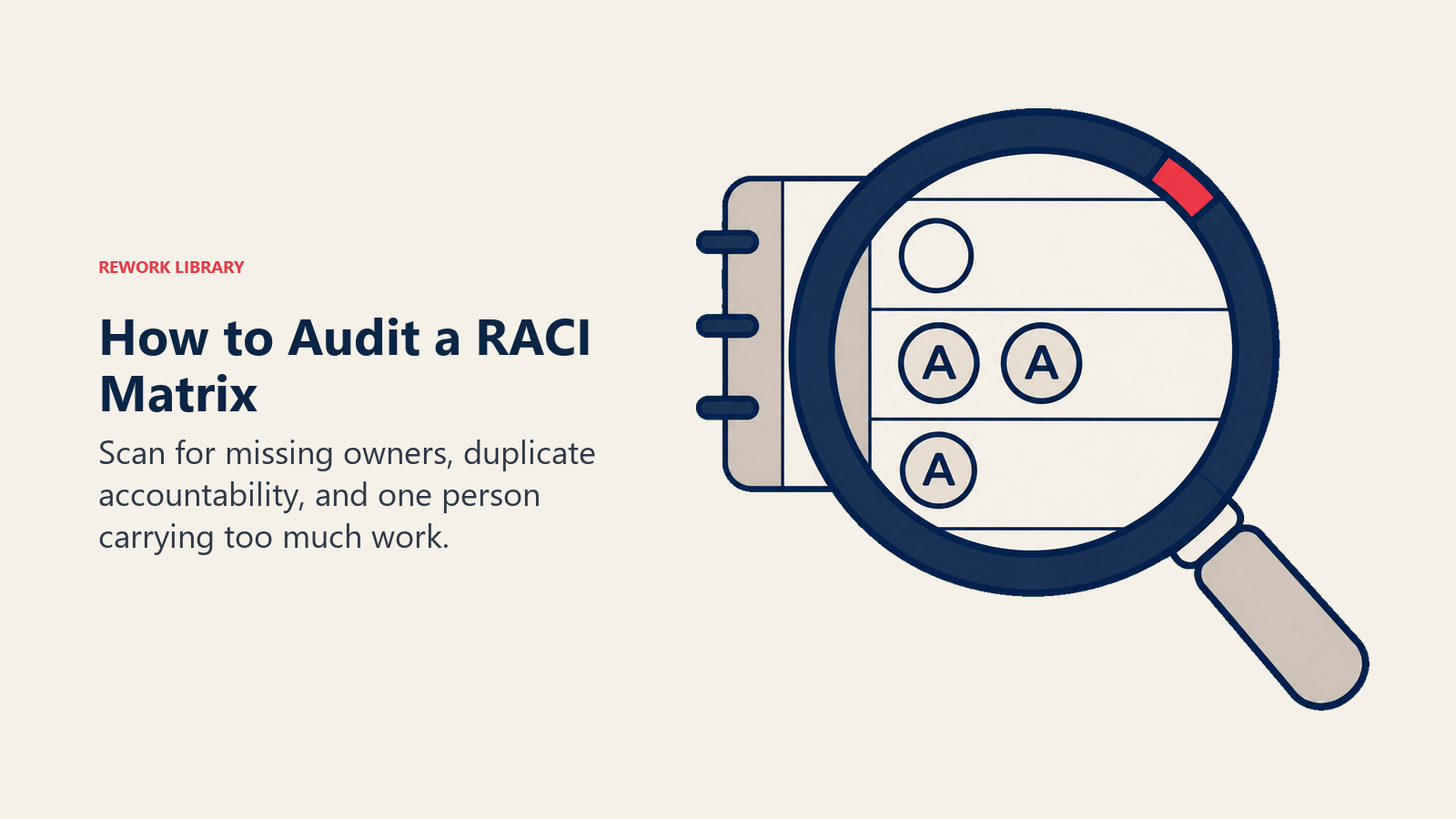
| A row with no A | No one is answerable if that task slips, even if several people are working on it | Assign exactly one Accountable, even if it's the same person already marked R |
| A row with two or more As | Two people believe they have final say, which in practice means neither one does | Pick one. Move the other to Consulted |
| A column that's all C, every single row | That person is being asked for input on everything, whether or not it's relevant to them | Check whether they need to be on the matrix for every row, or only where their expertise actually applies |
| One person is R on nearly every row | Delivery is concentrated in a single point of failure | Redistribute some rows to a second Responsible, or move to a shared-execution model like RASCI |
| A known stakeholder appears nowhere on the matrix | Someone with a real stake in the outcome was never mapped | Cross-check the finished matrix against your stakeholder analysis matrix |
| The Informed column keeps growing every review | Informed has turned into a catch-all instead of a deliberate one-way list | Prune it. Not everyone needs every update, and a long I list trains people to stop reading |
Choosing the right granularity
The most common way a RACI matrix goes wrong isn't a bad letter assignment, it's picking the wrong level of detail to build it at in the first place.
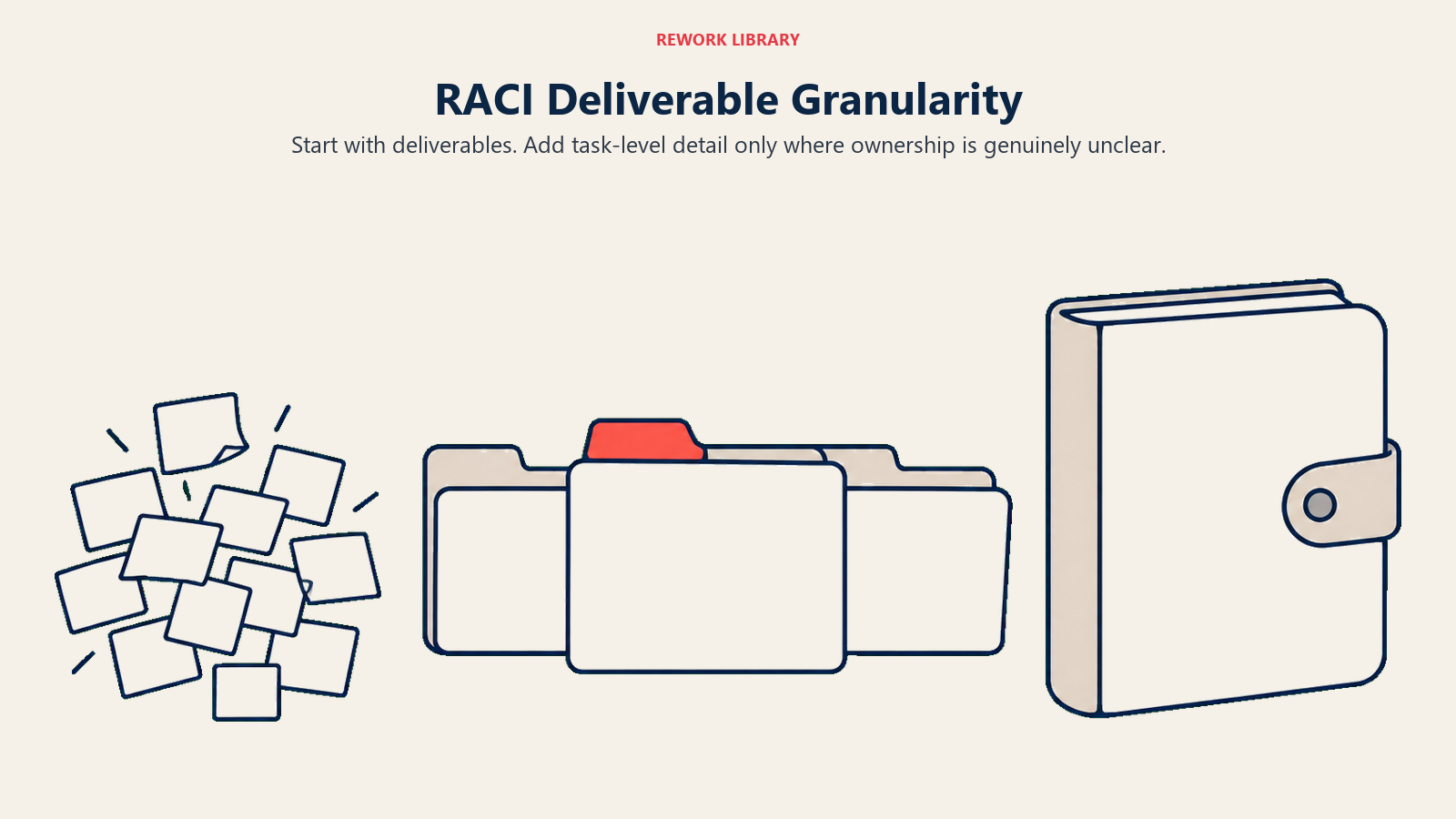
| Granularity | Typical row count | Best for | Risk of picking it by mistake |
|---|---|---|---|
| Task level | 20-50+ rows | Short sprints or single-team execution where each discrete action needs a named owner | Unreadable past a few dozen rows, and updates lag behind reality within a week |
| Deliverable level | 8-20 rows | Most cross-functional projects; this is the right default to start with | Occasionally too coarse to catch who owns the sub-steps inside one deliverable |
| Phase level | 4-10 rows | Multi-month programs, executive summaries, ERP or system rollouts | Too vague for day-to-day execution; hides where the actual work sits |
Start at the deliverable level almost every time. If your source list is a full work breakdown structure, don't map every leaf node; map the deliverables that sit above them, then drop to task level only for the two or three deliverables where ownership is genuinely contested. A matrix past 40-50 rows has usually stopped being a matrix anyone actually reads and turned into a spreadsheet people search instead.
Common RACI matrix mistakes
| Mistake | Fix |
|---|---|
| Building the matrix alone and circulating the final version | Build it with the people in it, or at minimum walk them through it before it's locked |
| Letting the matrix go stale once the project starts | Revisit it at every phase change or staffing change, not only at kickoff |
| Using job titles instead of names | Names remove the ambiguity that shows up the moment two people share a title |
| Skipping the legend | Spell out what R, A, C, and I mean at the top of every matrix, even for experienced teams |
| Treating Consulted as optional | A person marked C is required input before the work proceeds, not a courtesy heads-up |
| Forcing a decision into a RACI row | Route decisions (go/no-go, budget, prioritization) through a DACI-style model instead of stretching RACI to cover them |
Where the matrix lives after it's built
A RACI matrix that only exists in the kickoff deck is a matrix nobody checks again. Build it once, then plug it into the points in the project where ownership actually gets tested.
| Stage | What the matrix does there |
|---|---|
| Project kickoff meeting | Confirms every task has a named owner before any work starts, while it's still cheap to fix a gap |
| Ongoing status reporting | Anchors who reports on what, and who gets escalated to when something slips |
| Mid-project changes | Gets updated the moment scope, staffing, or a vendor changes; log the change itself in a RAID log so the reason isn't lost |
| Ongoing stakeholder updates | Feeds directly into a communication plan: the I column is your one-way distribution list, the C column is who needs a conversation, not just an email |
| Project closure and handover | Becomes the record of who owned what, which is exactly the kind of evidence the next project's baseline needs |
When RACI stops working
RACI assumes the output of every row is a deliverable someone completes. The moment a row is actually a decision, a go/no-go, a budget call, a prioritization fight, RACI starts to strain. You'll see it as arguments over whether something belongs in the A column or a decision that never quite gets made because everyone's Consulted and no one's clearly driving it.
That's the signal to stop forcing it and switch models for that row, or for that entire workstream. The full breakdown of when to use RACI vs RASCI vs DACI covers how to tell the difference and how to run both side by side without the two matrices contradicting each other.
A RACI matrix earns its keep in the conversation it forces before work starts, not in the document itself. Copy the blank template above, fill it in with the people it actually affects instead of alone at your desk, and revisit it the moment scope or staffing changes. One Accountable per row, a Responsible list that doesn't overload one person, and a Consulted and Informed list short enough that people actually read it: that's the whole system, and it scales from a three-person website relaunch to a multi-vendor ERP rollout without changing shape.

Senior Operations & Growth Strategist
On this page
- The blank RACI matrix template
- How to fill it in
- The rules that keep a matrix from rotting
- Six worked RACI matrix examples
- 1. Software release or product launch
- 2. Marketing campaign
- 3. New-hire onboarding
- 4. ERP or system implementation
- 5. Event or office move
- 6. Small-team RACI (one person holds several letters)
- How to read a broken matrix
- Choosing the right granularity
- Common RACI matrix mistakes
- Where the matrix lives after it's built
- When RACI stops working