RACI vs RASCI vs DACI: Responsibility Matrix Variants Compared
Turn this article into takeaways for your work.


Each assistant summarizes the article only for you and suggests best practices for your work.
RACI vs RASCI is one of the most common questions project managers ask once they've outgrown a basic task list. Pick the wrong variant and you end up with duplicate work, missed hand-offs, or no one sure who actually owns a decision.
This guide breaks down RACI, RASCI, and DACI so you can match the right model to your project in minutes, not meetings.
What is a responsibility assignment matrix?
A responsibility assignment matrix (RAM) maps every task or decision in a project to a named role. It answers two questions for every item: who does the work, and who has the final say. Without it, teams default to informal assumptions, and those assumptions break down the moment scope grows or headcount changes.
The most widely used format is the RACI matrix, but variations like RASCI and DACI have emerged to handle specific gaps: shared execution across large teams, or a clearer split between operational tasks and executive decisions.
Key Facts
- Organizations with clearly defined roles and responsibilities are 53% more likely to finish projects on time (PMI, 2023 Pulse of the Profession).
- 25% of project failures are attributed to unclear ownership and poor communication (Wellingtone, 2022 State of Project Management).
- Teams that document decision rights report 20% fewer escalations during execution (McKinsey Organizational Health Index, 2022).
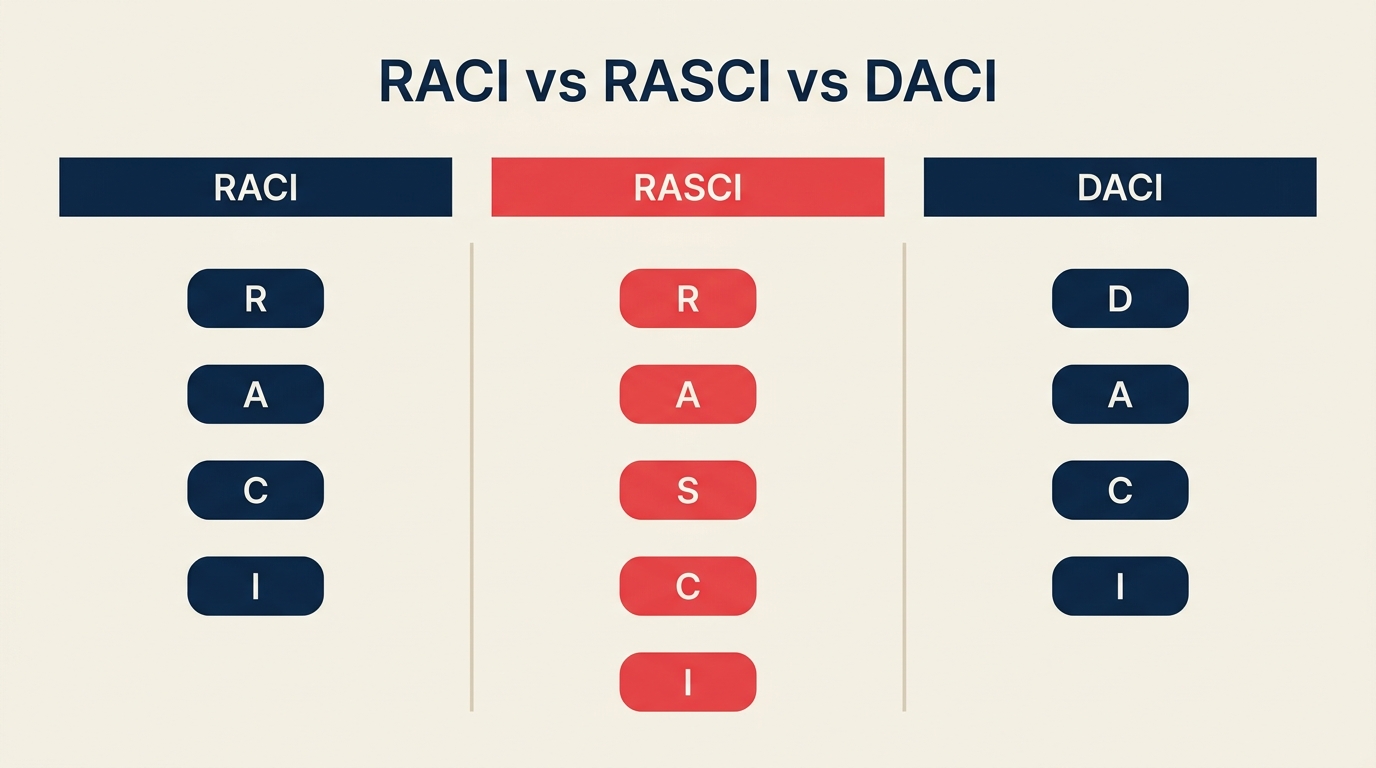
RACI vs RASCI vs DACI at a glance
| Model | Letters | Best for | Main weakness |
|---|---|---|---|
| RACI | Responsible, Accountable, Consulted, Informed | Task-heavy projects with clear owners | Doesn't show support roles; can leave shared execution ambiguous |
| RASCI | Responsible, Accountable, Support, Consulted, Informed | Projects where multiple people pitch in without full ownership | Adds complexity; "Support" can blur with "Responsible" if not defined well |
| DACI | Driver, Approver, Contributor, Informed | Decision-heavy processes (product strategy, budget, org change) | Less suited for operational task tracking |
| CARS | Communicate, Approve, Responsible, Support | Fast-moving product teams | Rarely used outside Silicon Valley circles |
| RAPID | Recommend, Agree, Perform, Input, Decide | Executive decision frameworks | Complex; better for governance than day-to-day PM |
CARS and RAPID are worth knowing but aren't covered in depth here. The three you're most likely to choose between are RACI, RASCI, and DACI.
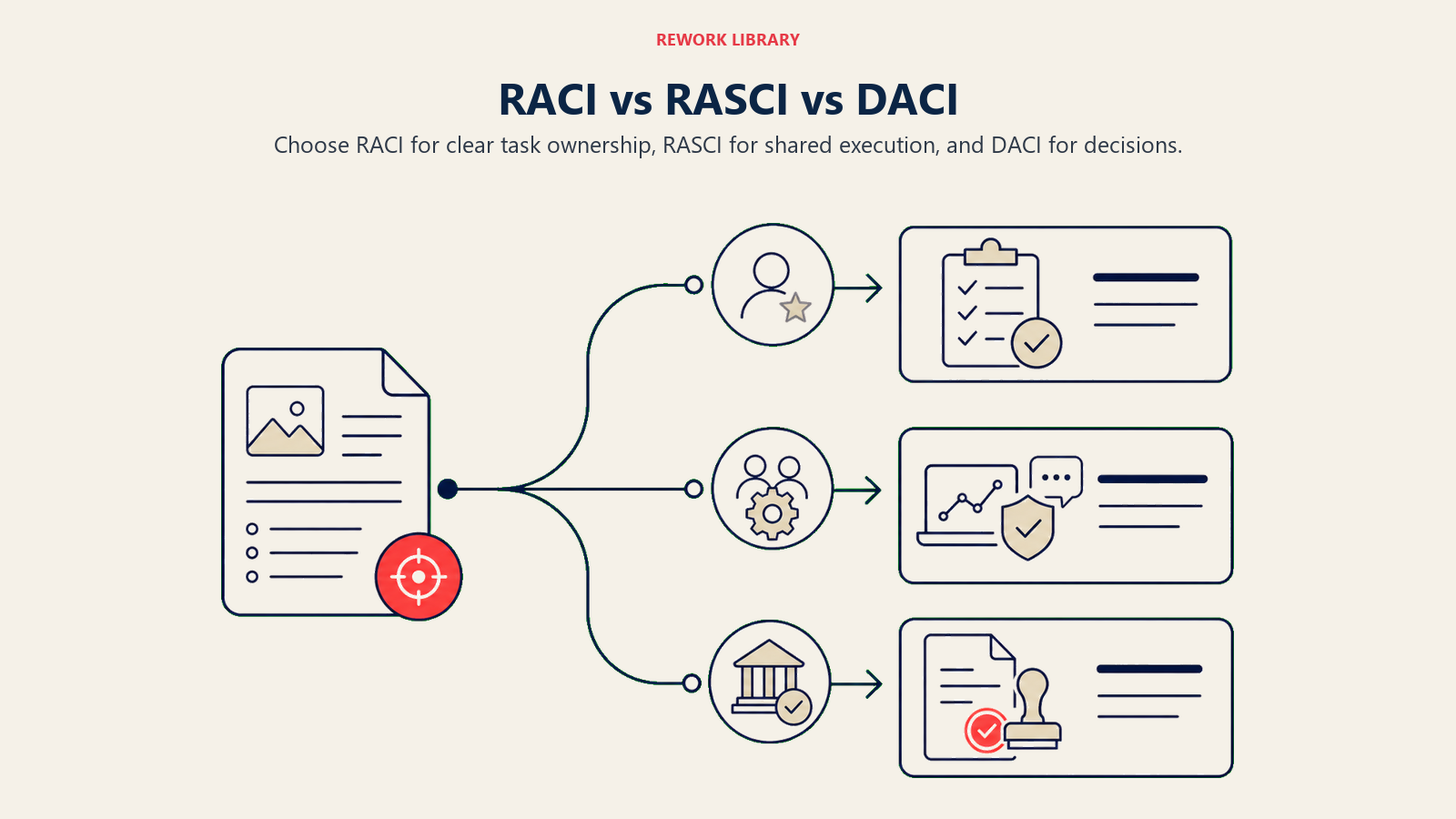
RACI
Letters: Responsible, Accountable, Consulted, Informed
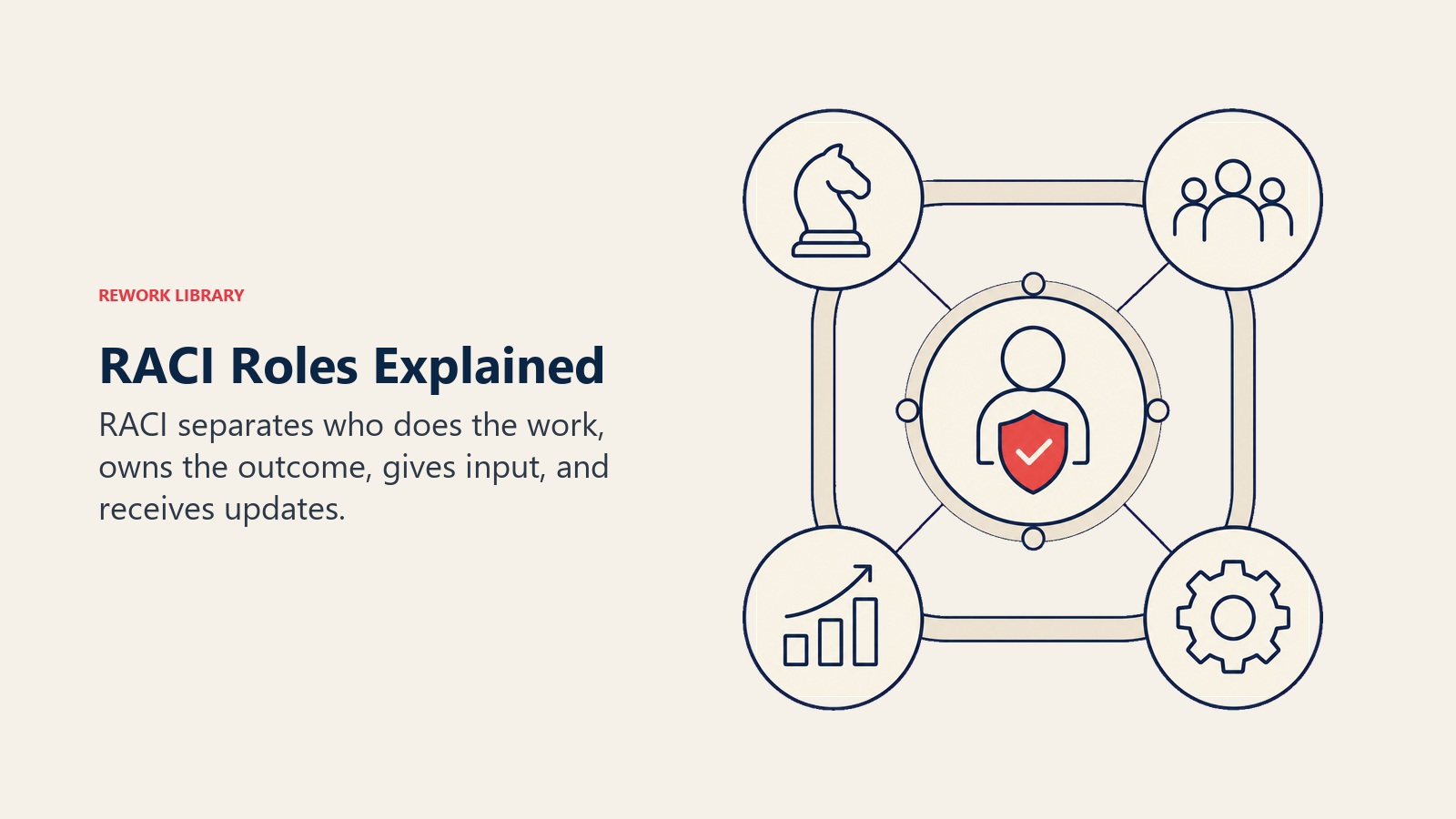
- Responsible (R): Does the work. There can be multiple Rs on a task, though a single R is cleaner.
- Accountable (A): Owns the outcome. One person only. Signs off that R delivered correctly.
- Consulted (C): Provides input before the work happens. Two-way communication.
- Informed (I): Gets updated after the fact. One-way communication.
When to use RACI: It's the right default for most project management scenarios: software rollouts, process documentation, event planning, or any situation where the work is task-based and you need someone to be on the hook for each deliverable. The full RACI deep-dive covers construction, common pitfalls, and a free template.
Weakness: RACI doesn't distinguish between people who are "helping" versus people who "own." On projects where two or more people share execution, you'll see multiple Rs on every row, which quickly becomes confusing.
RASCI
Letters: Responsible, Accountable, Support, Consulted, Informed
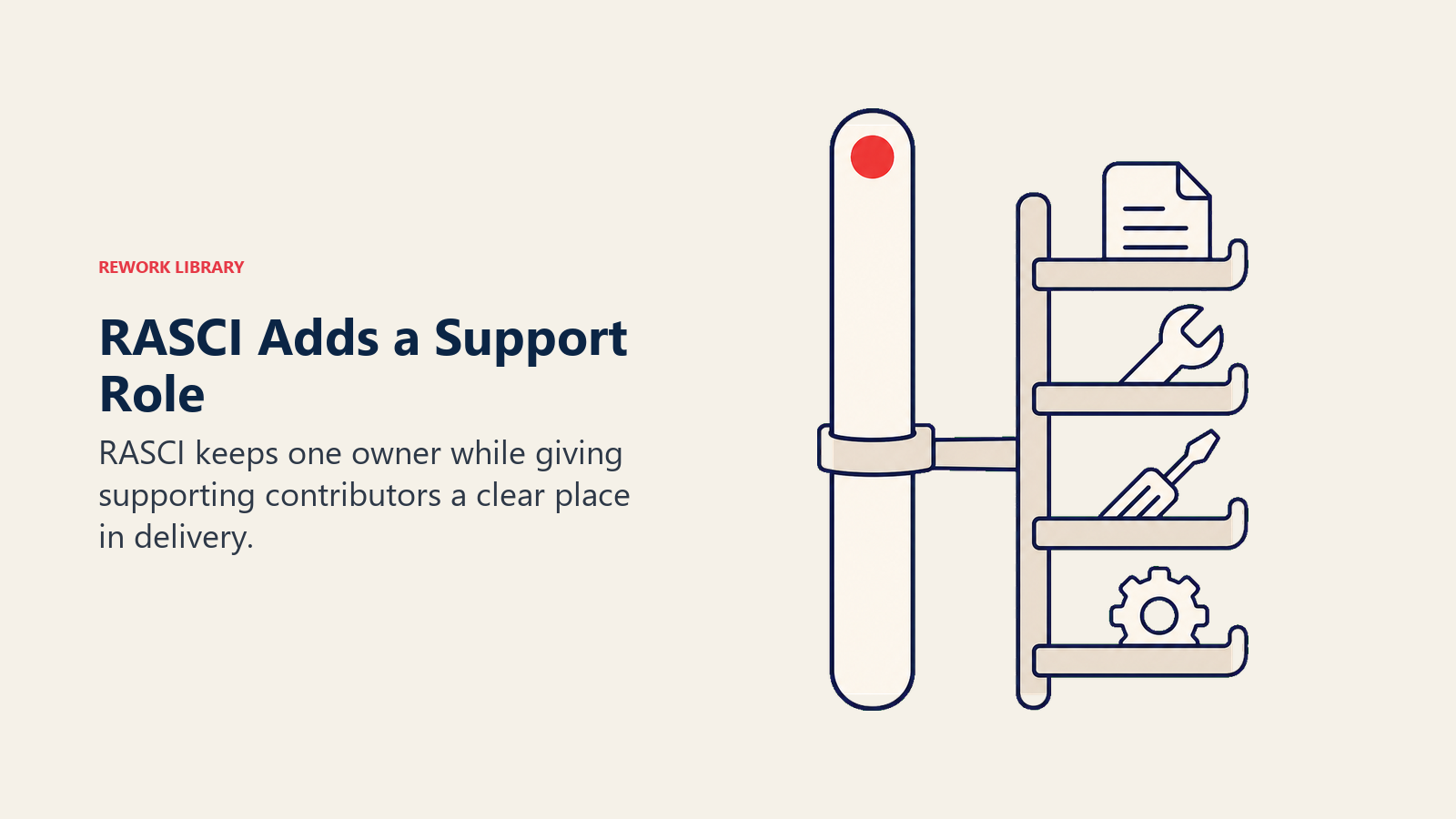
RASCI (sometimes spelled RASIC) adds one role between R and A:
- Support (S): Assists the Responsible person but doesn't own the task. Provides resources, capacity, or specialist skills on request.
The distinction matters when your Responsible person can't complete the task alone but you don't want to give multiple people equal ownership. Support roles handle the "help" without muddying accountability.
Example: A content manager (R) writes a product brief. A legal reviewer (S) contributes a compliance section. The CMO (A) approves. Without the S role, legal either gets listed as a second Responsible (implying ownership they don't have) or gets bumped to Consulted (implying their input is optional).
When to use RASCI: Any project with cross-functional collaboration where one team drives but others contribute work. Common in marketing campaigns, product launches, and annual reporting cycles. It pairs well with a communication plan that spells out how S-role contributors get briefed and debriefed.
Weakness: Teams that don't define "Support" precisely will watch it collapse into a second Responsible. Run a 15-minute kickoff to distinguish "S means you do specific tasks on request" from "R means you own delivery."
DACI
Letters: Driver, Approver, Contributor, Informed
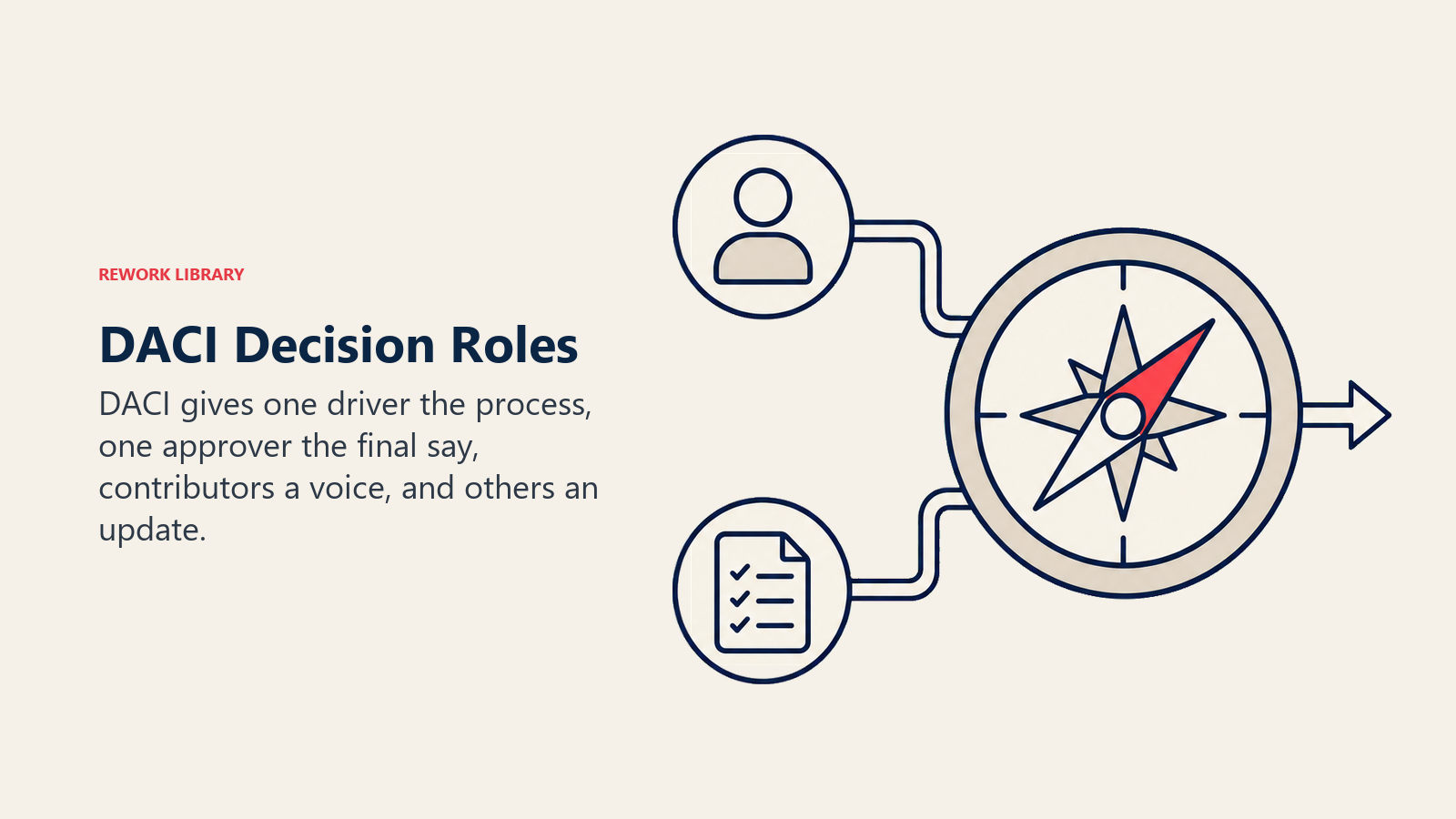
DACI is purpose-built for decisions, not tasks:
- Driver (D): Moves the decision forward. Gathers input, sets timeline, runs the process. One person only.
- Approver (A): Has final say. One person. If there's no clear single Approver, escalate before the DACI is built.
- Contributor (C): Provides input before the decision is made. Like RACI's Consulted, but the label "Contributor" signals active participation rather than passive expertise.
- Informed (I): Notified once the decision is made.
When to use DACI: Product roadmap prioritization. Budget allocation. Hiring decisions. Organizational restructuring. Any scenario where the output is a yes/no or a chosen option rather than a completed deliverable. DACI complements a project charter well: use the charter to define scope and objectives, then DACI to clarify who decides what inside that scope.
Weakness: DACI doesn't track execution well. Once the decision is made, you'll need RACI or RASCI to manage the work that follows.
How to choose between RACI, RASCI, and DACI
Step 1: Identify whether you're mapping tasks or decisions
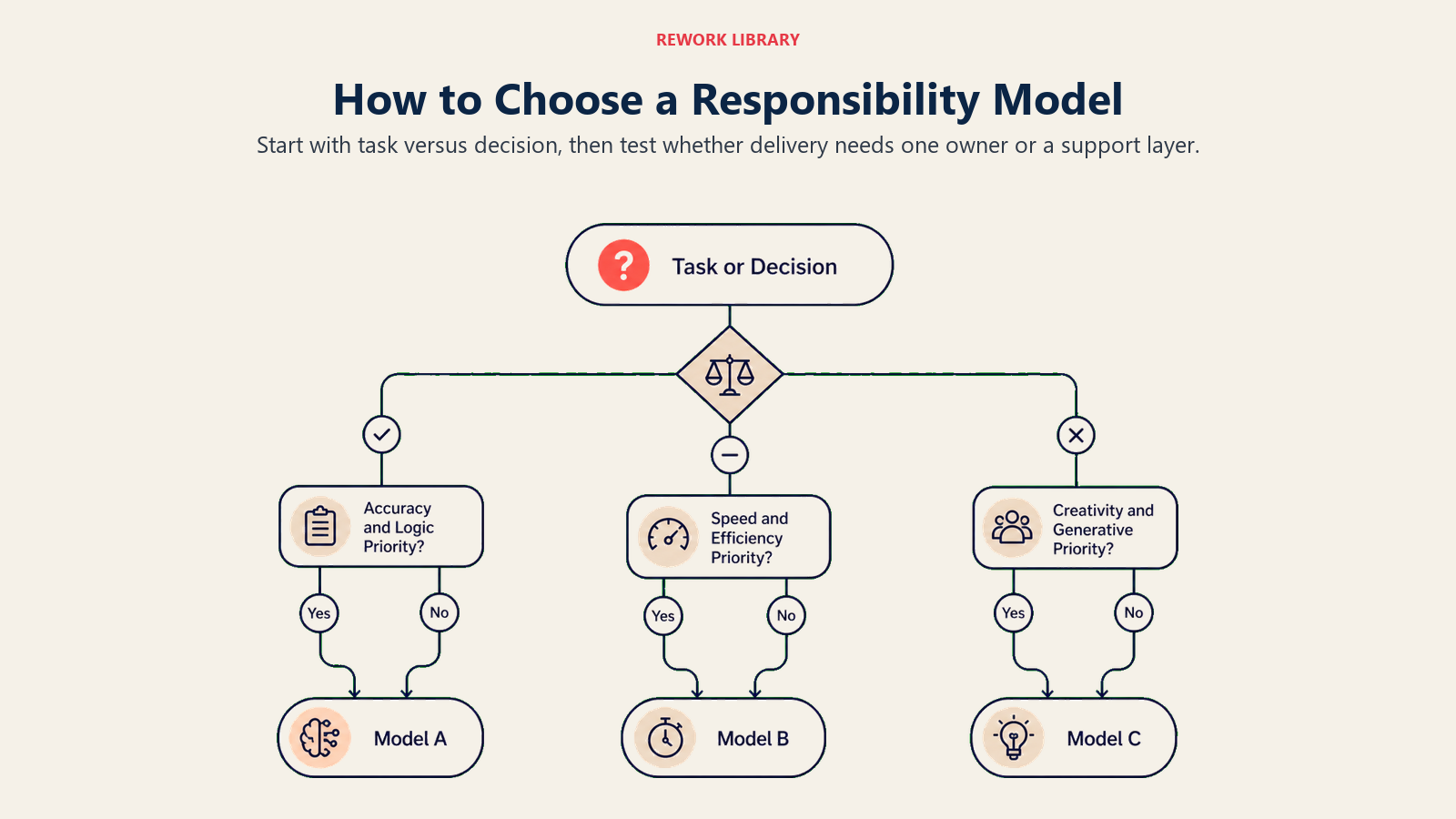
Ask: "Is the output a deliverable (document, feature, report) or a resolution (go/no-go, budget number, policy)?"
- Deliverable outputs: start with RACI. If multiple people share execution, add the S layer and use RASCI.
- Resolution outputs: use DACI.
Most projects need both. A product launch might use DACI for the pricing decision and RACI (or RASCI) for the execution plan. Keep them as separate matrices or clearly labeled tabs.
Step 2: Count your R's per row
Build a draft RACI. If more than two rows in your task list have three or more Rs, your project has shared-execution complexity. That's the signal to switch to RASCI: keep one primary R, and move everyone else into S.
A quick gut-check for team size:
| Scenario | Recommended model |
|---|---|
| Small team (under 8 people), clear task owners | RACI |
| Cross-functional team, shared execution | RASCI |
| Leadership or governance decisions | DACI |
| Complex org with layered decisions + task delivery | DACI for decisions, RASCI for execution |
If you're still unsure, RACI is the safest starting point. You can always add the S column once the matrix is live and you spot the pattern.
Examples
Software product launch (RASCI)
| Task | Product Manager | Engineering Lead | UX Designer | Legal | CEO |
|---|---|---|---|---|---|
| Define feature requirements | R | C | C | A | |
| Write technical spec | S | R | C | ||
| Design UI flows | C | S | R | ||
| Review compliance | R | A | |||
| Launch go/no-go | D (using DACI) | C | C | C | A |
The final row switches to DACI because "launch go/no-go" is a decision, not a deliverable. This hybrid approach is common and works well as long as the labels are clearly explained in the matrix header.
Annual budget allocation (DACI)
| Decision | CFO | CEO | Dept Heads | Finance Analyst |
|---|---|---|---|---|
| Total budget envelope | C | A | I | D |
| Dept-level allocations | D | A | C | S* |
*If this were a RASCI execution task, the Finance Analyst would be S. In DACI, there's no official S role, so you can annotate it or keep them as a second Contributor.
Common mistakes
1. Multiple Accountables on one task. One A per row, always. If two people need to sign off, one of them is Consulted (or Approver in DACI). Two As means no one is truly accountable.
2. Confusing Support and Responsible in RASCI. Write a one-sentence definition next to the legend: "R owns the deliverable. S provides resources or completes assigned sub-tasks on request but does not own the outcome." Review it in kickoff.
3. Building DACI when you need RACI. A common mistake on projects where stakeholders are nervous about ownership. DACI feels less threatening because "Driver" sounds less loaded than "Responsible." But if you're tracking work delivery rather than a decision, DACI will leave gaps. Use the right tool.
4. Skipping the matrix on small projects. Even a 3-person sprint benefits from a lightweight RACI. Without it, "whoever's free" becomes the de facto assignment model, which scales poorly. Pair a slim RACI with your RAID log to keep risks and ownership in one view.
5. Ignoring the Informed column. Informed stakeholders are often the source of late-stage surprises when they're left out. Keep I lists current. A stakeholder analysis matrix can feed directly into who belongs in the I column.
Picking your model and getting to work
Start with the question that matters: task or decision? If it's a task, RACI is your default and RASCI is your upgrade when shared execution is a reality. If it's a decision, DACI gives you the clearest structure for who drives, who decides, and who hears about it afterward.
A well-built matrix won't eliminate conflict, but it does eliminate the excuse of "I didn't know that was mine." For a practical walkthrough of building RACI from scratch, the RACI matrix deep-dive is the place to start. Pair it with MoSCoW prioritization to make sure you're only building matrices for work that belongs in the project scope in the first place.

Senior Operations & Growth Strategist
On this page
- What is a responsibility assignment matrix?
- RACI vs RASCI vs DACI at a glance
- RACI
- RASCI
- DACI
- How to choose between RACI, RASCI, and DACI
- Step 1: Identify whether you're mapping tasks or decisions
- Step 2: Count your R's per row
- Examples
- Software product launch (RASCI)
- Annual budget allocation (DACI)
- Common mistakes
- Picking your model and getting to work