Project Deliverables: Definition, Types, and Examples

Turn this article into takeaways for your work.


Each assistant summarizes the article only for you and suggests best practices for your work.
Ask five people on a project team to name "the deliverables" and you'll usually get five different answers, some of them tasks, some of them goals, one of them probably a milestone date. That confusion is not a vocabulary problem. It's a planning problem, because a deliverable is the one unit of project work that gets formally accepted or rejected, and if the team can't agree on what counts as one, nobody can agree on what "done" means either.
Key Facts
- PMI's own scope-statement guidance describes deliverables as "major, summary-level items whose full and satisfactory delivery marks completion of the project," a definition PMI has used consistently in its project scope guidance.
- The PMBOK Guide, Eighth Edition (PMI, November 2025) is the current standard and names scope, the domain that governs what a project must deliver, as one of seven performance domains alongside governance, schedule, finance, stakeholders, resources, and risk.
- PMI's Pulse of the Profession research (2014, "The High Cost of Low Performance" series) found that nearly half, 47%, of unsuccessful projects fail to meet their goals due to inaccurate requirements management, the same gap that shows up later as deliverables nobody can agree were actually finished.
- The Scrum Guide defines an Increment, agile's version of a deliverable, as usable the moment it meets the team's Definition of Done: "The moment a Product Backlog item meets the Definition of Done, an Increment is born."
What is a project deliverable?
A project deliverable is any unique, verifiable output, a product, document, service, or result, that a project must produce and formally hand off before that piece of work counts as complete. A deliverable isn't a goal and it isn't a task. It's a thing: something specific enough to point at, inspect, and either accept or send back.
PMI's own guidance on scope statements frames deliverables the same way: "major, summary-level items whose full and satisfactory delivery marks completion of the project." That's a useful test on its own. If you can't describe something as an item that gets delivered and satisfactorily accepted, it probably isn't a deliverable, it's a phase, an activity, or a goal wearing a deliverable's name.
Deliverables sit at the center of how a project actually gets planned and controlled. They come out of the project scope statement, get decomposed through the work breakdown structure into schedulable pieces, and get signed off against acceptance criteria. Every other planning artifact on a project, the schedule, the budget, the RACI, exists to get deliverables produced and accepted on time.
Deliverable vs milestone vs objective vs outcome vs task vs requirement
This is where most project pages get vague, and where most projects actually run into trouble. Six terms get used almost interchangeably in casual conversation, and each one answers a genuinely different question. Here's a one-line test for each.
| Term | What it actually is | One-line test | Example |
|---|---|---|---|
| Deliverable | A specific output someone hands off and someone else accepts | Can you point to a finished thing and ask "is this acceptable, yes or no?" | The signed-off homepage redesign |
| Milestone | A zero-duration marker on the schedule, often the moment a deliverable is finished or approved | Does it have a date but no size, effort, or owner producing it directly? | "Homepage design approved, June 14" |
| Objective | A measurable business outcome the project exists to achieve | Is it stated as a metric moving in a direction, not a thing you can hand over? | "Reduce homepage bounce rate by 15%" |
| Outcome | A change in behavior, capability, or condition that persists after the project ends | Would it still make sense to talk about a year after every deliverable shipped? | "Customers find pricing information faster" |
| Task | A unit of activity someone performs, with no independent acceptance of its own | Does it only matter as a means to producing a deliverable, never accepted on its own? | "Write homepage copy" |
| Requirement | A condition a deliverable must satisfy to be accepted | Is it a rule the deliverable is tested against, rather than the deliverable itself? | "Homepage must load in under 2.5 seconds" |
Reading the table left to right traces the actual chain of work on most projects: a business objective justifies the project, the project produces deliverables, each deliverable must satisfy a set of requirements, delivering it requires a series of tasks, finishing it gets marked by a milestone, and if the project succeeds, the whole thing eventually shows up as an outcome the business can point to. Mixing these up in a plan is how "build the homepage" (a task) ends up listed next to "increase conversion" (an objective) on the same deliverables list, with nobody able to say which one gets formally accepted.
The confusion between deliverable and milestone is the most common one in practice. A milestone chart plots dates, not volume of work, and a milestone frequently marks when a deliverable was finished or approved. But the milestone is the marker, not the thing itself. "Homepage launched" can be a milestone on a schedule and refer to a deliverable that was accepted the same day. They're related, not the same.
Types of project deliverables
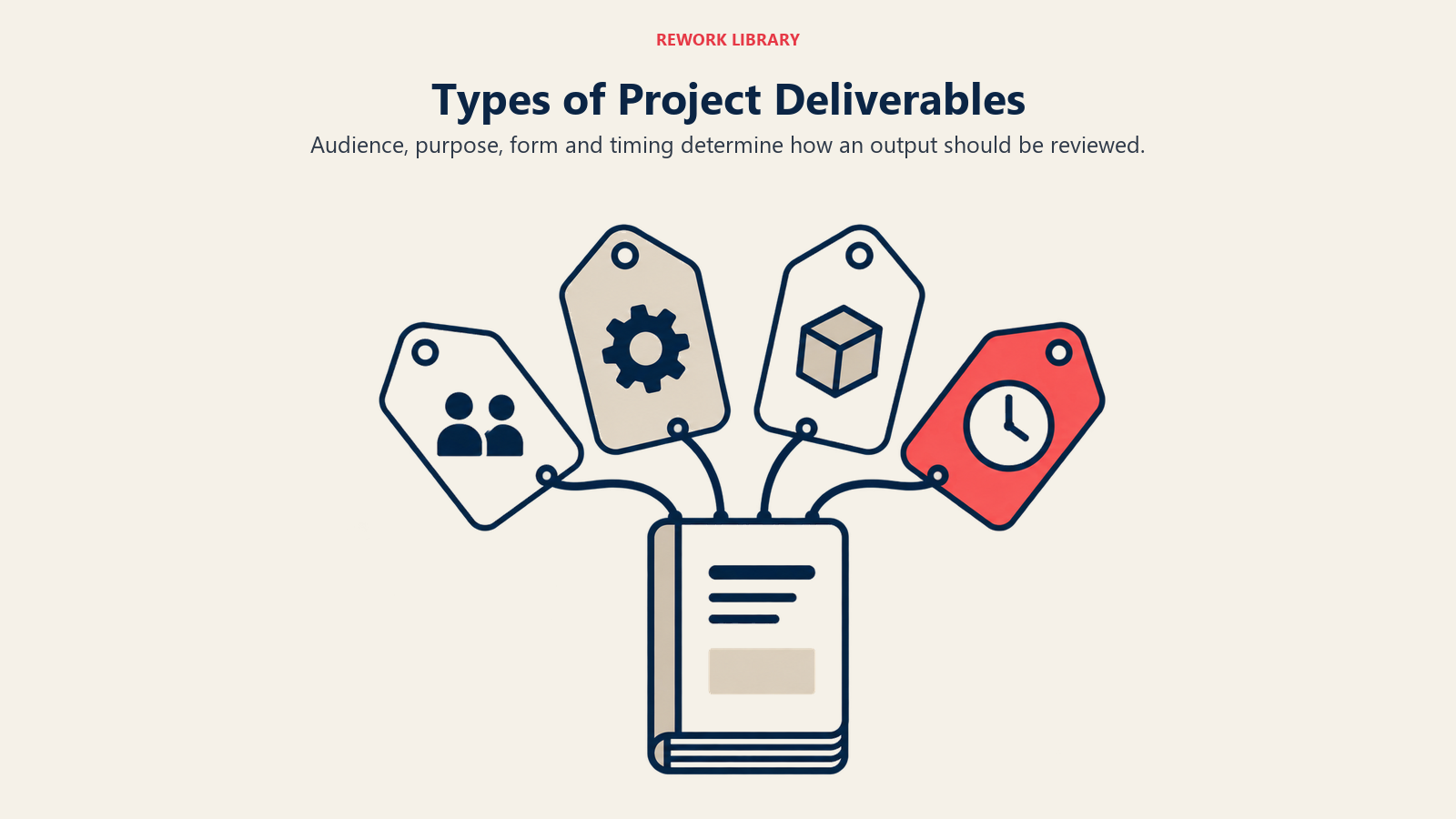
Once you've confirmed something is actually a deliverable, it still helps to classify it. Four axes come up in almost every project, and knowing which quadrant a deliverable sits in tells you who reviews it, how formally it gets accepted, and how visible it needs to be outside the delivery team.
Internal vs external deliverables
| Type | Who it's for | Review bar | Example |
|---|---|---|---|
| Internal deliverable | The project team, another internal department, or leadership | Usually lighter, reviewed by peers or a manager | An updated internal process document, a test plan, a design system library |
| External (client-facing) deliverable | A paying client, an external partner, or the public | Usually formal, tied to a contract or a statement of work | The finished website, a signed report, a shipped product feature |
External deliverables carry more risk if acceptance criteria are vague, because disagreements can become contract disputes rather than internal friction. That's a big part of why a statement of work usually lists external deliverables explicitly, with sign-off terms attached, while internal deliverables can often be accepted with a Slack message and a checkbox.
Process, product, tangible, intangible, interim, and final
| Axis | Type A | Type B | What the distinction affects |
|---|---|---|---|
| What it produces | Process deliverable, a plan, a process document, a governance artifact (a communications plan, a test strategy) | Product deliverable, the thing the project was actually commissioned to build (the software, the building, the campaign) | Process deliverables enable the work; product deliverables are usually what the sponsor remembers the project for |
| What form it takes | Tangible deliverable, something you can point to, open, or inspect directly (a document, a physical asset, a shipped feature) | Intangible deliverable, a capability, a trained skill, or a completed service (a training session delivered, a migration completed, a support runbook adopted) | Tangible deliverables get accepted by inspection; intangible ones usually need an observed demonstration or a completion report |
| When it lands | Interim deliverable, a checkpoint output produced partway through (a wireframe set, a draft report, a beta build) | Final deliverable, the last, complete version that closes out the work | Interim deliverables often get lighter, faster review cycles so problems surface early instead of at the end |
Most real deliverables sit at the intersection of more than one axis. A UAT test report is a process deliverable, tangible, and usually interim. A shipped mobile app is a product deliverable, tangible, and final. Naming the type up front helps you decide, before work starts, who reviews it and how strict that review needs to be.
From scope to signed-off deliverable: how deliverables get derived
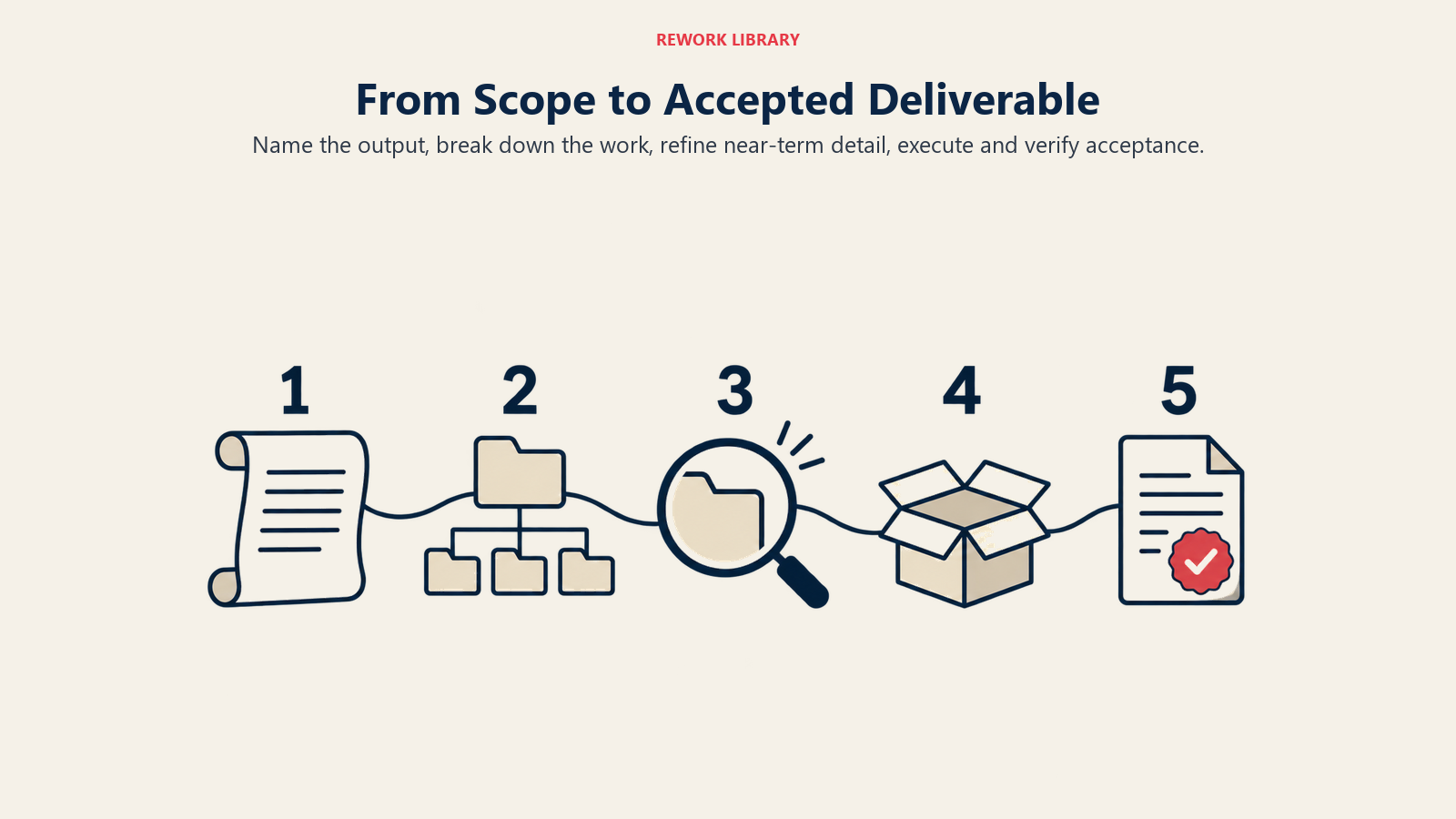
Deliverables don't get invented mid-project. They're derived through a specific chain, and skipping a link in that chain is where most "wait, who agreed to this?" conversations come from.
| Stage | Document or artifact | What it defines | Where the deliverable shows up |
|---|---|---|---|
| 1. Scope definition | Project scope statement | The full list of deliverables the project will and won't produce | Deliverables are named for the first time, as noun phrases, not activities |
| 2. Decomposition | Work breakdown structure | Each deliverable broken into sub-deliverables and work packages small enough to estimate and assign | Deliverables become schedulable, owned pieces of work |
| 3. Near-term detail, later coarseness | Rolling wave planning | How much detail a deliverable gets, based on how soon it's due | Deliverables in the current wave are broken down fully; later ones stay at a coarser, placeholder level until their wave arrives |
| 4. Execution | Work packages, tasks | The actual activity that produces the deliverable | Deliverables get built, drafted, tested, or assembled |
| 5. Acceptance | Acceptance criteria, sign-off | The specific, testable conditions the deliverable must meet | Deliverables get formally accepted, rejected, or sent back for rework |
The project scope statement is where every deliverable first gets named, as a noun phrase (a thing), never an activity (a verb). The work breakdown structure then takes those named deliverables and decomposes them until each work package is small enough for one owner to estimate and complete with confidence. On projects where the full scope isn't knowable up front, teams use rolling wave planning to keep near-term deliverables fully detailed while leaving later ones intentionally coarse, refining them only as their wave approaches. By the time a work package is finished, it should map back cleanly to a named deliverable in the original scope statement. If it doesn't, that's usually either scope creep or a deliverable nobody actually planned for.
Project deliverable examples by industry
Deliverable names change completely by industry, but the underlying shape, a specific, acceptable thing, doesn't. Here's what real deliverables look like across six common domains.
| Industry | Interim deliverable | Final deliverable | Typical approver |
|---|---|---|---|
| Software development | Technical design doc, sprint demo build, QA test report | Production release, user documentation, deployment runbook | Product owner, engineering lead |
| Construction | Architectural drawings, permit application, foundation inspection report | Certificate of occupancy, as-built drawings, punch list sign-off | General contractor, building inspector, owner's rep |
| Marketing | Creative concepts, campaign brief, media plan | Launched campaign assets, performance report, brand guidelines update | Marketing director, brand owner |
| Professional services / consulting | Discovery findings deck, draft recommendations report | Final recommendations report, implementation roadmap, executive presentation | Engagement partner, client sponsor |
| Event management | Venue contract, run-of-show draft, vendor confirmations | Executed event, post-event report, attendee survey results | Event lead, client or internal stakeholder |
| Internal operations / HR | Draft policy document, pilot training session | Published policy, completed training rollout, updated employee handbook | Department head, HR business partner |
Notice the pattern in the approver column. Someone specific is always named, never "the team" or "stakeholders." A deliverable without a named approver isn't really being managed as a deliverable, it's just work sitting on a list waiting for someone to eventually notice it's finished. Assigning that owner is exactly what a RACI is built for: every deliverable needs exactly one person accountable for getting it accepted, even when several people contribute to producing it.
How a deliverable actually gets accepted
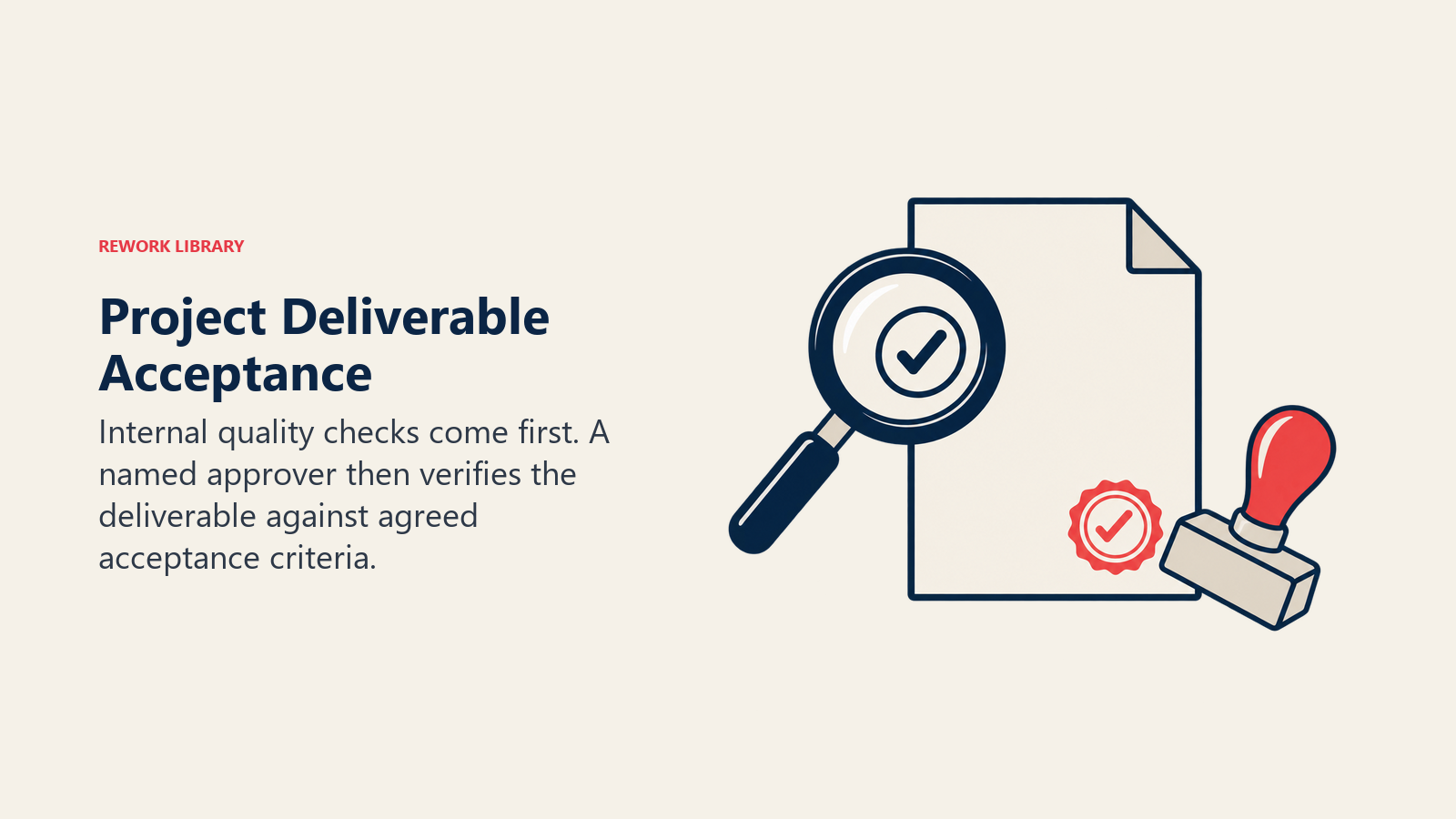
This is where most projects actually fail, not in the building, but in the handoff. A deliverable that's "done" by the team's own judgment and a deliverable that's "accepted" by whoever owns the decision are two different events, and treating them as the same one is how disputes happen.
Definition of done vs formal acceptance criteria
| Definition of done | Formal acceptance criteria | |
|---|---|---|
| Applies to | Every deliverable or increment at a given level (internal quality bar) | One specific deliverable |
| Set by | The delivery team, together | The sponsor, client, or stakeholder who owns the decision |
| Answers | "Did we do everything we always do before calling anything finished?" | "Does this specific deliverable meet the conditions we agreed to?" |
| Who checks it | The team, before handoff | The approver, at handoff |
| Failure means | The team reworks internally, often before anyone outside sees it | The deliverable is formally rejected and returned |
A definition of done is the team's own quality bar, code reviewed, tested, documented, whatever the team always requires before calling anything finished. Acceptance criteria are specific to one deliverable and belong to the person who has the authority to say yes. A deliverable can clear the team's definition of done completely and still fail formal acceptance, because the approver is checking against a different, deliverable-specific bar. Both gates have to pass. Neither one substitutes for the other.
Who actually signs off
Acceptance isn't a vibe, it's a decision made by a specific person with the authority to make it. For internal deliverables, that's often a manager or a peer reviewer. For external, client-facing deliverables, it's usually named in the statement of work itself, along with what happens if the deliverable is rejected: a defined rework window, a re-review date, sometimes a payment milestone tied to the signature. Projects that skip naming an approver in advance tend to discover, at the worst possible moment, that three different people believe they're the one with sign-off authority, and none of them agree.
Documenting deliverables: the deliverable register
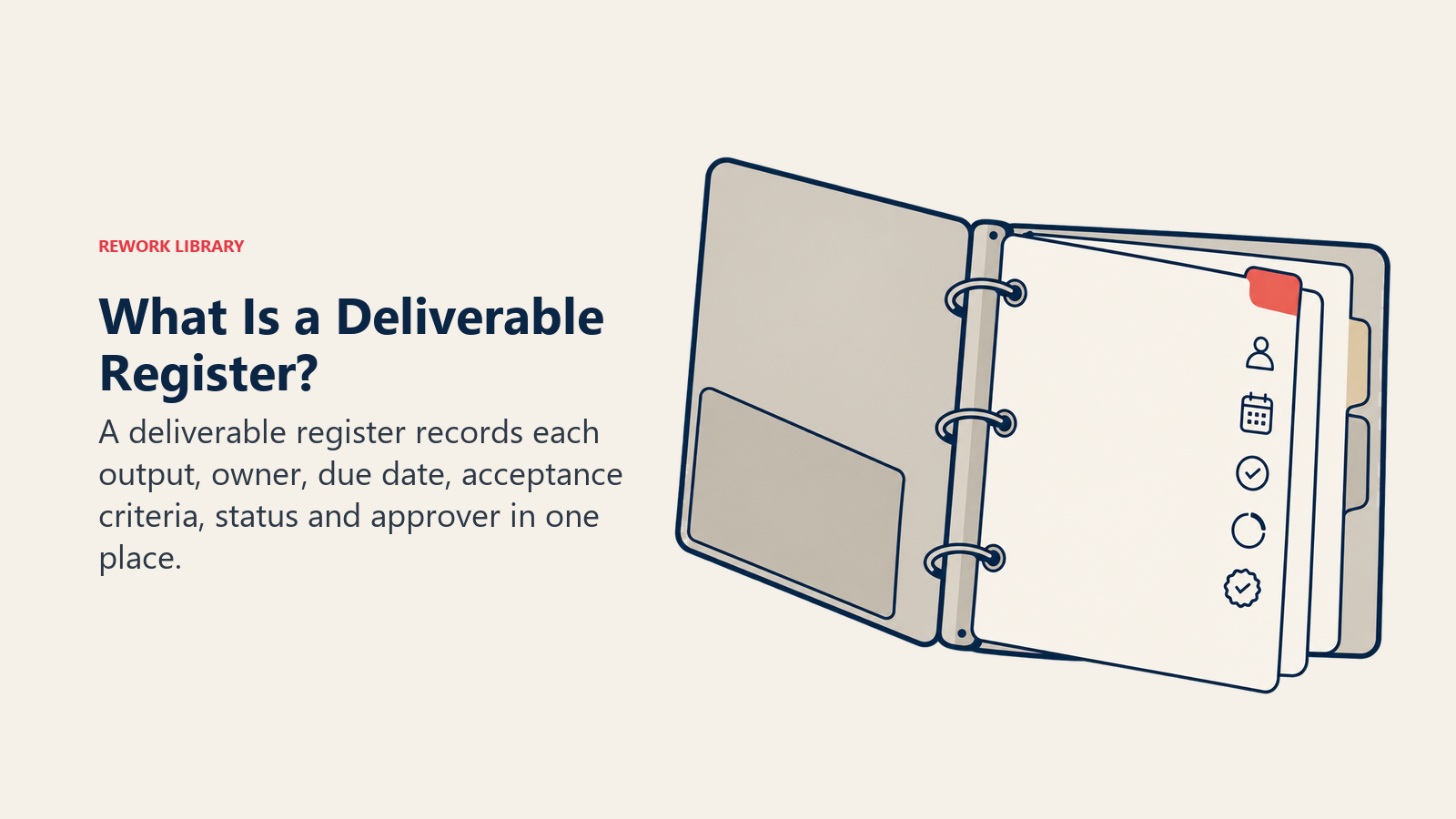
A deliverable register (sometimes called a deliverable tracker or log) is the single source of truth for every deliverable on a project: what it is, who owns it, when it's due, what "accepted" means, and where it currently stands. Without one, deliverable status lives in scattered emails and whoever remembers to ask.
| ID | Deliverable name | Description | Owner | Due date | Acceptance criteria | Status | Approver |
|---|---|---|---|---|---|---|---|
| D-01 | Homepage redesign | New responsive homepage matching approved wireframes | UX Lead | 2026-10-15 | Loads under 2.5s on 4G, passes WCAG AA contrast, matches approved design | In progress | Marketing Director |
| D-02 | QA test report | Full regression and cross-browser test results | QA Lead | 2026-10-20 | Zero critical defects, documented coverage across target browsers | Not started | Engineering Lead |
| D-03 | CMS training guide | Step-by-step guide for content editors | Technical Writer | 2026-10-22 | Reviewed by two editors who weren't involved in writing it, all steps verified | Not started | Product Owner |
Keep the register updated at the same cadence as your project status report, so deliverable status is never stale by the time stakeholders ask about it. When acceptance criteria live in the register rather than someone's inbox, a disputed handoff becomes a two-minute lookup instead of a memory contest. For deliverables tied to specific product or contractual requirements, cross-reference the register against a requirements traceability matrix so every requirement can be traced to the deliverable that's supposed to satisfy it, and every deliverable can be traced back to the requirement that justified building it.
Common deliverable problems
Most deliverable disputes trace back to one of a small number of repeat offenders. Naming them makes them easier to catch before they cost anyone a week of rework.
| Problem | What it looks like | Fix |
|---|---|---|
| No named owner | A deliverable sits on the plan with "team" or "TBD" in the owner field | Assign exactly one accountable person per deliverable, using a RACI if ownership spans multiple contributors |
| Described as an activity, not a thing | "Build the homepage" instead of "approved, responsive homepage" | Rename it as a noun phrase in the scope statement and the WBS; a deliverable is a thing, not a verb |
| Gold-plating | The team adds polish or extra scope nobody asked for, believing it adds value | Hold the deliverable to its written acceptance criteria, not the builder's personal bar for quality |
| Scope creep entering as "small additions" | A stakeholder asks for "just one more thing" and the team quietly absorbs it into an existing deliverable | Route every addition through the change control process; a small addition still changes the deliverable's scope |
| Acceptance criteria written after the work is done | Criteria get invented to match what was already built, rather than what was actually needed | Write and agree criteria before work starts, ideally during the same session the deliverable is added to the scope statement |
| No distinction between "done" and "accepted" | The team marks a deliverable complete based on their own judgment, then it stalls waiting on an approver who was never looped in | Name the approver at the start, not at handoff, and confirm the acceptance criteria with them directly |
Scope creep deserves its own callout here, because it rarely arrives as an obvious new deliverable. It almost always arrives disguised as a small addition to an existing one, a "quick extra field" on the form, one more slide in the deck, a page nobody originally scoped. Every one of those additions changes what the deliverable actually is, which means it changes what "accepted" should mean too.
Deliverables in agile: increments and definition of done
Agile teams don't usually use the word "deliverable" day to day, but the concept doesn't disappear, it gets renamed and delivered more frequently. In Scrum, the equivalent unit is the Increment: a piece of product that's usable and potentially releasable the moment it meets the team's definition of done.
| Traditional (predictive) deliverable | Agile Increment | |
|---|---|---|
| Cadence | Delivered once, at a planned point in the project | Delivered every sprint, potentially every story |
| Acceptance gate | Formal sign-off against written acceptance criteria | Definition of done, checked continuously by the team |
| Size | Often large: a full report, a completed building phase, a shipped release | Small: one usable slice of a larger product |
| Who decides "done" | A named approver, often outside the delivery team | The team itself, against a standard they wrote and agreed together |
The Scrum Guide is explicit that this bar isn't optional: "Work cannot be considered part of an Increment unless it meets the Definition of Done," and once it does, "the moment a Product Backlog item meets the Definition of Done, an Increment is born." That's a stricter, more continuous version of the same handoff logic that governs a traditional deliverable. The difference isn't whether acceptance happens, it's how often, and who's checking. A predictive project might formally accept five deliverables across a year. A Scrum team is running the same acceptance question every sprint, sometimes every day, just at a much smaller scale each time.
Best practices
- Name deliverables as things, never activities. If the name starts with a verb, it belongs in the WBS or the task list, not the deliverable list.
- Write acceptance criteria before work starts, not after. Criteria written retroactively describe what got built, not what was actually needed.
- Assign exactly one accountable owner per deliverable. Shared ownership is how deliverables quietly stall without anyone feeling personally responsible.
- Separate "done" from "accepted" explicitly. A team's own quality bar and a stakeholder's formal sign-off are two different checks, and both need to pass.
- Keep a live deliverable register, not a memory. Status, owner, due date, and acceptance criteria should all live in one place everyone can check.
- Treat every "small addition" as a scope question. The fastest way scope creep enters a project is through changes to an existing deliverable that never go through change control.
- Match acceptance formality to deliverable type. A client-facing final deliverable earns a stricter review than an internal interim draft; save the heaviest process for where the risk actually is.
- Trace deliverables back to requirements, not just forward to tasks. A requirements traceability matrix catches the deliverables that exist for no documented reason, and the requirements nobody ever built a deliverable to satisfy.
Frequently Asked Questions about Project Deliverables
What is the difference between a deliverable and a milestone?
A deliverable is a specific output someone hands off and someone else accepts, like a finished report or a shipped feature. A milestone is a zero-duration marker on the schedule, often the date a deliverable was completed or approved. A milestone can mark when a deliverable was accepted, but the milestone itself isn't a thing you can inspect or sign off on.
What is the difference between a deliverable and a task?
A task is a unit of activity someone performs, like "write the homepage copy," and it doesn't get independently accepted. A deliverable is the output that results from a group of tasks, like the finished, approved homepage. Tasks feed deliverables; they aren't deliverables themselves.
Who is responsible for accepting a project deliverable?
A named approver, agreed on before work starts, not after. For internal deliverables that's often a manager or peer reviewer. For external, client-facing deliverables, the approver and the acceptance process are usually spelled out in the statement of work. If nobody was named as the approver at the outset, expect disagreement about who actually has sign-off authority once the deliverable is ready.
What's the difference between acceptance criteria and a definition of done?
Acceptance criteria are specific to one deliverable and set by whoever has authority to accept it. A definition of done is a broader, reusable quality bar the delivery team applies to everything it produces, at a given level, before handoff. A deliverable can pass the team's definition of done and still fail its specific acceptance criteria, because the approver is checking a different, deliverable-specific bar.
How many deliverables should a project have?
Enough to cover 100% of the agreed scope, and no more than that. Most projects land somewhere between 5 and 15 major deliverables at the scope-statement level, further broken down into smaller work packages in the work breakdown structure. If a list runs much longer than that, some of the items are probably tasks or sub-deliverables that got promoted to the top level by mistake.
Are deliverables only used in traditional, predictive projects?
No. Agile teams deliver just as often, sometimes more often, they just use different terminology. A Scrum Increment is functionally a deliverable: a usable output that must meet an agreed bar (the definition of done) before it counts as finished. The acceptance logic is the same; agile just runs it continuously instead of at a handful of planned checkpoints.
A deliverable is the one word on a project plan that should never be ambiguous, because it's the thing everyone is ultimately being paid to produce, and the thing someone else has to agree is actually finished. Name deliverables as things, write their acceptance criteria before anyone starts building, and give each one exactly one owner and one approver. Get that right, and most of the "wait, is this actually done?" conversations that eat up a project's final weeks simply stop happening.

Senior Operations & Growth Strategist
On this page
- What is a project deliverable?
- Deliverable vs milestone vs objective vs outcome vs task vs requirement
- Types of project deliverables
- Internal vs external deliverables
- Process, product, tangible, intangible, interim, and final
- From scope to signed-off deliverable: how deliverables get derived
- Project deliverable examples by industry
- How a deliverable actually gets accepted
- Definition of done vs formal acceptance criteria
- Who actually signs off
- Documenting deliverables: the deliverable register
- Common deliverable problems
- Deliverables in agile: increments and definition of done
- Best practices