PMBOK Guide: The Project Management Body of Knowledge Explained
Turn this article into takeaways for your work.


Each assistant summarizes the article only for you and suggests best practices for your work.
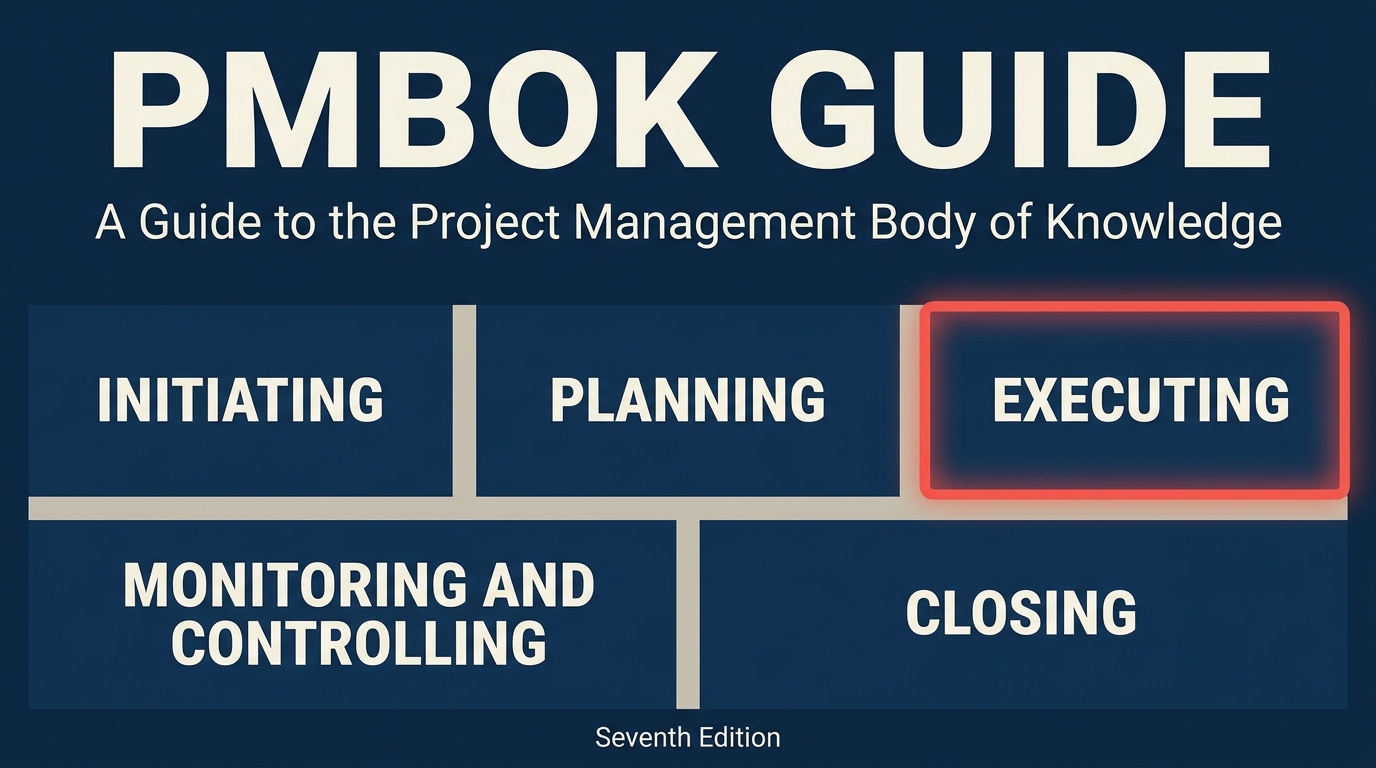
The Project Management Body of Knowledge (PMBOK) is the most widely referenced standard in the profession. If you've ever studied for the PMP exam, led a formal project, or worked in a PMO, you've encountered it. But the PMBOK Guide is more than an exam syllabus. It's a structured framework that thousands of organizations use to align how their teams plan, execute, and close projects.
This guide explains what the PMBOK Guide is, how it changed across the 6th, 7th and 8th editions, what its core components cover, and how to apply it practically whether you're chasing a PMP certification or building your organization's project playbook.
What is the PMBOK Guide?
The PMBOK Guide is a reference standard published by the Project Management Institute (PMI) that documents accepted practices, processes, and principles for managing projects across industries. It's not a prescriptive methodology. It defines what good project management looks like, and practitioners choose which parts apply to their context.
PMI introduced the first edition in 1996 as a response to demand for a common language in a field that was fragmented by industry-specific approaches. Since then it's been updated seven times, most recently with the Eighth Edition published in November 2025, and each revision reflects how the profession has evolved.
The guide forms the foundation for the Project Management Professional (PMP) certification exam. PMI requires that PMP candidates demonstrate familiarity with the guide's content, though the exam now tests both predictive (traditional) and agile approaches.
Key Facts
- First published: 1987 as a white paper; formal first edition released 1996 (Source: PMI, 2021)
- Current edition: 8th edition, released November 2025; the 7th edition (2021) is the previous one (Source: PMI)
- PMP certified professionals worldwide: over 1 million as of 2023 (Source: PMI, 2023)
PMBOK 6th edition vs 7th edition
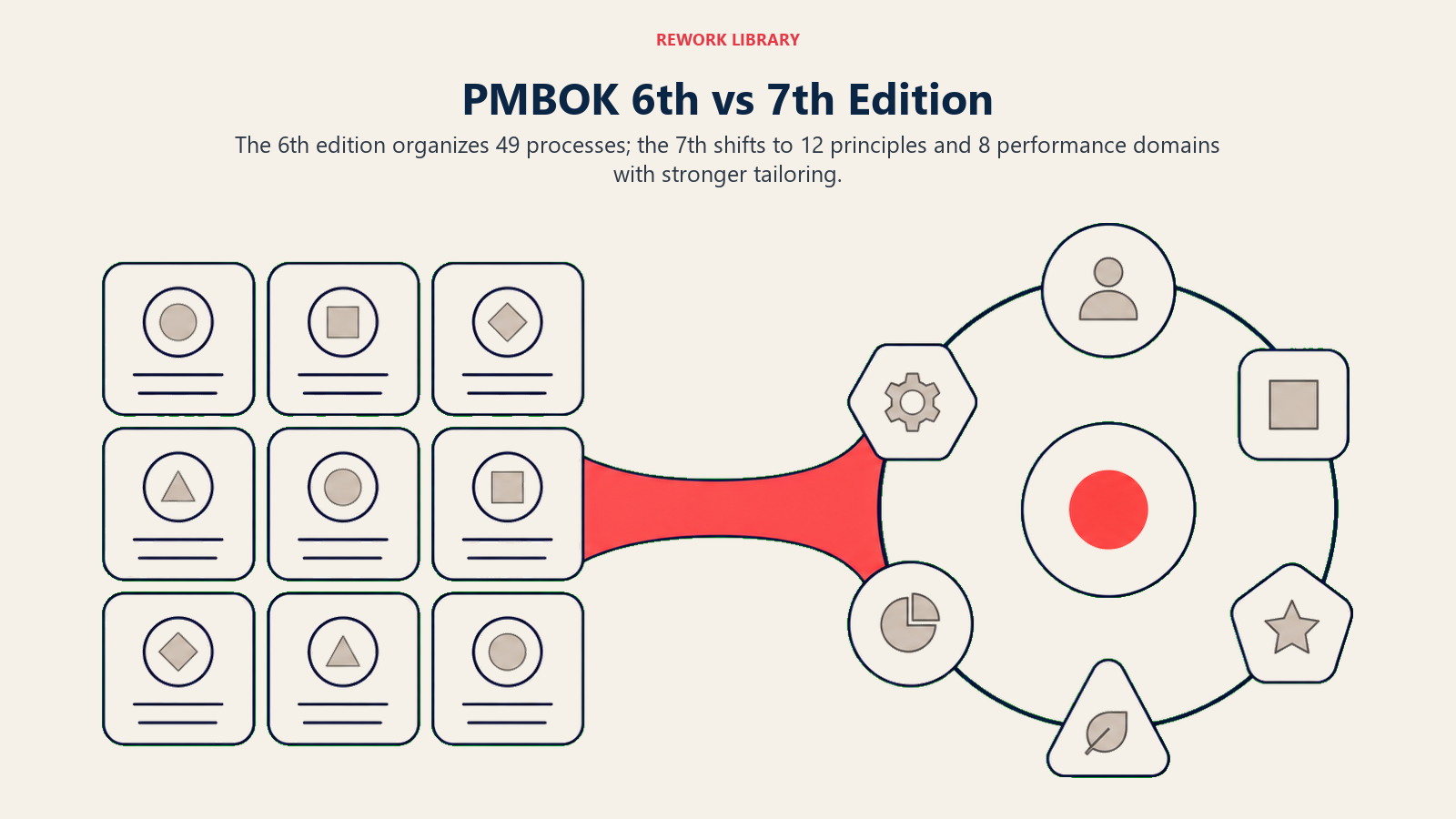
The shift from the 6th to the 7th edition was the biggest restructuring in the guide's history. The 6th edition was process-centric: it organized everything around 49 discrete processes, grouped into 5 process groups and 10 knowledge areas. The 7th edition stepped back from that prescriptive structure and moved toward outcomes and principles.
| Dimension | 6th Edition | 7th Edition |
|---|---|---|
| Core structure | 10 knowledge areas, 5 process groups, 49 processes | 12 principles, 8 performance domains |
| Orientation | Process-based: what to do, in what order | Outcomes-based: what to achieve and why |
| Agile coverage | Separate Agile Practice Guide as companion | Integrated throughout |
| Tailoring | Limited guidance | Explicit model for tailoring to context |
| Use of tools/techniques | Detailed inputs/outputs/tools per process | Flexible, context-dependent |
| Target reader | Project manager following a defined process | Practitioner choosing the right approach |
Both editions are still in use. Many organizations, certification programs, and procurement contracts still reference the 6th edition process framework. The PMP exam since 2021 blends 7th-edition thinking with practical application scenarios.
The 8th edition (November 2025)
The Eighth Edition is the current PMBOK Guide. PMI describes it as retaining "the principles and performance domains foundation of the Seventh Edition, but simplifies and clarifies them to be more actionable, blending mindset, technical, and practical guidance." In place of the 7th edition's 12 principles and 8 performance domains, it presents six core principles and seven performance domains: governance, scope, schedule, finance, stakeholders, resources, and risk. It also reintroduces process guidance, which PMI is careful to describe as "presented in an evolved, non-prescriptive way" rather than a return to the 6th edition's 49 processes, and expands coverage of AI, PMOs, and procurement.
A caution if you are researching this edition elsewhere: several training providers describe the 8th edition as having "five Focus Areas" and "40 processes." That framing does not appear anywhere in PMI's own description of the standard, so treat it as a training-provider interpretation rather than the published structure.
The 5 process groups
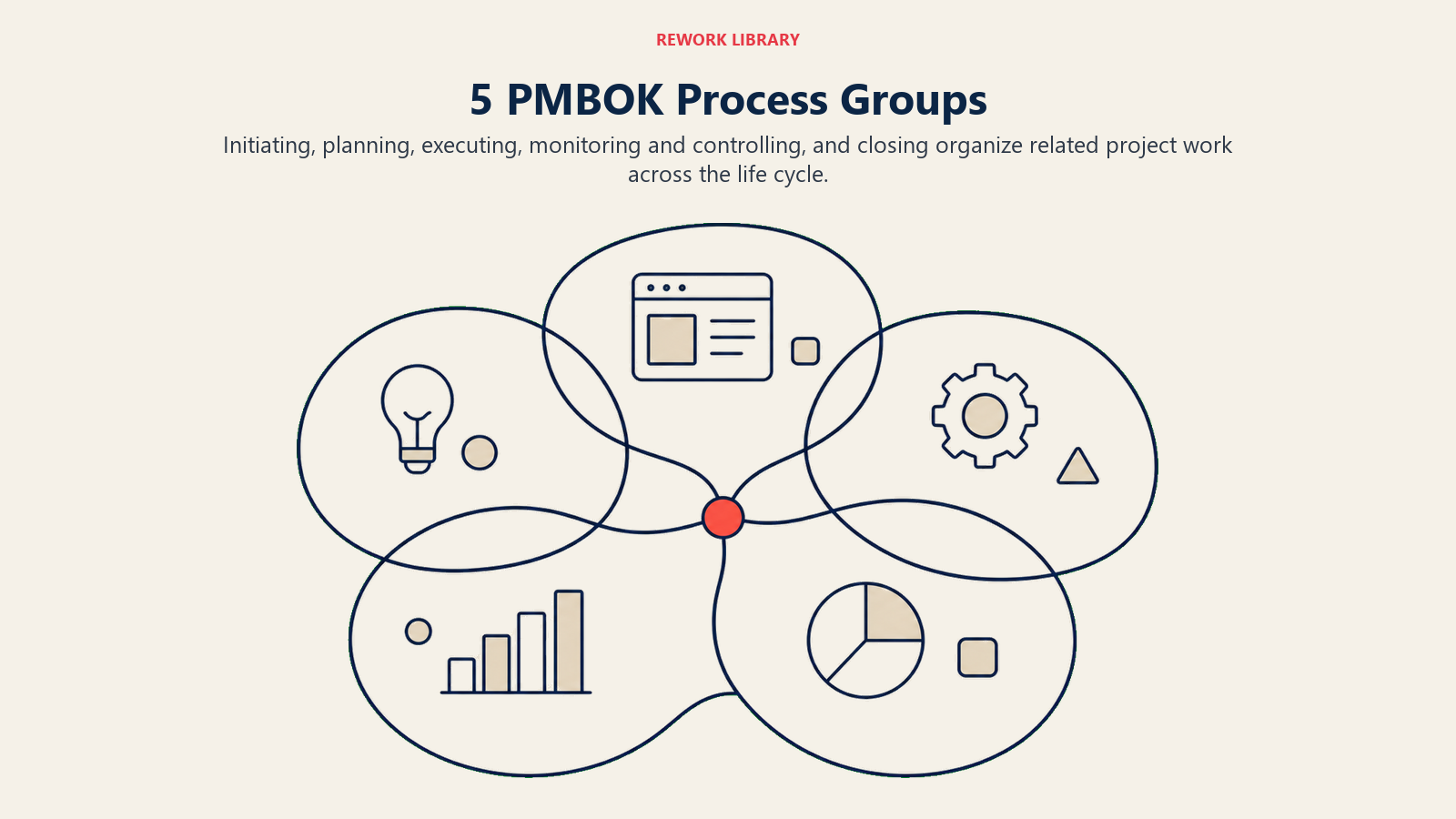
The 6th edition organized project work into five process groups. These aren't phases; they're buckets of related work that can overlap and repeat across a project's life cycle.
| Process Group | What it covers |
|---|---|
| Initiating | Defining the project, identifying stakeholders, and getting formal authorization (e.g., the project charter) |
| Planning | Establishing scope, schedule, cost, quality, communications, risk, procurement, and resource plans |
| Executing | Directing and managing project work, acquiring and developing the team, managing stakeholder engagement |
| Monitoring and Controlling | Tracking performance against the baseline, managing changes, and controlling scope, schedule, and cost |
| Closing | Finalizing all activities, delivering the product, releasing resources, capturing lessons learned |
The Monitoring and Controlling group runs in parallel with all other groups, not just at the end. That's a common misconception among new PMs.
The 10 knowledge areas
The 6th edition's knowledge areas cut across the process groups. Each area groups the processes that share a common domain of expertise.
| Knowledge Area | Core focus |
|---|---|
| Integration Management | Coordinating all project elements and managing change control |
| Scope Management | Defining what is (and isn't) in the project; building the Work Breakdown Structure |
| Schedule Management | Sequencing activities, estimating durations, developing the project plan |
| Cost Management | Estimating, budgeting, and controlling costs; foundation for earned value management |
| Quality Management | Planning for quality, managing quality assurance, and controlling deliverables |
| Resource Management | Planning, acquiring, developing, and managing team and physical resources |
| Communications Management | Planning and managing the flow of project information |
| Risk Management | Identifying, analyzing, and responding to project risks throughout the risk management process |
| Procurement Management | Planning and managing contracts and vendor relationships |
| Stakeholder Management | Identifying stakeholders, understanding their needs, and keeping them engaged |
Each knowledge area has its own set of processes. For example, Risk Management includes seven: Plan Risk Management, Identify Risks, Perform Qualitative Risk Analysis, Perform Quantitative Risk Analysis, Plan Risk Responses, Implement Risk Responses, and Monitor Risks.
The 12 principles and 8 performance domains (7th edition)
The 7th edition replaced the knowledge-area and process-group model with a principles-and-domains framework that applies regardless of delivery approach (predictive, agile, or hybrid).
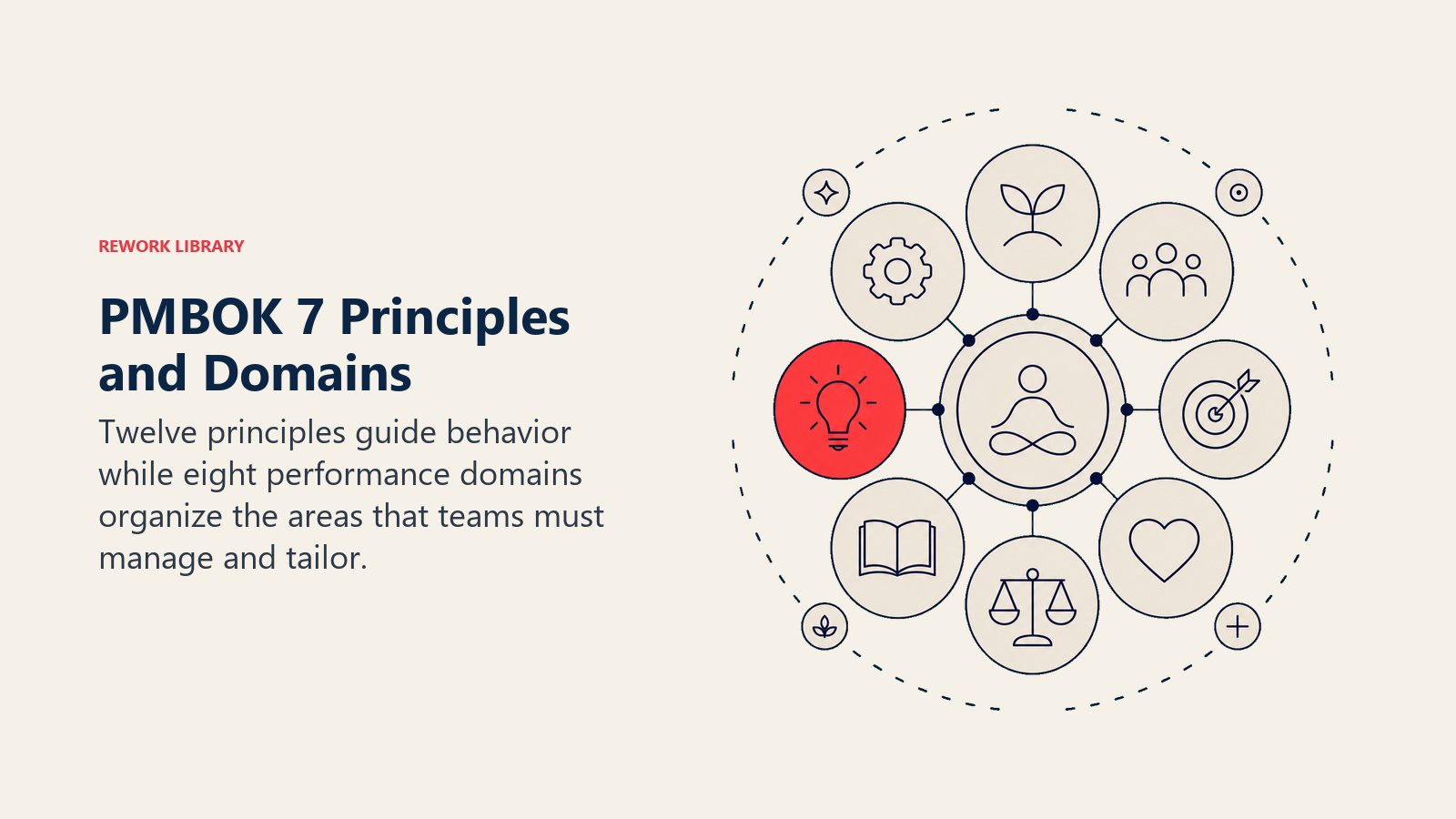
12 project management principles:
- Be a diligent, respectful, and caring steward
- Create a collaborative project team environment
- Engage stakeholders effectively
- Focus on value
- Recognize, evaluate, and respond to system interactions
- Demonstrate leadership behaviors
- Tailor based on context
- Build quality into processes and deliverables
- Navigate complexity
- Optimize risk responses
- Embrace adaptability and resiliency
- Enable change to achieve the envisioned future state
8 performance domains:
- Stakeholders
- Team
- Development approach and life cycle
- Planning
- Project work
- Delivery
- Measurement
- Uncertainty
The performance domains describe interrelated areas of activity. Unlike process groups, they don't have a defined sequence. A project team might work across all eight domains simultaneously.
How to use the PMBOK Guide in practice
The guide is a reference, not a recipe. Here's how practitioners actually put it to work.
Step 1: Tailor to your project type
Start by deciding your delivery approach. Is this a predictive project with a fixed scope, a fully agile delivery, or something in between? The 7th edition's tailoring guidance (and the companion Agile Practice Guide) help you choose the right methods. A two-week software sprint doesn't need 49 formal processes. A multi-year infrastructure project probably does.
Step 2: Map your methodology against PMBOK
If your organization uses a defined methodology (like PRINCE2), compare it against PMBOK's structure to find gaps. PMBOK's knowledge areas act as a checklist: are you explicitly managing stakeholders? Do you have a documented risk response plan? Many teams discover they skip whole domains without a framework to check against.
Step 3: Use it for PMP exam preparation
The PMP exam draws heavily from PMBOK content, but it tests application rather than memorization. Study the process inputs, outputs, and tools for each knowledge area. But spend equal time on scenario-based practice questions that ask what a project manager should do in a given situation. The triple constraint of scope, time, and cost shows up repeatedly.
Step 4: Combine with agile practices
PMBOK is not anti-agile. The 7th edition explicitly accommodates iterative and adaptive approaches. Teams running Scrum or Kanban can map their ceremonies to PMBOK's planning and monitoring activities without abandoning their agile workflow. The key is recognizing that PMBOK provides the what; your agile framework provides the how.
Step 5: Build reusable templates from it
Once you understand the knowledge areas, use them to build your template library: project charter, stakeholder register, risk register, change log, communications plan. Each knowledge area suggests what documents and artifacts a well-run project should have. A PMO that builds templates from PMBOK creates a consistent baseline across every team.
PMBOK vs PRINCE2 vs agile
These aren't competing systems. They're different tools for different purposes. Many organizations layer them.
| Dimension | PMBOK | PRINCE2 | Agile (Scrum) |
|---|---|---|---|
| Type | Reference standard | Prescriptive methodology | Framework for iterative delivery |
| Origin | PMI (USA, global) | AXELOS (UK government origin) | Agile Manifesto, Scrum Guide |
| Process structure | 49 processes / 12 principles | 7 principles, 7 themes, 7 processes | Sprints, ceremonies, roles |
| Tailoring | Encouraged | Built-in via themes | Core to the approach |
| Best fit | Large, cross-industry projects | Structured, governance-heavy environments | Software and product development |
| Certification | PMP | PRINCE2 Practitioner | Scrum Master (CSM, PSM) |
| Agile integration | Yes (7th edition + Agile Guide) | Limited (AgilePM is separate) | Native |
PRINCE2 is more prescriptive; it tells you exactly how to run a project. PMBOK tells you what good management looks like and lets you fill in the how. Agile frameworks narrow the scope to iterative delivery. A director managing a complex infrastructure rollout might use PMBOK as the governance layer, PRINCE2 for decision gates, and agile for the software component.
Frequently Asked Questions about PMBOK Guide
Is the PMBOK Guide a methodology?
No. PMI explicitly describes the PMBOK Guide as a standard, not a methodology. It documents recognized good practices. A methodology tells you exactly what to do and when; PMBOK gives you a framework of practices to choose from. Organizations typically build their own methodology on top of PMBOK.
Do you need to read PMBOK to pass the PMP exam?
The PMBOK Guide is required reading for the PMP exam, but it's not enough on its own. The current exam (since 2021) tests agile and hybrid approaches alongside predictive ones. PMI recommends pairing the guide with the Agile Practice Guide and working through scenario-based practice exams. Many candidates find that the 6th edition's process detail is more testable for process-group questions than the 7th edition's principle-based language.
Which edition should I study for the PMP?
Study the 7th edition as your primary reference, because that's the current standard. But keep the 6th edition's process tables handy. The PMP Examination Content Outline (ECO) specifies what the exam covers, and both predictive and agile content appear. Some training providers still teach from the 6th edition's structure because the process inputs/outputs are easier to map to exam questions.
Is PMBOK useful for agile projects?
Yes. The 7th edition's performance domains and tailoring guidance apply directly to agile work. Even in a Scrum team, you're doing stakeholder management, risk management, and quality control; PMBOK names and frames those activities. The Agile Practice Guide, published alongside the 7th edition by PMI and the Agile Alliance, bridges the gap explicitly.
How often is the PMBOK Guide updated?
PMI updates the guide roughly every four to five years. Editions have been released in 1996, 2000, 2004, 2008, 2013, 2017, and 2021. Updates reflect shifts in the profession: the 5th and 6th editions added stakeholder management as a full knowledge area; the 7th edition's shift to principles reflected the profession's embrace of agile and hybrid approaches.
Where the PMBOK Guide fits in your practice
The PMBOK Guide won't run your project for you. But it will tell you what you might be missing. Teams that treat it as a living reference, checking their planning approach against its knowledge areas, asking whether risk responses are documented, confirming stakeholder engagement plans exist, tend to catch gaps before they become problems.
The shift toward principles that began with the 7th edition, and that the 8th edition carries forward while restoring some process guidance, also signals where the profession is heading. Rigid process compliance is giving way to outcome-focused thinking, tailored delivery, and adaptability. Whether you're preparing for the PMP exam or building a team-level project playbook, understanding PMBOK's structure puts you in a better position to make deliberate choices about how your projects run.

Senior Operations & Growth Strategist
On this page
- What is the PMBOK Guide?
- PMBOK 6th edition vs 7th edition
- The 8th edition (November 2025)
- The 5 process groups
- The 10 knowledge areas
- The 12 principles and 8 performance domains (7th edition)
- How to use the PMBOK Guide in practice
- Step 1: Tailor to your project type
- Step 2: Map your methodology against PMBOK
- Step 3: Use it for PMP exam preparation
- Step 4: Combine with agile practices
- Step 5: Build reusable templates from it
- PMBOK vs PRINCE2 vs agile
- Where the PMBOK Guide fits in your practice