Crystal Methodology: The Agile Family Explained
Turn this article into takeaways for your work.


Each assistant summarizes the article only for you and suggests best practices for your work.
Someone mentions "Crystal" in an agile certification syllabus, right next to Scrum and XP, and then the course moves on before anyone learns what it actually is. That's the last most people ever hear of it. Crystal isn't one framework you install. It's a family of methods Alistair Cockburn built around a single idea: the amount of process a project needs depends on how big the team is and how much damage a mistake can do, not on which framework happens to be popular that year. That idea predates the Agile Manifesto Cockburn helped write in 2001, and it has arguably aged better than most of Crystal's own ceremonies.
This article covers what Crystal is, where it came from, which parts of the family and the properties of Crystal Clear hold up against Cockburn's own writing, how Crystal compares to Scrum, Extreme Programming, and Kanban, and what's actually worth taking from it even if you have no intention of running anything called "Crystal." Crystal is far less adopted today than the mainstream picture covered in what is agile methodology, and this piece is honest about that instead of pretending otherwise.
Key Facts
- Alistair Cockburn designed the Crystal family while consulting for the Central Bank of Norway in 1998, four years after IBM used his earlier methodology on an 18-month, $15 million Smalltalk project, and after two years spent interviewing teams worldwide on what made projects succeed. Source: Cockburn's own bio.
- Cockburn is one of the 17 original signatories of the Agile Manifesto, written at Snowbird, Utah in 2001, three years after Crystal already existed as a named methodology.
- In his own 2024 write-up, Cockburn states that Crystal Clear, Yellow, and Orange, the three lightest family members, cover teams "up to about 50 people," and that Crystal "has been used successfully since 1998" and remains in use "in some places." Source: Cockburn, "Crystal, the un-methodology," 2024.
What Crystal actually is
Crystal is a family of software development methods, not a single one. Cockburn's core claim is that a project's ideal process scales along two things: team size and criticality, meaning how bad it is if a defect slips through undetected. A six-person internal tool and a two-hundred-person payments platform shouldn't run the same process, and picking one methodology and forcing every project through it is, in Cockburn's view, the actual mistake most organizations make.
That's the one sentence that separates Crystal from Scrum and from Extreme Programming. Scrum gives you one process framework and expects you to adapt it through its own mechanisms, like sprint length and backlog grooming cadence. Extreme Programming (XP) goes further and prescribes specific engineering practices: test-first development, pair programming, continuous integration. Crystal does neither. It gives you a small set of properties it believes every successful small team already has, and then tells you to pick the family member (the "color") that fits your team's size and stakes, and shape the rest yourself. Cockburn's own framing calls Crystal "the un-methodology" for exactly this reason: it's less a set of rules than a description of what he found already working when he went looking.
Where Crystal came from
Cockburn didn't invent Crystal in a workshop. He built it from years of watching real teams, which is part of why its ideas hold up better than its brand recognition does.
| Year | Event | Source |
|---|---|---|
| Roughly 1991-1993 | Cockburn spends two years interviewing project teams worldwide, asking "What makes a successful project?" | Cockburn's own bio |
| 1993 | He writes an early version of what the industry now calls an agile methodology for the IBM Consulting Group, based on those interviews | Cockburn's own bio |
| 1994 | IBM uses that methodology on an 18 month, $15 million, fixed price Smalltalk project, with Cockburn as lead consultant and technical coordinator | Cockburn's own bio |
| 1998 | Cockburn designs the Crystal family of methodologies while consulting on a mainframe project for the Central Bank of Norway | Cockburn's own bio |
| Late 1990s | Crystal develops in parallel with Extreme Programming, which Kent Beck was formalizing around the same time | Cockburn, "Crystal, the un-methodology" |
| 2001 | Cockburn organizes the Snowbird, Utah meeting where he and 16 others write the Agile Manifesto | Cockburn's own bio; agilemanifesto.org |
| 2004 | Crystal Clear: A Human-Powered Methodology for Small Teams is published by Addison-Wesley, the fullest documentation of the lightest family member | Book publication record |
That sequence matters because it explains why Crystal doesn't read like a framework designed on a whiteboard. Cockburn spent two years asking practitioners what actually worked before he wrote anything down, and the Central Bank of Norway engagement is where the "family" idea, sizing the process to the project, first got named and organized rather than just practiced.
The two dimensions that pick your Crystal
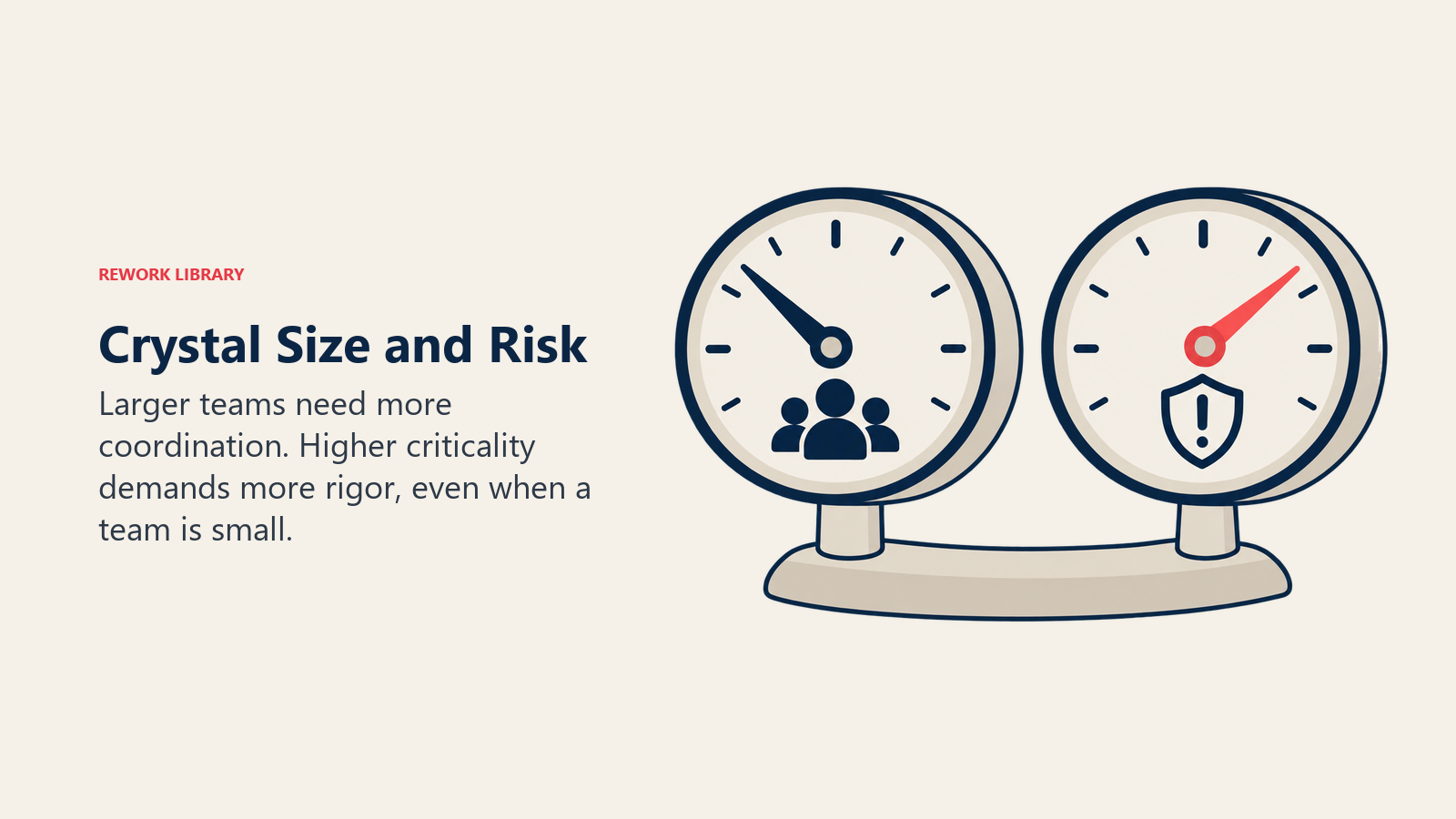
Cockburn selects a family member along two axes, not one. The first is familiar: team size, expressed as a color that gets darker as the team grows. The second is less obvious and, in his view, matters more: criticality, meaning the worst probable consequence of a defect that slips through unnoticed.
| Dimension | What it measures | Why it matters more than it looks |
|---|---|---|
| Team size (color) | How many people are working on the project, roughly doubling at each named color | Coordination cost rises with headcount, so a heavier process earns its keep only once there are enough people for informal communication to break down |
| Criticality (worst undetected defect) | How bad the outcome is if a bug ships and nobody catches it, ranging from mere inconvenience up to loss of life | Two teams the same size can need very different rigor. A six-person team building an internal dashboard and a six-person team building infusion-pump firmware are not the same project just because the headcount matches |
Cockburn's original criticality scale, laid out in his book Agile Software Development (Addison-Wesley, 2001), names four bands for the worst probable effect of an undetected defect: loss of comfort, loss of discretionary money, loss of essential money, and loss of life. That axis is the part of Crystal that gets left out of most casual summaries of the family, and it's arguably the more useful half of the idea. Team size alone tells you about coordination overhead. Criticality tells you how much you can afford to get wrong before someone finds out the hard way.
One honest caveat: web summaries of Crystal frequently draw this out as a single grid with a specific team-size number in every box, and those numbers disagree with each other from source to source once you get past the three lightest colors. Rather than repeat a table of exact headcounts that no two sources agree on, the reliable version is the one above: two dimensions, size and criticality, and a family member that gets heavier as either one climbs.
Meet the family: Clear, Yellow, Orange, and the darker colors nobody quite agrees on
The colors get darker as the team gets bigger. Cockburn's own words are the cleanest source for the lightest three.
| Family member | Who it's for | What's verified |
|---|---|---|
| Crystal Clear | Small, co-located teams, commonly cited around six to eight people | The most documented member, the subject of the 2004 book |
| Crystal Yellow | Slightly larger teams than Clear can handle | Named directly by Cockburn as one of the three colors "for teams up to about 50 people" combined with Clear and Orange |
| Crystal Orange | Larger still, the heaviest of the three colors Cockburn names in his own 2024 summary | Same source as above |
| Darker colors (Red and beyond, sometimes named Maroon, Diamond, or Sapphire depending on the source) | Larger teams or higher-criticality projects | Referenced widely in secondary write-ups, but the exact team-size cutoffs and even the color names past Orange vary between sources, so treat any specific number you see for these as unconfirmed |
Crystal Clear is the only family member Cockburn documented in a full book, which is why it's also the only one most people who've actually used Crystal can describe in any detail. The heavier colors exist in his broader writing as the logical extension of the same idea (more people, more coordination, more process) but they were never as widely adopted or as fully written up, and that gap shows in how inconsistently secondary sources describe them today.
Crystal Clear's seven properties
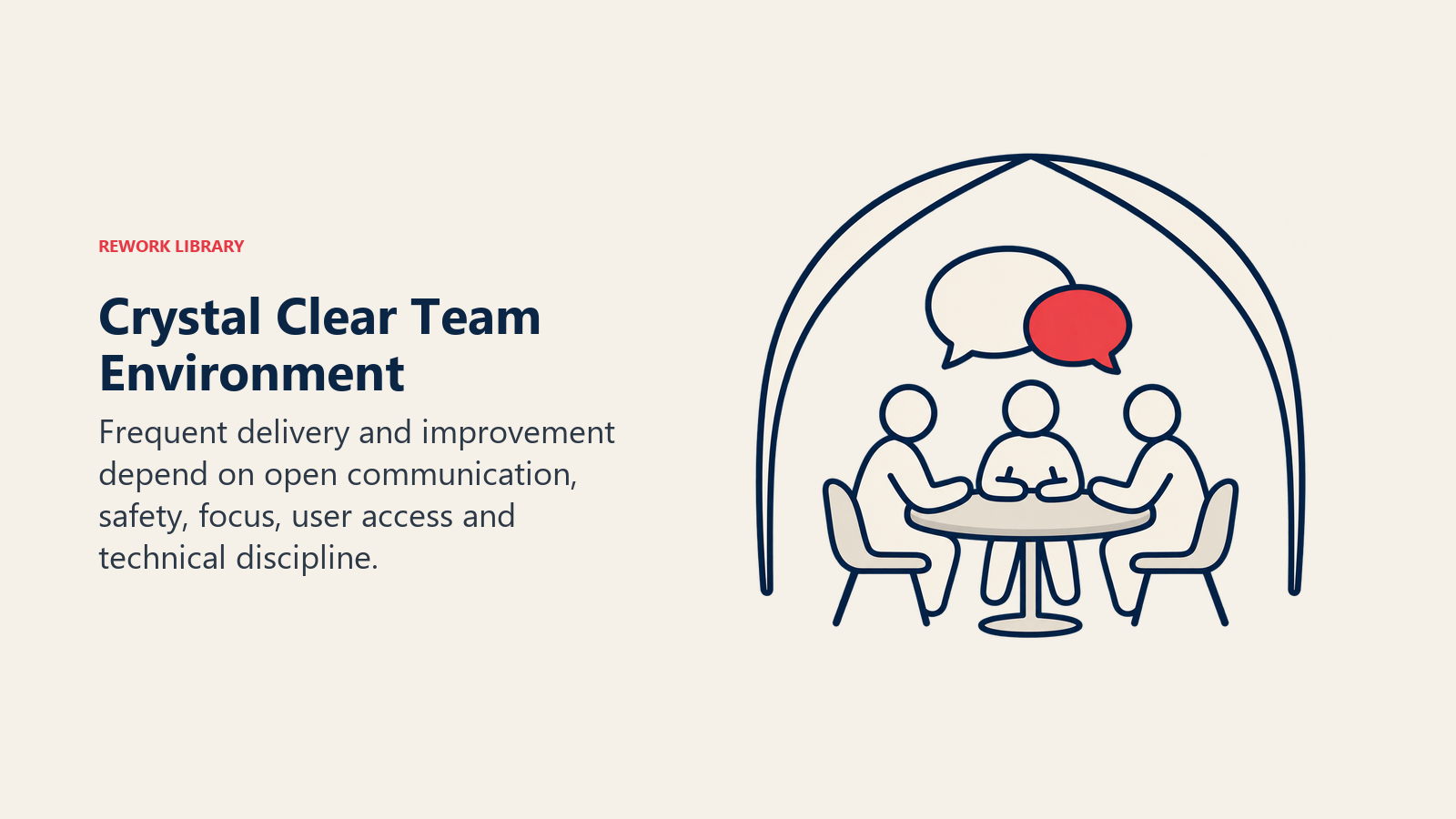
Crystal Clear, the small-team member of the family, is built around seven things Cockburn found present in every successful small team he'd interviewed. He calls them properties, deliberately not "best practices," because he's describing what he observed rather than prescribing a new invention.
| Property | What it looks like in practice |
|---|---|
| Frequent delivery | Working software reaches real users on a short, regular cycle, anywhere from every couple of weeks to every couple of months, not just at the end of the project |
| Reflective improvement | The team pauses periodically, often every few weeks, to talk through what's working and what isn't, and actually changes its own process based on that conversation |
| Osmotic communication | The team sits close enough, physically or otherwise, that information travels between people without anyone having to schedule a meeting to pass it along |
| Personal safety | People can raise a problem, admit a mistake, or push back on a decision without fear of it being held against them later |
| Focus | Everyone knows what matters right now and gets real uninterrupted time to work on it, rather than splitting attention across too many concurrent projects |
| Easy access to expert users | Someone who actually understands the problem domain is reachable, even briefly, so the team isn't guessing at requirements |
| Technical environment | Automated tests, configuration management, and frequent integration keep the codebase in a state the team can trust and change quickly |
Most descriptions of the book treat frequent delivery, reflective improvement, and osmotic communication as the non-negotiable baseline, with the remaining four marking the difference between a team that merely functions and one that's genuinely strong. Cockburn's own language in the book is softer than a strict mandatory list: he calls all seven essential rather than optional, which is a different claim than saying four of them are extra credit. Either way, the pattern worth noticing is what's absent. There's no story-point estimate, no named ceremony, no required tool. The properties describe an environment, not a procedure, which is consistent with Crystal's whole premise that people and communication carry a project further than the process wrapped around them.
Crystal vs Scrum, XP, and Kanban
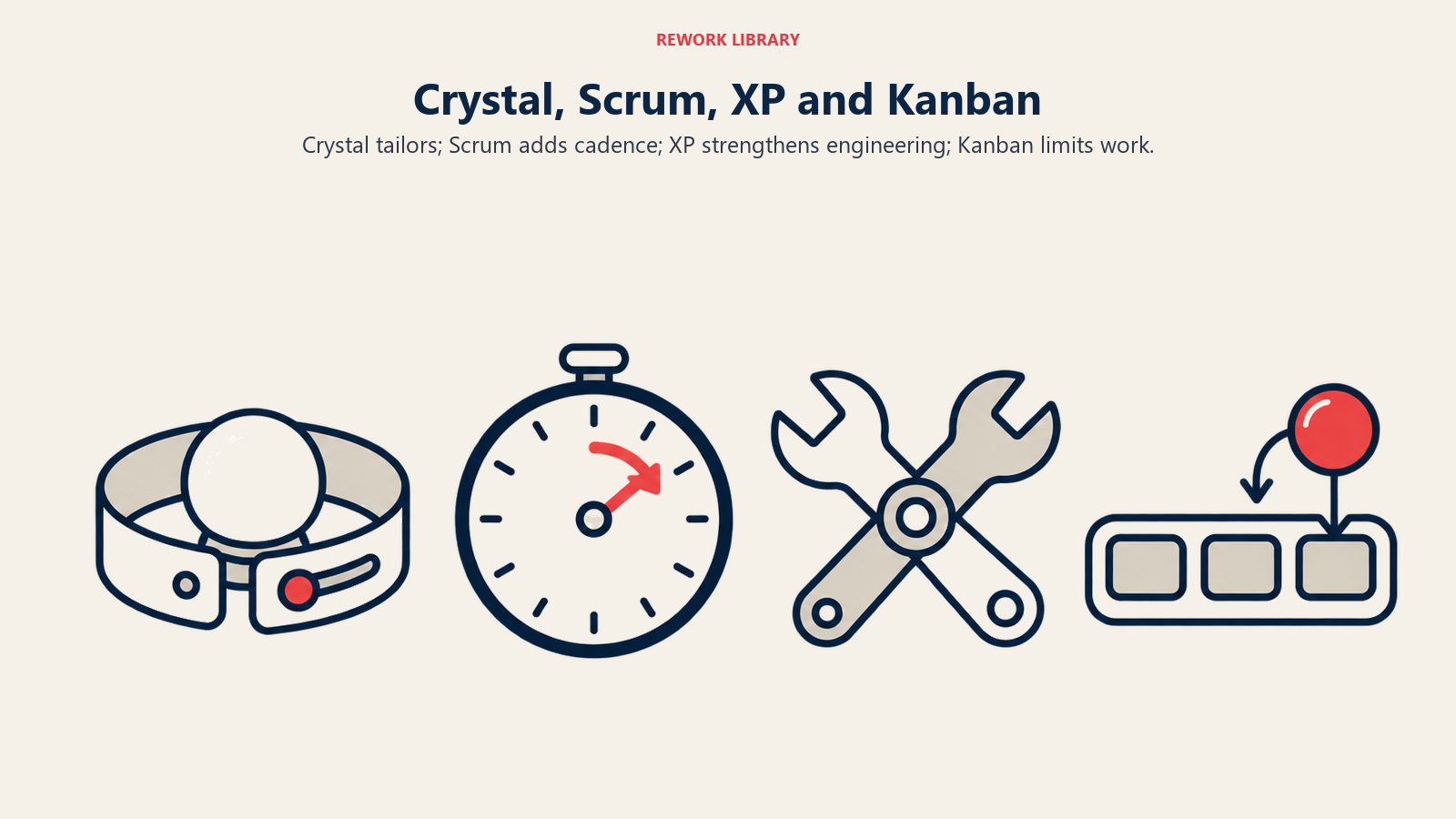
Crystal sits in an unusual spot next to the three methodologies people actually run today. It prescribes the least, which is both its selling point and the reason it never scaled into a certification industry the way Scrum did.
| Crystal (Clear) | Scrum | Extreme Programming | Kanban | |
|---|---|---|---|---|
| What it prescribes | Seven properties describing a healthy team environment, not a process | Fixed roles, sprints, and ceremonies (planning, daily standup, review, retrospective) | Specific engineering practices: TDD, pair programming, continuous integration | A visual flow system with WIP limits and continuous delivery, no fixed iterations |
| Team size fit | Small, co-located, roughly 6-8 people at the Clear level | Any size, though most literature assumes 5-11 per team | Small, typically 5-12 developers | Any size, scales by adding lanes or boards |
| How rigid it is | Deliberately loose; you're expected to tailor it | Moderately fixed; the ceremonies are the framework | Fairly strict on engineering discipline, looser on management process | Loose by design; flow and limits are the only real rules |
| Certification ecosystem | Minimal to none | Large (Scrum.org, Scrum Alliance, and others) | Small | Small to moderate |
| Where it's strongest | Small trusted teams that don't need much scaffolding | Cross-functional product teams that benefit from a shared cadence | Teams where code quality and technical debt are the main risk | Ongoing operational or support work with variable, unpredictable input |
| Practical weakness | Too little structure for teams that need training wheels, or for coordinating across many teams | Ceremony overhead can outgrow its value on very small or very senior teams | Doesn't address project management or stakeholder communication on its own | Doesn't tell you how to plan, estimate, or run meetings, just how to manage flow |
The honest read here is that Crystal's minimalism is exactly its problem in most organizations. Teams that already have strong communication and enough experience to self-correct don't need much scaffolding, and Crystal gets out of their way. Teams that don't have that yet, which describes a lot of teams, get very little from a framework whose main advice is "keep doing what's already working." Scrum's ceremonies, by contrast, work as training wheels precisely because they're fixed. That's not a compliment to Scrum's design so much as an explanation for why it won the adoption race that Crystal never really entered.
It's also worth separating Crystal from scaling frameworks that get mentioned in the same breath. Crystal scales by swapping in a heavier family member as the team grows, a different color for a different headcount. Large-Scale Scrum (LeSS) takes the opposite approach: it keeps a single Scrum team's rules intact and adds coordination structure around multiple teams sharing one product backlog, rather than handing each team a different rulebook. Both start from the same worry, that a framework built for one small team doesn't automatically work at a larger scale, and answer it in almost opposite ways.
Whether Crystal is actually used today
It's worth being straightforward about this instead of treating Crystal as a hidden gem nobody's discovered. Crystal is real, it worked for the teams that used it, and it is genuinely uncommon now. Cockburn himself, in his 2024 re-introduction of the family, doesn't claim Crystal is thriving. He says it "has been used successfully since 1998, and still is in use in some places," which is a modest claim from the person who built it, not a comeback pitch.
The wider picture points the same direction without ever naming Crystal. Ask around a dozen delivery teams what framework they run and most will describe something hybrid: Scrum events with a Kanban board, a retrospective cadence borrowed from one place and an estimation habit from another. Crystal doesn't show up in framework surveys, not because the tailoring idea lost, but because the idea won so completely that almost nobody names their process a single thing anymore. Most teams today are quietly doing what Cockburn described, sizing their process to their situation, without calling it Crystal or citing him for it.
What actually happened is that Scrum absorbed the market for "a named framework you can train people on and certify against," and Crystal's core insight, that the right process depends on the project, got folded into the general agile mainstream instead of staying attached to Cockburn's specific color scheme. That's a strange kind of survival: the idea won, the brand didn't.
When Crystal is genuinely worth choosing today
Crystal isn't a museum piece, but it fits a narrower set of situations than Scrum or Kanban do.
| Choose Crystal (Clear) when | Skip it when |
|---|---|
| The team is small, co-located or near it, and already communicates well without much formal process | The team is distributed across time zones with little overlap; osmotic communication depends on proximity |
| Leadership trusts the team enough to let them shape their own process | The organization needs a standard, auditable process across many teams for compliance or reporting reasons |
| The project's criticality is low to moderate, meaning a missed bug is inconvenient rather than dangerous or catastrophically expensive | The project is safety-critical, regulated, or handles significant financial risk, where documented process matters for reasons beyond team preference |
| You want a starting point for tailoring your own process rather than a rulebook to follow | You need something new hires can be trained on quickly through existing certification paths, which mostly don't exist for Crystal |
| The team already has senior, experienced people who don't need ceremony to stay aligned | The team is new to agile work altogether and would benefit from Scrum's more scaffolded ceremonies while building the habit |
The pattern across both columns is really about how much structure a team needs from outside itself. Crystal assumes the team already has good instincts and just needs permission to act on them. That's a fair assumption for some teams and a bad bet for others, and knowing which one you have before you pick a methodology is more useful than knowing the methodology's name.
What to steal from Crystal even if you run Scrum
This is the part of Crystal actually worth your time, whether or not you ever run anything called Crystal. None of it requires switching frameworks.
| Take this from Crystal | How to use it inside Scrum, Kanban, or anything else |
|---|---|
| Tailor the process to the project, not the other way around | Before defaulting to your standard sprint length or ceremony set, ask what this specific project's size and criticality actually call for, the same two questions Cockburn asked |
| Osmotic communication | Even on a Scrum team, protect the informal channels, shared channels, pairing, sitting near the people you depend on, that let information travel without a scheduled meeting |
| Reflective improvement | Don't let the sprint retrospective become a formality. Cockburn's version assumes the team will genuinely change its process based on what it hears, not just log action items nobody revisits |
| Criticality as a real input to process decisions | Match your rigor, code review depth, testing coverage, documentation, to actual risk, not to whatever your organization's default template says |
| Frequent delivery over big-bang releases | Whatever framework you're in, shrink the gap between finishing work and getting it in front of real users or expert users who can react to it |
| Personal safety before process | A team that's afraid to flag a problem will make your sprint planning numbers look fine while the actual work quietly falls behind |
None of these require a certification, a new tool, or permission from anyone to start doing tomorrow. That's the real argument for reading about Crystal even in 2026: not to adopt it, but to borrow the questions it asks before you accept whatever process your organization already has on the shelf.
Frequently Asked Questions about Crystal Methodology
Who created the Crystal methodology and when?
Alistair Cockburn designed the Crystal family of methodologies in 1998 while consulting on a mainframe project for the Central Bank of Norway, building on an earlier agile methodology he wrote for IBM in 1993 after two years of interviewing project teams. He later became one of the 17 original signatories of the Agile Manifesto in 2001.
What's the difference between Crystal and Crystal Clear?
Crystal is the family name for the whole approach. Crystal Clear is one specific member of that family, the lightest one, aimed at small co-located teams of roughly six to eight people. It's also the only family member Cockburn documented in a full book.
Is Crystal still used today?
Rarely as a named framework. Cockburn himself describes it as still in use "in some places" rather than widely adopted, and it doesn't appear in major industry surveys of methodology usage. Its core idea, tailoring process to project size and risk, is common practice now, but almost nobody attaches the Crystal name to it anymore.
How does Crystal decide which family member to use?
Along two dimensions: team size, expressed as a color that gets darker for bigger teams, and criticality, meaning the worst probable outcome if an undetected defect ships. A small team building something low-stakes needs less process than a similarly sized team building something where mistakes are expensive or dangerous.
What are the seven properties of Crystal Clear?
Frequent delivery, reflective improvement, osmotic communication, personal safety, focus, easy access to expert users, and a technical environment built on automated tests, configuration management, and frequent integration. Cockburn calls these properties rather than practices because he found them already present in successful teams instead of inventing them from scratch.
Should I switch my team to Crystal instead of Scrum?
Probably not, unless your team is small, co-located, already communicates well, and works in a lower-stakes context where you have room to shape your own process. For most teams, the more useful move is borrowing Crystal's ideas, tailoring process to the project and protecting informal communication, while staying inside whatever framework you already run.
Crystal never became a household name the way Scrum did, and Cockburn's own writing doesn't pretend otherwise. What it left behind is smaller and more durable than a certification track: the idea that a six-person team and a two-hundred-person team shouldn't be running the same process just because someone printed the same framework on both their walls. That's worth remembering the next time someone hands you a process template and calls it standard.

Senior Operations & Growth Strategist
On this page
- What Crystal actually is
- Where Crystal came from
- The two dimensions that pick your Crystal
- Meet the family: Clear, Yellow, Orange, and the darker colors nobody quite agrees on
- Crystal Clear's seven properties
- Crystal vs Scrum, XP, and Kanban
- Whether Crystal is actually used today
- When Crystal is genuinely worth choosing today
- What to steal from Crystal even if you run Scrum