Epics vs Features vs User Stories Explained
Turn this article into takeaways for your work.


Each assistant summarizes the article only for you and suggests best practices for your work.
Most agile teams know the words. Fewer agree on what they mean. Epics vs features vs stories is one of the most searched questions in product and project management because teams routinely mix up the levels, creating backlogs that are either impossibly vague or too granular to plan.
Getting the hierarchy right is not a naming exercise. It's how you connect a six-month strategic initiative to the two-day task a developer picks up on Monday morning.
What are epics, features, and user stories?
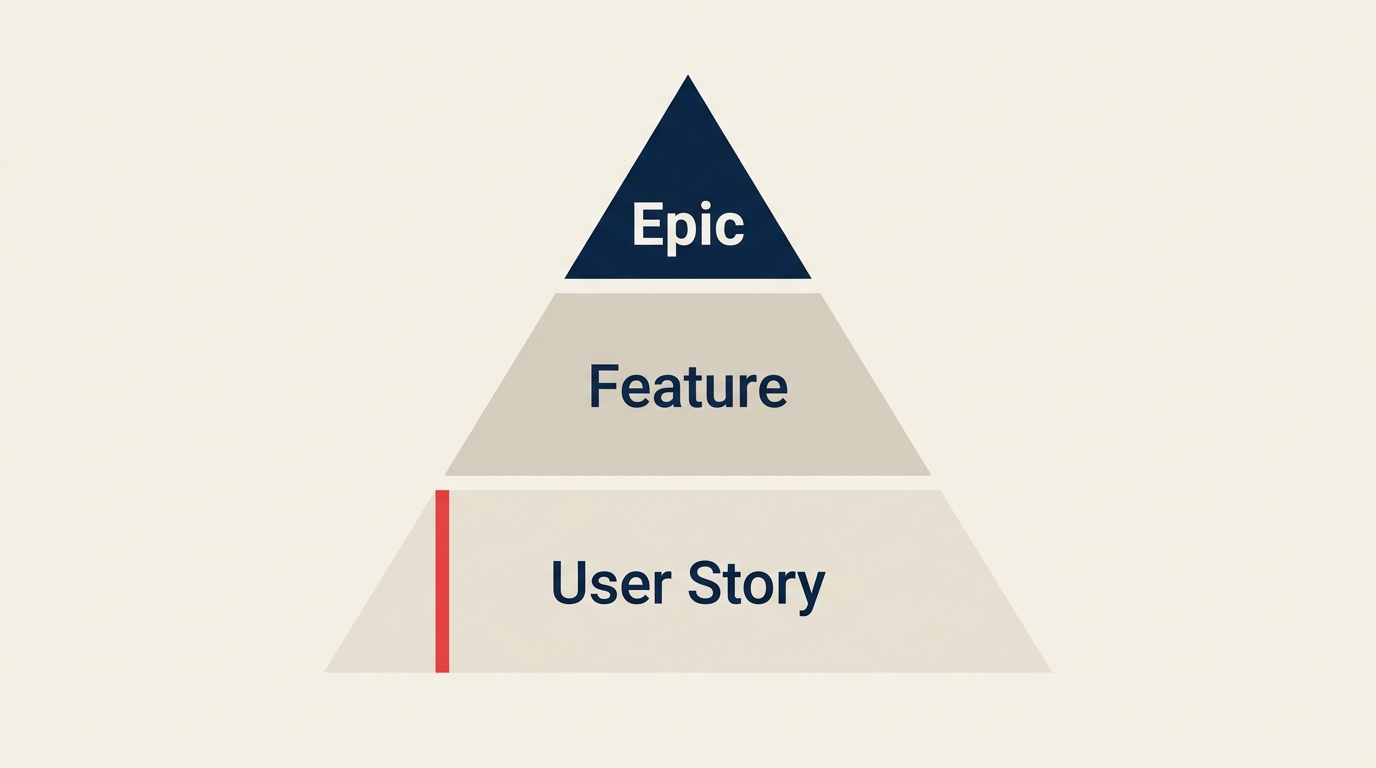
Epics, features, and user stories are three levels of a requirements hierarchy used in agile planning. An epic is a large body of work that spans multiple sprints, a feature is a shippable slice of that epic representing a distinct capability, and a user story is a single, small unit of value that a team can deliver in one sprint or less.
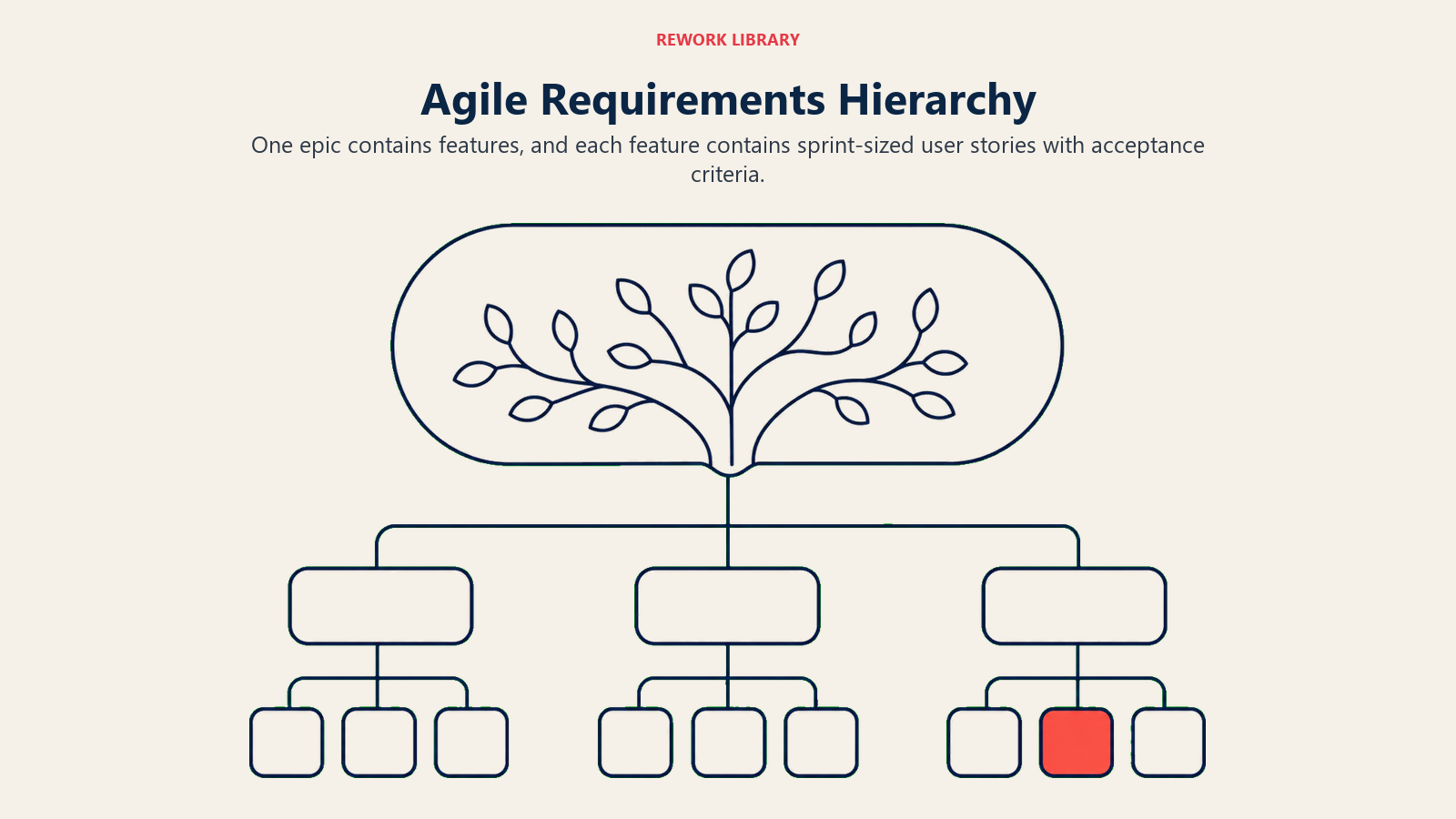
The three levels nest inside each other: one epic contains several features, each feature contains several user stories. Together they form the backbone of a healthy product backlog.
Key facts
- Teams that decompose requirements into clear hierarchies report 27% fewer scope-change failures than those using flat backlogs (Standish Group CHAOS Report, 2023).
- The State of Agile Report found that 68% of organizations name "inconsistent backlog structure" as a top contributor to missed sprint goals (Digital.ai, 2024).
- Poorly defined acceptance criteria are the leading cause of rework, costing teams an average of 20-25% of total project time (PMI Pulse of the Profession, 2023).
Understanding where each level starts and stops is the single fastest way to reduce planning friction and sprint blowouts.
Epic vs feature vs user story: the hierarchy
The table below pins down how each level behaves in practice. Notice that the key differentiators are scope, time horizon, and ownership, not just size.
| Level | Scope | Time horizon | Who owns it | Example |
|---|---|---|---|---|
| Epic | A strategic capability or large initiative | Multiple sprints, often a quarter or more | Product Manager or Product Owner | "Enable self-serve checkout for mobile users" |
| Feature | A shippable capability within the epic | One to a few sprints | Product Owner with Engineering lead | "Guest checkout flow (no account required)" |
| User story | One piece of user value, deliverable in a single sprint | 1-3 days of dev work | Dev team member (story author), Product Owner (acceptance) | "As a guest user, I can enter my email at checkout so I receive an order confirmation" |
Think of it as a zoom lens. The epic is the wide shot (you know the destination but not every turn). Features are the route segments. User stories are the individual instructions: turn left, continue 200 meters, park here.
For a deeper look at how stories themselves are structured, see the guide to user stories and the acceptance criteria reference.
Benefits of breaking work into this hierarchy
A three-level hierarchy does more than organize the backlog. It solves real coordination problems.
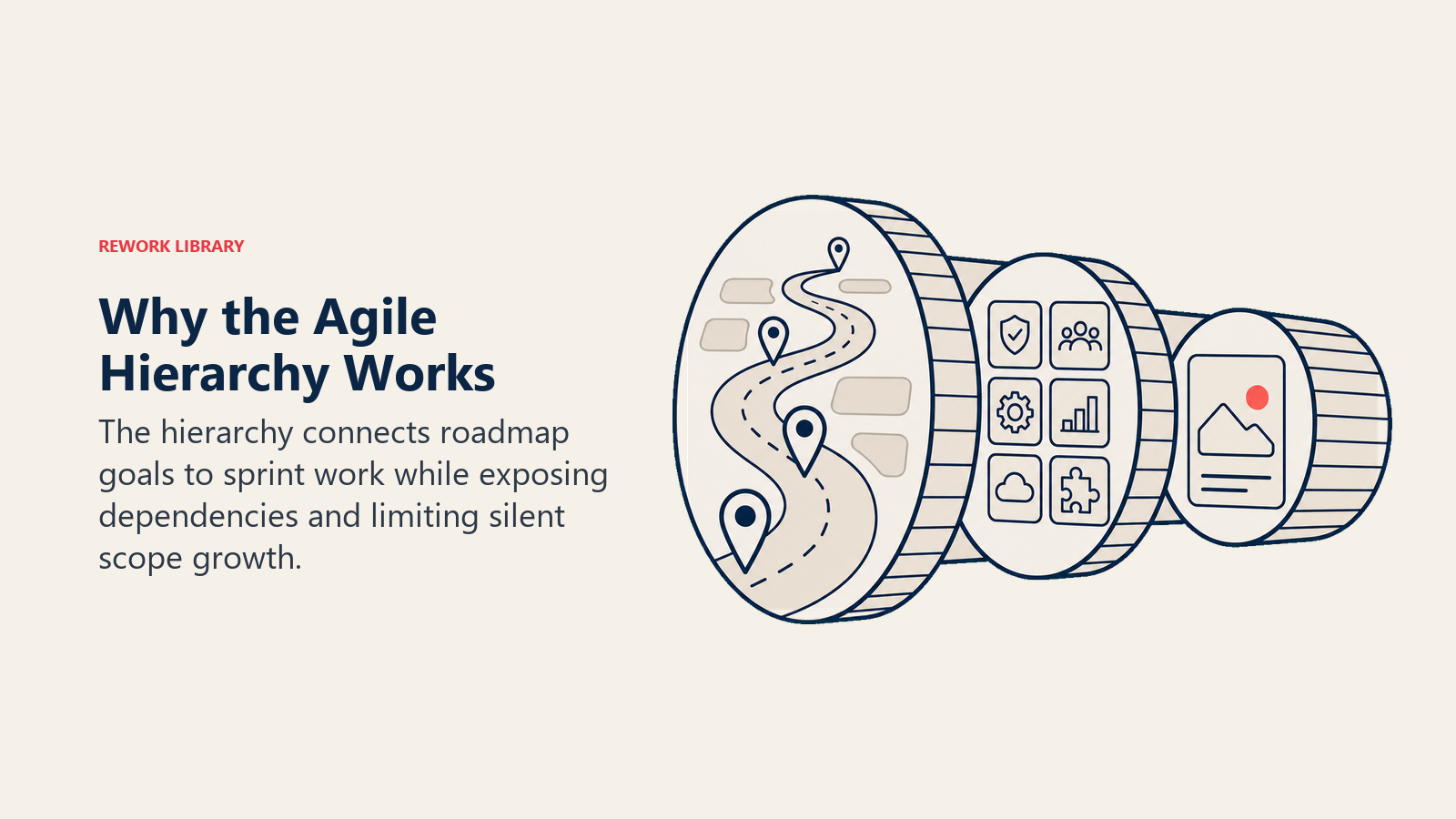
Roadmap clarity at every altitude. Executives and stakeholders can track epic-level progress without drowning in story details. Developers can focus on stories without needing the full strategic context of every quarter. Features bridge the two.
Predictable sprint planning. When stories are correctly sized, teams can reliably fill a sprint without over-committing. Story points estimation only works when the story is actually small enough to estimate.
Visible dependencies. Features often depend on each other, and surfacing those dependencies at the feature level (rather than discovering them at the story level mid-sprint) prevents last-minute blockers.
Better backlog refinement. Refinement sessions are faster when the team is not simultaneously debating scope and implementation. Epics and features frame the "what," so refinement can focus on the "how."
The hierarchy also makes scope creep visible. If a new request doesn't fit into an existing epic, it becomes its own epic, which forces a deliberate prioritization conversation rather than silent backlog bloat.
Common mistakes
Teams that understand the definitions still fall into predictable traps.
Stories that are too big. The most common mistake. If a story takes more than a few days or requires multiple people to pick up independently, it's a feature pretending to be a story. A sign: any story where you write "and" in the user benefit clause is probably two stories.
Epics that never close. An epic that stays open indefinitely becomes a dumping ground. It loses meaning as a planning unit. Epics should have a clear definition of done: a set of features shipped that together deliver the strategic capability.
Missing acceptance criteria. A user story without acceptance criteria is a wish, not a commitment. The team can't test it, and Product can't sign it off. Every story needs at least one criterion that confirms the value was delivered.
Features confused with themes. Themes group epics by strategic area ("customer retention"). Features are deliverable: you can release a feature to users. You can't release a theme. Keeping this distinction sharp prevents features from inflating into themes over time.
Skipping the feature level entirely. Some teams write epics and break them straight into stories. This works at very small scale, but it creates backlogs of hundreds of ungrouped stories with no intermediate structure for quarterly planning or dependency tracking.
How to break an epic into features and stories
The decomposition process is repeatable. Here it is applied to a concrete example: a checkout-flow epic for a B2B SaaS product.
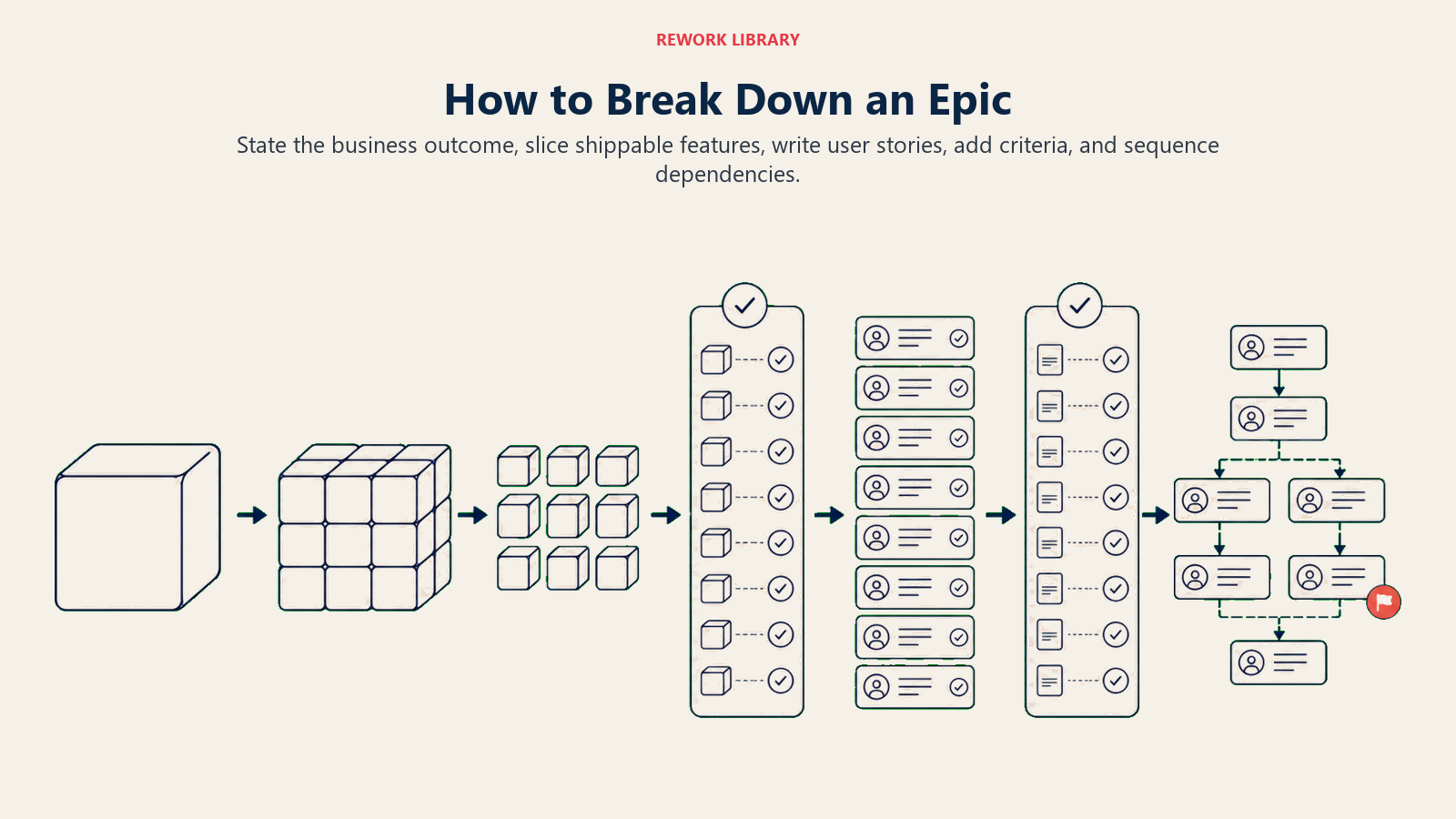
Step 1: State the epic as a business outcome
Write the epic as a goal, not a feature list. Good: "Enable buyers to complete a purchase without contacting sales." Bad: "Build checkout screen."
Step 2: Identify the major capability slices (features)
Ask: what distinct, shippable capabilities does this epic require? Each answer is a feature candidate. For the checkout epic:
- Guest checkout (no login required)
- Saved payment methods
- Order summary and confirmation
- Promo code entry
- Tax and shipping calculation
Each of these could ship independently and deliver value to users.
Step 3: Write user stories for each feature
For "Guest checkout," the stories might be:
- "As a guest, I can enter my email so I receive order confirmation."
- "As a guest, I can enter my billing address without creating an account."
- "As a guest, I can review my cart before placing the order."
Apply the INVEST criteria (see Best Practices below) to each story before moving it into a sprint.
Step 4: Add acceptance criteria to every story
Each story gets at least one testable criterion. For the email entry story: "Given a valid email format, when the user submits the field, then the system saves it and displays a confirmation message."
Step 5: Sequence features by dependency and value
Not all features are equal. Guest checkout is a prerequisite for promo codes, which depend on pricing logic. Map the dependency chain at the feature level before committing sprint order.
This five-step process applies to any domain. Swap out the checkout example for an onboarding flow, a reporting module, or a marketing automation sequence, and the logic holds.
Examples by team
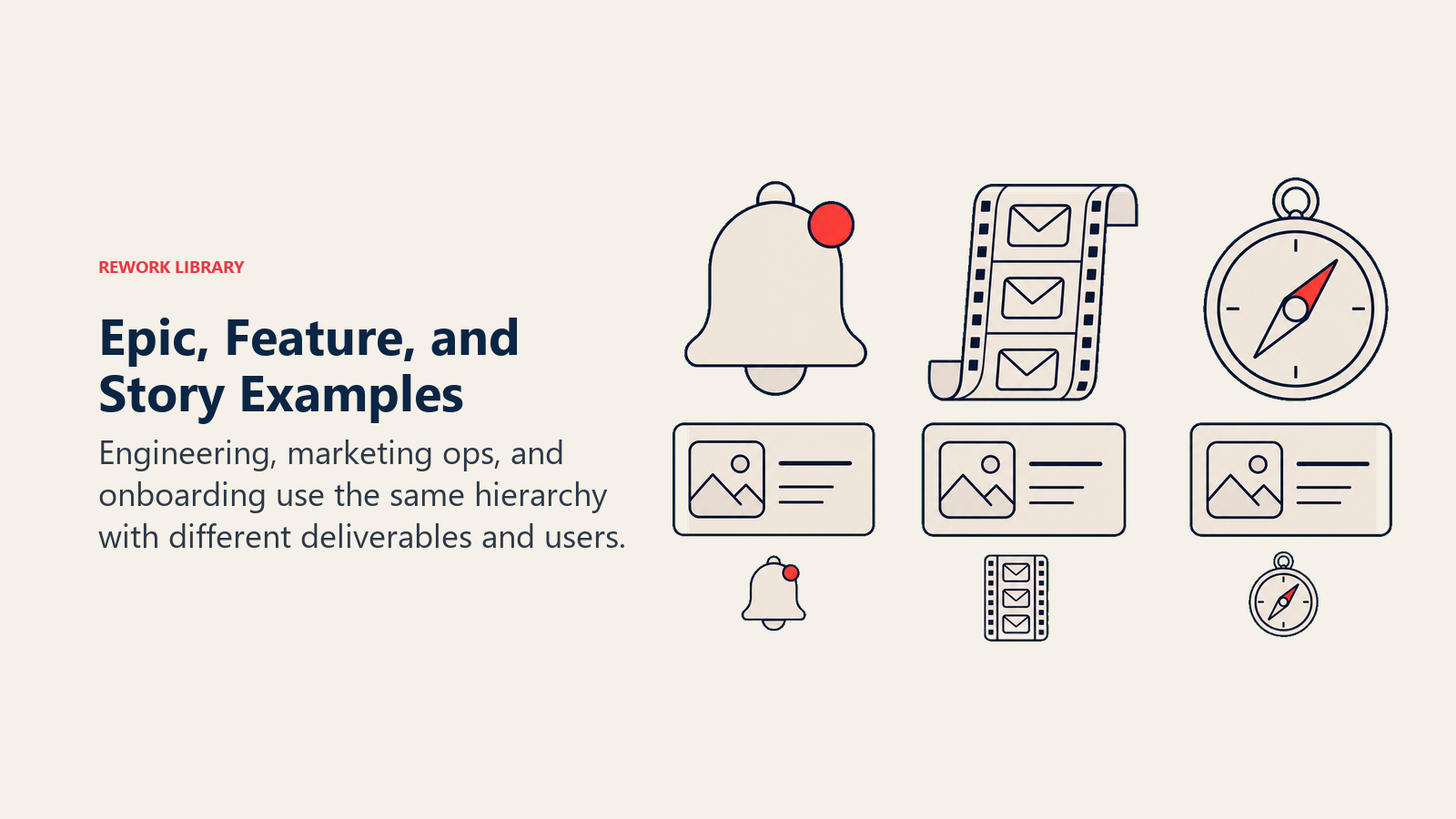
Different functions use the same hierarchy, but the content looks very different.
| Function | Epic | Feature | User story |
|---|---|---|---|
| Engineering | Launch real-time notification system | In-app notification center | "As a user, I can see a notification badge count so I know when to check alerts." |
| Marketing Ops | Build automated lead nurture program | Email drip sequence for trial signups | "As a marketing manager, I can trigger a 5-email sequence when a lead starts a trial so they receive timely onboarding content." |
| Customer Onboarding | Reduce time-to-first-value from 14 days to 5 | Guided setup wizard for new accounts | "As a new admin, I can connect my first integration in the setup wizard so I don't need to find the settings page manually." |
Notice that every user story, regardless of the team, follows the same shape: who the user is, what they need to do, and why. The "why" clause is what turns a task into a story with real acceptance criteria attached.
Best practices
Use the INVEST criteria for stories. A well-formed user story is: Independent (can be worked without requiring another story), Negotiable (scope is not locked), Valuable (delivers something to a real user), Estimable (team can size it), Small (fits in a sprint), Testable (has acceptance criteria). Run any story you're unsure about through this checklist before the sprint.
Slice vertically, not horizontally. A horizontal slice delivers one layer of the tech stack (e.g., "build the database schema for checkout"). A vertical slice cuts through all layers to deliver user-visible value (e.g., "guest can see an order confirmation"). Vertical slices enable faster feedback and earlier releases.
Set WIP limits at the feature level. Treating features as work-in-progress items, not just organizational buckets, helps teams avoid starting too many features in parallel. The Scrum framework encourages limiting concurrent work to improve flow.
Review epics quarterly, features per sprint, stories daily. The planning cadence should match the scope. Epics belong in quarterly roadmap reviews. Features belong in sprint planning. Stories belong in daily standups. Mixing these rhythms is a common source of planning overhead.
Connect epics to agile methodology goals. Every epic should trace back to a business objective (OKR, Objective and Key Result, or quarterly goal). If an epic can't be connected to a goal, it's a candidate for the backlog, not the active roadmap.
For teams working across multiple product lines or at scale, the Scaled Agile Framework (SAFe) adds two more levels above epics: capabilities and portfolio epics. And if you're resolving the common question of how Scrum practices apply to agile principles, see the comparison of agile vs Scrum.
Frequently Asked Questions about Epics vs Features vs User Stories Explained
Is a feature the same as a theme?
No. A theme is a label that groups related epics for roadmap communication (for example, "reliability" or "growth"). It has no delivery commitment attached. A feature is a shippable capability inside one epic. Themes organize epics; features break them down.
How many user stories should one epic contain?
There's no fixed number, but a workable range is 10-30 stories across all features in an epic. Fewer than 10 suggests the epic may actually be a feature. More than 50 often means the epic is too broad and should be split into two separate epics with their own goals.
Do epics have story points?
Not in the traditional sense. Story points are used to estimate the relative complexity of individual user stories, which is where the uncertainty is small enough to be useful. Epics are estimated in larger units: T-shirt sizes (S/M/L/XL) or rough sprint counts. Using story points at the epic level creates false precision.
When should I split a feature into two features?
Split when: the feature covers two distinct user journeys, when one part could ship and deliver value independently, or when one part has a significantly longer delivery time than the other. If you're writing a feature description and using "and" to connect two distinct capabilities, that's a signal to split.
Can a user story exist outside an epic?
Yes, technically. "Tech debt," "spike," and other non-feature work items are often written as stories without a parent epic. But for any customer-facing or product-level work, floating stories with no parent feature or epic become orphaned backlog items with no visible context. Keep them attached to a parent whenever possible.
Related reading
- User Stories
- Product Backlog
- Backlog Refinement
- Story Points
- Acceptance Criteria
- Definition of Done
- What is Agile Methodology
- Agile vs Scrum
- Scaled Agile Framework (SAFe)
Getting the hierarchy right is an investment that pays off every sprint. Teams that align on what an epic is versus a feature versus a story stop relitigating scope in planning and start shipping consistently. Start with one epic, decompose it through the five-step process above, and use it as the team's shared reference for every planning conversation that follows.

Senior Operations & Growth Strategist
On this page
- What are epics, features, and user stories?
- Epic vs feature vs user story: the hierarchy
- Benefits of breaking work into this hierarchy
- Common mistakes
- How to break an epic into features and stories
- Step 1: State the epic as a business outcome
- Step 2: Identify the major capability slices (features)
- Step 3: Write user stories for each feature
- Step 4: Add acceptance criteria to every story
- Step 5: Sequence features by dependency and value
- Examples by team
- Best practices
- Related reading