Lessons Learned in Project Management: Template and Process
Turn this article into takeaways for your work.


Each assistant summarizes the article only for you and suggests best practices for your work.
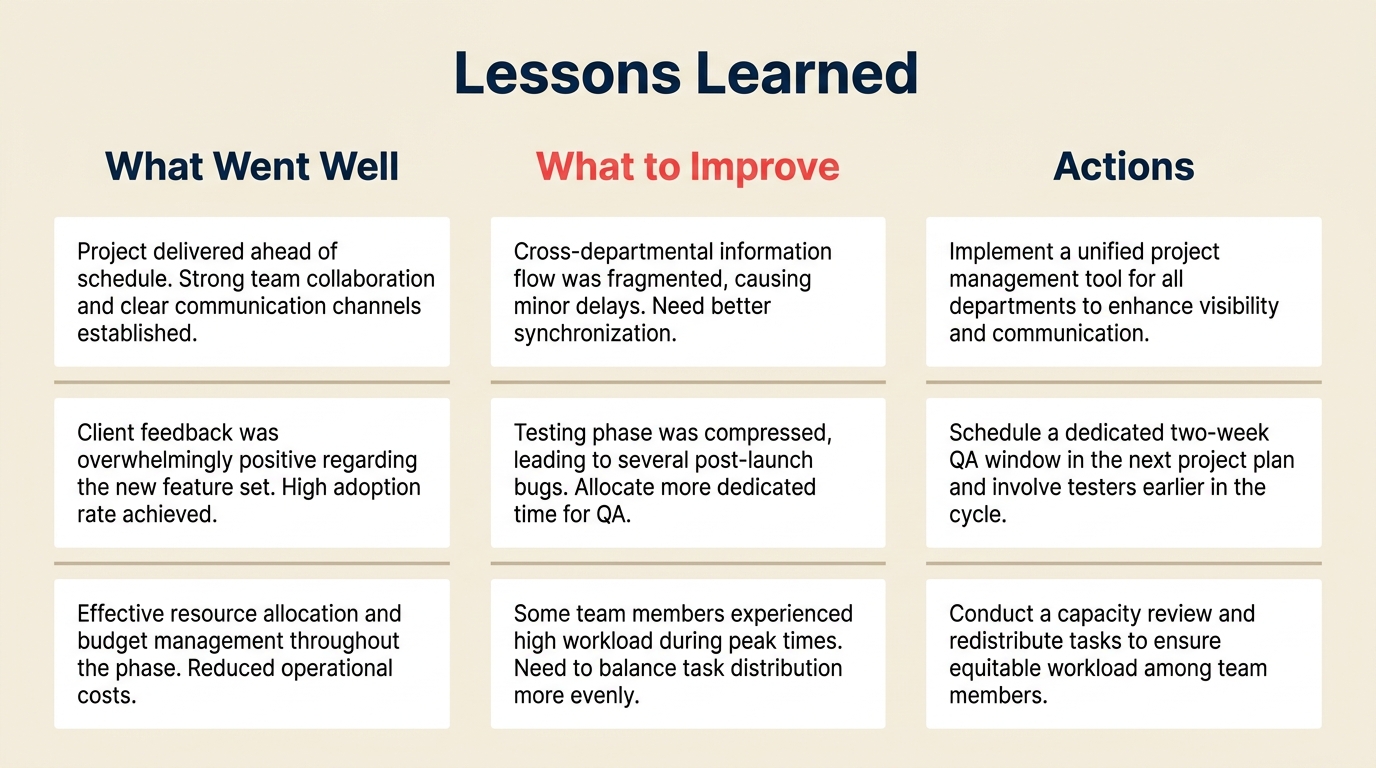
Lessons learned are the documented insights a project team captures about what went well, what didn't, and what they'd do differently. Most projects collect them. Far fewer actually use them on the next project.
That gap between documenting and applying is where most organizational value leaks. This guide walks through the full process: when to capture, what to capture, how to run the session, and how to make sure the output reaches the people who need it next time.
What are lessons learned?
Lessons learned are structured records of knowledge gained during a project. They cover both positive findings (practices that worked and should be repeated) and negative findings (problems that occurred and should be prevented). The goal isn't to assign blame. It's to give future project teams a head start.
A complete lessons-learned record captures not just what happened, but why it happened and what a team should do differently. That depth is what separates useful institutional knowledge from a list of complaints filed at project closure and never opened again.
Lessons learned differ from a sprint retrospective in scope: retros are short, sprint-specific ceremonies; lessons learned span the full project and often feed into organizational process assets used by teams that weren't part of the original project.
Key facts
- PMI research found that organizations that consistently capture and apply lessons learned complete more projects on time and on budget than those that don't, yet fewer than half of organizations have a formal process for doing so.
- A widely cited finding from IT project research is that roughly 70% of projects repeat mistakes from previous projects because knowledge captured at closure was never consulted at initiation.
- The Project Management Body of Knowledge (PMBOK Guide) classifies lessons-learned registers as organizational process assets, meaning they're expected to feed back into how an organization plans and executes future work.
When to capture lessons learned
The most common mistake is treating lessons learned as a one-time end-of-project event. By the time you reach closure, much of the important detail has faded. Effective teams capture them continuously, then consolidate at key milestones.
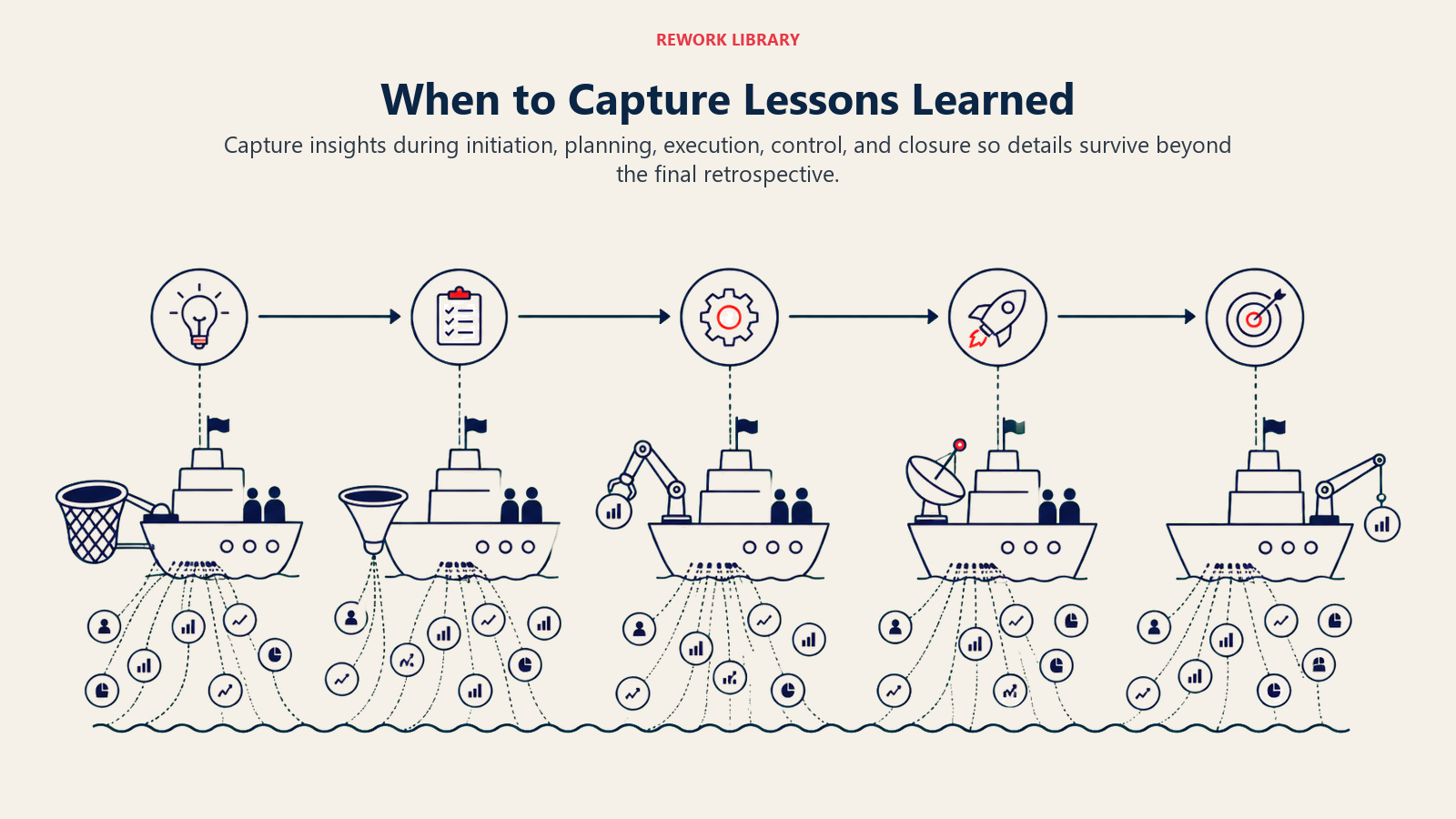
| Phase | What to capture |
|---|---|
| Initiation | Early assumptions that turned out to be wrong; gaps in the business case |
| Planning | Estimates that were off; stakeholder input that was missing or late |
| Execution | Risks that materialized; communication breakdowns; scope creep incidents |
| Monitoring and control | Variance patterns; reporting gaps; decision delays |
| Closure | Final retrospective; overall process assessment; vendor performance |
If your team uses agile methods, each sprint retrospective feeds directly into the lessons-learned register. You're doing this work already. The difference is whether that knowledge gets captured in a format that survives beyond the current team's memory.
See the full project life cycle for how these phases connect.
What to capture
The format of a lessons-learned entry matters. A vague note like "stakeholder communication was difficult" has almost no value for the next project manager. A structured entry does.
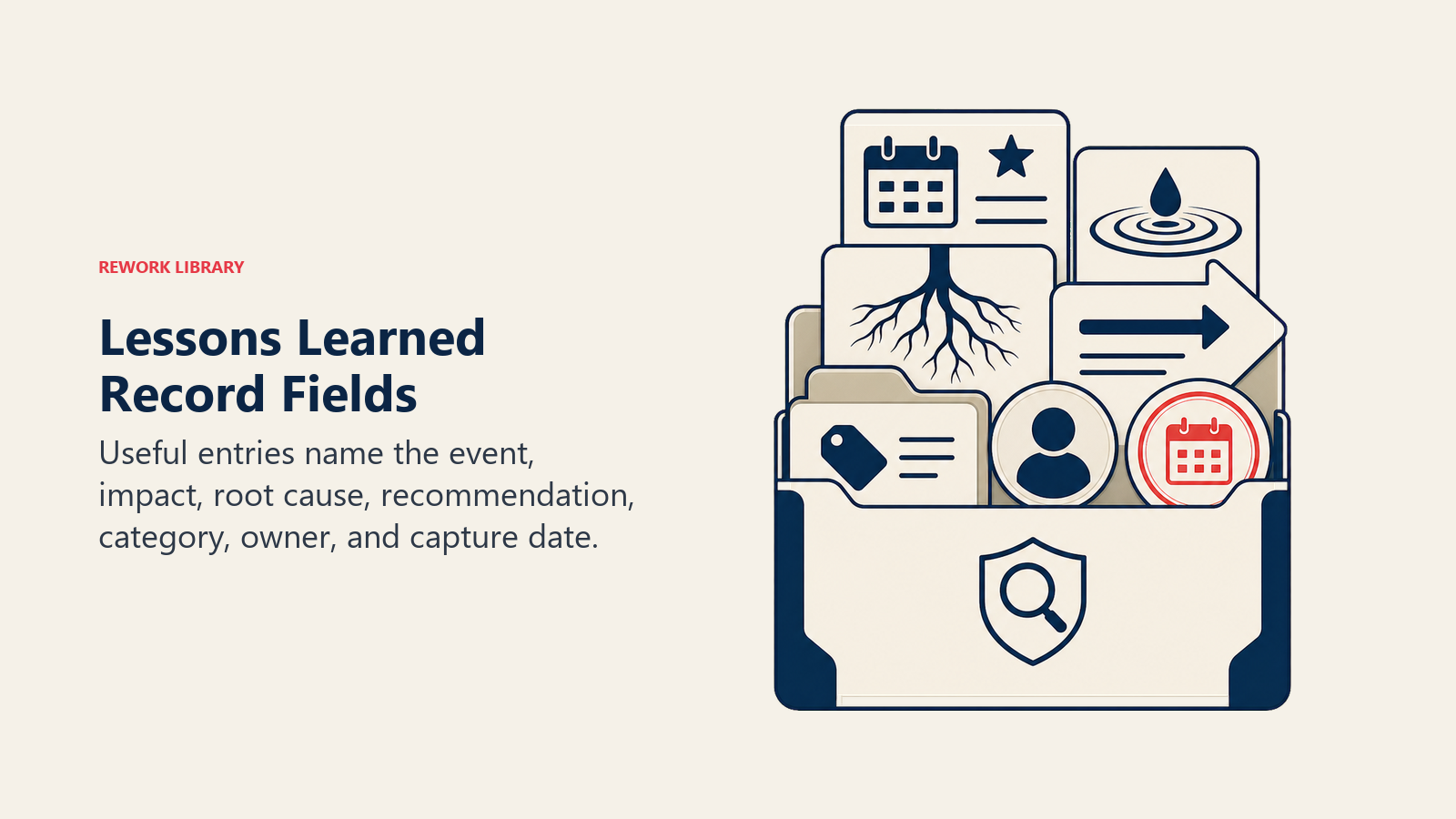
| Field | Description |
|---|---|
| Category | Area affected (schedule, scope, cost, risk, communication, team, vendor) |
| What happened | A brief, factual description of the event or pattern |
| Impact | The effect on schedule, cost, quality, or team |
| Root cause | The underlying reason, not just the symptom |
| Recommendation | The specific action future teams should take or avoid |
| Owner | Who documented this entry |
| Date | When the lesson was captured |
The "root cause" and "recommendation" fields are where most teams are vague. Push for specificity. "Conduct a stakeholder mapping exercise in week one using the RACI template" is useful. "Communicate better" is not.
For guidance on structuring stakeholder-related lessons, the RACI matrix gives a concrete framework for role clarity issues that often appear as recurring lessons.
How to run a lessons-learned session
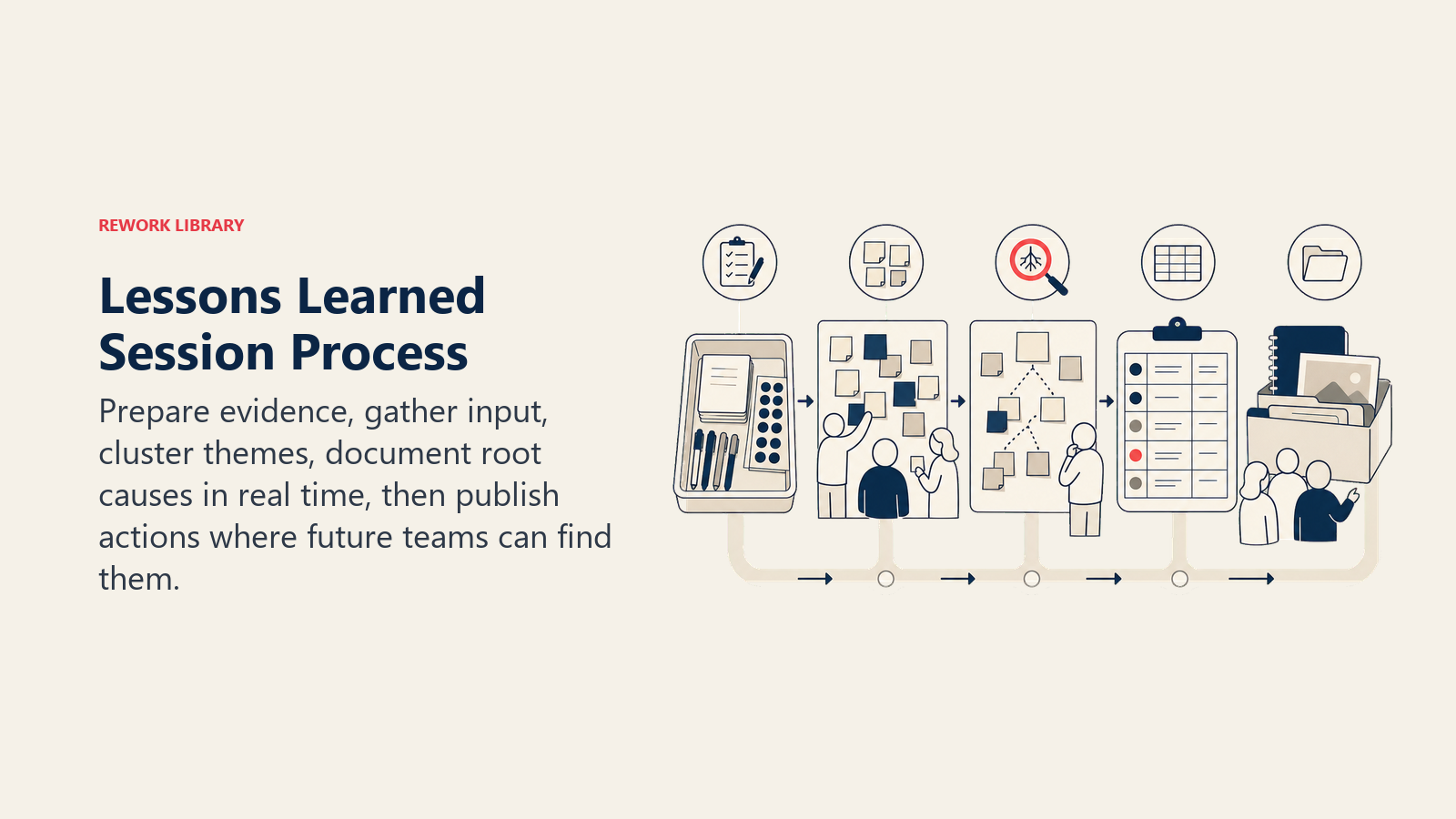
A 60-to-90 minute facilitated session at project closure is the standard vehicle for capturing consolidated lessons. Here's how to run one that produces actionable output.
Step 1: Prepare in advance
Send a short survey two to three days before the session. Ask participants to come with two or three specific examples in each category: what went well, what to improve, and what they'd do differently from the start. This prevents blank-slate moments in the meeting and gives quieter team members time to formulate their thoughts.
Pull relevant data from the project: schedule variance, cost variance, change log volume, RAID log entries, and any escalations. Numbers give the conversation an anchor.
Step 2: Gather input
Open the session with ground rules. This is not a performance review. The goal is process improvement, not assigning fault. Anonymous pre-session inputs can help if the team has sensitive dynamics.
Use a simple structure to collect input: "What should we start doing, stop doing, and keep doing?" Or adapt the retro format: "What went well / what didn't / what do we do next?" Both work. The specifics matter more than the format.
Step 3: Facilitate the discussion
Group similar inputs together to avoid repetitive discussion. For each clustered theme, push for root cause. "The scope kept changing" is a starting point, not a lesson. Dig into why: Was the communication plan unclear on who had change authority? Was the project kickoff meeting missing a scope-freeze agreement?
Allocate more time to items the team rates as high-impact. Not every lesson deserves equal airtime.
Step 4: Document in real time
Assign a notetaker who captures structured entries during the session, not after. Waiting until later introduces gaps and the natural tendency to soften language. Each entry should have: category, what happened, impact, root cause, and recommendation.
Aim for 10 to 20 substantive entries from a full project. More than 30 suggests you're capturing noise along with signal.
Step 5: Share and apply
A lessons-learned document stored on a network drive no one visits is not an organizational asset. It's a guilt receipt.
Make lessons findable. Tag them by project type, industry, methodology, and phase. If your organization uses a project management tool or knowledge base, link the register from the project closure checklist so the next project manager encounters it during planning.
Better still, assign an owner to review existing lessons at project initiation and pull the five most relevant entries into the new project's risk register.
Lessons learned template
Use this structure as a starting point. Adapt the category list to fit your organization's common failure modes.
| ID | Category | What happened | Impact | Root cause | Recommendation | Owner | Date |
|---|---|---|---|---|---|---|---|
| LL-001 | (e.g., Communication) | (brief description) | (schedule/cost/quality effect) | (underlying reason) | (specific action for future teams) | (name) | (YYYY-MM-DD) |
Store this as a shared spreadsheet, a page in your project wiki, or a dedicated section in your project management platform. The format matters less than the discipline of using it.
Lessons learned example
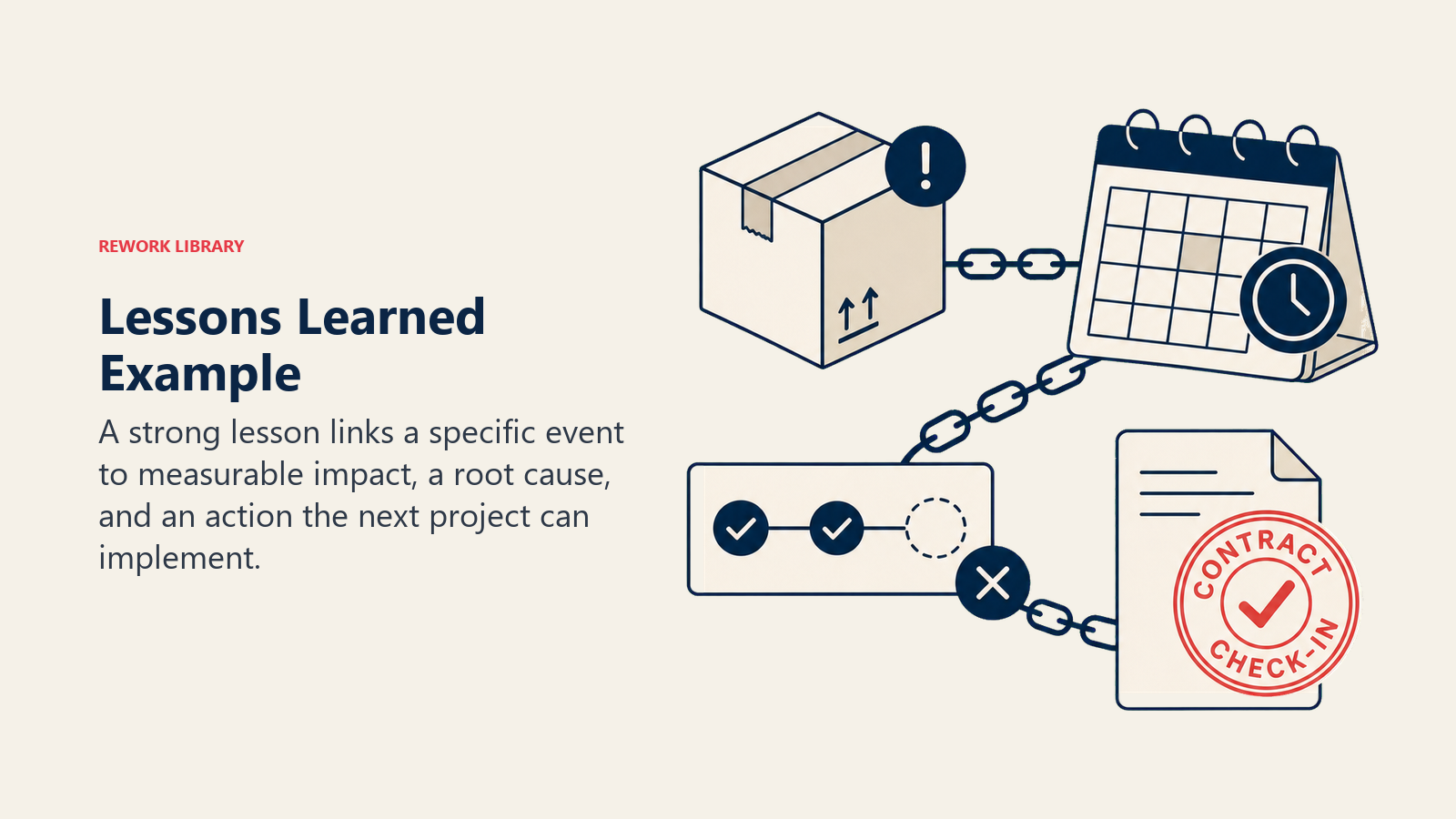
Here are three completed entries drawn from common project patterns:
| ID | Category | What happened | Impact | Root cause | Recommendation |
|---|---|---|---|---|---|
| LL-001 | Scope | Three major feature requests arrived in week six of an eight-week project | 2-week delay, 15% cost overrun | No formal scope-freeze process was defined at kickoff | Define a scope-freeze date at the kickoff meeting. Document it in the project charter and require written approval for any changes after that date. |
| LL-002 | Risk | A key vendor delivered three weeks late with no early warning | Critical path delayed; team idle for one week | No contractual milestone check-ins; vendor assumed internally managed | Add milestone check-in clauses to vendor contracts. Schedule a check-in call at 50% of each vendor delivery window. |
| LL-003 | Communication | Senior stakeholders were surprised by the final demo, requiring a re-do | One additional sprint and budget extension | Status reports went to project team only; sponsors weren't on the distribution list | Include all decision-makers on the bi-weekly status distribution. Confirm the list during kickoff. |
Each of these entries is specific enough that a project manager on a future similar project can act on them immediately.
Best practices
Make it blameless. The moment lessons-learned sessions become associated with accountability for failures, people stop contributing honestly. Frame every session around process and systems, not individuals. If a person made a mistake, the system question is: what process would have caught or prevented it?
Make it findable. Lessons stored in a project folder that's archived on day one of closure aren't useful. Tag entries with searchable metadata (project type, technology, department, methodology). The goal is for a project manager starting a similar project to find the five most relevant lessons within five minutes.
Actually reuse it. The discipline that separates high-performing project organizations from the rest is simple: review existing lessons at initiation, not closure. Build a review step into your project charter or kickoff checklist. Pull three to five relevant lessons and document them in the planning phase as known risks or process commitments.
Common mistakes
Filed and forgotten. The most common failure mode: a lessons-learned document is created at closure, stored somewhere reasonable, and never referenced again. The next team reinvents the same wheels. The fix is structural: build lessons review into project startup as a required step, not an optional one.
Only capturing negatives. Teams tend to focus on what went wrong. But positive lessons are equally valuable. If a particular estimation technique, vendor relationship, or communication cadence worked unusually well, document it so the next team can replicate it deliberately.
Waiting until closure. By project end, people have moved on mentally. Details fade. The team may not be in the same room anymore. Capturing lessons at phase gates and after significant events preserves accuracy. A running log updated throughout the project takes five minutes per entry and produces far richer output than a one-hour session six months later.
Generic language. "Communication could be better" helps no one. Every entry should be specific enough that someone who wasn't on the project can understand what happened, why, and exactly what to do differently.
Frequently Asked Questions about Lessons Learned in Project Management
What is the difference between lessons learned and a sprint retrospective?
A sprint retrospective is an agile ceremony held at the end of each sprint, typically 30 to 90 minutes, focused on how the team worked together during that specific iteration. Lessons learned are a broader project management practice that spans the full project lifecycle and often feed into organizational knowledge bases used by future teams. In practice, sprint retros are a great input to a lessons-learned register, but they're not a substitute for the end-of-project consolidation session.
Who owns lessons learned on a project?
The project manager typically owns the process: scheduling the session, ensuring documentation happens, and routing the final register to wherever the organization stores project knowledge. But ownership of individual entries should be distributed. Each team lead or functional owner should be accountable for entries in their domain. A single person trying to document everything for a large project will produce incomplete and low-quality records.
When should lessons-learned sessions happen?
At minimum, once at project closure. For longer projects, run short sessions at each phase gate or major milestone. Agile teams should treat each sprint retrospective as a mini lessons-learned session and consolidate the key findings at the end of the release or project.
Do lessons learned apply to agile projects?
Yes. The sprint retrospective ceremony is the agile equivalent of a lessons-learned session. The difference is cadence and formality. Agile teams run retros every sprint; traditional projects run them at phase gates and closure. For organizations running both agile and waterfall projects, a shared lessons-learned repository that accepts input from both formats is the most efficient approach.
How long should a lessons-learned document be?
Long enough to be useful, short enough to be read. A typical project generates 10 to 25 entries. A very large, complex program might produce 50. Avoid padding. Every entry should meet one test: would a project manager on a similar future project find this specific enough to act on?
Lessons learned only create value when they complete the loop: captured, stored somewhere findable, and reviewed when a new similar project begins. The session and the template are the easy part. Building the habit of starting new projects with a review of past lessons is the hard part, and the one that actually changes outcomes.
For a broader view of how lessons learned fit into formal project management structure, the project management office (PMO) typically owns the organizational process asset library where these registers live.

Senior Operations & Growth Strategist
On this page
- What are lessons learned?
- Key facts
- When to capture lessons learned
- What to capture
- How to run a lessons-learned session
- Step 1: Prepare in advance
- Step 2: Gather input
- Step 3: Facilitate the discussion
- Step 4: Document in real time
- Step 5: Share and apply
- Lessons learned template
- Lessons learned example
- Best practices
- Common mistakes