Agile vs Scrum: What's the Difference?
Turn this article into takeaways for your work.


Each assistant summarizes the article only for you and suggests best practices for your work.
Agile vs Scrum is one of the most searched questions in project management, and it trips up a surprising number of experienced practitioners. The short answer: Agile is a philosophy, and Scrum is a framework built on top of it.
Understanding the distinction saves you from a common, expensive mistake: adopting Scrum rituals while missing the mindset they depend on.
Agile vs Scrum: the short answer
Agile is a set of values and principles for building software incrementally, adapting to change, and delivering value early. It's defined by the Agile Manifesto, published in 2001 by 17 software practitioners. Agile doesn't tell you what meetings to run or what roles to hire. It tells you what to prioritize: working software over comprehensive documentation, customer collaboration over contract negotiation, responding to change over following a plan.
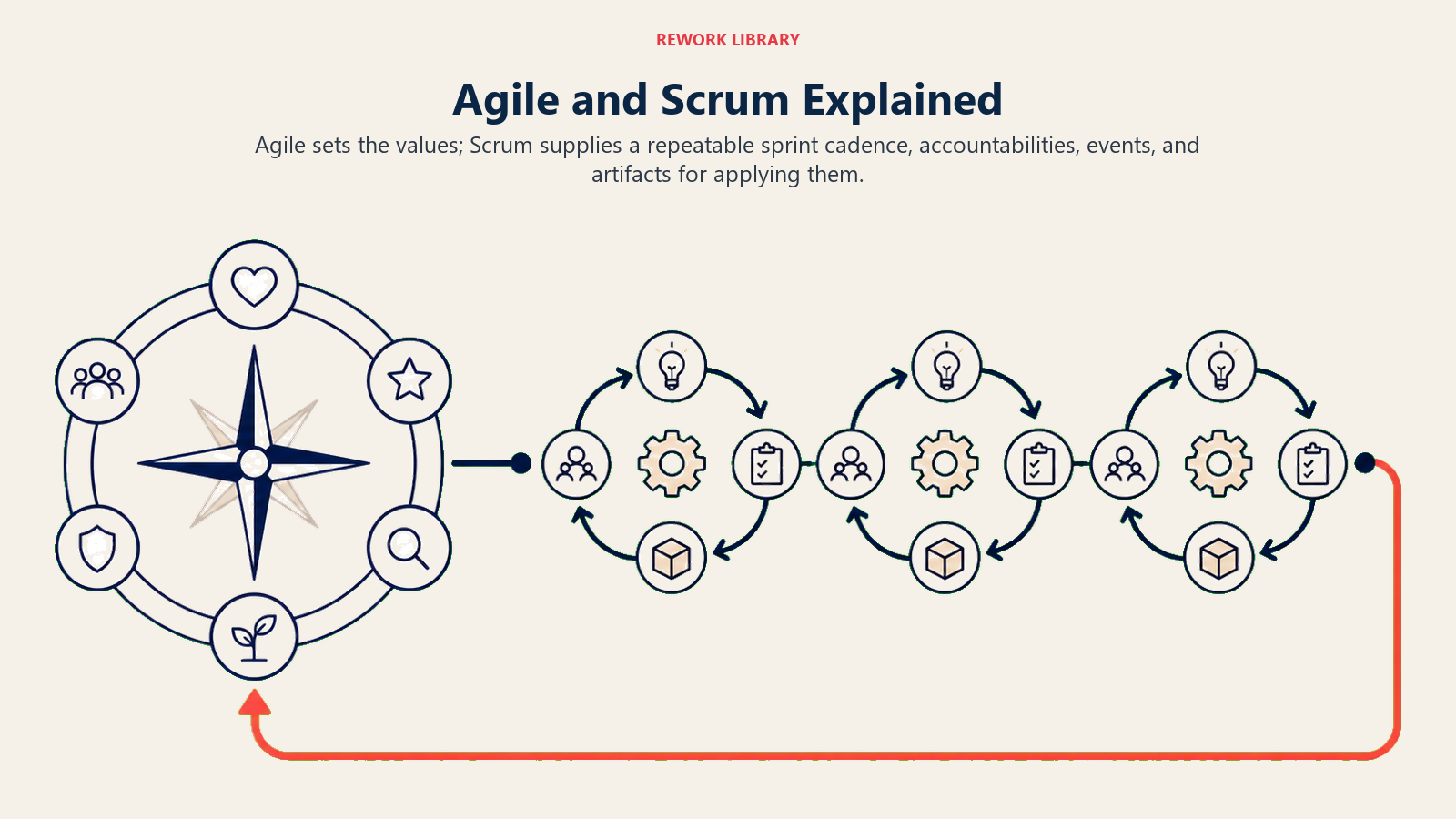
Scrum is a specific framework that puts Agile values into practice. It prescribes three roles (Product Owner, Scrum Master, Development Team), a set of events (Sprint Planning, Daily Scrum, Sprint Review, Sprint Retrospective), and three artifacts (Product Backlog, Sprint Backlog, Increment). Scrum gives you a concrete structure; Agile gives you the "why" behind that structure.
The key distinction: you can be Agile without using Scrum, but you can't run Scrum properly without understanding and practicing Agile values.
Key facts
- Scrum is the most widely adopted Agile framework, used by 81% of Agile teams (State of Agile Report, 2023).
- Organizations fully adopting Agile practices are 4x more successful at project delivery than those using waterfall methods (McKinsey, 2023).
- The Agile Manifesto has been signed by over 20,000 practitioners since its publication in 2001 (agilemanifesto.org, 2024).
Agile vs Scrum comparison table
| Dimension | Agile | Scrum |
|---|---|---|
| What it is | Philosophy / set of values and principles | A specific framework with defined roles, events, and artifacts |
| Scope | Umbrella term covering many frameworks | One framework under the Agile umbrella |
| Prescriptiveness | Flexible; no mandated process | Highly prescriptive; specific ceremonies, roles, timebox |
| Roles | Not defined by Agile itself | Product Owner, Scrum Master, Development Team |
| Cadence | Varies by framework | Fixed 1-4 week sprints |
| Artifacts | Not specified | Product Backlog, Sprint Backlog, Increment |
| When to use | When you need an adaptive, iterative approach | When you need structure, accountability, and regular delivery cycles |
What is Agile?
Agile methodology is a project management philosophy rooted in four values and twelve principles. At its core, it favors short delivery cycles over long, sequential phases. Teams build, get feedback, and adapt rather than defining everything upfront and building in one long stretch.
Agile emerged as a direct reaction to waterfall's rigidity. In Agile vs Waterfall contexts, the tradeoff is predictability vs adaptability. Agile wins when requirements are uncertain, feedback loops matter, and speed to value beats comprehensive upfront planning.
Agile is not a process you install. It's a set of beliefs about how work should flow. Different frameworks translate those beliefs into different processes: Scrum, Kanban, Extreme Programming (XP), and the Scaled Agile Framework (SAFe) all interpret Agile principles differently.
What is Scrum?
Scrum is a lightweight framework for developing complex products in short, repeatable iterations called sprints. A sprint is a fixed-length timebox, typically one to four weeks, at the end of which the team delivers a potentially shippable increment.
The framework is built around three accountability roles:
- Product Owner: owns the Product Backlog, prioritizes work, and maximizes value delivery.
- Scrum Master: removes impediments, coaches the team on Scrum practice, and protects the team's focus.
- Developers: self-organize to turn backlog items into increments within the sprint.
Every sprint follows a consistent rhythm: sprint planning to select the sprint goal and backlog items, daily standups to inspect and adapt, a Sprint Review to demonstrate the increment, and a Sprint Retrospective to improve the process.
Where they overlap and where they differ
Scrum and Agile share the same foundation. Scrum ceremonies like the sprint retrospective exist precisely to support the Agile principle of continuous improvement. The Scrum artifact of a Product Backlog exists to support the Agile value of customer collaboration. You can't run Scrum well if you treat its ceremonies as bureaucratic checkboxes rather than feedback loops.
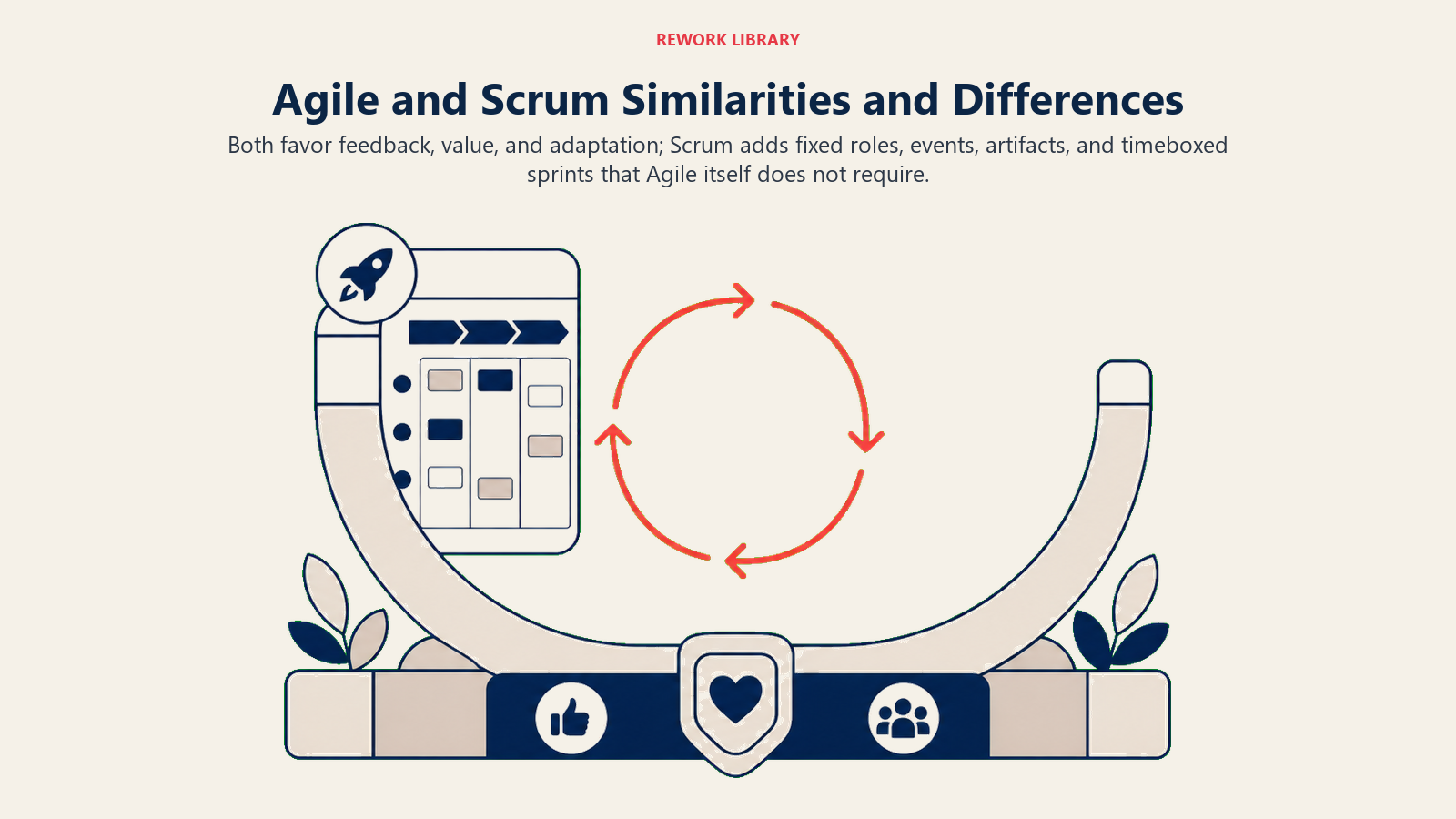
But they diverge on structure. Agile says "inspect and adapt." Scrum says "inspect and adapt every sprint, using these exact roles, this exact meeting, in this exact format." That specificity is Scrum's strength and also its main limitation.
Agile frameworks other than Scrum take a different path:
- Kanban focuses on visualizing workflow and limiting work in progress, with no fixed cadence or defined roles.
- Extreme Programming (XP) emphasizes engineering practices like test-driven development and pair programming, with heavy focus on automated testing and continuous integration.
- SAFe (Scaled Agile Framework) applies Agile at enterprise scale across multiple teams. See Scaled Agile Framework for an overview of how SAFe works in practice.
- Scrumban blends Scrum's sprint structure with Kanban's flow-based thinking for teams that need flexibility within a cadence.
You can also see how Scrum vs Kanban plays out in practice, since those two are the most common choice when teams debate their first Agile framework.
Common misconceptions
"Doing Scrum means you're Agile." Not automatically. You can run Scrum ceremonies by the book while the team is still waterfall-minded: long upfront planning, no real feedback loops, sprints that are just mini-waterfalls with fixed scope. Agile is the mindset. Scrum is only as Agile as the team running it.
"Agile means no documentation." The Agile Manifesto says "working software over comprehensive documentation," not "no documentation." It's about prioritizing outcome over paperwork. Teams that use epics, features, and stories to break down work are documenting requirements. They're just doing it iteratively rather than exhaustively upfront.
"Scrum is for software teams only." Scrum originated in software, but marketing, operations, and product teams now use it. The framework applies wherever work can be broken into timeboxed increments with clear priorities and review cycles.
"Agile is less rigorous than waterfall." Agile requires more frequent communication, regular retrospectives, continuous prioritization, and shorter feedback loops. Many teams find it more demanding, not less, especially in the first six months.
How to choose: Agile (which framework?) or Scrum
Step 1: Assess your requirements certainty
If your requirements are clear and unlikely to change (a regulatory compliance project, a physical build, a data migration), a structured approach like waterfall may fit better. If requirements will evolve with user feedback, start with an Agile framework.
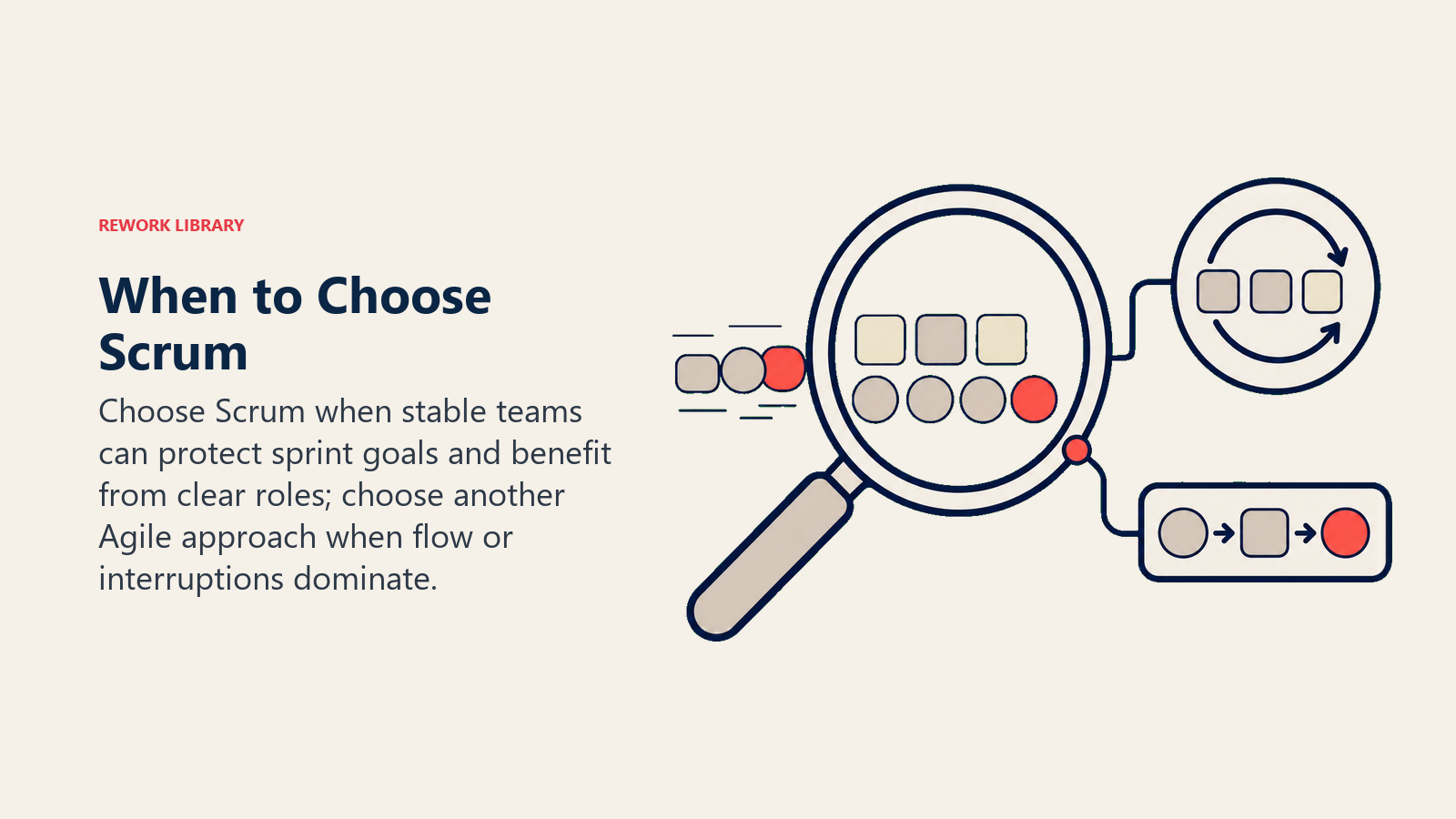
Step 2: Determine your team's need for structure
New teams often benefit from Scrum's explicit structure. It gives everyone a shared vocabulary, a clear cadence, and defined ownership. More experienced teams who understand Agile principles sometimes find Scrum's rigidity too constraining and prefer Kanban's flow-based approach or a hybrid like Scrumban.
Step 3: Consider scale
Scrum works best for teams of 3-9 people on a single product. If you're coordinating 5 teams building an integrated platform, you'll need Scrum at the team level and an enterprise Agile framework like SAFe or LeSS above it. Some organizations instead borrow from the Spotify model, which structures autonomous squads into tribes, chapters, and guilds.
Step 4: Match the framework to the work pattern
| Work pattern | Recommended framework |
|---|---|
| Software in short release cycles | Scrum |
| Continuous service (support, ops, content) | Kanban |
| Engineering with high quality gates | XP |
| Multi-team product delivery | SAFe or LeSS |
| Mixed sprint + flow work | Scrumban |
If you're choosing between Scrum and Kanban specifically, the practical differences in how you plan, prioritize, and measure flow matter more than the theoretical ones.
Frequently Asked Questions about Agile vs Scrum
Is Scrum the same as Agile?
No. Agile is a philosophy with values and principles. Scrum is one framework that applies those principles. Think of Agile as "how we think about building things" and Scrum as "one specific process for doing that."
Can you be Agile without using Scrum?
Yes. Kanban, XP, SAFe, and many hybrid approaches are all Agile without being Scrum. Agile doesn't prescribe any specific framework. It prescribes a way of thinking.
Is Kanban Agile?
Yes. Kanban is an Agile framework that emphasizes visualizing work, limiting work in progress, and managing flow. It doesn't use sprints or the Scrum role structure, but it's fully aligned with Agile principles.
Why do people confuse Agile and Scrum?
Because Scrum is by far the most popular Agile framework. When most people say "we're Agile," they mean "we use Scrum." The terms bleed into each other in everyday use, even though they're technically distinct.
What happens if you use Scrum without Agile values?
You get what practitioners call "ScrumBut": a team running ceremonies (standups, sprints, retrospectives) without the underlying mindset. The ceremonies become box-ticking, the backlog becomes a dumping ground, and the team loses the adaptability that makes Agile valuable. Scrum without Agile values is just a complicated meeting schedule.
The clearest way to remember the distinction: Agile is what you're trying to achieve, and Scrum is one way to get there. If your team is starting out, Scrum is a reasonable default because it gives you structure while you build the habits. But keep an eye on whether the structure is serving the mindset, or getting in its way.
Related reading

Senior Operations & Growth Strategist
On this page
- Agile vs Scrum: the short answer
- Agile vs Scrum comparison table
- What is Agile?
- What is Scrum?
- Where they overlap and where they differ
- Common misconceptions
- How to choose: Agile (which framework?) or Scrum
- Step 1: Assess your requirements certainty
- Step 2: Determine your team's need for structure
- Step 3: Consider scale
- Step 4: Match the framework to the work pattern
- Related reading