Critical Chain Project Management (CCPM) Explained
Turn this article into takeaways for your work.


Each assistant summarizes the article only for you and suggests best practices for your work.
Critical chain project management (CCPM) is a scheduling method that builds your plan around the scarcest resource, then protects that plan with shared time buffers instead of padding every task individually. It was developed by Eliyahu Goldratt and introduced in his 1997 book Critical Chain, as an application of his Theory of Constraints (TOC) to project work.
Most projects run late not because the work is underestimated but because the safety time hidden inside each task estimate evaporates through student syndrome and Parkinson's law. CCPM strips that padding out, pools it into a few visible buffers, and uses buffer consumption as the real early-warning system.
What is critical chain project management?
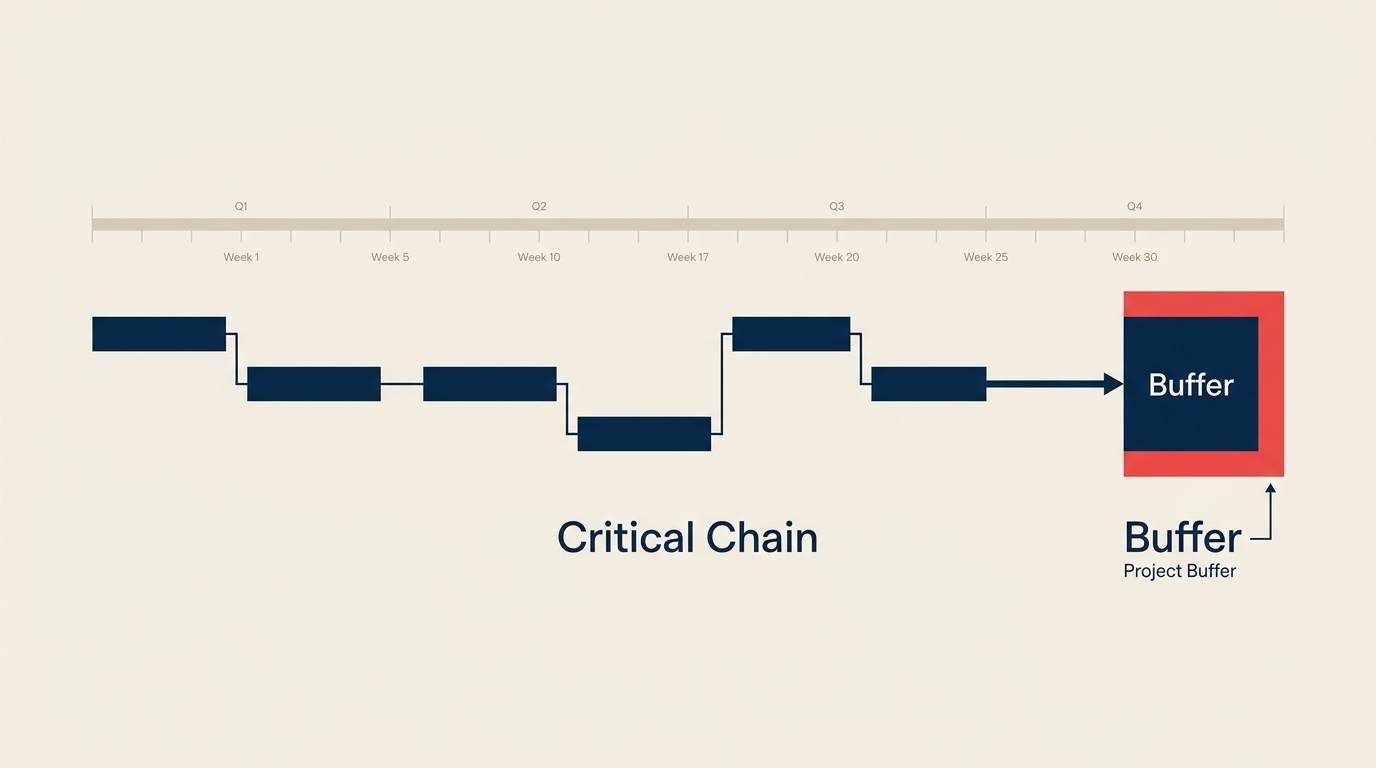
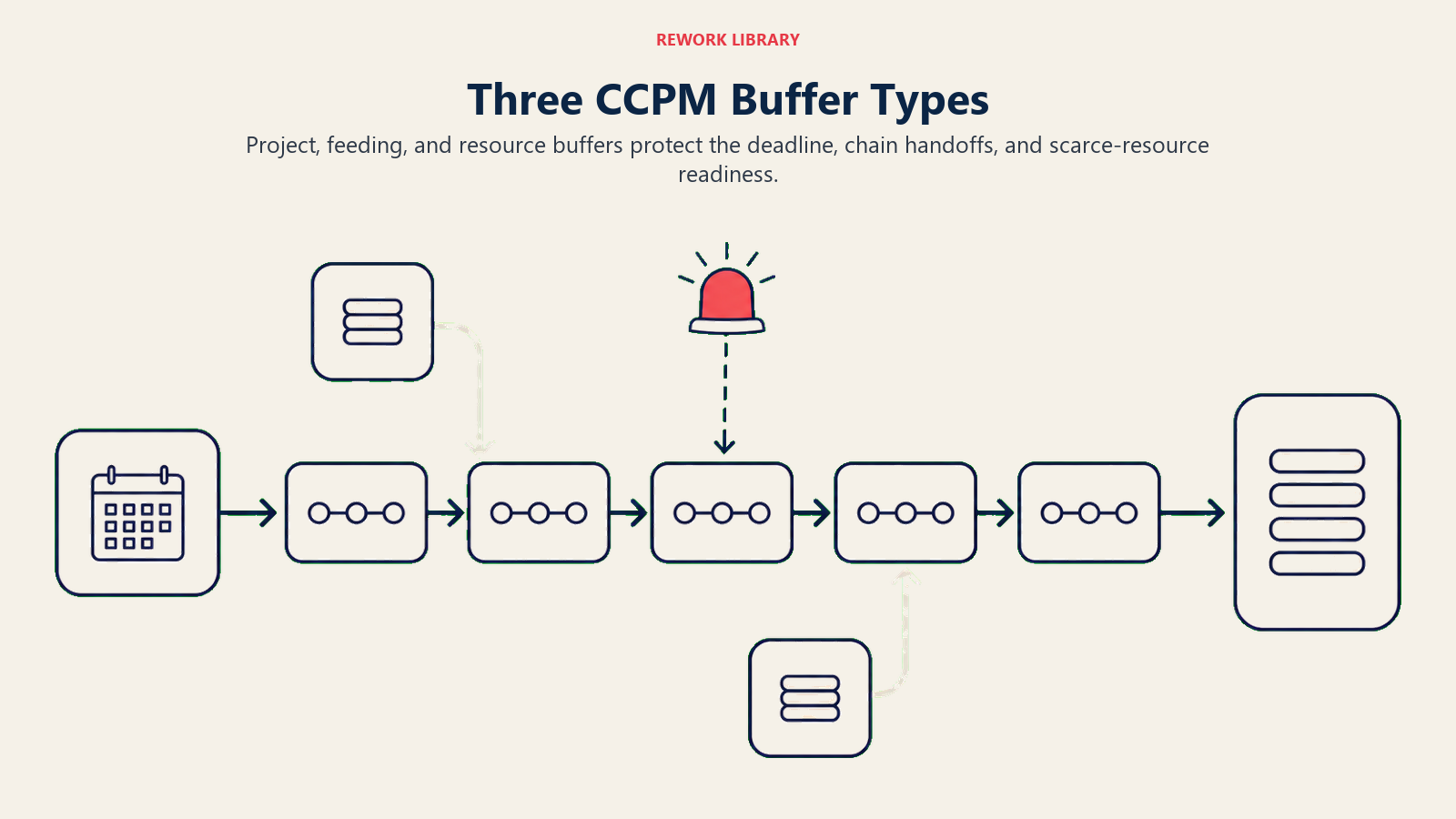
Critical chain project management is a project scheduling technique that identifies the longest chain of dependent tasks when both task dependencies AND resource availability are considered together, then protects the plan using three types of time buffers: a project buffer, feeding buffers, and resource buffers.
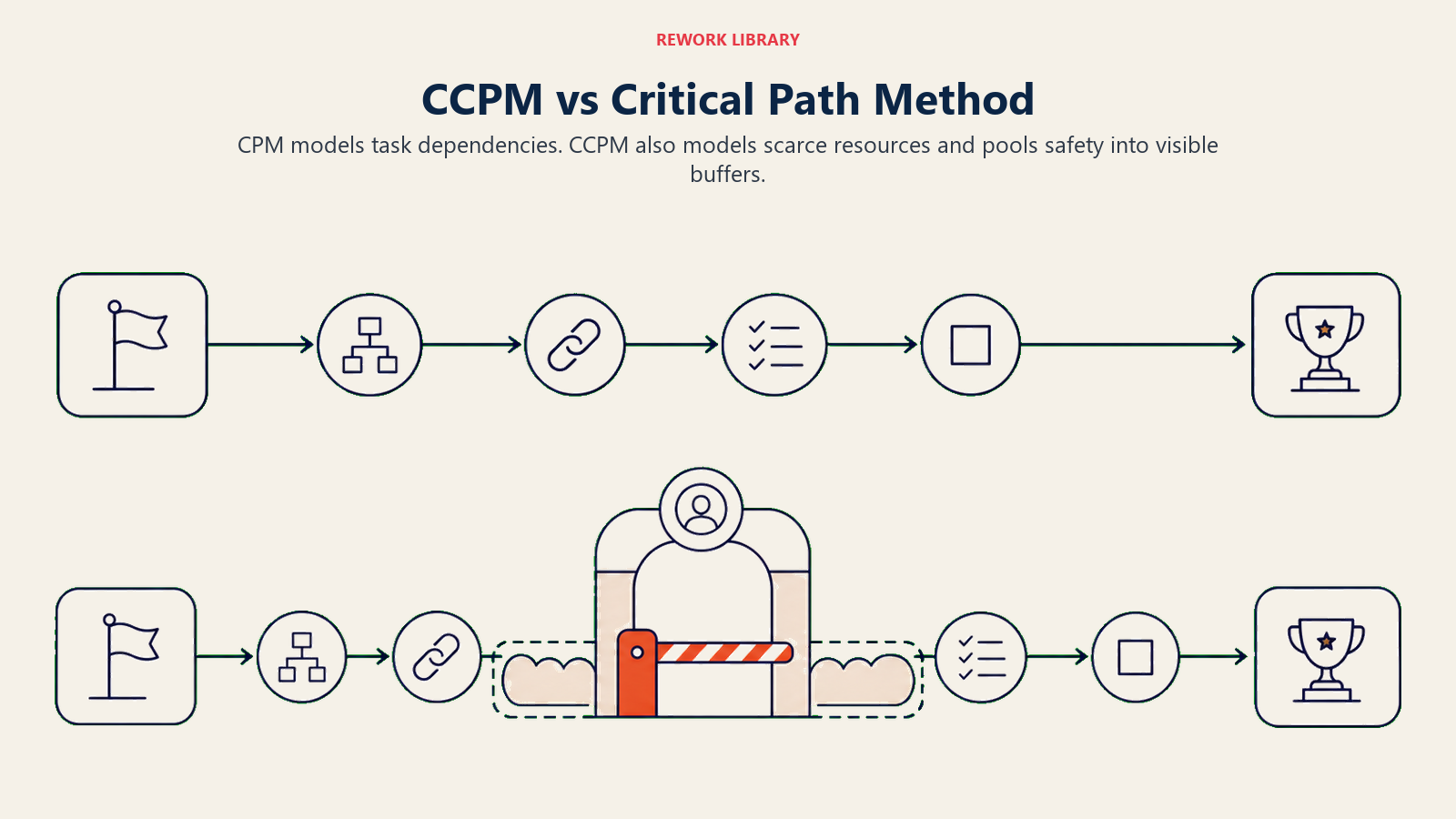
The phrase "critical chain" is deliberate. Unlike the critical path method (CPM), which finds the longest path of task dependencies alone, the critical chain accounts for who (or what) is needed to do the work. A task that is not on the traditional critical path can still delay the project if the person assigned to it is already busy on something else. CCPM forces that reality into the schedule from day one.
Core concepts:
- Critical chain: The longest sequence of dependent tasks that also respects resource constraints. It determines the project's minimum duration.
- Project buffer (PB): A time reserve added to the end of the critical chain. It absorbs delays from any task on that chain.
- Feeding buffer (FB): A time reserve inserted where a non-critical sequence of tasks feeds into the critical chain. It protects the critical chain from upstream slippage.
- Resource buffer (RB): Not a time reserve but an alert. It is a flag placed in the schedule to warn a resource that they will soon be needed on the critical chain.
- Student syndrome: The tendency to start work late because the task has a built-in deadline buffer, wasting the safety time before the work even begins.
- Parkinson's law: Work expands to fill the time available. Give a task five days and it takes five days, even if the real work is three.
Key Facts
The Standish Group's 2023 CHAOS Report found that only 31% of software projects were delivered on time and on budget, a figure that has remained roughly flat for two decades despite widespread adoption of Agile and traditional CPM scheduling.
- A 2017 study published in the International Journal of Project Management reviewed 30 construction projects using CCPM and found average schedule overrun dropped from 22% to under 5% after adoption (Leach, 2017).
- PMI's Pulse of the Profession 2022 reports that organizations lose an average of $97 million for every $1 billion invested due to poor project performance, with schedule slippage as the leading driver.
- Goldratt's original case studies showed buffer consumption rates can predict project completion risk weeks earlier than traditional earned value indicators (Goldratt, 1997).
CCPM vs the critical path method
Both methods build a project schedule from task dependencies, but they solve different problems. CPM assumes resources are unlimited and focuses purely on task sequence logic. CCPM assumes resources are limited and treats resource conflicts as a scheduling problem to solve upfront.
| Dimension | Critical Path Method (CPM) | Critical Chain Project Management (CCPM) |
|---|---|---|
| Core focus | Longest path of task dependencies | Longest chain of tasks constrained by both dependencies and resource availability |
| Resource modeling | Resources assigned after the schedule is built; conflicts resolved separately | Resources are part of the chain calculation; multi-tasking and contention are resolved during scheduling |
| Safety time | Embedded in individual task estimates (hidden padding) | Removed from task estimates and pooled into explicit project and feeding buffers |
| Multi-tasking | Not explicitly discouraged | Actively discouraged; each resource works on one critical chain task at a time |
| Student syndrome / Parkinson's law | Not addressed; individual task deadlines invite both behaviors | Addressed by removing per-task deadlines and replacing them with buffer consumption tracking |
| Early warning signal | Float consumption on the critical path | Buffer consumption rate (how fast the shared buffer is being eaten) |
| Best fit | Stable, well-defined projects with predictable resource availability | Projects with tight or shared resources and a history of schedule slippage |
CPM is the right tool when your resource picture is clean and your tasks are well understood. CCPM earns its place when resources are the real constraint, which is the case in most organizations running several projects at once. For a deeper look at how CPM calculates float and total project duration, see critical path method and float and slack.
The buffers in CCPM
Buffers are the heart of CCPM. They are not slack. They are managed reserves with a clear purpose: absorb uncertainty without letting that uncertainty cascade into a missed delivery date.
| Buffer type | Where it sits | What it protects | Typical size |
|---|---|---|---|
| Project buffer (PB) | End of the critical chain, before the final milestone | The entire project delivery date | 50% of critical chain duration (commonly; varies by risk profile) |
| Feeding buffer (FB) | Where each non-critical sequence meets the critical chain | The critical chain from delays in non-critical work | 50% of the feeding chain duration |
| Resource buffer (RB) | Before a critical chain task that requires a key resource | The availability of that resource when needed | Not time-based; a scheduled alert or pre-assignment flag |
A common sizing rule for project and feeding buffers is the "50% rule": estimate each task at the 50th percentile (the estimate with roughly even odds of being early or late), then set the buffer to half the sum of those estimates. Some teams use statistical aggregation instead, calculating buffer size from the standard deviation of individual task estimates.
Buffer penetration zones guide how the team responds:
- Green (0-33% consumed): On track. No action needed.
- Yellow (33-66% consumed): Watch it. Investigate causes; consider acceleration options.
- Red (66-100% consumed): Act now. The project is at risk; escalate and intervene.
Buffer consumption is the primary project health metric in CCPM. It replaces the waterfall milestone tick-box and is a more honest indicator than percent-complete.
Benefits of CCPM
Shorter schedules without cutting scope. By removing hidden padding from task estimates and pooling that time as shared buffers, CCPM schedules often run 10-25% shorter than the same project planned with traditional methods, while carrying no less protection against uncertainty.
Earlier visibility of real risk. Buffer consumption rate shows whether the project is on track far earlier than traditional variance reports. A buffer consuming at a faster-than-linear rate is a red flag even when individual tasks are reporting green on a status dashboard.
Reduced multi-tasking damage. CCPM explicitly sequences work so that a resource finishes one critical chain task before starting another. Context-switching is one of the most significant hidden costs in knowledge work. Cutting it improves both speed and quality.
One project priority at a time. In multi-project environments, CCPM staggered scheduling (often called drum-buffer-rope at the portfolio level) helps organizations agree on which project takes priority at any given moment instead of spreading every resource across everything simultaneously.
Behavior change, not just technique. CCPM changes the incentive structure. When tasks have no individual safety padding, there is no point in hoarding time. Early finishes are passed forward immediately rather than consumed by Parkinson's law. The project baseline is maintained more honestly.
Limitations and challenges
Cultural resistance is real. CCPM asks people to commit to aggressive task estimates and give up their personal safety margins. That's a hard sell, especially in organizations where missing a task estimate carries career risk. The cultural change required is often harder than the scheduling mechanics.
Software support is limited. Standard project management tools are built for CPM. Running CCPM properly, with dynamic buffer tracking and resource-leveled chain calculation, usually requires specialist tools (Exepron, ProChain, or custom setups) or significant manual overhead.
Multi-project CCPM is complex. Single-project CCPM is manageable. Scaling it across a portfolio of interdependent projects with shared resources requires a staggered scheduling approach that most teams find difficult to coordinate without dedicated support.
Not designed for highly iterative work. CCPM works best when the full scope is known upfront and tasks can be sequenced in advance. It fits less naturally with Agile sprints or discovery-heavy work where the next task is often undefined until the current one is complete. For those contexts, a work breakdown structure combined with rolling-wave planning may serve better.
Aggressive estimates can backfire. If the organization doesn't actually trust the buffer system and managers still hold people accountable to original task estimates, teams simply hide their padding elsewhere. The method fails without genuine commitment from leadership.
How to implement critical chain project management
Step 1: Define the full scope and task list
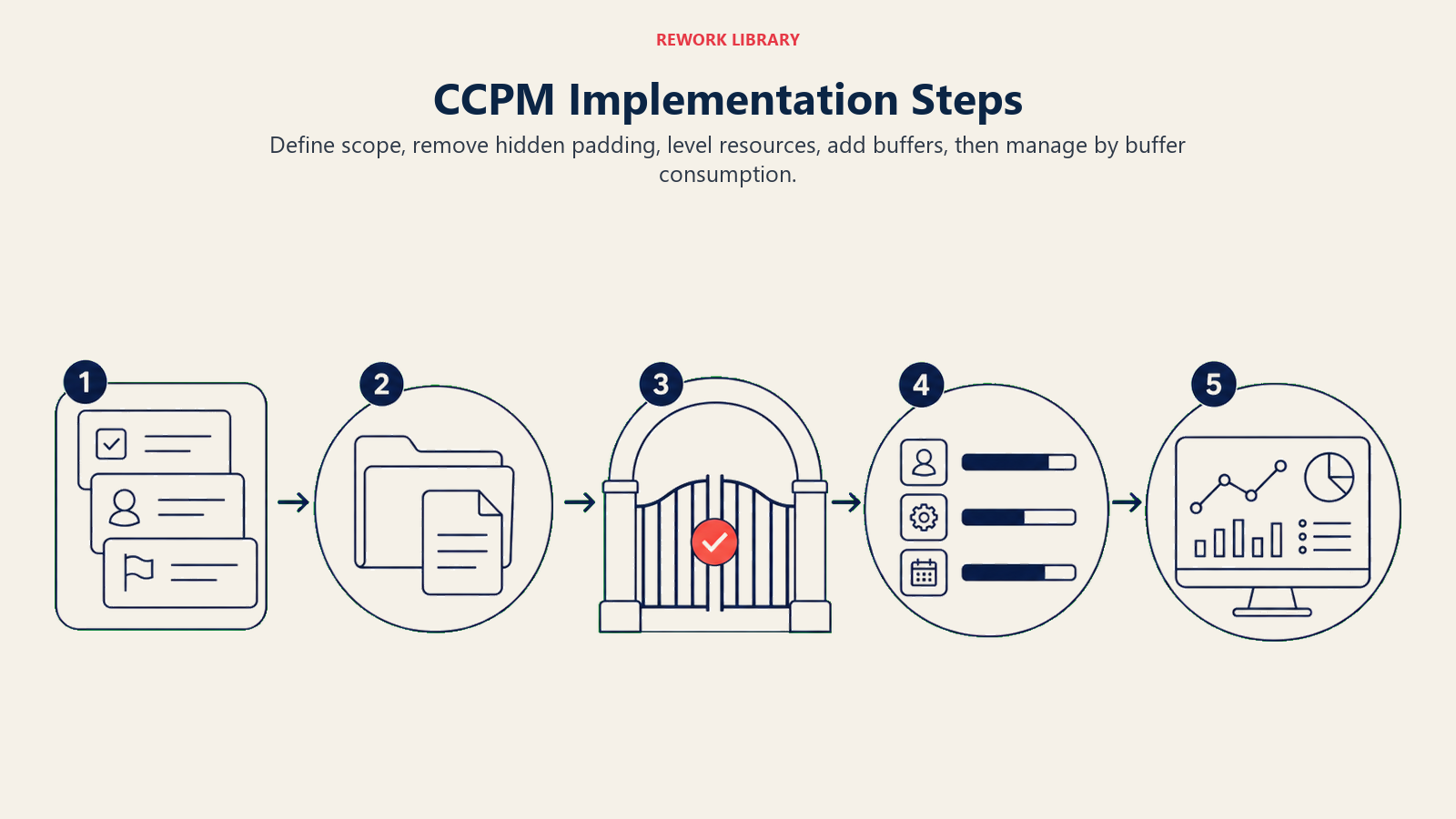
Build a complete task list with durations, dependencies, and resource requirements before any scheduling begins. Use a work breakdown structure to decompose the project scope. Incomplete scope at this stage means the critical chain calculation will miss constraints.
Step 2: Re-estimate task durations at the 50% confidence level
Ask each task owner: "What duration gives you roughly a coin-flip chance of finishing on time?" This removes the padding people naturally build into conservative estimates. Expect durations to drop by 20-50% compared to traditional estimates. Explain the buffer system so people understand their safety time isn't gone, it's just moved.
Step 3: Resolve resource conflicts and find the critical chain
Build the initial schedule using task dependencies, as you would with CPM. Then identify resource conflicts: places where the same person or piece of equipment is needed for two overlapping tasks. Resolve those conflicts by delaying lower-priority tasks. The resulting longest sequence of dependent, resource-constrained tasks is your critical chain.
Step 4: Insert project and feeding buffers
Add a project buffer at the end of the critical chain. Set the buffer size using your chosen method (50% rule or statistical). Identify every non-critical sequence that feeds into the critical chain and add a feeding buffer at each junction. Remove all per-task safety padding from the schedule; all safety time now lives in the buffers.
Step 5: Place resource buffers as alerts
For each critical chain task that requires a key resource who is finishing work elsewhere in the schedule, add a resource buffer: a flag or pre-assignment notification one to two days before that resource is needed. This prevents the scenario where a critical chain task starts late simply because the right person didn't know they were needed.
Step 6: Track buffer consumption and run the project
Start the project. Track task completions and update the schedule daily or weekly. Plot buffer consumption against project elapsed time. Use the green/yellow/red penetration zones to trigger responses. When tasks finish early, pass the time savings forward immediately rather than filling them with non-critical work. Hold a short weekly project status report review focused on buffer state, not individual task percent-complete.
Critical chain project management examples
The table below shows how CCPM has been applied across different industries.
| Industry | Scenario | CCPM outcome |
|---|---|---|
| Construction | A commercial building contractor managing 40 subcontractors with heavily shared equipment (cranes, inspection teams) found the critical path kept shifting because CPM scheduling ignored equipment conflicts. Switching to CCPM, the team identified crane availability as the primary constraint and rebuilt the schedule around crane slots. Feeding buffers protected crane handoffs from upstream delays. The project finished three weeks ahead of the original CPM schedule. | |
| Pharmaceutical R&D | A drug development team running a phase II clinical trial used CCPM to sequence lab work around two senior scientists who were the bottleneck for three concurrent workstreams. By scheduling each scientist's work sequentially on the critical chain and inserting feeding buffers before each hand-off from supporting teams, the trial protocol lock was reached two months earlier than the previous project of equivalent scope. | |
| IT systems migration | A financial services firm migrating core banking infrastructure to a new platform had a history of missing go-live dates due to cascading testing delays. The team applied CCPM to the testing phase specifically. They pooled all per-task testing buffer into a single project buffer and tracked penetration weekly. The buffer reached yellow but never red, and the migration cut-over happened on the originally targeted weekend, avoiding a costly schedule extension. |
Best practices
Do:
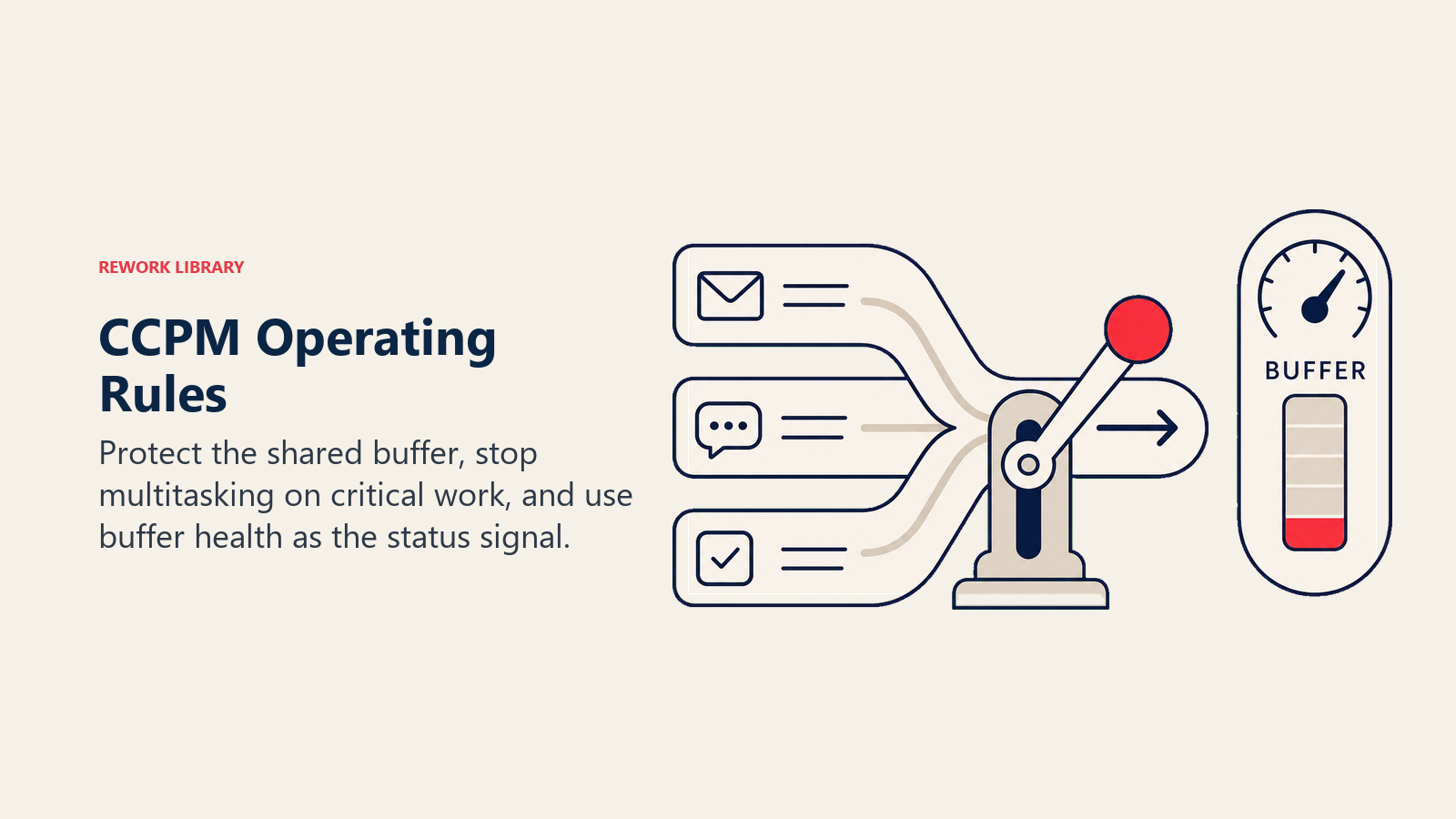
- Commit to the buffer system from the start. Partial adoption (keeping task padding AND adding buffers) doubles the schedule length and destroys credibility.
- Track buffer consumption at every status meeting. Make it the first metric on the agenda, not an afterthought after the task-by-task status update.
- Celebrate early finishes by passing the time savings forward. Build a team norm that "done early" means "help the next task start now."
- Use resource allocation and resource leveling data to feed the chain calculation accurately.
- Integrate CCPM with your project planning process early, not as an afterthought after the schedule is already set.
Don't:
- Hold individuals accountable to individual task estimates. That recreates the same padding behavior CCPM is designed to remove.
- Skip the cultural change conversation. CCPM will look like a trick to get people to commit to shorter deadlines unless you explain the buffer logic clearly upfront.
- Apply CCPM to highly iterative or exploratory work where scope is undefined. Use it on projects where the full sequence of tasks can be reasonably planned in advance.
- Ignore resource buffers. They look optional but they prevent a common failure mode: a resource finishes one task and doesn't know the critical chain is waiting for them.
- Let feeding buffer consumption go untracked. Feeding buffers that hit red are an early signal that the project buffer is about to start burning fast.
Projects fail on schedules more often than on technical complexity. CCPM doesn't make the work easier. But it does make the time pressure visible, shared, and manageable in a way that task-level padding never achieves. Start with one project, measure buffer penetration honestly, and the data will tell you whether it's worth scaling.
Related reading
- Critical path method for the dependency-only scheduling approach CCPM builds on
- Float and slack to understand the scheduling flexibility CCPM buffers replace
- Theory of Constraints for the parent framework behind CCPM
- Resource allocation and resource leveling vs smoothing for handling the resource conflicts CCPM surfaces
- Project planning for the upstream step where CCPM scheduling begins
- Task dependencies for understanding the dependency logic that feeds into the critical chain
- Milestone chart for tracking key checkpoints alongside buffer consumption

Senior Operations & Growth Strategist
On this page
- What is critical chain project management?
- Key Facts
- CCPM vs the critical path method
- The buffers in CCPM
- Benefits of CCPM
- Limitations and challenges
- How to implement critical chain project management
- Step 1: Define the full scope and task list
- Step 2: Re-estimate task durations at the 50% confidence level
- Step 3: Resolve resource conflicts and find the critical chain
- Step 4: Insert project and feeding buffers
- Step 5: Place resource buffers as alerts
- Step 6: Track buffer consumption and run the project
- Critical chain project management examples
- Best practices
- Related reading