Capacity Planning: How to Match Work to Resources
Turn this article into takeaways for your work.


Each assistant summarizes the article only for you and suggests best practices for your work.
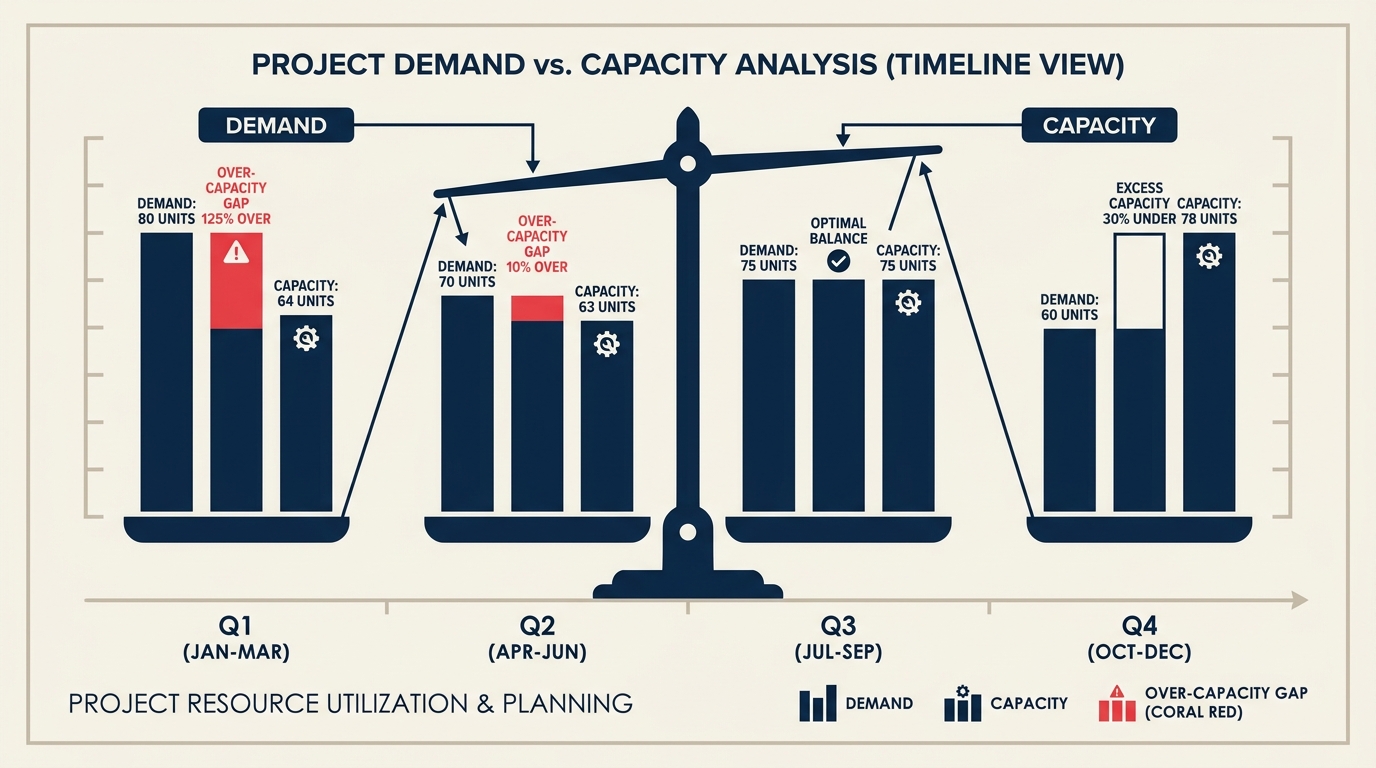
Capacity planning is the practice of figuring out whether your team has enough bandwidth to handle the work ahead of them. And if the numbers don't line up, you adjust: either reduce the work, add resources, or reset expectations before the deadline blows up.
Most teams skip this step. They accept projects based on optimism, not math. Then they wonder why sprints slip, people burn out, and delivery dates become fiction.
What Is Capacity Planning?
Capacity planning is the process of determining whether you have enough resource capacity to meet the demand of upcoming work, then adjusting one side or the other to close the gap. Capacity is the total productive hours your team can realistically deliver. Demand is the volume of work you've committed (or are considering committing) to complete.
The goal is to make those two numbers match before projects start, not after they're already late.
Key Facts
- Resource and capacity constraints are consistently cited as one of the top causes of project failure. According to PMI's Pulse of the Profession, organizations waste an average of $97 million for every $1 billion invested due to poor project performance, with resourcing gaps among the leading contributors. (PMI, 2023)
- Only 46% of organizations report high resource management maturity, according to the Wellingtone State of Project Management report, meaning most teams are still winging it. (Wellingtone, 2024)
- Knowledge workers are productive for roughly 4-5 hours per 8-hour day on deep work, making 100% utilization assumptions a guaranteed path to missed deadlines. (various workforce research, HBR synthesis)
"Capacity planning is the difference between a roadmap and a wish list."
Why Capacity Planning Matters
When teams skip capacity planning, a few things reliably go wrong.
Overcommitment. Managers say yes to work without checking whether the team has room to do it. The result: projects stack up, priorities conflict, and everyone is technically "assigned" to three things at once without making progress on any of them.
Idle resources. The flip side is just as costly. When work gets front-loaded to a few people and others have nothing billable to do, you're paying for capacity you're not using. That's a planning problem, not a people problem.
Missed deadlines. When demand consistently exceeds capacity, deadlines slip. Not because the team is slow, but because the math never worked in the first place. A team of five cannot deliver 600 hours of work in a month where they have 400 hours available, no matter how hard they try.
Burnout. Sustained overcommitment wears people down. The fix is structural, not motivational. If your team is exhausted, you probably have a capacity planning gap, not an attitude problem.
Types of Capacity Planning
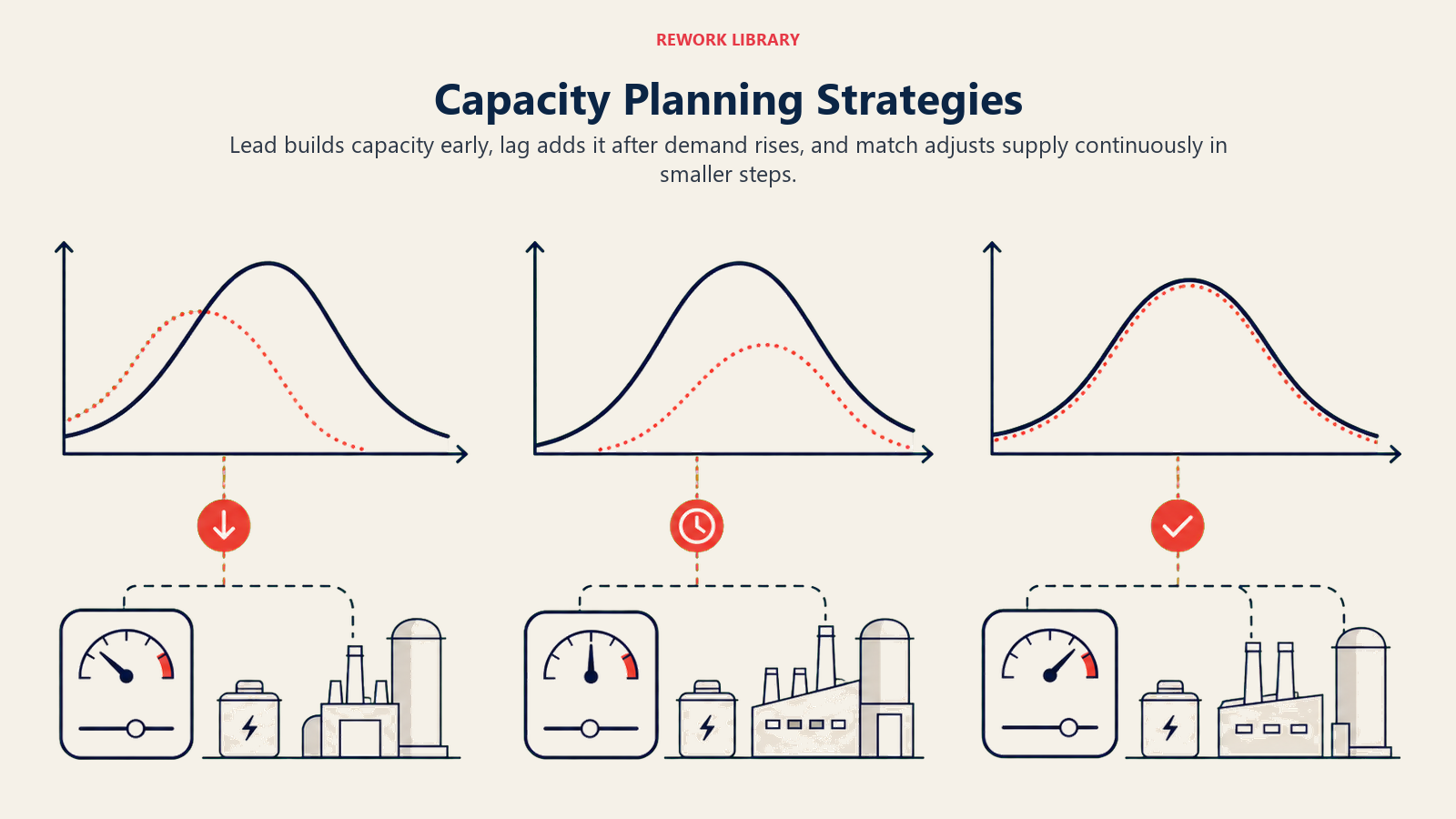
There are three common strategies for how organizations respond to the gap between supply and demand. Each works better in different situations.
| Strategy | What It Means | When to Use It |
|---|---|---|
| Lead strategy | Build capacity in advance of anticipated demand | High growth phases, seasonal spikes, product launches |
| Lag strategy | Add capacity only after demand has already exceeded supply | Cost-sensitive environments, uncertain or volatile demand |
| Match strategy | Continuously adjust capacity in small steps to track demand closely | Agile teams, mature ops with good demand forecasting |
Most teams default to lag strategy by accident: they hire or bring in contractors only after things break. Lead strategy requires more confidence in your forecasts. Match strategy requires the operational discipline to adjust frequently and read the signals early.
For short-term planning (weeks to a quarter), match strategy tends to work best. For long-term planning (annual headcount, infrastructure), lead strategy gives you the runway to act before the crunch arrives.
Capacity vs Demand: The Core Calculation
The math is not complicated. It's just rarely done.
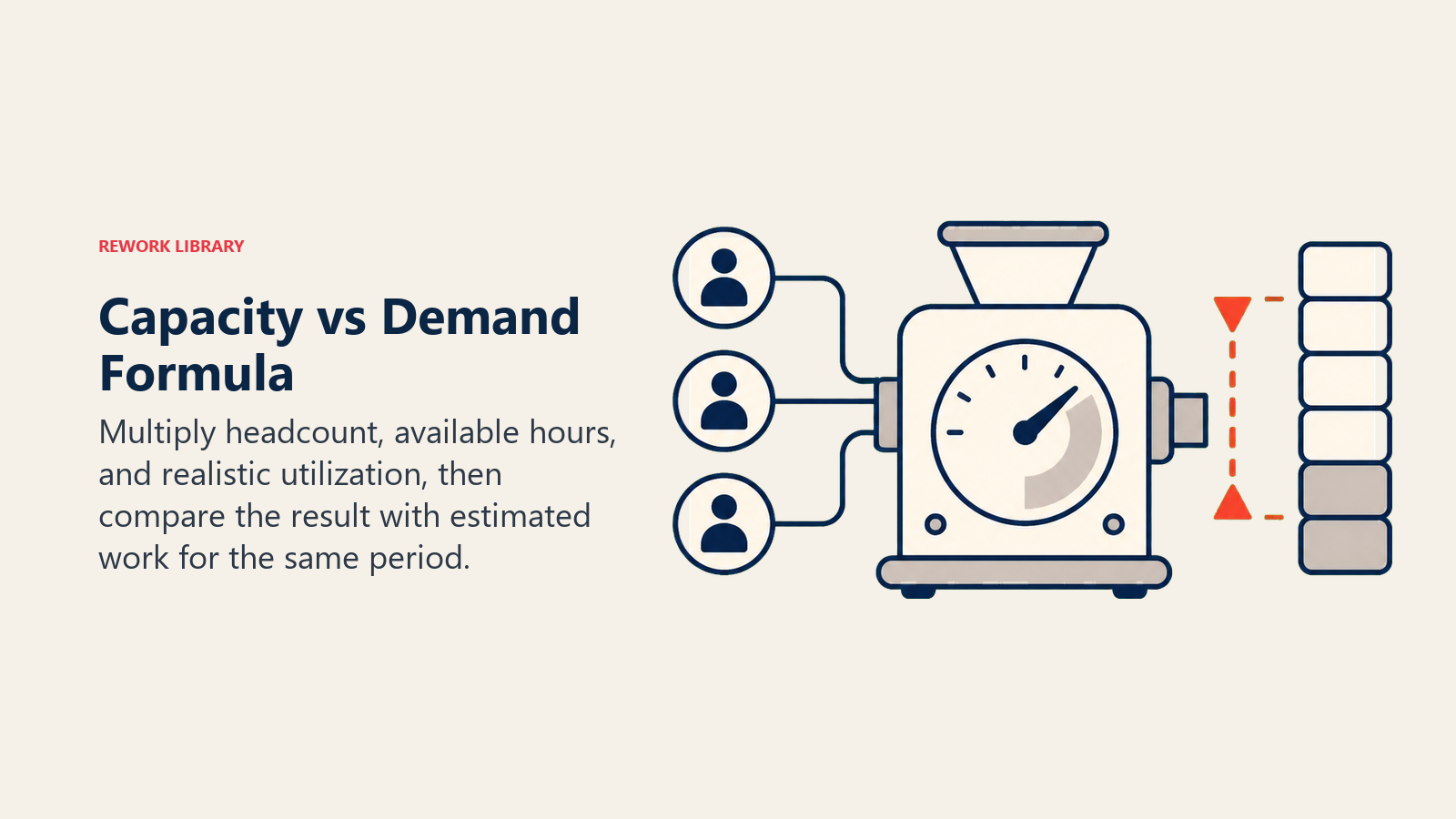
Available capacity is calculated as:
Capacity = Headcount x Available Hours x Utilization Rate
For example: a team of 8 people, working a 40-hour week, with a realistic utilization rate of 75% (accounting for meetings, admin, and context-switching), gives you:
8 x 40 x 0.75 = 240 productive hours per week
Demand is the sum of estimated effort across all projects and tasks assigned to that team for the same period. Pull this from your work breakdown structure or project planning tool.
If demand is 320 hours and capacity is 240, you have an 80-hour gap. You need to either reduce scope, push timelines, or add resources. None of those are fun conversations. But they are far less painful than having them three weeks after a deadline was missed.
Utilization rate is the key variable most managers underestimate. A 100% utilization assumption treats humans like machines. In practice, knowledge workers lose time to unplanned interruptions, meetings, context-switching, sick days, and time off. A 70-80% utilization rate is a realistic baseline for most teams.
How to Do Capacity Planning: Step by Step
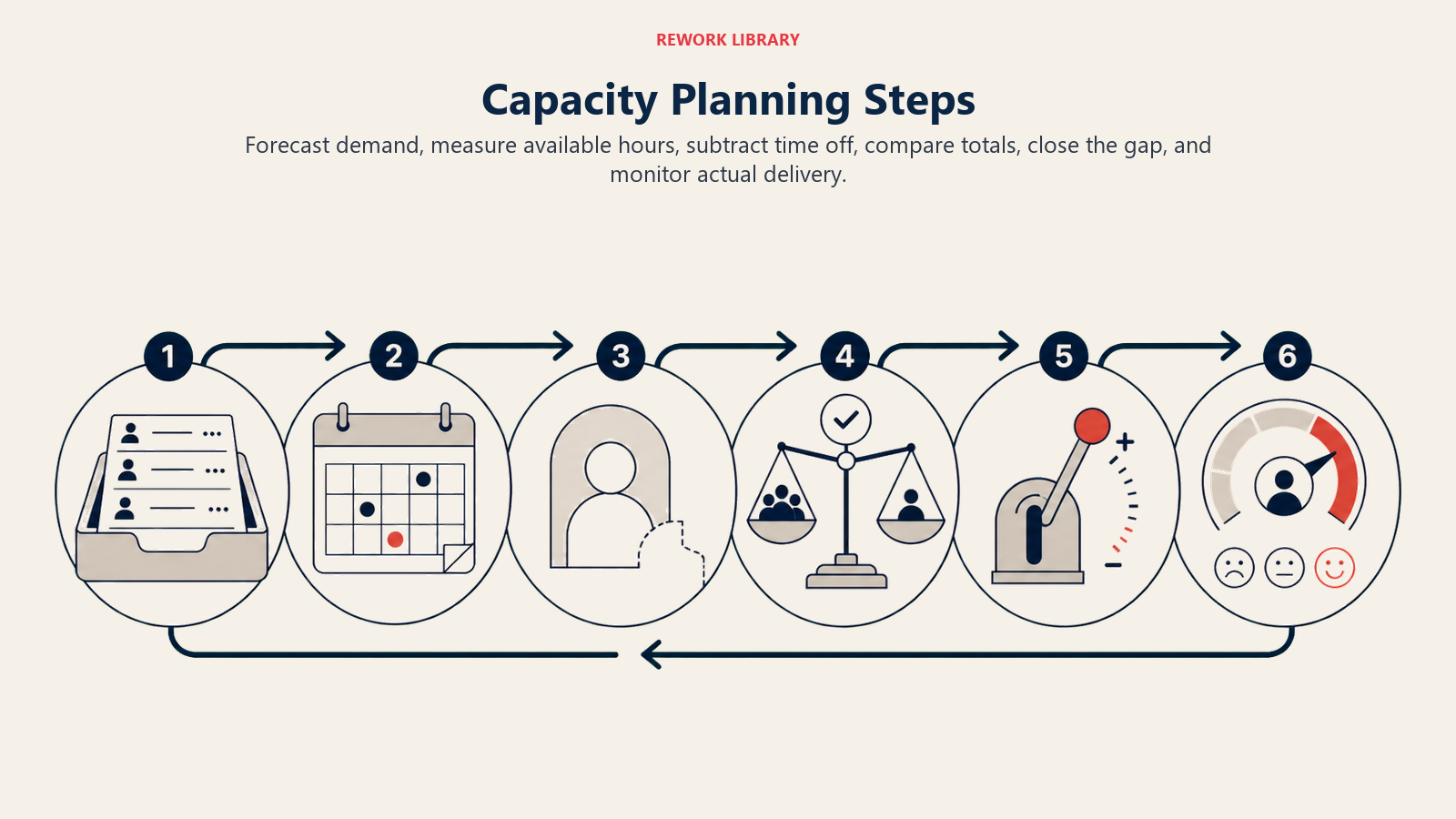
The workflow turns workload and availability estimates into an explicit decision about scope, timing, or resources.
Step 1: Forecast the Demand
List all the work your team is expected to complete in the planning period. Include active projects, incoming requests, maintenance work, and any recurring obligations. For each item, estimate the effort in hours. If you're doing this at the sprint level, story points work fine as a proxy.
Step 2: Measure Available Capacity
Count the working days in the period. Multiply by working hours per day. That gives you theoretical capacity. Then apply your utilization rate to get realistic capacity. Pull this number per person so you can see individual loads, not just team totals.
Step 3: Account for Utilization and Time Off
Subtract known absences: scheduled vacation, holidays, training days, all-hands events. Then factor in your standard utilization rate. If someone has three days of PTO in a two-week sprint, their available capacity for that sprint drops proportionally.
Step 4: Compare Capacity to Demand
Stack the two numbers side by side. If demand is within 80-90% of capacity, you're in good shape. If it exceeds capacity, you have a gap to close. If it's well below capacity, check whether work is being held up somewhere or if planning is off.
Step 5: Close the Gap
You have four levers:
- Reduce scope: cut lower-priority work from the period
- Push timelines: move deliverables to the next planning window
- Add resources: bring in a contractor or reassign someone from another team
- Reprioritize: drop the lower-value items entirely
The right lever depends on what's non-negotiable. Use your triple constraint framework to make that call explicitly, not by gut feel.
Step 6: Monitor and Adjust
Capacity planning is not a one-time exercise. Check in weekly or at sprint boundaries. Track actual hours logged versus planned. If actuals are consistently higher than forecasts, your estimates are too optimistic. Adjust both your estimates and your utilization rate accordingly.
Capacity Planning Example
Here's a simplified example for a five-person content team planning a four-week period.
Team capacity calculation:
| Person | Available Days | Hours/Day | Utilization | Capacity (hrs) |
|---|---|---|---|---|
| Alex | 18 | 8 | 75% | 108 |
| Bea | 16 | 8 | 75% | 96 |
| Carlos | 20 | 8 | 75% | 120 |
| Diana | 20 | 8 | 75% | 120 |
| Eric | 14 | 8 | 75% | 84 |
| Total | 528 hrs |
Alex and Eric have fewer available days due to vacation and a training event.
Demand for the period:
- Article batch A: 120 hrs
- Article batch B: 90 hrs
- Campaign support: 80 hrs
- Reviews and edits: 60 hrs
- Planning and meetings: 80 hrs
- Total demand: 430 hrs
Demand is 430 hours against a capacity of 528. There's 98 hours of slack. The team can accept one additional mid-size project, or carry a buffer for scope creep. This is a healthy position. If demand had come in at 600 hours, the team would need to push one batch to the next cycle or bring in a freelancer.
Capacity Planning vs Resource Allocation vs Scheduling
These three terms get used interchangeably. They mean different things.
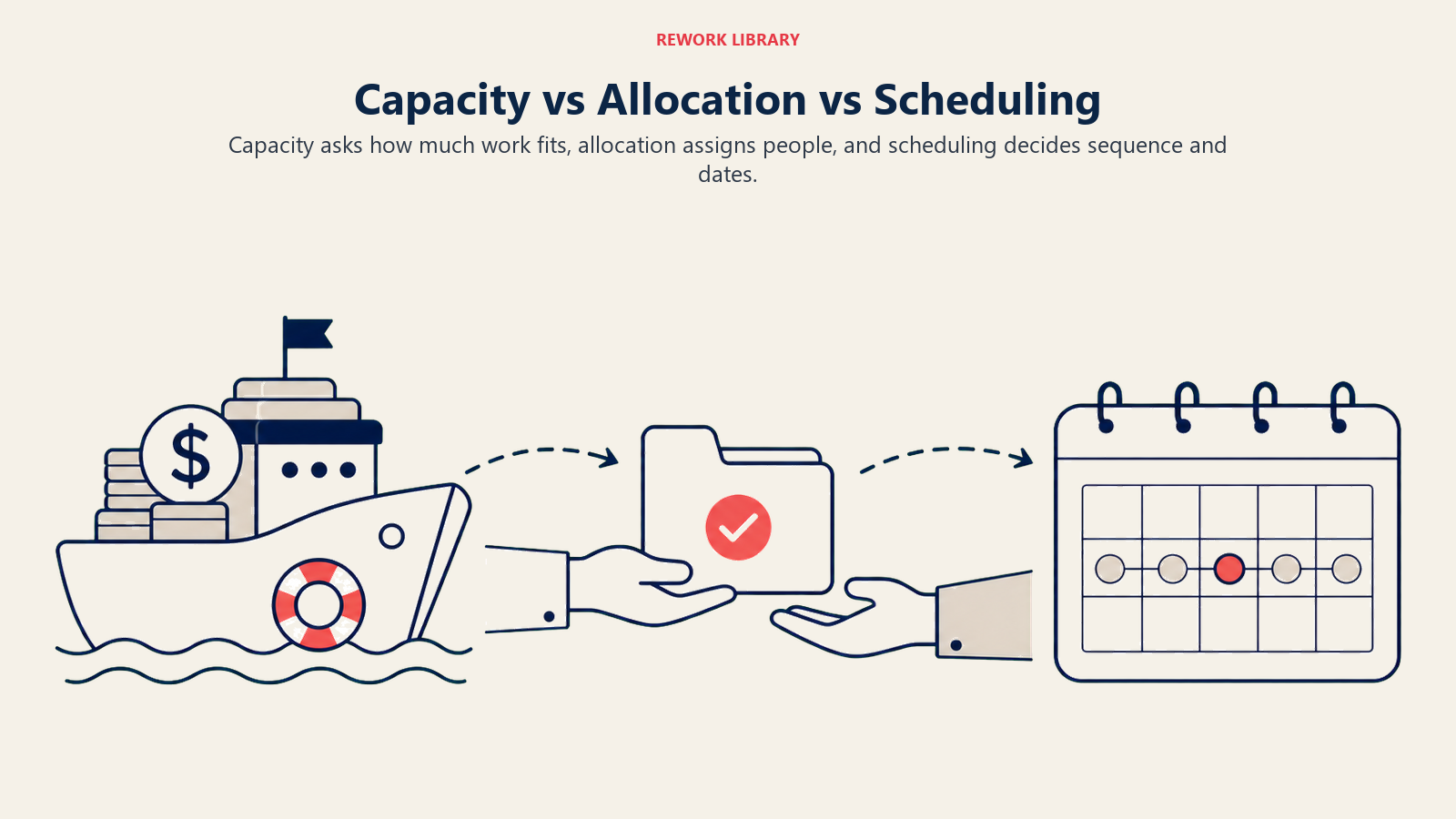
Capacity planning is the strategic question: do we have enough overall bandwidth to take on this work? It operates at the team or department level, often across multiple projects.
Resource allocation is the operational question: specifically who is doing what task, and when? It sits inside capacity planning. Once you know you have enough capacity, resource allocation assigns specific people to specific deliverables.
Scheduling is the tactical question: in what sequence do tasks happen, and on what dates? Tools like Gantt charts and critical path analysis live here.
Think of capacity as the budget. Allocation is how you spend it. Scheduling is when the payments go out.
Related: resource leveling vs smoothing covers what to do when allocation creates uneven workloads across a timeline.
Best Practices
Build in a buffer. Plan to use 80-85% of available capacity, not 100%. The remaining 15-20% absorbs the inevitable: a critical bug, a scope change, a teammate who calls in sick. Teams that plan to 100% have no room to respond to reality.
Plan on a rolling basis. Don't do capacity planning once a quarter and call it done. The best teams review capacity at the start of every sprint or every two weeks. Demand changes constantly. Your plan should keep pace.
Use real utilization numbers. If your team historically delivers at 70% utilization, plan at 70%. Do not assume things will be different this time. Optimism is not a capacity strategy. Track actuals versus forecasts over several cycles and let the data set your baseline.
Make it visible. When capacity is tracked in a spreadsheet that only the project manager sees, gaps get missed. Put the numbers somewhere your team and stakeholders can see them. Transparency makes it easier to have the scope conversation before a deadline, not after.
Connect to project planning. Capacity planning only works if it feeds into how projects get initiated. If new projects can be approved without a capacity check, the plan becomes irrelevant the moment someone senior says yes to something that wasn't on it.
Frequently Asked Questions about Capacity Planning
What is the difference between capacity planning and resource planning?
Capacity planning answers the question: do we have enough people-hours to meet demand? Resource planning goes a step further: it assigns specific people to specific tasks and manages their availability across projects. Capacity is the aggregate view. Resource planning is the individual view. You do capacity planning first, then resource planning inside that constraint.
What is a good utilization rate for capacity planning?
For knowledge workers, a realistic target is 70-80% utilization. That accounts for meetings, administrative tasks, unplanned interruptions, and context-switching. Planning above 85% consistently leads to missed deadlines, because there's no slack for anything unexpected. If your team is hitting 90-100% utilization week after week, that's a signal to expand capacity or reduce commitments.
How often should I do capacity planning?
For most teams, a rolling two-week or monthly review works well. Operational teams doing sprint-based work benefit from reviewing capacity at the start of every sprint. Strategic planning (headcount, major resource investments) is done quarterly or annually. The key is that it happens on a schedule, not reactively when things are already overloaded.
What tools do you need for capacity planning?
You don't need specialized software to start. A shared spreadsheet with headcount, available hours, utilization estimates, and project demand totals is enough for most teams. As you scale, dedicated project management tools or resource management software can automate the tracking. The discipline matters more than the tool.
Can capacity planning work for remote or distributed teams?
Yes, and it's arguably more important for remote teams. When people are working across time zones and you can't physically see whether someone is underwater, the numbers have to do the work. Track capacity per person, not just per team, and make sure estimated hours are visible to the people responsible for assignments. Capacity planning is one of those disciplines that feels like extra work until the first time it saves you from a delivery disaster. Start with a simple spreadsheet, get the team used to estimating effort upfront, and build the habit of checking the numbers before committing. The math is easy. The discipline is what makes the difference.

Senior Operations & Growth Strategist
On this page
- What Is Capacity Planning?
- Why Capacity Planning Matters
- Types of Capacity Planning
- Capacity vs Demand: The Core Calculation
- How to Do Capacity Planning: Step by Step
- Step 1: Forecast the Demand
- Step 2: Measure Available Capacity
- Step 3: Account for Utilization and Time Off
- Step 4: Compare Capacity to Demand
- Step 5: Close the Gap
- Step 6: Monitor and Adjust
- Capacity Planning Example
- Capacity Planning vs Resource Allocation vs Scheduling
- Best Practices