Spotify Model: Squads, Tribes, Chapters, and Guilds Explained
Turn this article into takeaways for your work.


Each assistant summarizes the article only for you and suggests best practices for your work.
The Spotify model is an agile-at-scale organizational structure built around small, autonomous product teams called squads. Spotify published two influential engineering culture papers in 2012, and the model quickly spread far beyond the music streaming world into banks, retailers, and software companies looking for a way to grow fast without bureaucracy strangling them.
Before going further: Spotify itself no longer runs the model as originally described. The company evolved past it. That's not a reason to dismiss it, but it is a reason to treat it as a source of ideas rather than a playbook to copy verbatim.
What is the Spotify model?
The Spotify model is an approach to scaling agile methodology across a large engineering organization. Instead of organizing teams by function (front-end, back-end, QA), it organizes teams by mission: small cross-functional squads own a slice of the product end-to-end and can ship without waiting on other teams.
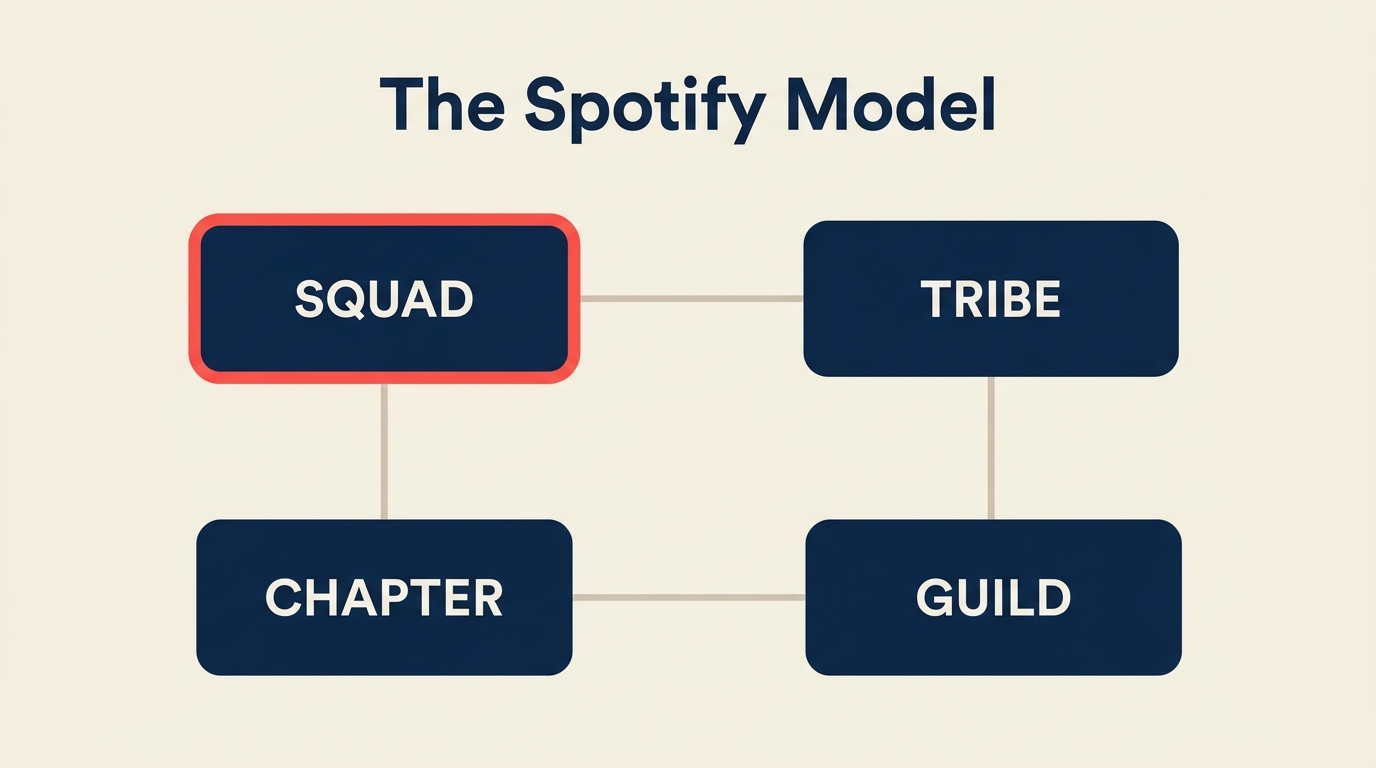
Four structural units define the model:
| Unit | What it is | Typical size |
|---|---|---|
| Squad | The core delivery team. Cross-functional, owns a product area end-to-end | 6-12 people |
| Tribe | A collection of squads working in a related area | 40-150 people |
| Chapter | A skill-based group that spans squads within a tribe | 5-15 people |
| Guild | An informal, interest-based community that spans the whole company | Varies |
Two additional concepts appear in later descriptions of the model:
- Trio: a Tribe Lead, a Product Lead, and a Design Lead who share accountability for a tribe's outcomes.
- Alliance: a coordination layer between tribes when their work is tightly coupled.
The philosophy behind all of this is the tension between autonomy and alignment. Squads need enough freedom to make fast decisions. But if every squad goes its own way, the product fractures. Chapters and guilds provide the connective tissue that keeps things coherent without adding command-and-control hierarchy.
Key Facts
- Spotify's original culture papers (Henrik Kniberg and Anders Ivarsson, 2012) described the model as "a way of thinking" rather than a fixed process, and explicitly noted it was still evolving.
- A 2019 blog post by Joakim Sunden, then a senior Spotify agile coach, acknowledged the company had evolved well beyond the original description. (Source: blog.crisp.se, 2019)
- A 2022 survey of 1,000 software organizations by McKinsey found that companies using cross-functional, mission-aligned team structures were 1.5x more likely to report fast time-to-market than those using functional siloes. (Source: McKinsey Digital, 2022)
Spotify model vs SAFe: key differences
Both address the same core problem: how do you keep large engineering organizations moving quickly? But they answer it differently.
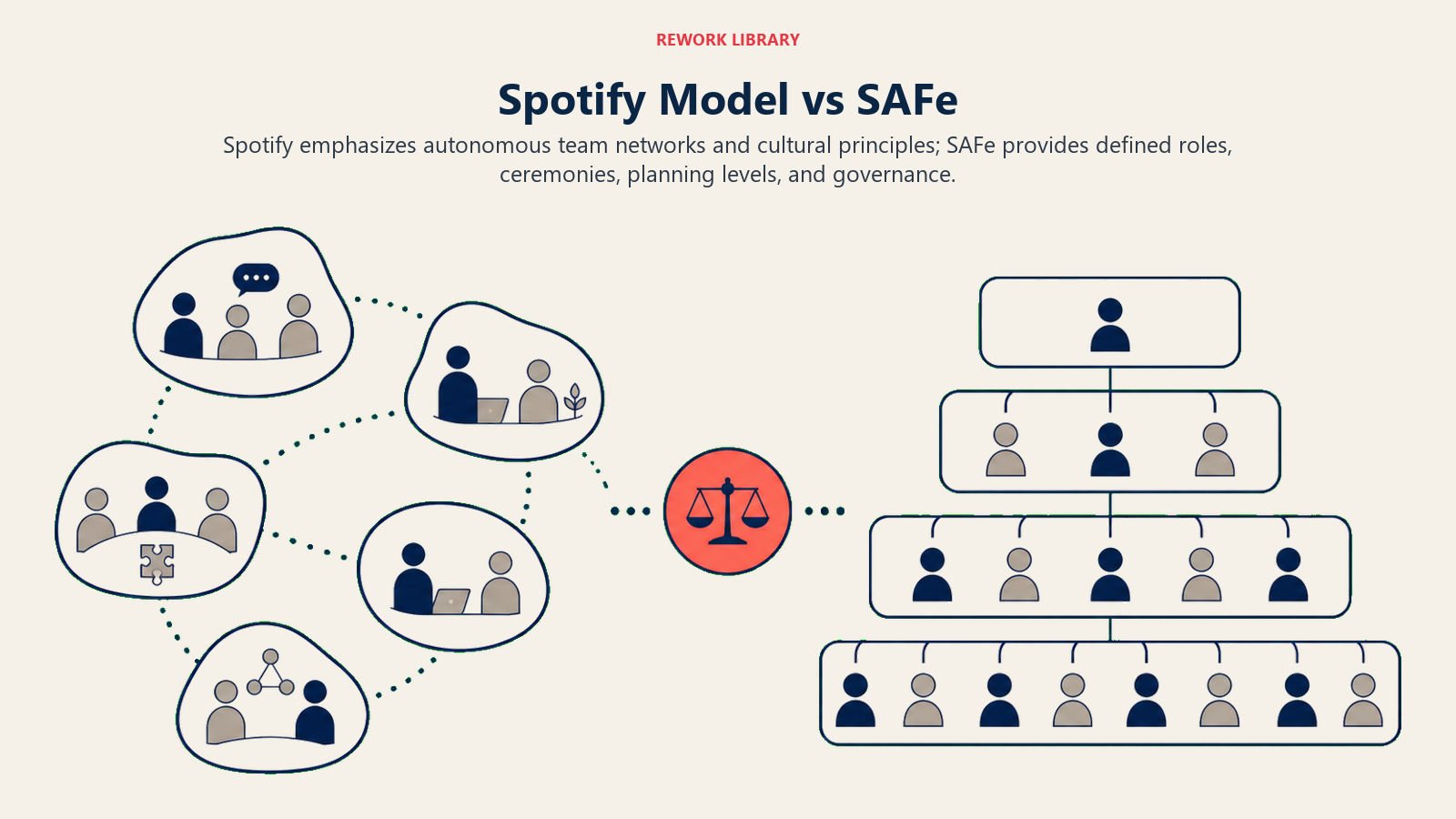
SAFe (Scaled Agile Framework) provides a detailed, prescriptive hierarchy: teams, programs, solutions, portfolio. There are defined roles (Release Train Engineer, Product Management), defined ceremonies (PI Planning, System Demo), and a structured release cadence.
The Spotify model is descriptive, not prescriptive. It says: here are the units that worked for us, here is the thinking behind them. You have to work out the ceremonies and cadence yourself.
| Dimension | Spotify model | SAFe |
|---|---|---|
| Prescriptiveness | Low: principles and units, no fixed ceremonies | High: defined roles, events, artifacts |
| Governance | Light: squads self-govern with tribe alignment | Structured: ARTs, PI Planning, portfolio layer |
| Best fit | Product companies with high engineer autonomy | Large enterprises needing compliance + coordination |
| Learning curve | Low to adopt the vocabulary; high to execute well | High: formal certification, long rollout |
| Risk | Misalignment without discipline | Overhead and rigidity if applied too literally |
Companies that need regulatory compliance, large hardware programs, or tight integration with external vendors often find SAFe's structure worth the overhead. Product-led companies that want squads to move like startups usually prefer the lighter Spotify approach, or a hybrid.
Benefits of the Spotify model
Faster delivery. Squads can ship continuously because they own the full stack for their product area. There's no hand-off between a "dev team" and a "QA team" and an "ops team." All three are in the squad. This is the same thinking behind what is scrum, but applied at scale.
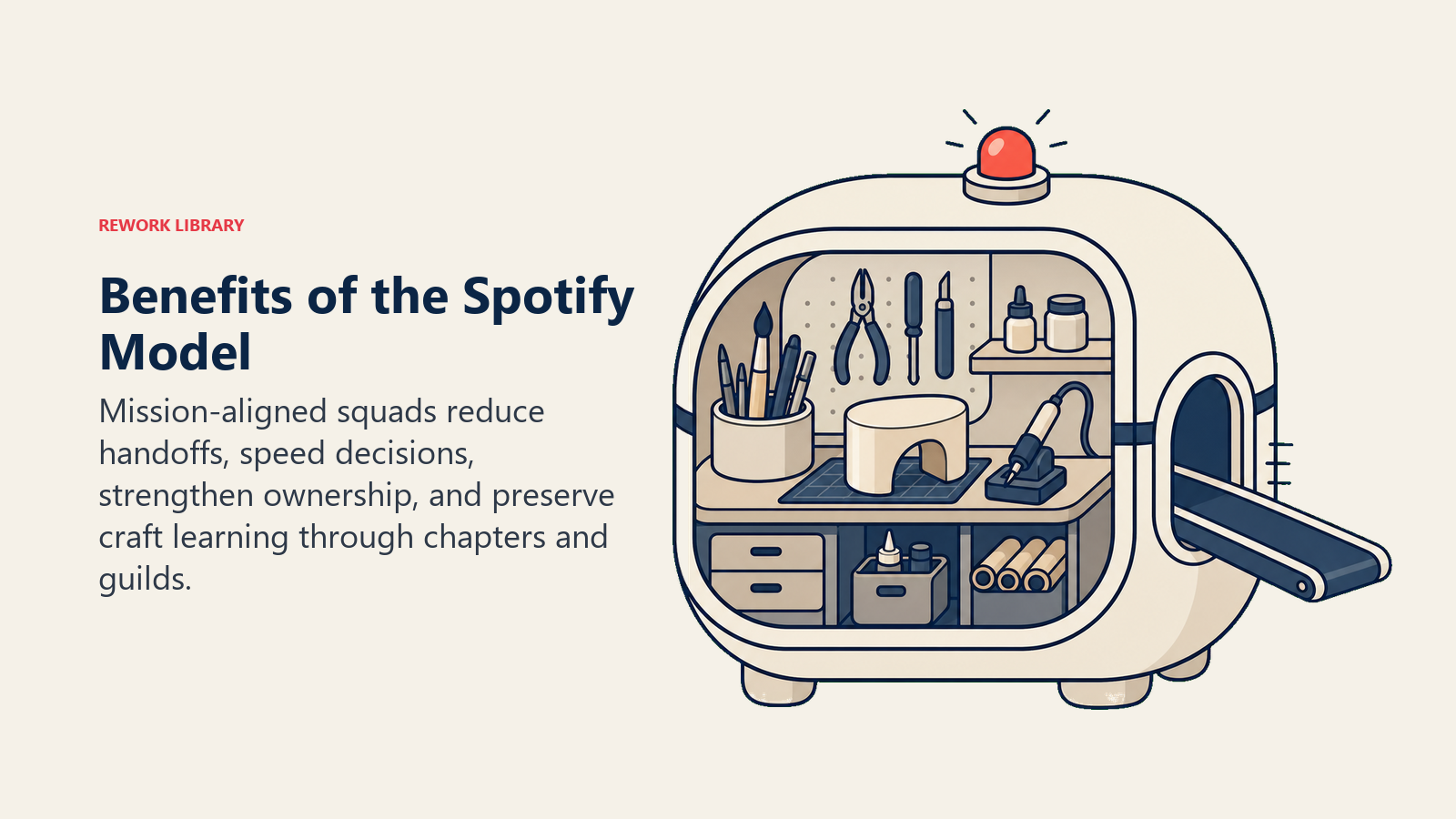
Reduced coordination cost. If a squad can deploy independently, it doesn't need to coordinate release windows with seven other teams. The model uses Conway's Law deliberately: the system architecture mirrors the team structure, so the teams stay decoupled.
Skill growth without functional silos. Chapters solve a real problem that fully autonomous teams create: engineers get isolated in their squad and miss out on craft community. A chapter of five iOS engineers across five squads meets regularly to share practices, raise the collective skill floor, and give the Chapter Lead a clear accountability for technical quality.
Culture of ownership. When a squad owns a user journey from front-end to database to on-call, the team feels the consequences of its decisions. That ownership changes behavior in ways that ticket-based hand-off structures simply don't.
Guilds accelerate knowledge transfer. A guild is essentially a community of practice. It has no formal authority, but it spreads good ideas across the company faster than any top-down memo. You might have a guild for accessibility, for observability, or for data engineering.
Limitations and criticisms
The model has well-documented failure modes, and you should read about them before you start reorganizing your teams.
Spotify itself moved on. The original 2012 papers were written when Spotify had roughly 30-40 squads. By 2019, the company had several hundred engineers and acknowledged that the model described in those papers no longer matched how they worked. The most honest framing: the papers documented one point in time, not an eternal organizational truth.
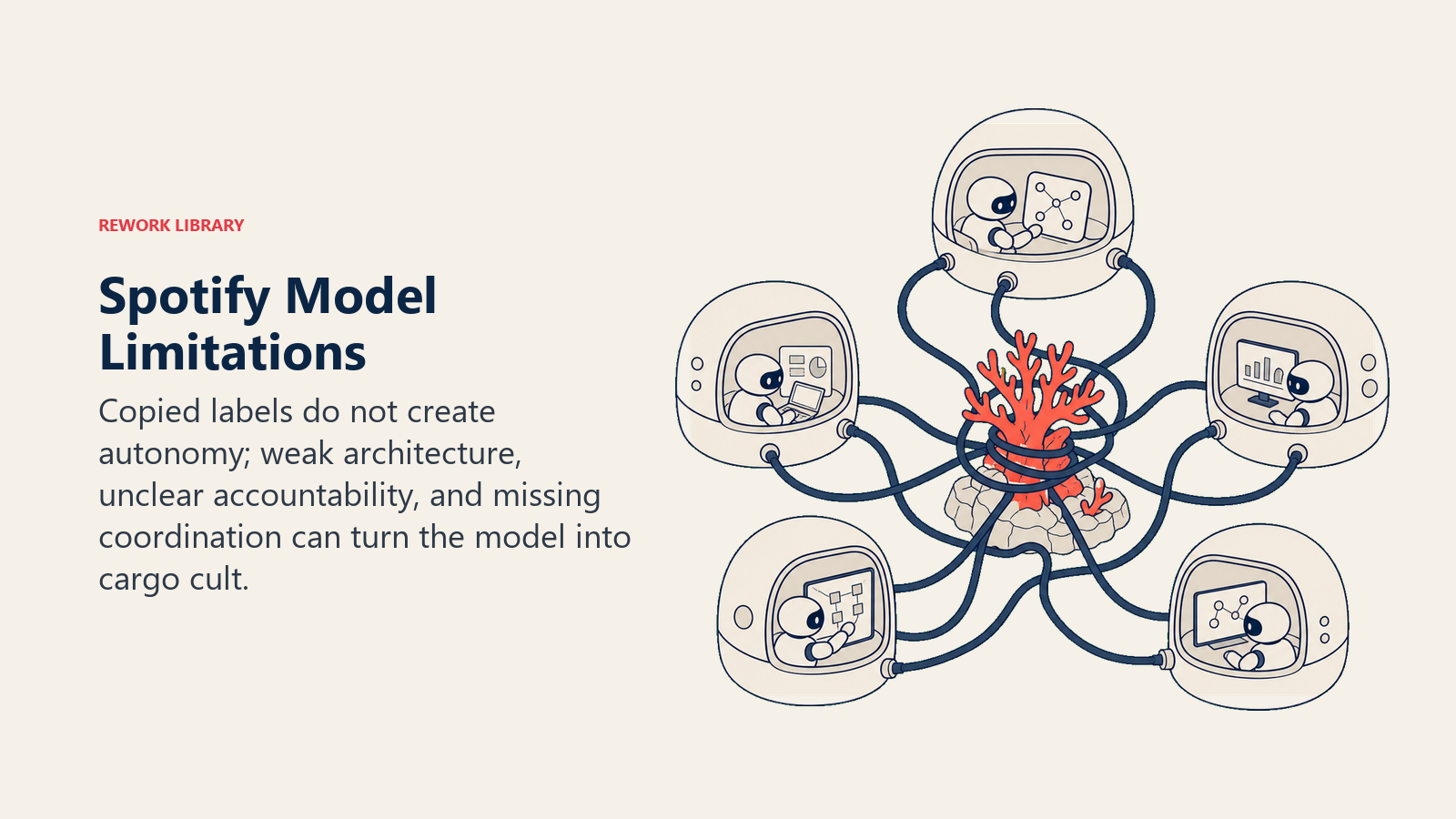
"Spotify model" became a cargo cult. Many companies copied the vocabulary (squads, tribes, chapters, guilds) without copying the cultural conditions that made it work at Spotify. Renaming your teams doesn't change how decisions get made.
Chapter Leads carry an awkward dual accountability. The Chapter Lead is both a people manager (performance reviews, hiring) and an individual contributor inside a squad. That's a hard role to play well. The chapter function can become either perfunctory or dominating, depending on the person.
Dependencies don't disappear. The model assumes squads can work independently. But in real products, squads share platforms, shared services, and data. Tribes and alliances are supposed to handle this, but the model underspecifies how. Many organizations end up recreating the integration meetings they were trying to escape, just with new names.
It's hard to scale the tribe concept. Tribes stay coherent when they're 40-80 people. Above that, the shared culture and informal communication that hold a tribe together start to break down. But the model doesn't give you explicit guidance on when to split a tribe or how to handle the split.
Not suitable for every culture. High squad autonomy requires engineers who want to own decisions, product managers who can work without deep hierarchy, and managers who are comfortable giving up control. Organizations with strong command-and-control cultures find the model destabilizing without intensive leadership change.
How to apply the Spotify model
If you're going to adopt this, treat it as a starting point and expect to customize it significantly. Here's a pragmatic sequence.
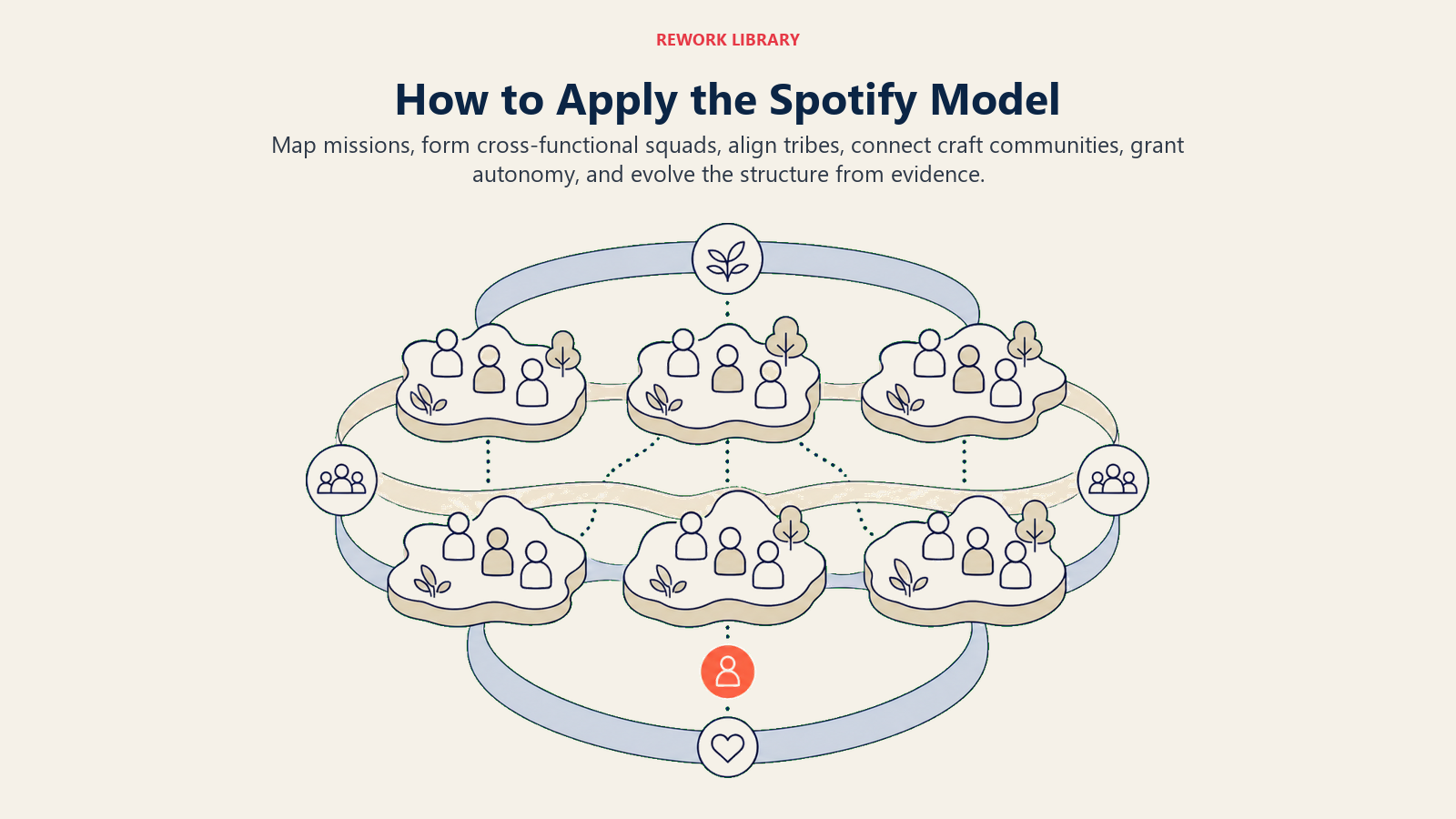
Step 1: Map your product into squad-sized missions
Start with the user journeys or product areas your engineering organization owns. A squad should own something meaningful end-to-end: a checkout experience, a notification system, a data pipeline. If you can't name what the squad owns, it's not the right size or scope.
Avoid the trap of creating squads that mirror your existing functional team structure. "Back-end squad" defeats the purpose. "Payments squad that owns everything from UI to settlement" is closer to the model's intent.
Step 2: Define tribes before squads multiply
Group squads into tribes early, before you have so many squads that the grouping becomes arbitrary. A tribe should have a coherent domain: growth, core product, platform, data. The Trio (Tribe Lead, Product Lead, Design Lead) should be named at this stage.
Aim for tribes below 100 people. Larger than that, and the informal trust network that holds a tribe together doesn't form naturally.
Step 3: Stand up chapters for each discipline
Identify the technical disciplines that cut across squads: front-end, back-end, mobile, data, QA. For each one, appoint a Chapter Lead who is strong technically and credible as a people manager. Define what the chapter is responsible for: coding standards, interview loops, onboarding, technical direction.
Don't make chapters too large. Five to fifteen people is manageable. A chapter of thirty engineers isn't a community, it's a department.
Step 4: Launch guilds organically, not by decree
Guilds work when people care enough to organize voluntarily. You can seed a few guilds by identifying engineers who are already evangelists for a topic (observability, accessibility, testing practices) and asking them to run a monthly forum.
Don't mandate guild membership or make guild participation part of performance reviews. That kills the informal character that makes guilds useful.
Step 5: Define your alignment mechanisms explicitly
This is the step most teams skip, and it's where many Spotify-model adoptions break down. Autonomy without alignment produces seventeen teams building seventeen different authentication systems.
Write down: how do squads communicate cross-squad dependencies? How are technology choices governed? Who decides when a platform capability becomes a shared service versus each squad building its own? These answers won't come from the Spotify model itself. You have to define them.
Step 6: Run retrospectives on the structure itself
Every six months, ask the Trio and Chapter Leads: is the squad structure still right? Have two squads become so interdependent that they should merge? Is a tribe too large? This kind of structural retrospective is as important as the sprint retrospectives inside squads.
Spotify model examples
The model spread across industries after the 2012 papers. Here are documented examples of how different organizations adapted it:
| Organization | How they adapted the model |
|---|---|
| ING Bank (Netherlands) | Reorganized ~3,500 employees into squads and tribes in 2015. Added a compliance chapter to meet banking regulatory requirements. Publicly cited 30% faster time-to-market for digital features. (Source: McKinsey, 2017) |
| Zalando | Adopted the squad model for product engineering. Maintained functional chapters for platform and security disciplines that needed consistent standards across the company. |
| Klarna | Used the model heavily during rapid growth. Added explicit dependency management meetings between squads (an acknowledgment that the model's informal coordination assumption didn't scale cleanly). |
| Large retailer case study | A 2021 ThoughtWorks case study noted that a major European retailer adopted the vocabulary but kept functional reporting lines intact. The result was squads in name only, with the old hierarchy persisting underneath. |
The ING case is probably the most-cited large enterprise implementation. Their key adaptation was treating the compliance chapter as a first-class citizen rather than an afterthought, which is a meaningful lesson for any regulated industry.
Best practices
A few principles that separate successful Spotify-model adoptions from cargo-cult implementations:
Do match squad boundaries to architecture. If you want squads to deploy independently, your systems need to be loosely coupled. Organizational design and technical architecture have to move together. This is why teams using agile ceremonies or extreme programming practices find the model easier to adopt: their technical habits already favor decoupling.
Don't rename without rewiring. Calling your teams "squads" and your departments "tribes" changes nothing by itself. The meaningful change is in how decisions get made, how work gets prioritized, and how conflicts between squads get resolved.
Do invest in Chapter Leads. The Chapter Lead role is harder than it looks. Good Chapter Leads actively raise the technical quality floor across their chapter, run effective 1:1s, and stay credible as individual contributors. Underfunding this role is one of the most common ways the model degrades.
Don't over-formalize guilds. If guild meetings become mandatory or guild outputs become review gates, you've turned a community of practice into a committee. Keep them lightweight.
Do borrow selectively. You don't have to adopt the full vocabulary. Some organizations run squads and tribes but skip guilds because they're too small. Others run chapters but call them "practice areas." The concepts matter more than the labels.
Don't treat the 2012 papers as current documentation. They're a historical snapshot of one fast-growing company at a specific moment. Read them, extract the reasoning, then build the version that fits your organization.
If you're comparing delivery rhythms across squads, Scrum's sprint cadence and Kanban's continuous flow model are both used inside squads in Spotify-model organizations. Some squads run Scrumban, a hybrid that gives them sprint planning discipline with Kanban's WIP limits. The Scrum vs Kanban trade-off is worth understanding before you decide what individual squads run.
The Spotify model gave the software world a vocabulary for talking about autonomous, mission-driven teams at scale. Even if Spotify itself evolved past the original design, the concepts of squads owning product areas end-to-end, chapters keeping disciplines coherent, and guilds spreading knowledge informally have proven useful far beyond one Swedish startup. Use them as lenses, not laws, and you'll get most of the value without the cargo-cult trap.
Related reading

Senior Operations & Growth Strategist
On this page
- What is the Spotify model?
- Spotify model vs SAFe: key differences
- Benefits of the Spotify model
- Limitations and criticisms
- How to apply the Spotify model
- Step 1: Map your product into squad-sized missions
- Step 2: Define tribes before squads multiply
- Step 3: Stand up chapters for each discipline
- Step 4: Launch guilds organically, not by decree
- Step 5: Define your alignment mechanisms explicitly
- Step 6: Run retrospectives on the structure itself
- Spotify model examples
- Best practices
- Related reading