Rolling Wave Planning: Progressive Elaboration Explained
Turn this article into takeaways for your work.


Each assistant summarizes the article only for you and suggests best practices for your work.
A sponsor asks for a fully detailed schedule through month eighteen of a project that's three weeks old, and you don't have the information to give it honestly. Rolling wave planning is the answer that isn't "I'll make something up" and isn't "you can't have a schedule at all." It's a real technique with real rules, and it gives you language a sponsor will accept instead of a plan you'll be rewriting by week six.
Key Facts
- The PMBOK Guide, Eighth Edition (PMI, November 2025) is the current PMBOK Guide, built around seven performance domains, including scope and schedule, the same two domains a rolling wave plan has to keep synchronized every time a wave turns over.
- "Rolling wave, if done well, gives the program team a framework for creating a balanced program approach for control and flexibility," according to PMI's own guidance on managing programs with a rolling wave by Gregory D. Githens, PMP.
- Hybrid project management adoption grew from 20% of projects in 2020 to 31.5% in 2023, a 57.5% increase, per PMI's research on the fit-for-purpose shift, the shift that made rolling wave planning common well outside its original program-management home.
- A planning package "must be converted to Work Packages prior to any charges being incurred for the effort," per PMI's guidance on using planning packages for earned value by Timothy J. Pasko, the rule that keeps a rolling wave plan from quietly spending against work nobody has detailed yet.
What rolling wave planning actually is (and how it's different from progressive elaboration)
Most pages on this topic use these two terms interchangeably, and that's the first thing to fix. Progressive elaboration is the principle: a plan gets more detailed and accurate as better information arrives, and that's true of a project plan's scope, cost, and risk sections just as much as its schedule. Rolling wave planning is the scheduling technique that puts that principle into practice on a defined cadence, turning "we'll figure it out as we go" into a horizon and a re-planning date.
In practice, that means decomposing near-term work down to the work-package or activity level, the point where a task has an owner, a duration, and a dependency list, while everything further out stays lumped into a coarse "planning package": a budget number and a rough milestone, nothing more. When the wave boundary arrives, the next chunk gets its detailed pass, and the horizon rolls forward. That's the "rolling" part, and it's what separates the technique from progressive elaboration happening ad hoc.
Keep that distinction handy: most of what goes wrong with rolling wave planning traces back to treating the technique itself, the wave, the cadence, converting planning packages into work packages, as optional while keeping only the vague spirit of "we'll adapt later." The PMBOK Guide's performance domains treat scope and schedule as areas to manage in an integrated way, and rolling wave planning is one concrete way of doing that when the far end of a project isn't knowable yet.
How rolling wave planning actually works: the wave-by-wave view
Picture a 12-month platform migration program, broken into four sequential phases: Discovery, Build, Test, and Cutover, with a 3-month wave horizon. At kickoff, only Discovery gets decomposed to the work-package level. Everything after it exists as a single planning package per phase: a budget total and a target completion month, no task list.
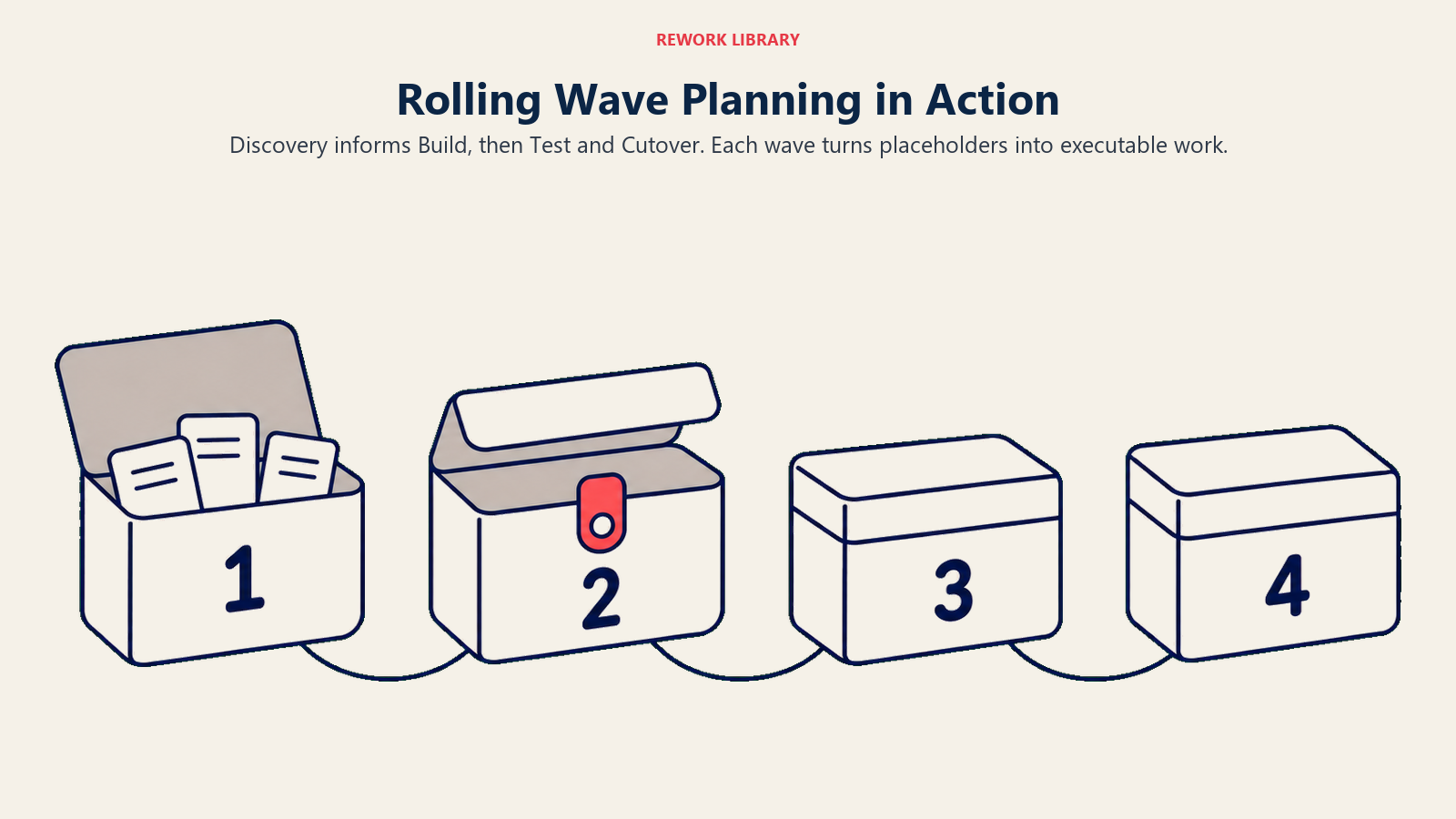
| Wave | Time window | Detailed to work-package level | Still a planning package |
|---|---|---|---|
| Wave 1 | Months 1-3 | Discovery: stakeholder interviews, current-state audit, requirements sign-off, each with an owner and duration | Build, Test, Cutover: budget and target month only |
| Wave 2 | Months 4-6 | Build: decomposed once Discovery's findings are in; Discovery closes and its actuals replace its old estimates | Test, Cutover: still coarse, refined once Build's real scope is known |
| Wave 3 | Months 7-9 | Test: decomposed once Build's actual output is known, not the scope assumed back at kickoff | Cutover: gets its first detailed pass |
| Wave 4 | Months 10-12 | Cutover: fully detailed, using lessons from every prior wave | Nothing left, the program is at full detail |
Two things make this work instead of being a nicer name for "we'll wing it." Every planning package still carries a real budget and target date, so the program has a total baseline from day one even though the internals aren't detailed. And converting a planning package to a work package happens on a fixed date, not whenever someone remembers. Gregory Githens' PMI write-up frames it well: identify future work with a "black box" placeholder standing in for detail you'll add later, and treat the wave boundary itself as scheduled work, a deliverable feeding into the same project deliverables discipline you'd apply to anything else the project produces. Near-wave deliverables get full acceptance criteria; deliverables two or three waves out stay a placeholder, until their wave arrives.
Choosing your wave horizon and cadence
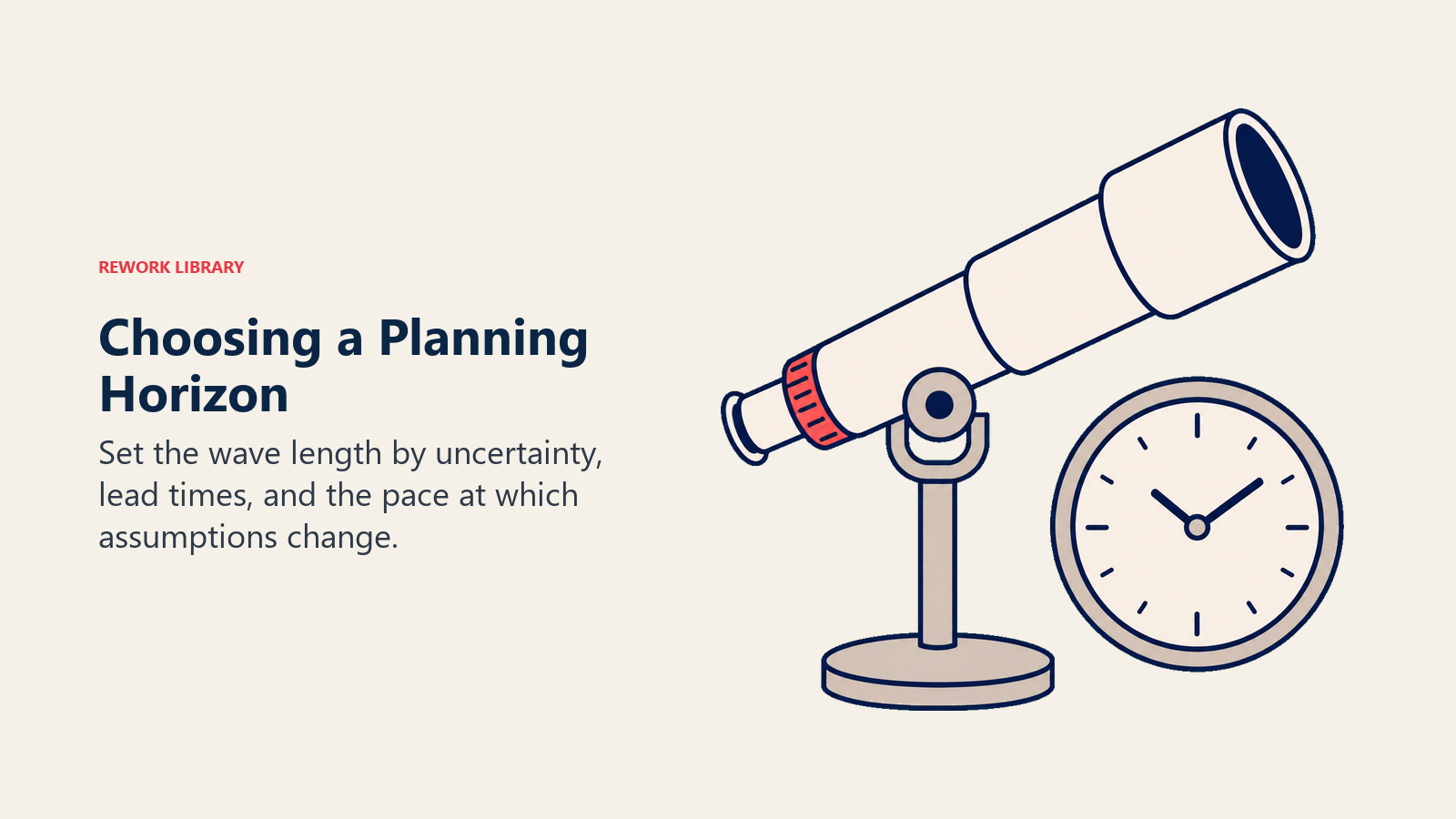
There's no PMI-issued table saying a wave should be exactly six weeks or exactly one quarter. The horizon is a judgment call, driven by how fast your assumptions go stale. Too short, and you're spending more time replanning than doing the work; too long, and the "detailed" wave you committed to has drifted from reality before you're halfway through it. The real drivers: requirement volatility, procurement or vendor lead times, contract type, and team stability (a horizon longer than your average team member's tenure is asking for trouble). Githens' own worked example is a useful reference point: an 18-month program using 3-month horizons and a 20 percent safety factor works out to roughly seven time horizons at the top of the WBS, each a checkpoint to revalidate assumptions before committing the next chunk of detail.
| Project type | Typical wave horizon | Typical re-planning cadence | Main driver |
|---|---|---|---|
| Software product work, agile-adjacent | 2-4 weeks | Every sprint or every other sprint | Requirements volatility, backlog reprioritization |
| Enterprise software or ERP rollout | 8-12 weeks (roughly one quarter) | Quarterly, aligned to a steering committee | Vendor statements of work, integration dependencies |
| Construction or capital program | 3-6 months | At each major procurement or permitting milestone | Long-lead procurement, regulatory approvals |
| R&D or innovation program | One quarter | Fixed quarterly gate | Technical uncertainty, unresolved unknowns |
| Government or defense acquisition | 6-12 months | At each acquisition milestone | Funding appropriation cycles, contract structure |
Treat this as a starting point, not a rule. The real test is whether your near-term wave stays accurate for its whole window. If it doesn't, shorten the horizon; if replanning feels like busywork because nothing changed, lengthen it. Uncertainty that's genuinely resolved doesn't need a wave at all, a call worth making during project risk management rather than defaulting to a horizon a table suggested.
Rolling wave planning and the work breakdown structure
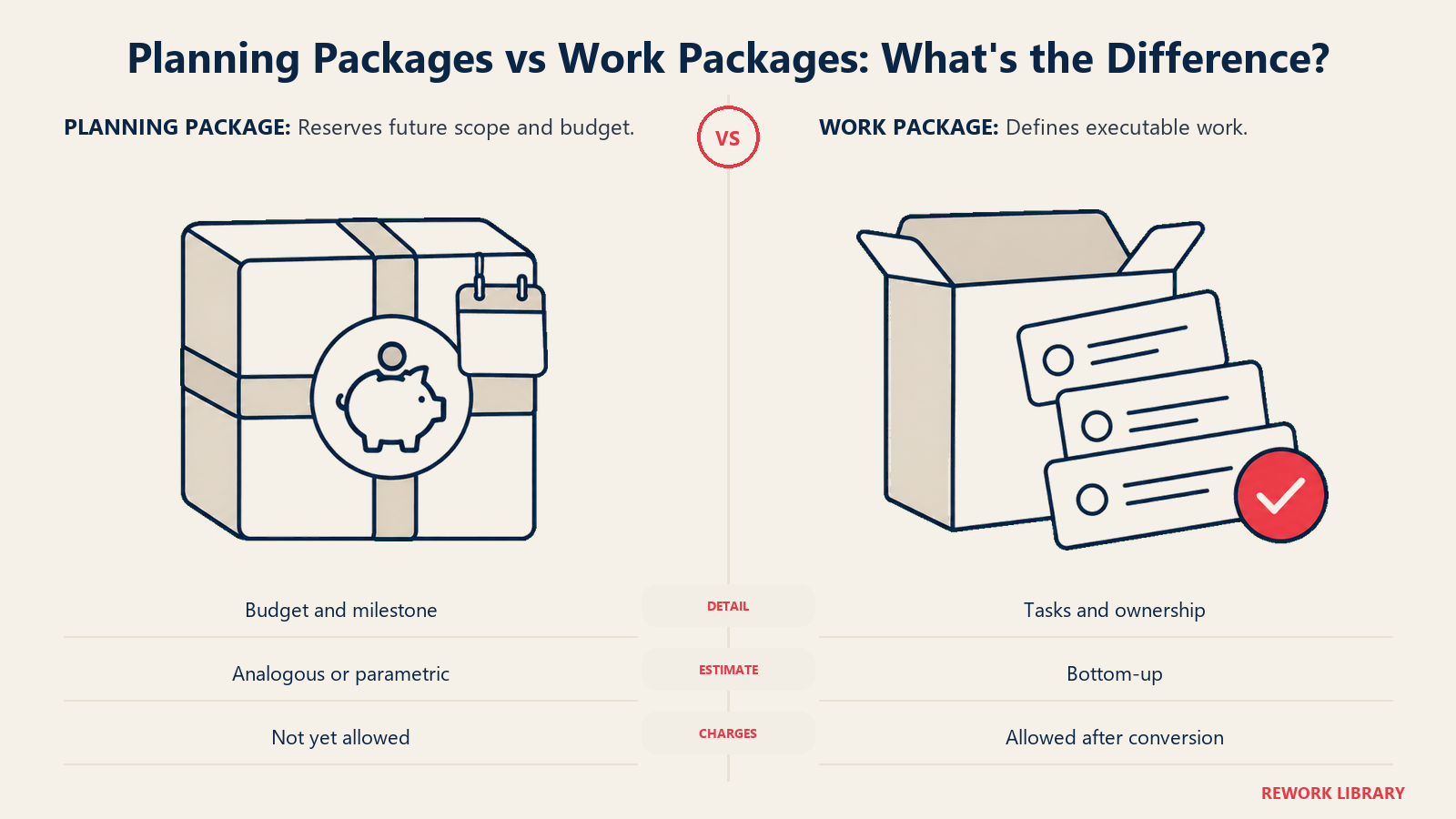
Rolling wave planning doesn't replace the work breakdown structure; it changes when each branch gets fully decomposed. The 100% rule still applies to the whole program at every point in time, but far branches satisfy it with a single planning package instead of a tree of work packages. That term is worth borrowing from earned value management even without formal EVM: Timothy Pasko's PMI write-up defines it as far-term work within a control account that can be identified, scheduled, and budgeted, but isn't yet detail-planned. The rule that gives it teeth: it converts to one or more work packages before any actual charges hit it. You can budget against a placeholder. You can't spend against one.
| Work package | Planning package | |
|---|---|---|
| Decomposition | Fully broken down, ideally to the 8/80-hour range | Left as a single line, not yet decomposed |
| Owner | One person or one team | The control account manager, until it converts |
| Estimate basis | Bottom-up, task-by-task | Analogous or parametric, at the package level |
| Charges allowed against it | Yes | No, not until it converts to a work package |
| When it converts | Already converted, that's what makes it a work package | At the wave boundary that brings it into the near-term horizon |
Building the full-program WBS at planning-package level first is what keeps the 100% rule intact across every wave. Skip that step and start each wave's WBS from scratch, and you'll rediscover forgotten scope three waves in, a far more expensive way to find it than checking against a placeholder you wrote down on day one.
Baselines and rolling wave planning: the hard part
Here's the part most explanations of this technique skip, and the part a real project manager actually gets stuck on: how do you hold a meaningful project baseline when half the WBS is deliberately undefined?
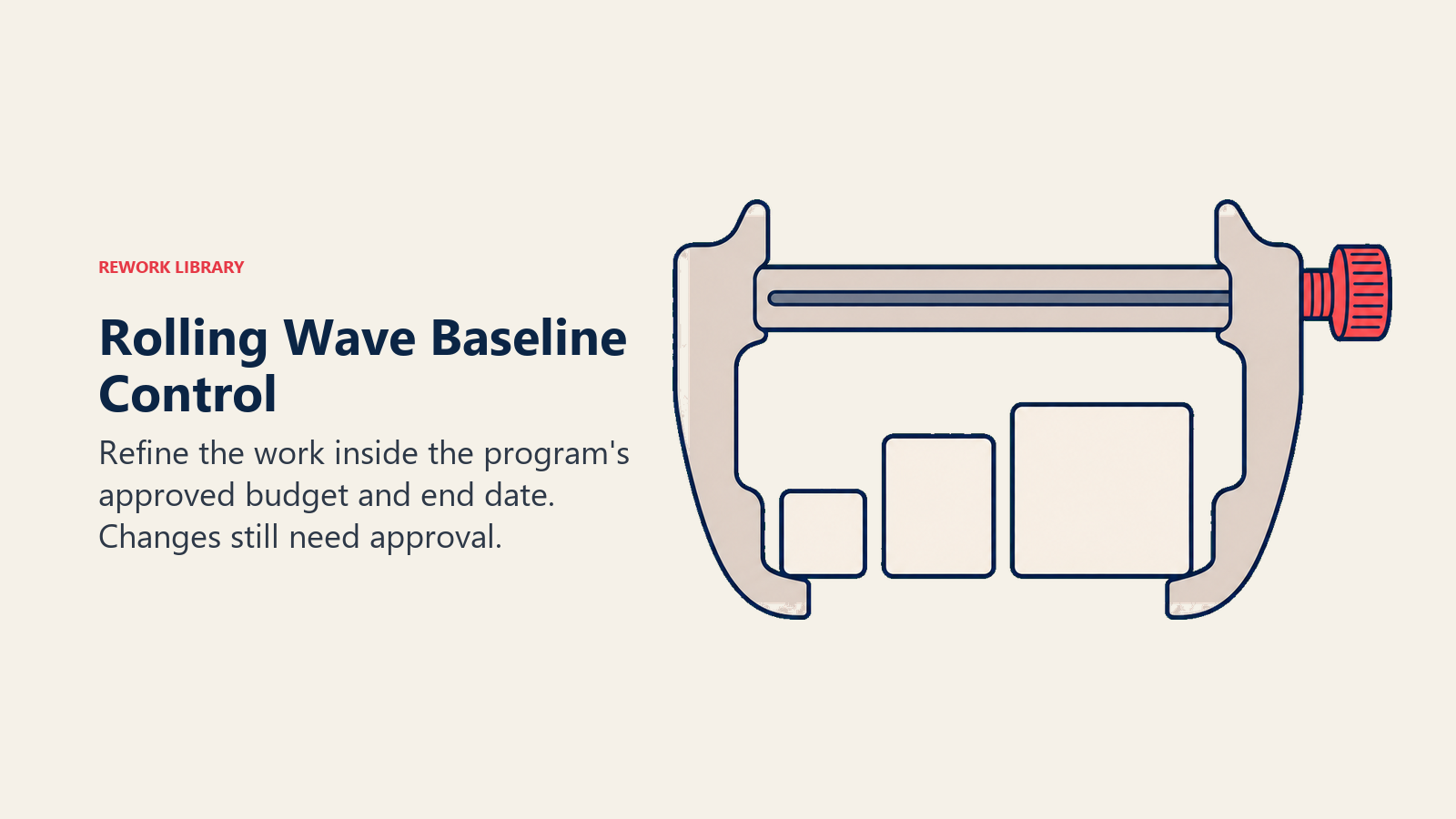
You baseline different things at different levels of confidence, and say so explicitly instead of pretending the whole plan carries equal weight. The current wave's scope, schedule, and cost get baselined at work-package detail, the same rigor you'd apply on a fully predictive project. Everything beyond it gets baselined too, just at the planning-package level: a budget total and a milestone date, not a task list. The outer constraint, the program's total budget and end date, gets baselined from day one and held as the thing every wave has to fit inside.
| Element | At program kickoff | At each wave boundary |
|---|---|---|
| Current wave's scope, schedule, cost | Fully baselined at work-package level | Closed out with actuals; the new current wave gets baselined next |
| Future waves | Baselined at planning-package level only: budget total and milestone date | Refined as they enter the current wave, then baselined at full detail |
| Overall program budget and end date | Baselined as the outer constraint the whole program has to fit | Reconfirmed, or formally rebaselined through change control if actuals moved it |
This is where rolling wave planning intersects a change control process most directly. Converting a planning package into work packages, on schedule, at the boundary you already committed to, isn't a change, it's the plan working as designed. What is a change: pulling scope forward from a future wave without revisiting its budget, or letting the current wave's detail expand past what the package was sized for. Both look, from the outside, exactly like scope creep in rolling-wave vocabulary, and the only thing that tells them apart is whether the change went through the same approval every other baseline change does. Convert packages without anyone signing off on the result, and you have a baseline that resets itself every few months with no one accountable for what changed.
Estimating in a rolling wave
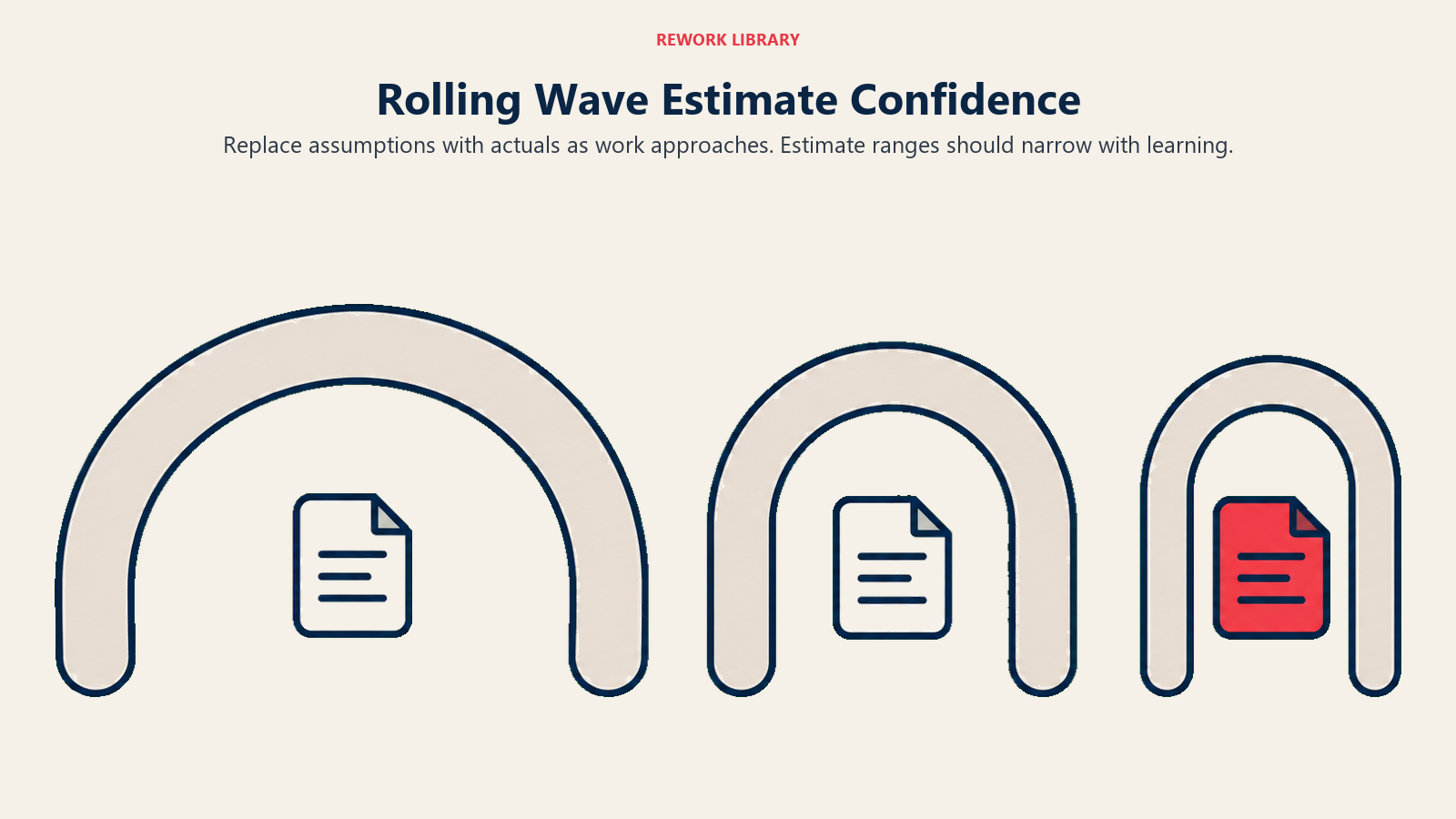
The current wave's estimate and one for a wave three horizons out shouldn't use the same method. Near-wave work is understood well enough to earn a bottom-up pass: break it into tasks and apply three-point estimation for an optimistic, most-likely, and pessimistic range instead of a single number dressed up as certainty. Far-wave work leans on analogous estimation (comparing the planning package to a similar one from a past program) or parametric estimation (a historical rate times a rough quantity), the techniques covered in project cost estimation for early-stage budgeting.
| Wave distance | Estimate method | Basis | Confidence |
|---|---|---|---|
| Current wave | Bottom-up, three-point estimation at the work-package level | Subject-matter input, historical actuals for comparable tasks | Highest, and what you're held to against the baseline |
| Next wave out | Analogous estimation against a comparable past planning package | Prior program actuals, vendor quotes | Medium |
| Two or more waves out | Parametric estimation or expert judgment | Historical unit costs, industry benchmarks | Lowest, and expected to move |
What should tighten, wave over wave, is the estimate for whatever's about to enter the current horizon: last wave it was a rough analogous number, this wave it's a bottom-up figure built from what you learned executing the wave before it. You'll see this progression described elsewhere with a specific confidence percentage attached to each estimate class, rough order of magnitude at one end, definitive estimate at the other. Treat any version you can't trace to a named, fetchable source as decoration, not evidence. What's true without a number attached: the range narrows because you're replacing assumption with measurement one wave at a time, and that narrowing is the point.
Where rolling wave planning fits: predictive, hybrid, and agile
Rolling wave planning came out of predictive, program-heavy project management, the world of control accounts and earned value. It's just as at home in hybrid delivery, where it's often the connective tissue: near-term work runs inside agile sprints, while everything further out sits at the planning-package level until it's close enough to warrant a sprint-ready backlog. That's a large part of why it's spread past its original home; PMI's own research on the shift toward fit-for-purpose delivery found hybrid adoption climbing from 20% of projects in 2020 to 31.5% in 2023.
Something most comparisons of agile vs waterfall gloss over: an agile team doing backlog refinement is structurally doing the same thing as a program running rolling wave planning, just with different vocabulary and a shorter horizon. The Scrum Guide describes refinement as breaking Product Backlog items down and adding detail, so items are "deemed ready for selection in a Sprint Planning event" only once they've picked up that detail, while items further down stay coarse until their turn comes. Swap "sprint" for "wave" and "backlog refinement" for "converting a planning package," and you're describing the same discipline.
| Rolling wave planning | Full upfront planning | Agile iteration planning | |
|---|---|---|---|
| Home discipline | Predictive and program management | Traditional waterfall | Scrum or Kanban |
| Near-term detail | Work package or activity level | Full detail from day one | Sprint backlog, task level |
| Far-term detail | Planning package: budget and milestone only | Full detail from day one, same rigor throughout | Product backlog: epic-level, lightly refined |
| Re-planning trigger | A fixed wave boundary set at kickoff | A formal change request against the baseline | Every sprint boundary, usually 1-4 weeks |
| Vocabulary | Waves, horizons, planning packages | Baseline, WBS, Gantt chart | Sprints, backlog refinement, story points |
| Best contract fit | Cost-reimbursable, time-and-materials, or milestone-based | Fixed-price, fixed-scope | Internal product work, time-and-materials |
| Underlying idea | Detail what's near, defer what's genuinely far | Detail everything now and accept some of it will be wrong | Same as rolling wave, at a shorter, fixed cadence |
The honest pitch for a sponsor skeptical of "agile-sounding" language: rolling wave planning isn't a concession to uncertainty, it's a more accurate way of representing uncertainty that already exists. Full upfront planning doesn't remove that uncertainty, it just hides it inside numbers that look more confident than they are.
When rolling wave planning is the wrong choice
The technique earns its keep when the far end of the project is genuinely unknowable. It's the wrong choice when that isn't true, or when whoever's paying needs certainty it structurally can't give them.
| Scenario | Why rolling wave struggles here | Better fit |
|---|---|---|
| Fixed-price, fixed-scope contract | The client is buying certainty on the whole scope; a coarse far-term package undermines the price itself | Full upfront planning, a detailed WBS negotiated before signature |
| Regulatory submission requiring a complete plan | A reviewer approves a finished plan, not black-box placeholders for later phases | Full upfront planning; keep progressive elaboration confined to internal execution detail |
| Short, simple projects | The whole project fits inside a single wave, so wave ceremony is pure overhead | Skip waves, plan the whole thing in detail once |
| Well-understood, repeatable work | Nothing about the later phases is actually uncertain, so coarse far-term planning buys you nothing | Full upfront planning, templated from the team's last run of this work |
Githens makes a related point worth repeating because it cuts the other way: rolling wave is built for development work, where the far end is genuinely unresolved, and applying it to a deployment project (a rollout, a migration, a go-live already well understood before it starts) can make that project slower and less efficient than planning it all up front. It's a specific answer to a specific kind of uncertainty, and it should leave the room once that uncertainty is gone.
How rolling wave planning gets abused
This is the section most explanations skip, and the one that matters most when you're defending the technique to a skeptical PMO. "Rolling wave" is a legitimate method, and also a phrase that covers for teams that never intended to plan at all.
| Tell | What's actually happening | Fix |
|---|---|---|
| Far waves have looked identical for three boundaries in a row | Nobody is doing the replanning work; the placeholder gets copied forward | Put a named owner and a hard date on every wave's replanning package, and treat missing it as a schedule slip |
| No one can say what triggers the next wave's detail pass | There's no real cadence, just a vague intention to figure it out later | Fix the horizon and re-planning date at kickoff, in the schedule |
| The far-term budget line hasn't moved despite several waves of learning | Estimates aren't tightening, meaning nobody is re-estimating | Require every wave boundary to update the next wave's estimate with what was just learned |
| "Rolling wave" is the answer whenever anyone asks for a full plan | The label covers for avoided commitment, not real uncertainty | Ask what's specifically uncertain; "nothing, we just haven't done it" means a missing plan, not rolling wave |
| Planning packages get spent against before converting to work packages | Budget discipline has quietly collapsed | Enforce the conversion rule: no charges against a planning package until it becomes a work package |
None of these are exotic. They're the predictable result of adopting rolling wave vocabulary without its discipline, and every one is fixable by putting a date, an owner, and an approval step where a vague intention used to be.
How to implement rolling wave planning: step by step
Step 1: Confirm this is actually the right technique
Check that the uncertainty is real, not just unaddressed. If later phases are well understood but nobody has scheduled the work to plan them, that's a planning gap, not a case for rolling wave. Genuine uncertainty usually traces back to unresolved dependencies, or a project life cycle where later phases are contingent on outcomes you don't have yet.
Step 2: Set the wave horizon and cadence
Use the drivers above: requirement volatility, procurement lead time, contract type, team stability. Write the horizon and re-planning dates into the schedule itself, not a side conversation.
Step 3: Build the full-program WBS at planning-package level
Every phase and deliverable gets at least a planning package, a budget number and a milestone date, before anything gets decomposed further. This protects the 100% rule across every wave from day one.
Step 4: Decompose the current wave to the work-package level
Apply the 8/80 rule to the current wave only. Estimate it with three-point estimation now that the work is understood well enough to support a real range.
Step 5: Baseline the current wave and the program's outer constraint
Baseline the current wave at full detail, and baseline the total program budget and end date as the constraint every future wave has to fit inside.
Step 6: Execute, track, and protect the wave boundary date
Run the current wave like any other well-managed piece of work, tracking actuals against the baseline you just set.
Step 7: Replan at the boundary, and treat it as a real deliverable
When the boundary arrives, convert the next planning package into work packages using what you learned executing the wave before it, run any resulting baseline change through formal change control, and roll the horizon forward.
Common mistakes with rolling wave planning
| Mistake | Fix |
|---|---|
| Treating rolling wave as license to skip planning entirely | Every wave still gets a full, real plan; only the timing of detail changes |
| No named owner or fixed date for the next wave's replanning | Put replanning on the schedule as its own package, with an owner and a due date |
| Baselining the entire project at work-package detail on day one | Baseline near-term detail and far-term packages separately, matching each wave's confidence |
| Letting planning packages carry charges before converting to work packages | Hold spend at the planning-package level to budget only, until it converts |
| Far-wave estimates that never tighten as the program progresses | Force a fresh estimate at every wave boundary, built from what the last wave taught |
| Confusing rolling wave planning with an excuse for scope creep | Keep the outer baseline, budget and end date, fixed; only internal detail rolls |
Frequently Asked Questions about Rolling Wave Planning
What's the difference between rolling wave planning and progressive elaboration?
Progressive elaboration is the general principle that a plan gets more detailed as better information arrives, applying to any part of a plan, not just the schedule. Rolling wave planning is the scheduling technique that applies it: near-term work gets decomposed to the work-package level, far-term work stays at a coarse planning-package level, and a fixed cadence rolls the detail forward wave by wave.
How far ahead should a wave plan in detail?
There's no fixed standard. The horizon should match how fast your assumptions go stale, driven by requirement volatility, procurement or contract lead times, and team stability. Software teams often run 2 to 4 week horizons aligned to sprints; enterprise programs commonly run a full quarter; capital and construction programs often stretch to 3 to 6 months tied to procurement milestones.
Is rolling wave planning the same as agile sprint planning?
Structurally similar, not identical. Both detail near-term work and defer far-term detail on a fixed cadence. Rolling wave planning comes out of predictive and program management, with formal planning packages and control accounts; agile iteration planning comes out of Scrum or Kanban, with backlog refinement and story points. An agile team doing backlog refinement is doing something very close to rolling wave planning under different vocabulary.
Can you baseline a project that's using rolling wave planning?
Yes, but the baseline has to reflect different levels of confidence. The current wave gets baselined at full work-package detail. Future waves get baselined at the planning-package level, a budget total and a milestone date. The overall program budget and end date get baselined as the outer constraint, and any change to it goes through formal change control regardless of which wave it touches.
Why do planning packages matter if my project isn't running formal earned value management?
The discipline still matters without formal EVM. A planning package is a placeholder carrying a real budget and date but no task list, and the rule that it shouldn't absorb charges until it converts to a work package keeps far-term uncertainty from quietly turning into unaccountable spend. Skipping that discipline is one of the most common ways rolling wave planning gets abused.
When should I avoid rolling wave planning entirely?
Avoid it on fixed-price contracts with a fully fixed scope, on regulatory work requiring a complete plan before approval, on short projects that fit inside a single wave, and on well-understood, repeatable work where nothing about later phases is genuinely uncertain. Full upfront planning is the more honest choice in all four cases.
Rolling wave planning isn't a hedge against having to commit. It's a more honest way of committing: full detail for what you know, a real budget and date for what you don't know yet, and a fixed point where that gap closes. Set the horizon deliberately, put a date on every wave's replanning work, and hold the outer baseline steady while the internal detail rolls forward, and you'll have a plan a sponsor can trust in month one and still trust in month twelve.

Senior Operations & Growth Strategist
On this page
- What rolling wave planning actually is (and how it's different from progressive elaboration)
- How rolling wave planning actually works: the wave-by-wave view
- Choosing your wave horizon and cadence
- Rolling wave planning and the work breakdown structure
- Baselines and rolling wave planning: the hard part
- Estimating in a rolling wave
- Where rolling wave planning fits: predictive, hybrid, and agile
- When rolling wave planning is the wrong choice
- How rolling wave planning gets abused
- How to implement rolling wave planning: step by step
- Step 1: Confirm this is actually the right technique
- Step 2: Set the wave horizon and cadence
- Step 3: Build the full-program WBS at planning-package level
- Step 4: Decompose the current wave to the work-package level
- Step 5: Baseline the current wave and the program's outer constraint
- Step 6: Execute, track, and protect the wave boundary date
- Step 7: Replan at the boundary, and treat it as a real deliverable
- Common mistakes with rolling wave planning