Integrated Change Control: How It Works in Project Management
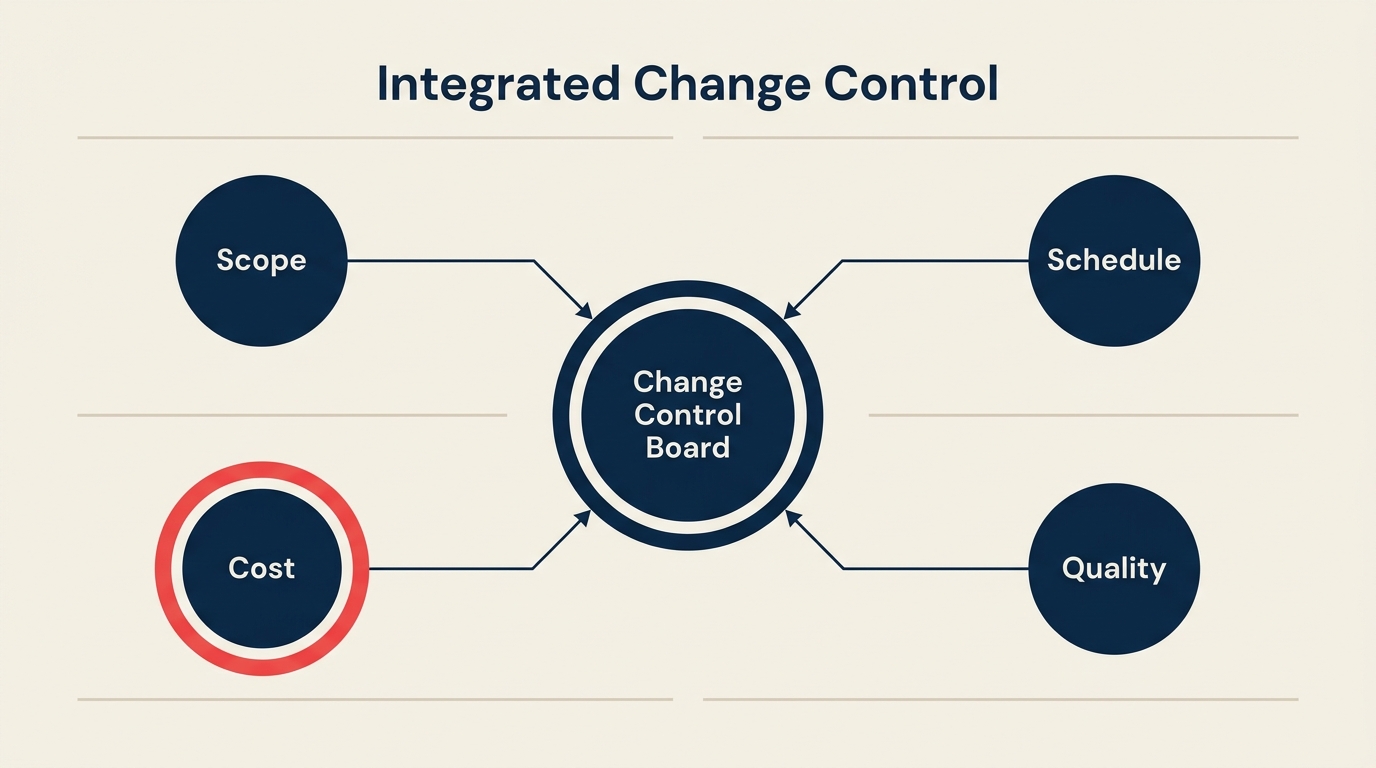 Integrated change control is the project management discipline that makes sure any proposed change is evaluated against all project constraints before anyone approves it. It's a defined process in the PMBOK Guide (Project Management Body of Knowledge) that sits at the intersection of scope, schedule, cost, and quality. When a stakeholder asks to add a feature, shift a deadline, or cut a deliverable, integrated change control is the mechanism that asks: "What happens to everything else if we say yes?"
Turn this article into takeaways for your work.


Each assistant summarizes the article only for you and suggests best practices for your work.
What Is Integrated Change Control?
Integrated change control is the PMBOK process of reviewing, approving, and managing all change requests across a project in a coordinated way. The word "integrated" is the key. A change to scope almost always affects schedule and cost. A budget cut usually compresses quality or timeline. Integrated change control treats those constraints as a system, not as isolated boxes, so no approval happens in a vacuum.
The formal PMBOK process name is Perform Integrated Change Control (process 4.6 in the PMBOK Guide, Seventh Edition framework). It belongs to the project integration management knowledge area, which is the glue that holds every other knowledge area together.
Without it, teams approve changes at the departmental level without checking the downstream effects. A developer agrees to a scope addition with the client. Engineering absorbs the work. No one tells the project manager that the timeline just slipped three weeks. By the time the sponsor notices, the budget is blown and the team is burned out.
Key Facts
- PMI's Pulse of the Profession (2023) found that organizations with mature project management practices waste 28 times less money than low-maturity organizations, largely because they control scope and change systematically.
- The Standish Group CHAOS Report consistently shows that scope creep is among the top three causes of project failure, affecting over 50% of challenged projects.
- The PMBOK Guide identifies integrated change control as one of the six core integration management processes, noting that uncontrolled changes are a primary driver of cost and schedule overruns.
Integrated Change Control vs. the Change Control Process
These two terms are easy to conflate, but they describe different things.
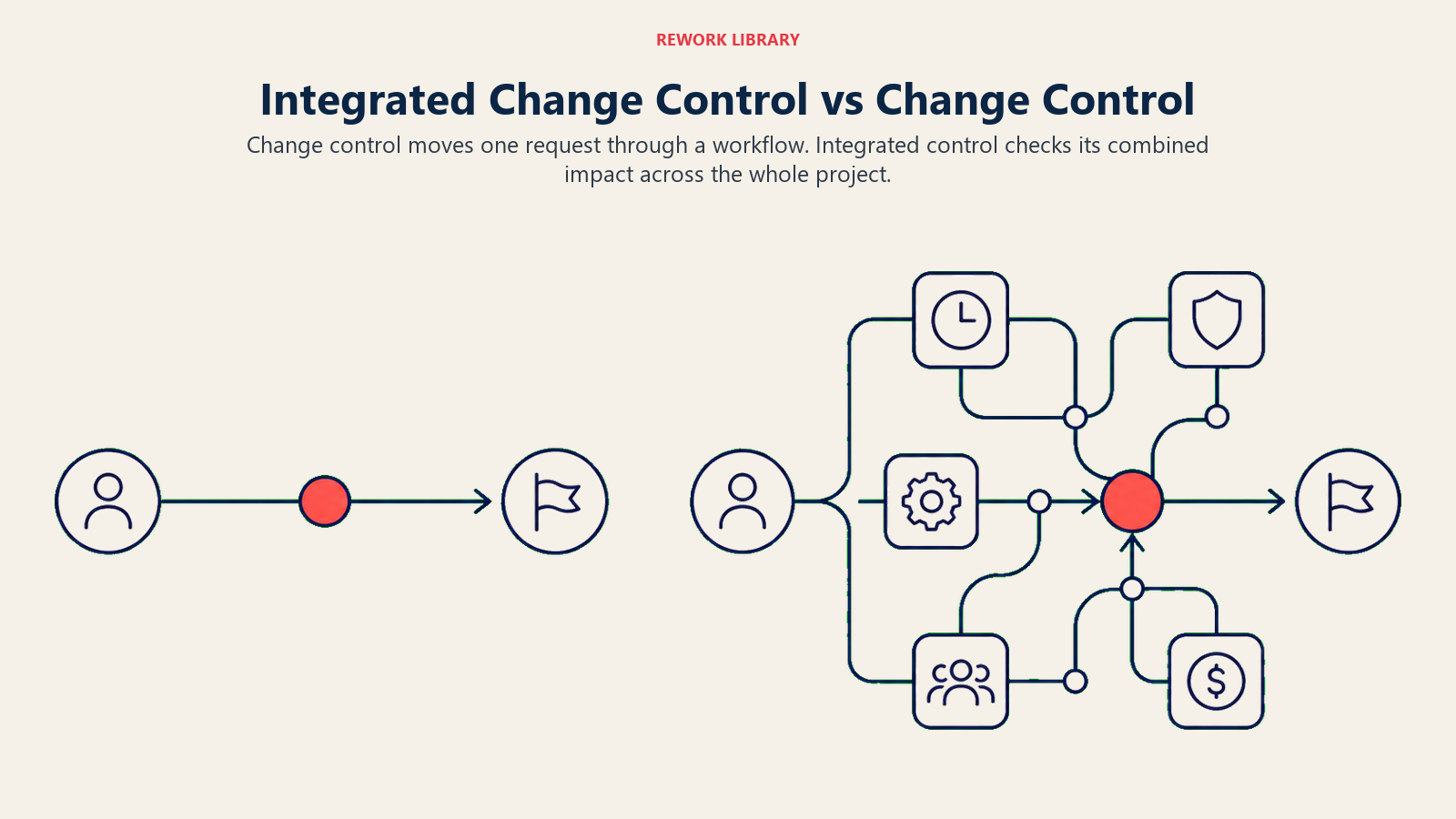
| Dimension | Integrated Change Control | Change Control Process |
|---|---|---|
| Scope | Evaluates a request against all constraints simultaneously (scope, schedule, cost, quality, risk) | Manages a single change request from submission to decision |
| Level | Strategic coordination discipline spanning the whole project | A step-by-step workflow for processing one request |
| Who owns it | Project manager and Change Control Board (CCB) collectively | Typically the project manager or a designated change analyst |
| Output | An approved, conditionally approved, or rejected change that has been cross-checked for impact | A logged, reviewed, and decided change request record |
| PMBOK reference | Process 4.6 "Perform Integrated Change Control" | A subset activity within process 4.6 |
| When it runs | Throughout the project life cycle | Whenever a formal change request is submitted |
Think of the change control process as the road a change request travels, and integrated change control as the traffic system that routes it correctly and checks that it doesn't cause accidents elsewhere on the network.
Why Integrated Change Control Matters
Most project teams already have some form of change approval. What integrated change control adds is coordination across constraints, not just sign-off from one person.
It prevents scope creep. Without a formal gate, small requests accumulate. Each one looks trivial in isolation. Together, they expand the project beyond its original budget and timeline with no one having made a deliberate decision to do so. The change control process handles individual requests; integrated change control makes sure those requests don't collectively drift the project off course.
It protects the baseline. The project baseline is your approved plan. Scope, schedule, and cost baselines are the measuring stick for earned value, variance reporting, and performance forecasting. Every approved change should update the baseline explicitly. Integrated change control makes that update mandatory, not optional. You can read more about how earned value management depends on a reliable baseline.
It creates an audit trail. Every change request, every impact assessment, every approval or rejection gets documented. That record is invaluable during disputes, audits, or lessons-learned reviews. It also protects the project manager by showing that changes were formally evaluated rather than casually accepted.
It aligns stakeholders. When a sponsor requests a feature addition, they often don't see the schedule impact. The CCB meeting is the place where that impact becomes visible to everyone who approved the change. Stakeholders who understand the trade-off make better decisions than those who only see the request.
The Role of the Change Control Board (CCB)
The Change Control Board (CCB) is the governing body that reviews and decides on change requests within the integrated change control process. It's the human layer that applies judgment where rules and checklists can't.
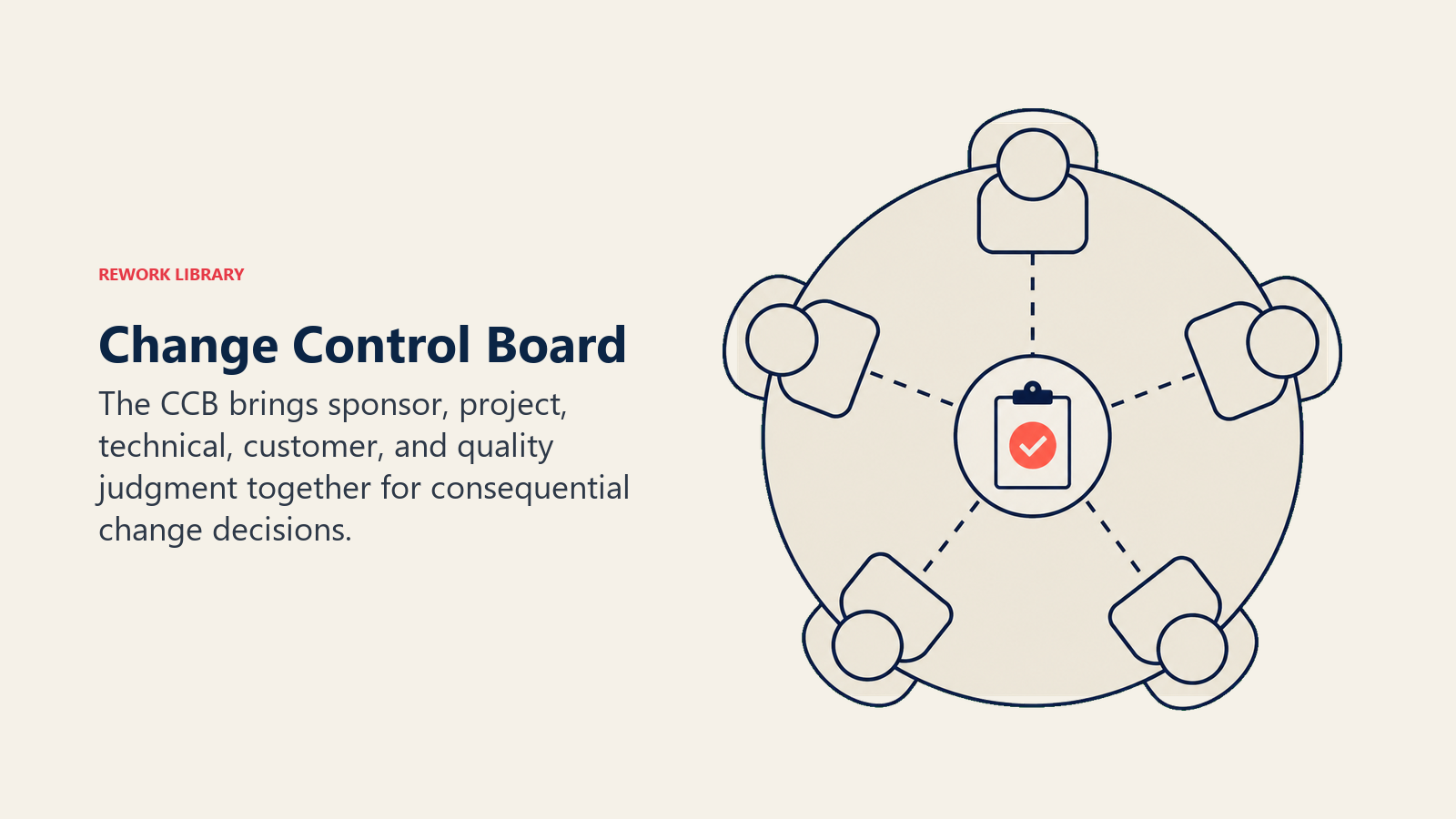
CCB composition varies by project size and organization, but typically includes:
- Project manager (usually chairs the meeting or facilitates the review)
- Project sponsor (authority to approve changes with budget implications)
- Key technical leads (assess feasibility and effort)
- Customer or client representative (confirms whether a change aligns with their needs)
- Quality manager (flags downstream quality effects)
Not every change needs the full CCB. Projects typically define thresholds in advance. A minor documentation change might need only the project manager's sign-off. A scope addition that affects the critical path goes to the full board.
The CCB's job is not to block change. It's to ensure that every approved change is:
- Clearly described and traceable to a business need
- Evaluated for impact on all relevant constraints
- Documented and communicated to the team before implementation begins
The project charter usually authorizes the CCB and documents its composition, authority levels, and quorum requirements.
How Integrated Change Control Works: Step by Step
Step 1: Submit a Change Request
Anyone on the project (team member, stakeholder, sponsor, client) can submit a change request. The request should describe what they want changed and why. Most organizations use a standardized change request form that captures the requestor, date, category (scope, schedule, cost, quality), and a brief description.
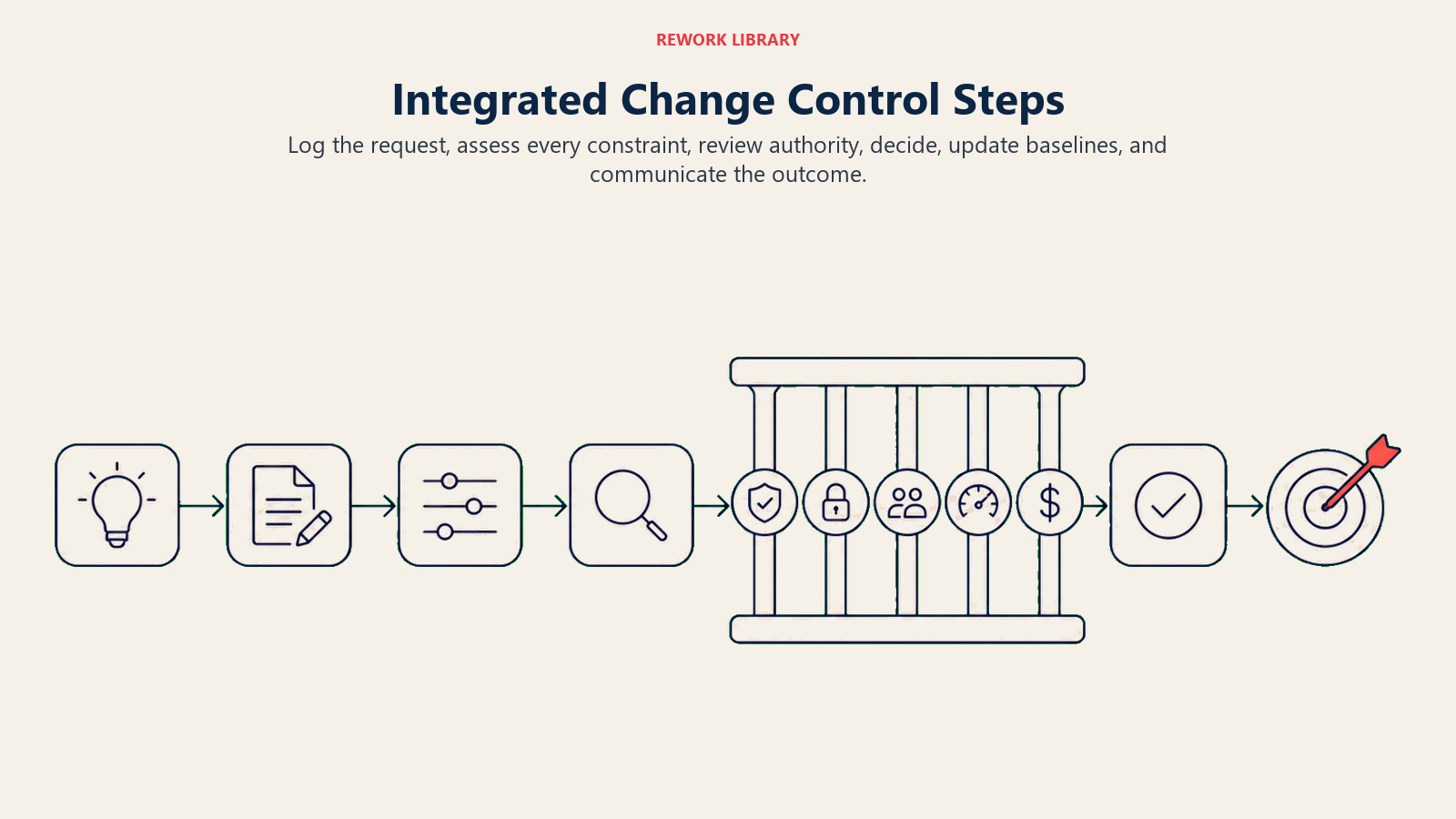
Step 2: Log and Track the Request
The project manager logs the request into the change log. Each request gets a unique ID so it can be tracked from submission to final disposition. Nothing moves forward without a log entry.
Step 3: Perform Impact Assessment
This is the "integrated" part. The project manager and relevant team leads assess what the proposed change would mean for each constraint:
- Scope: Does this add, remove, or modify deliverables?
- Schedule: Does it affect the critical path? Which tasks need to shift?
- Cost: What resources, labor hours, or materials are required?
- Quality: Does it change acceptance criteria or testing requirements?
- Risk: Does it introduce new risks or close existing ones?
A good impact assessment uses data from the schedule, cost estimates, and the requirements traceability matrix to show the knock-on effects in concrete terms.
Step 4: Review by the CCB
The change request and its impact assessment go to the CCB. The board can:
- Approve: The change proceeds as described; baselines are updated.
- Conditionally approve: The change proceeds with modifications (reduced scope, phased implementation, cost offset required).
- Defer: The change is valid but the timing isn't right; it goes to a later phase or release.
- Reject: The change isn't justified given its cost, risk, or misalignment with project goals.
Step 5: Update Project Documents
Approved changes require immediate updates to:
- The project management plan (scope, schedule, cost baselines)
- The change log (final disposition recorded)
- The risk register (new risks from the change noted)
- Any affected work packages or work breakdown structure elements
Step 6: Communicate and Implement
The project manager notifies all relevant stakeholders of the decision and its effective date. Approved changes go to the team for implementation under normal project execution controls. Rejected changes get communicated back to the requestor with a brief rationale.
Step 7: Monitor and Verify
During execution, the project manager confirms that the approved change was implemented as documented and that the actual impact matched the forecast. If it didn't, a new change request may be needed to address the variance.
Integrated Change Control Example
Consider a software development project with a fixed nine-month timeline and a $500,000 budget. Midway through development, the marketing team requests a new reporting dashboard that wasn't in the original scope.
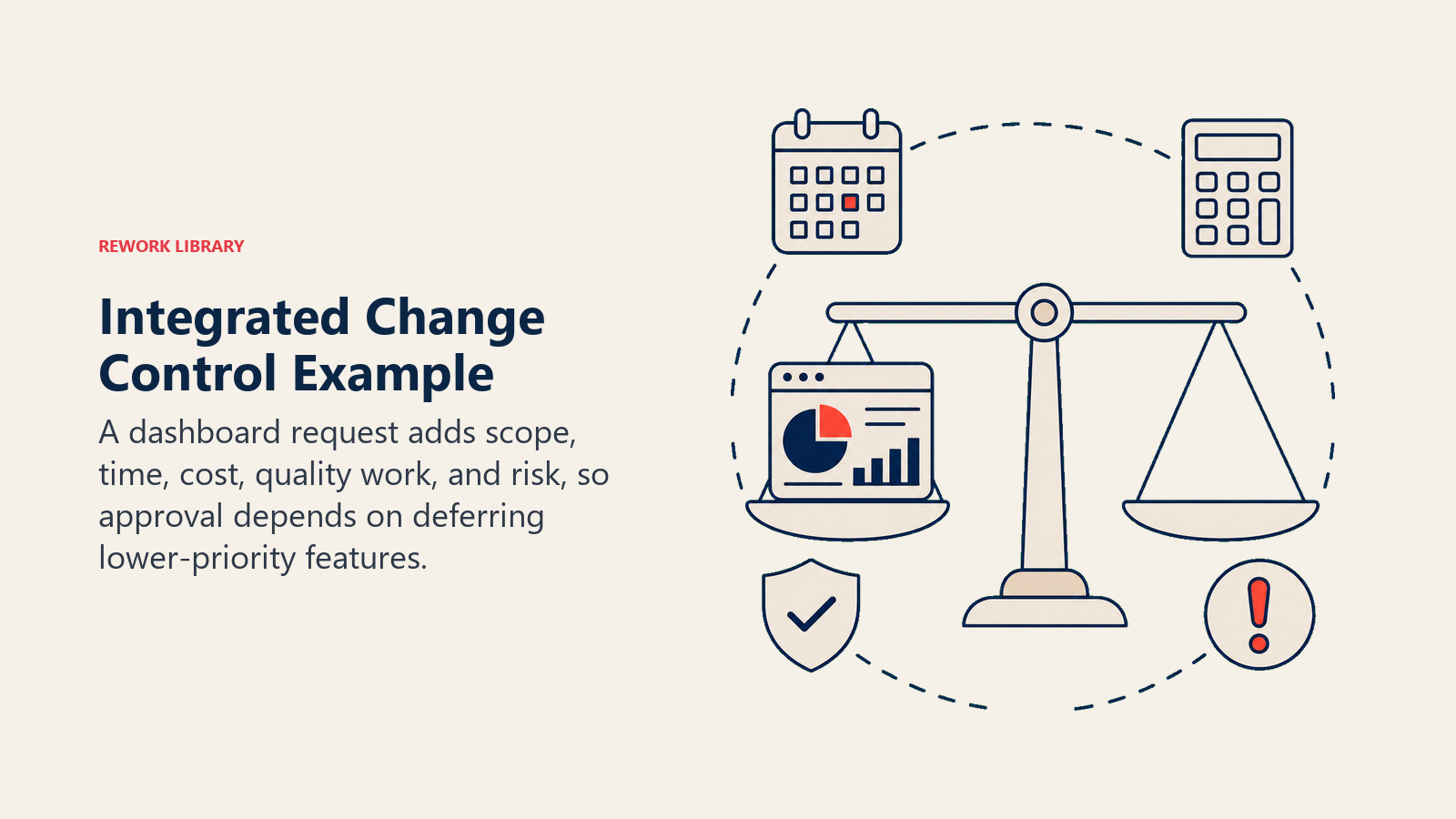
| Evaluation Area | Impact |
|---|---|
| Scope | Adds one new module: ~120 hours of development + 30 hours of QA |
| Schedule | Pushes the go-live date by three weeks unless another feature is deprioritized |
| Cost | Requires $18,000 in additional labor; no budget reserve remaining |
| Quality | Needs new test cases; existing QA plan must expand |
| Risk | Increases integration complexity; adds medium-probability regression risk |
The CCB reviews the assessment. The sponsor decides the dashboard is high value, but the timeline is immovable. The board conditionally approves the change on the condition that two lower-priority features are deferred to a post-launch release. The scope baseline is updated. The deferred features are logged in the change log as deferred, not removed. The team gets the updated plan before writing a single line of dashboard code.
That's integrated change control working as intended: the request was evaluated across all constraints, a real trade-off decision was made explicitly, and the project plan reflects reality.
Best Practices
Define change authority thresholds early. The project charter or the project management plan should document who can approve what, and up to what dollar or schedule impact. This prevents both bottlenecks (everything goes to the full CCB) and chaos (everyone approves changes informally).
Never let verbal approvals count. Any change that bypasses the formal log is invisible to the rest of the project. It won't show up in the baseline update, it won't get communicated to downstream teams, and it won't have an impact assessment. Insist on written requests for all changes, even minor ones.
Keep the change log current in real time. A change log updated weekly is already out of date. Project managers who keep the log current in real time always know the project's true status. Those who batch-update it discover surprises at status reviews.
Separate change requests from issues. An issue is something that has already occurred and needs resolution. A change request is a proposed modification to the plan. They're tracked differently and handled through different processes. Mixing them creates confusion and gaps in both logs.
Use impact assessment templates. Repeatable formats for scope impact, schedule impact, and cost impact make the assessment faster and easier to compare across requests. They also make it easier to spot when an assessment is incomplete.
Connect integrated change control to your triple constraint thinking. Teams that genuinely understand that scope, schedule, and cost form a system make better change requests and better change decisions. When requestors know an approval always costs something somewhere, they prioritize more carefully.
Document rejected changes too. A rejected change request is still a data point. It shows that the team considered the option and decided against it for documented reasons. That record prevents the same request from being resubmitted three times by different stakeholders.
Integrated change control isn't bureaucracy for its own sake. It's the process that makes it possible to say yes to good changes and no to bad ones, with full visibility into the consequences either way. Teams that treat it as overhead find out later, usually at the worst possible moment, exactly what that oversight cost them. The ones who build it into their workflow from day one keep control of the project even when the world around them changes.

Senior Operations & Growth Strategist
On this page
- What Is Integrated Change Control?
- Integrated Change Control vs. the Change Control Process
- Why Integrated Change Control Matters
- The Role of the Change Control Board (CCB)
- How Integrated Change Control Works: Step by Step
- Step 1: Submit a Change Request
- Step 2: Log and Track the Request
- Step 3: Perform Impact Assessment
- Step 4: Review by the CCB
- Step 5: Update Project Documents
- Step 6: Communicate and Implement
- Step 7: Monitor and Verify
- Integrated Change Control Example
- Best Practices