Scope Creep: What Causes It and How to Prevent It
Turn this article into takeaways for your work.


Each assistant summarizes the article only for you and suggests best practices for your work.
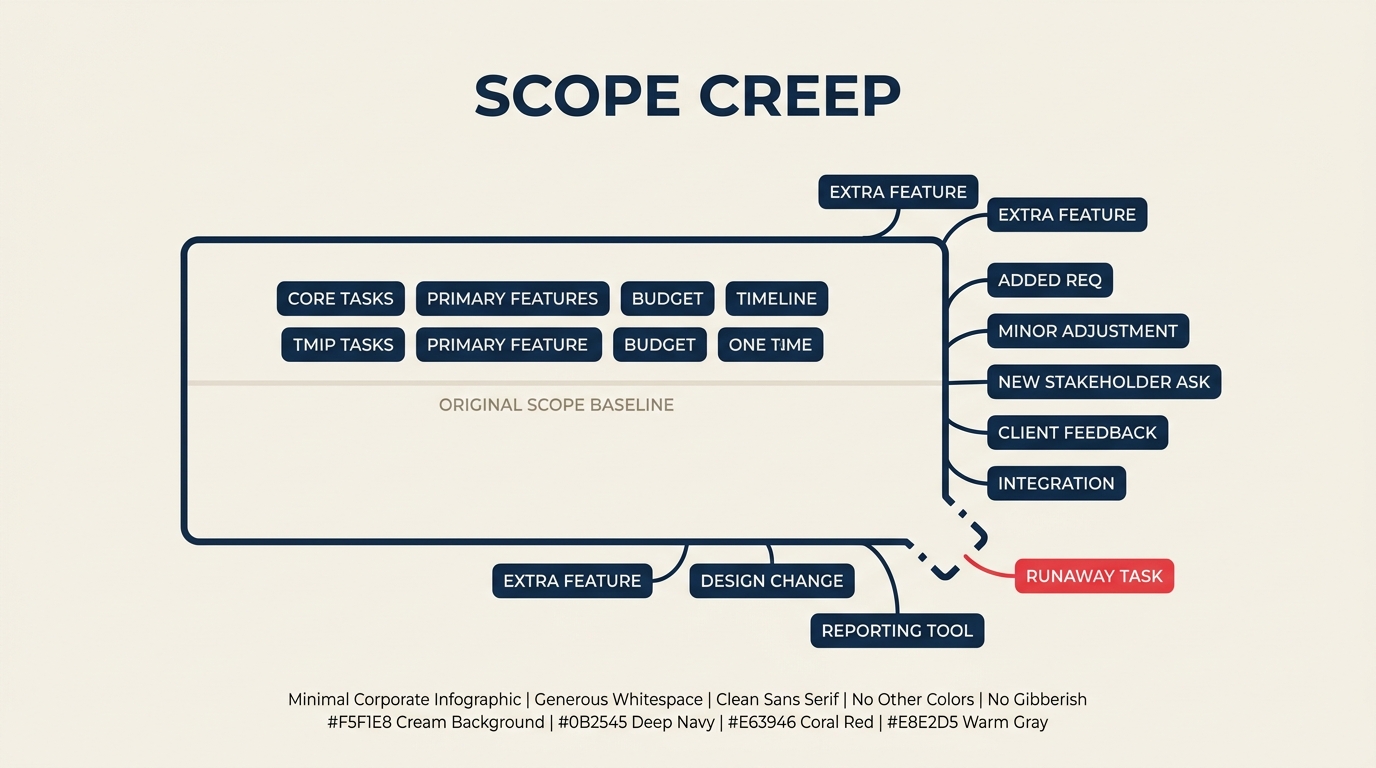
Scope creep is what happens when a project quietly grows beyond what was originally agreed. One stakeholder asks for a small addition here, a developer spots an improvement there, and before anyone raises a flag, the team is carrying twice the original workload on the same timeline and budget.
It's one of the most common reasons projects go over budget, miss deadlines, or get quietly abandoned. Understanding where scope creep comes from is the first step to keeping it from swallowing your project.
What is scope creep?
Scope creep is the gradual, often unauthorized expansion of a project's scope after the initial requirements have been agreed and signed off. Unlike a formal scope change, which goes through a review process, scope creep typically enters through informal channels: a quick request in a meeting, a "while you're at it" email, or a well-intentioned improvement that no one explicitly approved.
The word "creep" is intentional. The growth is incremental, and each individual addition can seem trivial. It's only when you step back that the cumulative effect becomes clear: the team is delivering a materially larger product than anyone budgeted for, without any adjustment to timeline, resources, or cost.
Key facts:
- The PMI Pulse of the Profession (2023) found that 34% of projects experienced scope creep, making it one of the top contributors to project failure alongside poor requirements management and ineffective communication.
- The Standish Group CHAOS Report consistently identifies incomplete requirements and lack of user involvement as root causes of budget and schedule overruns, both of which feed directly into uncontrolled scope growth.
- PMI also reports that organizations waste an average of $97 million for every $1 billion invested due to poor project performance, with scope issues cited among the leading causes.
Scope creep vs gold plating vs scope change
These three terms are often confused, but they describe meaningfully different situations.
| Concept | Who initiates it | Approved? | Intent |
|---|---|---|---|
| Scope creep | Stakeholder or team member | No | Adding "nice to have" features informally |
| Gold plating | Project team | No | Adding extra polish beyond requirements (usually well-intentioned) |
| Scope change | Stakeholder or sponsor | Yes, through change control | Formally adjusting the project baseline |
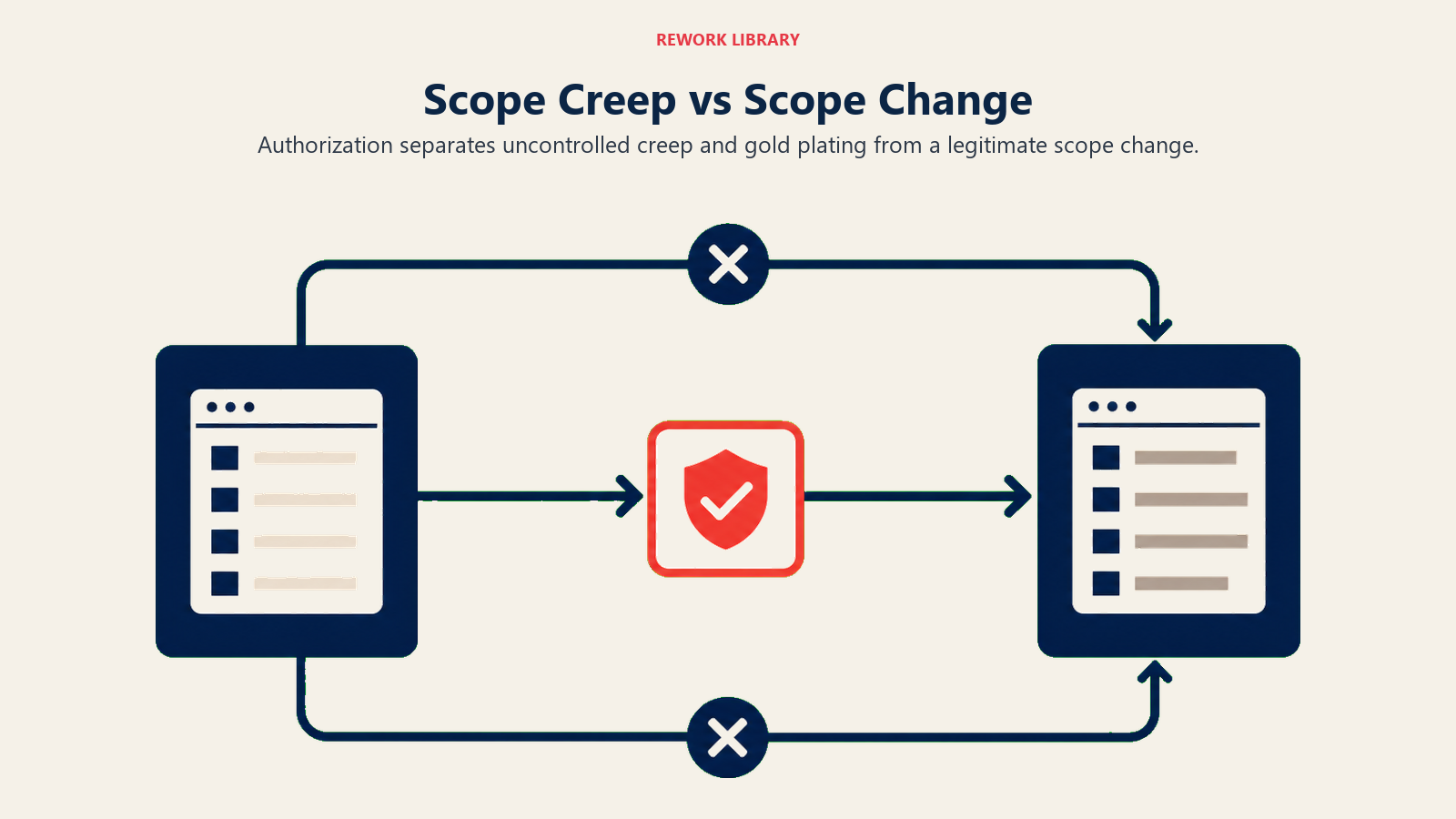
The critical distinction is authorization. A scope change goes through the change control process, gets evaluated for impact, and updates the project baseline before any work begins. Scope creep and gold plating bypass that gate entirely.
Gold plating is worth singling out because project teams sometimes confuse it with quality. A developer who spends an extra week making a feature "really solid" beyond what the spec required isn't delivering quality: they're consuming budget that wasn't allocated and potentially introducing risk. The right approach is to finish the agreed scope first, then propose improvements through formal change control if there's appetite.
What causes scope creep?
Root causes generally fall into a few recurring patterns.
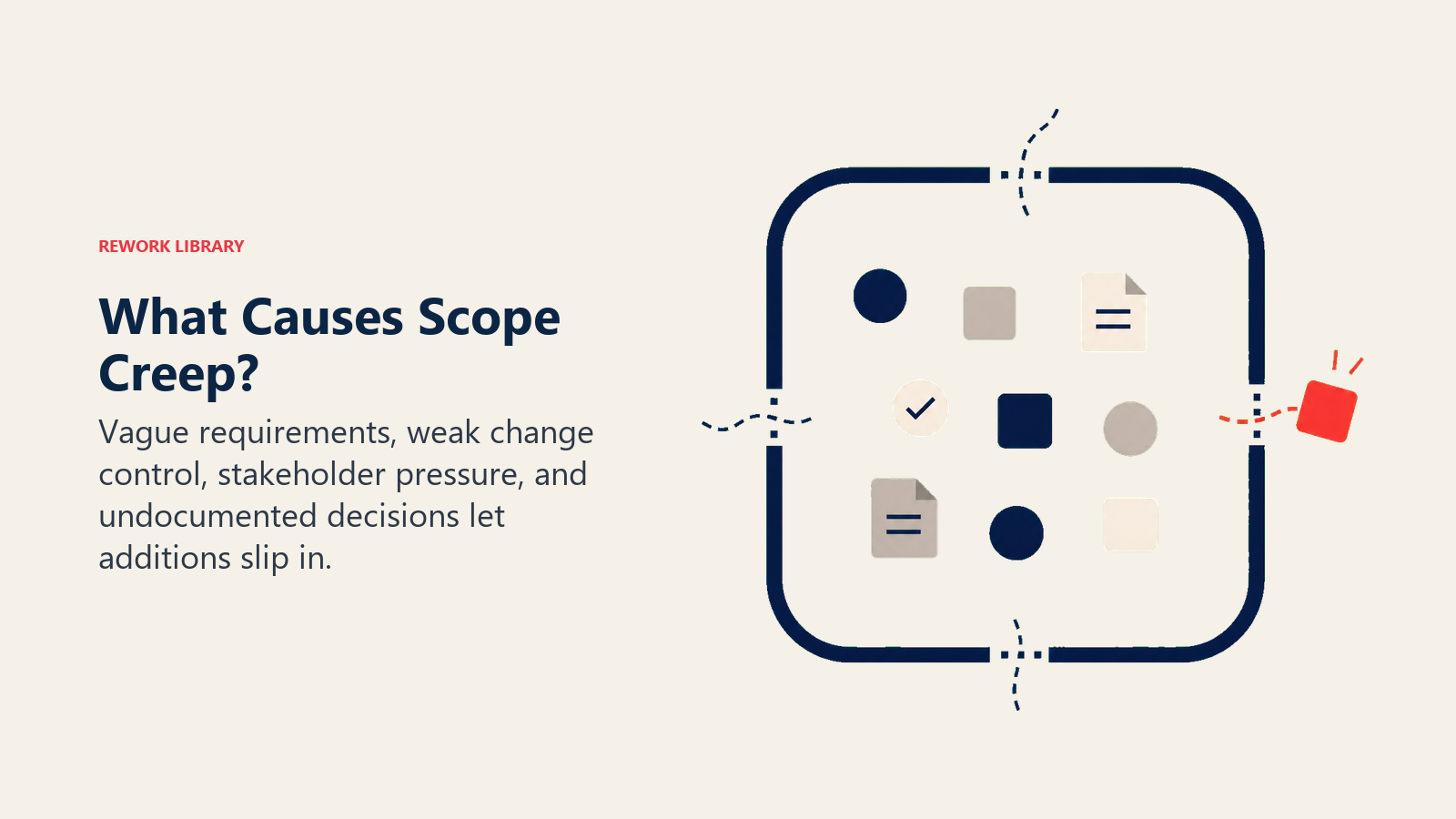
Vague initial requirements. When the project scope is defined in broad strokes rather than specific, measurable terms, there's room for interpretation. Every stakeholder reads the gap differently, and those different readings accumulate into unplanned work.
No formal change control process. If there's no clear mechanism for requesting and approving changes, requests land directly on the team. Without a process, the default answer tends to be "yes" because saying no feels obstructionist.
Stakeholder pressure. Sponsors and clients have authority, and teams often feel they can't push back. A request from a senior stakeholder gets treated as a directive rather than a change request that needs evaluation.
Scope not baselined in writing. Verbal agreements about what's in and out of scope are unreliable. When requirements aren't formally signed off and documented, it's impossible to distinguish an "addition" from something that was "always supposed to be there."
Poor stakeholder alignment at the start. When the people affected by the project aren't involved early in defining requirements, they bring new expectations later, often after significant work is already done.
Team members making local decisions. Developers and designers who identify a better approach sometimes implement improvements without checking whether it fits the scope. Each decision is well-reasoned on its own but adds up to unplanned work.
Inadequate use of a Work Breakdown Structure. Projects without a detailed work breakdown structure make it hard to see where new tasks fall relative to the original scope, so additions slip in unnoticed.
The cost of scope creep
The direct costs are visible on the budget: extra hours, extended contracts, additional tool licenses. But scope creep also carries indirect costs that are harder to measure.

Schedule slippage. Every unplanned task competes with planned work. When resources are finite, something has to give, and it's usually the delivery date.
Team morale erosion. Teams that see scope expand without a corresponding adjustment to expectations or resources get frustrated. They were asked to run a 10-kilometer race and find themselves halfway through a marathon with no warning.
Quality degradation. When scope expands but the deadline doesn't, teams cut corners to compensate. Testing gets compressed, documentation gets skipped, technical debt accumulates.
Stakeholder trust damage. A project that consistently misses dates trains stakeholders to distrust estimates. That credibility gap is hard to rebuild.
Opportunity cost. Every hour spent on unauthorized additions is an hour not spent on other prioritized work across the portfolio.
How to prevent scope creep
Define scope, secure sign-off, map work, control changes, prioritize trade-offs, and manage stakeholders.
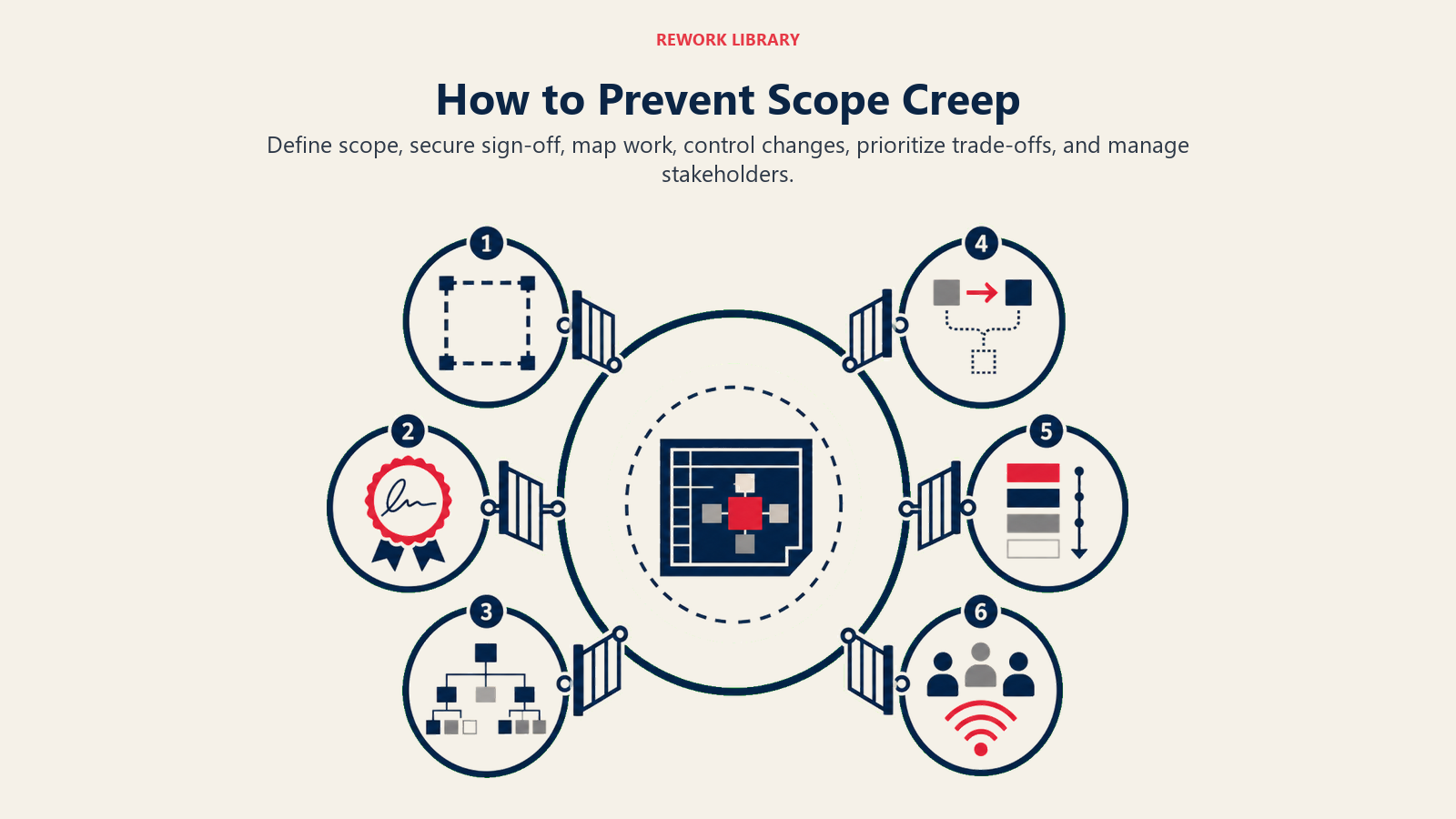
Step 1: Write a clear project scope statement
A project scope statement is the foundation of scope control. It documents, in plain language, what the project will deliver and, equally important, what it will not deliver. The "out of scope" section is not a formality. It's the primary defense against "but I assumed that was included."
The scope statement should be specific enough that a newcomer to the project can read it and know whether a given piece of work belongs in this project. Vague language invites interpretation; precise language closes the door.
Step 2: Get formal sign-off on requirements
Requirements need to be formally reviewed and signed off by the people who have authority over the project, typically the sponsor, key stakeholders, and the project manager. This isn't about bureaucracy. It's about creating a clear before/after line: anything in the agreed requirements is in scope, anything else goes through change control.
A requirements traceability matrix helps here. It maps each requirement to its business objective and then to the specific deliverables that fulfill it. When someone proposes an addition, you can ask: which approved requirement does this trace to?
Step 3: Build a Work Breakdown Structure
The work breakdown structure (WBS) decomposes the project into every discrete task and deliverable. When scope is broken down to that level of granularity, new requests have nowhere to hide. You can point to the WBS and ask where the proposed task fits. If it doesn't fit, it's new scope.
The WBS also makes estimation more reliable because it forces the team to think through what's actually involved before committing to a timeline.
Step 4: Implement a change control process
A change control process is the formal mechanism for evaluating and approving scope additions. Every request for a change, no matter how small, goes through the same steps: document the request, assess the impact on cost, schedule, and resources, present the trade-offs to the sponsor, get a decision in writing.
This process does two things. First, it makes the real cost of additions visible before they're accepted. Many "quick" additions look different when someone has to estimate their impact. Second, it gives the project manager a professional way to say no (or "yes, with these consequences") rather than just absorbing requests silently.
Step 5: Use MoSCoW prioritization for trade-off conversations
When stakeholders push for additions, MoSCoW prioritization gives you a shared language for the conversation. If the budget is fixed, every Must Have that gets added has to be funded by deprioritizing something else. This reframes the conversation from "can you fit this in?" to "what should we trade against this?"
It also helps during initial requirements gathering. Getting stakeholders to categorize requirements as Must/Should/Could/Won't before the project starts surfaces priorities and reduces the likelihood of late requests for things that were always important but never explicitly stated.
Step 6: Manage stakeholder expectations actively
A stakeholder analysis matrix identifies who has influence over the project and what their interests are. Stakeholders who aren't kept informed tend to generate scope creep: they ask for things because they don't know those things are already handled, or they escalate requests because they feel their needs aren't being considered.
Regular, proactive communication about progress, decisions, and trade-offs keeps stakeholders engaged without leaving information vacuums that breed informal requests. When stakeholders trust that the project is being managed well, they're less likely to insert themselves with unilateral asks.
Scope creep examples
Real scope creep shows up differently depending on the function and industry.
| Industry/Function | Original scope | What crept in |
|---|---|---|
| Software development | Build a customer login portal with email authentication | Stakeholder requests social sign-in, then a profile page, then a dashboard during development |
| Marketing campaign | Design and launch a 3-email nurture sequence | Sales team requests 2 additional emails for a different segment mid-production |
| Office renovation | Renovate two conference rooms | Facilities manager adds reception area painting after contracts are signed |
| ERP implementation | Configure core financial modules for one business unit | IT requests integration with three additional systems not in the original spec |
| Product launch | Launch product in one regional market | Leadership adds a second market 6 weeks before launch without adjusting the timeline |
The common thread in each case: the addition was framed as small or obvious, no one evaluated the impact on the baseline, and the team absorbed the work without a formal decision.
Best practices
Document everything in writing. If a stakeholder makes a verbal request and you discuss it, follow up with an email summarizing what was said and what was decided. Written records close the "I thought we agreed" loop.
Review the scope regularly. A brief scope review at each status meeting keeps the team anchored to what was agreed. It creates a natural moment to surface any tasks that have been added informally.
Empower the team to escalate. Team members who identify scope additions should know they're expected to flag them, not just absorb them. A culture where the team feels safe saying "that's not in scope, let's run it through change control" is far healthier than one where additions are quietly accommodated.
Communicate the cost of saying yes. When change requests come in, always attach an impact statement. "We can add this. It will add approximately 3 days and $X in resource cost, and will push the delivery date from June 10 to June 13. Do you want to proceed?" Visible consequences change behavior.
Resist gold plating. Coach the team to finish what was agreed before improving it. Improvements belong in the backlog and get evaluated like any other potential change.
Use a RACI matrix for change decisions. Ambiguity about who can approve a change is itself a source of scope creep. When the Responsible, Accountable, Consulted, and Informed roles are clear, requests route to the right person rather than bypassing the process.
Frequently Asked Questions about Scope Creep
What is the difference between scope creep and a legitimate scope change?
The difference is process. A scope change goes through formal review, gets evaluated for impact on cost, schedule, and resources, and requires explicit approval from the sponsor before any work begins. Scope creep bypasses that review. The work might be identical in either case, but a formal scope change updates the baseline and allocates budget; scope creep just adds work to an unchanged baseline.
Can scope creep ever be beneficial?
Occasionally, an informal addition genuinely improves the project outcome and the team has capacity to absorb it cleanly. But this is the exception, not the rule, and even in these cases it's worth running the addition through a lightweight change review to document the decision. Treating beneficial scope changes as exceptions to the rule erodes the discipline that keeps the process working.
How do you handle a stakeholder who keeps adding requests?
Redirect every request to the change control process and make the cost of each addition visible. Most stakeholders aren't trying to sabotage the project; they're optimizing for their own priorities without seeing the cumulative impact. When they see that each request costs time and money and has to be traded against existing priorities, the volume of informal requests tends to drop.
What is the project manager's role in preventing scope creep?
The project manager owns the scope baseline and is responsible for defending it. That means writing a tight scope statement, ensuring requirements are signed off, implementing change control, and proactively communicating with stakeholders. It also means coaching the team to escalate scope additions rather than absorb them, and giving the team political cover when they push back on informal requests.
When should you just say yes to a small request?
When the addition is truly trivial (a few minutes of work, zero risk to the schedule or budget), has no dependencies, and doesn't set a precedent. But document it, even informally. A pattern of small yeses is exactly how scope creep builds up, so keeping a record helps you see when the cumulative effect is becoming material. Every project will face requests to do more than what was agreed. That's normal. What separates projects that finish on time and on budget from ones that don't is rarely the absence of those requests. It's whether the team has the processes and habits to evaluate them honestly before saying yes.

Senior Operations & Growth Strategist
On this page
- What is scope creep?
- Scope creep vs gold plating vs scope change
- What causes scope creep?
- The cost of scope creep
- How to prevent scope creep
- Step 1: Write a clear project scope statement
- Step 2: Get formal sign-off on requirements
- Step 3: Build a Work Breakdown Structure
- Step 4: Implement a change control process
- Step 5: Use MoSCoW prioritization for trade-off conversations
- Step 6: Manage stakeholder expectations actively
- Scope creep examples
- Best practices