Change Control Process: Steps and Template for Projects
Turn this article into takeaways for your work.


Each assistant summarizes the article only for you and suggests best practices for your work.
Every project gets hit with change. The question isn't whether scope, budget, or timeline will shift, it's whether your team has a clear change control process to handle those shifts without losing track of what was agreed, who approved it, and why.
What is a change control process?
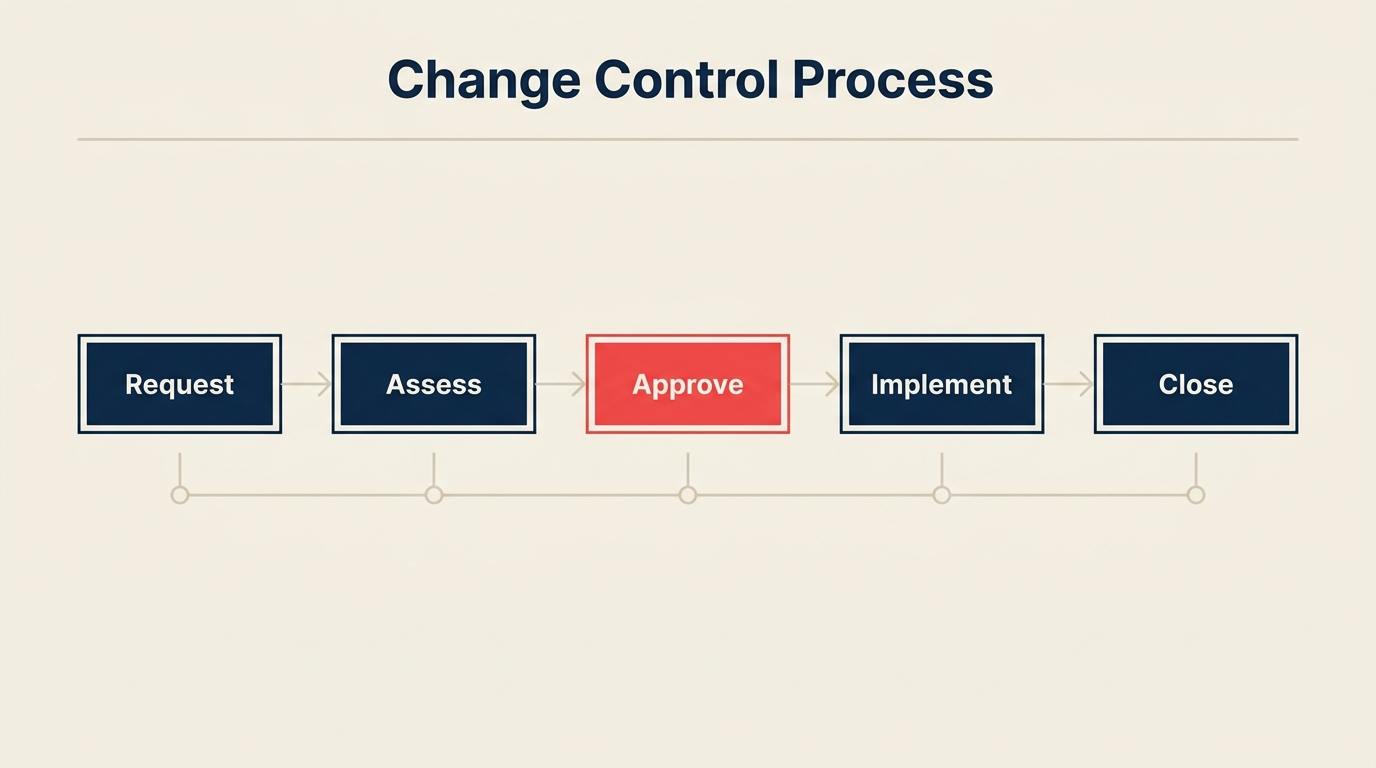
A change control process is a structured sequence of steps that a project team follows to submit, evaluate, approve or reject, implement, and document any proposed change to a project's scope, schedule, cost, or deliverables. It creates a controlled, auditable path from "someone wants something different" to "we've updated the plan and everyone knows about it."
Key facts
- Only 35% of projects meet their original goals when scope changes are handled informally, compared to 65% when a formal change process is in place (PMI Pulse of the Profession, 2024).
- The Standish CHAOS report consistently finds that scope creep is a contributing factor in more than half of challenged IT projects.
- PMBOK Guide 7th edition lists Perform Integrated Change Control as a core project management process, underscoring that no change should bypass assessment and formal approval.
A solid change control process protects the original project baseline while giving stakeholders a fair, transparent way to request changes that genuinely add value.
Change control vs change management
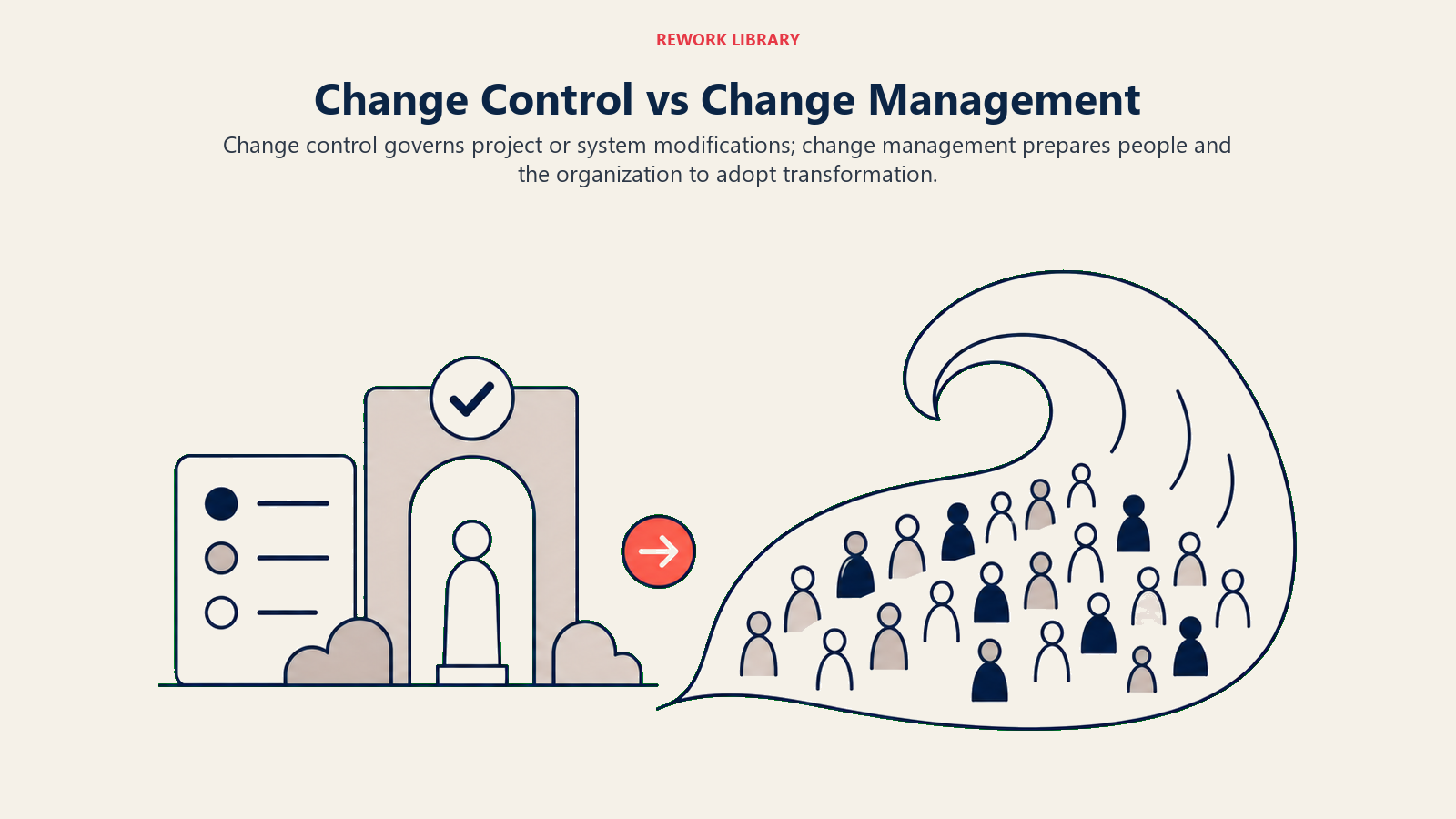
People often use these terms interchangeably, but they mean different things in a project context.
| Dimension | Change control | Change management |
|---|---|---|
| Scope | A specific project or system | An organization or transformation program |
| Focus | Controlling modifications to a defined baseline (scope, cost, schedule) | Managing the people side of change: adoption, resistance, communication |
| Owner | Project manager or Change Control Board | Change manager or HR / OD team |
| Key output | Approved or rejected change requests, updated project documents | Stakeholder engagement plans, training, communications |
| Timeframe | Active during project execution | Often spans years before and after a project |
| Typical tool | Change request log, issue register | Stakeholder impact assessment, ADKAR model |
Change control is a subset of change management. During a project, you need both: the formal process to control what gets built, and the people-side approach to make sure the team and stakeholders adapt smoothly.
Why the change control process matters
Skipping or shortcutting the change control process creates predictable problems.
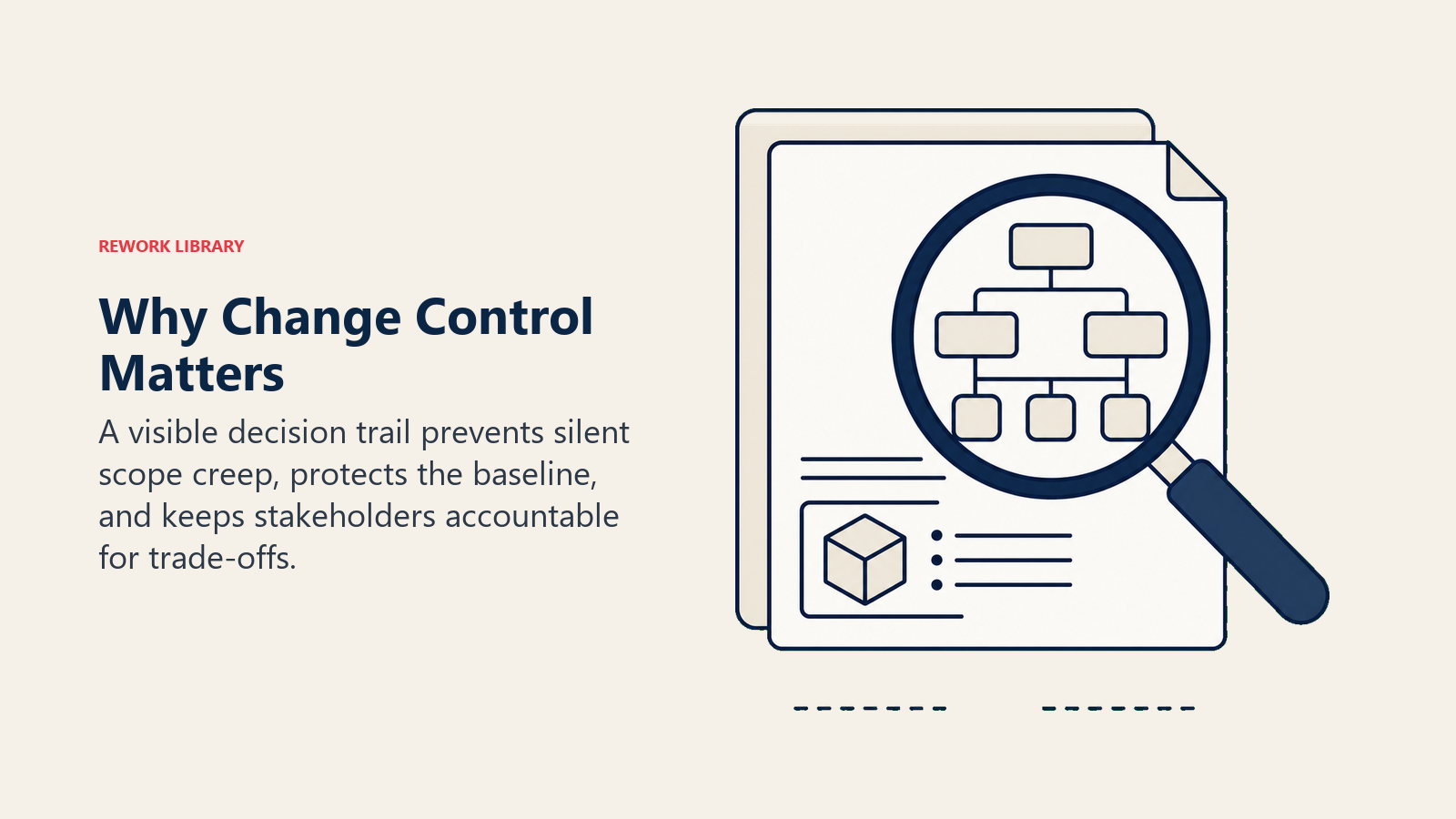
Scope creep goes undetected. When team members agree verbally to "just one small addition," that addition rarely stays small. And without a log, there's no way to trace when the project quietly grew beyond its original budget. See how this plays out in detail at /libraries/project-management/scope-creep.
Accountability disappears. If a change causes the schedule to slip by three weeks, who approved it? Without written records, finger-pointing replaces problem-solving.
Cost estimates fall apart. Each unlogged change can add hours that aren't covered by the budget. Multiply that across a six-month project and the overrun becomes significant.
Relationships suffer. Clients and sponsors who feel changes are being made without their input lose trust quickly.
A well-run change control process does the opposite: it gives stakeholders confidence that their requests are heard, evaluated fairly, and handled consistently regardless of who's asking.
Common change control mistakes
Even teams with a formal process make avoidable errors.
1. Treating every request as urgent. Not all changes need a decision by tomorrow. Categorize requests by priority so the team doesn't drop everything for low-impact asks.
2. Skipping the impact assessment. Approving a scope change without checking its effect on the schedule and budget is the single fastest way to blow both.
3. Routing changes to the wrong approver. Minor documentation tweaks don't need a full Change Control Board meeting. Define approval thresholds in advance so small changes move quickly and large ones get proper scrutiny.
4. Forgetting to update the project plan. A change is only complete when the project charter, schedule, and budget baseline reflect the approved modification. Lots of teams approve changes and then forget to file the paperwork.
5. Closing the loop verbally. Telling the requester "yes, we're doing it" is not enough. Send a written confirmation so there's a record of when the change was approved and what was agreed.
6. No consistent form. When everyone submits change requests differently (email, Slack, sticky note), reviewers waste time gathering basic information before they can even begin an assessment.
How to build a change control process
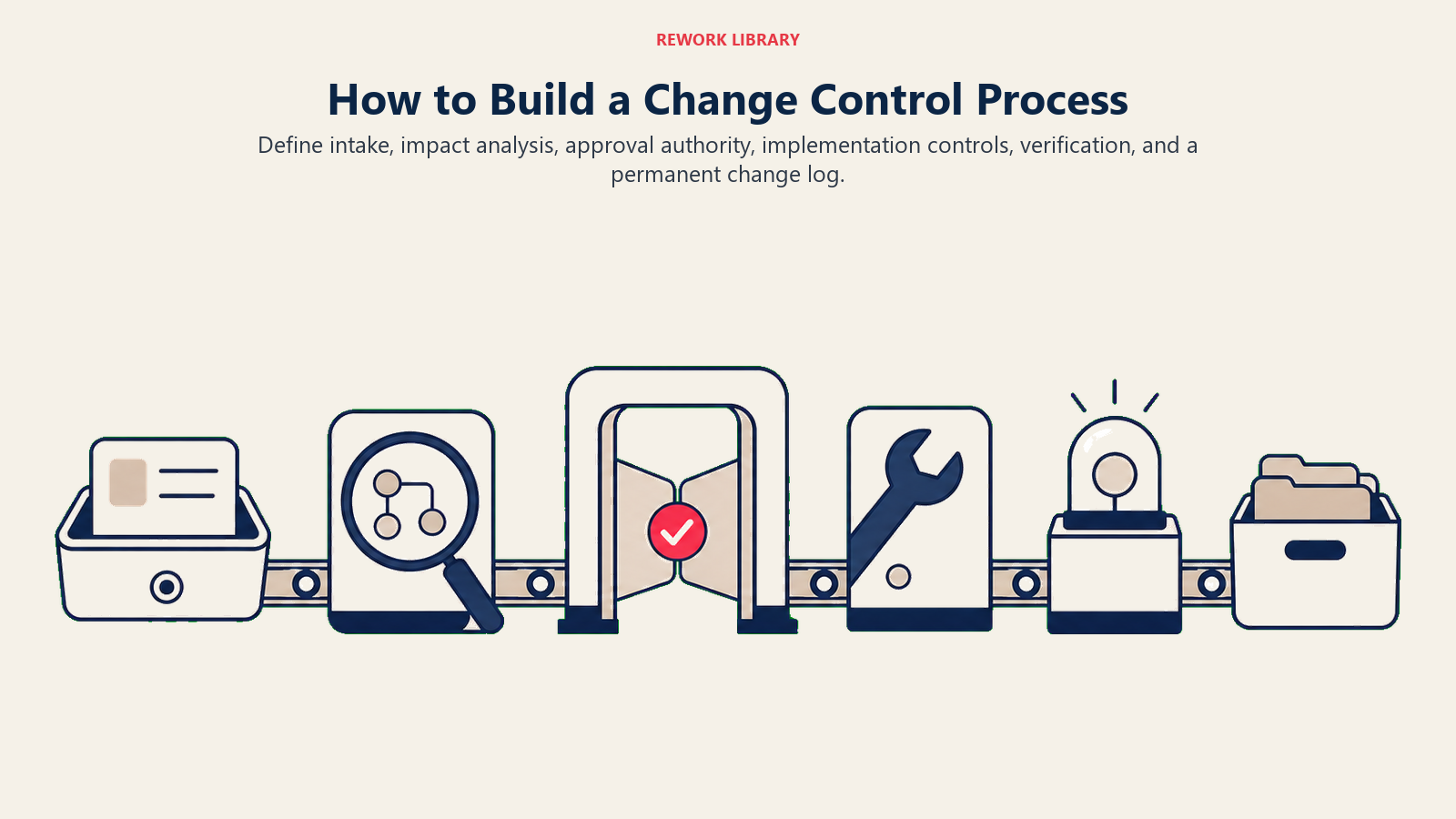
The steps below apply to most project types. Adapt the number of reviewers and the approval thresholds to fit your team's size and risk tolerance.
Step 1: Submit a change request
Anyone on the project or stakeholder group should be able to submit a change request using a standard form (see the template section below). The form captures what's being requested, why, and what happens if it isn't done. Requiring a written form filters out low-thought requests and gives reviewers a consistent starting point.
Step 2: Log it in the change register
The project manager logs every incoming request in a central change register, regardless of whether it will be approved. Each entry gets a unique ID, a received date, a status, and an owner. This log feeds into the RAID log as a source of project issues and decisions.
Step 3: Assess the impact
This is the most important step. The project manager, with input from relevant leads, assesses how the proposed change affects:
- Scope: What new work is added or removed?
- Schedule: How many days does it add or subtract?
- Cost: What is the budget impact?
- Resources: Are additional people or tools needed?
- Risk: Does the change introduce new risks or resolve existing ones?
- Quality: Does it affect the deliverable standard?
Document the assessment in writing. This becomes the basis for the approval decision.
Step 4: Review and approve via the Change Control Board
A Change Control Board (CCB) is a group, often the project manager, sponsor, and key technical leads, that reviews assessed change requests and issues a formal decision: approved, rejected, or deferred. For smaller projects, this might be a single approver rather than a committee.
The CCB's decision, along with the rationale, goes into the change register. Rejected requests are documented just as carefully as approved ones, because "why we didn't do that" is often valuable context later.
Step 5: Implement and verify
Once approved, the change is assigned to the appropriate team member with a target completion date. The project plan, communication plan, and relevant documents are updated to reflect the change. Stakeholders are notified according to the communication plan.
After implementation, the project manager or a designated reviewer confirms the change was executed as approved, not an approximation of it.
Step 6: Close the change request
Once implementation is verified, the change request is marked closed in the register. The final status, actual impact versus estimated impact, and any lessons learned are recorded. This close-out data improves future assessments.
A well-maintained change register connects directly to integrated change control, which is the broader PMBOK process that governs how changes flow across the entire project lifecycle.
Change request form template
A standard form is the backbone of the change control process. Here's the set of fields that appear in most effective change request forms.
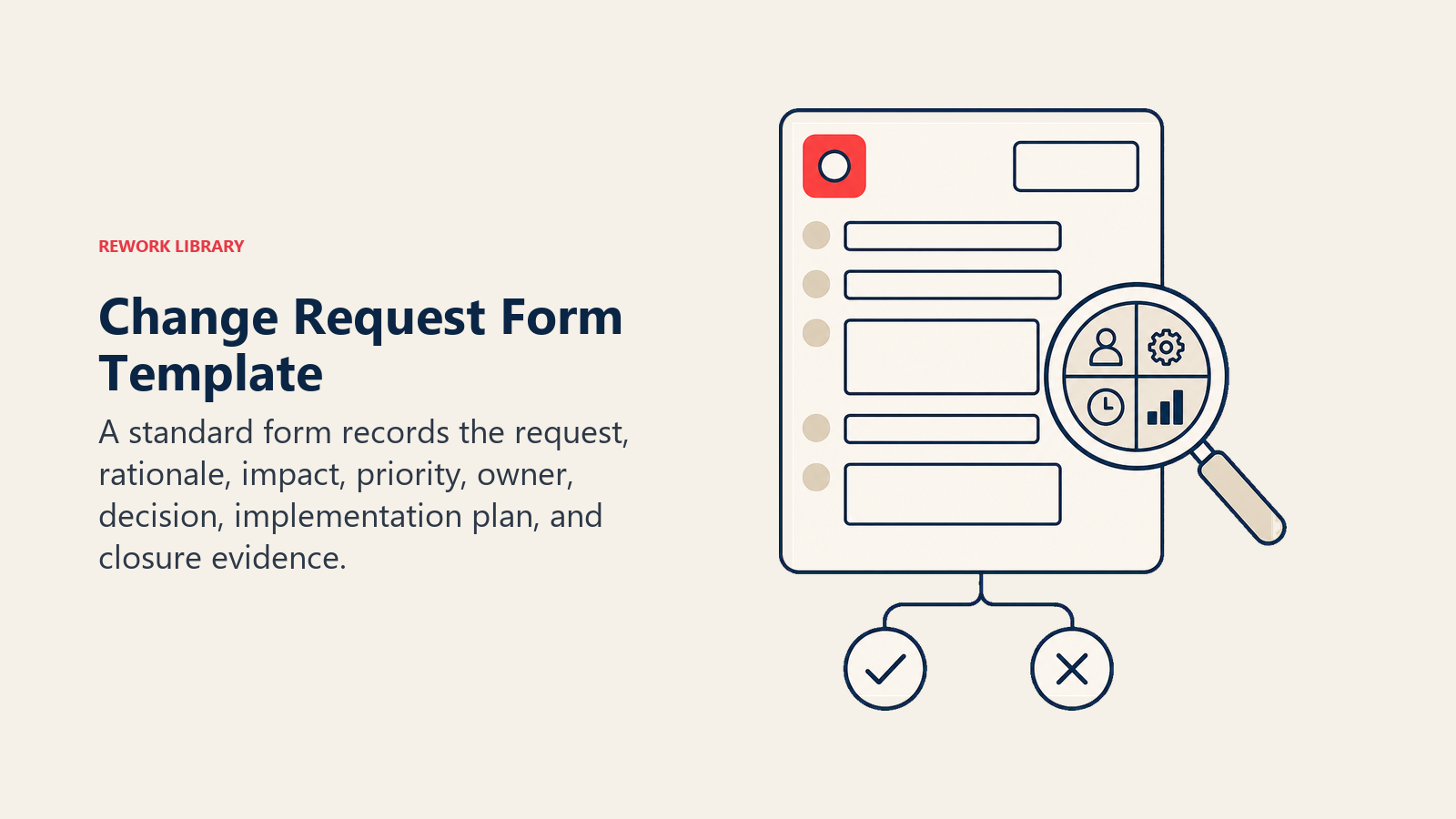
| Field | Description |
|---|---|
| Request ID | Unique identifier assigned on logging (e.g., CR-042) |
| Request date | Date the form was submitted |
| Requested by | Name and role of the person submitting |
| Project name / ID | Which project the request applies to |
| Change title | Short description (one line) |
| Change description | Full explanation of what is being requested and why |
| Change category | Scope / schedule / cost / resource / quality / other |
| Priority | High / medium / low |
| Business justification | The reason this change is necessary or beneficial |
| Impact if not approved | What happens if the request is rejected |
| Scope impact | New or removed deliverables |
| Schedule impact | Days added or removed; revised end date |
| Cost impact | Estimated budget change (+ / -) |
| Resource impact | Additional people, tools, or vendors required |
| Risk impact | New risks introduced or mitigated |
| Attachments | Supporting documents, mockups, or estimates |
| CCB decision | Approved / rejected / deferred + date |
| Decision rationale | Brief explanation from the approver |
| Implementation owner | Person responsible for executing the change |
| Target completion date | When the implementation should be done |
| Actual completion date | Filled in after close-out |
| Status | Open / in review / approved / rejected / implemented / closed |
Keep this form in a shared location so anyone on the project can find and submit it without hunting for it. Many teams add it as a tab in their project scope statement document or their project management tool.
Best practices
Define thresholds before the project starts. Agree upfront on what size of change goes to the full CCB versus what the project manager can approve alone. A common split: changes under a set dollar or day threshold go to the PM; anything above goes to the CCB. Document these thresholds in the project charter.
Process every request, even rejected ones. Logging rejections matters. It shows stakeholders their request was considered, and it creates a record that prevents the same request from resurfacing three weeks later under a different name.
Keep a live change register. The register only works if it's updated immediately. A stale register breeds confusion about what's been approved and what's still pending.
Communicate decisions promptly. Requesters shouldn't have to chase for an answer. Set a service level agreement: the CCB reviews standard requests within five business days, for example, and the project manager sends written confirmation within 24 hours of a decision.
Review the change log at project retrospectives. Patterns emerge over time. If you approved 14 scope changes in month two, ask why. Was the original scope unclear? Were stakeholders consulted properly at the start? These patterns inform how you write the project scope statement on the next project.
Tie the change register to your RAID log. Changes often surface risks and issues. When a change introduces a new risk, it should appear in the RAID log within the same update cycle.
Frequently Asked Questions about Change Control Process
What is the purpose of a Change Control Board?
The CCB exists so that approval decisions are made consistently by the right people, rather than by whoever happens to be in the room. It brings together the stakeholders who have the authority, technical knowledge, and business context to make an informed call on whether a change is worth its cost.
How is a change request different from an issue?
A change request is a proactive ask to modify something about the project baseline, scope, schedule, budget, or deliverables. An issue is something that has already gone wrong and needs to be resolved. Issues sometimes trigger change requests (for example, a technical problem that requires a scope change to fix), but they're tracked separately.
Can a change request be approved verbally?
Not in a well-run process. Even if the CCB discusses and decides verbally, the decision needs to be documented in writing before anyone acts on it. Verbal approvals are the fastest route to "I don't remember agreeing to that" disputes.
Who can submit a change request?
Most projects accept requests from any stakeholder: team members, clients, sponsors, and vendors. The form should be accessible to all of them. The CCB, not the requester's seniority, determines whether the change is approved.
How do we handle urgent changes?
Define an expedited path in advance. For genuinely urgent changes, a single designated approver (often the sponsor) can give conditional approval while the full impact assessment catches up. But the written form and the register entry still have to happen; they just happen faster. Projects that treat change as the exception end up chasing scope creep. Projects that build a clear change control process into the plan from day one stay in control, keep stakeholders informed, and deliver what was actually agreed, not a blurry approximation of it.

Senior Operations & Growth Strategist
On this page
- What is a change control process?
- Change control vs change management
- Why the change control process matters
- Common change control mistakes
- How to build a change control process
- Step 1: Submit a change request
- Step 2: Log it in the change register
- Step 3: Assess the impact
- Step 4: Review and approve via the Change Control Board
- Step 5: Implement and verify
- Step 6: Close the change request
- Change request form template
- Best practices