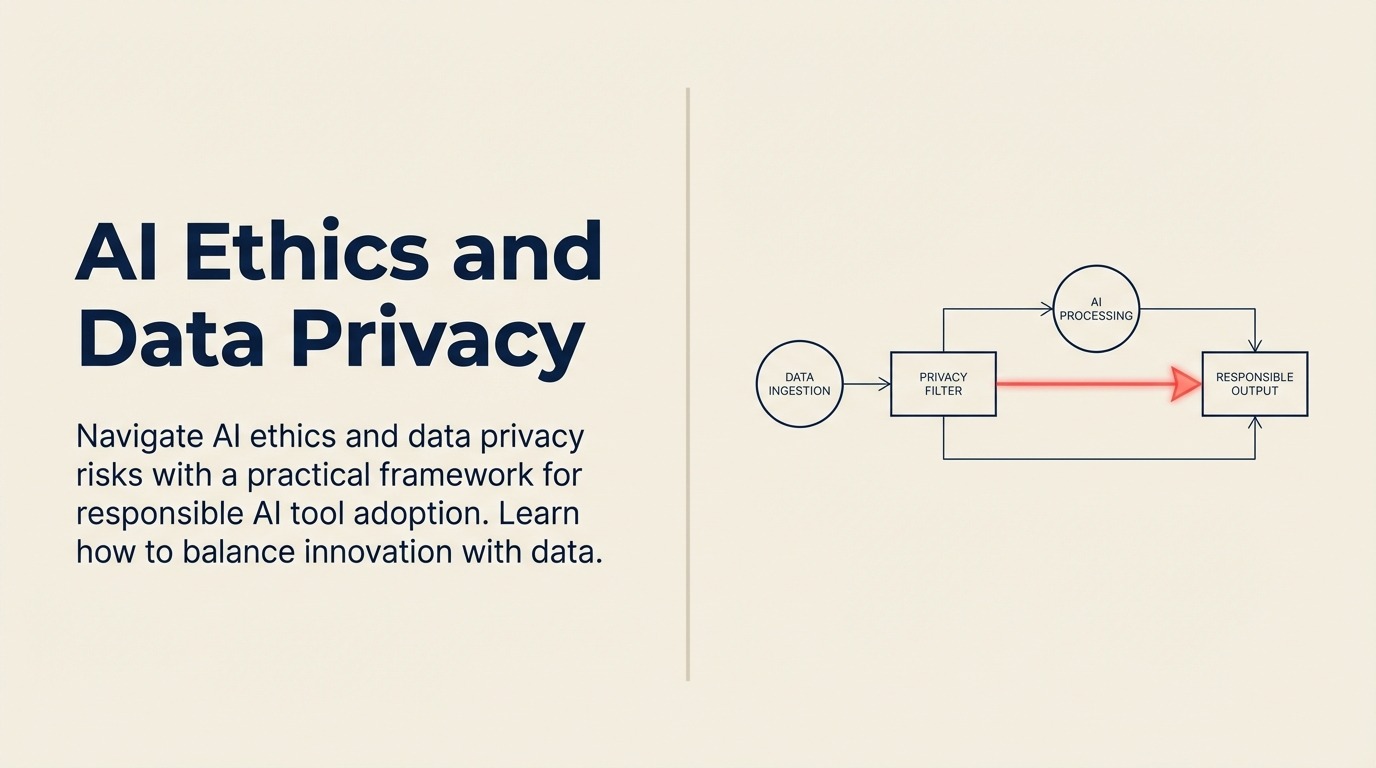
AI Ethics and Data Privacy: Responsible AI Productivity Tool Adoption
Turn this article into takeaways for your work.


Each assistant summarizes the article only for you and suggests best practices for your work.
The average cost of an AI-related data breach hit $4.3 million in 2026. That's 15% higher than traditional breaches because AI tools often touch more sensitive data and create new exposure points that traditional security doesn't address. According to IBM's Cost of a Data Breach Report, organizations with mature AI security practices experience significantly lower breach costs and faster containment times.
Most companies approach AI tool adoption focused entirely on capabilities and ROI. They evaluate what the tools can do and what time they'll save. Security and privacy become afterthoughts - boxes to check with legal and IT before final approval.
That's backwards. For AI tools specifically, privacy and ethics aren't just compliance requirements. They're fundamental to whether the tools will work in your environment and whether they'll create risks that outweigh their value. These considerations should be central to your AI tool selection framework from day one.
The companies that get this right build responsible AI programs before they scale AI adoption. They establish clear principles, governance structures, and policies that let them move fast while staying safe.
Core Ethical Principles for Business AI
Before diving into specific risks and controls, understand the four ethical principles that should guide all AI tool decisions. These aren't abstract philosophy - they're practical guideposts that prevent problems.
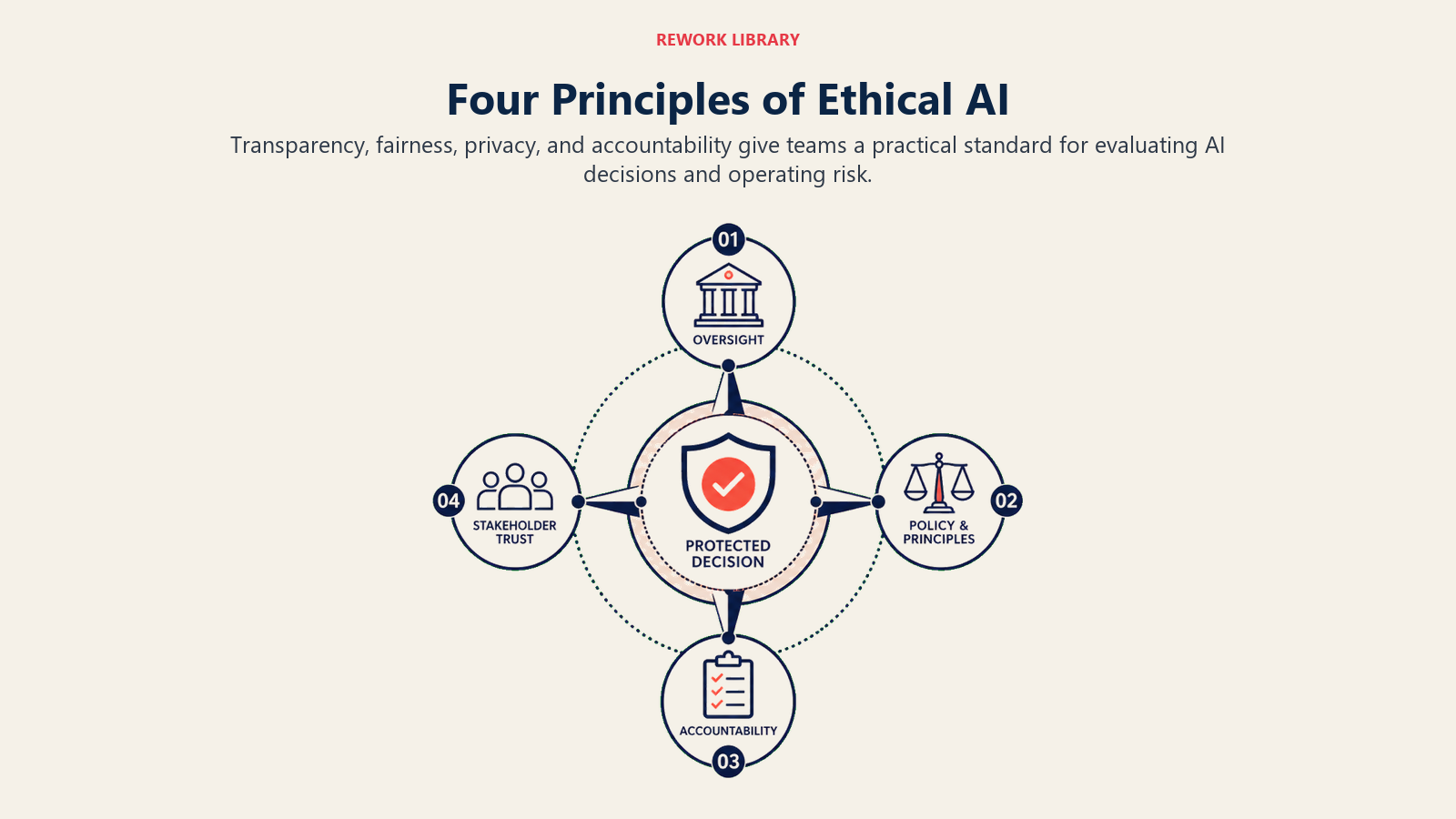
Principle 1: Transparency and Explainability
Users should understand when they're interacting with AI and what the AI is doing with their data. Executives should understand how AI tools make decisions that affect business outcomes.
This doesn't mean explaining every algorithm. It means:
- Disclosing when content is AI-generated
- Explaining what data the AI uses
- Providing reasoning for AI recommendations
- Acknowledging uncertainty in AI outputs
Why It Matters: A marketing team used AI content generation tools to create customer emails without disclosure. Recipients felt deceived when they realized the personal-seeming messages were automated. The resulting backlash cost more than the tool saved.
Principle 2: Fairness and Bias Mitigation
AI tools learn from data, and data reflects historical biases. Tools can perpetuate or amplify discrimination in hiring, lending, customer service, and other business processes.
What Fairness Requires:
- Auditing AI outputs for demographic disparities
- Testing tools with diverse data sets
- Monitoring for drift in AI behavior over time
- Having humans review high-stakes decisions
Real Example: A recruiting tool trained on historical hiring data gave lower scores to candidates from certain universities because past hires from those schools had higher attrition. The tool wasn't biased against those schools - it was learning a correlation that wasn't causal. But the effect was discriminatory regardless of intent.
Principle 3: Privacy and Data Protection
AI tools often need access to sensitive business and customer data to function effectively. That access creates risk that must be managed deliberately.
Privacy Requirements:
- Minimize data collection to what's actually needed
- Protect data in transit and at rest
- Control who can access what data
- Enable deletion when data retention isn't required
- Obtain appropriate consent for data use
Principle 4: Accountability and Governance
Someone must be responsible for how AI tools are used and what outcomes they produce. Accountability can't be diffused to "the algorithm."
Governance Essentials:
- Clear ownership for AI tool decisions
- Approval processes for new tools and use cases
- Regular audits of AI tool usage and outcomes
- Incident response plans for when things go wrong
- Documentation of decisions and rationale
Data Privacy Risks Specific to AI Tools
AI tools create privacy risks that traditional software doesn't. Understanding these risks helps you evaluate and mitigate them before they become breaches.
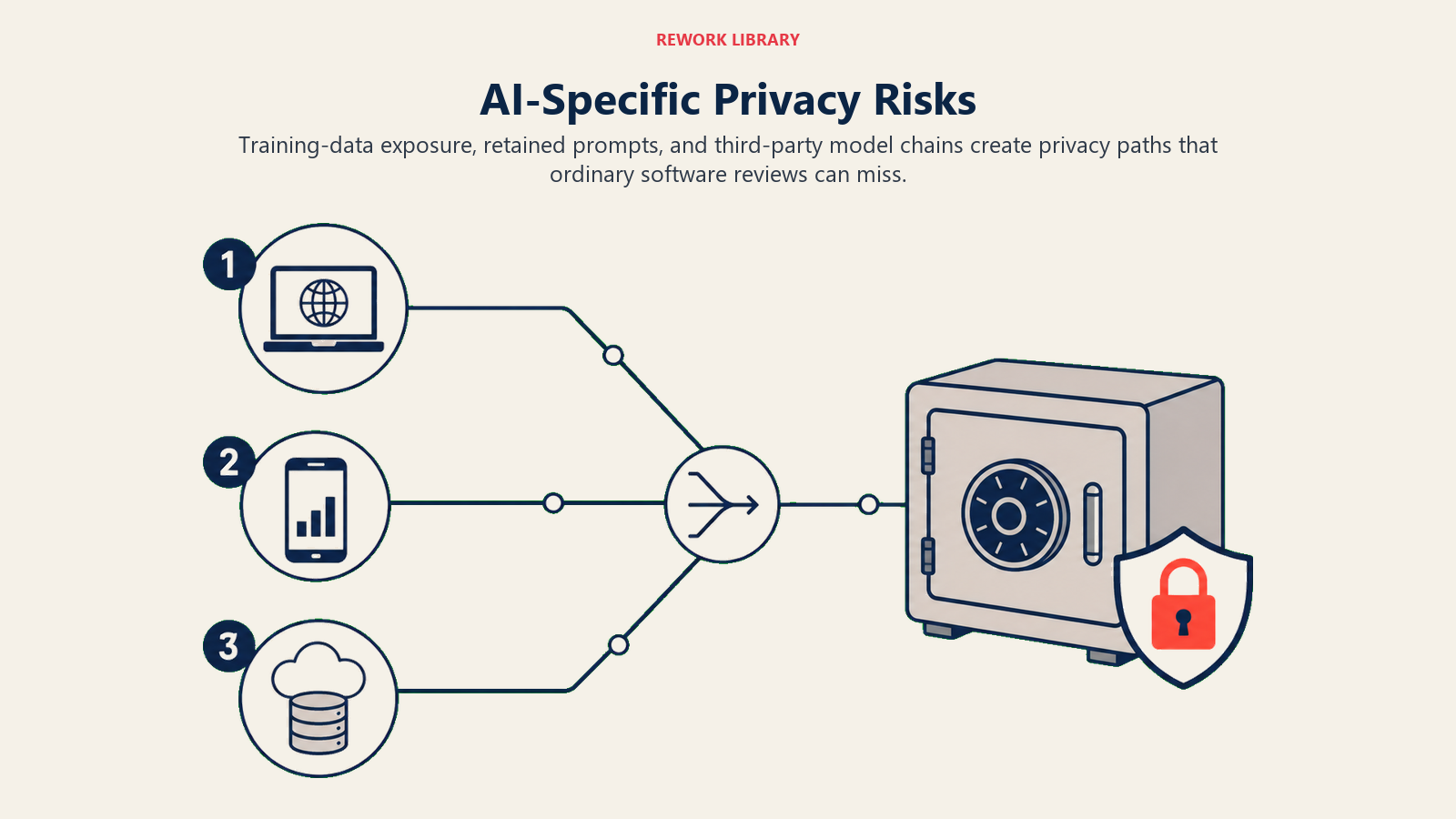
Risk 1: Training Data Exposure
Some AI models remember specific examples from their training data. If sensitive information was in that training data, it could be exposed through carefully crafted queries.
The Problem: A legal team used an AI research assistant trained on millions of documents. An external party discovered they could extract confidential client information from case documents that were part of the training set.
Mitigation:
- Use AI tools that guarantee data segregation
- Prefer tools trained only on public or licensed data
- Never input highly sensitive data into public AI tools
- Audit what data vendors use for training
Risk 2: Prompt Leakage and Data Retention
When you send a prompt to an AI tool, where does that data go? How long is it stored? Who can access it? Many users don't realize their prompts are logged and retained.
The Problem: Sales reps used a public AI tool to draft customer proposals, including pricing strategy and confidential customer information. The vendor retained all prompts for model improvement. Competitors using the same tool potentially could access patterns from those prompts.
Mitigation:
- Review data retention policies before adoption
- Use business versions with guaranteed data privacy
- Implement DLP tools to detect sensitive data in prompts
- Train users on what data is safe to share with AI tools
Risk 3: Third-Party Model Risks
Many AI tools use underlying models from third parties (OpenAI, Anthropic, Google). Your data passes through multiple systems, each with its own security posture.
The Problem: A financial services firm used an AI writing assistant that relied on a third-party API. The API provider had a security incident. Even though the writing assistant vendor had strong security, customer data was exposed through the model provider.
Mitigation:
- Map complete data flow including all third parties
- Evaluate security of entire chain, not just direct vendor
- Use enterprise agreements with contractual protections
- Consider on-premise or private cloud deployments for sensitive use cases
Risk 4: Cross-Border Data Transfer
AI model processing often happens in centralized data centers, frequently in the US. This creates compliance issues for companies operating under GDPR, CCPA, or industry-specific regulations.
The Problem: A European company used an AI customer service tool. Customer personal data was processed on US servers. This violated GDPR data residency requirements, resulting in regulatory action and fines.
Mitigation:
- Verify where data is processed, not just where it's stored
- Use tools with regional data centers when required
- Implement Standard Contractual Clauses or equivalent protections
- Conduct Data Protection Impact Assessments for high-risk processing
Regulatory Compliance Framework
AI tool adoption isn't optional - it's competitively necessary. But it must happen within regulatory boundaries that are evolving rapidly.
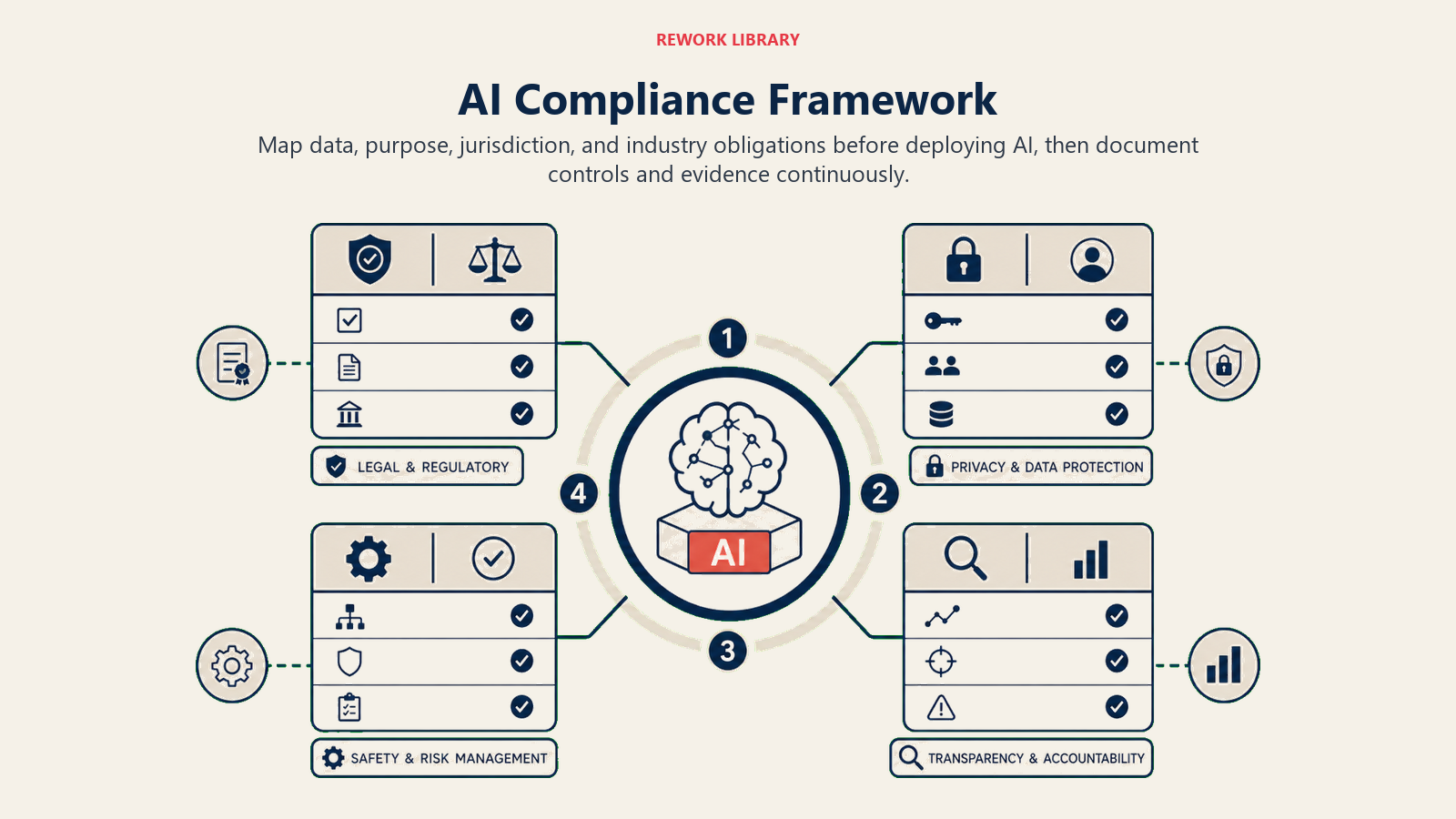
GDPR Requirements for EU Operations
The General Data Protection Regulation (GDPR) applies to any company processing personal data of EU residents. Key requirements for AI tools:
Lawful Basis for Processing: You need a legal basis to process personal data with AI tools. Legitimate interest often works for employee productivity tools. Customer-facing AI usually requires consent or contractual necessity.
Data Minimization: Only process data that's necessary for the specific purpose. Don't feed entire customer databases into AI tools when you only need specific fields.
Right to Explanation: When AI makes decisions that significantly affect individuals (hiring, credit, healthcare), you must be able to explain how the decision was made.
Data Subject Rights: Individuals can request copies of their data, corrections, or deletion. Your AI tools must support these rights - which can be difficult if data is embedded in training sets.
CCPA and US State Privacy Laws
The California Consumer Privacy Act and similar laws in other states create requirements for businesses handling California residents' data:
Disclosure Requirements: You must disclose what personal information you collect and how it's used. This includes AI processing purposes.
Opt-Out Rights: Consumers can opt out of having their data sold or shared. Some interpretations consider AI model training as "sharing" data.
Automated Decision-Making: California residents have the right to opt out of automated profiling that produces legal or similarly significant effects.
Industry-Specific Regulations
Certain industries face additional AI-related requirements:
HIPAA (Healthcare): Protected health information can only be processed by Business Associates with appropriate agreements. Most public AI tools don't qualify. Healthcare AI tools must be specifically HIPAA-compliant.
FINRA and Banking Regulations: Financial services AI must meet recordkeeping and supervision requirements. All AI-generated communications must be logged and reviewable.
SOX (Public Companies): AI tools that affect financial reporting must have appropriate controls. Audit trails must exist for AI-generated financial data.
Emerging AI-Specific Regulations
Governments worldwide are developing AI-specific regulations:
EU AI Act: Creates risk categories for AI systems with stricter requirements for high-risk applications (hiring, credit decisions, law enforcement). Most productivity AI falls into lower-risk categories but still faces transparency requirements. Learn more at the European Commission's AI Act page.
US Executive Order on AI: Establishes safety and security standards for AI systems, particularly around privacy-preserving techniques and discriminatory outcomes.
State-Level AI Laws: Several US states have passed or are considering AI-specific laws addressing algorithmic discrimination, transparency, and accountability.
What This Means: The regulatory landscape is actively changing. Build compliance programs that can adapt rather than meeting only current requirements. Ensure your AI security and compliance approach remains current with evolving regulations.
Vendor Security Assessment
Not all AI tool vendors have equivalent security postures. Systematic vendor assessment prevents choosing tools that create unacceptable risk.
Critical Security Questions for Every Vendor
Data Handling Practices:
- Is customer data segregated from other customers?
- Is customer data ever used to train models?
- Can we opt out of any data use beyond direct service provision?
- How long is data retained?
- What's the process for data deletion?
Encryption and Access Controls:
- Is data encrypted in transit (TLS 1.3 or better)?
- Is data encrypted at rest?
- Who has access to customer data internally?
- How are privileged access and credentials managed?
- Is multi-factor authentication required for all access?
Compliance Certifications:
- SOC 2 Type II (security controls audited annually)
- ISO 27001 (information security management)
- ISO 27701 (privacy management)
- Industry-specific certifications (HITRUST for healthcare, PCI DSS for payment data)
Security Practices:
- Frequency of security testing (penetration tests, vulnerability scans)
- Vulnerability disclosure and patching timeline
- Third-party security audits
- Security training for employees
- Incident history and response
Data Residency Options:
- Which geographic regions can process and store data?
- Can we specify data residency requirements?
- Does the vendor use sub-processors in other regions?
- How are cross-border transfers handled?
Red Flags That Should Stop Procurement
Some vendor responses should end evaluation immediately:
- Refusing to provide security documentation
- No SOC 2 or equivalent certification
- History of undisclosed security incidents
- Vague answers about data usage rights
- No option for data residency controls
- Using customer data for training without opt-out
Internal Governance Structure
External vendor security is necessary but insufficient. Strong internal governance prevents misuse even of secure tools.
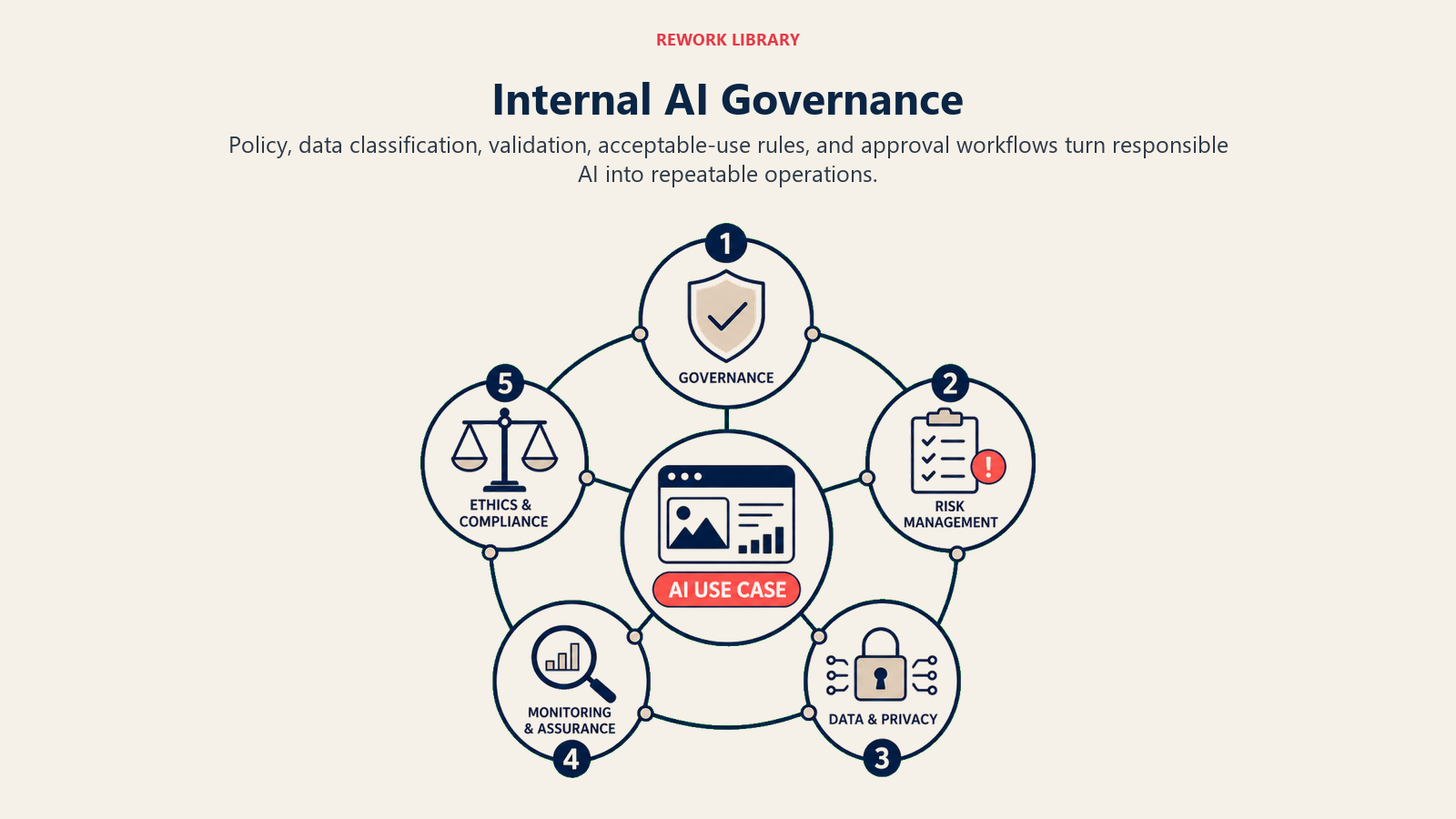
AI Usage Policies
Every organization needs clear policies covering:
Approved Use Cases: What can AI tools be used for? Categories might include:
- Approved: Internal documentation, draft content creation, data analysis
- Requires Approval: Customer-facing content, decision support
- Prohibited: Processing confidential data, making hiring decisions without human review
Data Classification:
- What data can be used with AI tools?
- How do users identify sensitive data?
- What happens if sensitive data is accidentally entered?
Output Validation:
- All AI outputs must be reviewed before use
- High-stakes decisions require human approval
- AI-generated content must be disclosed when appropriate
Acceptable Use Guidelines
Policies set boundaries. Guidelines help users work effectively within them.
Good Examples:
- Do use AI for brainstorming and first drafts
- Do cite when using AI to generate content
- Do review AI outputs for accuracy and bias
- Do report concerns about AI tool behavior
Bad Examples:
- Don't paste customer contracts into public AI tools
- Don't treat AI recommendations as authoritative without verification
- Don't use AI to make final decisions on hiring or performance reviews
- Don't share AI tools credentials or outputs with unauthorized parties
Approval Workflows
Not all AI tool adoption should require the same approval level:
Low Risk (Manager Approval):
- Tools used only for internal work
- Processing non-sensitive data
- Well-established vendors with strong security
Medium Risk (IT + Legal Approval):
- Tools processing customer data
- Integration with core business systems
- New vendors without extensive track records
High Risk (Executive + Committee Approval):
- Tools making or influencing decisions about people
- Processing highly sensitive or regulated data
- Novel use cases without industry precedent
Monitoring and Auditing
Policies don't enforce themselves. Regular monitoring catches problems early:
What to Monitor:
- Which AI tools are being used (shadow IT detection)
- What data is being sent to AI tools (DLP alerts)
- How frequently tools are used and by whom
- Support tickets and incident reports related to AI tools
Track these metrics alongside your broader AI productivity ROI metrics to ensure governance doesn't hinder value delivery.
Audit Activities:
- Quarterly reviews of AI tool inventory
- Annual vendor security reassessment
- Random sampling of AI-generated outputs for quality and compliance
- User surveys on understanding of policies
Building Responsible AI Culture Through Training
The best policies fail if employees don't understand them or why they matter. Training turns compliance from a checkbox into a capability.
Training Program Essentials
For All Employees:
- What AI tools are approved and how to use them
- What data can and cannot be used with AI
- How to recognize and report problems
- Why AI ethics and privacy matter
For Power Users:
- Advanced prompt engineering within policy boundaries
- Output quality evaluation
- Bias detection and mitigation
- When to escalate concerns
For Managers:
- Approving appropriate AI tool requests
- Monitoring team usage for compliance
- Supporting employees in responsible use
- Modeling good AI usage behaviors
For Executives:
- AI risk landscape and mitigation strategies
- Governance requirements and accountability
- Strategic AI decisions balancing opportunity and risk
- Board-level AI reporting and oversight
Training Delivery
One-time training doesn't work. Effective AI ethics training is ongoing:
- Initial onboarding module (30-45 minutes)
- Quarterly refreshers on new policies or tools (15 minutes)
- Just-in-time guidance when adopting new tools
- Examples and case studies from your own organization
- Easy-to-access reference materials and decision trees
Incident Response: When AI Tools Expose Sensitive Data
Despite best efforts, incidents will happen. Response quality determines whether an incident becomes a crisis.
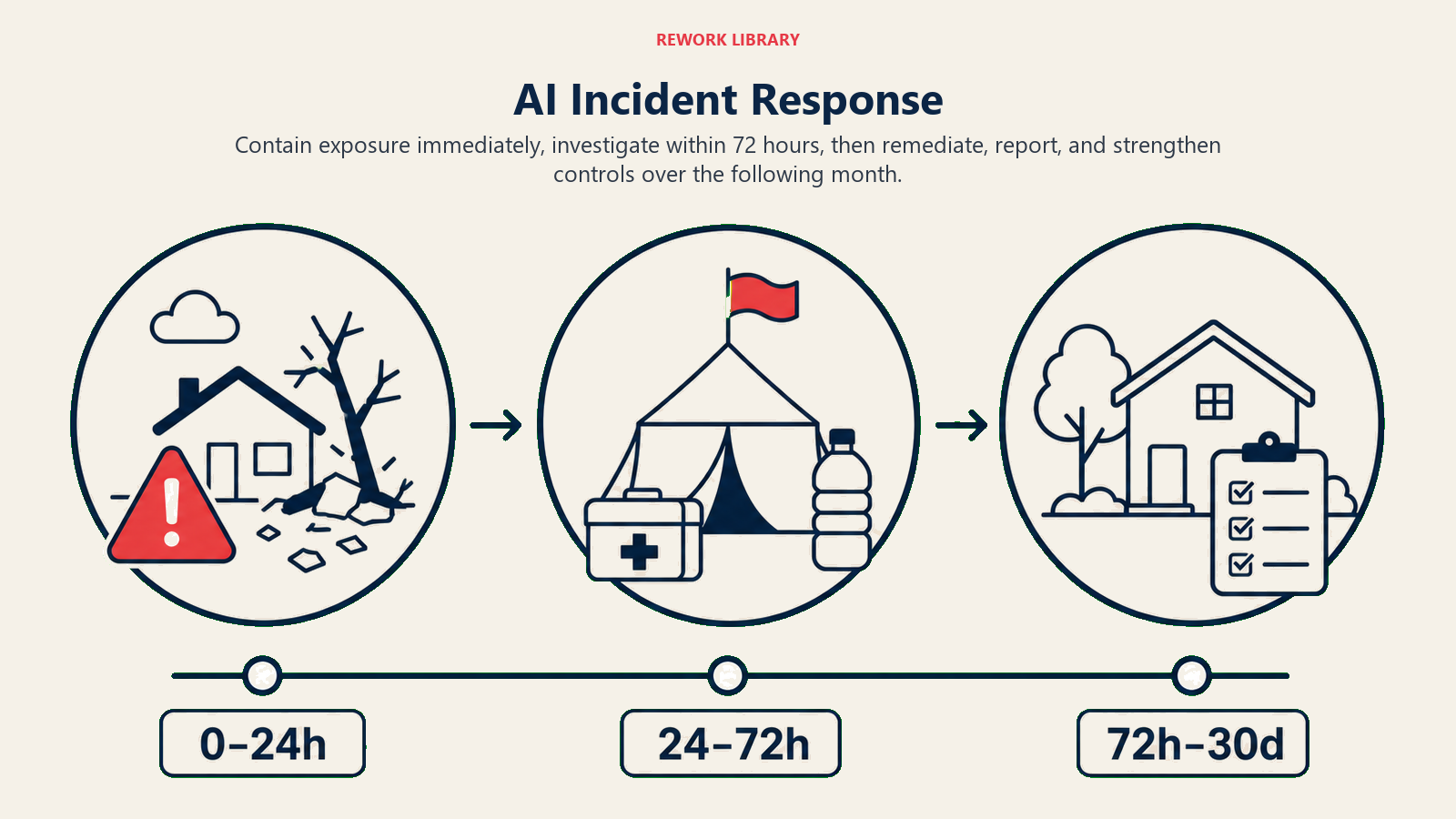
Immediate Response (0-24 Hours)
Contain the Exposure:
- Disable affected AI tool access if necessary
- Identify what data was exposed
- Determine scope of exposure (who saw it, where it went)
Notify Stakeholders:
- Inform internal legal and compliance teams
- Alert affected business units
- Prepare communication for affected individuals if required
Preserve Evidence:
- Log files and audit trails
- Screenshots of problematic outputs
- Timeline of events and actions taken
Investigation (24-72 Hours)
Root Cause Analysis:
- How did the incident occur?
- What controls failed or were bypassed?
- Were policies violated or were policies insufficient?
Impact Assessment:
- How many individuals affected?
- What sensitivity level of data was exposed?
- What are potential harms to affected individuals?
- What are regulatory obligations?
Vendor Coordination:
- Notify AI tool vendor
- Request their investigation and remediation
- Determine if incident affected other customers
Remediation (72 Hours - 30 Days)
Immediate Fixes:
- Implement controls to prevent recurrence
- Update policies if gaps were identified
- Retrain users if policy violations occurred
Regulatory Response:
- File required breach notifications (often 72 hours under GDPR)
- Respond to regulatory inquiries
- Document remediation steps
Long-Term Improvements:
- Update vendor security requirements
- Enhance monitoring and detection
- Revise training programs
- Consider whether tool should remain approved
Balancing Innovation with Risk
The goal isn't zero risk. It's intelligent risk-taking that captures AI value while protecting what matters.
Start with Low-Risk Use Cases: Begin with AI tools for internal productivity where data exposure impact is limited. Build confidence and capability before expanding to customer-facing or high-sensitivity use cases.
Layer Defenses: Don't rely on policy alone. Combine technical controls (DLP, access management), vendor security, user training, and monitoring for defense in depth.
Review and Adapt: Treat your AI governance program as a product that improves over time. Regular reviews catch emerging risks and opportunities to streamline without compromising protection.
Communicate the Why: People follow policies they understand and agree with. Explain the business and ethical reasons behind AI governance, not just the rules.
Related Resources
Continue building your responsible AI program:
- AI Tool Selection Framework - Incorporating security into tool selection
- AI Security and Compliance - Deep dive into technical controls
- AI Training and Onboarding - Building user capability
- Building an AI-First Culture - Cultural transformation approach
The companies leading in AI aren't the most aggressive adopters. They're the ones who figured out how to move fast while staying safe. That's not a technology problem - it's a governance problem. Get governance right, and you can adopt AI with confidence.

On this page
- Core Ethical Principles for Business AI
- Principle 1: Transparency and Explainability
- Principle 2: Fairness and Bias Mitigation
- Principle 3: Privacy and Data Protection
- Principle 4: Accountability and Governance
- Data Privacy Risks Specific to AI Tools
- Risk 1: Training Data Exposure
- Risk 2: Prompt Leakage and Data Retention
- Risk 3: Third-Party Model Risks
- Risk 4: Cross-Border Data Transfer
- Regulatory Compliance Framework
- GDPR Requirements for EU Operations
- CCPA and US State Privacy Laws
- Industry-Specific Regulations
- Emerging AI-Specific Regulations
- Vendor Security Assessment
- Critical Security Questions for Every Vendor
- Red Flags That Should Stop Procurement
- Internal Governance Structure
- AI Usage Policies
- Acceptable Use Guidelines
- Approval Workflows
- Monitoring and Auditing
- Building Responsible AI Culture Through Training
- Training Program Essentials
- Training Delivery
- Incident Response: When AI Tools Expose Sensitive Data
- Immediate Response (0-24 Hours)
- Investigation (24-72 Hours)
- Remediation (72 Hours - 30 Days)
- Balancing Innovation with Risk
- Related Resources