AI Change Management Strategies: Drive Adoption and Overcome Resistance
Turn this article into takeaways for your work.


Each assistant summarizes the article only for you and suggests best practices for your work.
You've deployed the AI tools. The budget's approved, the licenses are active, and the integrations are working. But six months later, usage reports tell a different story: 30% of users haven't logged in once, another 40% use it sporadically, and only a handful are getting real value.
This isn't a technology problem. It's a change management problem.
AI adoption fails when organizations treat it like any other software rollout. But AI is different. It threatens job security, challenges professional identity, and demands new skills. Without addressing these human concerns head-on, your AI investment becomes expensive shelfware.
Why AI Adoption is Different from Other Tech Changes
Traditional software implementations are challenging, but AI introduces psychological barriers that run deeper than typical technology resistance.
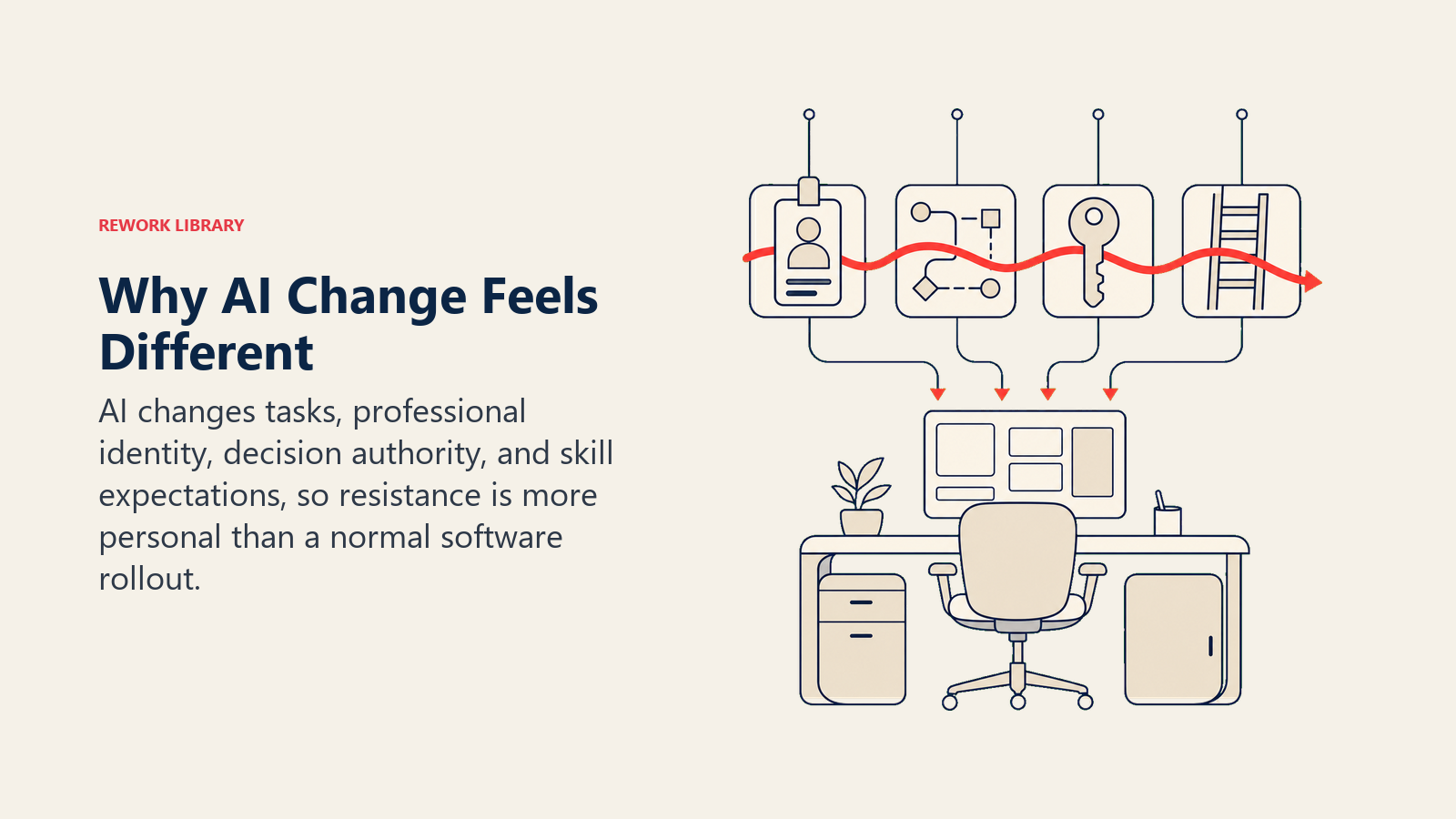
Job security concerns top the list. When you introduce automation software, employees worry about efficiency gains. When you introduce AI, they worry about obsolescence. The fear isn't irrational - AI can handle tasks that once required human expertise. Marketing writers see AI writing assistants. Financial analysts see AI predictive analytics models. Customer service reps see AI chatbots. And they all ask the same question: "Will I be replaced?"
Skill inadequacy fears compound the problem. Many employees built careers on expertise that took years to develop. Now they're being told to use tools that can do their work in seconds. This creates an identity crisis. A senior copywriter who spent a decade mastering their craft feels diminished when an AI writes decent copy in 30 seconds. The psychological impact goes beyond learning a new tool - it challenges professional self-worth.
Loss of control anxiety emerges when work processes change fundamentally. Employees who've refined their workflows over years suddenly face "black box" systems making suggestions they don't understand. A data analyst knows exactly how they built their Excel models - they can explain every formula. But when an AI recommends a different approach based on pattern recognition they can't see? Trust breaks down.
Trust in AI accuracy becomes the fourth barrier. Unlike traditional software with predictable outputs, AI can make mistakes that look convincingly correct. This creates a dilemma: do employees blindly trust AI outputs, or do they verify everything, negating efficiency gains? Without clear guidance, most choose verification, which defeats the purpose.
These aren't problems you solve with a lunch-and-learn session. They require systematic change management.
The AI Change Management Framework
Successful AI adoption follows a structured approach that addresses technology, process, and people simultaneously.
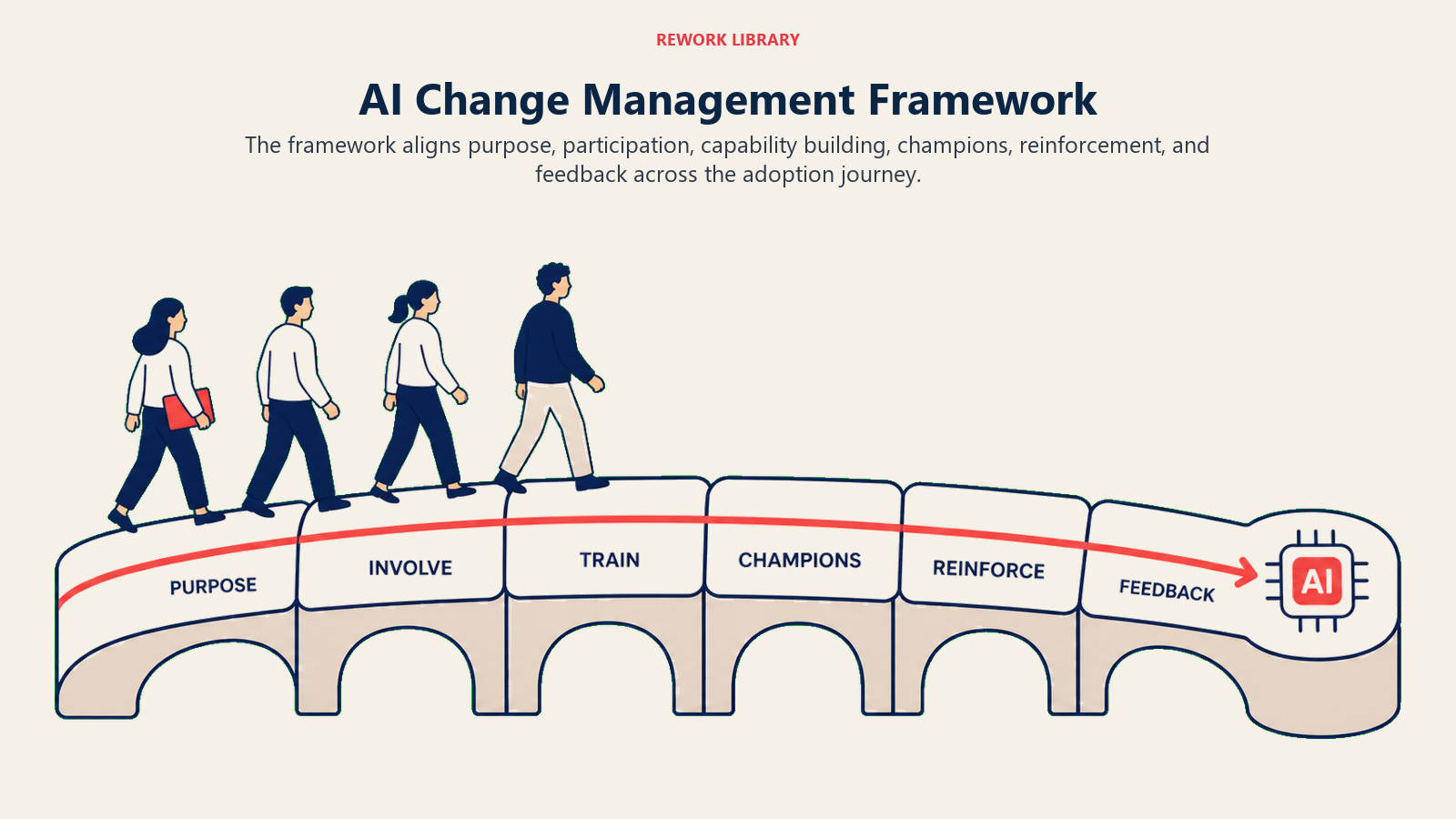
Vision and communication form the foundation. Employees need to understand not just what's changing, but why it matters and what's in it for them. Generic announcements like "We're implementing AI to improve productivity" don't work. Instead, paint a specific picture: "AI will handle the data entry and report formatting you've told us you hate, freeing you to focus on analysis and client recommendations."
The vision must address the job security elephant in the room directly. Don't dodge it. Explain how AI augments rather than replaces. Show how it eliminates tasks, not roles. Share your commitment to reskilling and how this technology creates opportunities for higher-value work.
Leadership alignment determines whether change succeeds or stalls. If executives talk about AI transformation while mid-level managers undermine it, adoption fails. Every leader must understand their role and model the behaviors you're asking employees to adopt.
This means executives need to use the tools publicly. When the CEO shares an AI-generated market analysis in an all-hands meeting and explains how it accelerated their thinking, that sends a message. When managers dismiss AI as a "toy" in private conversations, that message travels faster.
Stakeholder engagement recognizes that different groups have different concerns. Your sales team cares whether AI improves their close rates. Your legal team cares about compliance risks. Your IT team cares about security and integration. Generic messaging fails because it speaks to everyone and no one.
Create stakeholder-specific communication plans. Finance leaders need ROI projections. Department heads need implementation timelines. Individual contributors need skill development paths. Each group should see themselves in the change story.
Training and enablement must go beyond tool mechanics. Yes, employees need to know which buttons to click. But they also need to understand when to use AI versus when not to, how to evaluate outputs, and how to integrate AI into their existing workflows. This requires hands-on practice, not just documentation. Effective AI training and onboarding programs combine technical skills with contextual judgment.
Feedback and iteration close the loop. Early adopters will surface issues you didn't anticipate. Usage patterns will reveal workflow gaps. Resistance will highlight unaddressed concerns. Build mechanisms to capture this feedback and demonstrate responsiveness. When employees see their input shaping the rollout, they shift from victims of change to participants in change.
Overcoming Common Resistance Patterns
Every AI implementation faces predictable resistance. Prepare for these patterns with specific response strategies.
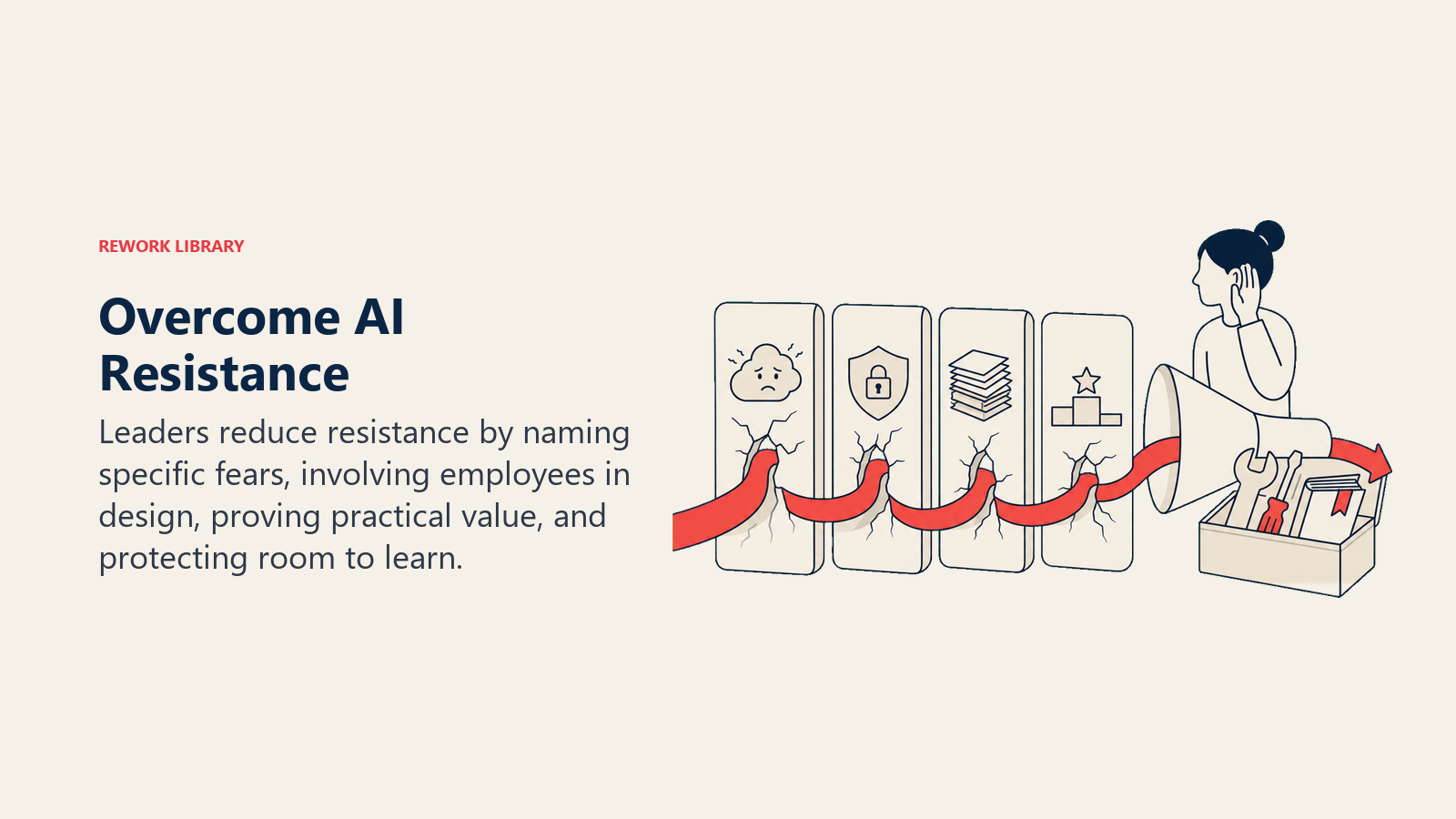
"AI will replace my job" requires honest, specific reassurance. Don't just say "No, it won't." Explain exactly what changes and what doesn't. A content marketer might hear: "AI will draft initial copy, but you'll shape the voice, ensure brand alignment, and make strategic decisions about messaging. You're moving from writer to creative director. We need that expertise more, not less."
Back this up with commitment. Announce a no-layoffs-due-to-AI policy for the rollout period. Create clear paths for role evolution. Show real examples of how other organizations used AI to elevate work, not eliminate it.
"I don't understand how it works" reflects a legitimate concern about black box systems. You don't need to teach everyone machine learning, but you do need to build appropriate mental models. Explain AI as pattern recognition from vast data, not magic or intelligence.
Use analogies that resonate with their work. For a financial analyst: "It's like having an assistant who's read every market report from the past decade and can spot patterns you'd miss." For a recruiter: "It screens resumes the way you would, but it's reviewed 10,000 applications to learn patterns that predict success."
Provide transparency where possible. Show the training data. Explain the confidence levels. Demonstrate how to validate outputs. The goal isn't complete understanding, but sufficient comfort.
"The old way is fine" comes from high performers who've mastered current processes. Why fix what isn't broken? This resistance masks a real concern: they've invested time perfecting their approach, and change threatens their competitive advantage.
Acknowledge their expertise. Don't position AI as fixing their broken process. Instead, frame it as amplifying their proven approach. "You've developed an excellent qualification methodology. AI lets you apply it to 10x more prospects in the same time. Your judgment becomes more valuable, not less."
Better yet, involve them early. Top performers make excellent AI champions because they can demonstrate advanced use cases that others aspire to.
"I don't trust the output" deserves validation, not dismissal. AI does make mistakes. Building trust requires a verification framework that balances checking with efficiency.
Establish clear guidelines: "Use AI for first drafts and check for accuracy. After you've verified outputs for your first 20 tasks and built confidence in the patterns, you can reduce verification to spot-checking." This gives employees a structured path from skepticism to trust based on their own experience.
Communication Strategy
Change communication requires precision across multiple levels, with each audience getting messages tailored to their concerns and role in the transformation.
Executive messaging sets the strategic context. Executives should communicate why AI matters to the business, how it connects to broader strategy, and what success looks like. They need to address the "what about our people" question directly, sharing commitments around reskilling, role evolution, and how AI creates opportunities alongside efficiency.
This communication should be frequent, visible, and authentic. Monthly updates work better than quarterly announcements. Town halls where executives answer unfiltered questions work better than polished presentations. Vulnerability works - when a CEO shares their own AI learning curve, it normalizes the challenge.
Manager enablement is where change lives or dies. Managers translate strategy into daily work. They address individual concerns in one-on-ones. They model adoption in team meetings. They recognize progress and coach through struggles.
Managers need specific tools: talking points for common concerns, scripts for difficult conversations, metrics to track progress, and clear escalation paths for issues they can't resolve. They also need permission to adapt the approach for their team's specific needs. Rigid corporate mandates breed resistance. Manager autonomy builds ownership.
Employee education must answer the "what's in it for me" question concretely. Generic benefits like "increased productivity" don't resonate. Specific examples do: "You'll spend 30 minutes instead of 3 hours on weekly reports, giving you back time for the client strategy work you've told us you want to do more of."
Use multiple channels - email announcements, team meetings, lunch-and-learns, Slack channels, video tutorials. Different people absorb information differently. Repetition matters. Plan to communicate key messages at least seven times through different media before assuming people heard it.
Success story sharing builds momentum. When an early adopter saves 5 hours a week and gets promoted because they had time to lead a strategic initiative, tell that story. When a team automates their least favorite task, celebrate it. When someone discovers an innovative use case, make them famous internally.
These stories do two things: they show tangible benefits, and they make adoption socially desirable. Humans are social creatures. We do what we see others rewarded for doing.
Creating AI Champions
Change spreads through networks, not org charts. Formal rollout plans matter less than informal influencers who advocate for adoption because they've experienced its value.
Identifying early adopters starts before the official launch. Who's already experimenting with ChatGPT? Who's excited about the announcement? Who has influence but isn't necessarily in leadership? These people become your champion candidates.
Look for specific traits: comfort with technology, willingness to learn, influence among peers, and a track record of helping others. The best champions aren't necessarily your highest performers - they're your best teachers.
Training power users goes deeper than standard training. Give champions early access. Teach them advanced techniques. Help them become genuinely excellent at using the tools. This serves two purposes: they become credible experts peers come to for help, and they help you refine training for the broader rollout.
Create a champions program with structure: monthly meetings to share learnings, direct access to implementation leads, and input into rollout decisions. This isn't just a focus group - it's a distributed enablement team.
Recognition programs formalize what you're asking champions to do. If you expect them to help colleagues without formal responsibility, recognize that contribution. Feature them in internal communications. Track their impact on peer adoption. Include champion program participation in performance reviews.
Some organizations offer incentives - gift cards, extra PTO, professional development budgets. Others rely on visibility and career benefits. The specific reward matters less than consistent recognition that this contribution is valued.
Community building sustains momentum beyond the initial rollout. Create spaces for ongoing learning and sharing - a Slack channel, monthly office hours, quarterly showcases where teams demo innovative uses.
These communities serve multiple purposes: peer support for troubleshooting, idea sharing that spreads best practices, and a feedback channel that helps you continuously improve. They also create positive social pressure. When channel conversations show everyone else using and benefiting from AI, holdouts feel increasing pressure to engage.
Measuring Adoption
You can't manage what you don't measure. Adoption metrics tell you whether your change management is working and where to intervene.
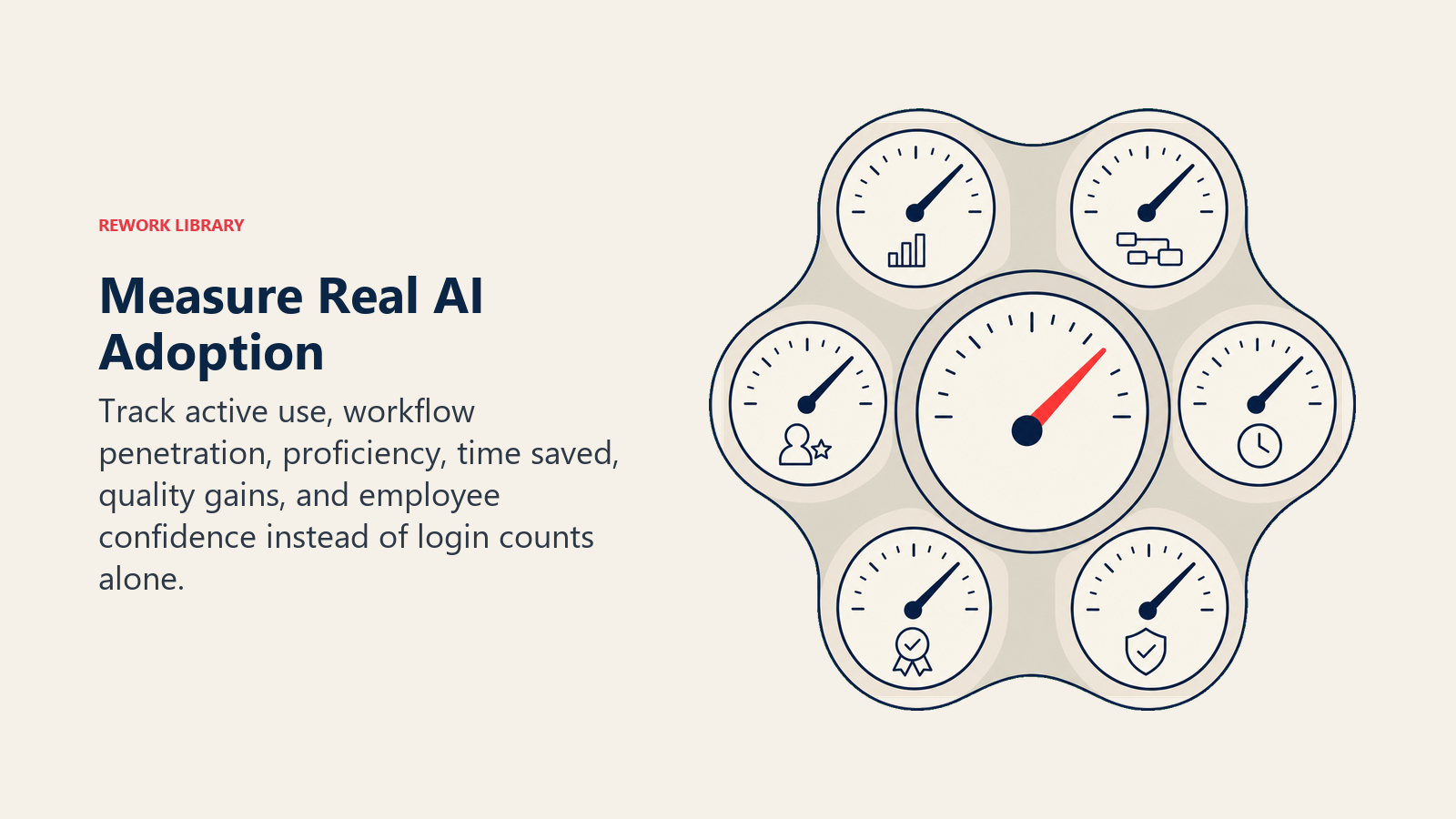
Usage metrics provide the foundation. Track active users, login frequency, feature utilization, and task completion. These numbers show breadth of adoption. If 80% of users have logged in at least once, you've cleared the awareness hurdle. If only 30% use it weekly, you've got an engagement problem.
Segment usage by role, department, and manager. This reveals patterns. If one team has 90% adoption while others struggle, what's that manager doing differently? Learn from success pockets and replicate.
Proficiency levels measure depth of adoption. Using a tool and using it well are different. Track progression from basic to advanced features. Monitor the sophistication of prompts or workflows. Assess whether users are integrating AI into their processes or treating it as a separate, occasional task. Understanding types of AI productivity tools helps define appropriate proficiency benchmarks for different categories.
Create a proficiency framework: beginners (know basic features), intermediate (use regularly with standard workflows), proficient (customize and optimize for their needs), and advanced (innovate new use cases and help others). Target movement up this ladder, not just initial usage.
Satisfaction scores reveal whether adoption is reluctant or enthusiastic. Survey users monthly. Ask specific questions: Do the tools work as expected? Are they saving time? Would they recommend them to colleagues? What barriers remain?
Low satisfaction with high usage indicates compliance without commitment. High satisfaction with low usage suggests a communication or access problem. Both signal different interventions.
Business impact correlation connects adoption to outcomes. Compare productivity metrics, quality indicators, or customer satisfaction between high-adoption and low-adoption teams. If the benefits aren't showing up in business results, either your metrics are wrong or your change management isn't working.
This data builds the case for continued investment and identifies where to focus improvement efforts.
Course Correction: When Adoption Stalls
Most AI rollouts hit plateaus or resistance points. Recognition and response separate successful transformations from failed ones.
Watch for warning signs: declining usage after an initial spike, growing negative sentiment in surveys, managers quietly discouraging use, or early adopters becoming frustrated and disengaging.
When adoption stalls, diagnose before prescribing. Talk to non-users. What's stopping them? Often the answer isn't what you expected. Maybe the tools don't integrate with a critical workflow. Maybe a respected manager is skeptical. Maybe training focused on features instead of relevant use cases.
Respond with targeted interventions. If it's a skills problem, add hands-on workshops. If it's a trust problem, share validation frameworks and success metrics. If it's a workflow problem, revisit integration points. If it's a leadership problem, have direct conversations with resistant managers.
Sometimes course correction requires slowing down. If you pushed too hard too fast, people feel overwhelmed and dig in. A temporary pause for consolidation, additional training, and feedback incorporation can prevent long-term failure.
Other times it requires doubling down. If adoption is strong in pockets but not spreading, invest more in champions, sharing more success stories, and making adoption more visible and valued.
The key is maintaining momentum without creating backlash. Change is uncomfortable. Your job is making the discomfort worthwhile.
The Path Forward
AI adoption isn't a technology project with an end date. It's an ongoing organizational capability that requires persistent attention to the human side of change. The technical implementation is table stakes. The real work is helping people navigate the psychological and practical challenges of working differently.
Start with empathy. Understand why resistance is rational. Then build systematic responses - clear communication, consistent leadership, structured training, and visible recognition. Create paths for people to move from skepticism to competence to advocacy.
Measure relentlessly, but remember that the goal isn't 100% adoption of a specific tool. It's building an organization that can continuously adapt to AI capabilities as they evolve. The change management skills you develop now prepare you for the next wave and the wave after that.
Because AI capabilities will keep advancing. The organizations that thrive won't be those with the best tools. They'll be those who've mastered helping people integrate new capabilities into their work without losing what makes them human - judgment, creativity, empathy, and strategic thinking. This is the essence of building an AI-first culture that can continuously adapt and evolve.
Your job isn't replacing humans with AI. It's helping humans be more effective with AI. That starts with managing change well.