AI Business Intelligence Platforms
Turn this article into takeaways for your work.


Each assistant summarizes the article only for you and suggests best practices for your work.
Your executive dashboard shows last month's performance metrics in beautiful visualizations. But those charts don't tell you what's about to go wrong this month, which opportunities you're missing, or what you should do differently.
This is the limitation of traditional business intelligence: it's excellent at showing what happened, but silent about what's happening now or what will happen next.
AI-enhanced BI platforms change this dynamic. They don't just report historical data, they proactively surface insights, predict trends, and recommend actions. The shift from backward-looking reports to forward-looking intelligence transforms how organizations make strategic decisions.
Traditional BI vs AI-Enhanced BI
The difference between traditional and AI-powered BI is fundamental.
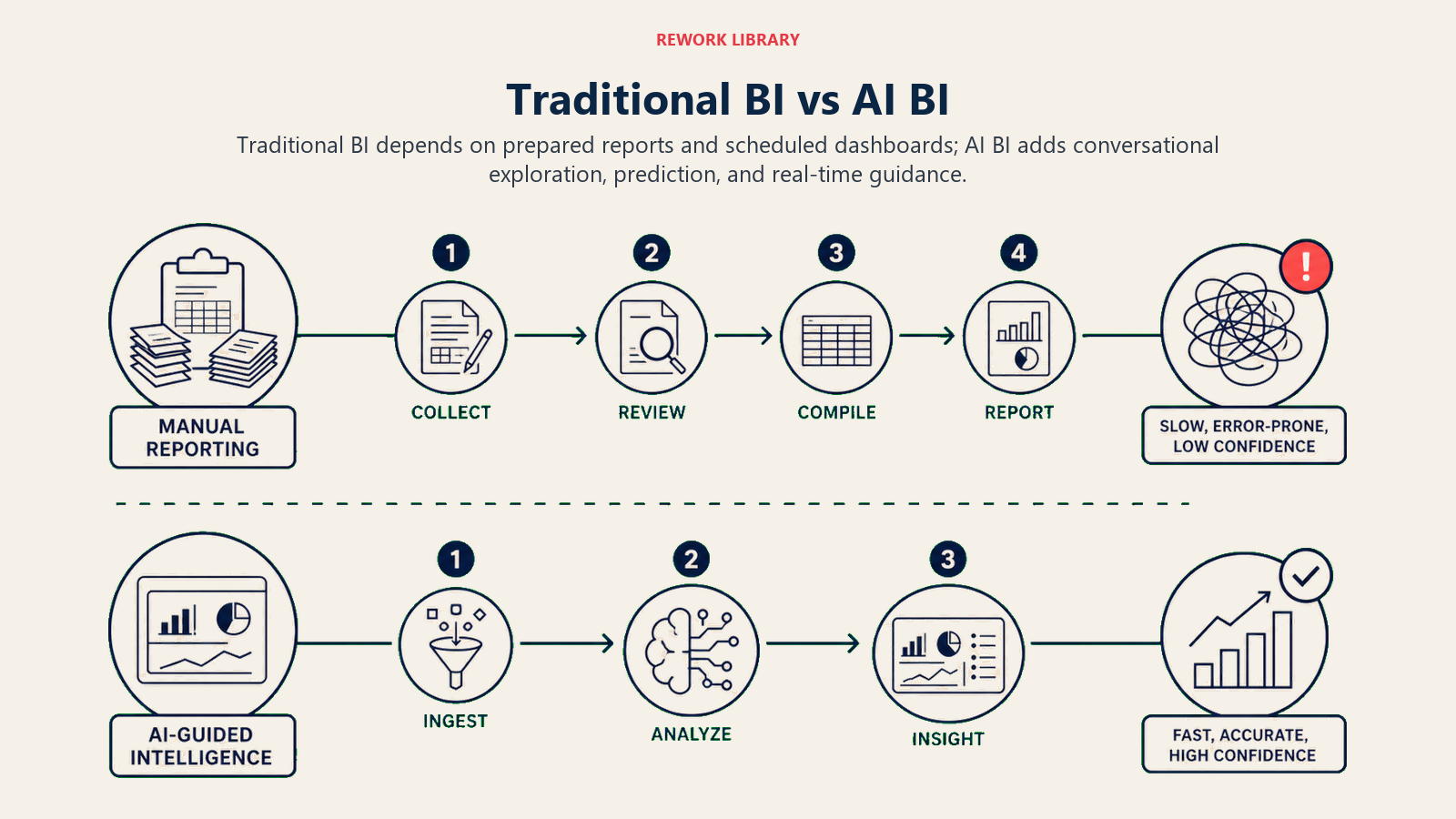
Manual report building vs auto-generated insights changes who needs to create analysis. Traditional BI requires someone to design reports and dashboards. AI BI automatically generates insights based on what's happening in your data and what you've shown interest in previously, similar to how AI data analysis tools proactively surface patterns worth investigating.
Static dashboards vs intelligent exploration shifts from fixed views to dynamic investigation. Static dashboards show the same charts every time. AI-enhanced platforms adapt to your questions and guide you toward relevant analysis paths.
Descriptive analytics vs predictive/prescriptive expands from "what happened" to "what will happen" and "what should we do." Traditional BI excels at historical reporting. AI BI adds forecasting and recommendation capabilities.
Scheduled reports vs real-time alerts moves from periodic updates to immediate notification. Instead of waiting for the weekly report to see problems, AI BI alerts you when metrics deviate from expected patterns.
AI Capabilities in Modern BI
AI adds several powerful capabilities to business intelligence platforms.
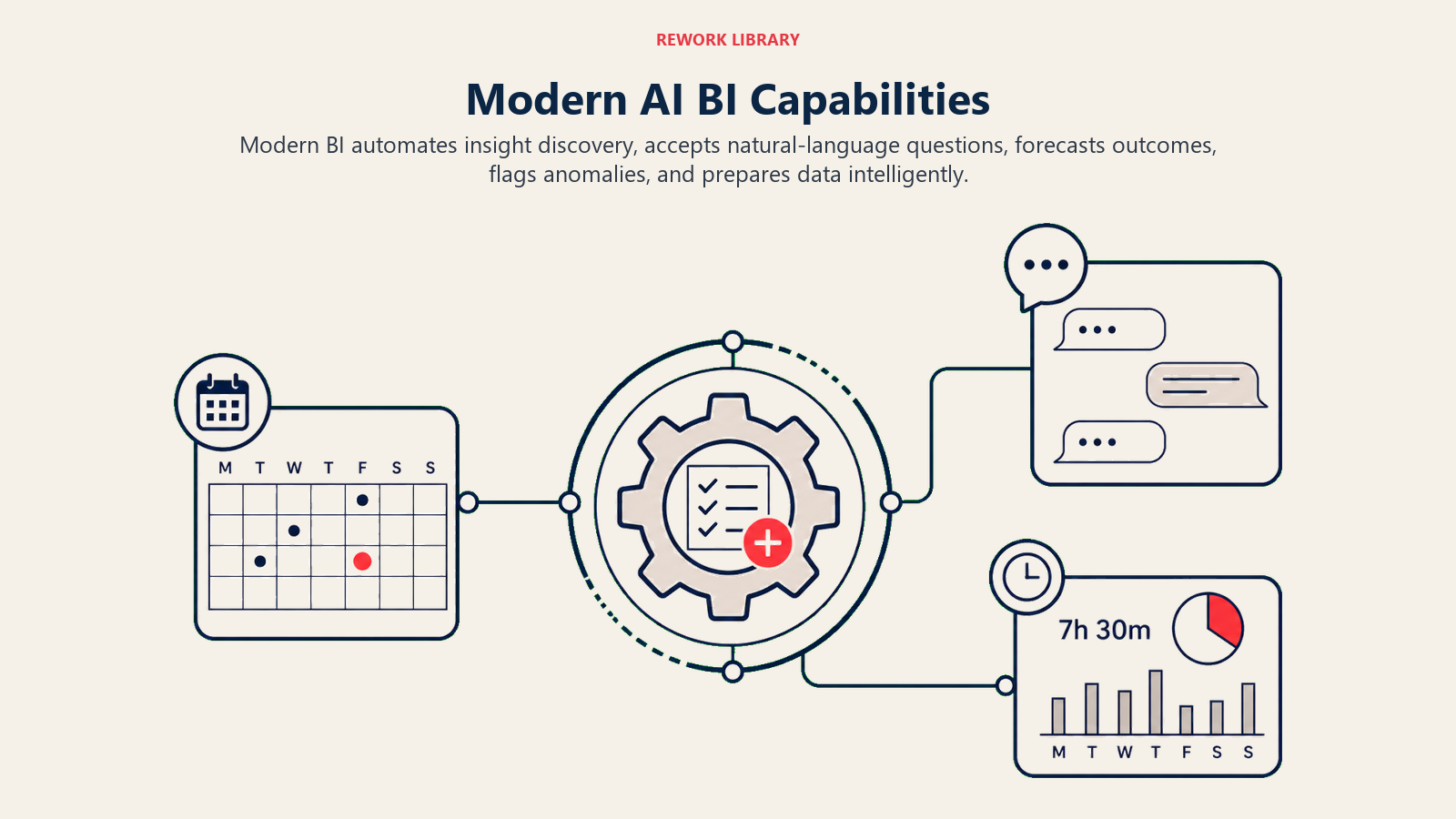
Automated insight generation proactively surfaces patterns worth investigating. The AI analyzes your data continuously and flags trends, anomalies, and correlations that deserve attention. You don't have to think of every question to ask, the platform suggests what to look at.
Natural language interfaces let executives and business users interact with data conversationally. Instead of navigating through report menus, you ask questions like "why did revenue drop in the Northeast region?" and get immediate answers with supporting visualizations.
Predictive forecasting generates future projections based on historical patterns and current trends. The platform can forecast next quarter's revenue, predict customer churn risk, or project resource needs without requiring data scientists to build custom models. These capabilities mirror what AI predictive analytics delivers across various business functions.
Anomaly and trend detection automatically identifies when metrics behave unusually. If sales suddenly spike in one region, conversion rates drop unexpectedly, or costs trend above normal patterns, the AI flags these deviations for investigation.
Smart data preparation handles much of the tedious work of cleaning and organizing data for analysis. AI can suggest data transformations, identify data quality issues, and even automatically join related datasets.
Leading AI BI Platforms
Several established platforms have integrated AI capabilities into their offerings.
Power BI with AI and Copilot brings Microsoft's AI investments into its widely-adopted BI platform. Power BI Copilot can create visualizations from text descriptions, generate narrative summaries of reports, and answer questions about data. Power BI's tight integration with Azure AI enables sophisticated predictive analytics without leaving the platform.
Tableau with Einstein Analytics combines Tableau's visualization strength with Salesforce's Einstein AI. Tableau users get automated insights, natural language generation that explains what charts show, and predictive modeling built into their familiar Tableau environment.
Qlik Sense with AI offers an associative analytics engine enhanced by AI-driven insights. Qlik unique approach to data exploration pairs well with AI capabilities that suggest hidden relationships and generate automated narratives.
Domo with AI features provides a cloud-native BI platform with embedded AI throughout. Domo's Beast Mode AI helps users create complex calculations in natural language, while its alerts system uses machine learning to determine when metrics truly deviate from normal.
Sisense with AI-driven insights focuses on embedded analytics with AI that adapts to each user's role and interests. The platform learns what matters to different users and prioritizes insights accordingly.
Enterprise BI Use Cases
AI-enhanced BI delivers value across strategic business functions.
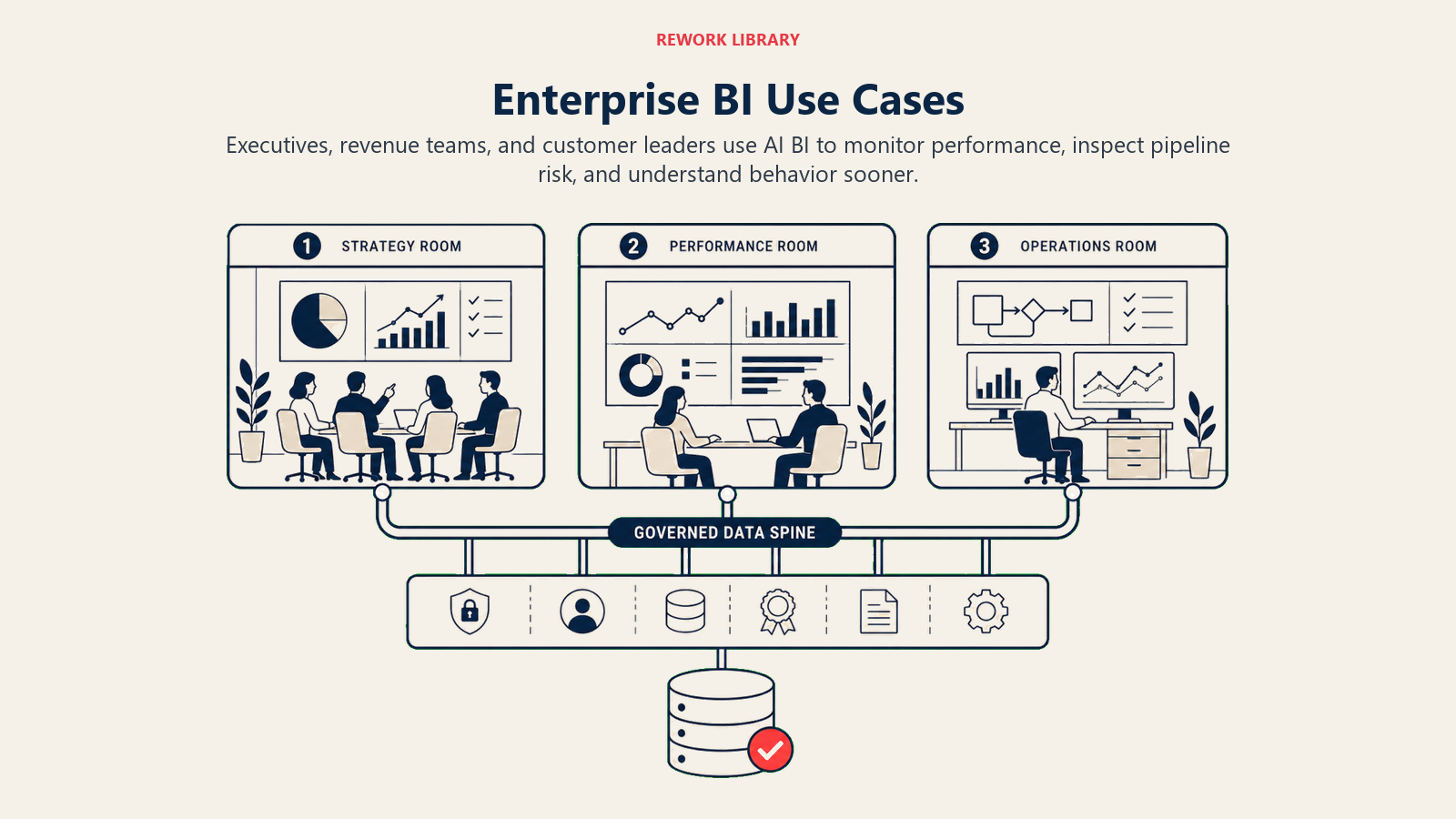
Executive Dashboards with AI Insights
Executive teams need high-level visibility with the ability to drill into details when something requires attention.
AI surfaces the metrics that deserve executive focus rather than showing every KPI. It highlights what's performing unusually (good or bad), explains potential causes, and suggests where leaders should direct attention.
When revenue drops in a region, the AI doesn't just show the decrease. It analyzes whether the issue relates to specific products, customer segments, sales reps, or seasonal patterns. Executives get context, not just numbers.
Revenue and Pipeline Intelligence
Sales and finance leaders need to understand revenue performance and forecast accuracy.
AI analyzes pipeline health beyond simple opportunity values. It identifies which deals are truly likely to close, which are stalling, and what patterns characterize wins versus losses.
Forecasting becomes more accurate when AI considers multiple factors: historical seasonality, current pipeline velocity, market conditions, and rep performance trends. The platform can flag when forecasts seem unrealistic based on underlying data.
Customer Behavior Analysis
Marketing and product teams need to understand what drives customer actions.
AI identifies customer segments based on actual behavior patterns rather than predefined criteria. It can discover that customers who engage with certain features have much higher retention, or that specific combinations of characteristics predict churn risk.
Journey analysis powered by AI shows the most common paths customers take and identifies where journeys typically succeed or fail. This reveals optimization opportunities that aren't obvious in aggregate metrics.
Operational Performance Monitoring
Operations leaders need visibility into process efficiency and capacity utilization.
AI-enhanced operational dashboards don't just show current metrics. They predict when you'll hit capacity constraints, identify which inefficiencies have the biggest impact, and flag when performance deviates from normal patterns.
When cycle times increase, the AI investigates whether the issue relates to volume spikes, resource constraints, quality problems, or process changes. You get diagnostic insights, not just symptom reporting.
Financial Planning and Analysis
CFOs and FP&A teams need accurate forecasts and variance explanations.
AI improves forecast accuracy by considering more variables than traditional models. It can incorporate leading indicators, identify early warning signs of variance, and adjust projections as new data arrives.
Variance analysis becomes automated. When actual spending exceeds budget, the AI identifies which cost categories drove the variance, whether it's a one-time event or trend, and how it impacts the full-year outlook.
The AI BI Stack
Modern AI-enhanced BI platforms integrate multiple layers.
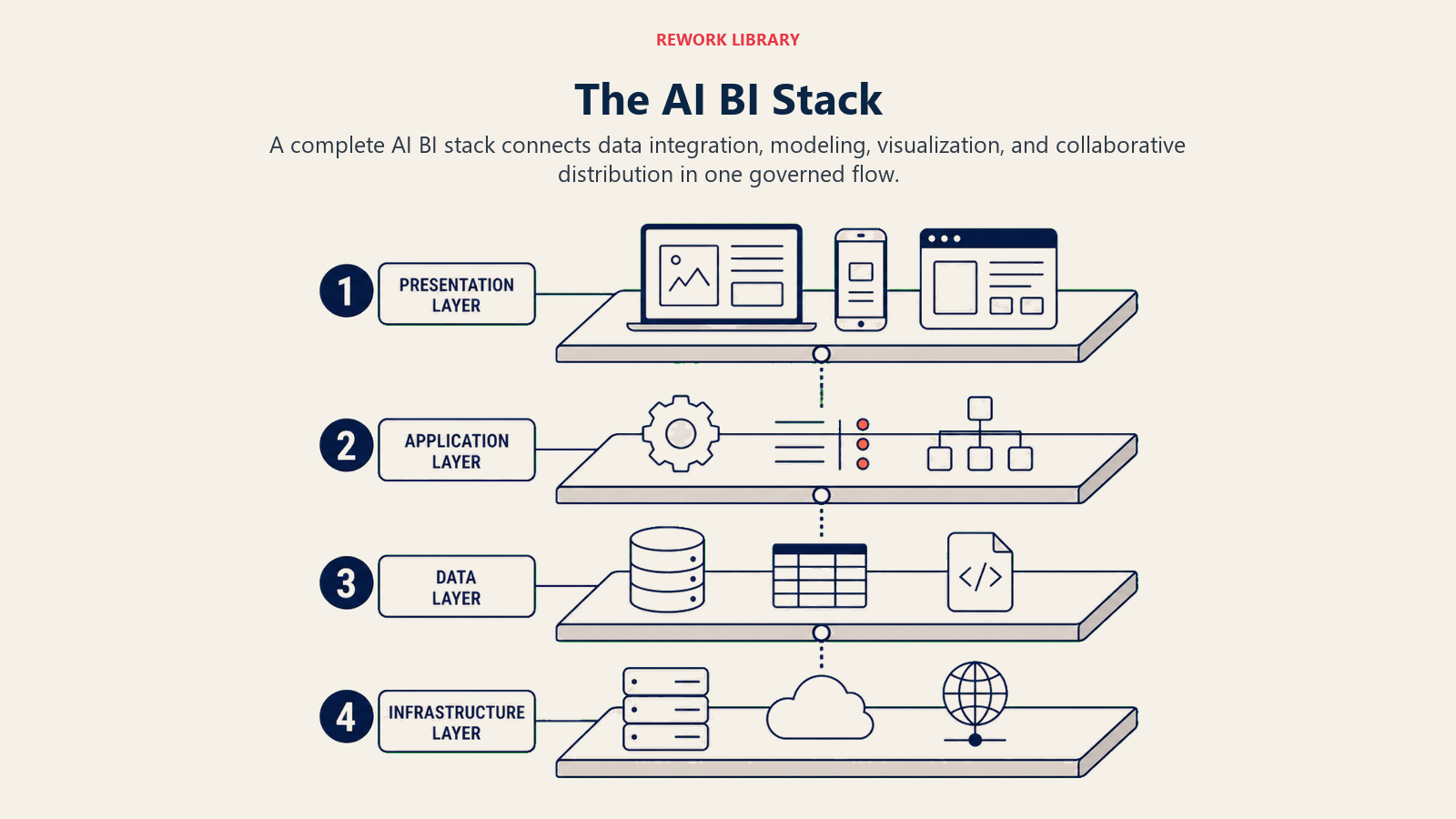
Data integration and preparation connects to various source systems and prepares data for analysis. AI helps by suggesting relevant data sources, identifying quality issues, and automating transformation logic.
Analytics and modeling performs the actual analysis and generates insights. AI powers predictive models, pattern recognition, and automated insight generation without requiring users to be data scientists.
Visualization and reporting presents findings in understandable formats. AI can automatically choose appropriate chart types, generate written summaries of what visualizations show, and adapt dashboards to user preferences. For organizations focused specifically on reporting automation, AI reporting and visualization tools provide specialized capabilities.
Distribution and collaboration shares insights with stakeholders who need them. AI determines what information matters to different users and can automatically distribute relevant insights via email, Slack, or Teams.
Implementation Approach
Successful AI BI implementation requires thoughtful planning.
Data strategy and governance must come first. AI BI platforms need clean, well-organized data to generate reliable insights. Establish data quality standards, define key metrics consistently, and implement proper access controls before rolling out AI features.
User adoption planning determines how different roles will use AI BI. Executives might primarily consume AI-generated insights, while analysts actively explore data using AI assistance. Tailor training and communication to each user group's needs, leveraging proven AI training and onboarding approaches.
Incremental AI feature rollout prevents overwhelming users with too much change at once. Start with automated insights or natural language querying, then add predictive features and recommendations as users become comfortable with initial capabilities.
Build trust through transparency. Help users understand how AI generates insights and predictions. When the platform makes a recommendation, show the supporting data so users can verify the logic.
Measure and communicate value as you go. Track specific examples where AI insights led to faster decisions or better outcomes. These success stories build momentum for broader adoption.
ROI Framework
AI-enhanced BI delivers value through faster, better decisions.
Decision speed improves when relevant insights surface automatically rather than requiring manual analysis. Measure how much faster key decisions happen when AI alerts stakeholders to important changes.
Analysis capacity expands when AI handles routine reporting and insight generation. Track how much time analysts save on recurring reports and what higher-value work they redirect that time toward.
Forecast accuracy should improve as AI incorporates more variables and learns from historical performance. Better forecasts lead to better resource allocation, inventory management, and capacity planning.
Issue detection happens earlier when AI continuously monitors for anomalies. Calculate the value of catching problems before they escalate, whether that's revenue leakage, operational inefficiency, or customer churn.
A software company implemented AI-enhanced BI and achieved:
- 40% reduction in time spent creating standard reports
- 3-day improvement in issue detection (AI flagged problems before they appeared in scheduled reports)
- 15% improvement in revenue forecast accuracy
- 200+ hours per month of analyst capacity redirected to strategic projects
Getting Started
Choose a platform that fits your existing technology ecosystem. If you're a Microsoft shop, Power BI with Copilot integrates seamlessly. If you're heavy Salesforce users, Tableau with Einstein makes sense.
Start with a high-value use case where AI can deliver obvious benefits. Executive dashboards, sales forecasting, or operational monitoring often provide clear wins that build organizational support.
Ensure your data foundation is solid before expecting great AI insights. The quality of AI-generated insights depends entirely on the quality of underlying data.
Train both technical and business users. Analysts need to understand how to configure and optimize AI features. Business users need to learn how to interact with AI capabilities and interpret results.
Build feedback loops to improve AI performance over time. When AI insights prove valuable, that reinforces the models. When insights miss the mark, understanding why helps improve the platform's effectiveness.
AI-enhanced business intelligence represents a fundamental shift from reactive reporting to proactive intelligence. When your BI platform can predict problems before they fully manifest, surface opportunities you weren't looking for, and guide you toward the most impactful questions, strategic decision-making improves dramatically.
The companies winning with data aren't just building better dashboards. They're deploying AI that turns their data into a competitive advantage.
Related Articles:

On this page
- Traditional BI vs AI-Enhanced BI
- AI Capabilities in Modern BI
- Leading AI BI Platforms
- Enterprise BI Use Cases
- Executive Dashboards with AI Insights
- Revenue and Pipeline Intelligence
- Customer Behavior Analysis
- Operational Performance Monitoring
- Financial Planning and Analysis
- The AI BI Stack
- Implementation Approach
- ROI Framework
- Getting Started