AI Performance Measurement: Track and Improve AI Tool Business Impact
Turn this article into takeaways for your work.


Each assistant summarizes the article only for you and suggests best practices for your work.
Six months after deploying AI tools, your CEO asks the obvious question: "Are we getting our money's worth?"
You know people are using the tools. You've seen impressive individual examples. But when pressed for hard numbers showing business impact, you realize you don't have them. Usage stats exist, but they don't translate to business value. Anecdotes are compelling, but they don't justify growing investment.
This is the AI measurement gap. Organizations deploy tools and hope for the best, measuring activity instead of outcomes. They track logins without tracking productivity gains. They count features used without connecting to business results. They celebrate adoption without proving value.
The consequence is predictable: when budgets tighten, investments without clear ROI get cut first. Your AI tools might be delivering enormous value, but if you can't demonstrate it systematically, that value becomes invisible to decision-makers.
Measurement isn't bureaucratic overhead. It's how you prove AI works, identify where to optimize, justify continued investment, and build the case for scaling. Without measurement, you're flying blind.
The AI Performance Metrics Hierarchy
Effective measurement follows a progression from basic activity tracking to business outcome demonstration.
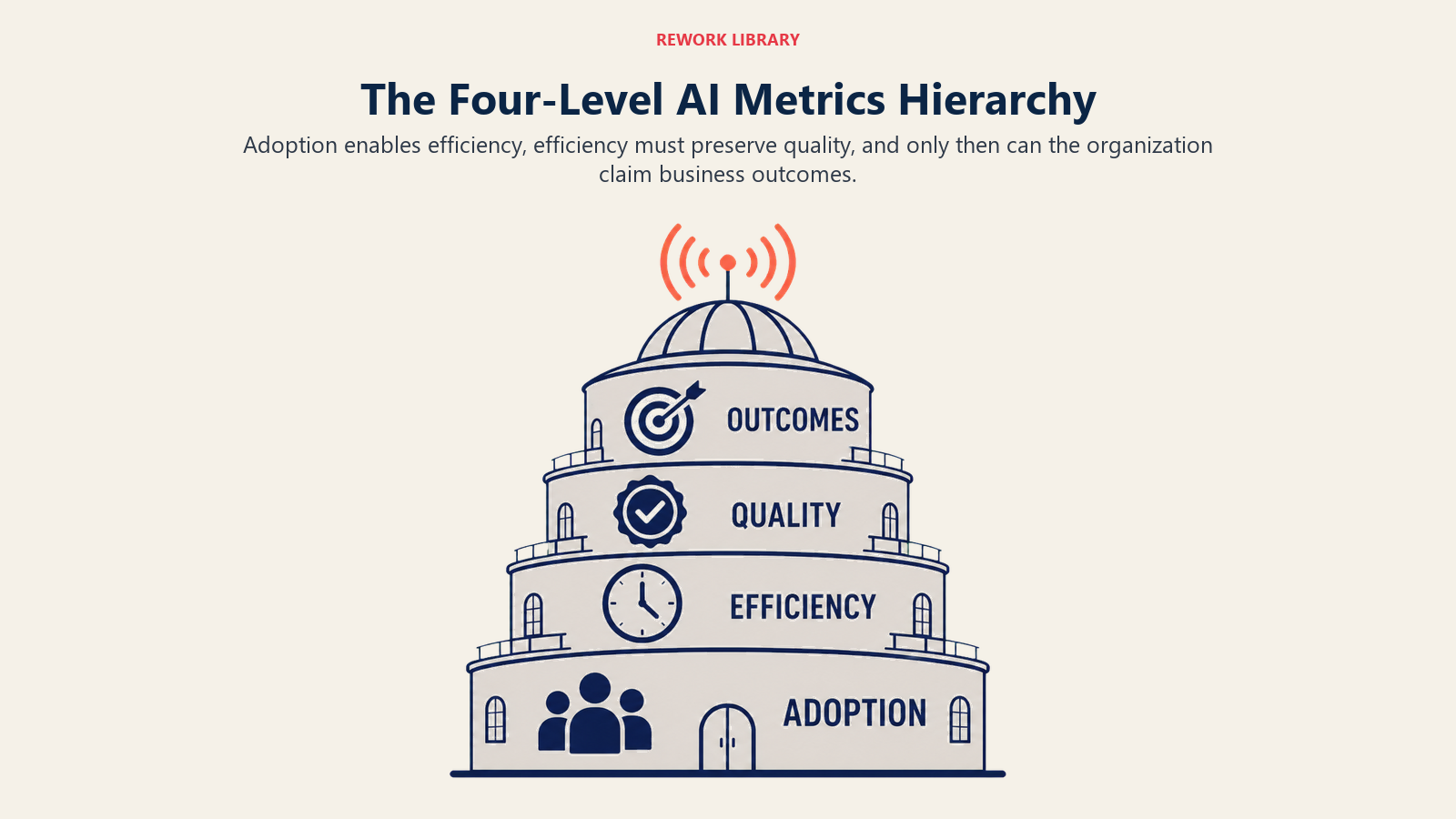
Level 1: Adoption metrics track whether people are using your AI tools at all. These are your foundational metrics: active user counts, login frequency, feature utilization rates, and task completion volume. If no one uses the tools, nothing else matters.
Track active users as a percentage of total licenses. Are you paying for 500 users when only 200 log in monthly? That's a different problem than 90% active usage. Monitor usage frequency - daily, weekly, monthly, or barely ever. Frequent users extract more value and justify investment better than occasional users.
Measure feature utilization by tracking which capabilities get used and which sit dormant. If you're paying for advanced features no one touches, you're wasting money. If everyone maxes out basic features but avoids advanced ones, you have a training gap.
Adoption metrics answer "Are people using this?" They don't answer "Is it valuable?" But they're prerequisites for every other metric.
Level 2: Efficiency metrics measure whether AI tools make work faster and easier. Time saved per task, volume of work completed, error reduction rates, and process automation percentages quantify productivity improvements.
This is where you start seeing value. If AI reduces report creation from three hours to 30 minutes, that's measurable efficiency. If it automates data entry that consumed five hours weekly, that's quantifiable time savings. If it cuts error rates from 5% to 0.5%, that's demonstrable quality improvement.
Calculate time savings across all users to show aggregate impact. If 100 employees each save three hours weekly, that's 300 hours per week or 15,600 hours annually - roughly eight full-time employees worth of capacity. That's a compelling number.
Level 3: Quality metrics assess whether AI improves work output, not just speed. Content quality scores, decision accuracy rates, customer satisfaction improvements, and output consistency measures show that AI doesn't just make work faster - it makes work better.
This matters because faster bad work doesn't help. You need evidence that AI-assisted work meets or exceeds human-only work quality. Survey customers about satisfaction with AI-assisted responses. Have editors rate AI-assisted content quality. Measure decision accuracy when AI provides analysis.
When you can show that AI-assisted customer service responses get 15% higher satisfaction ratings while being delivered 50% faster, you've made a powerful case.
Level 4: Business impact metrics connect AI performance to bottom-line results. Revenue increases, cost reductions, customer acquisition improvements, retention rate lifts, and profit margin expansion prove that AI tools deliver tangible business value.
This is the executive language. CFOs care about profit. Sales leaders care about revenue. Operations leaders care about costs. When you show that AI tools contributed to 10% revenue growth or $2M in cost avoidance, you've justified investment in terms that matter to decision-makers.
The challenge is attribution. AI tools are rarely the only factor in business improvements. Use control groups, before-after comparisons, and statistical analysis to isolate AI impact from other factors.
Key Performance Indicators by Tool Category
Different AI tool categories require different metrics because they deliver value differently.
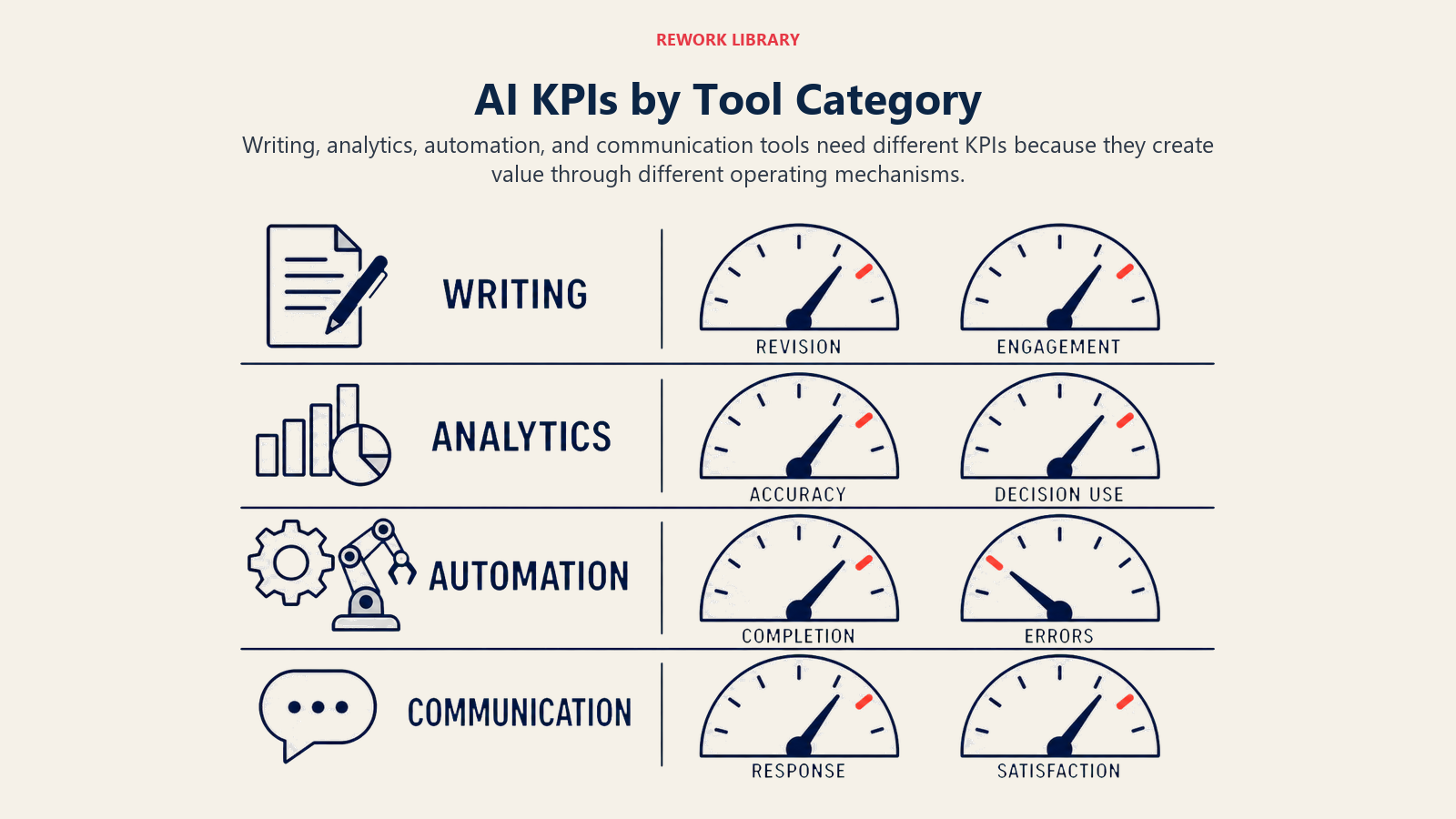
AI writing tools should be measured on content velocity (articles, emails, or posts produced per time period), editing time reduction (how much faster does review and polish happen), quality scores (readability, engagement, conversion rates), and creative variation (how many different approaches or versions can you generate quickly). Understanding AI writing assistants capabilities helps define appropriate metrics.
Track these before and after AI adoption. If your team produced eight blog posts monthly before AI and now produces 20 with the same team size and quality, that's a 150% productivity increase worth measuring.
AI automation tools perform best on process completion time (how long from trigger to completion), error rates (accuracy of automated processes), volume handled (how much work can be processed), and human intervention required (what percentage needs manual correction). Learn more about AI workflow automation strategies.
If AI automation handles 1,000 monthly invoices with 2% error rates versus 300 invoices with 5% error rates for manual processing, you've quantified both efficiency and quality gains.
AI analytics tools should measure time to insight (how quickly can you answer business questions), decision speed (how fast from question to action), forecast accuracy (how well predictions match reality), and analysis coverage (how much data can you examine versus sampling). Explore AI data analysis tools for comprehensive metrics.
When AI analytics lets you analyze 100% of customer feedback instead of 10% samples and do it in hours instead of weeks, that changes what's possible strategically.
AI communication tools focus on response time (how quickly are messages answered), meeting efficiency (shorter meetings with better outcomes), collaboration quality (how effectively teams work together), and communication clarity (fewer misunderstandings and iterations).
If AI meeting transcription and summarization cuts post-meeting alignment work by 60%, that's time saved for every meeting across the organization - a massive aggregate impact.
Measurement Infrastructure
Good intentions don't generate metrics. You need systems to capture, aggregate, and report performance data.
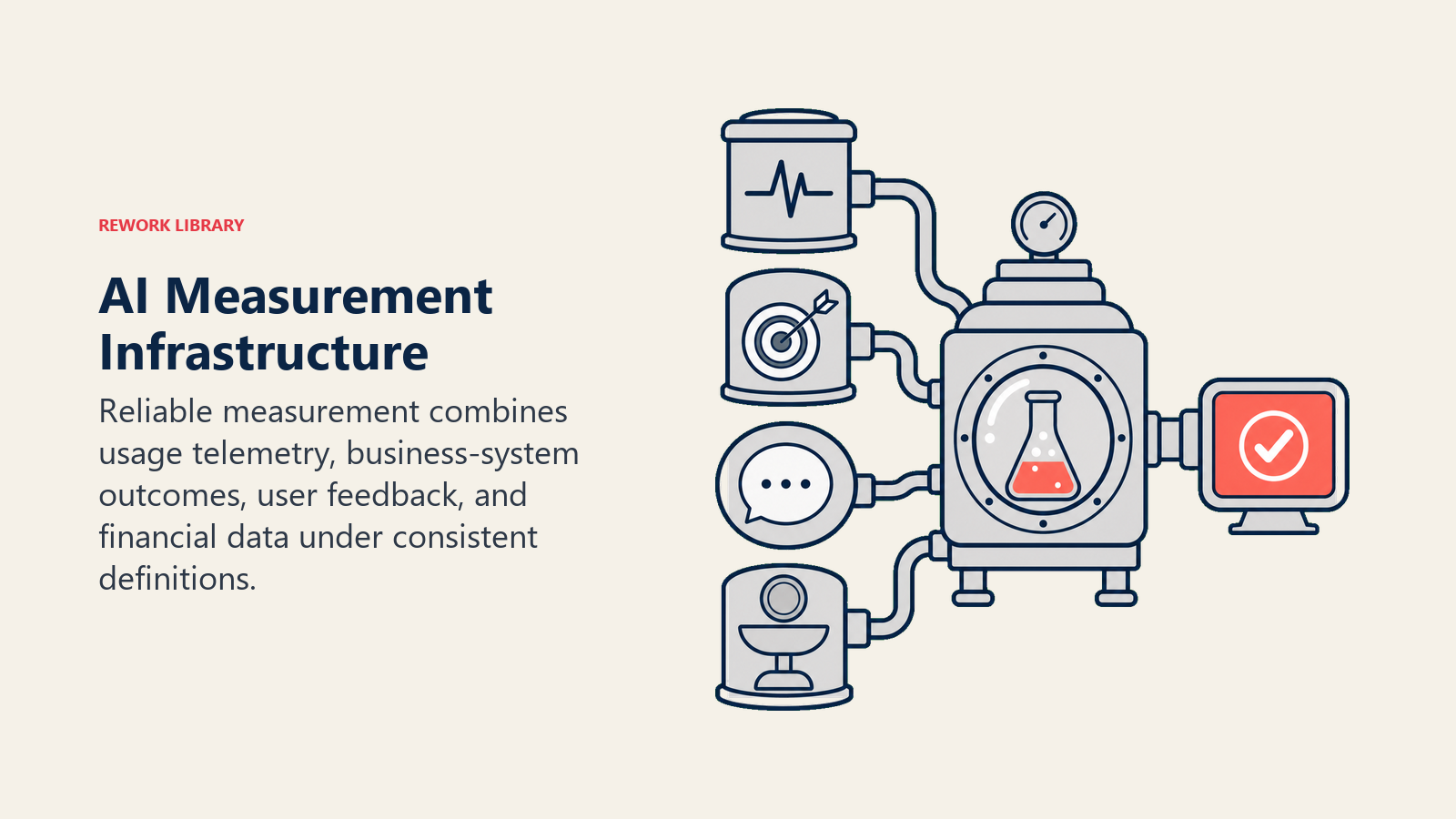
Usage analytics platforms track tool utilization automatically. Most AI platforms include built-in analytics showing user activity, feature usage, and consumption patterns. Connect these to your measurement framework by extracting key metrics regularly.
For tools without built-in analytics, implement tracking through API monitoring, user surveys, or activity logging. You can't manage what you don't measure, and you can't measure what you don't track.
Performance dashboards centralize metrics for easy visibility. Build dashboards showing current performance against targets across your metric hierarchy: adoption rates, efficiency gains, quality improvements, and business impacts.
Update dashboards at least monthly. Make them accessible to stakeholders who need to monitor AI performance. Different audiences need different views: executives want high-level business impact, managers want team performance details, and users want individual productivity metrics.
Benchmark establishment requires measuring performance before AI implementation. You can't show improvement without knowing where you started. If possible, capture baseline metrics for 2-3 months before deployment.
For tools already deployed, establish current baselines and track improvement from there. Use control groups not yet using AI to compare against AI-enabled groups. Statistical rigor matters when proving value.
Data collection methods vary by metric type. Automated system logs capture usage data. Time tracking tools measure efficiency improvements. Surveys assess satisfaction and quality perceptions. Business systems provide outcome data (revenue, costs, customer metrics).
Use the least burdensome collection method that provides reliable data. Asking employees to manually log every AI interaction won't scale. Automatically extracting usage from system logs will.
Baseline vs Post-Implementation Comparison
Demonstrating AI value requires comparing performance before and after adoption.
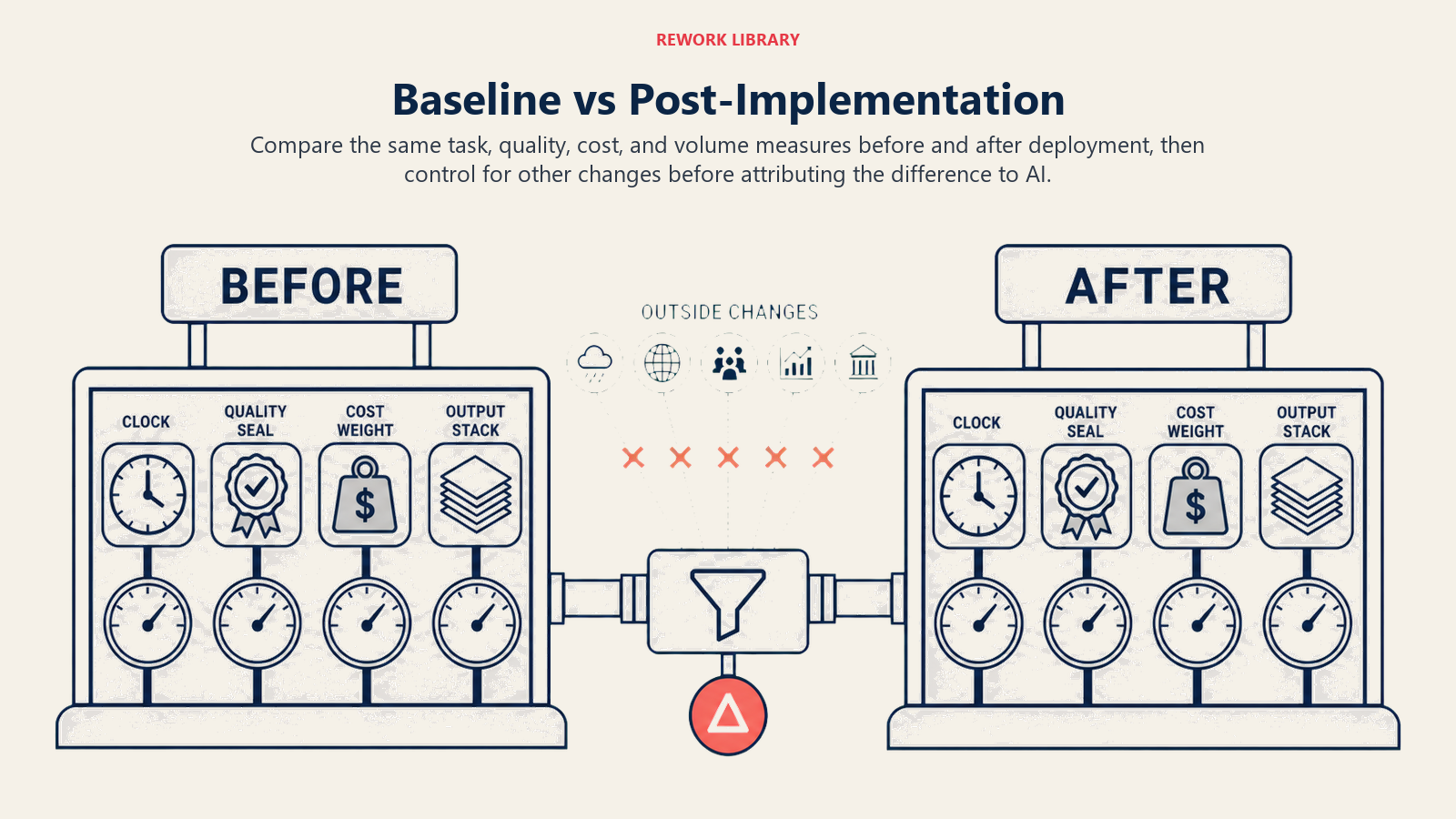
How to measure "before AI" depends on when you started planning. Ideally, identify key metrics and establish baselines 2-3 months before deployment. Measure current performance on metrics you'll track post-implementation: time per task, quality scores, cost per transaction, or whatever matters for your use cases.
If you didn't establish baselines before deploying AI, you have options. Use historical data from business systems (last year's numbers), create control groups that haven't adopted AI yet for comparison, or have users estimate pre-AI performance levels for key tasks (less reliable but better than nothing).
Tracking improvements over time shows the trajectory, not just a single snapshot. Month-over-month progress reveals whether gains are sustained or diminishing. Compare periods: "In month one post-deployment, we saved 500 hours. In month six, we saved 1,200 hours as proficiency and adoption increased."
This demonstrates that AI value compounds. Early gains from quick wins get amplified by growing proficiency and expanding use cases. That story helps justify continued investment.
Attribution challenges arise because AI tools rarely operate in isolation. If revenue increases 15% after deploying AI sales tools, how much was the AI versus seasonal trends, market conditions, or new salespeople?
Use multiple approaches for attribution: statistical controls comparing AI-using groups to non-using groups, time series analysis showing inflection points correlating with AI deployment, and user surveys asking people to estimate AI contribution to their improved performance. Triangulating multiple data sources builds confidence in your estimates.
ROI Dashboard Design
Different stakeholders need different views of AI performance to make their decisions.
Executive view shows high-level business impact in familiar financial terms. Display total cost of AI tools, total measurable value delivered, net ROI as a percentage, and strategic capability gains that don't fit neat ROI calculations. Effective AI tool cost management supports accurate reporting.
Focus on outcomes executives care about: "AI tools cost $300K annually and delivered $1.2M in measurable productivity gains plus strategic advantages in speed to market and customer experience." That's the language of executive decision-making.
Keep this view simple. Three to five key metrics that tell the story. Detailed analytics belong in other views.
Manager view provides team-level productivity metrics that help managers coach and optimize. Show team usage rates, top performers and strugglers, productivity gains by team, most valuable use cases, and areas where training or support could improve performance.
Managers need actionable insights: "Your team's usage is strong, but adoption of advanced features lags peers. Targeted training on workflow automation could boost value 30% based on comparable teams' experience."
User view gives individuals feedback on their AI productivity. Show personal time savings, tasks completed with AI assistance, proficiency progression, and peer comparisons (anonymized to avoid negative competition).
People are motivated by seeing their own progress. "You've saved 40 hours this quarter using AI writing assistance" makes the benefit concrete and personal. "You're at intermediate proficiency - advanced training could double your efficiency" provides a growth path.
Continuous Improvement Process
Measurement without action wastes effort. Use performance data to drive ongoing optimization.
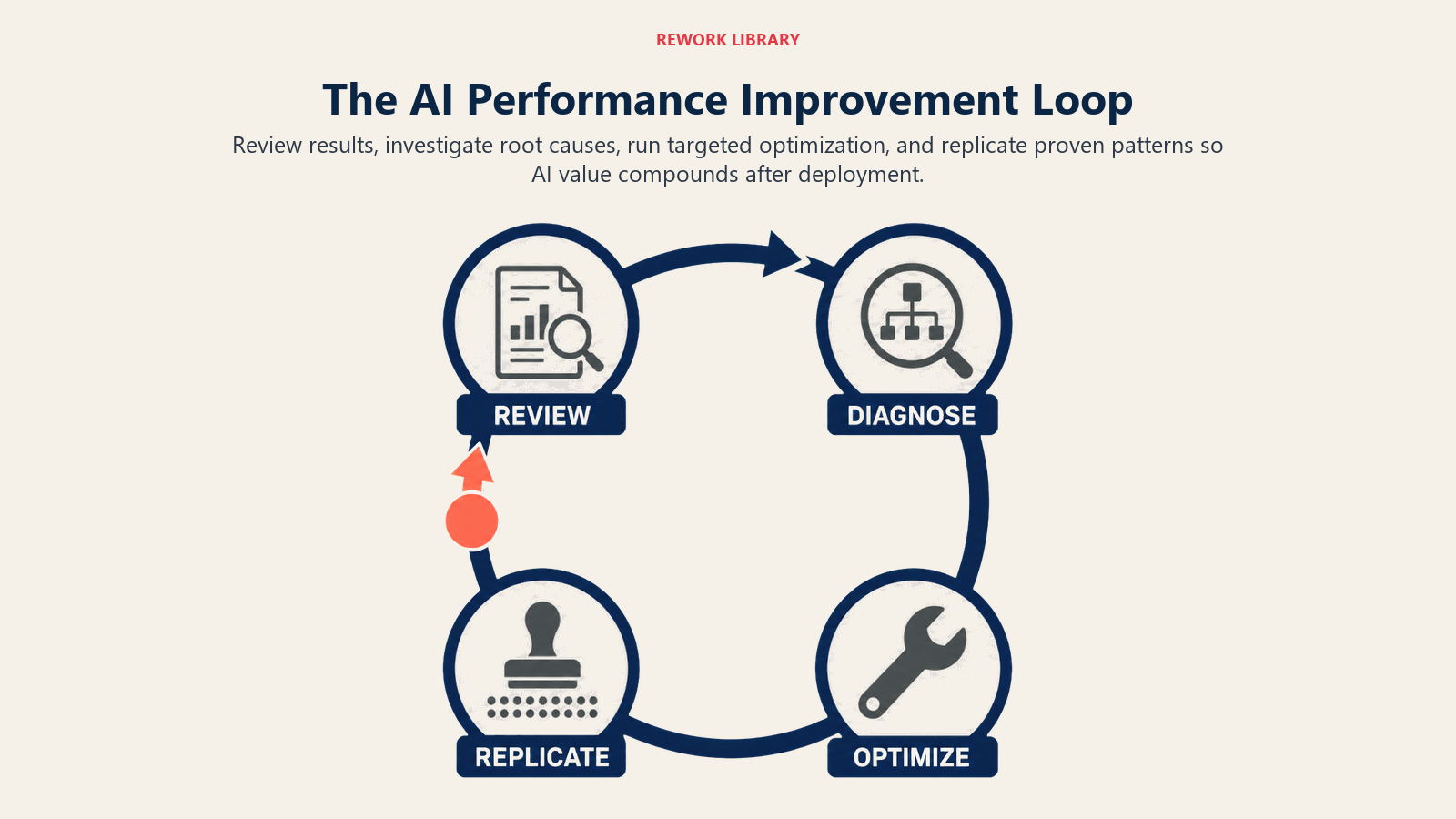
Regular performance reviews examine metrics systematically. Monthly team reviews look at usage trends and results. Quarterly stakeholder reviews assess overall program performance. Annual strategic reviews determine whether to expand, modify, or exit specific tools.
Make these reviews action-oriented. Don't just report numbers. Identify problems to fix, opportunities to exploit, and decisions to make based on data.
Underperformance investigation identifies why metrics disappoint. Low adoption might indicate training gaps, usability issues, or poor change management. Low productivity gains might suggest wrong use cases, inadequate tool capabilities, or process design problems.
Dig into underperforming areas. Talk to users. Observe workflows. Identify root causes, not symptoms. Then test interventions and measure impact.
Optimization initiatives address opportunities revealed by data. If certain use cases deliver exceptional ROI, expand them. If specific teams excel, learn from them and replicate. If features show disproportionate value, train everyone on them.
Treat AI implementation as ongoing optimization, not one-time deployment. Small continuous improvements compound into massive gains.
Success pattern replication scales what works. When you identify high-performing users, teams, or use cases, document what makes them successful. Then systematically teach those patterns to others through AI training and onboarding programs.
This is how 20% proficiency gains become 200% gains. You don't just optimize at the margins. You spread excellence broadly.
Reporting to Stakeholders
Communicating AI value to decision-makers determines continued support and investment.
Executives and board members need quarterly updates showing business impact in financial terms. Emphasize ROI, strategic advantages, competitive positioning, and risk management. Use clear visualizations, minimal jargon, and concrete examples.
Don't lead with usage statistics. Lead with business outcomes: "AI tools delivered $4.2M in measurable value against $800K investment, a 425% return." Then support with evidence: adoption data, efficiency metrics, quality improvements, and business results.
Tell stories alongside numbers. Quantitative data proves the case. Qualitative stories make it memorable and human. "Our sales team closed a $2M deal they would have lost because AI analysis revealed an approach competitors missed" resonates differently than "AI improved sales win rates 8%."
Frame challenges honestly. If certain areas underperform, acknowledge it and explain remediation plans. Credibility comes from balanced reporting, not painting everything rosy.
Include forward-looking perspectives. What's the plan for next quarter? What new capabilities are you exploring? How will AI impact evolve? Executives want to understand trajectory, not just current state.
The Path Forward
AI performance measurement isn't optional overhead. It's how you prove value, secure continued investment, identify optimization opportunities, and build organizational confidence in AI capabilities.
Build comprehensive measurement: track adoption through business impact, establish baselines for comparison, implement infrastructure for ongoing data collection, create stakeholder-specific dashboards, and use insights for continuous improvement.
Make measurement systematic, not episodic. Monthly reviews become routine. Quarterly stakeholder communications become expected. Annual strategic assessments inform budget planning and tool selection.
Partner with finance, analytics, and business unit leaders. AI measurement isn't an IT solo project. It requires collaboration to access business metrics, interpret results correctly, and communicate effectively.
Remember that perfect measurement is impossible and unnecessary. Directionally correct insight beats precisely wrong metrics. If you can show that AI tools deliver 3-5x ROI with confidence, that's sufficient. Don't delay action pursuing precision.
Start measuring now if you haven't already. Establish current baselines, identify key metrics aligned with business priorities, implement data collection, and create simple dashboards. Sophistication evolves over time.
The organizations winning with AI aren't necessarily those with the best tools. They're those who measure systematically, optimize continuously, and demonstrate value clearly. Measurement transforms AI from hopeful investment to proven capability.
That transformation starts with asking the right question - not "Are people using AI tools?" but "Is AI delivering measurable business value?" Then building the systems to answer it definitively.