Building an AI-First Culture: Transform How Your Organization Works
Turn this article into takeaways for your work.


Each assistant summarizes the article only for you and suggests best practices for your work.
You've deployed AI productivity tools across your organization. Licenses purchased, training sessions conducted, launch emails sent. Six months later, adoption is disappointing. Some teams are all-in. Others haven't touched the tools. Most fall somewhere in between, using AI occasionally but not fundamentally changing how they work.
The problem isn't your tools. It's your culture.
Technology changes fast. Culture changes slowly. Until your culture shifts to embrace AI as a default way of working rather than an optional experiment, you won't capture the full value of your AI investments.
Building an AI-first culture isn't about forcing tool usage. It's about transforming how your organization thinks about work, productivity, and continuous improvement.
What is an AI-First Culture
An AI-first culture exists when AI productivity tools are the natural starting point for how work gets done, not an afterthought or special case.
In a traditional culture, people think, "I need to write this report. I'll use Word." In an AI-first culture, they think, "I need to write this report. I'll use AI to outline the structure, generate the first draft from our data, and refine the message."
The difference is fundamental. Traditional approaches use tools to document work that's already been done manually. AI-first approaches use AI to do the work differently from the start.
But it's bigger than just using AI tools. An AI-first culture has distinct characteristics:
AI as the default approach: When facing any task or problem, the first question is "how can AI help?" not "should we use AI?" The burden of proof shifts. You need a reason not to use AI rather than needing a reason to use it.
Continuous learning mindset: In an AI-first culture, everyone expects their tools and methods to evolve constantly. What worked last quarter might not be the best approach this quarter. That's not chaos; it's progress.
Data-driven decision making: AI thrives on data. An AI-first culture collects, organizes, and leverages data systematically. Decisions get made based on what the data shows, enhanced by what AI analysis reveals.
Automation-first thinking: Before doing something manually, people ask "can this be automated?" Not everything should be automated, but everything should be evaluated for automation potential.
Experimentation and iteration: AI-first cultures expect people to try new approaches, learn what works, and improve continuously. Failures aren't career-limiting events. They're learning opportunities.
One software company I know put it simply: "We assume AI can help with everything until proven otherwise." That's AI-first thinking.
Cultural Characteristics of AI-First Organizations
Walk into an AI-first organization and you'll notice patterns that distinguish it from traditional companies.
Leaders model AI usage: Executives don't just sponsor AI initiatives; they use AI tools themselves and talk about how they use them. The CEO shares how AI helped prepare for board presentations. The CFO demonstrates AI-driven analysis techniques. Leadership isn't delegating AI to others; they're living it.
Teams share AI practices: Knowledge about effective AI usage flows freely. People share prompts, techniques, and use cases. There's a Slack channel or Teams space dedicated to AI tips. Someone discovered a clever way to use AI for competitive analysis; within days, half the company knows about it.
Failures are learning opportunities: Someone tried to use AI for a task and got poor results. Instead of hiding this failure or giving up on AI, the team dissects what went wrong and shares the learning. Maybe the prompt needed work. Maybe the use case wasn't suited to current AI capabilities. Either way, the failure advanced collective understanding.
AI literacy is an expected competency: Knowing how to work effectively with AI tools is like knowing how to use spreadsheets or presentation software. It's a baseline professional skill. New hires are expected to have or quickly develop AI literacy. Performance reviews include AI tool proficiency.
Innovation is encouraged and rewarded: People who find new ways to leverage AI get recognition. Teams that achieve breakthroughs through AI usage get highlighted. Managers who help their people become more effective with AI are celebrated.
These characteristics don't emerge by accident. They're cultivated through deliberate choices about what gets valued, measured, and rewarded.
Building Blocks of AI Culture
Culture feels abstract until you break it into concrete building blocks. Here's what you need to construct an AI-first culture.
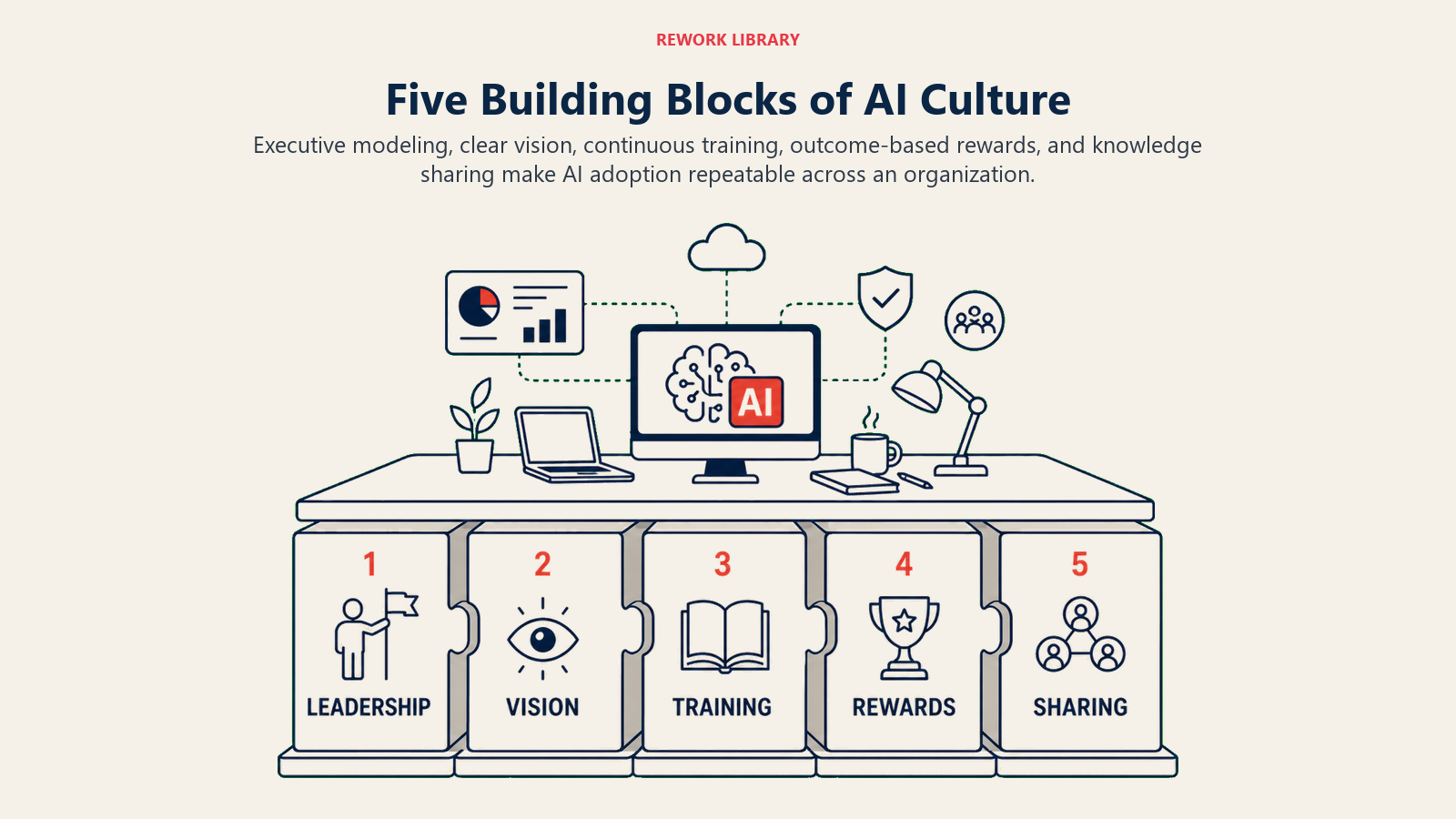
Executive sponsorship and role modeling: This can't be delegated. Your leadership team needs to visibly, consistently use AI tools and talk about their value. When the CEO uses AI to prepare for earnings calls and shares that with the organization, it signals "this is how we work here."
But sponsorship means more than usage. It means protecting experimentation time, funding AI initiatives, removing obstacles, and holding leaders accountable for driving AI adoption in their areas.
Clear vision and communication: People need to understand where you're headed and why. Not vague statements about "leveraging AI to stay competitive" but specific vision articulated through your AI tool implementation roadmap. For example: "Within 18 months, AI will handle 80% of our routine analysis work, freeing our analysts to focus on strategic insights and client relationships."
Communicate that vision repeatedly, in multiple forums, through multiple channels. Vision isn't a one-time announcement; it's a continuous narrative.
Investment in training and development: Culture doesn't change through wishful thinking. People need structured learning opportunities through AI training and onboarding. That means formal training sessions, self-paced courses, peer learning groups, hands-on workshops, access to AI education resources.
And this learning needs to be ongoing, not one-and-done. As AI capabilities evolve, your people's skills need to evolve with them.
Recognition and reward systems: What gets rewarded gets repeated. If you want AI-first behavior, reward it. Include AI usage effectiveness in performance evaluations. Celebrate teams that achieve productivity breakthroughs through AI. Give awards for most innovative AI applications.
This doesn't mean rewarding AI usage for its own sake. Reward outcomes: faster delivery, better quality, higher customer satisfaction, cost savings. The outcomes enabled by intelligent AI usage.
Community and knowledge sharing: Create spaces and opportunities for people to share what they're learning about AI. Regular show-and-tell sessions where teams demonstrate cool AI applications. Internal blogs or newsletters highlighting AI success stories. Peer mentoring programs pairing AI-savvy employees with those still learning.
One retail company created "AI Champions" in each department. These were people who became go-to resources for AI questions and helped their teammates learn effective usage. That peer-to-peer knowledge transfer accelerated adoption faster than any formal training program.
From Traditional to AI-First Mindset
Culture change means mindset change. Here's what that transformation looks like in practice.
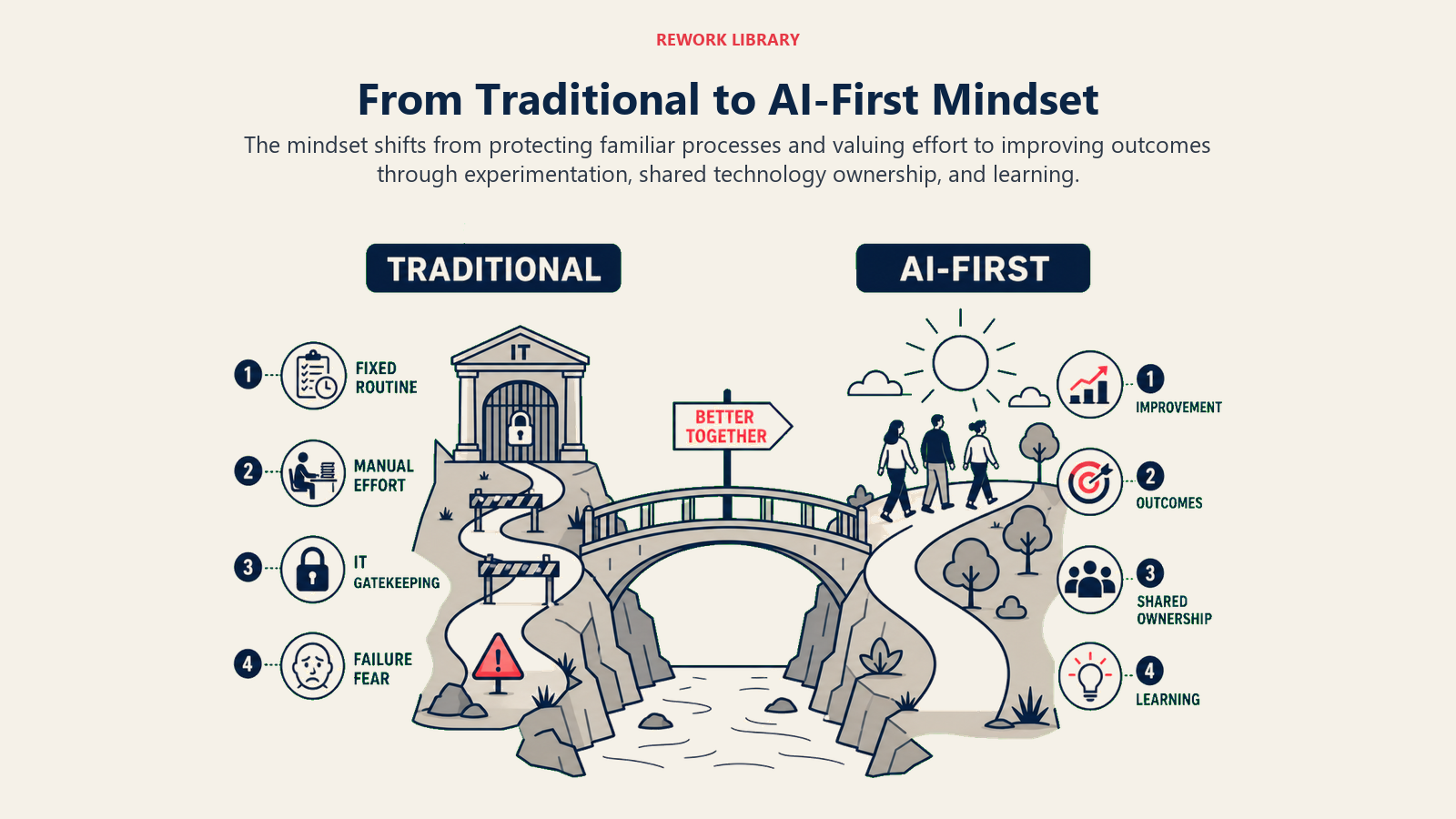
Old mindset: "We've always done it this way." New mindset: "How can AI make this better?"
This shift moves you from defending existing processes to constantly questioning whether there's a better way. Tradition becomes a starting point, not an endpoint.
Old mindset: Manual work shows effort and dedication. New mindset: Efficiency and results matter, not hours spent.
In traditional cultures, staying late and working hard gets valued even when it's inefficient. In AI-first cultures, finding a way to achieve better results in less time through AI gets celebrated.
Old mindset: Technology is IT's job. New mindset: Everyone leverages technology.
When technology is IT's domain, other teams wait for IT to solve problems. In AI-first cultures, everyone takes ownership of finding and implementing AI solutions for their work, with IT as enabler rather than gatekeeper.
Old mindset: Mistakes are failures to be avoided. New mindset: Experiments yield learning.
Risk-averse cultures kill innovation. When trying something new with AI is seen as risky rather than valuable, people won't try. AI-first cultures embrace intelligent experimentation.
Old mindset: Expertise means knowing the answers. New mindset: Expertise means knowing how to find and validate answers.
As AI makes information more accessible, the value of knowing facts decreases. The value of knowing how to extract insights, ask good questions, and apply knowledge increases.
These mindset shifts don't happen through announcements. They happen through consistent reinforcement of new behaviors over months and years.
Overcoming Cultural Barriers
Every organization faces resistance when transforming culture. Here are the barriers you'll encounter and how to address them.
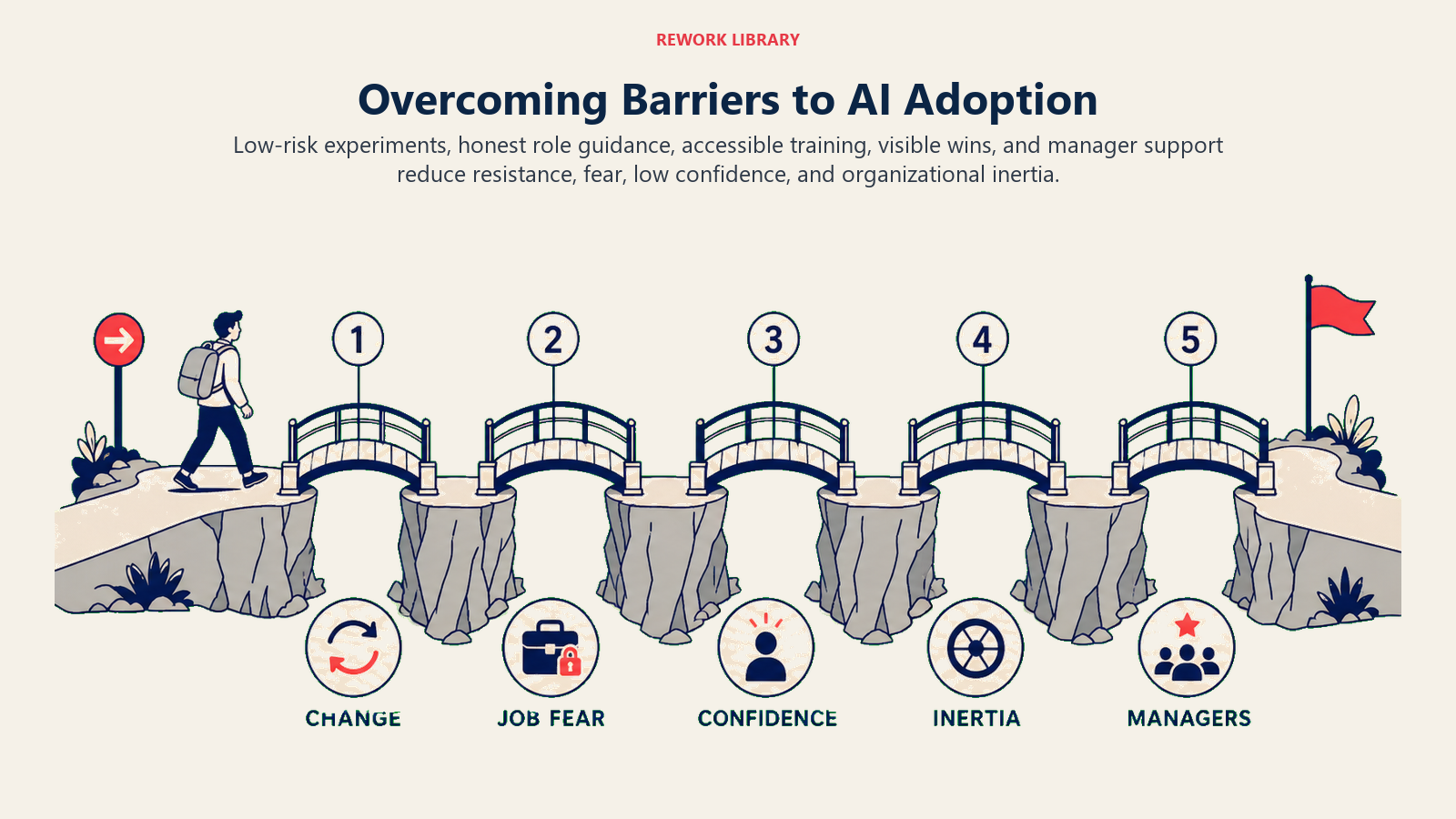
Resistance to change: People are comfortable with familiar ways of working. AI requires new approaches, new skills, new workflows. Some will resist just because it's different. Effective AI change management strategies address this resistance.
Address this by making change feel less risky. Start with low-stakes experiments. Provide plenty of support. Celebrate early wins. Show, don't just tell, that AI makes work easier.
Fear of job displacement: People worry that AI will eliminate their roles. That fear is sometimes justified but often overstated. Either way, it's real and needs addressing.
Be honest about how work will change. Yes, AI will eliminate some tasks. But it will also create new opportunities for people to do more strategic, creative, and valuable work. Invest in reskilling. Show clear career paths for people who embrace AI.
Lack of confidence with technology: Not everyone is comfortable with new technology. Some feel intimidated by AI. Others don't trust it.
Address this through accessible training, peer mentoring, and safe practice environments. Let people learn at their own pace. Pair less tech-savvy employees with AI-comfortable mentors. Create spaces to experiment without judgment.
Organizational inertia: Large organizations have momentum in existing directions. Changing course takes enormous energy.
Combat inertia by creating pockets of AI excellence that demonstrate value, then expanding successful approaches. Don't try to transform everything at once. Build momentum through visible successes.
Middle management resistance: Sometimes the biggest resistance comes from middle managers who feel threatened by changes that could reduce their team size or alter their role.
Engage managers early. Help them see how AI can make their teams more effective and them more valuable. Train them to lead in an AI-enabled environment. Make them champions, not casualties, of the transformation.
Leadership's Role in Culture Transformation
Leaders can't delegate culture change. Here's what you need to do personally to drive AI-first culture.
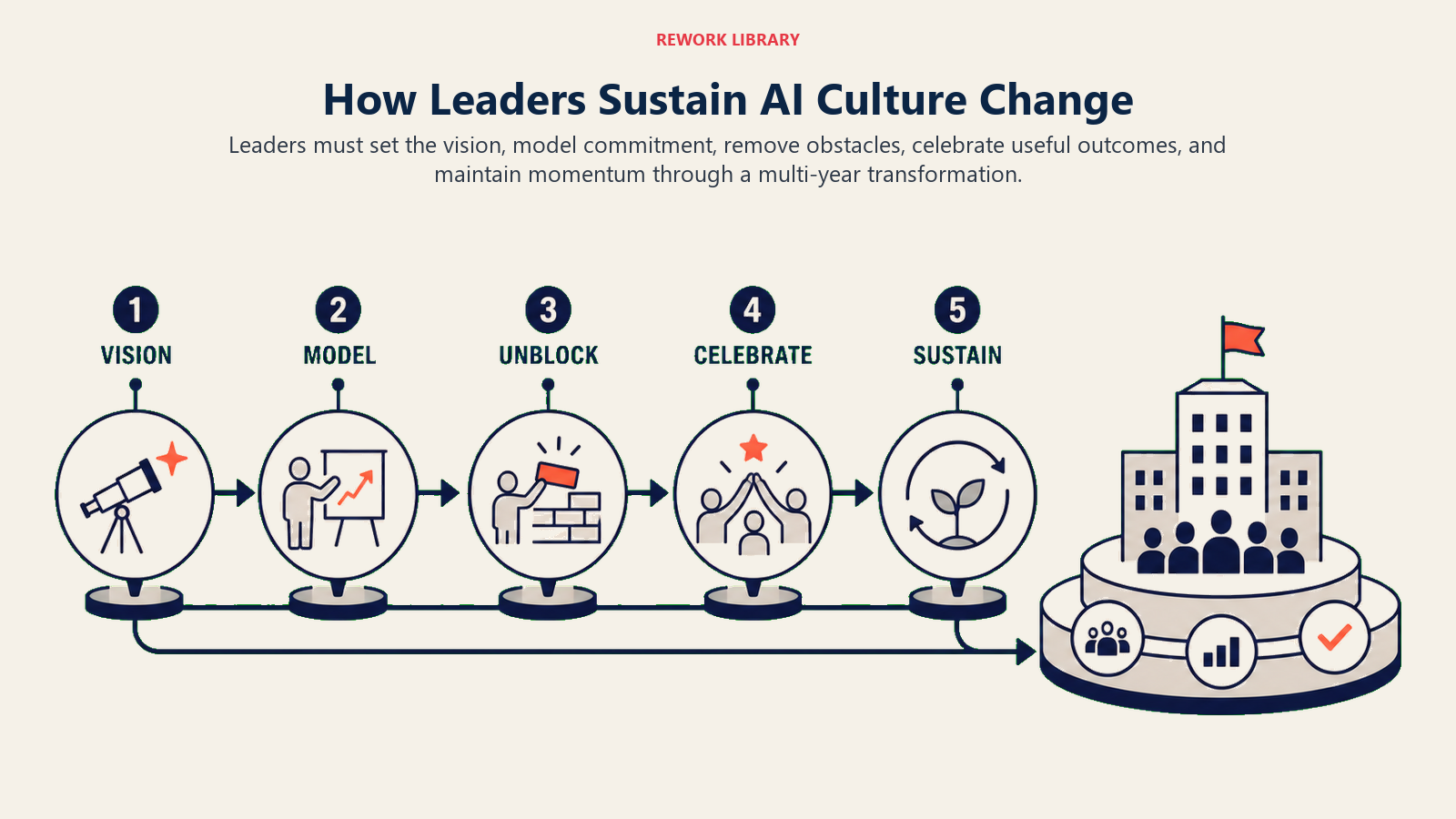
Setting the vision: Articulate a clear, compelling picture of what your AI-first organization looks like. Not abstract statements but concrete descriptions. How people work, what they accomplish, how it feels different.
Tie this vision to business outcomes. We're building an AI-first culture so we can serve customers better, innovate faster, operate more efficiently. Whatever matters most to your organization.
Demonstrating commitment: Talk about AI constantly. Use it visibly. Make it clear through words and actions that this isn't a passing initiative but a fundamental transformation.
Commit resources: budget, time, attention. Cancel other initiatives if necessary to make room. Nothing signals lack of commitment like treating culture transformation as something to squeeze in around everything else.
Removing obstacles: When teams encounter barriers to AI adoption (technology limitations, policy restrictions, skill gaps), clear those barriers quickly. Show that you're serious by making it easier, not harder, to work in AI-first ways.
Celebrating successes: Find and highlight every example of AI creating value. Tell those stories repeatedly. Make heroes of people and teams that exemplify AI-first behavior.
Celebration isn't just about feeling good. It teaches the organization what success looks like and reinforces the behaviors you want to see.
Maintaining momentum: Culture transformation takes years. Initial enthusiasm fades. You'll face setbacks. Your job is to sustain energy through the long middle period between launch and full transformation.
Keep finding new angles to talk about AI. Refresh the narrative. Bring in outside speakers. Run innovation challenges. Whatever it takes to prevent the initiative from feeling stale.
One CEO I know starts every executive team meeting with "AI spotlight." Someone shares how they used AI that week. This simple ritual keeps AI top of mind for leaders who then cascade that focus to their organizations.
Measuring Culture Change
How do you know if your culture transformation is working? Look for these signs.
Usage patterns shift: In early stages, AI usage is concentrated among enthusiasts. As culture changes, it spreads throughout the organization. You see broad, regular usage across teams and functions.
Conversation changes: Listen to how people talk about their work. Are they sharing AI use cases? Asking each other for AI tips? Discussing how to improve their prompts? Those conversations signal cultural shift.
New behaviors emerge: People start doing things you didn't explicitly ask for. Someone creates an AI best practices guide for their team. A manager starts screening candidates for AI literacy. Teams spontaneously share AI innovations. That's culture taking hold.
Speed of adoption accelerates: When you introduce new AI capabilities, adoption happens faster than previous tools. People are ready to experiment because they've developed AI-first mindset.
Business results improve: Ultimately, culture change should drive better outcomes measured through AI performance measurement. You should see productivity gains, quality improvements, faster delivery, better customer satisfaction. Whatever matters for your business.
Employee sentiment is positive: Survey your people. Are they enthusiastic about AI? Do they feel it makes their work better? Do they want more AI capabilities? Positive sentiment sustains culture change.
Track these indicators over time. Culture transformation is gradual. You won't see overnight changes, but you should see steady progress over quarters and years.
Making It Real
Building an AI-first culture isn't a program or initiative. It's a transformation in how your organization operates, led by executives who model the behavior they want to see, supported by systems that encourage AI usage, and sustained by continuous reinforcement of AI-first mindset.
Start with leadership. Get your executive team aligned and actively using AI. Then create the building blocks: clear vision, ongoing training, recognition systems, knowledge sharing. Address resistance directly and honestly. Remove barriers. Celebrate wins.
Expect the journey to take years. Cultural transformation doesn't happen quickly. But every quarter should show progress. More people using AI more effectively. Better results from AI-enabled work. Stronger conviction that AI-first is the right direction.
Your AI tools will keep getting better. New capabilities will emerge constantly. But tools alone won't transform your business. Culture will. When your people default to AI-first approaches, when they continuously experiment and improve, when they see AI as essential to their work, that's when transformation becomes real and sustained.
The question isn't whether AI will reshape how knowledge work gets done. It will. The question is whether your organization will lead that transformation or lag behind it. Culture is the difference between those outcomes.