AI for Market Research
Turn this article into takeaways for your work.


Each assistant summarizes the article only for you and suggests best practices for your work.
Your VP of Marketing just asked for competitive intelligence on five emerging competitors. Traditional approach? Hire a research firm, wait six weeks, and get a 40-page report that's outdated the moment it's delivered. By the time you've read it, two of those competitors have pivoted their positioning and three new ones have entered the market.
Market research used to be something you did quarterly or annually (discrete projects with defined scopes and delivery dates). AI has transformed it into something continuous, comprehensive, and actually current.
The Research Velocity Problem
Here's what traditional market research involves: defining research questions, identifying data sources, manually collecting information, analyzing findings, synthesizing insights, and presenting recommendations. For a comprehensive competitor analysis, you're looking at 8-12 weeks minimum.
And by the time you've completed that cycle, the market has moved. Pricing changes. New features launch. Customer sentiment shifts. Strategic positioning evolves. You're making decisions based on intelligence that's already stale.
The problem isn't that traditional research is bad. Markets just move faster than manual research processes can keep up with. You need continuous intelligence, not quarterly snapshots.
AI doesn't just speed up existing research methods. It enables entirely new approaches based on real-time data collection and analysis at scale.
AI Market Research Capabilities
Modern AI research tools operate across multiple dimensions simultaneously.
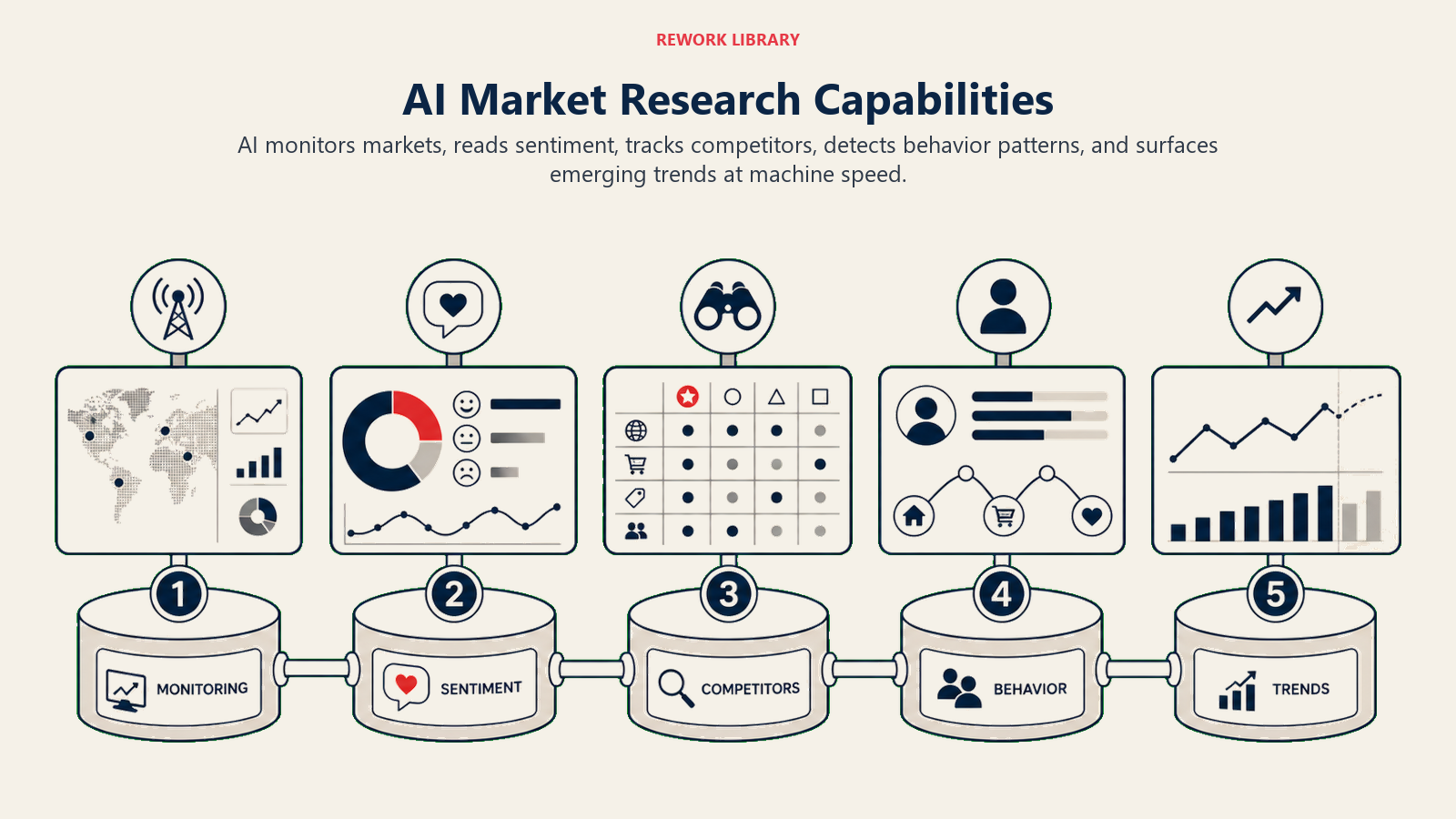
Automated Web Scraping and Monitoring: AI systems continuously monitor competitor websites, press releases, job postings, and public filings. When a competitor adds new product pages, changes pricing, or posts job openings for specific roles, you're notified. This isn't someone manually checking websites. It's automated monitoring that scales across hundreds of sources, using AI workflow automation to handle repetitive data collection tasks.
Social Media Sentiment Analysis: AI processes mentions, reviews, and discussions across social platforms. It doesn't just count mentions. It understands context, identifies sentiment, and groups conversations by topic. You'll know when sentiment around a competitor's product shifts from positive to negative, and you'll see the specific issues driving that change. These capabilities come from specialized AI sentiment analysis tools that process thousands of customer signals simultaneously.
Competitor Intelligence Gathering: AI tracks competitor marketing campaigns, content strategies, product releases, and strategic moves. It identifies patterns in their behavior and flags significant changes. When a competitor dramatically increases ad spending in a specific geography, that's signal worth investigating.
Consumer Behavior Pattern Detection: By analyzing search trends, purchase patterns, review content, and forum discussions, AI identifies emerging consumer preferences and pain points. You're seeing what customers care about before they're directly asking for it.
Trend Identification: AI connects disparate signals to identify emerging trends. It might notice that searches for "privacy-focused CRM" are increasing, customer reviews increasingly mention data security, and job postings for privacy engineers are up 40%. Those signals together suggest a trend worth paying attention to.
Research Areas Enhanced by AI
Different research questions benefit from AI capabilities in different ways.
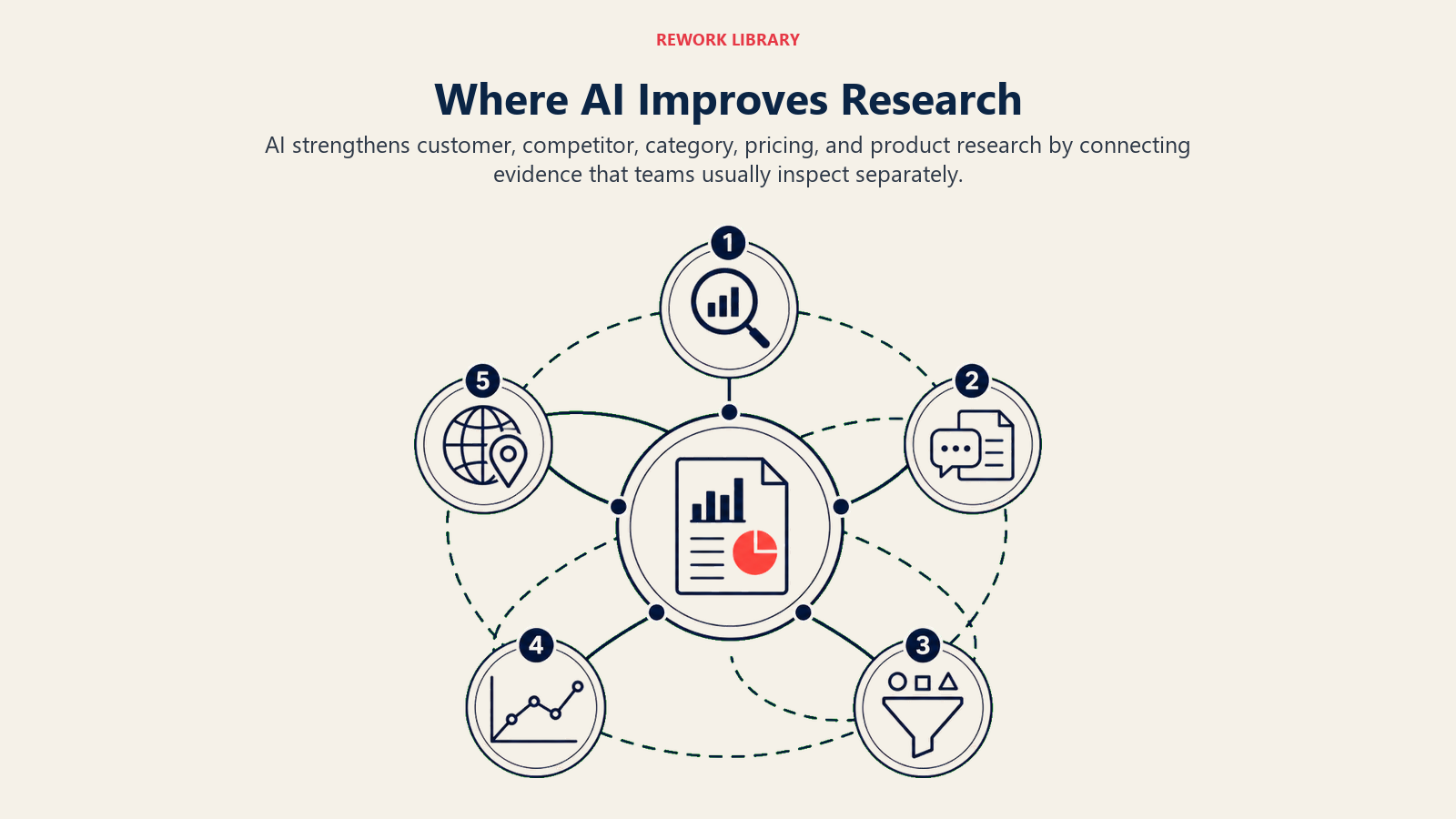
Competitor Analysis and Monitoring: AI provides continuous competitive intelligence rather than point-in-time analysis. Track competitor pricing changes in real-time. Monitor their content marketing topics and frequency. Identify which features they're emphasizing in their messaging. See which customer segments they're targeting through ad campaigns.
One software company uses AI to monitor 20 direct competitors and 30 adjacent players. They track pricing, feature announcements, customer reviews, social sentiment, job postings, and web traffic estimates. The system flags significant changes and provides weekly intelligence summaries. Their product and marketing teams always know what competitors are doing.
Customer Sentiment and Feedback Analysis: AI processes customer reviews, support tickets, social mentions, and forum discussions at scale. It identifies common themes, tracks sentiment trends, and highlights emerging issues. You're not reading individual reviews. You're seeing patterns across thousands of customer voices.
The insight isn't "customers like our product" or "customers are frustrated." It's something like: "Customer satisfaction with onboarding decreased 15% over the last month, primarily among enterprise customers, with 60% of complaints mentioning integration complexity."
Market Trend Identification: AI identifies trends by analyzing search volume data, news coverage, social discussions, investment activity, and industry publications. It distinguishes between short-term fads and meaningful shifts. When AI flags a trend, it provides supporting evidence from multiple signal sources.
Product Opportunity Discovery: By analyzing unmet needs mentioned in reviews, feature requests in forums, and gaps in competitor offerings, AI identifies product opportunities. The system might notice that 15% of reviews across your category mention a specific integration need that no current solution fully addresses.
Brand Perception Tracking: AI monitors how your brand and competitors are perceived across different audiences and channels. It tracks sentiment trends, identifies perception shifts, and highlights drivers of brand sentiment. You'll know when perception is changing and why.
Leading AI Market Research Tools
The AI research landscape includes both specialized platforms and general-purpose tools adapted for research.
Social Listening Tools: Platforms like Brandwatch, Sprout Social, and Mention monitor social media conversations at scale. They identify trending topics, measure sentiment, track brand mentions, and highlight influential voices. Brandwatch's AI can process millions of social posts daily, identifying patterns and insights that would be impossible to find manually.
Web Intelligence Platforms: Tools like Crayon, Kompyte, and SimilarWeb focus on competitive intelligence. They track competitor website changes, digital marketing activities, content strategies, and estimated web traffic. Crayon's AI specifically highlights changes that matter (new pricing, updated positioning, feature launches) while filtering out noise.
Survey Analysis Tools: Platforms like Qualtrics and SurveyMonkey have integrated AI to analyze open-ended survey responses. Instead of reading hundreds of text responses, you get AI-generated themes, sentiment analysis, and key insight summaries. Qualtrics' AI can process thousands of survey responses and deliver insight reports in minutes.
Custom AI Research: Large language models like GPT-4 and Claude can be used for specialized research tasks. You might feed them competitor websites and ask for positioning analysis, or provide them with customer reviews and request theme identification. The flexibility enables customized research workflows. Mastering prompt engineering best practices helps you get more accurate and actionable insights from these AI models.
The AI Research Workflow
Effective AI research follows a structured process, even though execution is largely automated.
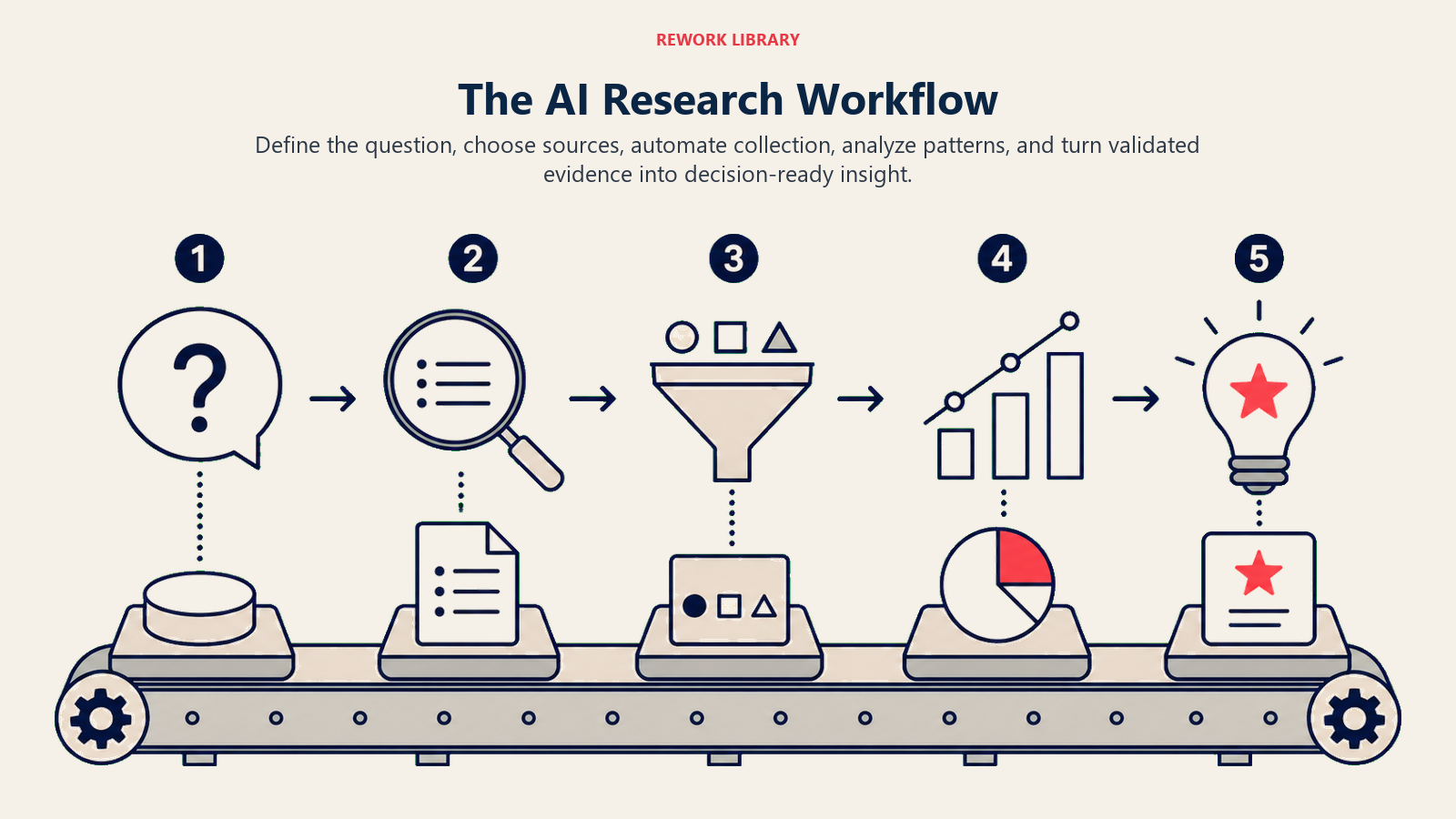
Research Question Definition: Start with clear questions. "What features do customers request most often in our category?" "How is competitor X positioning their new product?" "What emerging trends should influence our roadmap?" Specific questions lead to better research design.
Data Source Identification: Determine which sources will provide relevant signals. For competitor analysis, you might monitor their website, social channels, review sites, and press coverage. For customer sentiment, you'd track reviews, support tickets, social mentions, and forum discussions.
Automated Data Collection: Configure AI tools to continuously collect data from identified sources. This isn't a one-time scrape. It's ongoing monitoring. The system checks for changes, extracts relevant information, and structures it for analysis.
AI Analysis and Synthesis: AI processes collected data to identify patterns, trends, sentiment shifts, and significant changes. It applies natural language processing to text, sentiment analysis to customer feedback, and pattern recognition to behavioral data.
Insight Reporting: Results are packaged into digestible formats: weekly intelligence summaries, real-time alerts for significant changes, dashboards showing trend data, and detailed reports for deep dives.
One B2B software company runs this workflow across all their research needs. They have AI monitoring competitors, customers, and market trends continuously. Product managers receive weekly summaries, sales gets real-time competitive intelligence, and marketing sees trending topics for content creation. Research is embedded in operations, not a separate project.
Data Sources for AI Research
The breadth of available data sources determines research comprehensiveness.
Social Media Platforms: Twitter, LinkedIn, Facebook, Instagram, TikTok, and Reddit provide real-time sentiment and conversation data. Different platforms serve different purposes: Twitter for industry discussions, LinkedIn for professional perspectives, Reddit for detailed product conversations.
Review Sites and Forums: Sites like G2, Capterra, Trustpilot, and industry-specific review platforms contain detailed customer feedback. User forums and community sites provide unfiltered discussion about products, features, and experiences.
News and Publications: Industry publications, business news, press releases, and blogs provide formal announcements and analysis. AI can track coverage volume and sentiment across hundreds of publications.
Competitor Websites and Content: Monitoring competitor websites, blogs, resource libraries, and documentation reveals positioning changes, feature updates, and strategic direction.
Public Databases and Reports: Government filings, industry reports, research studies, and public datasets provide structured data for trend analysis and market sizing.
The key is combining multiple sources. Single sources provide limited perspective. Multiple sources create a comprehensive intelligence picture.
Quality and Validation
AI research is powerful, but it requires quality controls.
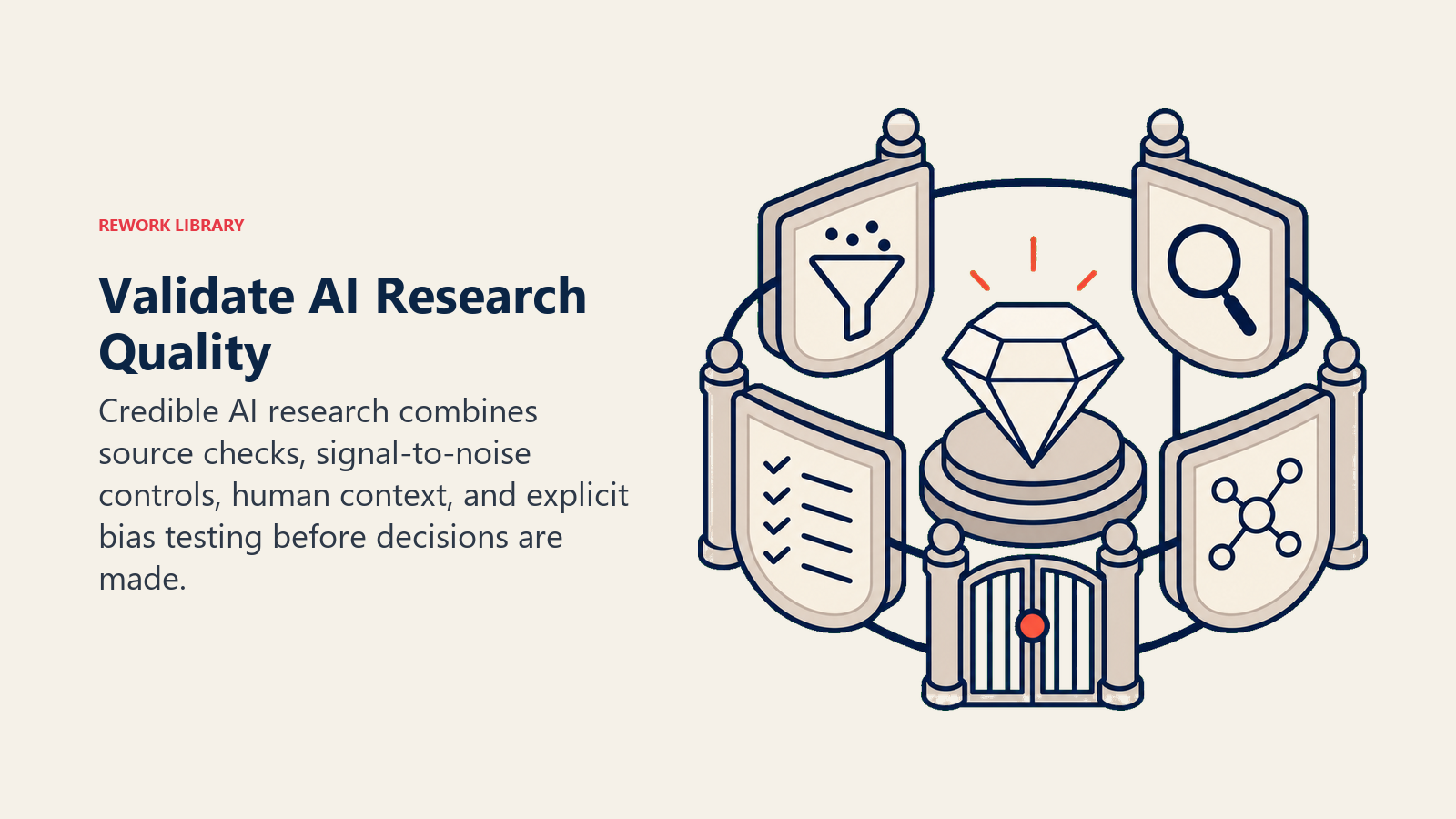
Source Credibility: Not all data sources are equally reliable. AI can help assess source credibility by considering factors like publication history, author expertise, and corroboration across sources. A trend identified from multiple reputable sources is more credible than one from a single blog post.
Signal vs. Noise: AI helps filter noise, but you still need to validate significant findings. When the system flags a trend, examine the underlying data. Are you seeing a genuine pattern or statistical noise? How strong is the signal?
Context and Interpretation: AI identifies patterns, but humans provide context. A 20% increase in negative sentiment might sound alarming. But if it's concentrated around a specific feature that affects 5% of users, the business impact differs from widespread dissatisfaction.
Bias Consideration: AI research can reflect biases in data sources or algorithms. If you're only monitoring English-language sources, you're missing international perspectives. If your sentiment analysis was trained on consumer reviews, it might misinterpret B2B feedback.
The workflow should include human review of AI-generated insights before acting on them. AI scales research capability, but human judgment validates findings and determines implications.
ROI of AI Market Research
The business value comes from several dimensions.
Speed: Research that took weeks now takes days or happens continuously. You're making decisions based on current intelligence, not outdated snapshots. When a competitor makes a significant move? You know within hours, not months.
Scale: AI monitors hundreds of sources simultaneously. A human researcher might track 5-10 competitors effectively. AI tracks 50+ without increasing cost. You're getting comprehensive market coverage rather than narrow samples.
Cost: Traditional research firm projects cost $30,000-$100,000+ for comprehensive competitive analysis. AI research tools cost $500-$5,000 monthly and run continuously. The cost per insight is dramatically lower.
Continuity: Market research becomes an ongoing capability rather than discrete projects. You're building institutional knowledge and tracking trends over time rather than getting disconnected snapshots. This continuous intelligence feeds into AI decision intelligence systems that inform strategic business decisions.
One enterprise software company calculated that AI research saved them $250,000 annually in research firm costs while providing more timely and comprehensive intelligence. Product decisions informed by continuous market intelligence led to better product-market fit and faster time-to-market.
Making AI Research Operational
Implementing AI research requires more than subscribing to tools.
Start by identifying your highest-priority intelligence needs. What questions do you ask repeatedly? What information would change decisions if you had it sooner? Those are your starting points.
Configure AI tools to monitor relevant sources for those specific questions. Don't try to monitor everything. Focus on what matters for your business.
Establish workflows for reviewing and acting on AI-generated insights. Who receives competitor intelligence alerts? How do customer sentiment trends reach product teams? What triggers deeper investigation?
Build institutional knowledge by maintaining research archives. AI can identify patterns, but human analysts recognize context and historical precedent. Combine AI's scale with human expertise.
The goal isn't to replace market researchers with AI. It's to transform researchers from data collectors into strategic analysts. Let AI gather and process information. Let humans interpret findings and develop strategy.
Your market won't slow down to match your research timeline. With AI handling continuous intelligence gathering, you can actually keep up with market velocity. That competitive move you would have discovered three months too late? Now you're responding in real-time.
Related Resources: